

Perceived social support and psychological wellbeing among Nepalese adolescents: the mediating role of self-esteem
Open accessThe DOI matches its Crossref record; 63 of the 63 references it cites were found in a registry or an index.
Abstract
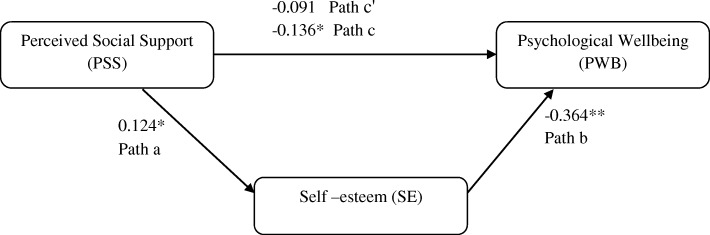
Background: Adolescence is characterized by unique, multiple physical, psychological and social development. Understanding the well-being of adolescents and the factors that contribute to it will help towards clarifying and defining ways to better help adolescents prepare for adult life. Therefore, the present study aims to find out the relationship between Perceived Social Support (PSS) and Psychological Well-Being (PWB) among Nepalese adolescence based on mediating role of Self-esteem (SE). Methods: The study was conducted among 348 adolescents studying in grade 9 and 10 of government secondary level schools of Pokhara Metropolitan city, Nepal. Data were collected through self-administered standard tools-Multidimensional Scale of Perceived Social Support (MSPSS), Rosenberg self-esteem scale (RSES) and General Health Questionnaire (GHQ-12). For statistical analysis descriptive statistics, correlation, regression and mediation analyses were used. The statistical significance of mediating effect of the tested model was examined through a path proposed by Baron and Kenny and Bootstrap method. Results: Overall, the finding suggests that PSS indirectly affects PWB of adolescents through mediating variable SE. Adolescents who perceive good social support had higher SE, which in turn contributed to their PWB. Furthermore, the study found no significant gender difference for PSS, SE and PWB. Also among various sources of PSS, both boys and girls were more oriented towards family for social support than friends and others. Conclusion: Adolescents who experience higher social support are likely to have higher SE and are more likely to have better PWB. The findings of the study will be useful to the parents, teachers, counselors, psychologist and researchers to develop strategies to enhance adolescent’s mental health.
Overview
The claims and statistics of this paper haven’t been checked yet.
Free: it reads the open-access text and checks the first 5 claims that cite a source we can check. Create a free account to check every claim.
Integrity signals
Registry
Cites
Statistics
Figures
Verification
Claims the paper makes
The claims and statistics of this paper haven’t been checked yet.
Free: it reads the open-access text and checks the first 5 claims that cite a source we can check. Create a free account to check every claim.
Claims other papers make about this one
Each is checked against this paper’s own text: does it say what the citing paper says it does?
The source backs part of the claim, not all of it — or backs it for a different population, condition or comparison.
In the citing paper
“Moreover, self-esteem and presence of meaning were positively affected by social support (Poudel et al., 2020; Li et al., 2021b), suggesting that individuals with a higher social support tend to view themselves positively and live a more meaningful life (Li et al., 2021a).”
From Mediator role of presence of meaning and self-esteem in the relationship of social support and death anxiety (2022) · cites this paper as Poudel et al., 2020
Experimental — accuracy not yet measuredThe source backs part of the claim, not all of it — or backs it for a different population, condition or comparison.
In the citing paper
“Previous researches on the interrelationships among social support, self-esteem, and presence of meaning show that these factors are positively correlated with each other (Zhang et al., 2019; Poudel et al., 2020; Li et al., 2021b).”
From Mediator role of presence of meaning and self-esteem in the relationship of social support and death anxiety (2022) · cites this paper as Poudel et al., 2020
Experimental — accuracy not yet measuredThe source backs part of the claim, not all of it — or backs it for a different population, condition or comparison.
In the citing paper
“thus higher social support is associated with less death anxiety via increasing self-esteem (Poudel et al., 2020).”
From Mediator role of presence of meaning and self-esteem in the relationship of social support and death anxiety (2022) · cites this paper as Poudel et al., 2020
Experimental — accuracy not yet measured
Self-check
Percentages, sums and reported differences re-computed from the paper’s own numbers.
The self-check needs the paper’s full text.
Citations
Cites
Baron, R. M., & Kenny, D. A. (1986) · Journal of Personality and Social Psychology · doi:10.1037/0022-3514.51.6.1173 · Cited by 91,532
(2013) · Cited by 44,563
Society and the Adolescent Self-Image
Rosenberg, M. (1965) · doi:10.1515/9781400876136 · Cited by 30,126
Stress, social support, and the buffering hypothesis
Cohen, S., & Wills, T. A. (1985) · Psychological Bulletin · doi:10.1037/0033-2909.98.2.310 · Cited by 18,093
The Multidimensional Scale of Perceived Social Support
Zimet, G. D., Dahlem, N. W., Zimet, S. G., & Farley, G. K. (1988) · Journal of Personality Assessment · doi:10.1207/s15327752jpa5201_2 · Cited by 13,339
(1979) · Medical Entomology and Zoology · Cited by 5,872
(1988) · NFER-Nelson eBooks · Cited by 5,560
Psychometric Characteristics of the Multidimensional Scale of Perceived Social Support
Zimet, G. D., Powell, S. S., Farley, G. K., Werkman, S., & Berkoff, K. A. (1990) · Journal of Personality Assessment · doi:10.1080/00223891.1990.9674095 · Cited by 4,855
Psychometric Characteristics of the Multidimensional Scale of Perceived Social Support
Zimet, G., Powell, S., Farley, G., Werkman, S., & Berkoff, K. (1990) · Journal of Personality Assessment · doi:10.1207/s15327752jpa5503&4_17 · Cited by 4,854
Baumeister, R. F., Campbell, J. D., Krueger, J. I., & Vohs, K. D. (2003) · Psychological Science in the Public Interest · doi:10.1111/1529-1006.01431 · Cited by 3,893
Research works printed but not linked: 1
- Ministry of Health Nepal, New ERA, ICF 2016 Nepal demographic and health survey key findings 2017 Kathmandu Ministry of Health Nepal
Cited by
Items 101–176 of 176
Li, Y., & Zhu, D. (2025) · BMC Psychology · doi:10.1186/s40359-025-03225-7 · Cited by 4
“…of social support, social support has been confirmed as a key protective factor under stress, significantly improving individual mental health and reducing the incidence of problem behaviors by reducing perceived stress [10], enhancing psychological resilience [11], and increasing self-esteem [12].”
Mohamed, N. N. I., Ma’rof, A. A., & Sulaiman, A. H. (2023) · International Journal of Academic Research in Business and Social Sciences · doi:10.6007/ijarbss/v13-i17/19823 · Cited by 1
Şahinoğlu, B., Saygılı, N., Muhtaroğulları, A., & Sınal, A. (2024) · Humanities and Social Sciences Communications · doi:10.1057/s41599-024-02848-2 · Cited by 2
“T he in fl uence of media on the audience has been a long-standing matter of interest (Hardyns et al. 2018; Näsi et al. 2021; Poudel et al. 2020; Salmi et al. 2007; Ullman 1999).”
InfluentialPark, C., & Bayne, H. B. (2024) · International Journal for the Advancement of Counselling · doi:10.1007/s10447-024-09559-y · Cited by 3
“…we (the authors) selected constructs of psychosocial well-being consisting of (a) self-esteem , indicating psychological aspect (Çiçek, 2021; Poudel et al., 2020), (b) social competence , representing social aspect (Holopainen et al., 2012), and (c) life satisfaction , indicating subjective…”
Empty Nest Syndrome: Loneliness and Social Support among Middle-aged Parents
Royena, P. M. (2024) · Journal of interdisciplinary perspectives · doi:10.69569/jip.2024.0338 · Cited by 1
Social–emotional competencies and psychological well‐being across secondary school transition
Shum, C., Dockray, S., Gallagher, S. M., & McMahon, J. (2025) · British Journal of Developmental Psychology · doi:10.1111/bjdp.12564 · Cited by 4
“As adolescents begin to independently navigate the complex terrain of their emotions, relationships, and self-perception, their ability to regulate emotions, access social support, and maintain healthy self-esteem becomes essential (Hu et al., 2014; Poudel et al., 2020).”
Psychological Well-Being of Exchange Program Students
Nova, D., Yula, S., & Lestari, S. (2025) · Bulletin of Counseling and Psychotherapy · doi:10.51214/002025071313000 · Cited by 1
Huang, X., & Li, L. (2025) · Frontiers in Psychology · doi:10.3389/fpsyg.2025.1617429 · Cited by 1
“Empirical findings indicate that higher levels of PASS contribute to psychological well-being (Cho et al., 2020; DeFreese and Smith, 2014; Poudel et al., 2020).”
Huang, Y., Liang, J., Huang, G., Liu, J., Zhu, D., Liu, J., & Hu, J. (2025) · BMC Psychology · doi:10.1186/s40359-025-03709-6 · Cited by 1
Yıldırım, M., Güler-Öztekin, G., Koçak, O., Makas, S., & Alkhulayfi, A. M. A. (2026) · Frontiers in Psychology · doi:10.3389/fpsyg.2026.1714036 · Cited by 2
“Another study revealed that individuals who perceived more social support had higher self-esteem and psychological wellbeing (Poudel et al., 2020).”
Self-Esteem, Anxiety, and Social Support among High School Girl Students in Nepal
Sujakhu, M., & Kim, E. S. (2022) · Asia-pacific Journal of Convergent Research Interchange · doi:10.47116/apjcri.2022.07.17 · Cited by 1
Social support as a predictor of psychological well-being of transfusion dependent thalassemics
Parimal, B. S., Goel, A., & Gupta, K. (2022) · International Journal of Health Sciences · doi:10.53730/ijhs.v6ns8.9666 · Cited by 1
Holopainen, L. K., Waltzer, K., Hoang, N., Lappalainen, K., Nuutinen, H., & Pesonen, H. (2023) · Psychology in the Schools · doi:10.1002/pits.22885 · Cited by 7
Fatima, A., & Rehna, T. (2024) · Pakistan Journal of Psychological Research · doi:10.33824/pjpr.2024.39.1.11 · Cited by 5
“Support work as a buffer for the person suffering stressful life conditions as well as helps a person in reducing the amount of experienced stress (Poudel et al., 2020) and also discovered the strong relationship between wellbeing and social support system.”
Sur, M. H., Shapiro, D. R., & Martin, J. J. (2024) · Journal of Clinical Sport Psychology · doi:10.1123/jcsp.2023-0058 · Cited by 4
Yusuf, Z. W., & Aliero, H. S. (2024) · African Journal of Humanities and Contemporary Education Research · doi:10.62154/ajhcer.2024.016.010371 · Cited by 3
“Psychological distress is a broad term that describes acute mental stress resulting from life circumstances or mental illness, and it is also a prominent manifestation of adolescent mental health problems (Poudel et al, 2020).”
BackgroundPsychological Well-being of the Elderly in Yogyakarta City: Descriptive Study
Astuti, B., Rachmawati, I., Kurniasari, M., Sari, W. J., & Lestari, R. (2024) · Bulletin of Counseling and Psychotherapy · doi:10.51214/002024061103000 · Cited by 1
“This study's results align with those of Poudel et al. (2020) and Habe et al. (2023), who state that there is no difference in psychological well-being based on gender.”
Xiang, Y., Hu, Z., Tan, Q., & Li, X. (2025) · Journal of Adolescence · doi:10.1002/jad.12348 · Cited by 1
Perceived multidimensional social support and gender differences among the shuttlers
Phukan, M. (2022) · International Journal of Physical Education Sports and Health · doi:10.22271/kheljournal.2022.v9.i4b.2566 · Cited by 3
Green, K. H., Schreuders, E., Blankenstein, N. E., Braams, B. R., Dobbelaar, S., van de Groep, S., Telzer, E. H., & Crone, E. A. (2023) · PsyArXiv (OSF Preprints) · doi:10.31234/osf.io/en74s · Cited by 2
Clarke, A. N. (2020) · University of Canterbury Research Repository (University of Canterbury) · doi:10.26021/10767 · Cited by 4
Nkrumah, J., Abuosi, A. A., & Nkrumah, R. B. (2020) · Research Square · doi:10.21203/rs.3.rs-122512/v1
“Although the social support theory is mostly used in health and wellbeing studies [17, 18, 19].”
Adolescent psychological well-being & sociodemographic profile in Kerala, India
Arjun, A., Dakshinamurthy, R., & Rajavel, N. (2022) · International Journal of Health Sciences · doi:10.53730/ijhs.v6ns5.10228
Elsayed, D. A. E.-H., Elattar, N. F. M., & A.Ahmed, F. (2022) · Benha Journal of Applied Sciences · doi:10.21608/bjas.2022.253611 · Cited by 1
“Table (2), Concerning their family data data, less than two thirds (62.9”
BackgroundMethodInfluentialStudents in Team-Based Learning Classes Report Greater Perceived Social Support
Madson, L., Hout, M. C., Wheat, S. C., & Fraune, M. R. (2022) · Teaching of Psychology · doi:10.1177/00986283221136865 · Cited by 3
“It is associated with fewer depressive symptoms in young adults (Ioannou et al., 2019; Roohafza et al., 2014), improved well-being (Cobo-Rendón et al., 2020; Poudel et al., 2020) and better adjustment to university (Rahat & I ̇ lhan, 2016).”
الخصائص السيکومترية لمقياس إستراتيجيات التنظيم الانفعالي لدي طلاب المرحلة الثانوية بمحافظة قنا
ابراهيم, و. ر. م., الطيب, ع. ع., & العزيز, د. م. ع. (2022) · Journal of Educational Sciences - Qena Faculty of Education · doi:10.21608/maeq.2022.141119.1086
Arzeen, N. (2023) · Journal of Development and Social Sciences · doi:10.47205/jdss.2023(4-iii)28 · Cited by 2
Ruengesri, S., & Isaranon, Y. (2022) · Chula Digiverse · doi:10.58837/chula.the.2022.314 · Cited by 1
ВЛИЯНИЕ СТРЕССА ОБУЧАЮЩИХСЯ НА ИХ АКАДЕМИЧЕСКУЮ УСПЕВАЕМОСТЬ
Исимова, А. (2023) · Habaršy. Psihologiâ seriâsy · doi:10.51889/2959-5967.2023.75.2.028
Assyafii, H. A., & Nuryanti, L. (2023) · Jurnal Psikologi Islam dan Budaya · doi:10.15575/jpib.v6i2.28393 · Cited by 4
Исимова, А. (2023) · Habaršy. Psihologiâ seriâsy · doi:10.51889/2959-5967.2023.76.3.010
Wise, R. (2023) · Journal of Psychological Perspective · doi:10.47679/jopp.526042023 · Cited by 2
“Among the predictors of adolescent self-esteem include parenting practices (Pérez-Fuentes et al., 2019), social support (Poudel et al., 2020), and school climate (Coelho et al., 2020).”
BackgroundPsychological Impact of COVID-19 on individuals: Through Active Choices and Passive Adaption
Fang, J., Lau, C. K. M., & Cheng, Y. (2024) · Frontiers research topics · doi:10.3389/978-2-8325-4481-5
Khoirunnisa, A., & Rosiana, D. (2023) · Humanitas (Jurnal Psikologi) · doi:10.28932/humanitas.v7i3.7637 · Cited by 17
Koprowicz, A., & Gumowska, I. (2024) · Kwartalnik Naukowy Fides et Ratio · doi:10.34766/fetr.v57i1.1260
Cho, M. S., & Kwon, M. Y. (2024) · Journal of Adolescent Health · doi:10.1016/j.jadohealth.2024.02.020
Opara, A. N., Ehusani, R., & Mutisya, S. (2024) · International Journal of Research Publication and Reviews · doi:10.55248/gengpi.5.0424.1072
Ma, L., Zhang, Y., Lv, G., Zhuang, H., Zhang, W., & Jiang, H. (2024) · Research Square · doi:10.21203/rs.3.rs-4341187/v1 · Cited by 1
Agarwal, D., Chauhan, A., & Kameswari, V. L. V. (2024) · International Journal of Agriculture Extension and Social Development · doi:10.33545/26180723.2024.v7.i6b.680 · Cited by 2
Ko, J.-S. (2024) · Pan-African Journal of Health and Environmental Science · doi:10.56893/ajhes2024v03i01.08
Suporte social, saúde e uso de álcool e tabaco em pessoas com câncer
Reis, J. B. (2024) · Digital Library of Theses and Dissertations (Universidade de São Paulo) · doi:10.11606/t.22.2024.tde-25062024-103430
Psychological Well-Being and Social Support Among Form Five Students in Rural Areas
Sukumaran, K., & Amat, S. (2024) · International Journal of Academic Research in Business and Social Sciences · doi:10.6007/ijarbss/v14-i8/22478 · Cited by 3
Murshid, M. E., Kawasaki, H., Rahman, M. M., Era, N. R., Islam, M. Z., & Shimpuku, Y. (2024) · Cureus · doi:10.7759/cureus.68009 · Cited by 1
Morency, M. M., & Reynolds, A. J. (2024) · Children and Youth Services Review · doi:10.1016/j.childyouth.2024.107972
Perceived Physical Competence, Perceived Social Support and Interpersonal Orientation Among Athletes
Radhika, T. H., & Thomas, S. (2024) · Studies in systems, decision and control · doi:10.1007/978-3-031-71649-2_8
Family correlates of behavioral problems among adolescents in Rwanda
Harerimana, E., MUZIKI, J. D., Nshimyumuremyi, E., Uwera, T., Nshimiyimana, A., & Mutabaruka, J. (2025) · PLoS ONE · doi:10.1371/journal.pone.0314507 · Cited by 2
Social Skill and Social Support as Predictors of Well-Being: A Structural Model
Padhy, M., Anand, V., Maryam, R., & Pandey, P. (2025) · Springer eBooks · doi:10.1007/978-981-96-0108-0_16 · Cited by 1
Autoestima y comunicación familiar como predictores del bienestar psicológico en mujeres peruanas
Apaza-Pari, E., Chaparro, J. E. T., Mamani-Benito, O. J., Castillo-Blanco, R., Esteban, R. F. C., & Caycho‐Rodríguez, T. (2025) · PSIQUEMAG/ Revista Científica Digital de Psicología · doi:10.18050/psiquemag.v14i1.3261 · Cited by 1
Latent profiles of youth social support: a study on variations and their impact on self-esteem
Yu, J., Guo, Y., Liang, Y., Peng, H., Li, N., Gu, W., & Liu, H. (2025) · Frontiers in Psychology · doi:10.3389/fpsyg.2025.1538464 · Cited by 1
“In addition, prior longitudinal and cross-sectional studies have established a reciprocal association between these two constructs among youth, supporting the rationale for examining them together using a person-centered approach (Marshall et al., 2014; Poudel et al., 2020).”
Holistic Health as Perceived by Nepalese Teenagers: A Qualitative Descriptive Study
Gauro, P., Balthip, K., Boonyasopun, U., & Songwathana, P. (2025) · Pacific Rim International Journal of Nursing Research · doi:10.60099/prijnr.2025.273325 · Cited by 1
Yıldırım, M. (2025) · Politik Ekonomik Kuram · doi:10.30586/pek.1655046
Nutrition Approaches for Adolescents and Older Adults
Huye, H. F., Ratcliffe, D., & Walker-Cartwright, T. (2025) · Nutrition and health · doi:10.1007/978-3-031-95373-6_10
Singh, R. K., Khanal, P., Garman, E. C., Tol, W. A., Jefferies, P., Jordans, M. J. D., & Lund, C. (2025) · Journal of Affective Disorders · doi:10.1016/j.jad.2025.120589 · Cited by 3
“Prior research in Nepal confirms that family-based social support significantly contributes to adolescent self-esteem and well-being (Poudel et al., 2020).”
Purna, R. S., Rahayuningsih, T., Rita, R. S., Angraini, F., Putri, A. C., & Andriani, M. P. (2025) · The Open Public Health Journal · doi:10.2174/0118749445422842251111075710 · Cited by 2
Bagul, J., Mahajan, M., Upaganlawar, A., & Upasani, C. D. (2025) · Journal of Phytochemical Insights · doi:10.71193/jpci.20250017
Ee, G. T., Lau, P. L., Erford, B. T., Sombuling, A., Kamu, A., Ho, C. M., & Halik, M. H. J. (2025) · Counseling Outcome Research and Evaluation · doi:10.1080/21501378.2025.2601913 · Cited by 1
“Furthermore, most of the literature focused on life satisfaction, psychological well-being, or subjective well-being (de Santos et al., 2018; Lee, 2022; Poudel et al., 2020) instead of directly using the word happiness in the study of social support and self-esteem.”
Nkrumah, J., Abuosi, A. A., & Nkrumah, R. B. (2021) · Figshare · doi:10.6084/m9.figshare.16599740
Ergin, D. A., & Akgül, G. (2025) · Erzincan Üniversitesi Eğitim Fakültesi Dergisi · doi:10.17556/erziefd.1611458
Liu, X., Chen, Q., Li, D., Xiong, H., Shi, H., Li, X., He, Y., Mei, X., & Ye, Z. (2026) · Frontiers in Psychology · doi:10.3389/fpsyg.2026.1773501 · Cited by 2
“This consistency suggests that interventions focusing on these psychological factors may have broad applicability, aligning with prior research (Poudel et al., 2020).”
Law, M.-Y., Siaw, Y.-L., Yim, S.-C., & How, P.-K. (2025) · Malaysian Journal of Medicine and Health Sciences · doi:10.47836/mjmhs.21.3.20 · Cited by 1
Peer Support and Help-seeking Efforts: Predictors of Psychological Well-being in School Adolescents
Kholiq, A., Muslikah, & Sofyan, A. (2026) · Journal of Indian Association for Child and Adolescent Mental Health · doi:10.1177/09731342261420460 · Cited by 6
“This study found moderate-to-strong positive correlations: Peer Support ( r = 0.547, P .001) and Psychological Help-Seeking ( r = 0.429, P .001) with PWB.”
InfluentialKaradaş, C., Karaman, M. A., Mızrak, Ş., Ayaz, A., & KALKAN, S. A. (2026) · Education Sciences · doi:10.3390/educsci16020339 · Cited by 6
“…on social support similarly demonstrates that perceived support predicts resilience and psychological well-being among adolescents (Guo et al., 2020), and contributes to higher self-esteem across cultural contexts (Gardner & Webb, 2019; Poudel et al., 2020; Spitz et al., 2022; Yang et al., 2023).”
InfluentialSeema, S., & Gehlawat, M. (2026) · Rozprawy Społeczne · doi:10.29316/rs/218716
Anilkumar, A. P., & Sheel, H. (2026) · Societies · doi:10.3390/soc16050148
Malca-Peralta, S. S., Mamani, P. G. R., Miquilena-Reyes, R. Y., Turpo-Chaparro, J. E., & Palomino-Ccasa, J. (2026) · Acta Psychologica · doi:10.1016/j.actpsy.2026.107125
Liu, C., Wang, M., Liu, J., Zhao, Y., & Yu, F. (2026) · BMC Psychology · doi:10.1186/s40359-026-04908-5
“COR theory has been empirically supported in studies of mental health and perceived social support among adolescents [42, 43, 46].”
Bertumbuh dalam Keluarga Bercerai: Kesejahteraan Psikologis Remaja dan Dukungan Sosial Orang Tua
Putri, P. M., Ningsih, A. D. S., Mumtaz, R. S., & Izdihar, A. N. (2026) · Indonesian Journal of Innovation Multidisipliner Research · doi:10.69693/ijim.v4i2.980
Földi, T., Wittmann, E., de Oliveira, O. R., Kapornai, K., & Kiss, E. (2026) · Child and Adolescent Psychiatry and Mental Health · doi:10.1186/s13034-026-01141-1
“This pattern is consistent with the view that self-esteem may represent one pathway linking supportive social environments to better mental health in youth [10, 22].”
The role of self-assessment in the formation of communication style in middle school children
Alimbayeva, S., Smatova, K. B., Sabraliyeva, Z., Sanay, G., Boltayev, A., & Aitenova, E. A. (2026) · Frontiers in Psychology · doi:10.3389/fpsyg.2026.1846073
“Self-esteem is interpreted as one of the most influential aspects governing social development (Poudel et al., 2020) and is considered the ‘source of social behavior’ (Rosenberg et al., 1989).”
Doğru, M. C., & Kurtça, T. T. (2026) · Journal of Community Psychology · doi:10.1002/jcop.70146 · Cited by 1
“…previous studies have reported negative associations between phubbing and self‐ esteem (Al‐Saggaf 2023; Bitar et al. 2021; Dai et al. 2024; Wang et al. 2021), whereas self‐esteem has been positively associated with psychological well‐being (Lee 2022; Poudel et al. 2020; Rehman et al. 2023).”
Tadessse, A. (2026) · Social Sciences & Humanities Open · doi:10.1016/j.ssaho.2026.103532
Thi, L.-H., Phan, M.-H. T., Dinh, H. T., Nguyen, P.-H. T., Pham, T. M., Luu, L. T., & Hoang, T.-H. T. (2026) · Health Psychology Report · doi:10.5114/hpr/235862
“This pattern suggests that self-esteem may represent a psychological resource linking social relationships with life satisfaction and the two indicators of psychological problems (Gao et al., 2024; Liu et al., 2021; Poudel et al., 2020).”
Thapa, S., Shetty, G., Khadka, P., Basnet, P., & Nepal, S. (2026) · BMC Psychology · doi:10.1186/s40359-026-05763-0
Zhu, X., Mohd-Said, N.-E., & Shamsudin, C. B. M. (2026) · Frontiers in Psychology · doi:10.3389/fpsyg.2026.1920700 · Cited by 3
Metadata
- Authors
- Poudel, A., Gurung, B., & Khanal, G. P.
- Affiliations
- Tribhuvan University (NP)
- Pokhara Academy of Health Sciences (NP)
- Corresponding author
- Poudel, Anju
- Venue
- BMC Psychology
- Published
- 2020-05-01
- Volume
- 8
- Issue
- 1
- Pages
- 43-43
- ISSN
- 2050-7283 (ISSN-L)
- PMC
- PMC7195718
- OpenAlex
- W3023224224
- Semantic Scholar
- 471929087e61da86b1c4ec0cfe456b5e5226849d
- Cited by
- 177
- References
- 62
- Citations by year
- 2026: 18 · 2025: 37 · 2024: 42 · 2023: 37 · 2022: 26 · 2021: 12 · 2020: 5
- FWCI
- 26.75
- Type
- journal article
- Language
- en
- Open access
- gold
- doi.org
- Licence
- cc-by
- creativecommons.org/licenses/by/4.0/ (tdm)
- creativecommons.org/licenses/by/4.0/ (vor)
- Locations
- BMC Psychology (publishedVersion, cc-by)
- PubMed Central (publishedVersion, cc-by)
- PubMed (publishedVersion)
- DOAJ (DOAJ: Directory of Open Access Journals) (submittedVersion, cc-by-sa)
- Topics
- Social Sciences › Psychology › Developmental and Educational Psychology › Psychosocial Factors Impacting Youth
- Social Sciences › Psychology › Social Psychology › Psychological Well-being and Life Satisfaction
- Social Sciences › Psychology › Clinical Psychology › Child and Adolescent Psychosocial and Emotional Development
- Keywords
- perceived social support, psychological well-being, self-esteem, adolescents, mediation, gender differences, family support, adolescent mental health, high school students
- MeSH terms
- Adolescent, Female, Humans, Male, Mental Health, Nepal, Surveys and Questionnaires, Self Concept, Social Support
About these checks
Registry, retraction, Cites and statistics results are computed, not judged, with one exception: a printed reference that no index lists is read once by a model before it counts as a citation error. Claims are extracted by a model and kept only when their quote appears verbatim in the text; each cited source is then checked, with a model’s help, for whether it says what the claim relies on. Those verdicts can be wrong — read the claim’s quote and the cited source before relying on one.
Statistics and arithmetic are recomputed, not judged.
Confidence bands are shown only for fields calibrated on our annotated test set. None is calibrated yet, so no band is shown.
What counts as a claim ›How we measure confidence ›How we check this ›
Are you an author, or do you see a problem with this page? Request a review
Data sources
Bibliographic data: Semantic Scholar, OpenAlex, Crossref.
Contains information from the Semantic Scholar Academic Graph Datasets, made available under the ODC Attribution License (ODC-BY 1.0).
Semantic Scholar’s data is described in: Kinney, R., et al. (2023). The Semantic Scholar Open Data Platform. arXiv:2301.10140.
