

A systematic review regarding women’s emotional and psychological experiences of high-risk pregnancies
Open accessThe DOI matches its Crossref record; 64 of the 64 references it cites were found in a registry or an index.
Abstract
Background: High-risk pregnancy refers to a pregnancy that negatively affects the health of the mother, the baby, or both. High-risk pregnancy evokes a range of emotional and psychological experiences for the expectant mother, and can adversely affect both the mother and the baby’s health. Medical research on high-risk pregnancy abounds, while women’s emotional/psychological experiences are not sufficiently documented, and hence much less attention and/or programming is directed to support women with high risk pregnancies. Methods: The aim of this review is to present published evidence of how studies reported on the emotional and psychological experiences of a woman’s high-risk pregnancy journey. The systematic review examined qualitative studies over a 10 year period that were published between January 2006 and June 2017. These studies were identified on 10 databases. The study utilised three stages of review (i.e. abstract reading, title reading, and full-text reading) and for a successful conduction of the meta-synthesis, this study applied one of the phases provided by Noblit and Hare. Results: The findings provide empirical evidence that women’s emotional and psychological experiences (i.e. shock, fear, frustration, grief, isolation and loneliness, anger, sadness, guilt, and mental health disorder) are evident throughout their high-risk pregnancies experience.
Overview
The claims and statistics of this paper haven’t been checked yet.
Free: it reads the open-access text and checks the first 5 claims that cite a source we can check. Create a free account to check every claim.
Integrity signals
Registry
Cites
Statistics
Figures
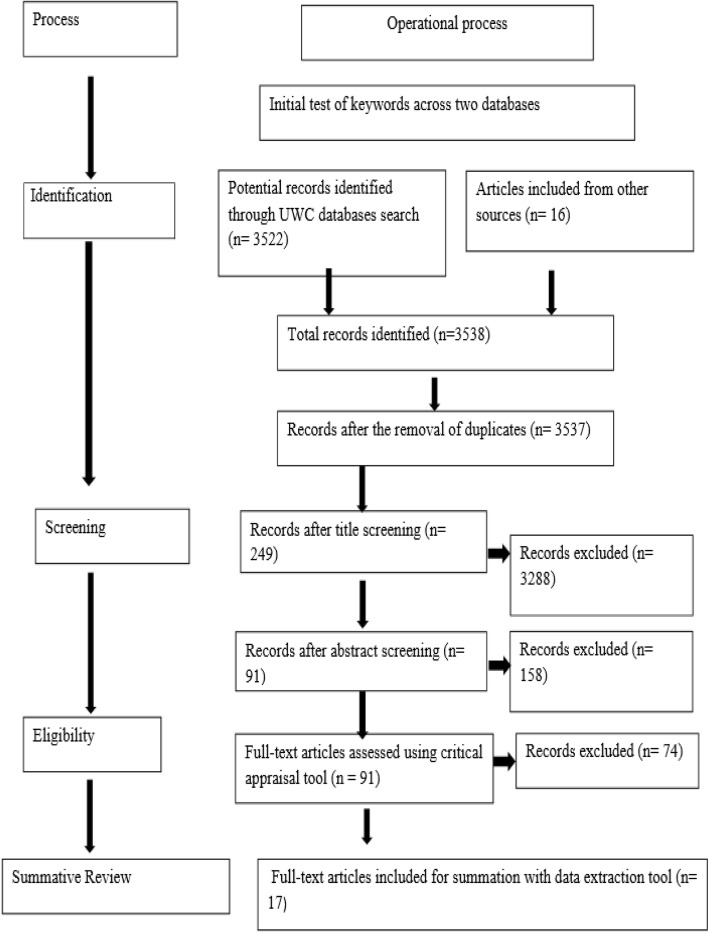
Verification
Claims the paper makes
The claims and statistics of this paper haven’t been checked yet.
Free: it reads the open-access text and checks the first 5 claims that cite a source we can check. Create a free account to check every claim.
Claims other papers make about this one
Each is checked against this paper’s own text: does it say what the citing paper says it does?
The source backs part of the claim, not all of it — or backs it for a different population, condition or comparison.
In the citing paper
“Among high-risk pregnant women, factors, such as domestic violence, anxiety, and experiencing significant disasters within the past year, have been observed to double the risk of prenatal depression [42].”
From High-risk Pregnancy Nursing: Analyzing the Impact of Prenatal Stress, Maternal-Fetal Attachment, and Social Support on Prenatal Depression (2024) · cites this paper as [42]
Experimental — accuracy not yet measured
Self-check
Percentages, sums and reported differences re-computed from the paper’s own numbers.
The self-check needs the paper’s full text.
Citations
Cites
Preferred Reporting Items for Systematic Reviews and Meta-Analyses: the PRISMA statement
Moher, D., Liberati, A., Tetzlaff, J., Altman, D. G., & for the PRISMA Group (2009) · BMJ · doi:10.1136/bmj.b2535 · Cited by 83,823
Preferred Reporting Items for Systematic Reviews and Meta-Analyses: The PRISMA Statement
Moher, D., Liberati, A., Tetzlaff, J., Altman, D. G., & The PRISMA Group (2009) · PLoS Medicine · doi:10.1371/journal.pmed.1000097 · Cited by 64,042
Wang, G., Ma, R., Qiao, G., Wada, K., Aizawa, Y., & Satoh, T. (2015) · Integrative Medicine International · doi:10.1159/000368408 · Cited by 18,657
Noblit, G., & Hare, R. (1988) · doi:10.4135/9781412985000 · Cited by 2,723
Meta-Ethnography: Synthesizing Qualitative Studies
Noblit, G. W., & Hare, R. D. (1988) · Medical Entomology and Zoology · Cited by 2,191
Effects of perinatal mental disorders on the fetus and child
Stein, A., Pearson, R. M., Goodman, S. H., Rapa, E., Rahman, A., McCallum, M., Howard, L. M., & Pariante, C. M. (2014) · The Lancet · doi:10.1016/s0140-6736(14)61277-0 · Cited by 2,166 · cited 1×
“Further to this, children whose mothers suffered with postnatal depression have a high risk of experiencing challenges with handling their emotions and social behavior growing up and it may impact their way of establishing relations with others [67].”
BackgroundAbnormal Psychology: An Integrative Approach
Barlow, D. H., & Durand, V. M. (1994) · Medical Entomology and Zoology · Cited by 626
WorldWide Antimalarial Resistance Network (WWARN) Lumefantrine PK/PD Study Group (2015) · BMC Medicine · doi:10.1186/s12916-015-0456-7 · Cited by 464
Coping and distress in pregnancy: An investigation of medically high risk women
Yali, A. M., & Lobel, M. (1999) · Journal of Psychosomatic Obstetrics & Gynecology · doi:10.3109/01674829909075575 · Cited by 364 · cited 1×
“Social support is important for any medical event such as a high-risk pregnancy as it might offer expectant women a sense of comfort and belonging [56].”
BackgroundSystematic Reviews and Meta-Analyses
(2019) · Documentary Research in the Social Sciences · doi:10.4135/9781529716559.n7 · Cited by 330
Research works printed but not linked: 11
- World Health Organization Maternal Mortality 2018
- National Department of Health Guidelines for maternity care in South Africa: a manual for clinics, community healthcare centres and district hospitals 2015 4
- Platt ES Campbell B Pinette MG Tetreau A 100 questions and answers about you high-risk pregnancy 2009 Boston Jones and Bartlett Publishers
- Polomeno V Brief historical overview of high-risk pregnancy Int J Childbirth Educ 1997 12 3 4 7
- The Cochrane Collaboration Glossary terms in the Cochrane collaboration 2005
- Smith MR, Franciscus G, Jacobs W, Munnik E, Swartbooi C. Developing a critical appraisal tool: the SFS scoring system (under review). Department of Psychology, Faculty of Community and Health Sciences. University of the Western Cape.
- McQuoid-Mason D Dada M A-Z medical law 2011 South Africa Juta
- Jones S Solomou W Statham H When expectant mothers know their baby has a fetal abnormality: exploring a crisis of motherhood through qualitative data-mining J Soc Work Res Eval 2005 62 2 195 206
- Jeronimus BF, Laceulle OM. A functional perspective. Switzerland: Springer International Publishing; 2017.
- Foss SK Waters W Distinction dissertation: a travelers guide to a one dissertation 2016 2 United Kingdom Rowman Littlefield
- Joaquim RM de Oliveira FCS Fajardo RS Caramaschi S Psychobiology of sadness: functional aspects in human evolution EC Psychology and Psychiatry 2018 7 12 1015 1022
Cited by
Items 101–109 of 109
From Broken Bodies to Broken Systems: Rethinking Risk in Maternal and Newborn Care
Goodarzi, B., Cheyney, M. J., & Vries, R. G. D. (2026) · Critical studies in risk and uncertainty · doi:10.1007/978-3-032-02731-3_5
Ahmad, A., & Reynolds, R. J. (2026) · The British Journal of Psychiatry · doi:10.1192/bjp.2026.10629
Dahan, O., Sciaky‐Tamir, Y., Albo, S., Shachar, I. B., & Horovitz, O. (2026) · Journal of Bioethical Inquiry · doi:10.1007/s11673-026-10552-w
Rosen, O., Moskovich, L., Salomon, K., Artzi‐Medvedik, R., & Ruban, A. (2026) · Research Square · doi:10.21203/rs.3.rs-9550759/v1
Jin, M., & Shon, S. (2026) · Child Health Nursing Research · doi:10.4094/chnr.2026.015
“Pregnant women with such high-risk conditions experience higher levels of anxiety than those with normal pregnancies because of concerns about the potential for obstetric complications and fetal health issues during pregnancy and childbirth [2].”
Tingting, Q., Yajing, Y., Dan, C., & Zhang, J. (2026) · Western Journal of Nursing Research · doi:10.1177/01939459261467543
Aslantaş, B. N., & Çankaya, S. (2026) · Behavioral Medicine · doi:10.1080/08964289.2026.2702951
Vladislav, E. O., Paica, C. I., Iordăchescu, D., Panaitescu, A. M., Mehedințu, C., & Gică, N. (2026) · Medicina · doi:10.3390/medicina62081512
“Comparative findings further suggest that women with high-risk pregnancies tend to rely less on problem-focused strategies and more on avoidance or rigid emotional control than women with low-risk pregnancies [6,18].”
Zuk, A. M., Green, S., Harry, J. A., Godfrey, C. M., Smith, G. N., Ospina, M. B., Premji, S., Goldie, C., Snelgrove‐Clarke, E., Ross‐White, A., et al. (2026) · JBI Evidence Synthesis · doi:10.11124/jbies-25-00403
Metadata
- Authors
- Isaacs, N. Z., & Andipatin, M. G.
- Affiliations
- University of the Western Cape (ZA)
- Corresponding author
- Isaacs, Nazeema Zainura
- Venue
- BMC Psychology
- Published
- 2020-05-03
- Volume
- 8
- Issue
- 1
- Pages
- 45-45
- ISSN
- 2050-7283 (ISSN-L)
- PMC
- PMC7197168
- OpenAlex
- W3023596637
- Semantic Scholar
- 6045036680db28459f9d10e5740ccb96de60d398
- Cited by
- 109
- References
- 64
- Citations by year
- 2026: 22 · 2025: 34 · 2024: 18 · 2023: 15 · 2022: 13 · 2021: 6 · 2020: 1
- FWCI
- 1.47
- Type
- journal article
- Language
- en
- Open access
- gold
- doi.org
- Licence
- cc-by
- creativecommons.org/licenses/by/4.0/ (tdm)
- creativecommons.org/licenses/by/4.0/ (vor)
- Locations
- BMC Psychology (publishedVersion, cc-by)
- PubMed Central (publishedVersion, cc-by)
- PubMed (publishedVersion)
- DOAJ (DOAJ: Directory of Open Access Journals) (submittedVersion, cc-by-sa)
- UWC Research Repository (University of the Western Cape) (submittedVersion)
- Funders
- National Research Foundation (Not applicable)
- Topics
- Health Sciences › Medicine › Public Health, Environmental and Occupational Health › Maternal Mental Health During Pregnancy and Postpartum
- Health Sciences › Medicine › Obstetrics and Gynecology › Maternal and Perinatal Health Interventions
- Health Sciences › Medicine › Pediatrics, Perinatology and Child Health › Maternal and Neonatal Healthcare
- Keywords
- high-risk pregnancy, maternal emotional experience, maternal mental health, grief, guilt, loneliness, fear, anger, isolation, maternal support
- MeSH terms
- Mental Disorders, Emotions, Fear, Female, Humans, Mothers, Pregnancy, Pregnancy, High-Risk, Qualitative Research
About these checks
Registry, retraction, Cites and statistics results are computed, not judged, with one exception: a printed reference that no index lists is read once by a model before it counts as a citation error. Claims are extracted by a model and kept only when their quote appears verbatim in the text; each cited source is then checked, with a model’s help, for whether it says what the claim relies on. Those verdicts can be wrong — read the claim’s quote and the cited source before relying on one.
Statistics and arithmetic are recomputed, not judged.
Confidence bands are shown only for fields calibrated on our annotated test set. None is calibrated yet, so no band is shown.
What counts as a claim ›How we measure confidence ›How we check this ›
Are you an author, or do you see a problem with this page? Request a review
Data sources
Bibliographic data: Semantic Scholar, OpenAlex, Crossref.
Contains information from the Semantic Scholar Academic Graph Datasets, made available under the ODC Attribution License (ODC-BY 1.0).
Semantic Scholar’s data is described in: Kinney, R., et al. (2023). The Semantic Scholar Open Data Platform. arXiv:2301.10140.
