

A systematic review regarding women’s emotional and psychological experiences of high-risk pregnancies
Open accessThe DOI matches its Crossref record; 65 of the 65 references it cites were found in a registry or an index.
Abstract
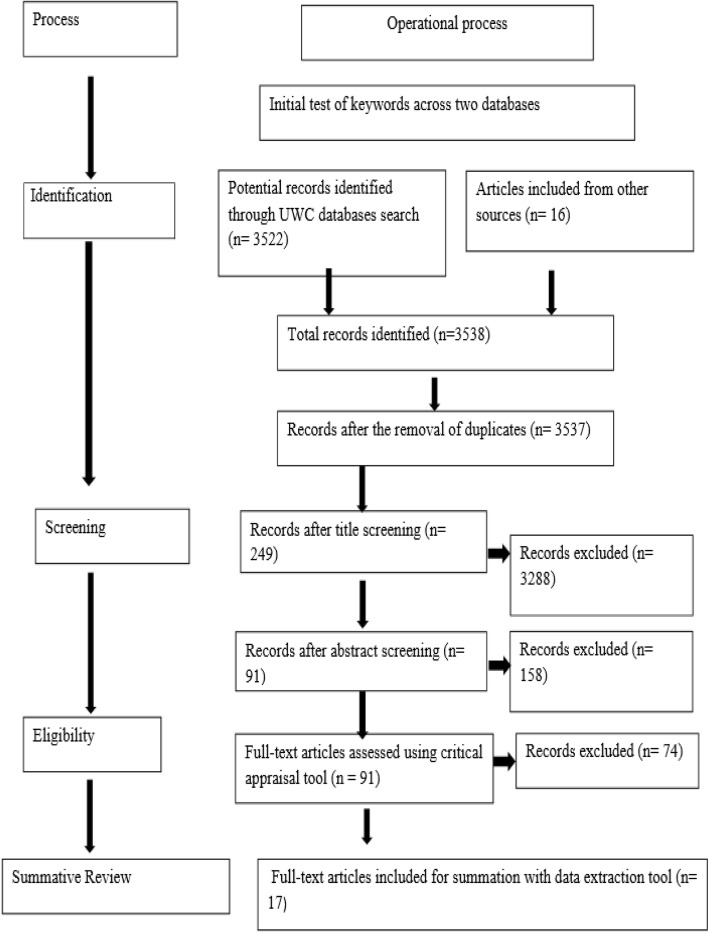
Background: High-risk pregnancy refers to a pregnancy that negatively affects the health of the mother, the baby, or both. High-risk pregnancy evokes a range of emotional and psychological experiences for the expectant mother, and can adversely affect both the mother and the baby’s health. Medical research on high-risk pregnancy abounds, while women’s emotional/psychological experiences are not sufficiently documented, and hence much less attention and/or programming is directed to support women with high risk pregnancies. Methods: The aim of this review is to present published evidence of how studies reported on the emotional and psychological experiences of a woman’s high-risk pregnancy journey. The systematic review examined qualitative studies over a 10 year period that were published between January 2006 and June 2017. These studies were identified on 10 databases. The study utilised three stages of review (i.e. abstract reading, title reading, and full-text reading) and for a successful conduction of the meta-synthesis, this study applied one of the phases provided by Noblit and Hare. Results: The findings provide empirical evidence that women’s emotional and psychological experiences (i.e. shock, fear, frustration, grief, isolation and loneliness, anger, sadness, guilt, and mental health disorder) are evident throughout their high-risk pregnancies experience.
Overview
The claims and statistics of this paper haven’t been checked yet.
Free: it reads the open-access text and checks the first 5 claims that cite a source we can check. Create a free account to check every claim.
Integrity signals
Registry
Cites
Statistics
Figures
Verification
Claims the paper makes
The claims and statistics of this paper haven’t been checked yet.
Free: it reads the open-access text and checks the first 5 claims that cite a source we can check. Create a free account to check every claim.
Claims other papers make about this one
Each is checked against this paper’s own text: does it say what the citing paper says it does?
The source backs part of the claim, not all of it — or backs it for a different population, condition or comparison.
In the citing paper
“Among high-risk pregnant women, factors, such as domestic violence, anxiety, and experiencing significant disasters within the past year, have been observed to double the risk of prenatal depression [42].”
From High-risk Pregnancy Nursing: Analyzing the Impact of Prenatal Stress, Maternal-Fetal Attachment, and Social Support on Prenatal Depression (2024) · cites this paper as [42]
Experimental — accuracy not yet measured
Self-check
Percentages, sums and reported differences re-computed from the paper’s own numbers.
The self-check needs the paper’s full text.
Citations
Cites
Preferred Reporting Items for Systematic Reviews and Meta-Analyses: the PRISMA statement
Moher, D., Liberati, A., Tetzlaff, J., Altman, D. G., & for the PRISMA Group (2009) · BMJ · doi:10.1136/bmj.b2535 · Cited by 83,823
Preferred Reporting Items for Systematic Reviews and Meta-Analyses: The PRISMA Statement
Moher, D., Liberati, A., Tetzlaff, J., Altman, D. G., & The PRISMA Group (2009) · PLoS Medicine · doi:10.1371/journal.pmed.1000097 · Cited by 64,042
Wang, G., Ma, R., Qiao, G., Wada, K., Aizawa, Y., & Satoh, T. (2015) · Integrative Medicine International · doi:10.1159/000368408 · Cited by 18,657
Noblit, G., & Hare, R. (1988) · doi:10.4135/9781412985000 · Cited by 2,723
Meta-Ethnography: Synthesizing Qualitative Studies
Noblit, G. W., & Hare, R. D. (1988) · Medical Entomology and Zoology · Cited by 2,191
Effects of perinatal mental disorders on the fetus and child
Stein, A., Pearson, R. M., Goodman, S. H., Rapa, E., Rahman, A., McCallum, M., Howard, L. M., & Pariante, C. M. (2014) · The Lancet · doi:10.1016/s0140-6736(14)61277-0 · Cited by 2,166 · cited 1×
“Further to this, children whose mothers suffered with postnatal depression have a high risk of experiencing challenges with handling their emotions and social behavior growing up and it may impact their way of establishing relations with others [67].”
BackgroundAbnormal Psychology: An Integrative Approach
Barlow, D. H., & Durand, V. M. (1994) · Medical Entomology and Zoology · Cited by 626
WorldWide Antimalarial Resistance Network (WWARN) Lumefantrine PK/PD Study Group (2015) · BMC Medicine · doi:10.1186/s12916-015-0456-7 · Cited by 464
Coping and distress in pregnancy: An investigation of medically high risk women
Yali, A. M., & Lobel, M. (1999) · Journal of Psychosomatic Obstetrics & Gynecology · doi:10.3109/01674829909075575 · Cited by 364 · cited 1×
“Social support is important for any medical event such as a high-risk pregnancy as it might offer expectant women a sense of comfort and belonging [56].”
BackgroundSystematic Reviews and Meta-Analyses
(2019) · Documentary Research in the Social Sciences · doi:10.4135/9781529716559.n7 · Cited by 330
Giving voice to the burden of blame: A feminist study of mothers’ experiences of mother blaming
Jackson, D., & Mannix, J. (2004) · International Journal of Nursing Practice · doi:10.1111/j.1440-172x.2004.00474.x · Cited by 252 · cited 3×
“Jackson D, Mannix J. Giving voice to the burden of blame: a feminist study of mothers experiences of mother blaming.”
BackgroundInfluentialHow social context impacts on women's fears of childbirth: A Western Australian example
Fisher, C., Hauck, Y., & Fenwick, J. (2006) · Social Science & Medicine · doi:10.1016/j.socscimed.2005.11.065 · Cited by 228 · cited 1×
“Psychological disorders during pregnancy may result in low birth weight and preterm delivery, and women with bipolar disorder experience onset of mood instability [16, 17].”
BackgroundApproaches to improve the quality of maternal and newborn health care: an overview of the evidence
Austin, A., Langer, A., Salam, R. A., Lassi, Z. S., Das, J. K., & Bhutta, Z. A. (2014) · Reproductive Health · doi:10.1186/1742-4755-11-s2-s1 · Cited by 212
Postpartum psychiatric disorders: Early diagnosis and management
Sharma, I., Rai, S., & Pathak, A. (2015) · Indian Journal of Psychiatry · doi:10.4103/0019-5545.161481 · Cited by 201 · cited 1×
“In the long term, women who suffered from a high-risk pregnancy may be diagnosed with depression and PTSD that may result in them having obsessions of child harm, and suicidal thoughts, feeling worthless which places them at risk of either harming themselves or the infant and thus require psychological support [65, 66…”
BackgroundThe role of self-blame and worthlessness in the psychopathology of major depressive disorder
Zahn, R., Lythe, K. E., Gethin, J. A., Green, S., Deakin, J. F. W., Young, A. H., & Moll, J. (2015) · Journal of Affective Disorders · doi:10.1016/j.jad.2015.08.001 · Cited by 198 · cited 2×
“Research has shown that both isolation and loneliness are associated with illness and mortality [57].”
Background(2014) · doi:10.1093/acprof:oso/9780199659180.001.0001 · Cited by 178
Isler, C. M., Rinehart, B. K., Terrone, D. A., Martin, R. W., Magann, E. F., & Martin, J. N. (1999) · American Journal of Obstetrics and Gynecology · doi:10.1016/s0002-9378(99)70343-1 · Cited by 178 · cited 1×
“After decades of improvement, there are still maternal and infant deaths [1].”
BackgroundMaternal Morbidity and Disability and Their Consequences: Neglected Agenda in Maternal Health
Koblinsky, M., Chowdhury, M. E., Moran, A., & Ronsmans, C. (2012) · Journal of Health, Population and Nutrition · doi:10.3329/jhpn.v30i2.11294 · Cited by 166 · cited 2×
“Koblinsky M, Chowdhury ME, Moran A, Ronsmans C. Maternal morbidity and disability and their consequences: neglected agenda in maternal health.”
BackgroundMaternal mental health in pregnancy and child behavior
Srinivasan, K., Satyanarayana, V., & Lukose, A. (2011) · Indian Journal of Psychiatry · doi:10.4103/0019-5545.91911 · Cited by 165
Unexpected Diagnosis of Fetal Abnormality: Women’s Encounters with Caregivers
Lalor, J. G., Devane, D., & Begley, C. M. (2007) · Birth · doi:10.1111/j.1523-536x.2006.00148.x · Cited by 159 · cited 7×
“Yeakey et al. [38], Saukko [23], and Kaye et al. [28] report that participants in different studies conducted in Malawi, England, and Uganda who had a high-risk pregnancy condition (i.e. obstetric fistula, uterine rupture or thrombophilia) suffered from major depressive disorder.”
BackgroundInfluentialGrief and Depression After Miscarriage: Their Separation, Antecedents, and Course
Beutel, M., Deckardt, R., von Rad, M., & Weiner, H. (1995) · Psychosomatic Medicine · doi:10.1097/00006842-199511000-00003 · Cited by 140 · cited 1×
“Participants who were hospitalised for HELLP syndrome or preterm birth in studies that occurred in South Africa and Haiti respectively expressed anger and resentment at the unjust treatment they received from medical professionals during hospitalisation [15, 59].”
BackgroundNarratives of family caregiving: The process of making meaning
Ayres, L. (2000) · Research in Nursing & Health · doi:10.1002/1098-240x(200012)23:6<424::aid-nur2>3.0.co;2-w · Cited by 138
Recasting Hope: A process of adaptation following fetal anomaly diagnosis
Lalor, J., Begley, C., & Galavan, E. (2008) · Social Science & Medicine · doi:10.1016/j.socscimed.2008.09.069 · Cited by 137 · cited 2×
“It often start at a diagnosis of pregnancy-related complications during an ultrasound examination which is traumatic for an expectant mother, as most pregnant women anticipate that their foetus would be healthy and they do not perceive themselves to be at risk [32].”
BackgroundGreenhalgh, T., Clinch, M., Afsar, N., Choudhury, Y., Sudra, R., Campbell-Richards, D., Claydon, A., Hitman, G. A., Hanson, P., & Finer, S. (2015) · BMC Medicine · doi:10.1186/s12916-015-0360-1 · Cited by 115
San Lazaro Campillo, I., Meaney, S., McNamara, K., & O'Donoghue, K. (2017) · BMJ Open · doi:10.1136/bmjopen-2017-017802 · Cited by 115 · cited 1×
“Psychological disorders during pregnancy may result in low birth weight and preterm delivery, and women with bipolar disorder experience onset of mood instability [16, 17].”
BackgroundSouza, J. P., Cecatti, J. G., Parpinelli, M. Â., Krupa, F., & Osis, M. J. D. (2009) · Birth · doi:10.1111/j.1523-536x.2009.00313.x · Cited by 113 · cited 6×
“10 Souza, Cecatti, Krupa, Osis, & Parpinelli (2009) [34] 71%”
BackgroundResultInfluentialStoreng, K. T., Murray, S. F., Akoum, M. S., Ouattara, F., & Filippi, V. (2010) · Social Science & Medicine · doi:10.1016/j.socscimed.2010.03.056 · Cited by 97 · cited 2×
“This is consistent with the findings of [45], who reported that their study participants’ expressed anger towards medical practitioners for receiving ill treatment that could have further complicated their pregnancies.”
ResultOne foot in-one foot out: Weathering the storm of pregnancy after perinatal loss
Arsenault, D. C., & Marshall, R. (2000) · Research in Nursing & Health · doi:10.1002/1098-240x(200012)23:6<473::aid-nur6>3.0.co;2-i · Cited by 96 · cited 4×
“When the assumption of normality is shattered by an adverse diagnosis, pregnant women in three of the included studies conducted in Canada and Ireland (n = 2) describe their initial emotional reaction as one of grief [42, 43, 48].”
BackgroundInfluentialThe lived experience of Malawian women with obstetric fistula
Yeakey, M. P., Chipeta, E. K., Taulo, F., & TSUI, A. O. (2009) · Culture Health & Sexuality · doi:10.1080/13691050902874777 · Cited by 92 · cited 4×
“Several facets of pregnancy are unknown and there is an aura of uncertainty that may accompany the pregnancy [38].”
BackgroundInfluentialExploration of a cognitive model to predict post-traumatic stress symptoms following childbirth
Ford, E., Ayers, S., & Bradley, R. (2010) · Journal of Anxiety Disorders · doi:10.1016/j.janxdis.2010.01.008 · Cited by 85 · cited 2×
“For instance, Ford, Ayers, and Bradley [63] report that 1–6% of women develop postpartum PTSD after birth trauma.”
BackgroundGeraghty, A. A., Alberdi, G., O’Sullivan, E. J., O’Brien, E. C., Crosbie, B., Twomey, P. J., & McAuliffe, F. M. (2017) · BMC Pregnancy and Childbirth · doi:10.1186/s12884-017-1543-x · Cited by 82
The Spiritual Experience of High‐Risk Pregnancy
Price, S. L., Lake, M., Breen, G., Carson, G., Quinn, C., & O’Connor, T. (2007) · Journal of Obstetric, Gynecologic & Neonatal Nursing · doi:10.1111/j.1552-6909.2006.00110.x · Cited by 81 · cited 4×
“These studies were conducted in United States, Ireland (n = 2), and Canada which indicate that expectant mothers were shocked after being informed by medical staff of their high-risk pregnancies [30, 31, 42, 43].”
BackgroundInfluentialA transformed pregnancy: the psychosocial consequences of gestational diabetes
Lawson, E. J., & Rajaram, S. (1994) · Sociology of Health & Illness · doi:10.1111/1467-9566.ep11347644 · Cited by 76
A simple model for prediction postpartum PTSD in high-risk pregnancies
Polachek, I. S., Dulitzky, M., Margolis-Dorfman, L., & Simchen, M. J. (2015) · Archives of Women s Mental Health · doi:10.1007/s00737-015-0582-4 · Cited by 73 · cited 2×
“Polacheck IS, Dulitzsky M, Margolis-Dorfman L, Simchen MJ.”
ResultSpecial features of high-risk pregnancies as factors in development of mental distress: a review
Rodrigues, P. B., Zambaldi, C. F., Cantilino, A., & Sougey, E. B. (2016) · Trends in Psychiatry and Psychotherapy · doi:10.1590/2237-6089-2015-0067 · Cited by 72 · cited 1×
“[9] reveal that healthcare providers consider the label of high-risk pregnancy to be an indication that a woman and/or her unborn infant are at risk of both physical and psychological harm.”
BackgroundDoes fetal screening affect women's worries about the health of their baby?
Öhman, S. G., Saltvedt, S., Grünewald, C., & Waldenström, U. (2004) · Acta Obstetricia Et Gynecologica Scandinavica · doi:10.1111/j.0001-6349.2004.00462.x · Cited by 70 · cited 1×
“When expectant women are diagnosed with a highrisk pregnancy, they may have difficulty confronting and dealing with this new reality which results in psychological and emotional consequences [10].”
BackgroundHigh-Risk Pregnancy and Hospitalization: The Women's Voices
Leichtentritt, R. D., Blumenthal, N., Elyassi, A., & Rotmensch, S. (2005) · Health & Social Work · doi:10.1093/hsw/30.1.39 · Cited by 69 · cited 2×
“The findings concurred within existing literature presented [5, 25].”
BackgroundResultWomen with high-risk pregnancy: experiences and perceptions of needs and care
Oliveira, D. D. C., & Mandú, E. N. T. (2015) · Escola Anna Nery · doi:10.5935/1414-8145.20150013 · Cited by 61
Grief and bereavement theories
Buglass, E. (2010) · Nursing Standard · doi:10.7748/ns2010.06.24.41.44.c7834 · Cited by 61 · cited 1×
“Grief is defined as “a natural human response to separation, bereavement or loss, in particular the loss of a loved one” [52].”
BackgroundNcube, R. K., Barlow, H., & Mayers, P. M. (2016) · Curationis · doi:10.4102/curationis.v39i1.1575 · Cited by 58 · cited 3×
“The findings from this review corroborated with the findings of [24] where participants who suffered from a high-risk pregnancy expressed their frustration with the medical practitioners and family members.”
BackgroundResultInfluentialFetal anomaly screening: what do women want to know?
Lalor, J., & Begley, C. (2006) · Journal of Advanced Nursing · doi:10.1111/j.1365-2648.2006.03884.x · Cited by 57 · cited 2×
“to the baby and how this would escalate the emotional pain should the infant pass away [15, 31].”
Background‘High-risk’ pregnancy after perinatal loss: understanding the label
Simmons, H. A., & Goldberg, L. (2010) · Midwifery · doi:10.1016/j.midw.2010.02.013 · Cited by 48 · cited 4×
“These findings were similar to that of Simmons and Goldberg [14], who reveal that there is an increase in depression disorder for mothers’ after a highrisk pregnancy experience.”
BackgroundResultInfluentialGrief and bereavement theories
Buglass, E. (2010) · Nursing Standard · doi:10.7748/ns.24.41.44.s46 · Cited by 46
Norhayati, M. N., Hussain, N. H. N., Razak, A. A., & Sulaiman, Z. (2017) · BMC Pregnancy and Childbirth · doi:10.1186/s12884-017-1377-6 · Cited by 42 · cited 6×
“[25] in Malaysia, some of the participants feared that they would receive blood contaminated with the human immunodeficiency virus (HIV) while others feared the possibility of not being able to conceive in the future after undergoing salpingectomy procedure for their ruptured tubal pregnancy.”
BackgroundResultInfluentialMalouf, R. S., & Redshaw, M. (2017) · BMC Pregnancy and Childbirth · doi:10.1186/s12884-017-1232-9 · Cited by 36 · cited 7×
“The fear of being hospitalised and being operated on was so severe for some participants in studies conducted in Ireland and Brazil that they declined critical procedures required to manage their high-risk pregnancies [37, 48].”
BackgroundInfluentialKhan, R., Blum, L. S., Sultana, M., Bilkis, S., & Koblinsky, M. (2012) · Journal of Health, Population and Nutrition · doi:10.3329/jhpn.v30i2.11309 · Cited by 35 · cited 5×
“[33] reported that participants in their study that took place in Bangladesh feared that they would experience pain during urination and defaecations and they reported that their bodies changed colour because of the obstetric complications.”
BackgroundInfluentialKaye, D. K., Kakaire, O., Nakimuli, A., Osinde, M. O., Mbalinda, S. N., & Kakande, N. (2014) · Reproductive Health · doi:10.1186/1742-4755-11-31 · Cited by 34
Clinical relationship and psychological experience of hospitalization in “high-risk” pregnancy
Pozzo, M., Brusati, V., & Cetin, I. (2010) · European Journal of Obstetrics & Gynecology and Reproductive Biology · doi:10.1016/j.ejogrb.2009.12.009 · Cited by 32 · cited 1×
“Recently, various worthwhile studies found in Europe, Africa, and North America have reported on the medical aspects and emotional and psychological experiences of women who experienced high-risk pregnancies [14, 15, 18, 19].”
BackgroundCurrie, J., & Barber, C. C. (2016) · New Zealand College of Midwives · doi:10.12784/nzcomjnl52.2016.5.35-40 · Cited by 25 · cited 3×
“Currie and Barber [13] contend that when there is a health threat during the pregnancy, women are more likely to experience psychological distress.”
BackgroundInfluentialMeaning‐making in the aftermath of sudden infant death syndrome
Krueger, G. (2006) · Nursing Inquiry · doi:10.1111/j.1440-1800.2006.00318.x · Cited by 24 · cited 2×
“As the identity of a mother includes accepting responsibility for the well-being of the foetus and outcome of their pregnancy, the mothers in a study that took place in United States therefore internalised the guilt they felt which resulted in self-blame [30, 53].”
BackgroundResultA Model for the HELLP Syndrome: The Maternal Experience
Kidner, M. C., & Flanders-Stepans, M. B. (2004) · Journal of Obstetric, Gynecologic & Neonatal Nursing · doi:10.1177/0884217503261131 · Cited by 23 · cited 2×
“These findings were similar to that of Kidner and Flanders-Stephans [49], who report that women felt betrayed by healthcare providers.”
BackgroundResultTinoco-Ojanguren, R., Glantz, N. M., Martínez-Hernández, I., & Ovando-Meza, I. (2008) · Social Science & Medicine · doi:10.1016/j.socscimed.2007.11.006 · Cited by 19
Curran, L., McCoyd, J. L. M., Munch, S., & Wilkenfeld, B. F. (2017) · Health Care For Women International · doi:10.1080/07399332.2017.1323904 · Cited by 16
Bell, B., Campbell, S., Carson‐Stevens, A., Evans, H. P., Cooper, A., Sheehan, C., Rodgers, S., Johnson, C., Edwards, A., Armstrong, S., et al. (2017) · BMJ Open · doi:10.1136/bmjopen-2016-013786 · Cited by 15
Handbook of Forensic Sociology and Psychology
Morewitz, S. J., & Goldstein, M. L. (2013) · Springer eBooks · doi:10.1007/978-1-4614-7178-3 · Cited by 14 · cited 1×
“Anger is defined as a negative feeling associated with particular cognitive and perceptual distortions and deficiencies [58].”
BackgroundThe everyday of a heart disease high-risk pregnancy: phenomenological study of care relashionships
Amorim, T. V., Souza, Í. E. D. O., Salimena, A. M. D. O., de Melo, M. C. S. C., Paiva, A. D. C. P. C., & Moura, M. A. V. (2016) · Escola Anna Nery · doi:10.5935/1414-8145.20160091 · Cited by 13
Naar, H., & Teroni, F. (2017) · Cambridge University Press eBooks · doi:10.1017/9781316275221 · Cited by 13
Experiences of pregnancy complications: Voices from central Haiti
Alex, M. R., & Whitty-Rogers, J. (2017) · Health Care For Women International · doi:10.1080/07399332.2017.1350179 · Cited by 12
Genetic risk online and offline: Two ways of being susceptible to blood clots
Saukko, P. M. (2009) · Health Risk & Society · doi:10.1080/13698570802538894 · Cited by 11 · cited 1×
“1 Saukko (2009) [23] 97% > 80% (excellent)”
(2008) · University Libraries (University of Maryland) · Cited by 9
Understanding HELLP Syndrome in the South African context: a feminist study
Andipatin, M. (2012) · University of the Western Cape Electronic Theses and Dissertations Repository (University of the Western Cape) · Cited by 9
Self-citationPregnancy, Childbirth and the Newborn: The Complete Guide
Kahn, R. P. (2011) · Birth · doi:10.1111/j.1523-536x.2011.00496_1.x · Cited by 7
Psychological Aspects of High-Risk Pregnancy
Zager, R. P. (2009) · The Global Library of Women s Medicine · doi:10.3843/glowm.10155 · Cited by 7 · cited 1×
“Recently, various worthwhile studies found in Europe, Africa, and North America have reported on the medical aspects and emotional and psychological experiences of women who experienced high-risk pregnancies [14, 15, 18, 19].”
BackgroundPregnancy, Childbirth, and the Newborn : The Complete Guide
Bolding, A., Simkin, P., Keppler, A. B., & Whalley, J. (1991) · Cited by 6
The psychological experience of women who survived HELLP syndrome in Cape Town, South Africa
Roomaney, R., Andipatin, M., & Naidoo, A. D. (2014) · Health SA Gesondheid · doi:10.4102/hsag.v19i1.762 · Cited by 5
Self-citation
Research works printed but not linked: 11
- World Health Organization Maternal Mortality 2018
- National Department of Health Guidelines for maternity care in South Africa: a manual for clinics, community healthcare centres and district hospitals 2015 4
- Platt ES Campbell B Pinette MG Tetreau A 100 questions and answers about you high-risk pregnancy 2009 Boston Jones and Bartlett Publishers
- Polomeno V Brief historical overview of high-risk pregnancy Int J Childbirth Educ 1997 12 3 4 7
- The Cochrane Collaboration Glossary terms in the Cochrane collaboration 2005
- Smith MR, Franciscus G, Jacobs W, Munnik E, Swartbooi C. Developing a critical appraisal tool: the SFS scoring system (under review). Department of Psychology, Faculty of Community and Health Sciences. University of the Western Cape.
- McQuoid-Mason D Dada M A-Z medical law 2011 South Africa Juta
- Jones S Solomou W Statham H When expectant mothers know their baby has a fetal abnormality: exploring a crisis of motherhood through qualitative data-mining J Soc Work Res Eval 2005 62 2 195 206
- Jeronimus BF, Laceulle OM. A functional perspective. Switzerland: Springer International Publishing; 2017.
- Foss SK Waters W Distinction dissertation: a travelers guide to a one dissertation 2016 2 United Kingdom Rowman Littlefield
- Joaquim RM de Oliveira FCS Fajardo RS Caramaschi S Psychobiology of sadness: functional aspects in human evolution EC Psychology and Psychiatry 2018 7 12 1015 1022
Cited by
Coping, wellbeing, and psychopathology during high-risk pregnancy: A systematic review
Williamson, S. P., Moffitt, R. L., Broadbent, J., Neumann, D. L., & Hamblin, P. S. (2022) · Midwifery · doi:10.1016/j.midw.2022.103556 · Cited by 105
Reproductive health after thoracic transplantation: An ISHLT expert consensus statement
Kittleson, M. M., DeFilippis, E. M., Bhagra, C., Casale, J. P., Cauldwell, M., Coscia, L. A., D'Souza, R. D., Gaffney, N., Gerovasili, V., Ging, P., et al. (2022) · The Journal of Heart and Lung Transplantation · doi:10.1016/j.healun.2022.10.009 · Cited by 70
McKinlay, A. R., Fancourt, D. E., & Burton, A. (2022) · BMC Pregnancy and Childbirth · doi:10.1186/s12884-022-04602-5 · Cited by 45
“For participants in our study with high-risk pregnancies who may have been more vulnerable to isolation, fear, and grief, [52] relationships with health professionals were reported to be especially important.”
BackgroundFatherhood and high-risk pregnancy: a scoping review
Jackson, K., Erasmus, E., & Mabanga, N. (2023) · BMC Pregnancy and Childbirth · doi:10.1186/s12884-023-05422-x · Cited by 23
“The research designs for the 15 studies included a secondary data analysis of individual interviews [2]; cross-sectional survey [1], a retrospective chart review”
BackgroundMethodPrevention of Pregnancy Loss: Combining Progestogen Treatment and Psychological Support
Картлосовна, Т. Н., Domar, A. D., & Bashiri, A. (2023) · Journal of Clinical Medicine · doi:10.3390/jcm12051827 · Cited by 27
Metadata
- Authors
- Isaacs, N. Z., & Andipatin, M. G.
- Affiliations
- University of the Western Cape (ZA)
- Corresponding author
- Isaacs, Nazeema Zainura
- Venue
- BMC Psychology
- Published
- 2020-05-03
- Volume
- 8
- Issue
- 1
- Pages
- 45-45
- ISSN
- 2050-7283 (ISSN-L)
- PMC
- PMC7197168
- OpenAlex
- W3023596637
- Cited by
- 109
- References
- 64
- Citations by year
- 2026: 22 · 2025: 34 · 2024: 18 · 2023: 15 · 2022: 13 · 2021: 6 · 2020: 1
- FWCI
- 1.47
- Type
- journal article
- Language
- en
- Open access
- gold
- doi.org
- Licence
- cc-by
- creativecommons.org/licenses/by/4.0/ (tdm)
- creativecommons.org/licenses/by/4.0/ (vor)
- Locations
- BMC Psychology (publishedVersion, cc-by)
- PubMed Central (publishedVersion, cc-by)
- PubMed (publishedVersion)
- DOAJ (DOAJ: Directory of Open Access Journals) (submittedVersion, cc-by-sa)
- UWC Research Repository (University of the Western Cape) (submittedVersion)
- Funders
- National Research Foundation (Not applicable)
- Topics
- Health Sciences › Medicine › Public Health, Environmental and Occupational Health › Maternal Mental Health During Pregnancy and Postpartum
- Health Sciences › Medicine › Obstetrics and Gynecology › Maternal and Perinatal Health Interventions
- Health Sciences › Medicine › Pediatrics, Perinatology and Child Health › Maternal and Neonatal Healthcare
- Keywords
- high-risk pregnancy, maternal emotional experience, maternal mental health, grief, guilt, loneliness, fear, anger, isolation, maternal support
- MeSH terms
- Mental Disorders, Emotions, Fear, Female, Humans, Mothers, Pregnancy, Pregnancy, High-Risk, Qualitative Research
About these checks
Registry, retraction, Cites and statistics results are computed, not judged, with one exception: a printed reference that no index lists is read once by a model before it counts as a citation error. Claims are extracted by a model and kept only when their quote appears verbatim in the text; each cited source is then checked, with a model’s help, for whether it says what the claim relies on. Those verdicts can be wrong — read the claim’s quote and the cited source before relying on one.
Statistics and arithmetic are recomputed, not judged.
Confidence bands are shown only for fields calibrated on our annotated test set. None is calibrated yet, so no band is shown.
What counts as a claim ›How we measure confidence ›How we check this ›
Are you an author, or do you see a problem with this page? Request a review
Data sources
Bibliographic data: Semantic Scholar, OpenAlex, Crossref.
Contains information from the Semantic Scholar Academic Graph Datasets, made available under the ODC Attribution License (ODC-BY 1.0).
Semantic Scholar’s data is described in: Kinney, R., et al. (2023). The Semantic Scholar Open Data Platform. arXiv:2301.10140.
