

The DOI matches its Crossref record; 77 of the 77 references it cites were found in a registry or an index.
Cognitive behavioural therapy for anxiety in children and young people on the autism spectrum: a systematic review and meta-analysis
Open accessAbstract
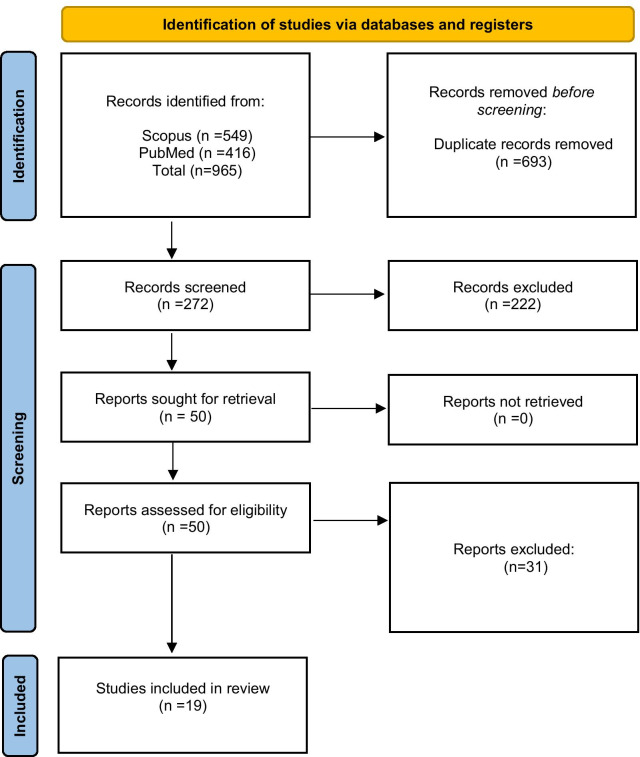
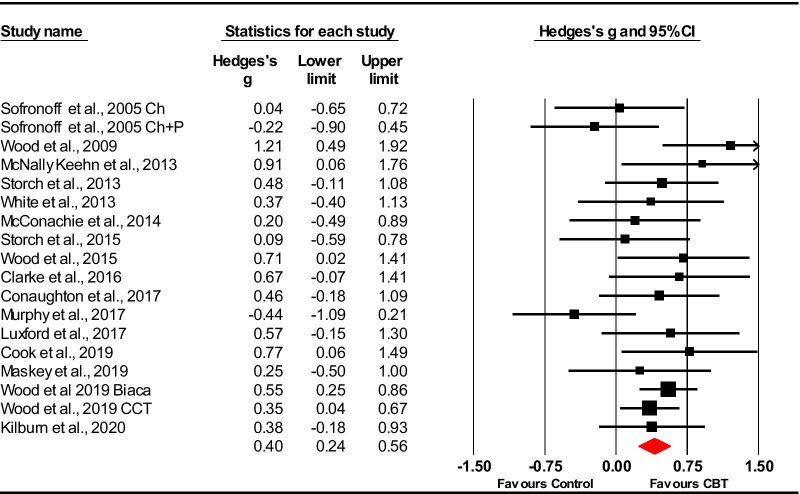
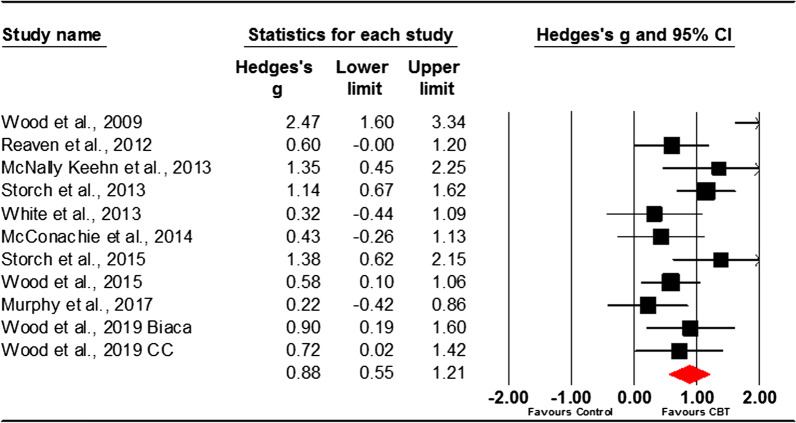
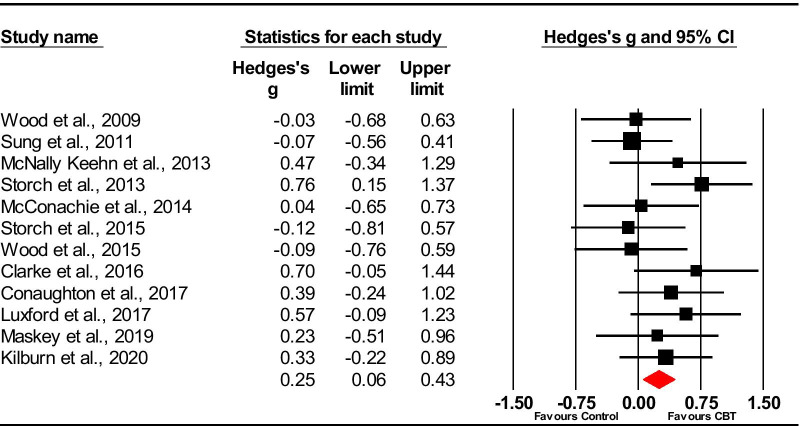
Background: Anxiety is common in youth on the autism spectrum and cognitive behavioural therapy (CBT) has been adapted to address associated symptoms. The aim of the current systematic review and meta-analysis was to examine the efficacy of CBT for reducing anxiety in autistic youth. Method: Searches of PubMed and Scopus databases were undertaken from January 1990 until December 2020. Studies were included if they consisted of randomised controlled trials (RCTs) using CBT to reduce anxiety in autistic youth. Separate random effects meta-analyses assessed anxiety ratings according to informant (clinician; parent; child), both at end-of-trial and at follow-up. Results: A total of 19 RCTs met our inclusion criteria (833 participants: CBT N = 487; controls N = 346). Random effects meta-analyses revealed a large effect size for clinician rated symptoms (g = 0.88, 95% CI 0.55, 1.12, k = 11), while those for both parent (g = 0.40, 95% CI 0.24, 0.56; k = 18) and child-reported anxiety (g = 0.25, 95% CI 0.06, 0.43; k = 13) were smaller, but significant. These benefits were not however maintained at follow-up. Moderator analyses showed that CBT was more efficacious for younger children (for clinician and parent ratings) and when delivered as individual therapy (for clinician ratings). Using the Cochrane Risk of Bias 2 tool, we found concerns about reporting bias across most trials. Conclusions: The efficacy of CBT for anxiety in autistic youth was supported in the immediate intervention period. However, substantial inconsistency emerged in the magnitude of benefit depending upon who was rating symptoms (clinician, parent or child). Follow-up analyses failed to reveal sustained benefits, though few studies have included this data. It will be important for future trials to address robustness of treatment gains overtime and to further explore inconsistency in efficacy by informant. We also recommend pre-registration of methods by trialists to address concerns with reporting bias.
Overview
The claims and statistics of this paper haven’t been checked yet.
Run the check — free, no account needed. It reads the open-access text and checks the sources it cites.
Integrity signals
Registry
Cites
Statistics
Figures
Verification
Claims the paper makes
The claims and statistics of this paper haven’t been checked yet.
Run the check — free, no account needed. It reads the open-access text and checks the sources it cites.
Claims other papers make about this one
Each is checked against this paper’s own text: does it say what the citing paper says it does?
The source backs part of the claim, not all of it — or backs it for a different population, condition or comparison.
In the citing paper
“Sharma et al. (2021) observed large effect sizes for clinician-rated symptoms but only small ones from the autistic individuals themselves, with benefits not sustained at follow-up.”
From Rethinking psychological interventions in autism: Toward a neurodiversity‐affirming approach. (2025) · cites this paper as Sharma et al., 2021
Experimental — accuracy not yet measuredThe cited source says what the claim attributes to it.
In the citing paper
“Los resultados de recientes revisiones y metaanálisis (Perihan et al., 2019;Sharma et al., 2021) sugieren que los TCC tienen el potencial de ser un componente eficaz para abordar los síntomas relacionados con la ansiedad en niños y niñas autistas.”
From Ansiedad y trastornos del espectro del autismo: notas para la intervención psicoeducativa (2022) · cites this paper as Sharma et al., 2021
The cited source says what the claim attributes to it.
In the citing paper
“Sharma et al. (2021) and Weston et al. (2016) reported higher effect sizes based on clinician evaluations, whereas autistic individuals' self-reports indicated only mild or moderate effects.”
From Rethinking psychological interventions in autism: Toward a neurodiversity‐affirming approach. (2025) · cites this paper as Sharma et al. (2021)
The check wasn’t confident either way, so it gives no verdict — never disputed.
In the citing paper
“clinician-reported outcomes are often prioritised over self-reports from autistic participants.”
From Rethinking psychological interventions in autism: Toward a neurodiversity‐affirming approach. (2025) · cites this paper as Sharma et al. (2021)
Experimental — accuracy not yet measured
Self-check
Percentages, sums and reported differences re-computed from the paper’s own numbers.
The self-check needs the paper’s full text.
Citations
Cites
Diagnostic and Statistical Manual of Mental Disorders
American Psychiatric Association (2013) · doi:10.1176/appi.books.9780890425596 · Cited by 116,369
Diagnostic and Statistical Manual of Mental Disorders
Williams, J. B. W., & First, M. B. (2013) · Oxford University Press eBooks · doi:10.1093/acrefore/9780199975839.013.104 · Cited by 109,842
The PRISMA 2020 statement: An updated guideline for reporting systematic reviews
Page, M. J., McKenzie, J. E., Bossuyt, P. M., Boutron, I., Hoffmann, T. C., Mulrow, C. D., Shamseer, L., Tetzlaff, J. M., Akl, E. A., Brennan, S. E., et al. (2021) · BMJ · doi:10.1136/bmj.n71 · Cited by 108,283
RoB 2: a revised tool for assessing risk of bias in randomised trials
Sterne, J. A. C., Savović, J., Page, M. J., Elbers, R. G., Blencowe, N. S., Boutron, I., Cates, C. J., Cheng, H.-Y., Corbett, M. S., Eldridge, S. M., et al. (2019) · BMJ · doi:10.1136/bmj.l4898 · Cited by 34,787
Cochrane Handbook for Systematic Reviews of Interventions: Cochrane Book Series
(2008) · doi:10.1002/9780470712184 · Cited by 25,048
Diagnostic and Statistical Manual of Mental Disorders
American Psychiatric Association (2022) · doi:10.1176/appi.books.9780890425787 · Cited by 23,476
Duval, S., & Tweedie, R. (2000) · Biometrics · doi:10.1111/j.0006-341x.2000.00455.x · Cited by 14,099
Cumpston, M., Li, T., Page, M. J., Chandler, J., Welch, V. A., Higgins, J. P., & Thomas, J. (2019) · Cochrane Database of Systematic Reviews · doi:10.1002/14651858.ed000142 · Cited by 7,218
A measure of anxiety symptoms among children
Spence, S. H. (1998) · Behaviour Research and Therapy · doi:10.1016/s0005-7967(98)00034-5 · Cited by 1,928
Lai, M.-C., Kassee, C., Besney, R., Bonato, S., Hull, L., Mandy, W., Szatmari, P., & Ameis, S. H. (2019) · The Lancet Psychiatry · doi:10.1016/s2215-0366(19)30289-5 · Cited by 1,892
Research works printed but not linked: 2
- Higgins JP, Thomas J, Chandler J, Cumpston M, Li T, Page MJ, Welch VA, editors. Cochrane handbook for systematic reviews of interventions. Hoboken: Wiley; 2019.
- Spence SH. Spence children’s anxiety scale-parent version. Brisbane: University of Queensland; 1999.
Cited by
Sorted by citations
Items 101–109 of 109
Losh, A., Middleton, C., Pickard, K. E., Meyer, A. T., Hayutin, L., Reyes, N., Blakeley-Smith, A., Boles, R., & Reaven, J. (2026) · Contemporary School Psychology · doi:10.1007/s40688-026-00586-7
Kunutu, R., & Ntshangase, S. D. (2026) · African Journal of Disability · doi:10.4102/ajod.v15i0.1773
“It Makes Me More Confident”: Clinicians’ Perspectives on ECHO Autism: Mental Health
Buranova, N., Levinstein, L., Maddox, B. B., & Sohl, K. (2026) · Focus on Autism and Other Developmental Disabilities · doi:10.1177/10883576261440822
Hazem, H., Ali, K., Maryam, C., Fatma, Y., Oumayma, H., Hajer, K., Mayssa, B., & Abbes, W. (2026) · Middle East Current Psychiatry · doi:10.1186/s43045-026-00638-x
Hargitai, L. D., Waldren, L. H., Robinson, R., Livingston, L. A., Leung, F. Y. N., & Shah, P. (2026) · BMC Psychiatry · doi:10.1186/s12888-026-08082-1
Hampton, S., Mandy, W., Zahir, R., Miller, O., Carter, S., Midouhas, E., Flouri, E., & Cooper, K. (2026) · Journal of Autism and Developmental Disorders · doi:10.1007/s10803-026-07463-5
Shao, S., Han, D., & Wang, J. (2026) · Research in Autism · doi:10.1016/j.reia.2026.203008
Cunningham, A., Rao, P. S., Loades, M. E., & Russell, A. (2026) · The Cognitive Behaviour Therapist · doi:10.1017/s1754470x26100919
Coverdale, G., Kuzminski, R., Magiati, I., Perry, Y., Badcock, N. A., & Alvares, G. A. (2026) · Research in Autism · doi:10.1016/j.reia.2026.203044
Metadata
- Authors
- Sharma, S., Hucker, A., Matthews, T., Grohmann, D., & Laws, K. R.
- Affiliations
- University of Hertfordshire (GB)
- Corresponding author
- Sharma, Shivani
- Venue
- BMC Psychology
- Published
- 2021-10-01
- Volume
- 9
- Issue
- 1
- Pages
- 151-151
- ISSN
- 2050-7283 (ISSN-L)
- PMC
- PMC8487131
- OpenAlex
- W3202426903
- Cited by
- 109
- References
- 77
- Citations by year
- 2026: 18 · 2025: 18 · 2024: 54 · 2023: 12 · 2022: 5 · 2021: 2
- FWCI
- 2.70
- Type
- journal article
- Language
- en
- Open access
- gold
- doi.org
- Locations
- BMC Psychology (publishedVersion, cc-by)
- Europe PMC (PubMed Central) (publishedVersion, other-oa)
- PubMed Central (publishedVersion, cc-by)
- PubMed (publishedVersion)
- University of Hertfordshire Research Archive (University of Hertfordshire) (acceptedVersion, other-oa)
- DOAJ (DOAJ: Directory of Open Access Journals) (submittedVersion, cc-by-sa)
- University of Hertfordshire Research Archive (University of Hertfordshire) (submittedVersion, cc-by)
- Topics
- Life Sciences › Neuroscience › Cognitive Neuroscience › Autism Spectrum Disorder Research
- Social Sciences › Psychology › Experimental and Cognitive Psychology › Anxiety, Depression, Psychometrics, Treatment, Cognitive Processes
- Social Sciences › Psychology › Clinical Psychology › Psychological Treatments and Assessments
- Keywords
- cognitive behavioral therapy, autism spectrum disorder, anxiety, autistic youth, treatment efficacy, clinician ratings, parent ratings, child self-report, individual psychotherapy, age differences, follow-up maintenance, reporting bias
- MeSH terms
- Adolescent, Anxiety, Anxiety Disorders, Autistic Disorder, Humans, Parents, Cognitive Behavioral Therapy
About these checks
Registry, retraction, Cites and statistics results are computed, not judged, with one exception: a printed reference that no index lists is read once by a model before it counts as a citation error. Claims are extracted by a model and kept only when their quote appears verbatim in the text; each cited source is then checked, with a model’s help, for whether it says what the claim relies on. Those verdicts can be wrong — read the claim’s quote and the cited source before relying on one.
Statistics and arithmetic are recomputed, not judged.
Confidence bands are shown only for fields calibrated on our annotated test set. None is calibrated yet, so no band is shown.
What counts as a claim ›How we measure confidence ›How we check this ›
Are you an author, or do you see a problem with this page? Request a review
