

Repetitive negative thinking: transdiagnostic correlate and risk factor for mental disorders? A proof-of-concept study in German soldiers before and after deployment to Afghanistan
Open accessThe DOI matches its Crossref record; 63 of the 63 references it cites were found in a registry or an index.
Abstract
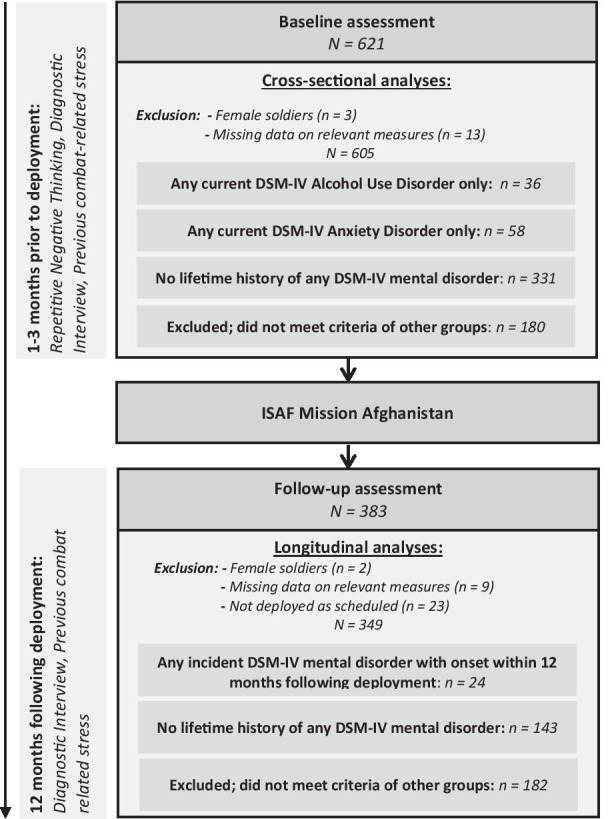
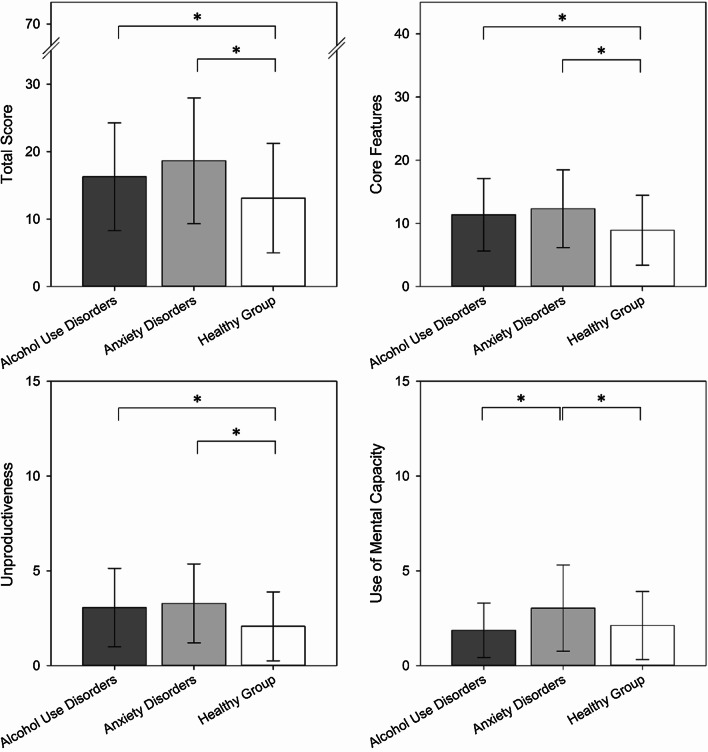
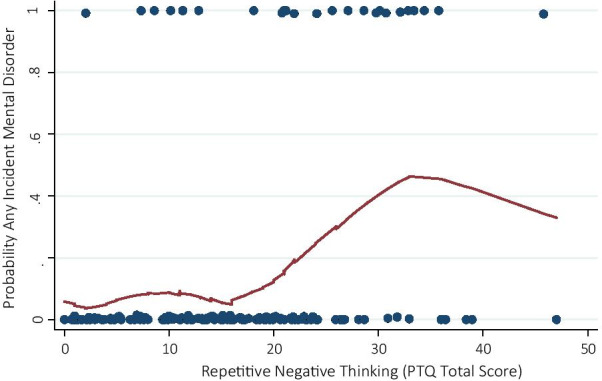
BACKGROUND AND OBJECTIVES: Disorder-specific forms of Repetitive Negative Thinking (RNT) are associated with multiple diagnostic categories, indicating a transdiagnostic nature. Few studies examined content-independent RNT processes across groups of diagnosed mental disorders. Moreover, theory describes RNT processes as critically involved in the etiology of mental disorders, empirical evidence however is scarce. We first tested the transdiagnostic nature by examining levels of RNT across groups of internalizing and externalizing mental disorders compared to healthy individuals and explored RNT levels in a comorbid disorder-group. Second, we examined whether RNT predicts incident psychopathology. METHODS: In a sample of German soldiers (n = 425) scheduled for deployment in Afghanistan, we compared RNT levels between diagnosed groups with alcohol use disorders, anxiety disorders and healthy individuals cross-sectionally. Exploratory analyses were conducted comparing a comorbid disorder-group to healthy individuals and to both single-disorder-groups. Longitudinally, we examined the predictive value of pre-deployment RNT levels for incident psychopathology after deployment (n = 167). RNT was measured using the Perseverative Thinking Questionnaire (PTQ), DSM-IV diagnoses were assessed using the standardized Composite International Diagnostic Interview (CIDI). RESULTS: Cross-sectional comparisons revealed that soldiers with alcohol use disorders and anxiety disorders showed significantly higher degrees of RNT compared to healthy soldiers. RNT levels in those with comorbid disorders were significantly higher compared to healthy soldiers but also compared to both single-disorder-groups. Longitudinal analyses revealed that higher levels of RNT prior to deployment were associated with a higher risk to have any incidental mental disorder after deployment. This however is only attributable to individuals with a PTQ score above a cut-off of 15. CONCLUSIONS: Findings provide evidence for RNT as a transdiagnostic correlate and a vulnerability factor for the development of mental disorders.
Overview
The claims and statistics of this paper haven’t been checked yet.
Free: it reads the open-access text and checks the first 5 claims that cite a source we can check. Create a free account to check every claim.
Integrity signals
Registry
Cites
Statistics
Figures
Verification
Claims the paper makes
The claims and statistics of this paper haven’t been checked yet.
Free: it reads the open-access text and checks the first 5 claims that cite a source we can check. Create a free account to check every claim.
Claims other papers make about this one
Each is checked against this paper’s own text: does it say what the citing paper says it does?
The source backs part of the claim, not all of it — or backs it for a different population, condition or comparison.
In the citing paper
“Repetitive negative thinking is another important transdiagnostic factor, present across various disorders, including insomnia (22, 40, 41).”
From The contribution of transdiagnostic vulnerability factors in patients with chronic insomnia (2023) · cites this paper as [41]
Experimental — accuracy not yet measured
Self-check
Percentages, sums and reported differences re-computed from the paper’s own numbers.
The self-check needs the paper’s full text.
Citations
Cites
A cognitive model of posttraumatic stress disorder
Ehlers, A., & Clark, D. M. (2000) · Behaviour Research and Therapy · doi:10.1016/s0005-7967(99)00123-0 · Cited by 6,147
Nolen-Hoeksema, S., Wisco, B. E., & Lyubomirsky, S. (2008) · Perspectives on Psychological Science · doi:10.1111/j.1745-6924.2008.00088.x · Cited by 5,172
Combat Duty in Iraq and Afghanistan, Mental Health Problems, and Barriers to Care
Hoge, C. W., Castro, C. A., Messer, S. C., McGurk, D., Cotting, D. I., & Koffman, R. L. (2004) · New England Journal of Medicine · doi:10.1056/nejmoa040603 · Cited by 4,778
Responses to depression and their effects on the duration of depressive episodes
Nolen-Hoeksema, S. (1991) · Journal of Abnormal Psychology · doi:10.1037/0021-843x.100.4.569 · Cited by 4,529 · cited 1×
“The lack of research testing associations with stress may mainly be due to the fact that disorder-specific expressions of RNT, particularly rumination and worry, have originally been conceptualized and measured as post-stressor coping strategies following preexisting symptoms, stressful or traumatic events [7, 10].”
BackgroundInfluentialAge of onset of mental disorders: a review of recent literature
Kessler, R. C., Amminger, G. P., Aguilar-Gaxiola, S., Alonso, J., Lee, S., & ??st??n, T. B. (2007) · Current Opinion in Psychiatry · doi:10.1097/yco.0b013e32816ebc8c · Cited by 3,457 · cited 1×
“For proper model specification, again we added age and educational level known to be associated with RNT levels [52, 53] as well as with incident mental disorders [57, 58].”
BackgroundRothman, K. J., Greenland, S., & Lash, T. L. (1998) · Cited by 2,096
The global burden of mental disorders: An update from the WHO World Mental Health (WMH) surveys
Kessler, R. C., Aguilar-Gaxiola, S., Alonso, J., Chatterji, S., Lee, S., Ormel, J., Üstün, T. B., & Wang, P. S. (2009) · Epidemiologia e Psichiatria Sociale · doi:10.1017/s1121189x00001421 · Cited by 1,895 · cited 1×
“Introduction Lifetime prevalence estimates for any mental disorder range from 18 to 36% representing a global health issue with enormous societal and economic costs [1, 2].”
BackgroundThe Structure of Common Mental Disorders
Krueger, R. F. (1999) · Archives of General Psychiatry · doi:10.1001/archpsyc.56.10.921 · Cited by 1,881 · cited 2×
“Further, many studies on the transdiagnostic nature of RNT focused on anxiety and depression symptoms, both part of the internalizing disorder spectrum sharing key components in development and maintenance [35].”
BackgroundMethodCost of disorders of the brain in Europe 2010
Gustavsson, A., Svensson, M., Jacobi, F., Allgulander, C., Alonso, J., Beghi, E., Dodel, R., Ekman, M., Faravelli, C., Fratiglioni, L., et al. (2011) · European Neuropsychopharmacology · doi:10.1016/j.euroneuro.2011.08.008 · Cited by 1,723
Social Phobia: Diagnosis, Assessment, and Treatment
Amada, G. (1996) · American Journal of Psychotherapy · doi:10.1176/appi.psychotherapy.1996.50.3.373 · Cited by 1,248
Research works printed but not linked: 2
- Corp S Stata statistical software 2017 College Station Stata Corporation
- Logistic PD Logistic regression diagnostics Ann Stat 1981 9 4 705 724
Cited by
Repetitive negative thinking as a transdiagnostic cognitive process
Moulds, M. L., & McEvoy, P. M. (2025) · Nature Reviews Psychology · doi:10.1038/s44159-024-00399-6 · Cited by 75
Tsuchiyagaito, A., Misaki, M., Cochran, G., Philip, N. S., Paulus, M. P., & Guinjoan, S. M. (2023) · Journal of Psychiatric Research · doi:10.1016/j.jpsychires.2023.10.058 · Cited by 13
The contribution of transdiagnostic vulnerability factors in patients with chronic insomnia
Habibi Asgarabad, M., Doos Ali Vand, H., Salehi Yegaei, P., Hooman, F., Ahmadi, R., Baglioni, C., & Moradi, S. (2023) · Frontiers in Psychiatry · doi:10.3389/fpsyt.2023.1162729 · Cited by 10
Perceived Parenting Stress Is Related to Cardiac Flexibility in Mothers: Data from the NorBaby Study
Parisi, F., Høifødt, R. S., Bohne, A., Wang, C. E. A., & Pfuhl, G. (2024) · Behavioral Sciences · doi:10.3390/bs14020117 · Cited by 6
Türkarslan, K. K., & Çınarbaş, D. C. (2024) · Psychiatry · doi:10.1080/00332747.2024.2347100 · Cited by 8
Metadata
- Authors
- Hummel, K. V., Trautmann, S., Venz, J., Thomas, S., & Schäfer, J.
- Affiliations
- Technische Universität Dresden (DE)
- MSH Medical School Hamburg – University of Applied Sciences and Medical University (DE)
- Corresponding author
- Schäfer, Judith
- Venue
- BMC Psychology
- Published
- 2021-12-19
- Volume
- 9
- Issue
- 1
- Pages
- 198-198
- ISSN
- 2050-7283 (ISSN-L)
- PMC
- PMC8686273
- OpenAlex
- W4200140054
- Cited by
- 12
- References
- 63
- Citations by year
- 2026: 2 · 2025: 4 · 2024: 2 · 2023: 3 · 2022: 1
- FWCI
- 1.45
- Type
- journal article
- Language
- en
- Open access
- gold
- doi.org
- Licence
- cc-by
- creativecommons.org/licenses/by/4.0 (tdm)
- creativecommons.org/licenses/by/4.0 (vor)
- Locations
- BMC Psychology (publishedVersion, cc-by)
- PubMed Central (publishedVersion, cc-by)
- PubMed (publishedVersion)
- DOAJ (DOAJ: Directory of Open Access Journals) (submittedVersion, cc-by-sa)
- Funders
- German Defense Ministry Medical Office (M/SAB X/9a004 and E/U2AD/HD008/CF550)
- Technische Universität Dresden
- Topics
- Social Sciences › Psychology › Experimental and Cognitive Psychology › Anxiety, Depression, Psychometrics, Treatment, Cognitive Processes
- Social Sciences › Psychology › Clinical Psychology › Posttraumatic Stress Disorder Research
- Social Sciences › Psychology › Experimental and Cognitive Psychology › Mental Health Research Topics
- Keywords
- repetitive negative thinking, transdiagnostic mechanisms, risk factors for mental disorders, military personnel, alcoholism, anxiety disorders, comorbidities, internalizing disorders, externalizing disorders
- MeSH terms
- Pessimism, Afghanistan, Alcoholism, Cross-Sectional Studies, Humans, Military Personnel, Risk Factors
About these checks
Registry, retraction, Cites and statistics results are computed, not judged, with one exception: a printed reference that no index lists is read once by a model before it counts as a citation error. Claims are extracted by a model and kept only when their quote appears verbatim in the text; each cited source is then checked, with a model’s help, for whether it says what the claim relies on. Those verdicts can be wrong — read the claim’s quote and the cited source before relying on one.
Statistics and arithmetic are recomputed, not judged.
Confidence bands are shown only for fields calibrated on our annotated test set. None is calibrated yet, so no band is shown.
What counts as a claim ›How we measure confidence ›How we check this ›
Are you an author, or do you see a problem with this page? Request a review
How to cite
Cite CoChat for the checks on this page, and the paper for its own findings.
- This page
- CoChat. (2026). Citation check: Repetitive negative thinking: transdiagnostic correlate and risk factor for mental disorders? A proof-of-concept study in German soldiers before and after deployment to Afghanistan. https://app.cochat.ai/papers/10.1186/s40359-021-00696-2
- The paper
- Hummel, K. V., Trautmann, S., Venz, J., Thomas, S., & Schäfer, J. (2021). Repetitive negative thinking: transdiagnostic correlate and risk factor for mental disorders? A proof-of-concept study in German soldiers before and after deployment to Afghanistan. BMC Psychology. https://doi.org/10.1186/s40359-021-00696-2
Data sources
Bibliographic data: Semantic Scholar, OpenAlex, Crossref.
Contains information from the Semantic Scholar Academic Graph Datasets, made available under the ODC Attribution License (ODC-BY 1.0).
Semantic Scholar’s data is described in: Kinney, R., et al. (2023). The Semantic Scholar Open Data Platform. arXiv:2301.10140.
