

Effect of blended and unguided online delivery of mindfulness-based cognitive therapy versus care as usual on distress among cancer patients and survivors: protocol for the three-arm parallel randomized controlled buddy trial
Open accessThe DOI matches its Crossref record; 33 of the 34 references it cites were found in a registry or an index; 9 of the 17 sources its claims cite were checked for support.
Abstract
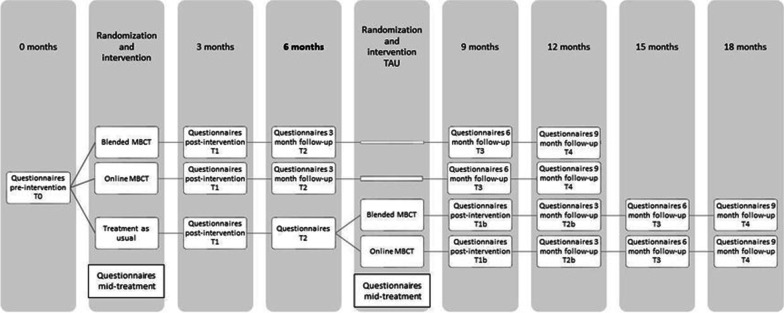
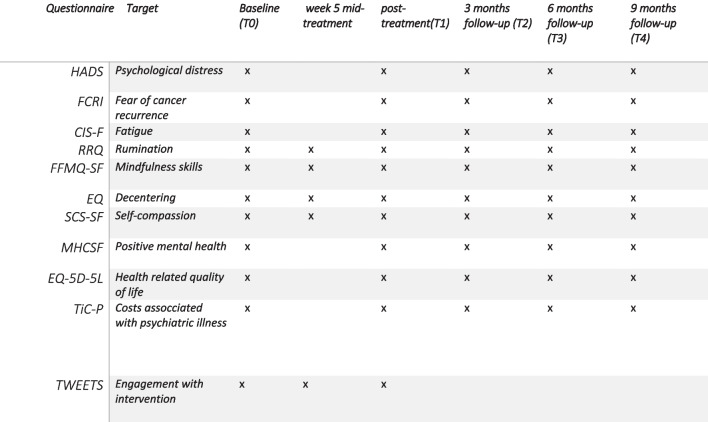
Background: One third of cancer patients and survivors experience psychological distress. Previous studies have shown that online mindfulness-based cognitive therapy (eMBCT) supports cancer patients and survivors in managing distress. Lack of peer support and asynchronicity during online interventions have been reported as barriers for treatment adherence and can result in higher drop-out rates. Considering this, two new formats of eMBCT were created. The primary objective of the Buddy trial is to evaluate the (cost) effectiveness of blended and unguided eMBCT versus care as usual (CAU) on psychological distress among cancer patients and survivors. Secondary objectives include evaluating effects on other psychological outcomes and investigating working mechanisms and treatment effect moderators. Methods: The Buddy trial is a parallel three-armed randomized controlled trial. Participants will be randomly assigned to blended therapist-assisted eMBCT, unguided individual eMBCT or CAU. Eligible participants will be Dutch-speaking adult cancer patients or survivors with access to internet. The primary outcome will be psychological distress scores as assessed by the Hospital Anxiety and Depression scale immediately post-treatment. Secondary outcome measures include fear of cancer recurrence (FCRI), fatigue (CIS-F), rumination (RRQ), mindfulness skills (FFMQ), decentering (EQ), self-compassion (SCS-SF), positive mental health (MHCSF), health related quality of life (EQ-5D), and costs associated with psychiatric illness (TiC-P). Outcome measures will be evaluated at baseline, mid-treatment, immediately post-treatment, and three-, six-, and nine-months follow-up. Possible mediators, such as engagement with interventions (TWEETS), and moderators will be also analyzed. Discussion: There is room to improve eMBCT for cancer patients prior to implementation to ensure adherence and scalability. Blended and unguided eMBCT may reduce psychological distress and improve quality of life and be easily accessible to cancer patients and survivors. Trial registration clinicaltrials.gov, NCT05336916, registered on April 20th, 2022. https://clinicaltrials.gov/ct2/show/NCT05336916. © 2023, The Author(s).
Overview
CoChat Summary
TL;DR
This is a protocol for a three-arm randomized controlled trial testing whether blended and unguided online mindfulness-based cognitive therapy (eMBCT) reduce psychological distress more than care as usual in Dutch-speaking adult cancer patients and survivors. The trial also plans to examine secondary psychological outcomes, mediators, moderators, and cost-effectiveness.
Key findings
- Not stated in the paper.
- The trial’s primary outcome is psychological distress at post-treatment, measured by the Hospital Anxiety and Depression Scale (HADS), with scores ranging from 0–42; higher scores indicate more distress.
- The protocol states a target sample size of at least 254 participants: 81 in blended eMBCT, 108 in unguided eMBCT, and 65 in care as usual; after the first 80 participants, the target was adjusted to at least 86 per arm because dropout appeared similar across groups (28%).
- Power calculations assumed effect sizes of d = 0.58 for blended eMBCT vs CAU and d = 0.45 for unguided eMBCT vs CAU, with alpha = 0.05 and correlation between baseline and post-treatment distress of 0.50.
Methods
- Three-arm parallel randomized controlled trial with blended eMBCT, unguided eMBCT, and care as usual; participants are Dutch-speaking adult cancer patients or survivors with internet access and computer literacy.
- Recruitment is through online and offline channels; participants are stratified by breast cancer vs other cancer and curative vs palliative treatment intent, then randomized, with CAU participants re-randomized after six months.
- Primary analysis uses intention-to-treat ANCOVA comparing post-treatment HADS scores between each eMBCT arm and CAU; secondary analyses include linear mixed models for follow-up outcomes, mediation/moderation analyses, and a cost-utility analysis.
Limitations
- The paper does not report study results because it is a protocol.
- Participants and trainers cannot be blinded to treatment allocation, which is an evident limitation of the design.
- The authors note anticipated dropout and adherence challenges in unguided online interventions, though they report that after one year of enrollment dropout appeared similar across conditions; this is stated as a rationale for the design rather than a tested limitation.
Model-written summary. Check it against the paper before relying on it.
Integrity signals
Registry
Cites
Statistics
Figures
Verification
Claims the paper makes
8 Valid · 1 Not valid · 8 Not checked · 15 Own results and interpretations
The cited sources support only part of this claim — read each source’s verdict below.
In the paper
“As adherence to unguided interventions often is lower than intended, persuasive technology known to improve adherence was included, such as reminders, videos, and virtual coaches [15].”
§ Effect of blended and unguided online delivery of mindfulness-based cognitive therapy versus care as usual on distress among cancer patients and survivors: protocol for the three-arm parallel randomized controlled buddy trial > Background
What the sources say
- Partly supportedcites [15] Kelders SM Kok RN Ossebaard HC Van Gemert-Pijnen JEWC Persuasive system design does matter: a systematic review of adherence to web-based interventions J Med Internet Res 2012 14 6 e152 10.2196/jmir.2104 23151820 PMC3510730 sourceExperimental — accuracy not yet measured
The Results (Characteristics of the Studies that Were Included; page unavailable) report that an average of 50.3% of participants adhered to intended intervention use. The Discussion (Principal Results; page unavailable) finds that more counselor interaction predicts better adherence. These findings support the general concern about low adherence, but the paper does not give a separate adherence rate for unguided interventions. (LLM, conf=0.82)
plain- Asserted: passes — The authors put it forward as true.
- Checkable: passes — It can be checked against evidence.
- Load-bearing: passes — The paper’s conclusions depend on it.
- Based: passes — The paper gives a reason why it holds.
- Partly supported
The cited sources support only part of this claim — read each source’s verdict below.
In the paper
“As adherence to unguided interventions often is lower than intended, persuasive technology known to improve adherence was included, such as reminders, videos, and virtual coaches [15].”
§ Effect of blended and unguided online delivery of mindfulness-based cognitive therapy versus care as usual on distress among cancer patients and survivors: protocol for the three-arm parallel randomized controlled buddy trial > Background
What the sources say
- Partly supportedcites [15] Kelders SM Kok RN Ossebaard HC Van Gemert-Pijnen JEWC Persuasive system design does matter: a systematic review of adherence to web-based interventions J Med Internet Res 2012 14 6 e152 10.2196/jmir.2104 23151820 PMC3510730 sourceExperimental — accuracy not yet measured
The Discussion (Principal Results; page unavailable) reports that more extensive dialogue support was associated with better adherence and that reminders can positively influence adherence. The Results (Persuasive Technology; page unavailable) identify reminders as a dialogue-support element, but the paper does not establish that videos or virtual coaches improve adherence. (LLM, conf=0.88)
boostedstates a cause- Asserted: passes — The authors put it forward as true.
- Checkable: passes — It can be checked against evidence.
- Load-bearing: passes — The paper’s conclusions depend on it.
- Based: passes — The paper gives a reason why it holds.
- Partly supported
A result the paper reports from its own data — it cites no other source for it, so there is none to check. The quote shows it is in the paper.
In the paper
“However, after inclusion of the first 80 participants, drop-out appeared to be similar across the three conditions (28%).”
- Also stated in: § Randomization · hedged
“However, upon inspection of completion rates after one year of enrollment, it appeared that the drop-out rates were quite similar across the three conditions.”
§ Effect of blended and unguided online delivery of mindfulness-based cognitive therapy versus care as usual on distress among cancer patients and survivors: protocol for the three-arm parallel randomized controlled buddy trial > Analysis > Power calculation and sample size
hedgedn = 80- Asserted: passes — The authors put it forward as true.
- Checkable: passes — It can be checked against evidence.
- Load-bearing: passes — The paper’s conclusions depend on it.
- Based: passes — The paper gives a reason why it holds.
- Also stated in: § Randomization · hedged
What the paper did — it cites no source for this, so there is none to check. The quote shows it is in the paper.
In the paper
“The Buddy trial is a parallel three-armed randomized controlled trial.”
- Also stated in: § Study design · plain
“The current study is a three-armed parallel RCT with blended eMBCT, unguided eMBCT, and CAU.”
§ Effect of blended and unguided online delivery of mindfulness-based cognitive therapy versus care as usual on distress among cancer patients and survivors: protocol for the three-arm parallel randomized controlled buddy trial > Abstract > Methods
plain- Asserted: passes — The authors put it forward as true.
- Checkable: passes — It can be checked against evidence.
- Load-bearing: passes — The paper’s conclusions depend on it.
- Based: passes — The paper gives a reason why it holds.
- Also stated in: § Study design · plain
In the paper
“Despite these positive effects, more patients in the eMBCT condition did not complete the intervention when compared to face-to-face MBCT.”
§ Effect of blended and unguided online delivery of mindfulness-based cognitive therapy versus care as usual on distress among cancer patients and survivors: protocol for the three-arm parallel randomized controlled buddy trial > Background
What the sources say
- Not checked — no full text of the sourcecites [8] Compen F Bisseling E Schellekens M Donders R Carlson L van der Lee M Face-to-face and internet-based mindfulness-based cognitive therapy compared with treatment as usual in reducing psychological distress in patients with cancer: a multicenter randomized controlled trial JCO 2018 36 23 2413 2421 10.1200/JCO.2017.76.5669 29953304 source
plain- Asserted: passes — The authors put it forward as true.
- Checkable: passes — It can be checked against evidence.
- Load-bearing: passes — The paper’s conclusions depend on it.
- Based: passes — The paper gives a reason why it holds.
- Probably not a substantial claim. 23
- It may state two separate claims as one. 9
Citations
Cites
Sung, H., Ferlay, J., Siegel, R. L., Laversanne, M., Soerjomataram, I., Jemal, A., & Bray, F. (2021) · CA: A Cancer Journal for Clinicians · doi:10.3322/caac.21660 · Cited by 108,699 · cited 1×
“4 million new cancer cases will occur in 2040; a 47% increase from 2020 [27].”
BackgroundPreacher, K. J., & Hayes, A. F. (2008) · Behavior Research Methods · doi:10.3758/brm.40.3.879 · Cited by 34,117 · cited 2×
“Preacher KJ, Hayes AF.”
MethodKabat-Zinn, J. (1982) · General Hospital Psychiatry · doi:10.1016/0163-8343(82)90026-3 · Cited by 4,255 · cited 1×
“Mindfulness is characterized by intentionally paying attention to moment-by-moment experiences in a non-judgmental way [14].”
BackgroundConstruction and factorial validation of a short form of the Self-Compassion Scale
Raes, F., Pommier, E., Neff, K. D., & Van Gucht, D. (2011) · Clinical Psychology & Psychotherapy · doi:10.1002/cpp.702 · Cited by 2,997
Webb, T. L., Joseph, J., Yardley, L., & Michie, S. (2010) · Journal of Medical Internet Research · doi:10.2196/jmir.1376 · Cited by 2,517 · cited 1×
“These experiences and barriers to participation in online interventions are known to occur across populations [30].”
BackgroundEvaluating the psychometric properties of the mental health continuum-short form (MHC-SF)
Lamers, S. M. A., Westerhof, G. J., Bohlmeijer, E. T., ten Klooster, P. M., & Keyes, C. L. M. (2011) · Journal of Clinical Psychology · doi:10.1002/jclp.20741 · Cited by 1,402
Persuasive System Design Does Matter: a Systematic Review of Adherence to Web-based Interventions
Kelders, S. M., Kok, R. N., Ossebaard, H. C., & Van Gemert-Pijnen, J. E. (2012) · Journal of Medical Internet Research · doi:10.2196/jmir.2104 · Cited by 1,308 · cited 1×
“As adherence to unguided interventions often is lower than intended, persuasive technology known to improve adherence was included, such as reminders, videos, and virtual coaches [15].”
BackgroundSelf-citationDutch Tariff for the Five-Level Version of EQ-5D
M. Versteegh, M., M. Vermeulen, K., M. A. A. Evers, S., de Wit, G. A., Prenger, R., & A. Stolk, E. (2016) · Value in Health · doi:10.1016/j.jval.2016.01.003 · Cited by 1,113 · cited 8×
“Dutch tariff for the five-level version of EQ-5D.”
MethodInfluentialMindfulness-based cognitive therapy for depression
Kumari, D., & Satyapal, N. (2025) · Industrial Psychiatry Journal · doi:10.4103/ipj.ipj_127_24 · Cited by 997
Bohlmeijer, E., ten Klooster, P. M., Fledderus, M., Veehof, M., & Baer, R. (2011) · Assessment · doi:10.1177/1073191111408231 · Cited by 990
Luyckx, K., Schwartz, S. J., Berzonsky, M. D., Soenens, B., Vansteenkiste, M., Smits, I., & Goossens, L. (2008) · Journal of Research in Personality · doi:10.1016/j.jrp.2007.04.004 · Cited by 901
Fresco, D. M., Moore, M. T., van Dulmen, M. H. M., Segal, Z. V., Ma, S. H., Teasdale, J. D., & Williams, J. M. G. (2007) · Behavior Therapy · doi:10.1016/j.beth.2006.08.003 · Cited by 810 · cited 1×
“The 11-item Decentering subscale of the Experiences Questionnaire (EQ) [11] measures the ability to observe one’s thoughts and feelings as temporary, objective events in the mind.”
BackgroundNiedzwiedz, C. L., Knifton, L., Robb, K. A., Katikireddi, S. V., & Smith, D. J. (2019) · BMC Cancer · doi:10.1186/s12885-019-6181-4 · Cited by 756 · cited 1×
“Psychological distress can manifest in different ways, including anxiety and depression symptoms [22] as well as fear of cancer recurrence [28].”
BackgroundCritical Review of Psychosocial Interventions in Cancer Care
Fawzy, F. I. (1995) · Archives of General Psychiatry · doi:10.1001/archpsyc.1995.03950140018003 · Cited by 560 · cited 1×
“Psychological interventions have shown to have positive effects on a variety of cancer-related problems [10].”
BackgroundGoldberg, S. B., Riordan, K. M., Sun, S., & Davidson, R. J. (2022) · Perspectives on Psychological Science · doi:10.1177/1745691620968771 · Cited by 520 · cited 1×
“Since their development, however, these interventions have shown beneficial across different domains, and they have been widely implemented for different conditions, including cancer [12].”
BackgroundBouwmans, C., De Jong, K., Timman, R., Zijlstra-Vlasveld, M., Van der Feltz-Cornelis, C., Tan, S. S., & Hakkaart-van Roijen, L. (2013) · BMC Health Services Research · doi:10.1186/1472-6963-13-217 · Cited by 401 · cited 1×
“Costs associated with Psychiatric illness will be assessed using the Trimbos/iMTA questionnaire for Costs associated with Psychiatric illness (TiC-P) [2].”
MethodMitchell, A. J., Meader, N., & Symonds, P. (2010) · Journal of Affective Disorders · doi:10.1016/j.jad.2010.01.067 · Cited by 394 · cited 1×
“The HADS is a 14-item self-report questionnaire that has been widely used to measure psychological distress in cancer patients [21].”
MethodThe assessment of fatigue: Psychometric qualities and norms for the Checklist individual strength
Worm-Smeitink, M., Gielissen, M., Bloot, L., van Laarhoven, H. W. M., van Engelen, B. G. M., van Riel, P., Bleijenberg, G., Nikolaus, S., & Knoop, H. (2017) · Journal of Psychosomatic Research · doi:10.1016/j.jpsychores.2017.05.007 · Cited by 360
Cillessen, L., Johannsen, M., Speckens, A. E. M., & Zachariae, R. (2019) · Psycho-Oncology · doi:10.1002/pon.5214 · Cited by 326 · cited 2×
“In the past years, evidence for the effectiveness of mindfulness-based interventions (MBIs), such as Mindfulness-Based Stress Reduction (MBSR) and mindfulness-based cognitive therapy (MBCT), has rapidly increased [5].”
BackgroundSelf-citationFear of cancer recurrence: a systematic literature review of self‐report measures
Thewes, B., Butow, P., Zachariae, R., Christensen, S., Simard, S., & Gotay, C. (2012) · Psycho-Oncology · doi:10.1002/pon.2070 · Cited by 262
Compen, F., Bisseling, E., Schellekens, M., Donders, R., Carlson, L., van der Lee, M., & Speckens, A. (2018) · Journal of Clinical Oncology · doi:10.1200/jco.2017.76.5669 · Cited by 248 · cited 2×
“MBCT, including when delivered online, has shown to reduce psychological distress for cancer patients and survivors [8].”
BackgroundMethodSelf-citationBrebach, R., Sharpe, L., Costa, D. S. J., Rhodes, P., & Butow, P. (2016) · Psycho-Oncology · doi:10.1002/pon.4099 · Cited by 139 · cited 1×
“However, there are known patient-reported barriers to engaging in faceto-face psychological interventions like MBIs, such as investment of time, stigma, fatigue, reluctance to return to the hospital, and indirect costs [3].”
BackgroundLengacher, C. A., Reich, R. R., Ramesar, S., Alinat, C. B., Moscoso, M., Cousin, L., Marino, V. R., Elias, M. N., Paterson, C. L., Pleasant, M. L., et al. (2018) · Psycho-Oncology · doi:10.1002/pon.4491 · Cited by 101 · cited 1×
“Although there is little evidence for online mindfulness-based interventions (eMBIs) in the context of psycho-oncology, some preliminary research has shown their potential [4, 19, 33].”
BackgroundSpotlight on the Fear of Cancer Recurrence Inventory (FCRI)
Smith, A. B., Costa, D., Galica, J., Lebel, S., Tauber, N., van Helmondt, S. J., & Zachariae, R. (2020) · Psychology Research and Behavior Management · doi:10.2147/prbm.s231577 · Cited by 98 · cited 1×
“Fear of cancer recurrence will be assessed using the nine-item Fear of Cancer Recurrence Inventory-severity subscale (FCRI-SF) [26].”
MethodKelders, S. M., Kip, H., & Greeff, J. (2020) · Journal of Medical Internet Research · doi:10.2196/17757 · Cited by 88
Methods for Human-Centered eHealth Development: Narrative Scoping Review
Kip, H., Keizer, J., da Silva, M. C., Beerlage-de Jong, N., Köhle, N., & Kelders, S. M. (2022) · Journal of Medical Internet Research · doi:10.2196/31858 · Cited by 67 · cited 1×
“Although it is still under debate on how optimal support should be given [17], it has been suggested that good quality online interventions consider the heterogeneity in patients characteristics and skills, the context, and evidence from previous development activities [17].”
BackgroundSelf-citationMethods for Human-Centered eHealth Development: Narrative Scoping Review (Preprint)
Kip, H., Keizer, J., da Silva, M. C., Beerlage-de Jong, N., Köhle, N., & Kelders, S. M. (2021) · doi:10.2196/preprints.31858 · Cited by 67
Self-citationWeb-based individual Mindfulness-Based Cognitive Therapy for cancer-related fatigue — A pilot study
Bruggeman Everts, F. Z., van der Lee, M. L., & de Jager Meezenbroek, E. (2015) · Internet Interventions · doi:10.1016/j.invent.2015.03.004 · Cited by 60 · cited 1×
“Although there is little evidence for online mindfulness-based interventions (eMBIs) in the context of psycho-oncology, some preliminary research has shown their potential [4, 19, 33].”
BackgroundCho, D., & Park, C. L. (2018) · European Journal of Cancer Care · doi:10.1111/ecc.12772 · Cited by 55 · cited 1×
“In addition, cancerrelated pain and fatigue are common patient-reported problems [6].”
BackgroundZernicke, K. A., Campbell, T. S., Speca, M., Ruff, K. M., Flowers, S., Tamagawa, R., & Carlson, L. E. (2016) · Mindfulness · doi:10.1007/s12671-016-0545-5 · Cited by 46 · cited 1×
“Although there is little evidence for online mindfulness-based interventions (eMBIs) in the context of psycho-oncology, some preliminary research has shown their potential [4, 19, 33].”
BackgroundCompen, F. R., Bisseling, E. M., Schellekens, M. P., Jansen, E. T., van der Lee, M. L., & Speckens, A. E. (2017) · Journal of Medical Internet Research · doi:10.2196/jmir.7783 · Cited by 38 · cited 1×
“Post-treatment interviews revealed that although some participants reported liking the flexibility in where, how, and when to participate in the online version, a proportion of patients were less satisfied with the asynchronicity of the responses and reported lacking peer support during eMBCT [7].”
BackgroundSelf-citationTranslation and validation of the Dutch version of the Fear of Cancer Recurrence Inventory (FCRI-NL)
van Helmondt, S. J., van der Lee, M. L., & de Vries, J. (2017) · Journal of Psychosomatic Research · doi:10.1016/j.jpsychores.2017.09.001 · Cited by 31
The prevalence of psychological distress by cancer site
Zabora, J., BrintzenhofeSzoc, K., Curbow, B., Hooker, C., & Piantadosi, S. (2001) · Psycho-Oncology · doi:10.1002/1099-1611(200101/02)10:1<19::aid-pon501>3.0.co;2-6
Cited by
Badaghi, N., van Kruijsbergen, M., Speckens, A. E. M., Vilé, J., Prins, J. B., Kelders, S. M., & Kwakkenbos, L. (2024) · JMIR Formative Research · doi:10.2196/52338 · Cited by 9
“The specific content for each session has been published elsewhere [18].”
BackgroundInfluentialSelf-citationBadaghi, N., Kwakkenbos, L., Prins, J. B., Donders, R., Kelders, S. M., & Speckens, A. E. M. (2025) · Psycho-Oncology · doi:10.1002/pon.70286 · Cited by 7
Self-citationYang, X.-M., Yang, X., Wang, X., & Gu, Y.-X. (2024) · World Journal of Gastrointestinal Oncology · doi:10.4251/wjgo.v16.i3.810 · Cited by 5
Walsh, E. A., Popok, P., Ream, M. E., Bainter, S. A., Perdomo, D. M., Taub, C. J., Saez-Flores, E., Kesmodel, S. B., Blomberg, B. B., & Antoni, M. H. (2023) · Supportive Care in Cancer · doi:10.1007/s00520-023-07939-5 · Cited by 5
Godinho, A., Dalmia, S., Phadke, S., Lalani, Y., Wach, A. C., Rana, P., & Wegier, P. (2025) · Mindfulness · doi:10.1007/s12671-025-02614-8 · Cited by 3
“Despite these challenges, several MBSR and MBCT programs have been successfully adapted for digital delivery (Badaghi et al., 2023; Brugge-man-Everts et al., 2015; Nissen et al., 2020).”
Metadata
- Authors
- Badaghi, N., van Kruijsbergen, M., Prins, J., Kelders, S., Cillessen, L., Compen, F., Donders, R., Kwakkenbos, L., & Speckens, A.
- Affiliations
- Radboud University Medical Center (NL)
- North-West University (ZA)
- Radboud University Nijmegen (NL)
- Corresponding author
- Badaghi, Nasim
- ORCID
- Venue
- BMC Psychology
- Published
- 2023-01-25
- Volume
- 11
- Issue
- 1
- Pages
- 21-21
- ISSN
- 2050-7283 (ISSN-L)
- PMC
- PMC9875458
- OpenAlex
- W4318043112
- Cited by
- 8
- References
- 34
- Citations by year
- 2026: 1 · 2025: 4 · 2024: 2 · 2023: 1
- FWCI
- 2.32
- Type
- journal article
- Language
- en
- Update notices
- correction (2023-02-13)
- Open access
- gold
- doi.org
- Licence
- cc-by
- creativecommons.org/licenses/by/4.0 (tdm)
- creativecommons.org/licenses/by/4.0 (vor)
- Locations
- BMC Psychology (publishedVersion, cc-by)
- PubMed Central (publishedVersion, cc-by)
- PubMed (publishedVersion)
- University of Twente Research Information (publishedVersion, cc-by)
- Radboud Repository (Radboud University) (submittedVersion)
- Radboud Repository (Radboud University) (submittedVersion, other-oa)
- University of Twente Research Information (submittedVersion, other-oa)
- DOAJ (DOAJ: Directory of Open Access Journals) (submittedVersion, cc-by-sa)
- Funders
- KWF Kankerbestrijding (12125)
- Topics
- Social Sciences › Psychology › Clinical Psychology › Mindfulness and Compassion Interventions
- Health Sciences › Medicine › Oncology › Cancer survivorship and care
- Social Sciences › Psychology › Applied Psychology › Digital Mental Health Interventions
- Keywords
- mindfulness-based cognitive therapy, online therapy, cancer patients, cancer survivors, psychological distress, fear of cancer recurrence, fatigue, rumination, mindfulness skills, decentering, self-compassion, positive mental health, health-related quality of life, cost-effectiveness, medication adherence, peer support
- MeSH terms
- Adult, Humans, Neoplasms, Quality of Life, Cognitive Behavioral Therapy, Randomized Controlled Trials as Topic, Treatment Outcome, Survivors, Mindfulness
About these checks
Registry, retraction, Cites and statistics results are computed, not judged, with one exception: a printed reference that no index lists is read once by a model before it counts as a citation error. Claims are extracted by a model and kept only when their quote appears verbatim in the text; each cited source is then checked, with a model’s help, for whether it says what the claim relies on. Those verdicts can be wrong — read the claim’s quote and the cited source before relying on one.
The claim verdicts this report counts are experimental: their accuracy is not yet measured.
A language model drew the claims from the paper on 2026-10-11, under version 3 of the claim definition (model deepseek-v4.1-flash, prompt extract-v3).
A second model labelled each claim on 2026-10-11 (model jev-1.13-20260917, definition revision gold-guideline-v0.2).
Cited sources are checked with a language model’s help (gpt-6-sol).
Statistics and arithmetic are recomputed, not judged.
Confidence bands are shown only for fields calibrated on our annotated test set. None is calibrated yet, so no band is shown.
What counts as a claim ›How we measure confidence ›How we check this ›
Are you an author, or do you see a problem with this page? Request a review
Data sources
Bibliographic data: Semantic Scholar, OpenAlex, Crossref.
Contains information from the Semantic Scholar Academic Graph Datasets, made available under the ODC Attribution License (ODC-BY 1.0).
Semantic Scholar’s data is described in: Kinney, R., et al. (2023). The Semantic Scholar Open Data Platform. arXiv:2301.10140.
