

Psychometric Evaluation of the TWente Engagement with Ehealth Technologies Scale (TWEETS): Evaluation Study
Open accessPublished version of a preprint
The DOI matches its Crossref record; 40 of the 40 references it cites were found in a registry or an index.
Abstract
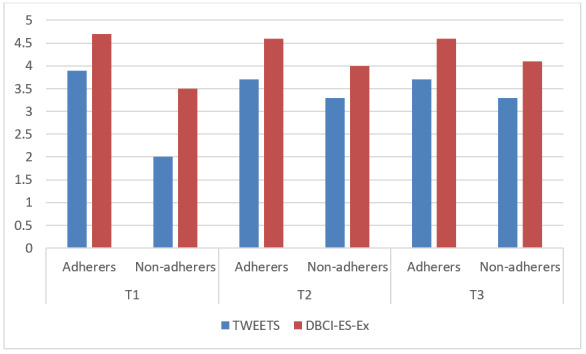
BACKGROUND: Engagement emerges as a predictor for the effectiveness of digital health interventions. However, a shared understanding of engagement is missing. Therefore, a new scale has been developed that proposes a clear definition and creates a tool to measure it. The TWente Engagement with Ehealth Technologies Scale (TWEETS) is based on a systematic review and interviews with engaged health app users. It defines engagement as a combination of behavior, cognition, and affect. OBJECTIVE: This paper aims to evaluate the psychometric properties of the TWEETS. In addition, a comparison is made with the experiential part of the Digital Behavior Change Intervention Engagement Scale (DBCI-ES-Ex), a scale that showed some issues in previous psychometric analyses. METHODS: In this study, 288 participants were asked to use any step counter app on their smartphones for 2 weeks. They completed online questionnaires at 4 time points: T0=baseline, T1=after 1 day, T2=1 week, and T3=2 weeks. At T0, demographics and personality (conscientiousness and intellect/imagination) were assessed; at T1-T3, engagement, involvement, enjoyment, subjective usage, and perceived behavior change were included as measures that are theoretically related to our definition of engagement. Analyses focused on internal consistency, reliability, and the convergent, divergent, and predictive validity of both engagement scales. Convergent validity was assessed by correlating the engagement scales with involvement, enjoyment, and subjective usage; divergent validity was assessed by correlating the engagement scales with personality; and predictive validity was assessed by regression analyses using engagement to predict perceived behavior change at later time points. RESULTS: The Cronbach alpha values of the TWEETS were .86, .86, and .87 on T1, T2, and T3, respectively. Exploratory factor analyses indicated that a 1-factor structure best fits the data. The TWEETS is moderately to strongly correlated with involvement and enjoyment (theoretically related to cognitive and affective engagement, respectively; P<.001). Correlations between the TWEETS and frequency of use were nonsignificant or small, and differences between adherers and nonadherers on the TWEETS were significant (P<.001). Correlations between personality and the TWEETS were nonsignificant. The TWEETS at T1 was predictive of perceived behavior change at T3, with an explained variance of 16%. The psychometric properties of the TWEETS and the DBCI-ES-Ex seemed comparable in some aspects (eg, internal consistency), and in other aspects, the TWEETS seemed somewhat superior (divergent and predictive validity). CONCLUSIONS: The TWEETS performs quite well as an engagement measure with high internal consistency, reasonable test-retest reliability and convergent validity, good divergent validity, and reasonable predictive validity. As the psychometric quality of a scale is a reflection of how closely a scale matches the conceptualization of a concept, this paper is also an attempt to conceptualize and define engagement as a unique concept, providing a first step toward an acceptable standard of defining and measuring engagement.
Overview
The claims and statistics of this paper haven’t been checked yet.
Free: it reads the open-access text and checks the first 5 claims that cite a source we can check. Create a free account to check every claim.
Integrity signals
Registry
Cites
Statistics
Figures
Verification
Claims the paper makes
The claims and statistics of this paper haven’t been checked yet.
Free: it reads the open-access text and checks the first 5 claims that cite a source we can check. Create a free account to check every claim.
Claims other papers make about this one
Each is checked against this paper’s own text: does it say what the citing paper says it does?
The source backs part of the claim, not all of it — or backs it for a different population, condition or comparison.
In the citing paper
“Cronbach alpha of the TWEETS has shown to be 0.86 in a Dutch sample [16].”
From Effect of blended and unguided online delivery of mindfulness-based cognitive therapy versus care as usual on distress among cancer patients and survivors: protocol for the three-arm parallel randomized controlled buddy trial (2023) · cites this paper as [16]
Experimental — accuracy not yet measuredThe cited source says what the claim attributes to it.
In the citing paper
“The TWEETS performs well as an engagement measure with high internal consistency, reasonable test-retest reliability and convergent validity, good divergent validity, and reasonable predictive validity (Kelders et al., 2020).”
From App-based intervention for reducing depressive symptoms in postpartum women: Protocol for a feasibility randomized controlled trial (2023) · cites this paper as Kelders et al., 2020
Self-check
Percentages, sums and reported differences re-computed from the paper’s own numbers.
The self-check needs the paper’s full text.
Citations
Cites
Making sense of cronbach’s alpha.
Tavakol, M., & Dennick, R. (2011) · International Journal of Medical Education · doi:10.5116/ijme.4dfb.8dfd · Cited by 15,126 · cited 1×
“9 was seen as good internal consistency [32,33].”
BackgroundMeasuring the involvement construct
Zaichkowsky, J. L. (1985) · Journal of Consumer Research · doi:10.1086/208520 · Cited by 6,013
Introduction to Classical and Modern Test Theory
Crocker, L. M., & Algina, J. J. (1986) · Cited by 5,090
Normality Tests for Statistical Analysis: A Guide for Non-Statisticians
Ghasemi, A., & Zahediasl, S. (2012) · International Journal of Endocrinology and Metabolism · doi:10.5812/ijem.3505 · Cited by 4,368 · cited 1×
“However, due to the relatively large sample size and the robustness of analyses such as Pearson correlations and analyses of variance (ANOVAs), parametric tests were used [29-31].”
A Brief Tutorial on the Development of Measures for Use in Survey Questionnaires
Hinkin, T. R. (1998) · Organizational Research Methods · doi:10.1177/109442819800100106 · Cited by 4,095 · cited 1×
“9 was seen as good internal consistency [32,33].”
BackgroundCHRISTIAN, M. S., GARZA, A. S., & SLAUGHTER, J. E. (2011) · Personnel Psychology · doi:10.1111/j.1744-6570.2010.01203.x · Cited by 2,903
McAuley, E., Duncan, T., & Tammen, V. V. (1989) · Research Quarterly for Exercise and Sport · doi:10.1080/02701367.1989.10607413 · Cited by 2,694
Personality Psychology in Europe
Vera-Bermudez, J., Raad, D. B., de Vries, J., García, A. M. P., Sanchez-Elvita, A., & Heck, G. V. (1997) · University of Groningen research database (University of Groningen / Centre for Information Technology) · Cited by 2,462
The Mini-IPIP Scales: Tiny-yet-effective measures of the Big Five Factors of Personality.
Donnellan, M. B., Oswald, F. L., Baird, B. M., & Lucas, R. E. (2006) · Psychological Assessment · doi:10.1037/1040-3590.18.2.192 · Cited by 2,442 · cited 2×
“Intellect/imagination—a person's preference for imaginative, artistic, and intellectual activities [26]—could also lead to participants using a DHI more, as many DHIs also involve some degree of intellectual activity.”
BackgroundMethodHibbard, J. H., & Greene, J. (2013) · Health Affairs · doi:10.1377/hlthaff.2012.1061 · Cited by 1,787
Cited by
Kaveladze, B. T., Wasil, A. R., Bunyi, J. B., Ramirez, V., & Schueller, S. M. (2022) · JMIR Human Factors · doi:10.2196/30766 · Cited by 104
Forbes, A., Keleher, M. R., Venditto, M., & DiBiasi, F. (2023) · Journal of Medical Internet Research · doi:10.2196/43727 · Cited by 94
Bijkerk, L. E., Oenema, A., Geschwind, N., & Spigt, M. (2022) · International Journal of Behavioral Medicine · doi:10.1007/s12529-022-10086-6 · Cited by 94
Targeting subjective engagement in experimental therapeutics for digital mental health interventions
Graham, A. K., Kwasny, M., Lattie, E. G., Greene, C. J., Gupta, N., Reddy, M. C., & Mohr, D. C. (2021) · Internet Interventions · doi:10.1016/j.invent.2021.100403 · Cited by 60
Understanding users’ perspectives on mobile apps for anxiety management
Balaskas, A., Schueller, S. M., Cox, A. L., & Doherty, G. J. (2022) · Frontiers in Digital Health · doi:10.3389/fdgth.2022.854263 · Cited by 65
Metadata
- Authors
- Kelders, S. M., Kip, H., & Greeff, J.
- Affiliations
- North-West University (ZA)
- University of Twente (NL)
- Corresponding author
- Kelders, Saskia Marion
- Venue
- Journal of Medical Internet Research
- Publisher
- JMIR Publications Inc.
- Published
- 2020-10-06
- Volume
- 22
- Issue
- 10
- Pages
- e17757
- ISSN
- 1438-8871 (ISSN-L)
- PMC
- PMC7576538
- OpenAlex
- W3044695116
- Cited by
- 88
- References
- 40
- Citations by year
- 2026: 22 · 2025: 16 · 2024: 18 · 2023: 15 · 2022: 7 · 2021: 10
- FWCI
- 8.35
- Type
- journal article
- Language
- en
- Open access
- gold
- doi.org
- Licence
- cc-by
- Locations
- Journal of Medical Internet Research (publishedVersion, cc-by)
- PubMed Central (publishedVersion, cc-by)
- PubMed (publishedVersion)
- University of Twente Research Information (publishedVersion, cc-by)
- DOAJ (DOAJ: Directory of Open Access Journals) (submittedVersion, cc-by-sa)
- University of Twente Research Information (submittedVersion, cc-by)
- Funders
- Nederlandse Organisatie voor Wetenschappelijk Onderzoek (451-17-031)
- Topics
- Health Sciences › Health Professions › General Health Professions › Mobile Health and mHealth Applications
- Social Sciences › Psychology › Applied Psychology › Digital Mental Health Interventions
- Physical Sciences › Computer Science › Human-Computer Interaction › Innovative Human-Technology Interaction
- Keywords
- engagement, eHealth technologies, digital health interventions, tweets, scale development, psychometric properties, involvement, enjoyment, adherence, behaviour change interventions, mobile application, factor structure, convergent validity, predictive validity, conscientiousness, personality
- MeSH terms
- Factor Analysis, Statistical, Female, Humans, Male, Psychometrics, Surveys and Questionnaires, Reproducibility of Results, Telemedicine
About these checks
Registry, retraction, Cites and statistics results are computed, not judged, with one exception: a printed reference that no index lists is read once by a model before it counts as a citation error. Claims are extracted by a model and kept only when their quote appears verbatim in the text; each cited source is then checked, with a model’s help, for whether it says what the claim relies on. Those verdicts can be wrong — read the claim’s quote and the cited source before relying on one.
Statistics and arithmetic are recomputed, not judged.
Confidence bands are shown only for fields calibrated on our annotated test set. None is calibrated yet, so no band is shown.
What counts as a claim ›How we measure confidence ›How we check this ›
Are you an author, or do you see a problem with this page? Request a review
How to cite
Cite CoChat for the checks on this page, and the paper for its own findings.
- This page
- CoChat. (2026). Citation check: Psychometric Evaluation of the TWente Engagement with Ehealth Technologies Scale (TWEETS): Evaluation Study. https://app.cochat.ai/papers/10.2196/17757
- The paper
- Kelders, S. M., Kip, H., & Greeff, J. (2020). Psychometric Evaluation of the TWente Engagement with Ehealth Technologies Scale (TWEETS): Evaluation Study. Journal of Medical Internet Research. https://doi.org/10.2196/17757
Data sources
Bibliographic data: Semantic Scholar, OpenAlex, Crossref.
Contains information from the Semantic Scholar Academic Graph Datasets, made available under the ODC Attribution License (ODC-BY 1.0).
Semantic Scholar’s data is described in: Kinney, R., et al. (2023). The Semantic Scholar Open Data Platform. arXiv:2301.10140.
