

The use of artificial intelligence in psychotherapy: development of intelligent therapeutic systems
The DOI matches its Crossref record; 9 of the 9 references it cites were found in a registry or an index.
Abstract
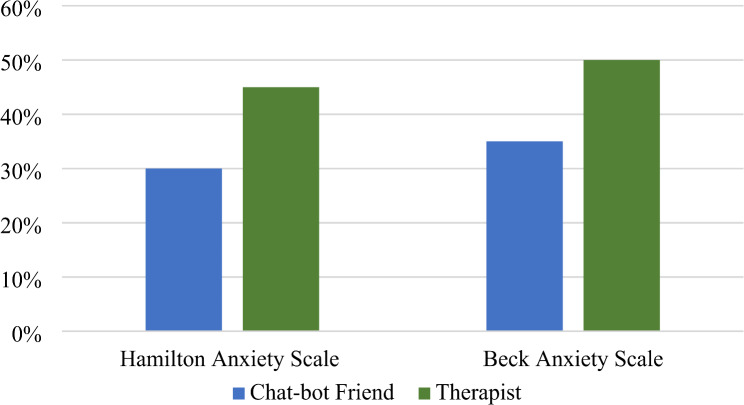
BACKGROUND: The increasing demand for psychotherapy and limited access to specialists underscore the potential of artificial intelligence (AI) in mental health care. This study evaluates the effectiveness of the AI-powered Friend chatbot in providing psychological support during crisis situations, compared to traditional psychotherapy. METHODS: A randomized controlled trial was conducted with 104 women diagnosed with anxiety disorders in active war zones. Participants were randomly assigned to two groups: the experimental group used the Friend chatbot for daily support, while the control group received 60-minute psychotherapy sessions three times a week. Anxiety levels were assessed using the Hamilton Anxiety Rating Scale and Beck Anxiety Inventory. T-tests were used to analyze the results. RESULTS: Both groups showed significant reductions in anxiety levels. The control group receiving traditional therapy had a 45% reduction on the Hamilton scale and a 50% reduction on the Beck scale, compared to 30% and 35% reductions in the chatbot group. While the chatbot provided accessible, immediate support, traditional therapy proved more effective due to the emotional depth and adaptability provided by human therapists. The chatbot was particularly beneficial in crisis settings where access to therapists was limited, proving its value in scalability and availability. However, its emotional engagement was notably lower compared to in-person therapy. CONCLUSIONS: The Friend chatbot offers a scalable, cost-effective solution for psychological support, particularly in crisis situations where traditional therapy may not be accessible. Although traditional therapy remains more effective in reducing anxiety, a hybrid model combining AI support with human interaction could optimize mental health care, especially in underserved areas or during emergencies. Further research is needed to improve AI's emotional responsiveness and adaptability.
Overview
The claims and statistics of this paper haven’t been checked yet.
Free: it reads the open-access text and checks the first 5 claims that cite a source we can check. Create a free account to check every claim.
Integrity signals
Registry
Cites
Statistics
Figures
Verification
Claims the paper makes
The claims and statistics of this paper haven’t been checked yet.
Free: it reads the open-access text and checks the first 5 claims that cite a source we can check. Create a free account to check every claim.
Claims other papers make about this one
Each is checked against this paper’s own text: does it say what the citing paper says it does?
The source backs part of the claim, not all of it — or backs it for a different population, condition or comparison.
In the citing paper
“For many users, especially those facing isolation or psychological distress, these emotionally intelligent systems offer the promise of connection (Jiang et al., 2022; Spytska, 2025).”
From Emotional AI and the rise of pseudo-intimacy: are we trading authenticity for algorithmic affection? (2025) · cites this paper as Spytska, 2025
Experimental — accuracy not yet measured
Self-check
Percentages, sums and reported differences re-computed from the paper’s own numbers.
The self-check needs the paper’s full text.
Citations
Cites
ELIZA—a computer program for the study of natural language communication between man and machine
Weizenbaum, J. (1966) · Communications of the ACM · doi:10.1145/365153.365168 · Cited by 4,452 · cited 1×
“Technological innovation has had a tremendous impact on the area of psychology, particularly with the development of the first chatbot by psychologist Weizenbaum [17].”
Li, H., Zhang, R., Lee, Y.-C., Kraut, R. E., & Mohr, D. C. (2023) · npj Digital Medicine · doi:10.1038/s41746-023-00979-5 · Cited by 598 · cited 2×
“Li et al. [6] also emphasised the effectiveness of conversational AI bots in delivering real-time support, complementing rather than replacing traditional treat-ment.”
(2014) · doi:10.5555/2615731.2617415 · Cited by 553
Schaeuffele, C., Meine, L. E., Schulz, A., Weber, M. C., Moser, A., Paersch, C., Recher, D., Boettcher, J., Renneberg, B., Flückiger, C., et al. (2024) · Nature Human Behaviour · doi:10.1038/s41562-023-01787-3 · Cited by 91 · cited 1×
“Schaeuffele et al. [38] discovered that, while AI-driven therapies are useful in the short term, they may not provide the same long-term advantages as transdiagnostic CBT, which has been shown to sustain emotional stability over time.”
Clark, D. M., Wild, J., Warnock-Parkes, E., Stott, R., Grey, N., Thew, G., & Ehlers, A. (2023) · Psychological Medicine · doi:10.1017/s0033291722002008 · Cited by 88 · cited 1×
“This conclusion is consistent with Clark et al. [45], who demonstrated that online cognitive therapy may greatly expand therapists’ reach, boosting treatment outcomes in disorders such as social anxiety disorder.”
Artificial intelligence for psychotherapy: a review of the current state and future directions
Beg, M. J., Verma, M., M., V. C. K. M., & Verma, M. K. (2025) · Indian Journal of Psychological Medicine · doi:10.1177/02537176241260819 · Cited by 82 · cited 1×
“The use of AI technology in medicine is growing more popular, particularly for physical health, although its use in mental health remains limited [14].”
Detecting presence of PTSD using sentiment analysis from text data
Sawalha, J., Yousefnezhad, M., Shah, Z., Brown, M. R. G., Greenshaw, A. J., & Greiner, R. (2022) · Frontiers in Psychiatry · doi:10.3389/fpsyt.2021.811392 · Cited by 58 · cited 1×
“Ellie, a virtual therapist created by the Institute of Creative Technologies, uses voice recognition and computer vision to evaluate mental health during virtual consultations [25].”
Green, E. P., Lai, Y., Pearson, N., Rajasekharan, S., Rauws, M., Joerin, A., Kwobah, E., Musyimi, C., Jones, R. M., Bhat, C., et al. (2020) · doi:10.2196/preprints.17895 · Cited by 49 · cited 1×
“Green et al. [37] revealed that AI systems might dramatically increase access to mental health treatment in resource-constrained settings, similar to what the Friend chatbot did in this study for participants in conflict zones.”
Technological Interventions for Pain Management
Suso-Ribera, C., Castilla, D., Martínez-Borba, V., Jaén, I., Botella, C., Baños, R. M., & García-Palacios, A. (2022) · Comprehensive Clinical Psychology · doi:10.1016/b978-0-12-818697-8.00009-1 · Cited by 6
Research works printed but not linked: 42
- Mosquera FEC, Guevara-Montoya MC, Serna-Ramirez V, Liscano Y. Neuroinflammation and Schizophrenia: new therapeutic strategies through Psychobiotics, Nanotechnology, and Artificial Intelligence (AI). J Pers Med. 2024;14(4):391. 10.3390/jpm14040391 38673018 PMC11051547 · DOI
- Prescott J, Barnes S. Artificial intelligence positive psychology and therapy. Couns Psychother Res. 2024;24:843–5. 10.1002/capr.12784 · DOI
- Pandey A, Misra M. Artificial Intelligence in Mental Health Care. Artificial Intelligence and Machine Learning in Healthcare. Singapore: Springer. 2023;117–28. 10.1007/978-981-99-6472-7_8 · DOI
- Kang C, Novak D, Urbanova K, Cheng Y, Hu Y. Domain-specific improvement on psychotherapy chatbot using assistant. In: IEEE International Conference on Acoustics, Speech, and Signal Processing Workshops. Seoul: IEEE. 2024;351-5. 10.1109/ICASSPW62465.2024.10626529 · DOI
- Zheng G, Zheng W, Zhang Y, Wang J, Chen M, Wang Y, Cai T, Yao Z, Hu B. An attention-based multi-modal MRI fusion model for major depressive disorder diagnosis. J Neural Eng. 2023;20(6):066005. 10.1088/1741-2552/ad038c 37844568 · DOI
- Wang J, Li T, Sun Q, Guo Y, Yu J, Yao Z, Hou N, Hu B. Automatic diagnosis of major depressive disorder using a high- and low-frequency feature fusion framework. Brain Sci. 2023;13(11):1590. 10.3390/brainsci13111590 38002549 PMC10670347 · DOI
- Poalelungi DG, Musat CL, Fulga A, Neagu M, Neagu AI, Piraianu AI, Fulga I. Advancing patient care: how artificial intelligence is transforming healthcare. J Pers Med. 2023;13(8):1214. 10.3390/jpm13081214 37623465 PMC10455458 · DOI · Paper page
- Ooi PB, Wilkinson G. Enhancing ethical codes with artificial intelligence governance– a growing necessity for the adoption of generative AI in counselling. Br J Guid Couns. 2024;1–15. 10.1080/03069885.2024.2373180 · DOI
- Haber Y, Levkovich I, Hadar-Shoval D, Elyoseph Z. The artificial third: a broad view of the effects of introducing generative artificial intelligence on psychotherapy. JMIR Ment Health. 2024;11:e54781. 10.2196/54781 38787297 PMC11137430 · DOI · Paper page
- Ronneberg CR, Lv N, Ajilore OA, Kannampallil T, Smyth J, Kumar V, Barve A, Garcia C, Dosala S, Wittels N, Xiao L, Aborisade G, Zhang A, Tang Z, Johnson J, Ma J. Study of a PST-trained voice-enabled artificial intelligence counselor for adults with emotional distress (SPEAC-2): design and methods. Contemp Clin Trials. 2024;142:107574. 10.1016/j.cct.2024.107574 38763307 PMC12668796 · DOI
- Alimour SA, Alnono E, Aljasmi S, El Farran H, Alqawasmi AA, Alrabeei MM, Shwedeh F, Aburayya A. The quality traits of artificial intelligence operations in predicting mental healthcare professionals’ perceptions: a case study in the psychotherapy division. J Auton Intell. 2024;7(4):1–17. 10.32629/jai.v7i4.1438 · doi:10.32629/jai.v7i4.1438
- Plakun EM. Psychotherapy and artificial intelligence. J Psychiatr Pract. 2023;29(6):476–9. 10.1097/PRA.0000000000000748 37948172 · DOI
- Huțul TD, Popescu A, Karner-Huțuleac A, Holman AC, Huțul A. Who’s willing to lay on the virtual couch? Attitudes, anthropomorphism and need for human interaction as factors of intentions to use chatbots for psychotherapy. Couns Psychother Res. 2024;00:1–10. 10.1002/capr.12794 · DOI
- Klooster D. Evaluating robustness of brain stimulation biomarkers for depression: a systematic review of magnetic resonance imaging and electroencephalography studies. Biol Psychiatry. 2024;95(6):553–63. 10.1016/j.biopsych.2023.09.009 37734515 · DOI
- Alhuwaydi AM. Exploring the role of artificial intelligence in mental healthcare: current trends and future directions– A narrative review for a comprehensive insight. Risk Manag Healthc Policy. 2024;17:1339–48. 10.2147/RMHP.S461562 38799612 PMC11127648 · DOI
- Bocheliuk V, Panov M, Nechyporenko V, Pozdniakova-Kyrbiatieva E. Formation of mental set of subjects of higher education institution for management by the correction game method. Astra Salvens. 2019;7(13):275–88.
- Borna S, Maniaci MJ, Haider CR, Gomez-Cabello CA, Pressman SM, Haider SA, Demaerschalk BM, Cowart JB, Forte AJ. Artificial intelligence support for informal patient caregivers: a systematic review. Bioengineering. 2024;11(5):483. 10.3390/bioengineering11050483 38790350 PMC11118398 · DOI
- Durden E, Pirner MC, Rapoport SJ, Williams A, Robinson A, Forman-Hoffman VL. Changes in stress, burnout, and resilience associated with an 8-week intervention with relational agent Woebot. Internet Interv. 2023;33:100637. 10.1016/j.invent.2023.100637 37635948 PMC10457544 · DOI · Paper page
- Tahan M, Saleem T. An overview of the application of artificial intelligence in psychotherapy: a systematic review. Neuropsychiatr Neuropsychol. 2024;19(1):28–39. 10.5114/nan.2024.141887 · DOI
- Kryshtanovych M, Kryshtanovych S, Stepanenko L, Brodiuk Y, Fast A. Methodological approach to determining the main factors for the development of creative thinking in students of creative professions. Creat Stud. 2021;14(2):391–404. 10.3846/cs.2021.14806 · DOI
- Bocheliuk V, Shevtsov A, Pozdniakova O, Panov M, Zhadlenko I. Effectiveness of Psycho-Correctional methods and technologies in Work with children who have autism. Syst Rev J Intel Disabil– Diagn Treat. 2023;11(1):10–20. 10.6000/2292-2598.2023.11.01.2 · doi:10.6000/2292-2598.2023.11.01.2
- Efremov A. The fear primacy hypothesis in the structure of Emotional States: a systematic literature review. Psychol Rep. 2025. 10.1177/00332941241313106 39772887 · DOI
- Romaniuk O. Expression and interpretation of attraction and interpersonal intimacy: a comparative study of female nonverbal behaviour. Anal Univer Craiova - Ser Stiinte Filolog Ling. 2021;43(1–2):220–37.
- Romaniuk O, Yavorska L. Complimenting behaviour in young adults’ first impression scripts. Anal Univer Craiova - Ser Stiinte Filolog Ling. 2022;44(1–2):168–87. 10.52846/aucssflingv.v44i1-2.58 · doi:10.52846/aucssflingv.v44i1-2.58
- Shaituro O, Holodnyk Y, Pevko S, Khan O. Legal awareness as a factor in preventing illegal (deviant) behavior. Dialog Hum Soc Sci. 2025;3(1):9–16. 10.71261/dhss/3.1.9.16 · doi:10.71261/dhss/3.1.9.16
- Shamne A, Dotsevych T, Akimova A. Psychosemantic peculiarities of promotional videos perception. Psycholing. 2019;25(1):384–408. 10.31470/2309-1797-2019-25-1-384-408 · DOI
- Sokól-Szawlowska M. Paternal perinatal depression: cases. Psychol Polska. 2020;54(6):1123–35. 10.12740/PP/110610 33740800 · DOI
- Hoffman V, Flom M, Mariano TY, Chiauzzi E, Williams A, Kirvin-Quamme A, Pajarito S, Durden E, Perski O. User engagement clusters of an 8-week digital mental health intervention guided by a relational agent (woebot): exploratory study. J Med Internet Res. 2023;25:e47198. 10.2196/47198 37831490 PMC10612009 · DOI
- Sedlakova J, Trachsel M. Conversational artificial intelligence in psychotherapy: a new therapeutic tool or agent? Am J Bioeth. 2022;23(5):4–13. 10.1080/15265161.2022.2048739 35362368 · DOI · Paper page
- Verma A, Jain P, Kumar T. An effective depression diagnostic system using speech signal analysis through deep learning methods. Int J Artif Intell Tools. 2023;32(2):2340004. 10.1142/S0218213023400043 · doi:10.1142/s0218213023400043
- Wahid N, Sajid IA. Factors contributing to On-campus drug use among students: a study of the boys’ hostels in the University of Peshawar. Rev Law Soc Sci. 2025;3(1):23–38. 10.71261/rlss/3.1.23.38 · doi:10.71261/rlss/3.1.23.38
- American Psychological Association. Summary of the clinical practice guideline for the treatment of depression across three age cohorts. Am Psychol. 2022;77(6):770–80. 10.1037/amp0000904 34843274 · doi:10.1037/amp0000904
- Lindqvist Bagge AS, Lekander M, Olofsson Bagge R, Carlander A. Mental health, stress, and well-being measured before (2019) and during (2020) COVID-19: A Swedish socioeconomic population-based study. Psychol Health. 2023;1–18. 10.1080/08870446.2023.2257747 37728316 · DOI
- Dingle GA, Han R, Alhadad SS, Beckman E, Bentley SV, Gomersall SR, Hides L, Maccallum F, McKimmie BM, Rossa K, Smith SS, Walter ZC, Williams E, Wright O. Data from four consecutive cohorts of students in Australia (2019–2022) show the impact of the COVID-19 pandemic on domestic and international university students’ mental health. Aust N Z J Psychiatry. 2024;58(6):528–36. 10.1177/00048674241233111 38383969 PMC11128135 · DOI
- Lee M, Jeong S, Kim CS, Yang YJ. Analysis of health behavior, mental health, and nutritional status among Korean adolescents before and after COVID-19 outbreak: based on the 2019–2020 Korea National Health and Nutrition Examination Survey. J Nutr Health. 2023;56(6):667–82. 10.4163/jnh.2023.56.6.667 · DOI
- Adepoju OE, Valdez MR. Trends in mental health utilization before and during the COVID-19 pandemic: federally qualified health centers as a case study. Popul Health Manag. 2023;26(3):143–8. 10.1089/pop.2023.0006 37184901 · DOI
- Richards D. Artificial intelligence and psychotherapy: a counterpoint. Couns Psychother Res. 2024;1–6. 10.1002/capr.12758 · DOI
- Sufyan NS, Fadhel FH, Alkhathami SS, Mukhadi JYA. Artificial intelligence and social intelligence: preliminary comparison study between AI models and psychologists. Front Psychol. 2024;15:1353022. 10.3389/fpsyg.2024.1353022 38379623 PMC10878391 · DOI
- Upadhyay DK, Mohapatra S, Singh NK. An early assessment of persistent depression disorder using machine learning algorithm. Multimed Tools Appl. 2023;83:49149–71. 10.1007/s11042-023-17369-4 · DOI
- Wang C. Application of MPP database and artificial intelligence system in online evaluation of college students’ mental health. Prev Med. 2023;173:107580. 10.1016/j.ypmed.2023.107580 37352939 · DOI
- Aafjes-van Doorn K. Feasibility of artificial intelligence-based measurement in psychotherapy practice: patients’ and clinicians’ perspectives. Couns Psychother Res. 2024;1–11. 10.1002/capr.12800 · DOI
- Bhatt S. Digital mental health: role of artificial intelligence in psychotherapy. Ann Neurosci. 2024. 10.1177/09727531231221612 39544658 PMC11559931 · DOI
Cited by
Emotional AI and the rise of pseudo-intimacy: are we trading authenticity for algorithmic affection?
Babu, J., Joseph, D., Kumar, R. M., Alexander, E., Sasi, R., & Joseph, J. (2025) · Frontiers in Psychology · doi:10.3389/fpsyg.2025.1679324 · Cited by 76
The algorithmic self: how AI is reshaping human identity, introspection, and agency
Joseph, J. (2025) · Frontiers in Psychology · doi:10.3389/fpsyg.2025.1645795 · Cited by 63
“The rise of emotionally intelligent AI solutions, such as chatbots and therapeutic apps, has given rise to a system in which users depend on algorithms for emotional navigation, moral decision-making, and even self-reflection (Spytska, 2025).”
A roadmap for evaluating moral competence in large language models
Haas, J., Bridgers, S., Manzini, A., Henke, B., May, J., Levine, S., Weidinger, L., Shanahan, M., Lum, K., Gabriel, I., et al. (2026) · Nature · doi:10.1038/s41586-025-10021-1 · Cited by 25
Encountering Generative AI: Narrative Self-Formation and Technologies of the Self Among Young Adults
Kvietkute, D., & Ness, I. J. (2026) · Societies · doi:10.3390/soc16010026 · Cited by 5
“A third strand concerns the delegation of introspection—the process whereby self-awareness, traditionally cultivated through journaling or therapy, is outsourced to algorithmic systems [6,7].”
Nan, J., Purpura, S., Jaiswal, S., Afshar, H., Maric, V., Manchanda, J. K., Taylor, C. T., Ramanathan, D., & Mishra, J. (2026) · NPP—Digital Psychiatry and Neuroscience · doi:10.1038/s44277-026-00062-3 · Cited by 1
Metadata
- Authors
- Spytska, L.
- Venue
- BMC Psychology
- Published
- 2025-02-28
- Volume
- 13
- Issue
- 1
- ISSN
- 2050-7283
- PMC
- PMC11871827
- Cited by
- 113
- References
- 9
- Language
- en
- Licence
- creativecommons.org/licenses/by-nc-nd/4.0 (tdm)
- creativecommons.org/licenses/by-nc-nd/4.0 (vor)
About these checks
Registry, retraction, Cites and statistics results are computed, not judged, with one exception: a printed reference that no index lists is read once by a model before it counts as a citation error. Claims are extracted by a model and kept only when their quote appears verbatim in the text; each cited source is then checked, with a model’s help, for whether it says what the claim relies on. Those verdicts can be wrong — read the claim’s quote and the cited source before relying on one.
Statistics and arithmetic are recomputed, not judged.
Confidence bands are shown only for fields calibrated on our annotated test set. None is calibrated yet, so no band is shown.
What counts as a claim ›How we measure confidence ›How we check this ›
Are you an author, or do you see a problem with this page? Request a review
Data sources
Bibliographic data: Semantic Scholar, OpenAlex, Crossref.
Contains information from the Semantic Scholar Academic Graph Datasets, made available under the ODC Attribution License (ODC-BY 1.0).
Semantic Scholar’s data is described in: Kinney, R., et al. (2023). The Semantic Scholar Open Data Platform. arXiv:2301.10140.
