

Students’ struggle with digital addiction: the truth of brain rot
Open accessThe DOI matches its Crossref record; 50 of the 51 references it cites were found in a registry or an index; 12 of the 26 sources its claims cite were checked for support.
Abstract
BACKGROUND: Due to the high level of digital addiction, the term brain rot was chosen as the word of the year for 2024 determined by a public vote conducted by Oxford University, and it has been used by experts to express the effect of consuming an excessive amount of low-quality online content, especially on social media. This study investigates the prevalence of brain rot among higher education students in a faculty of education, explores its underlying causes, examines its implications for education, and identifies potential preventive measures. METHODS: A qualitative case study design was employed to gain an in-depth understanding of the phenomenon. The study group comprised 113 students enrolled in various departments of the Faculty of Education at a public university in Türkiye during the 2024 to 2025 academic year. Participants were selected using criterion sampling, a purposive method designed to identify information-rich cases. Data were collected through observations, semi-structured interviews, and document analysis, and analyzed using content analysis. RESULTS: The findings indicate that nearly all participants experienced symptoms of brain rot, which were attributed to emotional factors, habitual behaviors, and environmental, social, and cognitive influences. It has been determined that brain rot primarily causes students to experience attention deficits, learning difficulties, mental fog, diminished cognitive performance, reduced academic achievement, weakened social relationships, reluctance to attend school or engage in educational activities, and decreased time efficiency. Participants recommended several strategies to mitigate brain rot, including educational interventions, environmental modifications, digital usage regulation, digital detox, and personal self-regulation practices. CONCLUSIONS: The results highlight how students’ experiences of brain rot are reflected in their educational lives and underscore the measures that need to be taken to prevent its occurrence.
Overview
CoChat Summary
TL;DR
This qualitative case study of 113 pre-service teachers at one Turkish faculty of education found that all participants reported brain-rot symptoms tied to digital addiction, with emotional, habitual, environmental, social, and cognitive causes. Participants linked brain rot to attention deficits, learning difficulties, reduced academic achievement, weakened social relationships, and time loss, and suggested education, environmental changes, usage control, and personal alternatives.
Key findings
- All 113 participants experienced symptoms of brain rot; average daily unproductive screen time was 6 h 30 min versus 32 min 30 s productive, while the 30 interviewed students reported 4 h 38 min unproductive versus 1 h 36 min productive. One six-day sample showed 37 h unproductive screen time versus 1 h 50 min productive.
- The most prominent perceived causes were emotional: boredom/desire for relaxation (documents f=30, interviews f=12) and avoiding tasks/desire for inaction (28/10), followed by habitual, environmental, social, and cognitive causes.
- Educational impacts included attention deficiency (92 documents/74 interviews), inability to focus on lessons (102/19), cognitive decline (57/5), mental fog (57/5), decline in academic success (16/4), weakened social relationships (9/13), and time loss (24/11).
- Suggested prevention strategies included developing hobbies (59/12), setting time limitations (31/6), digital addiction awareness training and education on the harms of brain rot (each 29/12), and digital detox (7/1).
Methods
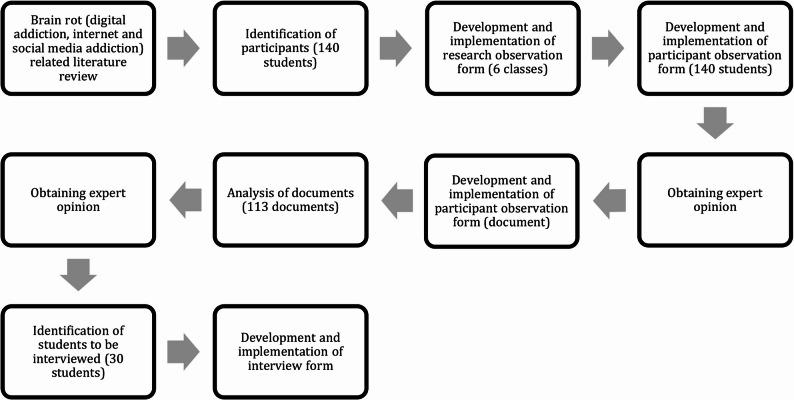
- Qualitative case study using criterion sampling; 113 pre-service teachers enrolled in six departments of the Faculty of Education at Kahramanmaraş Sütçü İmam University, a public university in Türkiye, during the 2024–2025 academic year (72 female, 41 male).
- Data came from observations (140 distributed forms, 113 valid), participant documents/reflective narratives from 113 students, and semi-structured interviews with 30 students selected to data saturation; analysis used content analysis and inductive coding.
- Inter-coder agreement was 0.91 using Miles and Huberman’s formula; triangulation and Lincoln and Guba’s credibility, transferability, dependability, and confirmability strategies were used.
Limitations
- Stated: the study was conducted at only one university in Türkiye, limiting generalizability; self-reported screen-time data may be biased; the researcher’s active observation may have introduced subjective influence; and only 30 of 113 participants were interviewed, limiting detailed qualitative insight into those not interviewed.
- Evident from the text: the paper notes that screen-time reported in the participant observation form differed from screen time reported in interviews, indicating possible self-report inconsistency; the qualitative case-study design cannot establish causality or broader prevalence.
Model-written summary. Check it against the paper before relying on it.
Integrity signals
Registry
Cites
Statistics
Figures
Verification
Claims the paper makes
8 Valid · 4 Not valid · 16 Not checked · 111 Own results and interpretations
The cited sources that could be checked couldn’t confirm or dispute this claim.
In the paper
“Brain rot is associated with broader constructs such as digital, internet, and social media addiction [26–28].”
§ Students’ struggle with digital addiction: the truth of brain rot > Introduction
What the sources say
- Not checked — no full text of the sourcecites [26] Griffiths M. A ‘components’ model of addiction within a biopsychosocial framework. J Subst Use. 2005;10(4):191–7. 10.1080/14659890500114359. source
- Not checked — no full text of the sourcecites [27] Young KS. Internet addiction: the emergence of a new clinical disorder. Cyberpsychol Behav. 1998;1(3):237–44. 10.1089/cpb.1998.1.237. source
- Could not verifycites [28] Griffiths MD, Szabo A. Is excessive online usage a function of medium or activity? An empirical pilot study. J Behav Addict. 2014;3(1):74–7. 10.1556/JBA.2.2013.016. 25215216 PMC4117278 sourceExperimental — accuracy not yet measured
The Introduction and Discussion discuss Internet addiction and addiction to specific online activities, including social networking. Neither those passages nor searches for “brain rot” and related terms address whether brain rot is associated with these constructs. (LLM, conf=0.76)
plainstates an association- Asserted: passes — The authors put it forward as true.
- Checkable: passes — It can be checked against evidence.
- Load-bearing: passes — The paper’s conclusions depend on it.
- Based: passes — The paper gives a reason why it holds.
The cited sources that could be checked couldn’t confirm or dispute this claim.
In the paper
“At the same time, brain rot is an important problem that also affects the educational process [16].”
§ Students’ struggle with digital addiction: the truth of brain rot > Introduction
What the sources say
- Could not verifycites [16] Rathakrishnan B, Bikar Singh SS, Kamaluddin MR, Yahaya A, Mohd Nasir MA, Ibrahim F, et al. Smartphone addiction and sleep quality on academic performance of university students: an exploratory research. Int J Environ Res Public Health. 2021;18(16):8291. 10.3390/ijerph18168291. 34444042 PMC8394437 sourceExperimental — accuracy not yet measured
The Introduction and Conclusions link smartphone addiction and poor sleep quality to students’ academic performance. A search for “brain rot” found no passage identifying it with either condition or addressing its effect on education, so the cited paper does not verify the claim about brain rot. (LLM, conf=0.76)
plainstates a cause- Asserted: passes — The authors put it forward as true.
- Checkable: passes — It can be checked against evidence.
- Load-bearing: passes — The paper’s conclusions depend on it.
- Based: passes — The paper gives a reason why it holds.
- Could not verify
The cited sources support only part of this claim — read each source’s verdict below.
In the paper
“Uğurlu [44] further confirmed that increased free time is associated with greater risk of social media addiction.”
§ Students’ struggle with digital addiction: the truth of brain rot > Discussion
What the sources say
- Partly supportedcites [44] Uğurlu A. Predictive power of leisure boredom on social media addiction in university students. Mediterr J Sport Sci. 2023;6(3):939–51.. sourceExperimental — accuracy not yet measured
The Abstract and Discussion/Result (p. of our copy) report that among 453 university students, Leisure Boredom Scale scores correlated positively with Social Media Addiction Scale scores (virtual tolerance–boredom r = .33; virtual communication–boredom r = .27) and that regression showed leisure boredom significantly predicted social media addiction — so an association between a leisure/free-time factor and greater social-media-addiction risk is supported. However, the source measured the PERCEPTION of boredom in free time (Iso-Ahola & Weissinger's LBS), not the amount of free time: the Personal Information Form covered only age, gender and regular physical-activity participation, and no hours-of-free-time variable appears anywhere. The claim's phrasing 'increased free time' therefore attributes a quantity-of-leisure finding that this paper does not report; its closest statement is that participants 'who do not see their free time as a part of their quality of life are connected to the internet'. (LLM, conf=0.78)
boostedstates an association- Asserted: passes — The authors put it forward as true.
- Checkable: passes — It can be checked against evidence.
- Load-bearing: unclear — It is unclear whether the paper’s conclusions depend on it.
- Based: passes — The paper gives a reason why it holds.
- Partly supported
Every source the paper cites for this claim was checked and supports it.
In the paper
“Kandasamy et al. [17] identified similar effects in their work on internet addiction, highlighting mental, emotional, and physical consequences”
§ Students’ struggle with digital addiction: the truth of brain rot > Discussion
What the sources say
- Supportedcites [17] Kandasamy S, Buhari AM, Janaki S. A study on anxiety disorder among college students with internet addiction. Int J Community Med Public Health. 2019;6(4):1695–700. 10.18203/2394-6040.ijcmph20191407. source
The Discussion reports anxious mood, fear, and tension among students with internet addiction. The Conclusion describes psychosomatic effects that compromise young people's mental and physical well-being, supporting the claim's mental, emotional, and physical dimensions. (LLM, conf=0.88)
plainstates an association- Asserted: passes — The authors put it forward as true.
- Checkable: passes — It can be checked against evidence.
- Load-bearing: unclear — It is unclear whether the paper’s conclusions depend on it.
- Based: passes — The paper gives a reason why it holds.
- Supported
A result the paper reports from its own data — it cites no other source for it, so there is none to check. The quote shows it is in the paper.
In the paper
“some participants reported going online initially to connect with others, only to find themselves overwhelmed or distracted (K20).”
§ Students’ struggle with digital addiction: the truth of brain rot > Findings > Causes of participants’ brain rot
plainstates a cause- Asserted: passes — The authors put it forward as true.
- Checkable: passes — It can be checked against evidence.
- Load-bearing: unclear — It is unclear whether the paper’s conclusions depend on it.
- Based: passes — The paper gives a reason why it holds.
- Rests on an assumption not shown here.
53 more claims
Create a free account to see all 139 claims and to verify the 1 reference still open.
- It may state two separate claims as one. 44
- Probably not a substantial claim. 40
- The quote only partly states this claim. 5
Self-check
Percentages, sums and reported differences re-computed from the paper’s own numbers.
Each contradiction between two passages listed here was confirmed by an independent check.
Rated minor: it would not touch a result — a value no result rests on, a p-value that stays on the same side of the significance level, or a conflict that is clerical, resolved elsewhere in the paper, or outside its own findings.
In the paper
§ Students’ struggle with digital addiction: the truth of brain rot > Discussion
“Wibowo et al. [59] found that individuals with higher self-regulation are less susceptible to digital addiction”
§ Students’ struggle with digital addiction: the truth of brain rot > References
“71. Wibowo MRS, Wahidah FRN, Agil HM. Self-regulation and tendency of smartphone addiction among college students. J Ilm Psikol Terap. 2024;12(1):33–8. 10.22219/jipt.v12i1.28638.”
Rated minor: it would not touch a result — a value no result rests on, a p-value that stays on the same side of the significance level, or a conflict that is clerical, resolved elsewhere in the paper, or outside its own findings.
In the paper
§ Students’ struggle with digital addiction: the truth of brain rot > Findings > Findings on the effect of the participants’ brain rot on their education
“These observations were corroborated by classroom monitoring on 22 October 2025, during which students remained physically inactive, using their phones throughout an extended class break.”
§ Students’ struggle with digital addiction: the truth of brain rot > Method > Validity and reliability
“The researcher engaged with participants from September 2024 to March 2025, observing them in natural settings and collecting in-depth data.”
Rated minor: it would not touch a result — a value no result rests on, a p-value that stays on the same side of the significance level, or a conflict that is clerical, resolved elsewhere in the paper, or outside its own findings.
In the paper
§ Students’ struggle with digital addiction: the truth of brain rot > Method > Study group
“Participants’ identities were anonymized using codes (K1–K15 for interviews; D1–D113 for documents).”
§ Students’ struggle with digital addiction: the truth of brain rot > Method > Study group
“| K30 | Turkish Language Ed. | 1 | 18 | E | 6 h | 2 h |”
Citations
Cites
Qualitative Data Analysis: An Expanded Sourcebook
(1994) · Journal of Environmental Psychology · doi:10.1016/s0272-4944(05)80231-2 · Cited by 48,420
Lincoln, Y. S., Guba, E. G., & Pilotta, J. J. (1985) · International Journal of Intercultural Relations · doi:10.1016/0147-1767(85)90062-8 · Cited by 45,787
A theory of social comparison processes
Festinger, L. (1954) · Human Relations · doi:10.1177/001872675400700202 · Cited by 20,926
A neural substrate of prediction and reward
Schultz, W., Dayan, P., & Montague, P. R. (1997) · Science · doi:10.1126/science.275.5306.1593 · Cited by 9,388 · cited 1×
“Dopamine brings about the expectation of reward and, consequently, behavioral addiction [47].”
Internet Addiction: The Emergence of a New Clinical Disorder
YOUNG, K. S. (1998) · CyberPsychology & Behavior · doi:10.1089/cpb.1998.1.237 · Cited by 5,513 · cited 1×
“Young [27] demonstrated the effectiveness of time restrictions in curbing internet addiction, while Varma [69] recommended structured detox periods as a preventive strategy.”
Motivational, emotional, and behavioral correlates of fear of missing out
Przybylski, A. K., Murayama, K., DeHaan, C. R., & Gladwell, V. (2013) · Computers in Human Behavior · doi:10.1016/j.chb.2013.02.014 · Cited by 3,932
A “components” model of addiction within a biopsychosocial framework
Griffiths, M. (2005) · Journal of Substance Use · doi:10.1080/14659890500114359 · Cited by 3,088 · cited 1×
“Brain rot is associated with broader constructs such as digital, internet, and social media addiction [26–28].”
Online Social Networking and Addiction—A Review of the Psychological Literature
Kuss, D. J., & Griffiths, M. D. (2011) · International Journal of Environmental Research and Public Health · doi:10.3390/ijerph8093528 · Cited by 2,038 · cited 1×
“Recent scholarship points to its adverse impact not only on individuals’ cognitive and emotional development but also on educational and societal systems at large [29, 30].”
Cognitive control in media multitaskers
Ophir, E., Nass, C., & Wagner, A. D. (2009) · Proceedings of the National Academy of Sciences · doi:10.1073/pnas.0903620106 · Cited by 1,810
Google Effects on Memory: Cognitive Consequences of Having Information at Our Fingertips
Sparrow, B., Liu, J., & Wegner, D. M. (2011) · Science · doi:10.1126/science.1207745 · Cited by 1,762 · cited 1×
“Consistent with the findings of this study, Sparrow et al. [57] demonstrated that the widespread use of the internet fosters a form of cognitive offloading, leading to cognitive laziness and a diminished capacity for deep information processing.”
Facebook and academic performance
Kirschner, P. A., & Karpinski, A. C. (2010) · Computers in Human Behavior · doi:10.1016/j.chb.2010.03.024 · Cited by 1,578 · cited 2×
“Kirschner and Karpinski [22] found that frequent use of platforms like Facebook correlates with reduced study time and poorer academic outcomes.”
Electronic media use and sleep in school-aged children and adolescents: A review
Cain, N., & Gradisar, M. (2010) · Sleep Medicine · doi:10.1016/j.sleep.2010.02.006 · Cited by 1,376 · cited 1×
“Physically, students described symptoms such as insomnia, neck and back pain, and eye strain conditions supported by Cain and Gradisar [60], who found that increased screen time disrupts sleep cycles, and by Achangwa et al. [61], who reported musculoskeletal discomfort among those with smartphone…”
Twenge, J. M., & Campbell, W. K. (2018) · Preventive Medicine Reports · doi:10.1016/j.pmedr.2018.10.003 · Cited by 1,304 · cited 1×
“Twenge and Campbell [45] argued that digital addiction functions as an emotional coping mechanism among youth, echoing the present study’s findings.”
Oberst, U., Wegmann, E., Stodt, B., Brand, M., & Chamarro, A. (2017) · Journal of Adolescence · doi:10.1016/j.adolescence.2016.12.008 · Cited by 894 · cited 1×
“Research increasingly links digital addiction to a range of psychosocial and academic problems, including stress, social anxiety, depression, loneliness [12, 13], insomnia, eating disorders [14], reduced academic motivation [15] and declining academic performance [16].”
Thoreau, H. D., & Carew, T. (1854) · doi:10.5962/bhl.title.146169 · Cited by 590
Omar, B., & Dequan, W. (2020) · International Journal of Interactive Mobile Technologies (iJIM) · doi:10.3991/ijim.v14i04.12429 · Cited by 493
Khang, H., Kim, J. K., & Kim, Y. (2013) · Computers in Human Behavior · doi:10.1016/j.chb.2013.05.027 · Cited by 326 · cited 1×
“Defined as a dependence on multiple forms of digital media, including the internet, digital games, smart-phones, and social networking platforms [3], digital addiction is widely recognized as a modern behavioral disorder [4].”
Scherr, S., & Wang, K. (2021) · Computers in Human Behavior · doi:10.1016/j.chb.2021.106893 · Cited by 230
Meng, K. S., & Leung, L. (2021) · Telecommunications Policy · doi:10.1016/j.telpol.2021.102172 · Cited by 224
Is excessive online usage a function of medium or activity?: An empirical pilot study
Griffiths, M. D., & Szabo, A. (2014) · Journal of Behavioral Addictions · doi:10.1556/jba.2.2013.016 · Cited by 201 · cited 1×
“Brain rot is associated with broader constructs such as digital, internet, and social media addiction [26–28].”
Rathakrishnan, B., Bikar Singh, S. S., Kamaluddin, M. R., Yahaya, A., Mohd Nasir, M. A., Ibrahim, F., & Ab Rahman, Z. (2021) · International Journal of Environmental Research and Public Health · doi:10.3390/ijerph18168291 · Cited by 189 · cited 3×
“At the same time, brain rot is an important problem that also affects the educational process [16].”
Lu, X., & Lu, Z. (2019) · Lecture notes in computer science · doi:10.1007/978-3-030-21902-4_17 · Cited by 160
The Role of Attention in Learning in the Digital Age.
Lodge, J. M., & Harrison, W. J. (2019) · PubMed Central · Cited by 144
Aznar-Díaz, I., Romero-Rodríguez, J.-M., García-González, A., & Ramírez-Montoya, M.-S. (2020) · PLOS ONE · doi:10.1371/journal.pone.0233655 · Cited by 113 · cited 2×
“These results align with Aznar-Díaz et al. [19], who identified a strong link between problematic internet use and academic procrastination.”
Achangwa, C., Ryu, H. S., Lee, J. K., & Jang, J.-D. (2022) · Healthcare · doi:10.3390/healthcare11010014 · Cited by 102
Tülübaş, T., Karakose, T., & Papadakis, S. (2023) · European Journal of Investigation in Health, Psychology and Education · doi:10.3390/ejihpe13100143 · Cited by 90
Demystifying the New Dilemma of Brain Rot in the Digital Era: A Review
Yousef, A. M. F., Alshamy, A., Tlili, A., & Metwally, A. H. S. (2025) · Brain Sciences · doi:10.3390/brainsci15030283 · Cited by 86 · cited 2×
“Grounded in neuroscientific evidence, brain rot manifests as mental exhaustion and a measurable decline in cognitive functions and attentional capacity resulting from prolonged exposure to excessive digital content [31–33].”
Digital Addiction and Related Factors among College Students
Han, S. J., Nagduar, S., & Yu, H.-J. (2023) · Healthcare · doi:10.3390/healthcare11222943 · Cited by 54
Montag, C., & Rumpf, H.-J. (2021) · Current Addiction Reports · doi:10.1007/s40429-021-00376-6 · Cited by 44 · cited 1×
“Recent scholarship points to its adverse impact not only on individuals’ cognitive and emotional development but also on educational and societal systems at large [29, 30].”
Stress and Internet Addiction: Mediated by Anxiety and Moderated by Self-Control
Shen, X., Wang, C., Chen, C., Wang, Y., Wang, Z., Zheng, Y., & Liu, H. (2023) · Psychology Research and Behavior Management · doi:10.2147/prbm.s411412 · Cited by 42
‘It speaks to me in brain rot’: Theorising ‘brain rot’ as a genre of participation among teenagers
Owens, E. (2025) · New Media & Society · doi:10.1177/14614448251351527 · Cited by 40
Bağcı, H. (2022) · International Journal of Contemporary Educational Research · doi:10.33200/ijcer.546326 · Cited by 27
Internet Addiction and Family Stress: Symptoms, Causes and Effects
Mustafa, M. Y., Rose, N. N., & Ishak, A. S. (2020) · Journal of Physics Conference Series · doi:10.1088/1742-6596/1529/3/032017 · Cited by 27
The Problem of the Century: Brain Rot
Yazgan, A. M. (2025) · OPUS Toplum Araştırmaları Dergisi · doi:10.26466/opusjsr.1651477 · Cited by 25
GÖKBULUT, B., & Bilen, H. (2024) · Journal of Higher Education and Science · doi:10.5961/higheredusci.1326038 · Cited by 21
Gençlerin TikTok Kullanım ve Doyumu Üzerine Nitel Bir Araştırma
KIZILKAYA, Z. Z. (2022) · Anemon Muş Alparslan Üniversitesi Sosyal Bilimler Dergisi · doi:10.18506/anemon.962352 · Cited by 19
Personality traits associated with Internet addiction among college students in South India
Eapen, J. C., & Jeyavel, S. (2022) · Cogent Education · doi:10.1080/2331186x.2022.2142455 · Cited by 19
BRAIN ROT: OVERCONSUMPTION OF ONLINE CONTENT (AN ESSAY ON THE PUBLICNESS SOCIAL MEDIA)
İdikut Özpençe, A. (2024) · Journal of Business Innovation and Governance · doi:10.54472/jobig.1605072 · Cited by 18 · cited 4×
“Therefore, solutions need to be found on a global scale [23].”
InfluentialA study on anxiety disorder among college students with internet addiction
Kandasamy, S., Buhari, A. M., & Janaki, S. (2019) · International Journal Of Community Medicine And Public Health · doi:10.18203/2394-6040.ijcmph20191407 · Cited by 16
Sun, W., & Chao, M. (2024) · Education and Information Technologies · doi:10.1007/s10639-024-12811-y · Cited by 15 · cited 1×
“Sun and Chao [63] further demonstrated that multitasking with digital media leads to fragmented attention and diminished academic performance.”
RESEARCH ABOUT THE RELATION OF SOCIAL MEDIA CONSUMPTION WITH COMMUNICATION SKILLS
ÇAKMAK, S., & Müezzin, E. E. (2018) · Electronic Journal of New Media · doi:10.17932/iau.ejnm.25480200.2018.2/3.196-203 · Cited by 14
Internet addiction and its effects on psychological wellbeing: A community-based study
Jaishy, R., Maggu, G., Srivastava, M., Srivastava, M., Chaudhury, S., & Saldanha, D. (2022) · Industrial Psychiatry Journal · doi:10.4103/ipj.ipj_61_22 · Cited by 12
Balcı, Ş., Akgül, T. E., & Astam, F. K. (2024) · Erciyes İletişim Dergisi · doi:10.17680/erciyesiletisim.1442074 · Cited by 9
Lakilaki, E., Puri, R. M., Saputra, A. N. Z., Shawmi, A. N., Asiah, N., & Rizky, M. (2025) · TOFEDU: The Future of Education Journal · doi:10.61445/tofedu.v4i1.408 · Cited by 9
Self-regulation and tendency of smartphone addiction among college students
Wibowo, M. R. S., Wahidah, F. R. N., & Agil, H. M. (2024) · Jurnal Ilmiah Psikologi Terapan · doi:10.22219/jipt.v12i1.28638 · Cited by 8
Dampak Penggunaan Media Sosial "Brain Rot" terhadap Kesehatan Mental Remaja
Aribowo, P., & Bagaskara, M. I. (2025) · Jurnal Sosial Teknologi · doi:10.59188/jurnalsostech.v5i3.32020 · Cited by 7
THE COGNITIVE CONSEQUENCES OF DIGITAL ADDICTION: EXPLORING THE PHENOMENON OF “BRAIN ROT”
Adam, N. L., & Cik Soh, S. (2025) · Journal of Information System and Technology Management · doi:10.35631/jistm.1039008 · Cited by 6
Predictive Power of Leisure Boredom on Social Media Addiction in University Students
UGURLU, A. (2023) · Akdeniz Spor Bilimleri Dergisi · doi:10.38021/asbid.1265805 · Cited by 5
Does digital learning affect students' digital addiction?
Miniakhmetova, I. I., Peterson, E., Чикова, О. А., & Maksimova, L. A. (2020) · AIP conference proceedings · doi:10.1063/5.0032276 · Cited by 5
Ortaöğretime Devam Eden Öğrencilerde Problemli İnternet Kullanımının Akademik Güdülenmeye Etkisi
AKBABA, T., & KAYA, M. (2022) · Bayburt Eğitim Fakültesi Dergisi · doi:10.35675/befdergi.712372 · Cited by 3
Teknoloji Bağımlılığı Araştırması Raporu
YTE, T. B. (2020) · Bilişim Teknolojileri ve İletişim: Birey ve Toplum Güvenliği · doi:10.53478/tuba.2020.013 · Cited by 2
Research works printed but not linked: 13
- Yetkiner B, Öztürk B. TikTok usage of Inönü University Faculty of Communication students in the context of uses and gratifications approach. Iğdır Univ J Soc Sci. 2020;24:215–36.
- Büyükgebiz Koca E, Tunca MZ. A study on the effects of internet and social media addiction on students. Alanya Acad Rev. 2020;4(1):77–103.
- Oxford University Press. Brain rot named Oxford word of the year 2024. 2024 Dec 2 [cited YYYY Mon DD]. Available from: https://corp.oup.com/news/brain-rot-named-oxford-word-of-the-year-2024/.
- Nayak P. Brain rot’ – unintended consequence of digital lifestyle? Indian J Physiol Allied Sci. 2025;77(1):1–2.
- Merriam SB, Tisdell EJ. Qualitative research: A guide to design and implementation. John Wiley & Sons; 2015.
- Silverman D. Doing qualitative research: A practical handbook. Sage Publications; 2005.
- Duhigg C. The power of habit: Why we do what we do in life and business. Random House; 2012.
- Dinç M. Technology addiction and youth. Youth Res J. 2015;3(3):31–65.
- Carr N. The shallows: What the Internet is doing to our brains. New York: W.W. Norton & Company; 2020.
- Bandura A. Social Learning Theory. Englewood Cliffs, NJ: Prentice Hall; 1977.
- Lakilaki E, Puri RM, Saputra NZS, Shawmi AN, Asiah N, Rizky M. The phenomenological analysis of the impact of digital overstimulation on attention control in elementary school students: a study on the ‘brain rot’ phenomenon in the learning process. TOFEDU: Future Educ J. 2025;4(1):265–74. 10.61445/tofedu.v4i1.408. · DOI · Paper page
- Gök T. The positive and negative effects of digital technologies on students’ learning. Eurasia Proc Educ Soc Sci. 2015;2:173–7.
- Varma H. Digital detox: the art of switching off. INROADS- Int J Jaipur Natl Univ. 2018;7:8–12.
Cited by
The Cognitive Cost of Brain Rot: Indirect Effects on Depression via Burnout, Stress, and Anxiety
Batmaz, H., Özsağır, C. B., & Şekkeli, H. A. (2026) · Psychological Reports · doi:10.1177/00332941261450856 · Cited by 2
Dijital Çağda Dikkat Ekonomisi ve Beyin Çürümesi: Halkla İlişkiler Bağlamında Teorik Bir İnceleme
Taşkıran, İ. B. (2026) · Uluslararası Ekonomi İşletme ve Politika Dergisi · doi:10.29216/ueip.1864592
Chen, R., Xiao, Q., Lin, S., Xiao, J., Yin, M., Ma, Y., Zhang, B., & Zhong, H. (2026) · Computers in Human Behavior · doi:10.1016/j.chb.2026.109126
Metadata
- Authors
- Gül, M.
- Affiliations
- Kahramanmaraş Sütçü İmam University (TR)
- Corresponding author
- Gül, Mustafa
- ORCID
- Gül, Mustafa
- Venue
- BMC Psychology
- Published
- 2025-12-18
- Volume
- 14
- Issue
- 1
- Pages
- 98-98
- ISSN
- 2050-7283 (ISSN-L)
- PMC
- PMC12829215
- OpenAlex
- W4417449875
- Semantic Scholar
- adfbec0d6d475b0a77c2d22304cd966f51483a38
- Cited by
- 4
- References
- 47
- Citations by year
- 2026: 4
- FWCI
- 6.92
- Type
- journal article
- Language
- en
- Open access
- gold
- doi.org
- Licence
- cc-by-nc-nd
- creativecommons.org/licenses/by-nc-nd/4.0 (tdm)
- creativecommons.org/licenses/by-nc-nd/4.0 (vor, 35 d)
- Locations
- BMC Psychology (publishedVersion, cc-by-nc-nd)
- PubMed (publishedVersion)
- PubMed Central (publishedVersion, cc-by-nc-nd)
- DOAJ (DOAJ: Directory of Open Access Journals) (submittedVersion, cc-by-sa)
- Topics
- Social Sciences › Sociology and Political Science › Impact of Technology on Adolescents
- Social Sciences › Communication › Digital Media and Philosophy
- Social Sciences › Decision Sciences › Information Systems and Management › Personal Information Management and User Behavior
- Keywords
- brain rot, digital addiction, university students, social media use, attention deficits, learning difficulties, cognitive performance, academic performance, interpersonal relationships, digital detox, self-regulation, prevention
- MeSH terms
- Internet Addiction Disorder, Academia, Digital Media, Adult, Female, Humans, Male, Students, Universities, Behavior, Addictive, Qualitative Research, Young Adult, Social Media
About these checks
Registry, retraction, Cites and statistics results are computed, not judged, with one exception: a printed reference that no index lists is read once by a model before it counts as a citation error. Claims are extracted by a model and kept only when their quote appears verbatim in the text; each cited source is then checked, with a model’s help, for whether it says what the claim relies on. Those verdicts can be wrong — read the claim’s quote and the cited source before relying on one.
The claim verdicts this report counts are experimental: their accuracy is not yet measured.
A language model drew the claims from the paper on 2026-10-10, under version 3 of the claim definition (model deepseek-v4.1-flash, prompt extract-v3).
A second model labelled each claim on 2026-10-10 (model jev-1.13-20260917, definition revision gold-guideline-v0.2).
Cited sources are checked with a language model’s help (gpt-6-sol and qwen3.8-omni-flash).
Statistics and arithmetic are recomputed, not judged.
Confidence bands are shown only for fields calibrated on our annotated test set. None is calibrated yet, so no band is shown.
What counts as a claim ›How we measure confidence ›How we check this ›
Are you an author, or do you see a problem with this page? Request a review
Data sources
Bibliographic data: Semantic Scholar, OpenAlex, Crossref.
Contains information from the Semantic Scholar Academic Graph Datasets, made available under the ODC Attribution License (ODC-BY 1.0).
Semantic Scholar’s data is described in: Kinney, R., et al. (2023). The Semantic Scholar Open Data Platform. arXiv:2301.10140.
