

Systemic inflammation in a melanoma patient treated with immune checkpoint inhibitors—an autopsy study
Open accessThe DOI matches its Crossref record; 31 of the 31 references it cites were found in a registry or an index.
Abstract
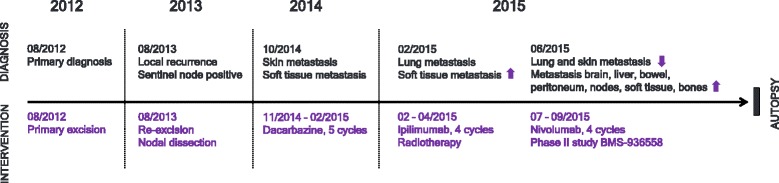
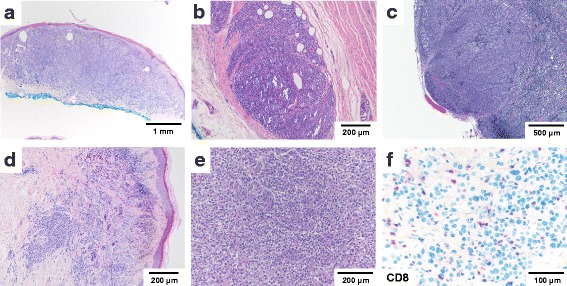
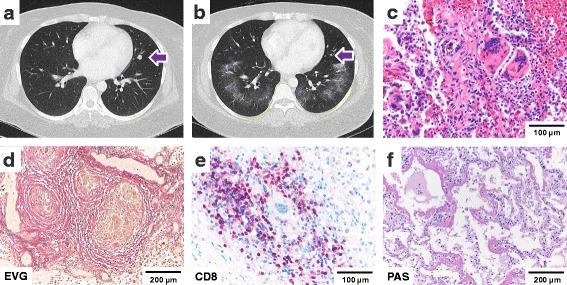
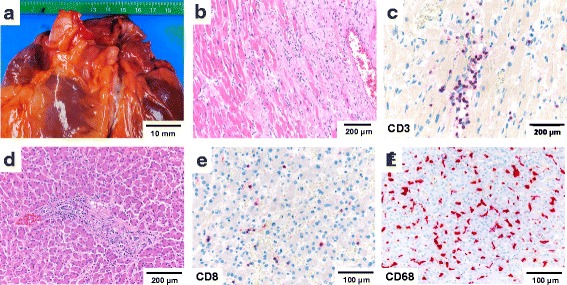
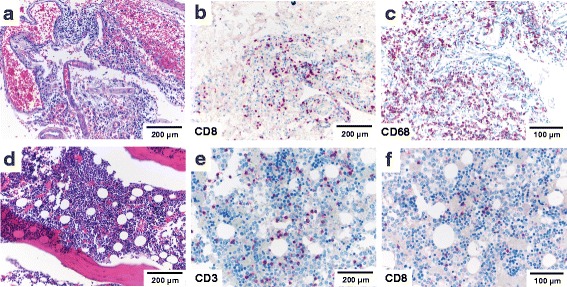
BACKGROUND: Immune checkpoint inhibitors targeting cytotoxic T-lymphocyte-associated protein 4 (CTLA-4) and programmed cell death protein 1 (PD-1) have been recently approved for treatment of patients with metastatic melanoma and non-small cell lung cancer (NSCLC). Despite important clinical benefits, these therapies are associated with a diverse spectrum of immune-related adverse events (irAEs) that are typically transient, but occasionally severe or even fatal. CASE PRESENTATION: This autopsy case illustrates that clinically overt irAEs may represent only a fraction of the total spectrum of immune-related organ pathology in patients treated with immune checkpoint inhibitors. We report a comprehensive analysis of systemic irAE pathology based on the autopsy of a 35-year-old female patient with metastatic melanoma treated first with ipilimumab and then nivolumab. The clinical course was characterized by a mixed tumor response with regression of skin and lung metastases and fatal progression of metastatic disease in the small bowel, peritoneum and brain. During therapy with ipilimumab, radiographic features of immune-related pneumonitis were noted. The autopsy examination established a sarcoid-like granulomatous reaction of the lung, pulmonary fibrosis and diffuse alveolar damage. Importantly, a clinically unapparent but histologically striking systemic inflammation involving the heart, central nervous system, liver and bone marrow was identified. Severe immune-related end-organ damage due to lymphocytic myocarditis was found. CONCLUSIONS: Autopsy studies are an important measure of quality control and may identify clinically unapparent irAEs in patients treated with immunotherapy. Pathologists and clinicians need to be aware of the broad spectrum of irAEs for timely management of treatment-related morbidity.
Overview
The claims and statistics of this paper haven’t been checked yet.
Free: it reads the open-access text and checks the first 5 claims that cite a source we can check. Create a free account to check every claim.
Integrity signals
Registry
Cites
Statistics
Figures
Verification
Claims the paper makes
The claims and statistics of this paper haven’t been checked yet.
Free: it reads the open-access text and checks the first 5 claims that cite a source we can check. Create a free account to check every claim.
Claims other papers make about this one
Each is checked against this paper’s own text: does it say what the citing paper says it does?
The source backs part of the claim, not all of it — or backs it for a different population, condition or comparison.
In the citing paper
“Cardiac biopsies from patients with ICI myocarditis revealed myocardial infiltration primarily by T cells”
From Autoimmune Myocarditis, Old Dogs and New Tricks. (2024) · cites this paper as [81]
Experimental — accuracy not yet measuredThe cited source says what the claim attributes to it.
In the citing paper
“one of the best examples of drug-induced lymphocytic myocarditis is ICI myocarditis, which may occur following ICI treatment in patients with cancer.”
From Autoimmune Myocarditis, Old Dogs and New Tricks. (2024) · cites this paper as [81]
The cited source says what the claim attributes to it.
In the citing paper
“suggesting a potential role of T cells in driving the pathogenesis of this condition.”
From Autoimmune Myocarditis, Old Dogs and New Tricks. (2024) · cites this paper as [81]
Self-check
Percentages, sums and reported differences re-computed from the paper’s own numbers.
The self-check needs the paper’s full text.
Citations
Cites
PD-1 and PD-L1 Immune Checkpoint Blockade to Treat Breast Cancer
Hartkopf, A. D., Taran, F.-A., Wallwiener, M., Walter, C. B., Krämer, B., Grischke, E.-M., & Brucker, S. Y. (2016) · Breast Care · doi:10.1159/000453569 · Cited by 30,845
Adverse Renal Effects of Immune Checkpoint Inhibitors: A Narrative Review
Wanchoo, R., Karam, S., Uppal, N. N., Barta, V. S., Deray, G., Devoe, C., Launay-Vacher, V., Jhaveri, K. D., & on behalf of Cancer and Kidney International Network Workgroup on Immune Checkpoint Inhibitors (2017) · American Journal of Nephrology · doi:10.1159/000455014 · Cited by 15,256
Improved Survival with Ipilimumab in Patients with Metastatic Melanoma
Hodi, F. S., O'Day, S. J., McDermott, D. F., Weber, R. W., Sosman, J. A., Haanen, J. B., Gonzalez, R., Robert, C., Schadendorf, D., Hassel, J. C., et al. (2010) · New England Journal of Medicine · doi:10.1056/nejmoa1003466 · Cited by 15,155 · cited 2×
“A non-infectious myocarditis in patients treated with nivolumab [3, 29] and ipilimumab [4] has been previously described, but biopsy studies are rare.”
BackgroundSafety, activity, and immune correlates of anti–PD-1 antibody in cancer
Topalian, S. L., Hodi, F. S., Brahmer, J. R., Gettinger, S. N., Smith, D. C., McDermott, D. F., Powderly, J. D., Carvajal, R. D., Sosman, J. A., Atkins, M. B., et al. (2012) · New England Journal of Medicine · doi:10.1056/nejmoa1200690 · Cited by 12,628 · cited 1×
“Immune checkpoint inhibitors interacting with the PD-1/PD-L1 axis were recently approved by the Food and Drug Administration (FDA) based on successful large randomized controlled clinical trials [2] of patients with metastatic melanoma [3, 4], non-small cell lung cancer (NSCLC) [5, 6] and renal cell cancer [7].”
BackgroundPD-1 Blockade in Tumors with Mismatch-Repair Deficiency
Le, D. T., Uram, J. N., Wang, H., Bartlett, B. R., Kemberling, H., Eyring, A. D., Skora, A. D., Luber, B. S., Azad, N. S., Laheru, D., et al. (2015) · New England Journal of Medicine · doi:10.1056/nejmoa1500596 · Cited by 9,377
Nivolumab versus docetaxel in advanced nonsquamous non-small-cell lung cancer
Borghaei, H., Paz-Ares, L., Horn, L., Spigel, D. R., Steins, M., Ready, N. E., Chow, L. Q., Vokes, E. E., Felip, E., Holgado, E., et al. (2015) · New England Journal of Medicine · doi:10.1056/nejmoa1507643 · Cited by 9,335 · cited 3×
“Immune checkpoint inhibitors interacting with the PD-1/PD-L1 axis were recently approved by the Food and Drug Administration (FDA) based on successful large randomized controlled clinical trials [2] of patients with metastatic melanoma [3, 4], non-small cell lung cancer (NSCLC) [5, 6] and renal cell cancer [7].”
BackgroundInfluentialNivolumab versus Docetaxel in Advanced Squamous-Cell Non–Small-Cell Lung Cancer
Brahmer, J., Reckamp, K. L., Baas, P., Crinò, L., Eberhardt, W. E. E., Poddubskaya, E., Antonia, S., Pluzanski, A., Vokes, E. E., Holgado, E., et al. (2015) · New England Journal of Medicine · doi:10.1056/nejmoa1504627 · Cited by 8,447 · cited 3×
“Immune checkpoint inhibitors interacting with the PD-1/PD-L1 axis were recently approved by the Food and Drug Administration (FDA) based on successful large randomized controlled clinical trials [2] of patients with metastatic melanoma [3, 4], non-small cell lung cancer (NSCLC) [5, 6] and renal cell cancer [7].”
BackgroundInfluentialNivolumab versus Everolimus in Advanced Renal-Cell Carcinoma
Motzer, R. J., Escudier, B., McDermott, D. F., George, S., Hammers, H. J., Srinivas, S., Tykodi, S. S., Sosman, J. A., Procopio, G., Plimack, E. R., et al. (2015) · New England Journal of Medicine · doi:10.1056/nejmoa1510665 · Cited by 5,807 · cited 1×
“Immune checkpoint inhibitors interacting with the PD-1/PD-L1 axis were recently approved by the Food and Drug Administration (FDA) based on successful large randomized controlled clinical trials [2] of patients with metastatic melanoma [3, 4], non-small cell lung cancer (NSCLC) [5, 6] and renal cell cancer [7].”
BackgroundNivolumab in Previously Untreated Melanoma without BRAF Mutation
Robert, C., Long, G. V., Brady, B., Dutriaux, C., Maio, M., Mortier, L., Hassel, J. C., Rutkowski, P., McNeil, C., Kalinka-Warzocha, E., et al. (2015) · New England Journal of Medicine · doi:10.1056/nejmoa1412082 · Cited by 5,519 · cited 2×
“A non-infectious myocarditis in patients treated with nivolumab [3, 29] and ipilimumab [4] has been previously described, but biopsy studies are rare.”
BackgroundCancer immunotherapy comes of age
Mellman, I., Coukos, G., & Dranoff, G. (2011) · Nature · doi:10.1038/nature10673 · Cited by 3,893 · cited 1×
“Four years after the approval of the first checkpoint inhibitor ipilimumab (anti-CTLA-4) for advanced melanoma in 2011, cancer immunotherapy is now considered one of the pillars of cancer therapy [1].”
BackgroundPD-1 Blockade with Nivolumab in Relapsed or Refractory Hodgkin's Lymphoma
Ansell, S. M., Lesokhin, A. M., Borrello, I., Halwani, A., Scott, E. C., Gutierrez, M., Schuster, S. J., Millenson, M. M., Cattry, D., Freeman, G. J., et al. (2015) · New England Journal of Medicine · doi:10.1056/nejmoa1411087 · Cited by 3,560 · cited 1×
“A non-infectious myocarditis in patients treated with nivolumab [3, 29] and ipilimumab [4] has been previously described, but biopsy studies are rare.”
BackgroundImmune Checkpoint Blockade in Cancer Therapy
Postow, M. A., Callahan, M. K., & Wolchok, J. D. (2015) · Journal of Clinical Oncology · doi:10.1200/jco.2014.59.4358 · Cited by 2,709 · cited 1×
“This rate of grade 3 or 4 toxicity is similar to that seen with many chemotherapeutic agents or targeted therapies [21].”
BackgroundWeber, J. S., D'Angelo, S. P., Minor, D., Hodi, F. S., Gutzmer, R., Neyns, B., Hoeller, C., Khushalani, N. I., Miller, W. H., Lao, C. D., et al. (2015) · The Lancet Oncology · doi:10.1016/s1470-2045(15)70076-8 · Cited by 2,676 · cited 2×
“Hepatic toxicity and elevation of liver enzymes has been described as a mostly low-grade irAE in patients treated with ipilimumab [11] and nivolumab [20].”
BackgroundFreeman-Keller, M., Kim, Y., Cronin, H., Richards, A., Gibney, G., & Weber, J. S. (2016) · Clinical Cancer Research · doi:10.1158/1078-0432.ccr-15-1136 · Cited by 863 · cited 1×
“severity of irAEs with treatment response has also been described [14].”
BackgroundBertrand, A., Kostine, M., Barnetche, T., Truchetet, M.-E., & Schaeverbeke, T. (2015) · BMC Medicine · doi:10.1186/s12916-015-0455-8 · Cited by 704 · cited 6×
“Several case reports have previously illustrated the diverse clinical spectrum of irAEs including diffuse alveolar damage and immune mediated pneumonitis [15], myocarditis [16], arthritis [17], severe skin toxicity [11], hypophysitis and meningoencephalitis [18].”
BackgroundResultInfluentialCombination Therapy with Anti–CTLA-4 and Anti–PD-1 Leads to Distinct Immunologic Changes In Vivo
Das, R., Verma, R., Sznol, M., Boddupalli, C. S., Gettinger, S. N., Kluger, H., Callahan, M., Wolchok, J. D., Halaban, R., Dhodapkar, M. V., et al. (2015) · The Journal of Immunology · doi:10.4049/jimmunol.1401686 · Cited by 461 · cited 1×
“Indeed, combination therapy leads to divergent gene expression changes in T-cells and monocyte populations that may underlie these specific irAEs [24].”
BackgroundAnti–PD-1–Related Pneumonitis during Cancer Immunotherapy
Nishino, M., Sholl, L. M., Hatabu, H., Ramaiya, N. H., & Hodi, F. S. (2015) · New England Journal of Medicine · doi:10.1056/nejmc1505197 · Cited by 373 · cited 2×
“Several case reports have previously illustrated the diverse clinical spectrum of irAEs including diffuse alveolar damage and immune mediated pneumonitis [15], myocarditis [16], arthritis [17], severe skin toxicity [11], hypophysitis and meningoencephalitis [18].”
BackgroundBashey, A., Medina, B., Corringham, S., Pasek, M., Carrier, E., Vrooman, L., Lowy, I., Solomon, S. R., Morris, L. E., Holland, H. K., et al. (2009) · Blood · doi:10.1182/blood-2008-07-168468 · Cited by 364 · cited 1×
“Indeed, CTLA4-related pneumonitis during cancer immunotherapy has been previously described as a rare event, but was diagnosed based on radiographic assessment only [22].”
BackgroundLäubli, H., Balmelli, C., Bossard, M., Pfister, O., Glatz, K., & Zippelius, A. (2015) · Journal for ImmunoTherapy of Cancer · doi:10.1186/s40425-015-0057-1 · Cited by 319 · cited 1×
“Several case reports have previously illustrated the diverse clinical spectrum of irAEs including diffuse alveolar damage and immune mediated pneumonitis [15], myocarditis [16], arthritis [17], severe skin toxicity [11], hypophysitis and meningoencephalitis [18].”
BackgroundSelf-citationIpilimumab-associated Hepatitis: Clinicopathologic Characterization in a Series of 11 Cases
Johncilla, M., Misdraji, J., Pratt, D. S., Agoston, A. T., Lauwers, G. Y., Srivastava, A., & Doyle, L. A. (2015) · American Journal of Surgical Pathology · doi:10.1097/pas.0000000000000453 · Cited by 208 · cited 1×
“In a biopsy study, a pan-lobular hepatitis with prominent sinusoidal histiocytic infiltrates and central vein endothelialitis has been previously suggested as a histologic clue to ipilimumab-associated hepatitis [30].”
BackgroundPulmonary Sarcoid-Like Granulomatosis Induced by Ipilimumab
Berthod, G., Lazor, R., Letovanec, I., Romano, E., Noirez, L., Mazza Stalder, J., Speiser, D. E., Peters, S., & Michielin, O. (2012) · Journal of Clinical Oncology · doi:10.1200/jco.2011.39.3298 · Cited by 182 · cited 1×
“Interestingly, a similar occurrence following CTLA-4 blockade has been described by other authors [11, 23].”
ResultThe cytokine network in sarcoidosis and its clinical relevance
Ziegenhagen, M. W., & Müller–Quernheim, J. (2003) · Journal of Internal Medicine · doi:10.1046/j.1365-2796.2003.01074.x · Cited by 142 · cited 1×
“In particular, interleukin-2 (IL-2) secretion by activated T-cells is thought to play a role in the pathogenesis of sarcoidosis [26] and may be a mechanism linking sarcoid-like granulomatous reactions to immunotherapy.”
BackgroundNeurological immune-related adverse events of ipilimumab
Bot, I., Blank, C. U., Boogerd, W., & Brandsma, D. (2013) · Practical Neurology · doi:10.1136/practneurol-2012-000447 · Cited by 131 · cited 2×
“Several case reports have previously illustrated the diverse clinical spectrum of irAEs including diffuse alveolar damage and immune mediated pneumonitis [15], myocarditis [16], arthritis [17], severe skin toxicity [11], hypophysitis and meningoencephalitis [18].”
BackgroundAutoimmune Arthropathy and Uveitis as Complications of Programmed Death 1 Inhibitor Treatment
de Velasco, G., Bermas, B., & Choueiri, T. K. (2015) · Arthritis & Rheumatology · doi:10.1002/art.39406 · Cited by 84
Acid-base balance in amphibian gastric mucosa
Silen, W., Machen, T. E., & Forte, J. (1975) · American Journal of Physiology-Legacy Content · doi:10.1152/ajplegacy.1975.229.3.721 · Cited by 55 · cited 1×
“There is a broad activity in different cancer types including DNA mismatch repair deficient colorectal cancer [8], ovarian cancer [9] and treatment-refractory Hodgkin lymphoma [10].”
BackgroundNivolumab plus ipilimumab in the treatment of advanced melanoma
Tsai, K. K., & Daud, A. I. (2015) · Journal of Hematology & Oncology · doi:10.1186/s13045-015-0219-0 · Cited by 48 · cited 1×
“inhibitors may cause more adverse drug reactions than monotherapy [13].”
BackgroundIpilimumab (Yervoy) and the TGN1412 catastrophe
Bakács, T., Mehrishi, J. N., & Moss, R. W. (2011) · Immunobiology · doi:10.1016/j.imbio.2011.07.005 · Cited by 48
Sarcoidosis in a Patient with Acquired Immunodeficiency Syndrome Treated with Interleukin‐2
Blanche, P., Gombert, B., Rollot, F., Salmon, D., & Sicard, D. (2000) · Clinical Infectious Diseases · doi:10.1086/317475 · Cited by 31 · cited 1×
“Indeed, the disease activity of a preexisting sarcoidosis may also be increased by high dose IL-2 treatment of neoplasia [27] and human immunodeficiency virus (HIV) infection [28].”
BackgroundLogan, T. F. (2005) · Thorax · doi:10.1136/thx.2004.024018 · Cited by 26 · cited 1×
“Indeed, the disease activity of a preexisting sarcoidosis may also be increased by high dose IL-2 treatment of neoplasia [27] and human immunodeficiency virus (HIV) infection [28].”
BackgroundVillasboas, J. C., & Ansell, S. M. (2015) · Expert Review of Anticancer Therapy · doi:10.1586/14737140.2016.1121812 · Cited by 14 · cited 1×
“There is a broad activity in different cancer types including DNA mismatch repair deficient colorectal cancer [8], ovarian cancer [9] and treatment-refractory Hodgkin lymphoma [10].”
BackgroundBocchi, E. A., Tanigawa, R. Y., Brandão, S. M. G., Cruz, F. D. D., Issa, V. S., Ayub‐Ferreira, S. M., Chizzola, P. R., Souza, G., Fiorelli, A. I., Bacal, F., et al. (2014) · Transplantation Proceedings · doi:10.1016/j.transproceed.2013.12.062 · Cited by 7
Cited by
Wang, D. Y., Salem, J.-E., Cohen, J. V., Chandra, S., Menzer, C., Ye, F., Zhao, S., Das, S., Beckermann, K. E., Ha, L., et al. (2018) · JAMA Oncology · doi:10.1001/jamaoncol.2018.3923 · Cited by 2,674
Adverse effects of immune-checkpoint inhibitors: epidemiology, management and surveillance
Martins, F., Sofiya, L., Sykiotis, G. P., Lamine, F., Maillard, M., Fraga, M., Shabafrouz, K., Ribi, C., Cairoli, A., Guex-Crosier, Y., et al. (2019) · Nature Reviews Clinical Oncology · doi:10.1038/s41571-019-0218-0 · Cited by 2,314
Fulminant Myocarditis with Combination Immune Checkpoint Blockade
Johnson, D. B., Balko, J. M., Compton, M. L., Chalkias, S., Gorham, J., Xu, Y., Hicks, M., Puzanov, I., Alexander, M. R., Bloomer, T. L., et al. (2016) · New England Journal of Medicine · doi:10.1056/nejmoa1609214 · Cited by 2,308
Palaskas, N., Lopez‐Mattei, J., Durand, J. B., Iliescu, C., & Deswal, A. (2020) · Journal of the American Heart Association · doi:10.1161/jaha.119.013757 · Cited by 535
“Last, if patients with cardiac symptoms also present with other IRAEs, then the possibility of ICI-associated myocarditis becomes higher.(22) Furthermore, myocarditis has been reported more commonly in association with ICI-related myasthenia gravis and ICI-related myositis compared with other IRAEs.”
BackgroundCardiovascular magnetic resonance in immune checkpoint inhibitor-associated myocarditis
Zhang, L., Awadalla, M., Mahmood, S. S., Nohria, A., Hassan, M. Z. O., Thuny, F., Zlotoff, D. A., Murphy, S. P., Stone, J. R., Golden, D. L. A., et al. (2020) · European Heart Journal · doi:10.1093/eurheartj/ehaa051 · Cited by 355
“Subclinical ICI-associated myocarditis cases have also been reported.(22,43) For example, in a case of metastatic melanoma treated with ipilimumab and nivolumab, cardiac involvement was clinically unapparent, but patchy fibrosis and diffuse mononuclear infiltrates of myocardium were found in post-mortem autopsy.”
Background
Metadata
- Authors
- Koelzer, V. H., Rothschild, S. I., Zihler, D., Wicki, A., Willi, B., Willi, N., Voegeli, M., Cathomas, G., Zippelius, A., & Mertz, K. D.
- Affiliations
- University of Bern (CH)
- University Hospital of Basel (CH)
- Kantonsspital Baselland (CH)
- Corresponding author
- Mertz, Kirsten D.
- ORCID
- Venue
- Journal for ImmunoTherapy of Cancer
- Publisher
- BMJ
- Published
- 2016-03-15
- Volume
- 4
- Issue
- 1
- Pages
- 13-13
- ISSN
- 2051-1426 (ISSN-L)
- PMC
- PMC4791920
- OpenAlex
- W2301851804
- Cited by
- 200
- References
- 31
- Citations by year
- 2026: 6 · 2025: 9 · 2024: 12 · 2023: 15 · 2022: 19 · 2021: 26 · 2020: 27 · 2019: 21 · 2018: 25 · 2017: 31 · 2016: 9
- FWCI
- 15.64
- Type
- journal article
- Language
- en
- Open access
- gold
- doi.org
- Licence
- cc-by
- creativecommons.org/licenses/by/4.0/ (tdm)
- Locations
- Journal for ImmunoTherapy of Cancer (publishedVersion, cc-by)
- PubMed Central (publishedVersion, cc-by)
- PubMed (publishedVersion)
- Zurich Open Repository and Archive (University of Zurich) (acceptedVersion, cc-by)
- Zurich Open Repository and Archive (University of Zurich) (submittedVersion, cc-by)
- Zurich Open Repository and Archive (University of Zurich)
- Topics
- Health Sciences › Medicine › Oncology › Cancer Immunotherapy and Biomarkers
- Life Sciences › Immunology and Microbiology › Immunology › Immunotoxicology and immune responses
- Health Sciences › Medicine › Pulmonary and Respiratory Medicine › Sarcoidosis and Beryllium Toxicity Research
- Keywords
- immune-related adverse events, immune checkpoint inhibitors, metastatic melanoma, ipilimumab, nivolumab, CTLA-4, PD-1, lymphocytic myocarditis, immune-related pneumonitis, pulmonary fibrosis, diffuse alveolar damage, systemic inflammation, autopsy findings, immunotherapy toxicity
About these checks
Registry, retraction, Cites and statistics results are computed, not judged, with one exception: a printed reference that no index lists is read once by a model before it counts as a citation error. Claims are extracted by a model and kept only when their quote appears verbatim in the text; each cited source is then checked, with a model’s help, for whether it says what the claim relies on. Those verdicts can be wrong — read the claim’s quote and the cited source before relying on one.
Statistics and arithmetic are recomputed, not judged.
Confidence bands are shown only for fields calibrated on our annotated test set. None is calibrated yet, so no band is shown.
What counts as a claim ›How we measure confidence ›How we check this ›
Are you an author, or do you see a problem with this page? Request a review
Data sources
Bibliographic data: Semantic Scholar, OpenAlex, Crossref.
Contains information from the Semantic Scholar Academic Graph Datasets, made available under the ODC Attribution License (ODC-BY 1.0).
Semantic Scholar’s data is described in: Kinney, R., et al. (2023). The Semantic Scholar Open Data Platform. arXiv:2301.10140.
