

The DOI matches its Crossref record; 64 of the 64 references it cites were found in a registry or an index.
Glycoprotein NMB: a novel Alzheimer’s disease associated marker expressed in a subset of activated microglia
Open accessAbstract
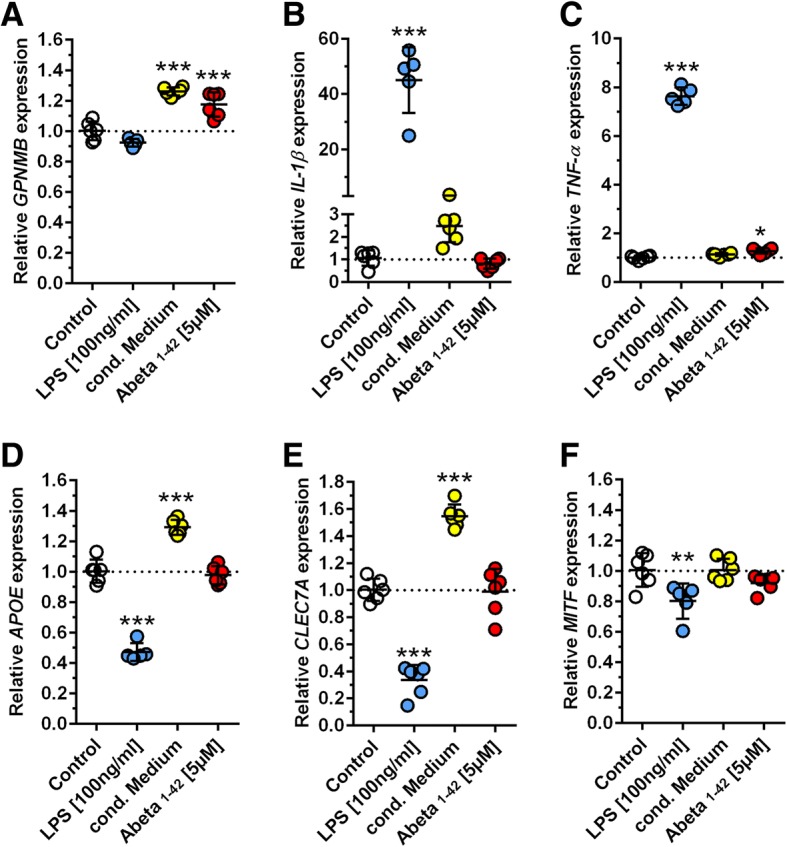
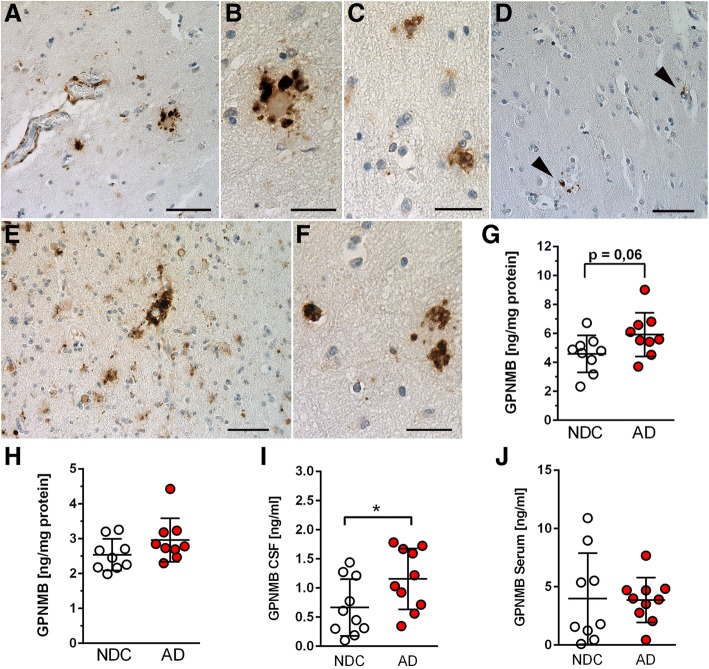
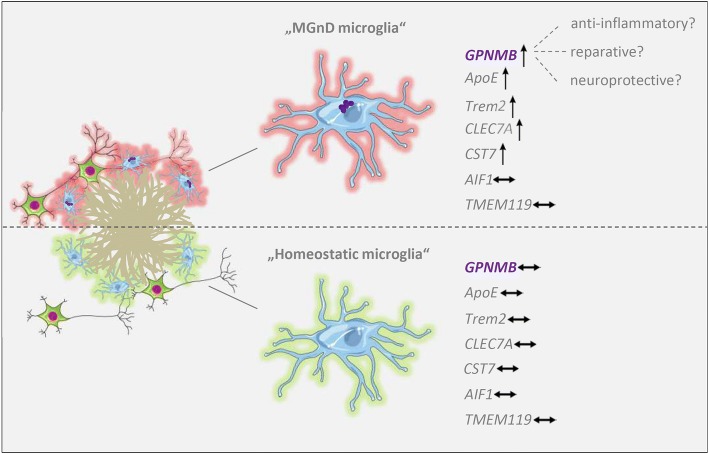
Alzheimer's disease (AD) is an irreversible, devastating neurodegenerative brain disorder characterized by the loss of neurons and subsequent cognitive decline. Despite considerable progress in the understanding of the pathophysiology of AD, the precise molecular mechanisms that cause the disease remain elusive. By now, there is ample evidence that activated microglia have a critical role in the initiation and progression of AD. The present study describes the identification of Glycoprotein nonmetastatic melanoma protein B (GPNMB) as a novel AD-related factor in both transgenic mice and sporadic AD patients by expression profiling, immunohistochemistry and ELISA measurements. We show that GPNMB levels increase in an age-dependent manner in transgenic AD models showing profound cerebral neuron loss and demonstrate that GPNMB co-localizes with a distinct population of IBA1-positive microglia cells that cluster around amyloid plaques. Our data further indicate that GPNMB is part of a microglia activation state that is only present under neurodegenerative conditions and that is characterized by the up-regulation of a subset of genes including TREM2, APOE and CST7. In agreement, we provide in vitro evidence that soluble Aβ has a direct effect on GPNMB expression in an immortalized microglia cell line. Importantly, we show for the first time that GPNMB is elevated in brain samples and cerebrospinal fluid (CSF) of sporadic AD patients when compared to non-demented controls.The current findings indicate that GPNMB represents a novel disease-associated marker that appears to play a role in the neuroinflammatory response of AD.
Overview
The claims and statistics of this paper haven’t been checked yet.
Run the check — free, no account needed. It reads the open-access text and checks the sources it cites.
Integrity signals
Registry
Cites
Statistics
Figures
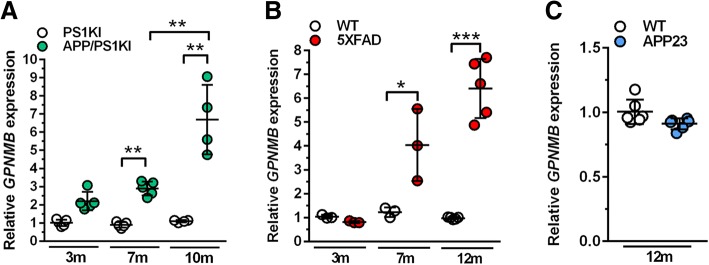
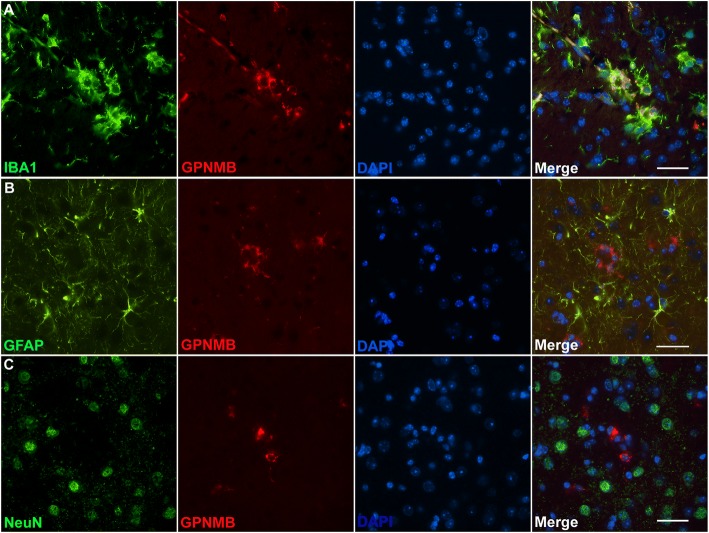
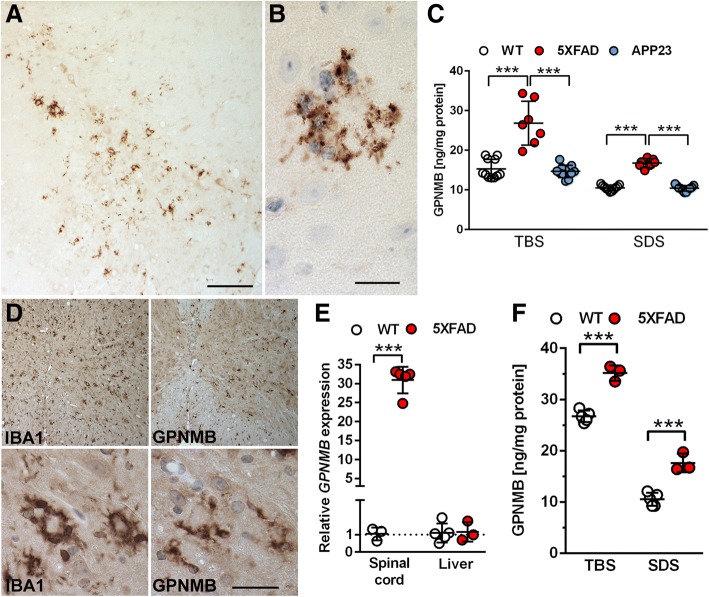
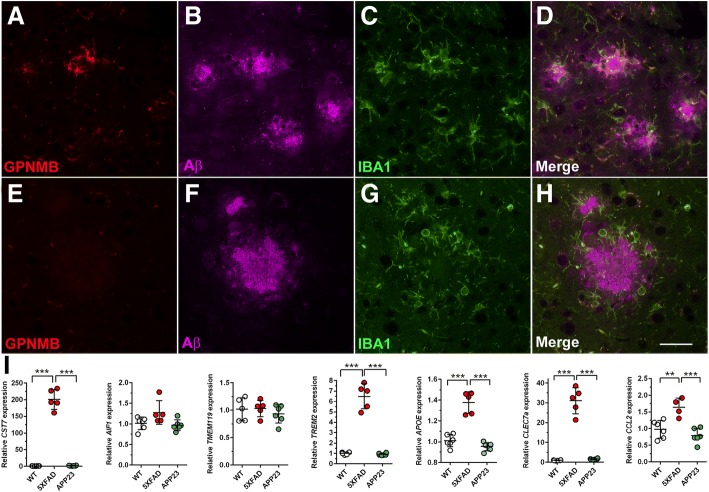
Verification
Claims the paper makes
The claims and statistics of this paper haven’t been checked yet.
Run the check — free, no account needed. It reads the open-access text and checks the sources it cites.
Claims other papers make about this one
Each is checked against this paper’s own text: does it say what the citing paper says it does?
The cited source says what the claim attributes to it.
In the citing paper
“In the list, 4 proteins (GPNMB, SMOC1, NPTX2 and VGF) have previously been reported in AD CSF (Dayon et al., 2018; Huttenrauch et al., 2018; Llano et al., 2019; Xiao et al., 2017)”
From Deep Multilayer Brain Proteomics Identifies Molecular Networks in Alzheimer’s Disease Progression (2020) · cites this paper as Huttenrauch et al., 2018
The cited source says what the claim attributes to it.
In the citing paper
“While, SMOC1 and GPNMB have been reported as putative CSF biomarkers in previous studies [18, 33, 62]”
From Integrated analysis of ultra-deep proteomes in cortex, cerebrospinal fluid and serum reveals a mitochondrial signature in Alzheimer’s disease (2020) · cites this paper as [62]
The cited source says what the claim attributes to it.
In the citing paper
“Consistently, SMOC1 and GPNMB were reported to be CSF biomarker candidates for AD in other recent biomarker studies [62, 69].”
From Integrated analysis of ultra-deep proteomes in cortex, cerebrospinal fluid and serum reveals a mitochondrial signature in Alzheimer’s disease (2020) · cites this paper as [62]
Self-check
Percentages, sums and reported differences re-computed from the paper’s own numbers.
The self-check needs the paper’s full text.
Citations
Cites
Analyzing real-time PCR data by the comparative CT method
Schmittgen, T. D., & Livak, K. J. (2008) · Nature Protocols · doi:10.1038/nprot.2008.73 · Cited by 26,190
The amyloid hypothesis of Alzheimer's disease at 25 years
Selkoe, D. J., & Hardy, J. (2016) · EMBO Molecular Medicine · doi:10.15252/emmm.201606210 · Cited by 6,164
A Unique Microglia Type Associated with Restricting Development of Alzheimer’s Disease
Keren-Shaul, H., Spinrad, A., Weiner, A., Matcovitch-Natan, O., Dvir-Szternfeld, R., Ulland, T. K., David, E., Baruch, K., Lara-Astaiso, D., Toth, B., et al. (2017) · Cell · doi:10.1016/j.cell.2017.05.018 · Cited by 5,493
Zhang, Y., Chen, K., Sloan, S. A., Bennett, M. L., Scholze, A. R., O'Keeffe, S., Phatnani, H. P., Guarnieri, P., Caneda, C., Ruderisch, N., et al. (2014) · The Journal of Neuroscience · doi:10.1523/jneurosci.1860-14.2014 · Cited by 4,875
Oakley, H., Cole, S. L., Logan, S., Maus, E., Shao, P., Craft, J., Guillozet-Bongaarts, A., Ohno, M., Disterhoft, J., Van Eldik, L., et al. (2006) · The Journal of Neuroscience · doi:10.1523/jneurosci.1202-06.2006 · Cited by 3,530 · cited 1×
“At 12 months of age, the model shows a massive Aβ plaque load in various brain regions, which is accompanied by extensive astro- and microgliosis [19, 33].”
BackgroundHarold, D., Abraham, R., Hollingworth, P., Sims, R., Gerrish, A., Hamshere, M. L., Pahwa, J. S., Moskvina, V., Dowzell, K., Williams, A., et al. (2009) · Nature Genetics · doi:10.1038/ng.440 · Cited by 3,326
Self-citationTREM2 Variants in Alzheimer's Disease
Guerreiro, R., Wojtas, A., Bras, J., Carrasquillo, M., Rogaeva, E., Majounie, E., Cruchaga, C., Sassi, C., Kauwe, J. S. K., Younkin, S., et al. (2013) · New England Journal of Medicine · doi:10.1056/nejmoa1211851 · Cited by 3,020
Krasemann, S., Madore, C., Cialic, R., Baufeld, C., Calcagno, N., El Fatimy, R., Beckers, L., O’Loughlin, E., Xu, Y., Fanek, Z., et al. (2017) · Immunity · doi:10.1016/j.immuni.2017.08.008 · Cited by 2,979
Genome-wide association study identifies variants at CLU and CR1 associated with Alzheimer's disease
the European Alzheimer's Disease Initiative Investigators, Lambert, J.-C., Heath, S., Even, G., Campion, D., Sleegers, K., Hiltunen, M., Combarros, O., Zelenika, D., Bullido, M. J., et al. (2009) · Nature Genetics · doi:10.1038/ng.439 · Cited by 2,234
Initiative, T. A. D. N., Hollingworth, P., CHARGE consortium, EADI1 consortium, Harold, D., Sims, R., Gerrish, A., Lambert, J.-C., Carrasquillo, M. M., Abraham, R., et al. (2011) · Nature Genetics · doi:10.1038/ng.803 · Cited by 1,997
Self-citation
Cited by
Sorted by citations
Microglia Biology: One Century of Evolving Concepts
Prinz, M., Jung, S., & Priller, J. (2019) · Cell · doi:10.1016/j.cell.2019.08.053 · Cited by 1,525
Deep Multilayer Brain Proteomics Identifies Molecular Networks in Alzheimer’s Disease Progression
Bai, B., Wang, X., Li, Y., Chen, P.-C., Yu, K., Dey, K. K., Yarbro, J. M., Han, X., Lutz, B. M., Rao, S., et al. (2020) · Neuron · doi:10.1016/j.neuron.2019.12.015 · Cited by 565
“(F) Consistent protein changes of 8 proteins in AD brain tissue and CSF.”
BackgroundInfluentialSmajić, S., Prada-Medina, C. A., Landoulsi, Z., Ghelfi, J., Delcambre, S., Dietrich, C., Jarazo, J., Henck, J., Balachandran, S., Pachchek, S., et al. (2022) · Brain · doi:10.1093/brain/awab446 · Cited by 590
McQuade, A., Kang, Y. J., Hasselmann, J., Jairaman, A., Sotelo, A., Coburn, M., Shabestari, S. K., Chadarevian, J. P., Fote, G., Tu, C. H., et al. (2020) · Nature Communications · doi:10.1038/s41467-020-19227-5 · Cited by 361
Microglia in Brain Development, Homeostasis, and Neurodegeneration
Bohlen, C. J., Friedman, B. A., Dejanovic, B., & Sheng, M. (2019) · Annual Review of Genetics · doi:10.1146/annurev-genet-112618-043515 · Cited by 212
Metadata
- Authors
- Hüttenrauch, M., Ogorek, I., Klafki, H., Otto, M., Stadelmann, C., Weggen, S., Wiltfang, J., & Wirths, O.
- Affiliations
- Universitätsmedizin Göttingen (DE)
- Heinrich Heine University Düsseldorf (DE)
- Universität Ulm (DE)
- German Center for Neurodegenerative Diseases (DE)
- Corresponding author
- Wirths, Oliver
- Venue
- Acta Neuropathologica Communications
- Published
- 2018-10-19
- Volume
- 6
- Issue
- 1
- Pages
- 108-108
- ISSN
- 2051-5960 (ISSN-L)
- PMC
- PMC6194687
- OpenAlex
- W2898010909
- Cited by
- 166
- References
- 64
- Citations by year
- 2026: 22 · 2025: 23 · 2024: 27 · 2023: 22 · 2022: 15 · 2021: 34 · 2020: 12 · 2019: 8 · 2018: 1
- FWCI
- 6.18
- Type
- journal article
- Language
- en
- Open access
- gold
- doi.org
- Licence
- Locations
- Acta Neuropathologica Communications (publishedVersion, cc-by)
- Europe PMC (PubMed Central) (publishedVersion, other-oa)
- PubMed Central (publishedVersion, cc-by)
- PubMed (publishedVersion)
- DOAJ (DOAJ: Directory of Open Access Journals) (submittedVersion, cc-by-sa)
- GoeScholar The Publication Server of the Georg-August-Universität Göttingen (Georg-August-Universität Göttingen) (submittedVersion, cc-by)
- DZNE Pub (submittedVersion, cc-by)
- Funders
- Alzheimer Forschung Initiative (16013)
- Topics
- Life Sciences › Neuroscience › Neurology › Neuroinflammation and Neurodegeneration Mechanisms
- Life Sciences › Neuroscience › Cellular and Molecular Neuroscience › Alzheimer's disease research and treatments
- Health Sciences › Medicine › Psychiatry and Mental health › Dementia and Cognitive Impairment Research
- Keywords
- GPNMB, Alzheimer's disease, microglial activation, disease biomarkers, amyloid plaques, TREM2, apolipoprotein E, cystatin F, amyloid-beta, neuroinflammation, cerebrospinal fluid, transgenic mouse model, sporadic Alzheimer's disease
- MeSH terms
- Age Factors, Aged, Aged, 80 and over, Alzheimer Disease, Animals, Brain, Cell Line, Transformed, Disease Models, Animal, Female, Glial Fibrillary Acidic Protein, Humans, Lipopolysaccharides, Male, Membrane Glycoproteins, Mice, Transgenic, Mutation, Peptide Fragments, Phosphopyruvate Hydratase, Up-Regulation, Amyloid beta-Peptides, Amyloid beta-Protein Precursor, Microglia, Mice, Presenilin-1
About these checks
Registry, retraction, Cites and statistics results are computed, not judged, with one exception: a printed reference that no index lists is read once by a model before it counts as a citation error. Claims are extracted by a model and kept only when their quote appears verbatim in the text; each cited source is then checked, with a model’s help, for whether it says what the claim relies on. Those verdicts can be wrong — read the claim’s quote and the cited source before relying on one.
Statistics and arithmetic are recomputed, not judged.
Confidence bands are shown only for fields calibrated on our annotated test set. None is calibrated yet, so no band is shown.
What counts as a claim ›How we measure confidence ›How we check this ›
Are you an author, or do you see a problem with this page? Request a review
