

The DOI matches its Crossref record; 65 of the 65 references it cites were found in a registry or an index.
APOE genotype and sex affect microglial interactions with plaques in Alzheimer’s disease mice
Open accessAbstract
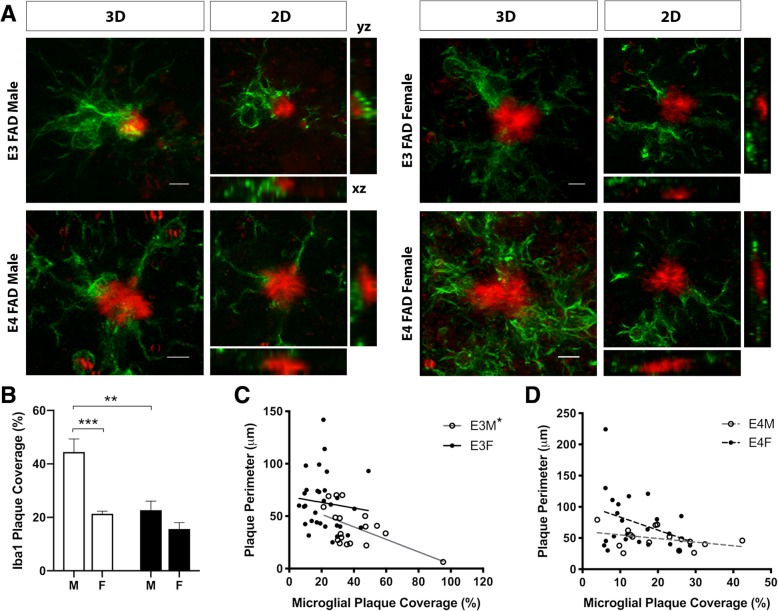
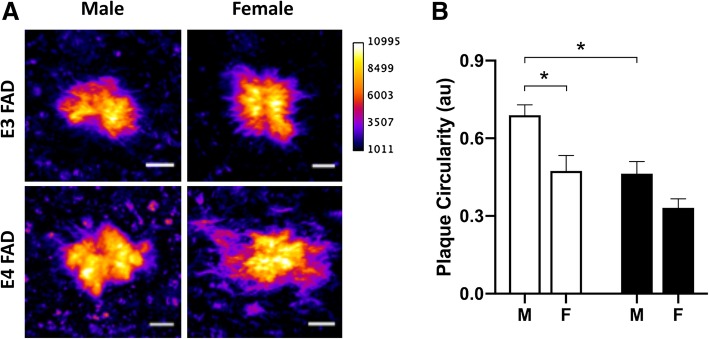
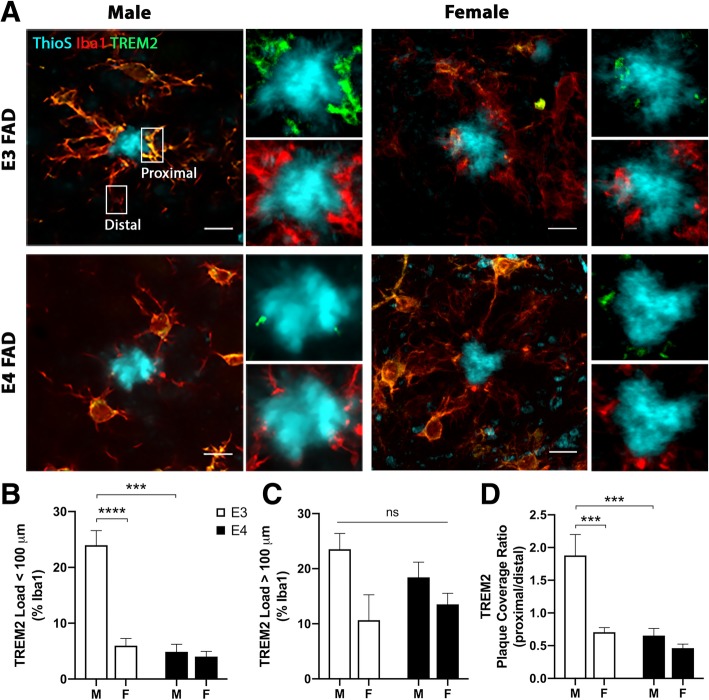
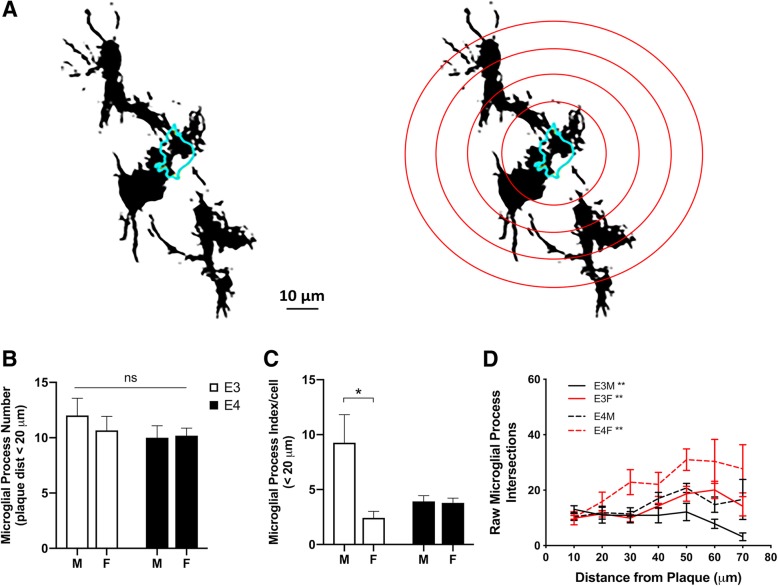
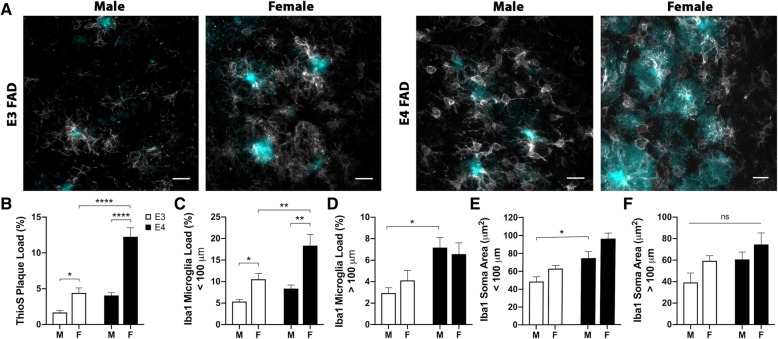
Microglia affect Alzheimer's disease (AD) pathogenesis in opposing manners, by protecting against amyloid accumulation in early phases of the disease and promoting neuropathology in advanced stages. Recent research has identified specific microglial interactions with amyloid plaques that exert important protective functions including attenuation of early pathology. It is unknown how these protective microglial interactions with plaques are affected by apolipoprotein E (APOE) genotype and sex, two well-established AD risk factors that modulate microglial function. We investigated this question using quantitative confocal microscopy to compare microglial interactions with amyloid plaques in male and female EFAD mice across APOE3 and APOE4 genotypes at 6 months of age. We observed that microglial coverage of plaques is highest in male APOE3 mice with significant reductions in coverage observed with both APOE4 genotype and female sex. Plaque compaction, a beneficial consequence of microglial interactions with plaques, showed a similar pattern in which APOE4 genotype and female sex were associated with significantly lower values. Within the plaque environment, microglial expression of triggering receptor expressed on myeloid cells 2 (TREM2), a known regulator of microglial plaque coverage, was highest in male APOE3 mice and reduced by APOE4 genotype and female sex. These differences in plaque interactions were unrelated to the number of microglial processes in the plaque environment across groups. Interestingly, the pattern of amyloid burden across groups was opposite to that of microglial plaque coverage, with APOE4 genotype and female sex showing the highest amyloid levels. These findings suggest a possible mechanism by which microglia may contribute to the increased AD risk associated with APOE4 genotype and female sex.
Overview
The claims and statistics of this paper haven’t been checked yet.
Run the check — free, no account needed. It reads the open-access text and checks the sources it cites.
Integrity signals
Registry
Cites
Statistics
Figures
Verification
Claims the paper makes
The claims and statistics of this paper haven’t been checked yet.
Run the check — free, no account needed. It reads the open-access text and checks the sources it cites.
Claims other papers make about this one
Each is checked against this paper’s own text: does it say what the citing paper says it does?
The source backs part of the claim, not all of it — or backs it for a different population, condition or comparison.
In the citing paper
“Reactive microglia migrate towards Aβ plaques, surround them and upregulate APOE, which binds to TREM2 and promotes plaque compaction154.”
From Multifaceted roles of APOE in Alzheimer disease (2024) · cites this paper as [154]
Experimental — accuracy not yet measuredThe source backs part of the claim, not all of it — or backs it for a different population, condition or comparison.
In the citing paper
“Previous reports have demonstrated that gender can affect AD pathology, microglia response and APOE expression (Stephen et al, 2019; Thomas et al, 2016; Sala Frigerio et al, 2019), while the protective and disease causing effects of APOE2 and APOE4 are variable in different ethnic populations (Farrer et al, 1997; Naslavsky et al, 2022).”
From APOE from astrocytes restores Alzheimer’s Aβ-pathology and DAM-like responses in APOE deficient microglia (2024) · cites this paper as Stephen et al, 2019
Experimental — accuracy not yet measuredThe cited source says what the claim attributes to it.
In the citing paper
“They discovered that microglial coverage of amyloid plaques is highest in male APOE3 mice and reduced by female sex and APOE4 genotype.”
Self-check
Percentages, sums and reported differences re-computed from the paper’s own numbers.
The self-check needs the paper’s full text.
Citations
Cites
Neuroinflammation in Alzheimer's disease
Heneka, M. T., Carson, M. J., Khoury, J. E., Landreth, G. E., Brosseron, F., Feinstein, D. L., Jacobs, A. H., Wyss-Coray, T., Vitorica, J., Ransohoff, R. M., et al. (2015) · The Lancet Neurology · doi:10.1016/s1474-4422(15)70016-5 · Cited by 6,226
A Unique Microglia Type Associated with Restricting Development of Alzheimer’s Disease
Keren-Shaul, H., Spinrad, A., Weiner, A., Matcovitch-Natan, O., Dvir-Szternfeld, R., Ulland, T. K., David, E., Baruch, K., Lara-Astaiso, D., Toth, B., et al. (2017) · Cell · doi:10.1016/j.cell.2017.05.018 · Cited by 5,493
Harold, D., Abraham, R., Hollingworth, P., Sims, R., Gerrish, A., Hamshere, M. L., Pahwa, J. S., Moskvina, V., Dowzell, K., Williams, A., et al. (2009) · Nature Genetics · doi:10.1038/ng.440 · Cited by 3,326
Krasemann, S., Madore, C., Cialic, R., Baufeld, C., Calcagno, N., El Fatimy, R., Beckers, L., O’Loughlin, E., Xu, Y., Fanek, Z., et al. (2017) · Immunity · doi:10.1016/j.immuni.2017.08.008 · Cited by 2,979
Variant of TREM2 Associated with the Risk of Alzheimer's Disease
Jonsson, T., Stefansson, H., Steinberg, S., Jonsdottir, I., Jonsson, P. V., Snaedal, J., Bjornsson, S., Huttenlocher, J., Levey, A. I., Lah, J. J., et al. (2013) · New England Journal of Medicine · doi:10.1056/nejmoa1211103 · Cited by 2,558
Identification of a unique TGF-β–dependent molecular and functional signature in microglia
Butovsky, O., Jedrychowski, M. P., Moore, C. S., Cialic, R., Lanser, A. J., Gabriely, G., Koeglsperger, T., Dake, B., Wu, P. M., Doykan, C. E., et al. (2014) · Nature Neuroscience · doi:10.1038/nn.3599 · Cited by 2,543
Genome-wide association study identifies variants at CLU and CR1 associated with Alzheimer's disease
the European Alzheimer's Disease Initiative Investigators, Lambert, J.-C., Heath, S., Even, G., Campion, D., Sleegers, K., Hiltunen, M., Combarros, O., Zelenika, D., Bullido, M. J., et al. (2009) · Nature Genetics · doi:10.1038/ng.439 · Cited by 2,234
the Immunological Genome Consortium, Gautier, E. L., Shay, T., Miller, J., Greter, M., Jakubzick, C., Ivanov, S., Helft, J., Chow, A., Elpek, K. G., et al. (2012) · Nature Immunology · doi:10.1038/ni.2419 · Cited by 1,972
TREM2 Lipid Sensing Sustains the Microglial Response in an Alzheimer’s Disease Model
Wang, Y., Cella, M., Mallinson, K., Ulrich, J. D., Young, K. L., Robinette, M. L., Gilfillan, S., Krishnan, G. M., Sudhakar, S., Zinselmeyer, B. H., et al. (2015) · Cell · doi:10.1016/j.cell.2015.01.049 · Cited by 1,736
The microglial sensome revealed by direct RNA sequencing
Hickman, S. E., Kingery, N. D., Ohsumi, T. K., Borowsky, M. L., Wang, L.-C., Means, T. K., & El Khoury, J. (2013) · Nature Neuroscience · doi:10.1038/nn.3554 · Cited by 1,511
Cited by
Sorted by citations
Mechanisms of sex differences in Alzheimer’s disease
Lopez-Lee, C., Torres, E. R. S., Carling, G., & Gan, L. (2024) · Neuron · doi:10.1016/j.neuron.2024.01.024 · Cited by 376
APOE mediated neuroinflammation and neurodegeneration in Alzheimer’s disease
Parhizkar, S., & Holtzman, D. M. (2022) · Seminars in Immunology · doi:10.1016/j.smim.2022.101594 · Cited by 255
Multifaceted roles of APOE in Alzheimer disease
Jackson, R. J., Hyman, B. T., & Serrano-Pozo, A. (2024) · Nature Reviews Neurology · doi:10.1038/s41582-024-00988-2 · Cited by 193
Sex Differences in Alzheimer’s Disease: Insights From the Multiomics Landscape
Guo, L., Zhong, M. B., Zhang, L., Zhang, B., & Cai, D. (2022) · Biological Psychiatry · doi:10.1016/j.biopsych.2021.02.968 · Cited by 164
Exploring Sex-Related Differences in Microglia May Be a Game-Changer in Precision Medicine
Lynch, M. A. (2022) · Frontiers in Aging Neuroscience · doi:10.3389/fnagi.2022.868448 · Cited by 146
Metadata
- Authors
- Stephen, T. L., Cacciottolo, M., Balu, D., Morgan, T. E., LaDu, M. J., Finch, C. E., & Pike, C. J.
- Affiliations
- University of Southern California (US)
- University of Illinois Chicago (US)
- Corresponding author
- Pike, C. J.
- Venue
- Acta Neuropathologica Communications
- Published
- 2019-05-21
- Volume
- 7
- Issue
- 1
- Pages
- 82-82
- ISSN
- 2051-5960 (ISSN-L)
- PMC
- PMC6528326
- OpenAlex
- W2946924931
- Cited by
- 115
- References
- 65
- Citations by year
- 2026: 8 · 2025: 14 · 2024: 30 · 2023: 13 · 2022: 15 · 2021: 17 · 2020: 14 · 2019: 4
- FWCI
- 5.50
- Type
- journal article
- Language
- en
- Open access
- gold
- doi.org
- Locations
- Acta Neuropathologica Communications (publishedVersion, cc-by)
- PubMed Central (publishedVersion, cc-by)
- PubMed (publishedVersion)
- DOAJ (DOAJ: Directory of Open Access Journals) (submittedVersion, cc-by-sa)
- Funders
- National Institute on Aging (AG058068)
- Cure Alzheimer's Fund
- Topics
- Life Sciences › Neuroscience › Neurology › Neuroinflammation and Neurodegeneration Mechanisms
- Life Sciences › Neuroscience › Cellular and Molecular Neuroscience › Alzheimer's disease research and treatments
- Life Sciences › Neuroscience › Neurology › Neurological Disease Mechanisms and Treatments
- Keywords
- Alzheimer's disease, microglia, amyloid plaques, apolipoprotein E, APOE ε4, APOE3, sex differences, TREM2, amyloid burden, neuroprotection
- MeSH terms
- Alzheimer Disease, Animals, Brain, Female, Genotype, Male, Membrane Glycoproteins, Mice, Transgenic, Receptors, Immunologic, Sex Characteristics, Microglia, Apolipoprotein E3, Apolipoprotein E4, Plaque, Amyloid
About these checks
Registry, retraction, Cites and statistics results are computed, not judged, with one exception: a printed reference that no index lists is read once by a model before it counts as a citation error. Claims are extracted by a model and kept only when their quote appears verbatim in the text; each cited source is then checked, with a model’s help, for whether it says what the claim relies on. Those verdicts can be wrong — read the claim’s quote and the cited source before relying on one.
Statistics and arithmetic are recomputed, not judged.
Confidence bands are shown only for fields calibrated on our annotated test set. None is calibrated yet, so no band is shown.
What counts as a claim ›How we measure confidence ›How we check this ›
Are you an author, or do you see a problem with this page? Request a review
