

Living with pathological narcissism: a qualitative study
Open accessThe DOI matches its Crossref record; 96 of the 96 references it cites were found in a registry or an index; 9 of the 84 sources its claims cite were checked for support.
Abstract
Background: Research into the personality trait of narcissism have advanced further understanding of the pathological concomitants of grandiosity, vulnerability and interpersonal antagonism. Recent research has established some of the interpersonal impacts on others from being in a close relationship with someone having such traits of pathological narcissism, but no qualitative studies exist. Individuals with pathological narcissism express many of their difficulties of identity and emotion regulation within the context of significant interpersonal relationships thus studying these impacts on others is warranted. Method: We asked the relatives of people high in narcissistic traits (indexed by scoring above a cut-off on a narcissism screening measure) to describe their relationships (N = 436; current romantic partners [56.2%]; former romantic partners [19.7%]; family members [21.3%]). Participants were asked to describe their relative and their interactions with them. Verbatim responses were thematically analysed. Results: Participants described ‘grandiosity’ in their relative: requiring admiration, showing arrogance, entitlement, envy, exploitativeness, grandiose fantasy, lack empathy, self-importance and interpersonal charm. Participants also described ‘vulnerability’ of the relative: contingent self-esteem, hypersensitivity and insecurity, affective instability, emptiness, rage, devaluation, hiding the self and victimhood. These grandiose and vulnerable characteristics were commonly reported together (69% of respondents). Participants also described perfectionistic (anankastic), vengeful (antisocial) and suspicious (paranoid) features. Instances of relatives childhood trauma, excessive religiosity and substance abuse were also described. Conclusions: These findings lend support to the importance of assessing the whole dimension of the narcissistic personality, as well as associated personality patterns. On the findings reported here, the vulnerable aspect of pathological narcissism impacts others in an insidious way given the core deficits of feelings of emptiness and affective instability. These findings have clinical implications for diagnosis and treatment in that the initial spectrum of complaints may be misdiagnosed unless the complete picture is understood. Living with a person with pathological narcissism can be marked by experiencing a person who shows large fluctuations in affect, oscillating attitudes and contradictory needs.
Overview
CoChat Summary
TL;DR
This qualitative study analyzed relatives’ descriptions of people high in pathological narcissism and found that grandiose and vulnerable features commonly co-occurred. Participants also described other personality features (perfectionistic, vengeful, suspicious) and contextual themes such as trauma, religiosity, and substance use.
Key findings
- Among 436 participants, 69% described both grandiose and vulnerable characteristics in their relative; 11% focused on grandiose features only and 20% on vulnerable features only.
- Grandiosity included requiring admiration, arrogance, entitlement, envy, exploitation, grandiose fantasy, grandiose self-importance, lack of empathy, belief in own specialness, and charm.
- Vulnerability included contingent self-esteem, devaluing, emotional emptiness/coldness, hiding the self, hypersensitivity, insecurity, rage, affective instability, and victim mentality.
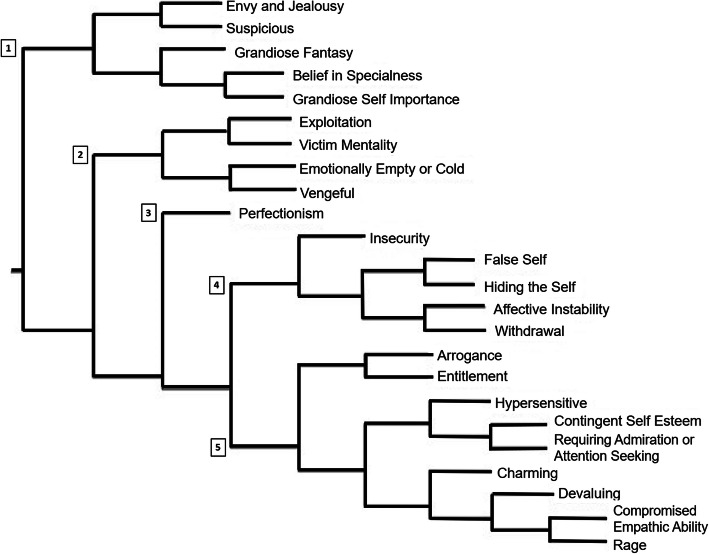
- Additional features were perfectionism, vengefulness, and suspiciousness; descriptive themes included childhood trauma, excessive religiosity, and substance use. A total of 1098 node expressions and 2182 references were coded.
Methods
- Informant-based qualitative study: 436 relatives of people scoring ≥36 on a carer version of the Super Brief Pathological Narcissism Inventory (SB-PNI-CV); participants were current romantic partners (56.2%), former romantic partners (19.7%), and family members (21.3%).
- Participants responded to the prompt “What is your relative like, how do you get on together?”; mean response length was 233 words (SD = 190), range 70–1279 words.
- Verbatim responses were analyzed using phenomenological reading and codebook thematic analysis in NVivo 11, with inter-rater reliability κ = 0.81 on 10% of data; a cluster analysis dendrogram was also generated.
Limitations
- The paper states that online recruitment limited understanding of participant motivation; informant ratings could not control for severity, specificity, or accuracy; the screening tool may have primed participants; gender disparity was substantial; and severity/specificity could not be separated because narcissistic individuals were not assessed via structured clinical interview.
- The paper also notes the sample likely ranged from adaptive/high-functioning narcissism to more severe character disorders and reported broad co-occurring problems.
- Evident from the text: participants were self-selected from narcissism-specific mental health websites, and the sample was predominantly female participants (79.6%) reporting on predominantly male relatives (75.7%), which may limit generalizability.
Model-written summary. Check it against the paper before relying on it.
Integrity signals
Registry
Cites
Statistics
Figures
Verification
Claims the paper makes
8 Valid · 0 Not valid · 34 Not checked · 87 Own results and interpretations
Every source the paper cites for this claim was checked and supports it.
In the paper
“We thus probably studied those ranging from ‘adaptive’ or high functioning narcissism [82] to more severe and disabling character disorders.”
§ Living with pathological narcissism: a qualitative study > Discussion > Limitations
What the sources say
- Supportedcites [82] Miller JD Lynam DR Hyatt CS Campbell KW Controversies in narcissism Annu Rev Clin Psychol 2017 13 291 315 10.1146/annurev-clinpsy-032816-045244 28301765 source
The section “What Are the Distinctions Between Normal and Pathological Narcissism?” discusses the distinction between so-called normal or adaptive narcissism and pathological narcissism, with pathology depending in part on impairment. The citation is attached to the label ‘adaptive’ or high-functioning narcissism, not to the citing authors’ conjecture about whom they studied. The source cautions that apparently normal narcissism is not necessarily adaptive. (LLM, conf=0.86)
hedged- Asserted: passes — The authors put it forward as true.
- Checkable: passes — It can be checked against evidence.
- Load-bearing: unclear — It is unclear whether the paper’s conclusions depend on it.
- Based: passes — The paper gives a reason why it holds.
- Supported
A result the paper reports from its own data — it cites no other source for it, so there is none to check. The quote shows it is in the paper.
In the paper
“Participants regularly described their relative as engaging in substance use.”
§ Living with pathological narcissism: a qualitative study > Results > Descriptive themes
plain- Asserted: passes — The authors put it forward as true.
- Checkable: passes — It can be checked against evidence.
- Load-bearing: unclear — It is unclear whether the paper’s conclusions depend on it.
- Based: passes — The paper gives a reason why it holds.
A result the paper reports from its own data — it cites no other source for it, so there is none to check. The quote shows it is in the paper.
In the paper
“Interestingly, despite being related to these other aspects of narcissism, ‘perfectionism’ was factored as reflecting its own cluster, labelled ‘Controlling’.”
§ Living with pathological narcissism: a qualitative study > Results > Cluster analysis
plain- Asserted: passes — The authors put it forward as true.
- Checkable: passes — It can be checked against evidence.
- Load-bearing: unclear — It is unclear whether the paper’s conclusions depend on it.
- Based: passes — The paper gives a reason why it holds.
A result the paper reports from its own data — it cites no other source for it, so there is none to check. The quote shows it is in the paper.
In the paper
“One feature regularly endorsed by participants that is not encompassed in DSM-5 criteria is relatives’ level of interpersonal charm and likability.”
§ Living with pathological narcissism: a qualitative study > Discussion > Grandiose narcissism
plain- Asserted: passes — The authors put it forward as true.
- Checkable: passes — It can be checked against evidence.
- Load-bearing: unclear — It is unclear whether the paper’s conclusions depend on it.
- Based: passes — The paper gives a reason why it holds.
A result the paper reports from its own data — it cites no other source for it, so there is none to check. The quote shows it is in the paper.
In the paper
“Relatives were also described as displaying perfectionistic, vengeful and suspicious personality features.”
§ Living with pathological narcissism: a qualitative study > Conclusions
plain- Asserted: passes — The authors put it forward as true.
- Checkable: passes — It can be checked against evidence.
- Load-bearing: passes — The paper’s conclusions depend on it.
- Based: passes — The paper gives a reason why it holds.
64 more claims
Create a free account to see all 129 claims and to verify the 5 references still open.
- Probably not a substantial claim. 35
- It may state two separate claims as one. 35
- The quote only partly states this claim. 3
Claims other papers make about this one
Each is checked against this paper’s own text: does it say what the citing paper says it does?
In the citing paper
“Day et al. (2020) report on features of affective instability, hypersensitivity and rage for individuals with pathological narcissism.”
From Pathological narcissism: An analysis of interpersonal dysfunction within intimate relationships (2022) · cites this paper as Day et al. (2020)
Self-check
Percentages, sums and reported differences re-computed from the paper’s own numbers.
Rated minor: it would not touch a result — a value no result rests on, a p-value that stays on the same side of the significance level, or a conflict that is clerical, resolved elsewhere in the paper, or outside its own findings.
In the paper
“| Not Specified | 4% (n = 7) |”
§ Living with pathological narcissism: a qualitative study > Method > Participants
Reported 4 · recomputed 4.605263
Rated minor: it would not touch a result — a value no result rests on, a p-value that stays on the same side of the significance level, or a conflict that is clerical, resolved elsewhere in the paper, or outside its own findings.
In the paper
“| Borderline Personality Disorder | 5% (n = 9) |”
§ Living with pathological narcissism: a qualitative study > Method > Participants
Reported 5 · recomputed 5.921053
Citations
Cites
Diagnostic and Statistical Manual of Mental Disorders
American Psychiatric Association (2013) · doi:10.1176/appi.books.9780890425596 · Cited by 116,369
Diagnostic and Statistical Manual of Mental Disorders, 5th ed.
Carter, M. J. (2014) · Therapeutic Recreation Journal · Cited by 15,166
Interpretative Phenomenological Analysis: Theory, Method and Research
(2010) · QMiP Bulletin · doi:10.53841/bpsqmip.2010.1.10.44 · Cited by 8,189 · cited 1×
“First, a phenomenological approach was adopted which places primacy on understanding the ‘lived experience’ of participant responses [42] whilst ‘bracketing’ researcher preconceptions.”
Method(2005) · PubMed · Cited by 7,011
International Statistical Classification of Diseases and Related Health Problems
(2011) · Encyclopedia of Clinical Neuropsychology · doi:10.1007/978-0-387-79948-3_3055 · Cited by 4,151
International Statistical Classification of Diseases and Related Health Problems
Eisfeld, J. (2014) · TSQ: Transgender Studies Quarterly · doi:10.1215/23289252-2399740 · Cited by 3,570
Braun, V., Clarke, V., Hayfield, N., & Terry, G. (2019) · Handbook of Research Methods in Health Social Sciences · doi:10.1007/978-981-10-5251-4_103 · Cited by 2,910
Winnicott, D. W. (2019) · Cited by 1,757
Grant, B. F., Chou, S. P., Goldstein, R. B., Huang, B., Stinson, F. S., Saha, T. D., Smith, S. M., Dawson, D. S., Pulay, A. J., Pickering, R. P., et al. (2008) · The Journal of Clinical Psychiatry · doi:10.4088/jcp.v69n0404 · Cited by 1,618
Initial construction and validation of the Pathological Narcissism Inventory.
Pincus, A. L., Ansell, E. B., Pimentel, C. A., Cain, N. M., Wright, A. G. C., & Levy, K. N. (2009) · Psychological Assessment · doi:10.1037/a0016530 · Cited by 1,334
Research works printed but not linked: 1
- Jackson K Bazeley P Qualitative analysis with Nvivo 2019 3 London SAGE Publications Limited
Cited by
Pathological narcissism: An analysis of interpersonal dysfunction within intimate relationships
Day, N. J. S., Townsend, M. L., & Grenyer, B. F. S. (2022) · Personality and Mental Health · doi:10.1002/pmh.1532 · Cited by 47
“A recent study by Day et al. (2020) investigated the reported characteristics of individuals with pathological narcissism from the perspective of those in an intimate relationship.”
BackgroundResultSelf-citationUsing Schema Modes for Case Conceptualization in Schema Therapy: An Applied Clinical Approach
Edwards, D. J. A. (2022) · Frontiers in Psychology · doi:10.3389/fpsyg.2021.763670 · Cited by 83
Kampe, L., Bohn, J., Remmers, C., & Hörz‐Sagstetter, S. (2021) · Frontiers in Psychiatry · doi:10.3389/fpsyt.2021.661948 · Cited by 53
van Schie, C. C., Jarman, H. L., Reis, S., & Grenyer, B. F. S. (2021) · BMC Psychiatry · doi:10.1186/s12888-021-03249-4 · Cited by 31
Self-citationInvestigating pathological narcissism and loneliness, and the link with life satisfaction
Kealy, D., Woolgar, S. R., & Hewitt, J. M. A. (2021) · Scandinavian Journal of Psychology · doi:10.1111/sjop.12773 · Cited by 32
Self-serving social strategies: A systematic review of social cognition in narcissism
Eddy, C. M. (2021) · Current Psychology · doi:10.1007/s12144-021-01661-3 · Cited by 10
Narcissistic personality disorder and pathological narcissism
Bliton, C. F., Halberstadt, A. L., Asan, A. E., & Pincus, A. L. (2023) · Elsevier eBooks · doi:10.1016/b978-0-323-91497-0.00238-1 · Cited by 18
Day, N. J. S., Townsend, M. L., & Grenyer, B. F. S. (2022) · BMC Psychiatry · doi:10.1186/s12888-021-03660-x · Cited by 19
“[33]) were separately invited to participate in the current study.”
MethodSelf-citationBiberdzic, M., Tan, J., & Day, N. J. S. (2023) · Borderline Personality Disorder and Emotion Dysregulation · doi:10.1186/s40479-022-00209-6 · Cited by 13
Self-citationSociopathic narcissistic leadership: How about their victims?
Khorram‐Manesh, A., & Burkle, F. M. (2023) · World Medical & Health Policy · doi:10.1002/wmh3.588 · Cited by 14
Kealy, D., Woolgar, S. R., Hewitt, J. M. A., & Cox, D. W. (2022) · Current Psychology · doi:10.1007/s12144-022-02976-5 · Cited by 16
“The interpersonal problems of individuals with narcissistic difficulties often have a social ripple effect, negatively affecting those around them (Dashineau et al., 2019; Day et al., 2020).”
BackgroundHoward, V., & Adan, A. (2022) · Cyberpsychology Journal of Psychosocial Research on Cyberspace · doi:10.5817/cp2022-4-10 · Cited by 17
“Similarly, the academic and scholarly literature often avoids using this term and posits research from the viewpoint of the disordered narcissist rather than from their distressed and damaged victims (see Day et al., 2020; Green & Charles, 2019).”
BackgroundKealy, D., Hewitt, P. L., Cox, D. W., & Laverdière, O. (2021) · Current Psychology · doi:10.1007/s12144-021-01644-4 · Cited by 14
Day, N. J. S., Green, A., Denmeade, G., Bach, B., & Grenyer, B. F. S. (2024) · Journal of Clinical Psychology · doi:10.1002/jclp.23701 · Cited by 18
Self-citationKealy, D., & Gazzillo, F. (2023) · Journal of Clinical Psychology · doi:10.1002/jclp.23625 · Cited by 9
Yang, Y., Zhao, M., Li, Y., Li, B., Dong, Y. H., & Fang, Y. (2022) · Current Psychology · doi:10.1007/s12144-022-03770-z · Cited by 7
“Researchers have noted that narcissism has multiple manifestations (Dawood & Pincus, 2018; Day et al., 2020; Miller et al., 2011; Pincus & Lukowitsky, 2010; Kjærvik & Bush-man, 2021; Wink, 1991).”
Parent Grandiose Narcissism and Child Socio-Emotional Well Being: The Role of Parenting
Rawn, K. P., Keller, P. S., & Widiger, T. A. (2023) · Psychological Reports · doi:10.1177/00332941231208900 · Cited by 9
“…of narcissists ’ relatives (predominantly spouses and parents), participants described narcissists ’ constant need for attention and praise, ostracism of persons who question grandiose views, contempt for others, and jealousy of their children if they receive more attention (Day et al., 2020).”
Green, A., & Hart, C. M. (2024) · Sex Roles · doi:10.1007/s11199-024-01477-y · Cited by 5
“…to target the psychological processes inherent in narcissistic women that inhibit their ability to emphasise with others – specifically their tendency to envy others, and therefore view themselves as a victim to justify their enactment of behaving aggressively towards others (Day et al., 2020 ).”
Day, N. J. S., Biberdzic, M., Green, A., Denmeade, G., Bach, B., & Grenyer, B. F. S. (2025) · Clinical Psychology & Psychotherapy · doi:10.1002/cpp.70070 · Cited by 8
“Grandiose elements include instances of fantasies of omnipotence, self-importance and admiration-seeking, whereas vulnerable elements include instances of interpersonal hypersensitivity, feelings of shame, victimhood and affective instability (Day et al. 2020).”
Self-citationKumar, M. R., & Christopher, G. (2023) · World Journal of English Language · doi:10.5430/wjel.v13n2p232 · Cited by 5
Dark Tetrad Personality Traits: An Analysis by Gender in Aggressors and Victims of School Bullying
Estévez, E., Estévez-García, J. F., & Flores, E. (2025) · School Mental Health · doi:10.1007/s12310-025-09772-z · Cited by 4
“The narcissist’s tendency toward victimization is equally consistent with other psychological characteristics associated with narcissists, such as the higher propensity to be vindictive and paranoid (Day et al., 2020).”
Emotional Dysfunction: Difficulties in Emotion Regulation and Affect Integration
Solbakken, O. A., Frederiksen, C. K., & Monsen, J. T. (2025) · Oxford University Press eBooks · doi:10.1093/9780191964343.003.0012 · Cited by 4
Self-citationDay, N. J. S., Kealy, D., Biberdzic, M., Green, A., Denmeade, G., & Grenyer, B. F. S. (2025) · Personality and Mental Health · doi:10.1002/pmh.70038 · Cited by 2
“Pathological narcissism is a maladaptive personality constellation that contains grandiose (e.g., omnipotent fantasy and attention seeking) and vulnerable (e.g., hypersensitivity and negative affect) dimensions (Day et al. 2020b; Krizan and Herlache 2017; Pincus and Lukowitsky 2010).”
InfluentialSelf-citationFinzi‐Dottan, R., Riff, A. R., & Dagan, G. (2025) · The Family Journal · doi:10.1177/10664807251321510 · Cited by 5
The Never Ending Intellectual Theft of Truth: How the Mainstream Media Cartel Dismembers the Facts
Ross, D. B., & Peyton, G. L. (2021) · Advances in educational technologies and instructional design book series · doi:10.4018/978-1-7998-6474-5.ch003 · Cited by 1
Howard, R., & Duggan, C. F. (2022) · Cambridge University Press eBooks · doi:10.1017/9781911623892.003 · Cited by 1
Basereh, S., Safarzadeh, S., & Hooman, F. (2022) · Journal of Multidisciplinary Care · doi:10.34172/jmdc.2022.43 · Cited by 1
Treatment of Alec: “History does not have to repeat itself”
Weinberg, I. (2023) · Journal of Clinical Psychology · doi:10.1002/jclp.23613 · Cited by 1
“They are more likely to attempt or die by suicide (Ronningstam & Weinberg, 2013) and they tend to evoke distress in people close to them (Day et al., 2020).”
BackgroundTan, W.-K., & Dong, J.-Y. (2024) · Service Business · doi:10.1007/s11628-024-00564-0 · Cited by 1
“Hiding the self involves emotional or physical withdrawal (Day et al. 2020) and contingent self-esteem involves fluctuation in self-esteem (Naidu et al. 2019).”
InfluentialCorrection to: Living with pathological narcissism: a qualitative study
Day, N. J. S., Townsend, M. L., & Grenyer, B. F. S. (2022) · Borderline Personality Disorder and Emotion Dysregulation · doi:10.1186/s40479-022-00177-x
Self-citationde la Torre-Risquez, A. (2021) · Gredos (University of Salamanca) · doi:10.14201/gredos.149576
Showing True Colours: EMA Case Descriptions of Narcissistic States
Freund, V. L., Peeters, F. P. M. L., & Lobbestael, J. (2023) · Journal of Personality Assessment · doi:10.1080/00223891.2023.2244074
“Moreover, clinical research found that, for example, relatives describe narcissistic individuals in terms of both grandiose and vulnerable characteristics (Day et al., 2020).”
BackgroundDonald Trump und der pathologische Narzissmus
Hinz, G. (2024) · NeuroTransmitter · doi:10.1007/s15016-024-3922-7
Staff Observational Differences Between Depressive Disorders and Personality Disorders
Jayakody, K., McKinnon, I., & Cousins, D. A. (2024) · Journal of Psychiatric and Mental Health Nursing · doi:10.1111/jpm.13134
Bush, G. J., & Luchner, A. F. (2025) · Journal of Emotion and Psychopathology · doi:10.55913/joep.v1i2.68 · Cited by 1
“Individuals with both grandiose and vulnerable narcissism may increase susceptibility to negative emotions within individuals by denying their autonomy, enforcing obedience, and making them feel inferior or less important (Day et al., 2020; Gabbard & Crisp, 2018; Sherry et al., 2018).”
Enhancing ethical hiring practices: a remedy for academic narcissism
Kasaeiyan, R. (2025) · Mental Wellness · doi:10.4081/mw.2025.27
Narrative Accounts of the Self
Williams, L. A. (2025) · Cambridge University Press eBooks · doi:10.1017/9781009445955.023
Pathological Narcissism and Loneliness
Kealy, D., & Finch, E. F. (2025) · Springer eBooks · doi:10.1007/978-3-032-02959-1_5
Bedard, T., MacIsaac, A., Visser, B. A., & Mushquash, A. R. (2025) · Personality and Individual Differences · doi:10.1016/j.paid.2025.113597
Kyranides, M. N., AlAbbas, A., & Hafetz, J. S. (2026) · The Journal of Psychology · doi:10.1080/00223980.2026.2688115
Vulnerability and Emotional Abilities
Schmidt-Boddy, P. (2026) · Cambridge University Press eBooks · doi:10.1017/9781009627269.014
Vulnerability and Psychopathology: Emotions and Their Embodiment
Melichar, H. G., Schmidt-Boddy, P., Fuchs, T., & Tewes, C. (2026) · Cambridge University Press eBooks · doi:10.1017/9781009627269.011
Fanti, E., Nitti, G., Pisati, E., Sarno, M. D., Felici, C., Pincus, A. L., Madeddu, F., Preti, E., & Pierro, R. D. (2026) · Current Psychology · doi:10.1007/s12144-026-09815-x
“The latter pattern may reflect a representa - tion of the other as warm and admiring of the grandiose self, consistent with patterns described in the clinical literature on idealizing transference (Day et al., 2020; Diamond et al., 2022; Gabbard & Crisp, 2018; Kernberg, 2007; Kohut & Wolf, 1978).”
Jacob, K. L., & Unruh, B. T. (2026) · Harvard Review of Psychiatry · doi:10.1097/hrp.0000000000000475
“22,24 The DSM-5, Section II categorical diagnostic approach describes the more narrowly defined construct of NPD as a pervasive pattern of grandiosity with associated arro-gance, lack of empathy, and need for admiration.”
Metadata
- Authors
- Day, N. J. S., Townsend, M. L., & Grenyer, B. F. S.
- Affiliations
- University of Wollongong (AU)
- Corresponding author
- Grenyer, Brin F. S.
- Venue
- Borderline Personality Disorder and Emotion Dysregulation
- Published
- 2020-08-14
- Volume
- 7
- Issue
- 1
- Pages
- 19-19
- ISSN
- 2051-6673 (ISSN-L)
- PMC
- PMC7427292
- OpenAlex
- W3049237279
- Semantic Scholar
- 1da414aff027207fc15dbb99c04923c39b002604
- Cited by
- 47
- References
- 96
- Citations by year
- 2026: 5 · 2025: 10 · 2024: 7 · 2023: 8 · 2022: 8 · 2021: 9
- FWCI
- 2.50
- Type
- journal article
- Language
- en
- Update notices
- correction (2022-01-22)
- Open access
- gold
- doi.org
- Licence
- cc-by
- creativecommons.org/licenses/by/4.0 (tdm)
- creativecommons.org/licenses/by/4.0 (vor)
- Locations
- Borderline Personality Disorder and Emotion Dysregulation (publishedVersion, cc-by)
- PubMed Central (publishedVersion, cc-by)
- PubMed (publishedVersion)
- Research Online (University of Wollongong) (submittedVersion)
- DOAJ (DOAJ: Directory of Open Access Journals) (submittedVersion, cc-by-sa)
- Figshare (submittedVersion)
- Funders
- NSW Ministry of Health
- Topics
- Social Sciences › Psychology › Clinical Psychology › Personality Disorders and Psychopathology
- Social Sciences › Psychology › Clinical Psychology › Personality Traits and Psychology
- Social Sciences › Psychology › Clinical Psychology › Psychoanalysis and Psychopathology Research
- Keywords
- pathological narcissism, narcissistic personality disorder, grandiosity, vulnerability, interpersonal relationships, romantic partners, family members, emptiness, neuroticism, empathy deficits, misdiagnosis, childhood trauma, antisocial personality traits
About these checks
Registry, retraction, Cites and statistics results are computed, not judged, with one exception: a printed reference that no index lists is read once by a model before it counts as a citation error. Claims are extracted by a model and kept only when their quote appears verbatim in the text; each cited source is then checked, with a model’s help, for whether it says what the claim relies on. Those verdicts can be wrong — read the claim’s quote and the cited source before relying on one.
The claim verdicts this report counts are experimental: their accuracy is not yet measured.
A language model drew the claims from the paper on 2026-10-10, under version 3 of the claim definition (model deepseek-v4.1-flash, prompt extract-v3).
A second model labelled each claim on 2026-10-10 (model jev-1.13-20260917, definition revision gold-guideline-v0.2).
Cited sources are checked with a language model’s help (gpt-6-sol).
Statistics and arithmetic are recomputed, not judged.
Confidence bands are shown only for fields calibrated on our annotated test set. None is calibrated yet, so no band is shown.
What counts as a claim ›How we measure confidence ›How we check this ›
Are you an author, or do you see a problem with this page? Request a review
Data sources
Bibliographic data: Semantic Scholar, OpenAlex, Crossref.
Contains information from the Semantic Scholar Academic Graph Datasets, made available under the ODC Attribution License (ODC-BY 1.0).
Semantic Scholar’s data is described in: Kinney, R., et al. (2023). The Semantic Scholar Open Data Platform. arXiv:2301.10140.
