

Living with pathological narcissism: a qualitative study
Open accessThe DOI matches its Crossref record; 96 of the 96 references it cites were found in a registry or an index; 9 of the 84 sources its claims cite were checked for support.
Abstract
Background: Research into the personality trait of narcissism have advanced further understanding of the pathological concomitants of grandiosity, vulnerability and interpersonal antagonism. Recent research has established some of the interpersonal impacts on others from being in a close relationship with someone having such traits of pathological narcissism, but no qualitative studies exist. Individuals with pathological narcissism express many of their difficulties of identity and emotion regulation within the context of significant interpersonal relationships thus studying these impacts on others is warranted. Method: We asked the relatives of people high in narcissistic traits (indexed by scoring above a cut-off on a narcissism screening measure) to describe their relationships (N = 436; current romantic partners [56.2%]; former romantic partners [19.7%]; family members [21.3%]). Participants were asked to describe their relative and their interactions with them. Verbatim responses were thematically analysed. Results: Participants described ‘grandiosity’ in their relative: requiring admiration, showing arrogance, entitlement, envy, exploitativeness, grandiose fantasy, lack empathy, self-importance and interpersonal charm. Participants also described ‘vulnerability’ of the relative: contingent self-esteem, hypersensitivity and insecurity, affective instability, emptiness, rage, devaluation, hiding the self and victimhood. These grandiose and vulnerable characteristics were commonly reported together (69% of respondents). Participants also described perfectionistic (anankastic), vengeful (antisocial) and suspicious (paranoid) features. Instances of relatives childhood trauma, excessive religiosity and substance abuse were also described. Conclusions: These findings lend support to the importance of assessing the whole dimension of the narcissistic personality, as well as associated personality patterns. On the findings reported here, the vulnerable aspect of pathological narcissism impacts others in an insidious way given the core deficits of feelings of emptiness and affective instability. These findings have clinical implications for diagnosis and treatment in that the initial spectrum of complaints may be misdiagnosed unless the complete picture is understood. Living with a person with pathological narcissism can be marked by experiencing a person who shows large fluctuations in affect, oscillating attitudes and contradictory needs.
Overview
CoChat Summary
TL;DR
This qualitative study analyzed relatives’ descriptions of people high in pathological narcissism and found that grandiose and vulnerable features commonly co-occurred. Participants also described other personality features (perfectionistic, vengeful, suspicious) and contextual themes such as trauma, religiosity, and substance use.
Key findings
- Among 436 participants, 69% described both grandiose and vulnerable characteristics in their relative; 11% focused on grandiose features only and 20% on vulnerable features only.
- Grandiosity included requiring admiration, arrogance, entitlement, envy, exploitation, grandiose fantasy, grandiose self-importance, lack of empathy, belief in own specialness, and charm.
- Vulnerability included contingent self-esteem, devaluing, emotional emptiness/coldness, hiding the self, hypersensitivity, insecurity, rage, affective instability, and victim mentality.
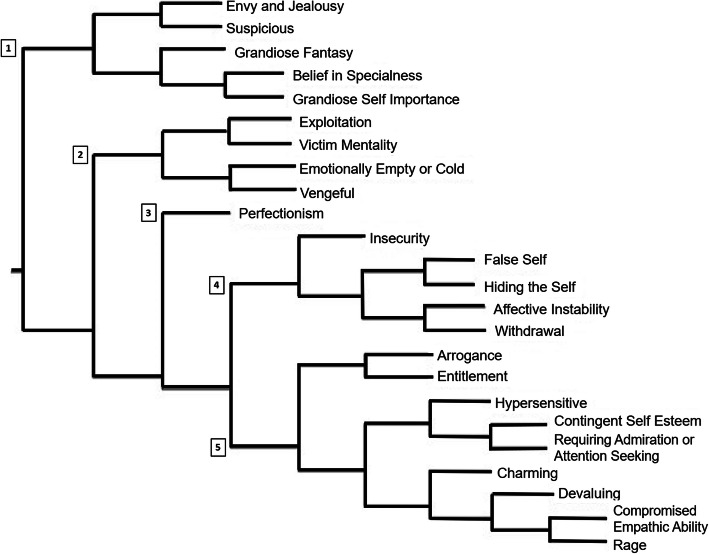
- Additional features were perfectionism, vengefulness, and suspiciousness; descriptive themes included childhood trauma, excessive religiosity, and substance use. A total of 1098 node expressions and 2182 references were coded.
Methods
- Informant-based qualitative study: 436 relatives of people scoring ≥36 on a carer version of the Super Brief Pathological Narcissism Inventory (SB-PNI-CV); participants were current romantic partners (56.2%), former romantic partners (19.7%), and family members (21.3%).
- Participants responded to the prompt “What is your relative like, how do you get on together?”; mean response length was 233 words (SD = 190), range 70–1279 words.
- Verbatim responses were analyzed using phenomenological reading and codebook thematic analysis in NVivo 11, with inter-rater reliability κ = 0.81 on 10% of data; a cluster analysis dendrogram was also generated.
Limitations
- The paper states that online recruitment limited understanding of participant motivation; informant ratings could not control for severity, specificity, or accuracy; the screening tool may have primed participants; gender disparity was substantial; and severity/specificity could not be separated because narcissistic individuals were not assessed via structured clinical interview.
- The paper also notes the sample likely ranged from adaptive/high-functioning narcissism to more severe character disorders and reported broad co-occurring problems.
- Evident from the text: participants were self-selected from narcissism-specific mental health websites, and the sample was predominantly female participants (79.6%) reporting on predominantly male relatives (75.7%), which may limit generalizability.
Model-written summary. Check it against the paper before relying on it.
Integrity signals
Registry
Cites
Statistics
Figures
Verification
Claims the paper makes
8 Valid · 0 Not valid · 34 Not checked · 87 Own results and interpretations
Every source the paper cites for this claim was checked and supports it.
In the paper
“We thus probably studied those ranging from ‘adaptive’ or high functioning narcissism [82] to more severe and disabling character disorders.”
§ Living with pathological narcissism: a qualitative study > Discussion > Limitations
What the sources say
- Supportedcites [82] Miller JD Lynam DR Hyatt CS Campbell KW Controversies in narcissism Annu Rev Clin Psychol 2017 13 291 315 10.1146/annurev-clinpsy-032816-045244 28301765 source
The section “What Are the Distinctions Between Normal and Pathological Narcissism?” discusses the distinction between so-called normal or adaptive narcissism and pathological narcissism, with pathology depending in part on impairment. The citation is attached to the label ‘adaptive’ or high-functioning narcissism, not to the citing authors’ conjecture about whom they studied. The source cautions that apparently normal narcissism is not necessarily adaptive. (LLM, conf=0.86)
hedged- Asserted: passes — The authors put it forward as true.
- Checkable: passes — It can be checked against evidence.
- Load-bearing: unclear — It is unclear whether the paper’s conclusions depend on it.
- Based: passes — The paper gives a reason why it holds.
- Supported
A result the paper reports from its own data — it cites no other source for it, so there is none to check. The quote shows it is in the paper.
In the paper
“Participants regularly described their relative as engaging in substance use.”
§ Living with pathological narcissism: a qualitative study > Results > Descriptive themes
plain- Asserted: passes — The authors put it forward as true.
- Checkable: passes — It can be checked against evidence.
- Load-bearing: unclear — It is unclear whether the paper’s conclusions depend on it.
- Based: passes — The paper gives a reason why it holds.
A result the paper reports from its own data — it cites no other source for it, so there is none to check. The quote shows it is in the paper.
In the paper
“Interestingly, despite being related to these other aspects of narcissism, ‘perfectionism’ was factored as reflecting its own cluster, labelled ‘Controlling’.”
§ Living with pathological narcissism: a qualitative study > Results > Cluster analysis
plain- Asserted: passes — The authors put it forward as true.
- Checkable: passes — It can be checked against evidence.
- Load-bearing: unclear — It is unclear whether the paper’s conclusions depend on it.
- Based: passes — The paper gives a reason why it holds.
A result the paper reports from its own data — it cites no other source for it, so there is none to check. The quote shows it is in the paper.
In the paper
“One feature regularly endorsed by participants that is not encompassed in DSM-5 criteria is relatives’ level of interpersonal charm and likability.”
§ Living with pathological narcissism: a qualitative study > Discussion > Grandiose narcissism
plain- Asserted: passes — The authors put it forward as true.
- Checkable: passes — It can be checked against evidence.
- Load-bearing: unclear — It is unclear whether the paper’s conclusions depend on it.
- Based: passes — The paper gives a reason why it holds.
A result the paper reports from its own data — it cites no other source for it, so there is none to check. The quote shows it is in the paper.
In the paper
“Relatives were also described as displaying perfectionistic, vengeful and suspicious personality features.”
§ Living with pathological narcissism: a qualitative study > Conclusions
plain- Asserted: passes — The authors put it forward as true.
- Checkable: passes — It can be checked against evidence.
- Load-bearing: passes — The paper’s conclusions depend on it.
- Based: passes — The paper gives a reason why it holds.
64 more claims
Create a free account to see all 129 claims and to verify the 5 references still open.
- Probably not a substantial claim. 35
- It may state two separate claims as one. 35
- The quote only partly states this claim. 3
Claims other papers make about this one
Each is checked against this paper’s own text: does it say what the citing paper says it does?
In the citing paper
“Day et al. (2020) report on features of affective instability, hypersensitivity and rage for individuals with pathological narcissism.”
From Pathological narcissism: An analysis of interpersonal dysfunction within intimate relationships (2022) · cites this paper as Day et al. (2020)
Self-check
Percentages, sums and reported differences re-computed from the paper’s own numbers.
Rated minor: it would not touch a result — a value no result rests on, a p-value that stays on the same side of the significance level, or a conflict that is clerical, resolved elsewhere in the paper, or outside its own findings.
In the paper
“| Not Specified | 4% (n = 7) |”
§ Living with pathological narcissism: a qualitative study > Method > Participants
Reported 4 · recomputed 4.605263
Rated minor: it would not touch a result — a value no result rests on, a p-value that stays on the same side of the significance level, or a conflict that is clerical, resolved elsewhere in the paper, or outside its own findings.
In the paper
“| Borderline Personality Disorder | 5% (n = 9) |”
§ Living with pathological narcissism: a qualitative study > Method > Participants
Reported 5 · recomputed 5.921053
Citations
Cites
Diagnostic and Statistical Manual of Mental Disorders
American Psychiatric Association (2013) · doi:10.1176/appi.books.9780890425596 · Cited by 116,369
Diagnostic and Statistical Manual of Mental Disorders, 5th ed.
Carter, M. J. (2014) · Therapeutic Recreation Journal · Cited by 15,166
Interpretative Phenomenological Analysis: Theory, Method and Research
(2010) · QMiP Bulletin · doi:10.53841/bpsqmip.2010.1.10.44 · Cited by 8,189 · cited 1×
“First, a phenomenological approach was adopted which places primacy on understanding the ‘lived experience’ of participant responses [42] whilst ‘bracketing’ researcher preconceptions.”
Method(2005) · PubMed · Cited by 7,011
International Statistical Classification of Diseases and Related Health Problems
(2011) · Encyclopedia of Clinical Neuropsychology · doi:10.1007/978-0-387-79948-3_3055 · Cited by 4,151
International Statistical Classification of Diseases and Related Health Problems
Eisfeld, J. (2014) · TSQ: Transgender Studies Quarterly · doi:10.1215/23289252-2399740 · Cited by 3,570
Braun, V., Clarke, V., Hayfield, N., & Terry, G. (2019) · Handbook of Research Methods in Health Social Sciences · doi:10.1007/978-981-10-5251-4_103 · Cited by 2,910
Winnicott, D. W. (2019) · Cited by 1,757
Grant, B. F., Chou, S. P., Goldstein, R. B., Huang, B., Stinson, F. S., Saha, T. D., Smith, S. M., Dawson, D. S., Pulay, A. J., Pickering, R. P., et al. (2008) · The Journal of Clinical Psychiatry · doi:10.4088/jcp.v69n0404 · Cited by 1,618
Initial construction and validation of the Pathological Narcissism Inventory.
Pincus, A. L., Ansell, E. B., Pimentel, C. A., Cain, N. M., Wright, A. G. C., & Levy, K. N. (2009) · Psychological Assessment · doi:10.1037/a0016530 · Cited by 1,334
Pathological narcissism and narcissistic personality disorder
Pincus, A. L., & Lukowitsky, M. R. (2010) · Annual Review of Clinical Psychology · doi:10.1146/annurev.clinpsy.121208.131215 · Cited by 1,082
Thoughts on Narcissism and Narcissistic Rage
Kohut, H. (1972) · The Psychoanalytic Study of the Child · doi:10.1080/00797308.1972.11822721 · Cited by 955
Forms and Transformations of Narcissism
Kohut, H. (1966) · Journal of the American Psychoanalytic Association · doi:10.1177/000306516601400201 · Cited by 912
Rokach, L., & Maimon, O. (2006) · Data Mining and Knowledge Discovery Handbook · doi:10.1007/0-387-25465-x_15 · Cited by 906
Cain, N. M., Pincus, A. L., & Ansell, E. B. (2008) · Clinical Psychology Review · doi:10.1016/j.cpr.2007.09.006 · Cited by 876
Assessing Hypersensitive Narcissism: A Reexamination of Murray's Narcism Scale
Hendin, H. M., & Cheek, J. M. (1997) · Journal of Research in Personality · doi:10.1006/jrpe.1997.2204 · Cited by 851
Miller, J. D., Lynam, D. R., Hyatt, C. S., & Campbell, W. K. (2017) · Annual Review of Clinical Psychology · doi:10.1146/annurev-clinpsy-032816-045244 · Cited by 572
Psychoanalytic Diagnosis: Understanding Personality Structure in the Clinical Process
Chessick, R. D. (1995) · American Journal of Psychotherapy · doi:10.1176/appi.psychotherapy.1995.49.3.448 · Cited by 546
The structure of personality pathology: Both general (‘g’) and specific (‘s’) factors?
Sharp, C., Wright, A. G. C., Fowler, J. C., Frueh, B. C., Allen, J. G., Oldham, J., & Clark, L. A. (2015) · Journal of Abnormal Psychology · doi:10.1037/abn0000033 · Cited by 515
Psychoanalytic Diagnosis: Understanding Personality Structure in the Clinical Process
McWilliams, N. (1994) · Medical Entomology and Zoology · Cited by 481
Psychotherapy for Borderline Personality: Focusing on Object Relations
(2006) · American Journal of Psychiatry · doi:10.1176/appi.ajp.163.5.944 · Cited by 426
The Five-Factor Narcissism Inventory: A Five-Factor Measure of Narcissistic Personality Traits
Glover, N., Miller, J. D., Lynam, D. R., Crego, C., & Widiger, T. A. (2012) · Journal of Personality Assessment · doi:10.1080/00223891.2012.670680 · Cited by 393
(2011) · Wiley eBooks · doi:10.1002/9781118093108 · Cited by 351
Doing qualitative analysis in psychology.
Andersson, G. (1998) · Clinical Psychology & Psychotherapy · Cited by 338
Stinson, F. S., Dawson, D. A., Golstein, R. B., Chou, P., Huang, B., Smith, S. M., Ruan, W. J., Pulay, A. J., Saha, T. D., Pickering, R. P., et al. (2008) · The Journal of Clinical Psychiatry · doi:10.4088/jcp.v69n0701 · Cited by 337
Informant-reports of personality disorder: relation to self-reports and future research directions
Klonsky, E. D., Oltmanns, T. F., & Turkheimer, E. (2002) · Clinical Psychology: Science and Practice · doi:10.1093/clipsy.9.3.300 · Cited by 314
Refining the Construct of Narcissistic Personality Disorder: Diagnostic Criteria and Subtypes
Russ, E., Shedler, J., Bradley, R., & Westen, D. (2008) · American Journal of Psychiatry · doi:10.1176/appi.ajp.2008.07030376 · Cited by 272
Narcissistic grandiosity and narcissistic vulnerability in psychotherapy.
Pincus, A. L., Cain, N. M., & Wright, A. G. C. (2014) · Personality Disorders: Theory, Research, and Treatment · doi:10.1037/per0000031 · Cited by 267
Vulnerable Narcissism Is (Mostly) a Disorder of Neuroticism
Miller, J. D., Lynam, D. R., Vize, C., Crowe, M., Sleep, C., Maples‐Keller, J. L., Few, L. R., & Campbell, W. K. (2018) · Journal of Personality · doi:10.1111/jopy.12303 · Cited by 240
Krizan, Z., & Johar, O. (2015) · Journal of Personality and Social Psychology · doi:10.1037/pspp0000013 · Cited by 234
Narcissistic Personality Disorder: Facing DSM-V
Ronningstam, E. (2009) · Psychiatric Annals · doi:10.3928/00485713-20090301-09 · Cited by 226 · cited 2×
“As such, these results support the notion that an individual’s narcissism presentation may fluctuate over time [20, 21] and that vulnerable and grandiose presentations are inter-related and oscillating [9, 19].”
BackgroundResultDevelopment of a brief version of the Pathological Narcissism Inventory.
Schoenleber, M., Roche, M. J., Wetzel, E., Pincus, A. L., & Roberts, B. W. (2015) · Psychological Assessment · doi:10.1037/pas0000158 · Cited by 199
Narcissistic personality disorder: a current review.
Ronningstam, E. (2010) · Current Psychiatry Reports · doi:10.1007/s11920-009-0084-z · Cited by 177
Psychodynamic Diagnostic Manual (PDM)
Stern, R. (2009) · The Journal of Clinical Psychiatry · doi:10.4088/jcp.09bk05461 · Cited by 161
The Relationship between Grandiose and Vulnerable (Hypersensitive) Narcissism
Jauk, E., Weigle, E., Lehmann, K., Benedek, M., & Neubauer, A. C. (2017) · Frontiers in Psychology · doi:10.3389/fpsyg.2017.01600 · Cited by 154
Theory-led thematic analysis: Social identification in small companies.
Hayes, N. (1997) · doi:10.4324/9781315804552-13 · Cited by 154
Manual of Instructions for Using the Gottschalk-Gleser Content Analysis Scales
Gottschalk, L. A., Winget, C. N., & Gleser, G. C. (1969) · doi:10.1525/9780520318816 · Cited by 152
Clinical Correlates of Vulnerable and Grandiose Narcissism: A Personality Perspective
Kaufman, S. B., Weiss, B., Miller, J. D., & Campbell, W. K. (2020) · Journal of Personality Disorders · doi:10.1521/pedi_2018_32_384 · Cited by 148 · cited 3×
“Recent research supports this defensive function of grandiosity, with Kaufman, Weiss [11] stating “grandiose narcissism was less consistently and strongly related to psychopathology … and even showed positive correlations with adaptive coping, life satisfaction and image-distorting defense mechanisms” (p. 18).”
BackgroundResultWhite, Y., & Grenyer, B. F. S. (1999) · Journal of Advanced Nursing · doi:10.1046/j.1365-2648.1999.01236.x · Cited by 145
Self-citationThe Almost Untreatable Narcissistic Patient
Kernberg, O. F. (2007) · Journal of the American Psychoanalytic Association · doi:10.1177/00030651070550020701 · Cited by 143 · cited 1×
“Regarding the ‘vengeful’ node, Kernberg [16], Kernberg [59] describes that as a result of a pain-rage-hatred cycle, justification of revenge against the frustrating object is an almost unavoidable consequence.”
BackgroundGottschalk, L. A., Winget, C. N., & Gleser, G. C. (1979) · Medical Entomology and Zoology · Cited by 138
Wright, A. G. C., Stepp, S. D., Scott, L. N., Hallquist, M. N., Beeney, J. E., Lazarus, S. A., & Pilkonis, P. A. (2017) · Journal of Abnormal Psychology · doi:10.1037/abn0000286 · Cited by 129
Narcissistic Personality Disorder in DSM-V—In Support of Retaining a Significant Diagnosis
Ronningstam, E. (2011) · Journal of Personality Disorders · doi:10.1521/pedi.2011.25.2.248 · Cited by 122
Welwood, J. (2000) · Cited by 110
Kernberg, O. F., & Yeomans, F. E. (2013) · Bulletin of the Menninger Clinic · doi:10.1521/bumc.2013.77.1.1 · Cited by 108 · cited 1×
“For instance, treatment of individuals with depressive disorders require different approaches than individuals with a vulnerably narcissistic presentation [24, 77].”
BackgroundThe Wax and Wane of Narcissism: Grandiose Narcissism as a Process or State
Giacomin, M., & Jordan, C. H. (2016) · Journal of Personality · doi:10.1111/jopy.12148 · Cited by 103
Supporting a Person With Personality Disorder: A Study of Carer Burden and Well-Being
Bailey, R. C., & Grenyer, B. F. S. (2014) · Journal of Personality Disorders · doi:10.1521/pedi_2014_28_136 · Cited by 101
Self-citationThe Pathological Narcissism Inventory.
Pincus, A. L. (2013) · Understanding and treating pathological narcissism. · doi:10.1037/14041-006 · Cited by 96
Subtypes, Dimensions, Levels, and Mental States in Narcissism and Narcissistic Personality Disorder
Levy, K. N. (2012) · Journal of Clinical Psychology · doi:10.1002/jclp.21893 · Cited by 93
Down-Regulating Narcissistic Tendencies: Communal Focus Reduces State Narcissism
Giacomin, M., & Jordan, C. H. (2014) · Personality and Social Psychology Bulletin · doi:10.1177/0146167213516635 · Cited by 85
Interpersonal Perception of Pathological Narcissism: A Social Relations Analysis
Lukowitsky, M. R., & Pincus, A. L. (2013) · Journal of Personality Assessment · doi:10.1080/00223891.2013.765881 · Cited by 83
Narcissistic personality disorder in DSM-5.
Skodol, A. E., Bender, D. S., & Morey, L. C. (2014) · Personality Disorders: Theory, Research, and Treatment · doi:10.1037/per0000023 · Cited by 83
[Psychodynamic Diagnostic Manual, PDM].
Ferrari, H. A. (2006) · PubMed · Cited by 82
A Historical Review of Narcissism and Narcissistic Personality
Levy, K. N., Ellison, W. D., & Reynoso, J. S. (2011) · The Handbook of Narcissism and Narcissistic Personality Disorder · doi:10.1002/9781118093108.ch1 · Cited by 79 · cited 1×
“First, this study extends and supports the widespread acknowledged limitation of DSM-5 criteria for narcissistic personality disorder regarding the exclusion of vulnerable features (for a review of changes to dignostic criteria over time, see [74, 75]) and we acknowledge the current discussion regarding therapist deci…”
ResultThe lived experience of recovery in borderline personality disorder: a qualitative study
Ng, F. Y. Y., Townsend, M. L., Miller, C. E., Jewell, M., & Grenyer, B. F. S. (2019) · Borderline Personality Disorder and Emotion Dysregulation · doi:10.1186/s40479-019-0107-2 · Cited by 79
Self-citationNarcissism From the Perspective of the Dynamic Self‐Regulatory Processing Model
Morf, C. C., Torchetti, L., & Schürch, E. (2011) · The Handbook of Narcissism and Narcissistic Personality Disorder · doi:10.1002/9781118093108.ch6 · Cited by 77 · cited 1×
“As such, pathological narcissism has been understood as a characterological way of understanding the self and others in which feelings of vulnerability are defended against through grandiosity [56], and threats to grandiosity trigger dysregulating and disintegrating feelings of vulnerability [53].”
BackgroundCurrent understanding of narcissism and narcissistic personality disorder
Yakeley, J. (2018) · BJPsych Advances · doi:10.1192/bja.2018.20 · Cited by 77
Miller, J. D., Hoffman, B. J., Campbell, W. K., & Pilkonis, P. A. (2008) · Comprehensive Psychiatry · doi:10.1016/j.comppsych.2007.08.012 · Cited by 74
Childhood physical abuse and aggression: Shame and narcissistic vulnerability
Keene, A. C., & Epps, J. (2016) · Child Abuse & Neglect · doi:10.1016/j.chiabu.2015.09.012 · Cited by 74
Countertransference when working with narcissistic personality disorder: An empirical investigation.
Tanzilli, A., Muzi, L., Ronningstam, E., & Lingiardi, V. (2017) · Psychotherapy · doi:10.1037/pst0000111 · Cited by 73
Nealis, L. J., Sherry, S. B., Sherry, D. L., Stewart, S. H., & Macneil, M. A. (2015) · Journal of Research in Personality · doi:10.1016/j.jrp.2015.02.006 · Cited by 66
Dimaggio, G., Semerari, A., Falcone, M., Nicolò, G., Carcione, A., & Procacci, M. (2002) · Journal of Psychotherapy Integration · doi:10.1037/1053-0479.12.4.421 · Cited by 59 · cited 1×
“This factor may involve a literal physical withdrawal and isolation [14] but may also include a subtler emotional or psychic withdrawal due to feelings of inadequacy and shame which may result in the development of an imposter or inauthentic ‘false self’ [11, 15], and which may also include a disavowal of emotions, be…”
BackgroundNarcissistic Personality Disorder: Progress in Understanding and Treatment
Weinberg, I., & Ronningstam, E. (2022) · Focus · doi:10.1176/appi.focus.20220052 · Cited by 59
Green, A., & Charles, K. (2019) · Sage Open · doi:10.1177/2158244019846693 · Cited by 53 · cited 2×
“For example, a recent study by Valashjardi and Charles [35] provided such a perspective within the context of domestic violence.”
BackgroundNarcissistic Personality Disorder: Progress in Recognition and Treatment
Ronningstam, E., & Weinberg, I. (2013) · Focus · doi:10.1176/appi.focus.11.2.167 · Cited by 50
Grandiose and Vulnerable Narcissism in Borderline Personality Disorder
Euler, S., Stöbi, D., Sowislo, J., Ritzler, F., Huber, C. G., Lang, U. E., Wrege, J., & Walter, M. (2018) · Psychopathology · doi:10.1159/000486601 · Cited by 47 · cited 2×
“These aspects of narcissism have also been documented within published literature [12, 27, 53, 54].”
BackgroundSimon, R. I. (2002) · Harvard Review of Psychiatry · doi:10.1080/10673220216206 · Cited by 45
Parental Invalidation and the Development of Narcissism
Huxley, E., & Bizumic, B. (2017) · The Journal of Psychology · doi:10.1080/00223980.2016.1248807 · Cited by 42
Narcissistic traits in young people: understanding the role of parenting and maltreatment
van Schie, C. C., Jarman, H. L., Huxley, E., & Grenyer, B. F. S. (2020) · Borderline Personality Disorder and Emotion Dysregulation · doi:10.1186/s40479-020-00125-7 · Cited by 42
Self-citationPathological Narcissism: A Study of Burden on Partners and Family
Day, N. J. S., Bourke, M. E., Townsend, M. L., & Grenyer, B. F. S. (2020) · Journal of Personality Disorders · doi:10.1521/pedi_2019_33_413 · Cited by 40 · cited 4×
“This measure was then adapted into a carer version (SB-PNI-CV) in the current research, consistent with previous methodology [33] by changing all selfreferential terms (i.”
BackgroundMethodInfluentialSelf-citationKernberg, O. F. (2004) · Medical Entomology and Zoology · Cited by 39
Psychodynamic diagnostic manual: PDM-2, 2nd ed.
Lingiardi, V., & McWilliams, N. (2017) · Cited by 36
Facial Emotion Recognition and Social-Cognitive Correlates of Narcissistic Features
De Panfilis, C., Antonucci, C., Meehan, K. B., Cain, N. M., Soliani, A., Marchesi, C., Clarkin, J. F., & Sambataro, F. (2019) · Journal of Personality Disorders · doi:10.1521/pedi_2018_32_350 · Cited by 34
Gold, A., & Wilpizeski, C. R. (1966) · The Laryngoscope · doi:10.1288/00005537-196604000-00006 · Cited by 31
Cheek, J., Kealy, D., Joyce, A., & Ogrodniczuk, J. (2018) · Archives of Psychiatry and Psychotherapy · doi:10.12740/app/90328 · Cited by 30
Informant assessment: The Informant Five-Factor Narcissism Inventory.
Oltmanns, J. R., Crego, C., & Widiger, T. A. (2018) · Psychological Assessment · doi:10.1037/pas0000487 · Cited by 29
Hörz-Sagstetter, S., Diamond, D., Clarkin, J. F., Levy, K. N., Rentrop, M., Fischer-Kern, M., Cain, N. M., & Doering, S. (2018) · Journal of Personality Disorders · doi:10.1521/pedi_2017_31_306 · Cited by 28
Caligor, E., & Stern, B. L. (2020) · Journal of Personality Disorders · doi:10.1521/pedi.2020.34.supp.104 · Cited by 27
Interpersonal problems of narcissistic patients.
Kealy, D. (2013) · Understanding and treating pathological narcissism. · doi:10.1037/14041-007 · Cited by 25
Lenzenweger, M. F., Clarkin, J. F., Caligor, E., Cain, N. M., & Kernberg, O. F. (2018) · Psychopathology · doi:10.1159/000492228 · Cited by 24 · cited 1×
“Extreme expressions of acting out these “ego-syntonic” revenge fantasies may also highlight the presence of an extreme form of pathological narcissism in this sample – malignant narcissism, which involves the presence of a narcissistic personality with prominent paranoia and antisocial features [60].”
BackgroundPersonality in PDM-2: Controversial issues.
McWilliams, N., Grenyer, B. F. S., & Shedler, J. (2018) · Psychoanalytic Psychology · doi:10.1037/pap0000198 · Cited by 21
Self-citationSandage, S. J., & Moe, S. P. (2011) · The Handbook of Narcissism and Narcissistic Personality Disorder · doi:10.1002/9781118093108.ch37 · Cited by 19 · cited 1×
“Research on narcissism and religious spirituality has steadily accumulated over the years (for a review see: [72]) and the term ‘spiritual bypassing’ [73] is used for individuals who use religion in the service of a narcissistic defence.”
BackgroundInterpersonal Views of Narcissism and Authentic High Self-Esteem: It is Not all about you
Byrne, J. S., & O'Brien, E. J. (2014) · Psychological Reports · doi:10.2466/21.09.pr0.115c15z9 · Cited by 19
Historical overview of pathological narcissism.
Grenyer, B. F. S. (2013) · Understanding and treating pathological narcissism. · doi:10.1037/14041-001 · Cited by 16
Self-citationJoiner, T. E., Petty, S., Perez, M., Sachs-Ericsson, N., & Rudd, M. D. (2008) · Psychiatry Research · doi:10.1016/j.psychres.2007.05.009 · Cited by 16 · cited 1×
“Lastly, Joiner, Petty [61] report that depressive symptoms in narcissistic personalities may evoke paranoid attitudes, which may in turn be demonstrated in the behaviours and attitudes expressed in the ‘suspicious’ node we found.”
BackgroundRevising the diagnosis of personality disorder: Can it be single, clinical and factorial?
Grenyer, B. F. S. (2018) · Australian & New Zealand Journal of Psychiatry · doi:10.1177/0004867417741984 · Cited by 15 · cited 1×
“While this study focused on a narcissistic presentation, the presence in this sample of these other personality features (which could alternatively be described as ‘anankastic’, ‘antisocial’ and ‘paranoid’) is informed by the current conversation regarding dimensional versus categorical approaches [62, 63].”
BackgroundSelf-citationLevy, K. N., Meehan, K. B., Cain, N. M., & Ellison, W. D. (2013) · Understanding and treating pathological narcissism. · doi:10.1037/14041-003 · Cited by 12
Hersh, R. G., McCommon, B., & Golkin, E. G. (2019) · Current Behavioral Neuroscience Reports · doi:10.1007/s40473-019-00193-2 · Cited by 11
A clinician's quick guide to evidence‐based approaches: Narcissistic personality disorder
King, R. M., Grenyer, B. F. S., Gurtman, C. G., & Younan, R. (2020) · Clinical Psychologist · doi:10.1111/cp.12214 · Cited by 10
Self-citationDefining narcissistic subtypes.
Russ, E., & Shedler, J. (2013) · Understanding and treating pathological narcissism. · doi:10.1037/14041-002 · Cited by 8
[Experiences with 6-dehydro-retroprogesterone int the treatment of placental insufficiency].
Mistò, A. (1967) · PubMed · Cited by 7
An Interpersonal Measure of Hostility Based on Speech Context
Gift, T. E., Cole, R. E., & Wynne, L. C. (1986) · Springer eBooks · doi:10.1007/978-3-642-71085-8_6 · Cited by 5
(2017) · Cited by 3
Puschmann, R., & Bräunlich, H. (1972) · PubMed · Cited by 2
[Is the prevention of myocardial infarct using reserpine also possible in man?].
Gillmann, H. (1968) · PubMed · Cited by 1
[Proteoglycans of the bovine vitreous body].
Kaneko, M. (1984) · PubMed · Cited by 1
Research works printed but not linked: 1
- Jackson K Bazeley P Qualitative analysis with Nvivo 2019 3 London SAGE Publications Limited
Cited by
Pathological narcissism: An analysis of interpersonal dysfunction within intimate relationships
Day, N. J. S., Townsend, M. L., & Grenyer, B. F. S. (2022) · Personality and Mental Health · doi:10.1002/pmh.1532 · Cited by 47
“A recent study by Day et al. (2020) investigated the reported characteristics of individuals with pathological narcissism from the perspective of those in an intimate relationship.”
BackgroundResultSelf-citationUsing Schema Modes for Case Conceptualization in Schema Therapy: An Applied Clinical Approach
Edwards, D. J. A. (2022) · Frontiers in Psychology · doi:10.3389/fpsyg.2021.763670 · Cited by 83
Kampe, L., Bohn, J., Remmers, C., & Hörz‐Sagstetter, S. (2021) · Frontiers in Psychiatry · doi:10.3389/fpsyt.2021.661948 · Cited by 53
van Schie, C. C., Jarman, H. L., Reis, S., & Grenyer, B. F. S. (2021) · BMC Psychiatry · doi:10.1186/s12888-021-03249-4 · Cited by 31
Self-citationInvestigating pathological narcissism and loneliness, and the link with life satisfaction
Kealy, D., Woolgar, S. R., & Hewitt, J. M. A. (2021) · Scandinavian Journal of Psychology · doi:10.1111/sjop.12773 · Cited by 32
Metadata
- Authors
- Day, N. J. S., Townsend, M. L., & Grenyer, B. F. S.
- Affiliations
- University of Wollongong (AU)
- Corresponding author
- Grenyer, Brin F. S.
- Venue
- Borderline Personality Disorder and Emotion Dysregulation
- Published
- 2020-08-14
- Volume
- 7
- Issue
- 1
- Pages
- 19-19
- ISSN
- 2051-6673 (ISSN-L)
- PMC
- PMC7427292
- OpenAlex
- W3049237279
- Semantic Scholar
- 1da414aff027207fc15dbb99c04923c39b002604
- Cited by
- 47
- References
- 96
- Citations by year
- 2026: 5 · 2025: 10 · 2024: 7 · 2023: 8 · 2022: 8 · 2021: 9
- FWCI
- 2.50
- Type
- journal article
- Language
- en
- Update notices
- correction (2022-01-22)
- Open access
- gold
- doi.org
- Licence
- cc-by
- creativecommons.org/licenses/by/4.0 (tdm)
- creativecommons.org/licenses/by/4.0 (vor)
- Locations
- Borderline Personality Disorder and Emotion Dysregulation (publishedVersion, cc-by)
- PubMed Central (publishedVersion, cc-by)
- PubMed (publishedVersion)
- Research Online (University of Wollongong) (submittedVersion)
- DOAJ (DOAJ: Directory of Open Access Journals) (submittedVersion, cc-by-sa)
- Figshare (submittedVersion)
- Funders
- NSW Ministry of Health
- Topics
- Social Sciences › Psychology › Clinical Psychology › Personality Disorders and Psychopathology
- Social Sciences › Psychology › Clinical Psychology › Personality Traits and Psychology
- Social Sciences › Psychology › Clinical Psychology › Psychoanalysis and Psychopathology Research
- Keywords
- pathological narcissism, narcissistic personality disorder, grandiosity, vulnerability, interpersonal relationships, romantic partners, family members, emptiness, neuroticism, empathy deficits, misdiagnosis, childhood trauma, antisocial personality traits
About these checks
Registry, retraction, Cites and statistics results are computed, not judged, with one exception: a printed reference that no index lists is read once by a model before it counts as a citation error. Claims are extracted by a model and kept only when their quote appears verbatim in the text; each cited source is then checked, with a model’s help, for whether it says what the claim relies on. Those verdicts can be wrong — read the claim’s quote and the cited source before relying on one.
The claim verdicts this report counts are experimental: their accuracy is not yet measured.
A language model drew the claims from the paper on 2026-10-10, under version 3 of the claim definition (model deepseek-v4.1-flash, prompt extract-v3).
A second model labelled each claim on 2026-10-10 (model jev-1.13-20260917, definition revision gold-guideline-v0.2).
Cited sources are checked with a language model’s help (gpt-6-sol).
Statistics and arithmetic are recomputed, not judged.
Confidence bands are shown only for fields calibrated on our annotated test set. None is calibrated yet, so no band is shown.
What counts as a claim ›How we measure confidence ›How we check this ›
Are you an author, or do you see a problem with this page? Request a review
Data sources
Bibliographic data: Semantic Scholar, OpenAlex, Crossref.
Contains information from the Semantic Scholar Academic Graph Datasets, made available under the ODC Attribution License (ODC-BY 1.0).
Semantic Scholar’s data is described in: Kinney, R., et al. (2023). The Semantic Scholar Open Data Platform. arXiv:2301.10140.
