

RecencyMiner: mining recency-based personalized behavior from contextual smartphone data
Open accessThe DOI matches its Crossref record; 41 of the 41 references it cites were found in a registry or an index.
Abstract
Due to the advanced features in recent smartphones and context-awareness in mobile technologies, users’ diverse behavioral activities with their phones and associated contexts are recorded through the device logs. Behavioral patterns of smartphone users may vary greatly between individuals in different contexts—for example, temporal, spatial, or social contexts. However, an individual’s phone usage behavior may not be static in the real-world changing over time. The volatility of usage behavior will also vary from user-to-user. Thus, an individual’s recent behavioral patterns and corresponding machine learning rules are more likely to be interesting and significant than older ones for modeling and predicting their phone usage behavior. Based on this concept of recency, in this paper, we present an approach for mining recency-based personalized behavior, and name it “RecencyMiner” for short, utilizing individual’s contextual smartphone data, in order to build a context-aware personalized behavior prediction model. The effectiveness of RecencyMiner is examined by considering individual smartphone user’s real-life contextual datasets. The experimental results show that our proposed recency-based approach better predicts individual’s phone usage behavior than existing baseline models, by minimizing the error rate in various context-aware test cases.
Overview
The claims and statistics of this paper haven’t been checked yet.
Free: it reads the open-access text and checks the first 5 claims that cite a source we can check. Create a free account to check every claim.
Integrity signals
Registry
Cites
Statistics
Figures
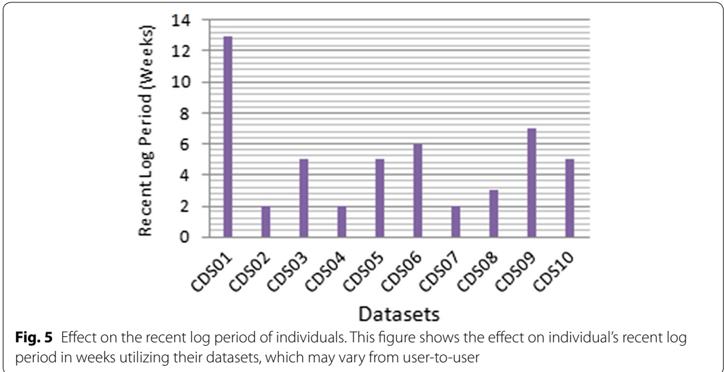
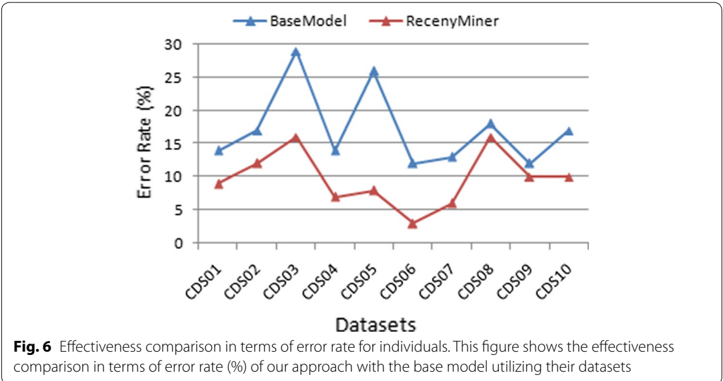
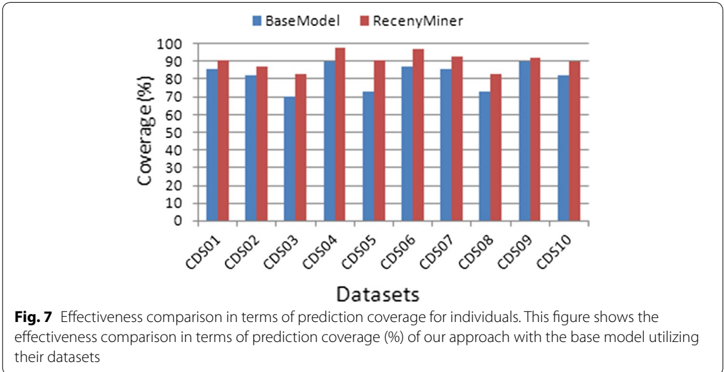
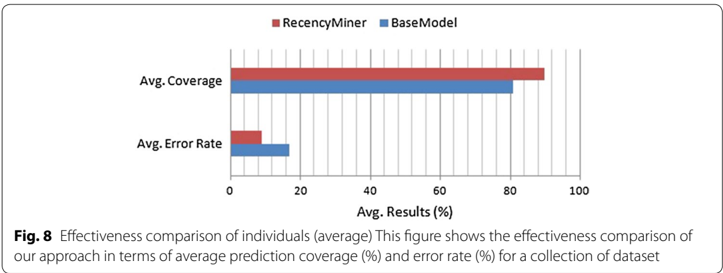
Verification
Claims the paper makes
The claims and statistics of this paper haven’t been checked yet.
Free: it reads the open-access text and checks the first 5 claims that cite a source we can check. Create a free account to check every claim.
Claims other papers make about this one
Each is checked against this paper’s own text: does it say what the citing paper says it does?
The cited source says what the claim attributes to it.
In the citing paper
“Besides, the concept of RecencyMiner, proposed in our earlier paper Sarker et al. [108] that takes into account recent behavioral patterns could be effective while analyzing behavioral data as it may not be static in the real-world changes over time.”
From Data Science and Analytics: An Overview from Data-Driven Smart Computing, Decision-Making and Applications Perspective (2021) · cites this paper as [108]
The cited source says what the claim attributes to it.
In the citing paper
“Thus, rather than considering the traditional data analysis, the concept of RecencyMiner, i.e., recent pattern-based extracted insight or knowledge proposed in our earlier paper Sarker et al. [108] might be effective.”
From Data Science and Analytics: An Overview from Data-Driven Smart Computing, Decision-Making and Applications Perspective (2021) · cites this paper as [108]
Self-check
Percentages, sums and reported differences re-computed from the paper’s own numbers.
The self-check needs the paper’s full text.
Citations
Cites
Data mining: concepts and techniques
(2012) · Choice Reviews Online · doi:10.5860/choice.49-3305 · Cited by 28,531
Self-citation(1992) · Cited by 23,431
Mining association rules between sets of items in large databases
Agrawal, R., Imieliński, T., & Swami, A. (1993) · Proceedings of the 1993 ACM SIGMOD international conference on Management of data · doi:10.1145/170035.170072 · Cited by 14,907 · cited 1×
“On the other hand, association rule learning [13] is the discovery of associations or relationships among a set of available items in a given dataset.”
BackgroundMining association rules between sets of items in large databases
Agrawal, R., Imieliński, T., & Swami, A. (1993) · ACM SIGMOD Record · doi:10.1145/170036.170072 · Cited by 4,551
Reality mining: sensing complex social systems
Eagle, N., & (Sandy) Pentland, A. (2006) · Personal and Ubiquitous Computing · doi:10.1007/s00779-005-0046-3 · Cited by 2,772
Witten, I. H., & Frank, E. (2005) · Cited by 815
A General Incremental Technique for Maintaining Discovered Association Rules
Cheung, D. W., Lee, S. D., & Kao, B. (1997) · Database Systems for Advanced Applications '97 · doi:10.1142/9789812819536_0020 · Cited by 371
Mining Mobile User Preferences for Personalized Context-Aware Recommendation
Zhu, H., Chen, E., Xiong, H., Yu, K., Cao, H., & Tian, J. (2015) · ACM Transactions on Intelligent Systems and Technology · doi:10.1145/2532515 · Cited by 157
MobileMiner: mining your frequent patterns on your phone
Srinivasan, V., Moghaddam, S., Mukherji, A., Rachuri, K. K., Xu, C., & Tapia, E. M. (2014) · Proceedings of the 2014 ACM International Joint Conference on Pervasive and Ubiquitous Computing · doi:10.1145/2632048.2632052 · Cited by 141
PrefMiner: mining user's preferences for intelligent mobile notification management
Mehrotra, A., Hendley, R., & Musolesi, M. (2016) · Proceedings of the 2016 ACM International Joint Conference on Pervasive and Ubiquitous Computing · doi:10.1145/2971648.2971747 · Cited by 137
Research works printed but not linked: 3
- Witten IH, Frank E. Data miining: practical machine learning tools and techniques. New York: Morgan Kaufmann; 2005.
- Agrawal R, Srikant R. Fast algorithms for mining association rules. In: Proceedings of the international joint conference on very large data bases, Santiago Chile, vol. 1215; 1994. p. 487–99.
- Cheung DW, Han J, Ng VT, Wong C. Maintenance of discovered association rules in large databases: an incremental updating technique. In: On IEEE data engineering, proceedings of the twelfth international conference. 1996. p. 106–14.
Cited by
Sarker, I. H. (2021) · SN Computer Science · doi:10.1007/s42979-021-00815-1 · Cited by 2,678
Self-citationSarker, I. H. (2022) · SN Computer Science · doi:10.1007/s42979-022-01043-x · Cited by 1,208
“Furthermore, rule-based models may be quickly improved according to the demands by adding, deleting, or updating rules based on domain expert information, or recency, i.e. based on recent trends [83].”
BackgroundSelf-citationCybersecurity data science: an overview from machine learning perspective
Sarker, I. H., Kayes, A. S. M., Badsha, S., Alqahtani, H., Watters, P., & Ng, A. (2020) · Journal of Big Data · doi:10.1186/s40537-020-00318-5 · Cited by 766
Self-citationAI-Driven Cybersecurity: An Overview, Security Intelligence Modeling and Research Directions
Sarker, I. H., Furhad, M. H., & Nowrozy, R. (2021) · SN Computer Science · doi:10.1007/s42979-021-00557-0 · Cited by 543
Self-citationSarker, I. H. (2021) · SN Computer Science · doi:10.1007/s42979-021-00765-8 · Cited by 570
Self-citation
Metadata
- Authors
- Sarker, I. H., Colman, A., & Han, J.
- Affiliations
- Chittagong University of Engineering & Technology (BD)
- Swinburne University of Technology (AU)
- Corresponding author
- Sarker, Iqbal H.
- Venue
- Journal of Big Data
- Published
- 2019-06-06
- Volume
- 6
- Issue
- 1
- ISSN
- 2196-1115 (ISSN-L)
- OpenAlex
- W2948335084
- Cited by
- 65
- References
- 41
- Citations by year
- 2025: 5 · 2024: 8 · 2023: 7 · 2022: 8 · 2021: 14 · 2020: 14 · 2019: 8
- FWCI
- 4.93
- Type
- journal article
- Language
- en
- Open access
- gold
- doi.org
- Licence
- cc-by
- creativecommons.org/licenses/by/4.0 (tdm)
- creativecommons.org/licenses/by/4.0 (vor)
- Locations
- Journal Of Big Data (publishedVersion, cc-by)
- DOAJ (DOAJ: Directory of Open Access Journals) (submittedVersion, cc-by-sa)
- Swinburne figshare (Swinburne University of Technology) (submittedVersion, cc-by)
- Funders
- Charles Sturt University
- Swinburne University of Technology
- Topics
- Physical Sciences › Computer Science › Computer Vision and Pattern Recognition › Context-Aware Activity Recognition Systems
- Social Sciences › Transportation › Human Mobility and Location-Based Analysis
- Physical Sciences › Computer Science › Information Systems › Data Mining Algorithms and Applications
- Keywords
- smartphone usage behavior, contextual information, context awareness
About these checks
Registry, retraction, Cites and statistics results are computed, not judged, with one exception: a printed reference that no index lists is read once by a model before it counts as a citation error. Claims are extracted by a model and kept only when their quote appears verbatim in the text; each cited source is then checked, with a model’s help, for whether it says what the claim relies on. Those verdicts can be wrong — read the claim’s quote and the cited source before relying on one.
Statistics and arithmetic are recomputed, not judged.
Confidence bands are shown only for fields calibrated on our annotated test set. None is calibrated yet, so no band is shown.
What counts as a claim ›How we measure confidence ›How we check this ›
Are you an author, or do you see a problem with this page? Request a review
How to cite
Cite CoChat for the checks on this page, and the paper for its own findings.
- This page
- CoChat. (2026). Citation check: RecencyMiner: mining recency-based personalized behavior from contextual smartphone data. https://app.cochat.ai/papers/10.1186/s40537-019-0211-6
- The paper
- Sarker, I. H., Colman, A., & Han, J. (2019). RecencyMiner: mining recency-based personalized behavior from contextual smartphone data. Journal of Big Data. https://doi.org/10.1186/s40537-019-0211-6
Data sources
Bibliographic data: Semantic Scholar, OpenAlex, Crossref.
Contains information from the Semantic Scholar Academic Graph Datasets, made available under the ODC Attribution License (ODC-BY 1.0).
Semantic Scholar’s data is described in: Kinney, R., et al. (2023). The Semantic Scholar Open Data Platform. arXiv:2301.10140.
