

Context-aware rule learning from smartphone data: survey, challenges and future directions
Open accessThe DOI matches its Crossref record; 134 of the 135 references it cites were found in a registry or an index.
Abstract
Smartphones are considered as one of the most essential and highly personal devices of individuals in our current world. Due to the popularity of context-aware technology and recent developments in smartphones, these devices can collect and process raw contextual data about users’ surrounding environment and their corresponding behavioral activities with their phones. Thus,smartphone data analytics and building data-driven context-aware systems have gained wide attention from both academia and industry in recent days. In order to build intelligent context-aware applications on smartphones, effectively learning a set of context-aware rules from smartphone data is the key. This requires advanced data analytical techniques with high precision and intelligent decision making strategies based on contexts. In comparison to traditional approaches,machine learning based techniques provide more effective and efficient results for smartphone data analytics and corresponding context-aware rule learning. Thus, this article first makes a survey on previous work in the area of contextual smartphone data analytics and then presents a discussion of challenges and future directions for effectively learning context-aware rules from smartphone data, in order to build rule-based automated and intelligent systems.
Overview
The claims and statistics of this paper haven’t been checked yet.
Free: it reads the open-access text and checks the first 5 claims that cite a source we can check. Create a free account to check every claim.
Integrity signals
Registry
Cites
Statistics
Figures
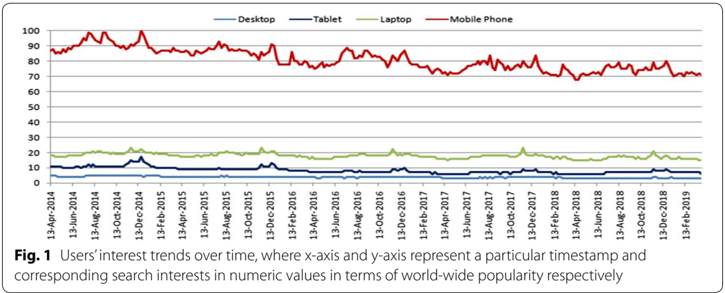
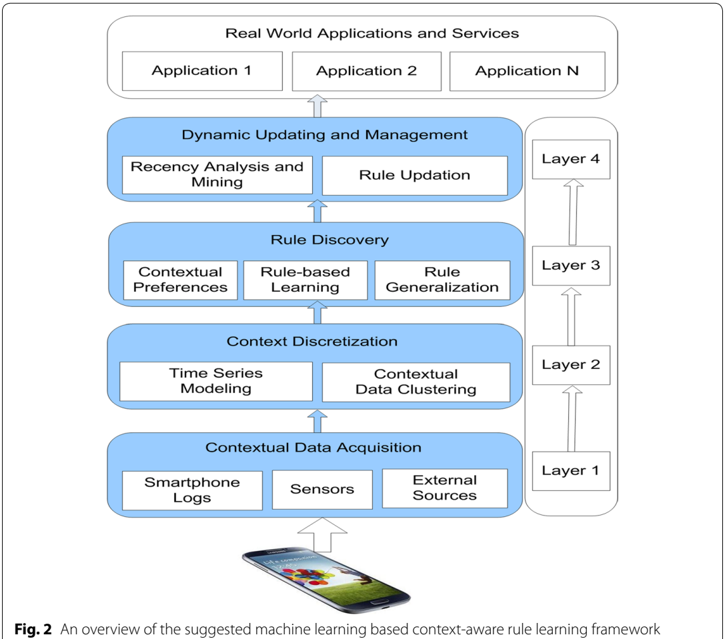
Verification
Claims the paper makes
The claims and statistics of this paper haven’t been checked yet.
Free: it reads the open-access text and checks the first 5 claims that cite a source we can check. Create a free account to check every claim.
Claims other papers make about this one
Each is checked against this paper’s own text: does it say what the citing paper says it does?
The cited source says what the claim attributes to it.
In the citing paper
“Besides, incorporating contextual information such as temporal context, spatial context, social context, environmental context, etc. [100] can be used for building an adaptive, context-aware, and dynamic model or framework, depending on the problem domain.”
From Data Science and Analytics: An Overview from Data-Driven Smart Computing, Decision-Making and Applications Perspective (2021) · cites this paper as [100]
Self-check
Percentages, sums and reported differences re-computed from the paper’s own numbers.
The self-check needs the paper’s full text.
Citations
Cites
Data Mining: Practical Machine Learning Tools and Techniques
(2011) · Elsevier eBooks · doi:10.1016/c2009-0-19715-5 · Cited by 25,437
(1992) · Cited by 23,431
Quinlan, J. R. (1986) · Machine Learning · doi:10.1007/bf00116251 · Cited by 21,439
Fast algorithms for mining association rules
Agrawal, R., & Srikant, R. (1998) · Cited by 11,307
Mining frequent patterns without candidate generation
Han, J., Pei, J., & Yin, Y. (2000) · ACM SIGMOD Record · doi:10.1145/335191.335372 · Cited by 6,402
Survey of Clustering Algorithms
Xu, R., & WunschII, D. (2005) · IEEE Transactions on Neural Networks · doi:10.1109/tnn.2005.845141 · Cited by 6,197
Top 10 algorithms in data mining
Wu, X., Kumar, V., Ross Quinlan, J., Ghosh, J., Yang, Q., Motoda, H., McLachlan, G. J., Ng, A., Liu, B., Yu, P. S., et al. (2008) · Knowledge and Information Systems · doi:10.1007/s10115-007-0114-2 · Cited by 5,667
Understanding and Using Context
Dey, A. K. (2001) · Personal and Ubiquitous Computing · doi:10.1007/s007790170019 · Cited by 5,012
Context-Aware Computing Applications
Schilit, B., Adams, N., & Want, R. (1994) · 1994 First Workshop on Mobile Computing Systems and Applications · doi:10.1109/wmcsa.1994.16 · Cited by 3,231 · cited 1×
“[20] the important aspects of context are: (i) where you are, (ii) whom you are with, and (iii) what resources are nearby.”
BackgroundBobadilla, J., Ortega, F., Hernando, A., & Gutiérrez, A. (2013) · Knowledge-Based Systems · doi:10.1016/j.knosys.2013.03.012 · Cited by 3,158
Reality mining: sensing complex social systems
Eagle, N., & (Sandy) Pentland, A. (2006) · Personal and Ubiquitous Computing · doi:10.1007/s00779-005-0046-3 · Cited by 2,772
The International Telecommunication Union
Jones, R. W. (2002) · IEEE Antennas and Propagation Society International Symposium 1997. Digest · doi:10.1109/aps.1997.631791 · Cited by 1,909
Very Simple Classification Rules Perform Well on Most Commonly Used Datasets
Holte, R. C. (1993) · Machine Learning · doi:10.1023/a:1022631118932 · Cited by 1,791
Recommender system application developments: A survey
Lu, J., Wu, D., Mao, M., Wang, W., & Zhang, G. (2015) · Decision Support Systems · doi:10.1016/j.dss.2015.03.008 · Cited by 1,578
What we talk about when we talk about context
Dourish, P. (2004) · Personal and Ubiquitous Computing · doi:10.1007/s00779-003-0253-8 · Cited by 1,529
Disseminating active map information to mobile hosts
Schilit, B. N., & Theimer, M. M. (1994) · IEEE Network · doi:10.1109/65.313011 · Cited by 1,410
A new location technique for the active office
Ward, A., Jones, A., & Hopper, A. (1997) · IEEE Personal Communications · doi:10.1109/98.626982 · Cited by 1,354
Generating Accurate Rule Sets Without Global Optimization
Frank, E., & Witten, I. H. (1998) · Research Commons (University of Waikato) · doi:10.5555/645527.657305 · Cited by 1,269
Habits make smartphone use more pervasive.
Oulasvirta, A., Rattenbury, T., Ma, L., & Raita, E. (2012) · Personal and Ubiquitous Computing · doi:10.1007/s00779-011-0412-2 · Cited by 1,190
Interestingness measures for data mining: A survey
Geng, L., & Hamilton, H. J. (2006) · ACM Computing Surveys · doi:10.1145/1132960.1132963 · Cited by 1,141
The Application of Computers to Taxonomy
Sneath, P. H. A. (1957) · Microbiology · doi:10.1099/00221287-17-1-201 · Cited by 936
Maintenance of discovered association rules in large databases: an incremental updating technique
Cheung, D. W., Han, J., Ng, V. T., & Wong, C. Y. (2002) · Proceedings of the Twelfth International Conference on Data Engineering · doi:10.1109/icde.1996.492094 · Cited by 800
Context-aware applications: from the laboratory to the marketplace
Brown, P. J., Bovey, J. D., & Chen, X. (1997) · IEEE Personal Communications · doi:10.1109/98.626984 · Cited by 751
Rule discovery from time series
Das, G., Lin, K.-I., Mannila, H., Renganathan, G., & Smyth, P. (1998) · Cited by 637
Weka: Practical machine learning tools and techniques with Java implementations
Witten, I. H., Frank, E., Trigg, L. E., Hall, M. A., Holmes, G., & Cunningham, S. J. (1999) · Research Commons (University of Waikato) · Cited by 629
SEGMENTING TIME SERIES: A SURVEY AND NOVEL APPROACH
Keogh, E., Chu, S., Hart, D., & Pazzani, M. (2004) · Series in Machine Perception and Artificial Intelligence · doi:10.1142/9789812565402_0001 · Cited by 600
An Outline of a Theory of Three-Way Decisions
Yao, Y. (2012) · Lecture Notes in Computer Science · doi:10.1007/978-3-642-32115-3_1 · Cited by 502
Contributions to the study of SMS spam filtering: new collection and results
Almeida, T. A., Hidalgo, J. M. G., & Yamakami, A. (2011) · Proceedings of the 11th ACM symposium on Document engineering · doi:10.1145/2034691.2034742 · Cited by 463
Data Science: A Comprehensive Overview
Cao, L. (2018) · ACM Computing Surveys · doi:10.1145/3076253 · Cited by 407
Location-Based Recommendation System Using Bayesian User’s Preference Model in Mobile Devices
Park, M.-H., Hong, J.-H., & Cho, S.-B. (2007) · Lecture Notes in Computer Science · doi:10.1007/978-3-540-73549-6_110 · Cited by 381
A General Incremental Technique for Maintaining Discovered Association Rules
Cheung, D. W., Lee, S. D., & Kao, B. (1997) · Database Systems for Advanced Applications '97 · doi:10.1142/9789812819536_0020 · Cited by 371
Enhanced Reality Fieldwork: the Context Aware Archaeological Assistant
Ryan, N. S., Pascoe, J., & Morse, D. R. (1999) · Universitätsbibliothek Tübingen · doi:10.15496/publikation-3519 · Cited by 366
Large-scale assessment of mobile notifications
Sahami Shirazi, A., Henze, N., Dingler, T., Pielot, M., Weber, D., & Schmidt, A. (2014) · Proceedings of the SIGCHI Conference on Human Factors in Computing Systems · doi:10.1145/2556288.2557189 · Cited by 341
The Stick-e Document: a Framework for Creating Context-aware Applications
Brown, P. J. (1996) · Cited by 335
Collaborative Filtering Meets Mobile Recommendation: A User-Centered Approach
Zheng, V., Cao, B., Zheng, Y., Xie, X., & Yang, Q. (2010) · Proceedings of the AAAI Conference on Artificial Intelligence · doi:10.1609/aaai.v24i1.7577 · Cited by 321
Some Thoughts on Bacterial Classification
Sneath, P. H. A. (1957) · Journal of General Microbiology · doi:10.1099/00221287-17-1-184 · Cited by 319
InterruptMe: designing intelligent prompting mechanisms for pervasive applications
Pejovic, V., & Musolesi, M. (2014) · Proceedings of the 2014 ACM International Joint Conference on Pervasive and Ubiquitous Computing · doi:10.1145/2632048.2632062 · Cited by 282
Activity-Aware Map: Identifying Human Daily Activity Pattern Using Mobile Phone Data
Phithakkitnukoon, S., Horanont, T., Di Lorenzo, G., Shibasaki, R., & Ratti, C. (2010) · Lecture Notes in Computer Science · doi:10.1007/978-3-642-14715-9_3 · Cited by 275
Grosan, C., & Abraham, A. (2011) · Intelligent Systems Reference Library · doi:10.1007/978-3-642-21004-4_7 · Cited by 268
Set-oriented mining for association rules in relational databases
Houtsma, M., & Swami, A. (2002) · Proceedings of the Eleventh International Conference on Data Engineering · doi:10.1109/icde.1995.380413 · Cited by 263
A survey of Clustering Algorithms
Rokach, L. (2009) · Data Mining and Knowledge Discovery Handbook · doi:10.1007/978-0-387-09823-4_14 · Cited by 245
Context-aware system for proactive personalized service based on context history
Hong, J., Suh, E.-H., Kim, J., & Kim, S. (2009) · Expert Systems with Applications · doi:10.1016/j.eswa.2008.09.002 · Cited by 231
PROCEEDINGS OF WORLD ACADEMY OF SCIENCE, ENGINEERING AND TECHNOLOGY, VOL 8
Tushabe, F., & Baryamureeba, V. (2005) · Cited by 223
An efficient algorithm for the incremental updation of association rules in large databases
Thomas, S., Bodagala, S., Alsabti, K., & Ranka, S. (1997) · Cited by 215
Data Science: A Comprehensive Overview
Cao, L. (2020) · arXiv (Cornell University) · doi:10.48550/arxiv.2007.03606 · Cited by 210
Exploiting Context in HCI Design for Mobile Systems
Cheverst, K., Davies, N., Dix, A. J., & Rodden, T. A. (1998) · Lancaster EPrints (Lancaster University) · Cited by 204
Notifications and awareness: a field study of alert usage and preferences
Iqbal, S. T., & Horvitz, E. (2010) · Proceedings of the 2010 ACM conference on Computer supported cooperative work · doi:10.1145/1718918.1718926 · Cited by 203
Personalized Travel Package Recommendation
Liu, Q., Ge, Y., Li, Z., Chen, E., & Xiong, H. (2011) · 2011 IEEE 11th International Conference on Data Mining · doi:10.1109/icdm.2011.118 · Cited by 202
Predicting The Next App That You Are Going To Use
Baeza-Yates, R., Jiang, D., Silvestri, F., & Harrison, B. (2015) · Proceedings of the Eighth ACM International Conference on Web Search and Data Mining · doi:10.1145/2684822.2685302 · Cited by 161
Mining Mobile User Preferences for Personalized Context-Aware Recommendation
Zhu, H., Chen, E., Xiong, H., Yu, K., Cao, H., & Tian, J. (2015) · ACM Transactions on Intelligent Systems and Technology · doi:10.1145/2532515 · Cited by 157
Where and what: Using smartphones to predict next locations and applications in daily life
Tri, T. M., & Gática-Pérez, D. (2013) · Pervasive and Mobile Computing · doi:10.1016/j.pmcj.2013.03.006 · Cited by 152
Effects of content and time of delivery on receptivity to mobile interruptions
Fischer, J. E., Yee, N., Bellotti, V., Good, N., Benford, S., & Greenhalgh, C. (2010) · Proceedings of the 12th international conference on Human computer interaction with mobile devices and services · doi:10.1145/1851600.1851620 · Cited by 146 · cited 2×
“The SMS log contains all the message including the spam and nonspam text messages [32, 33], which can be used in the task of automatic spam filtering”
BackgroundMethodMobileMiner: mining your frequent patterns on your phone
Srinivasan, V., Moghaddam, S., Mukherji, A., Rachuri, K. K., Xu, C., & Tapia, E. M. (2014) · Proceedings of the 2014 ACM International Joint Conference on Pervasive and Ubiquitous Computing · doi:10.1145/2632048.2632052 · Cited by 141
PrefMiner: mining user's preferences for intelligent mobile notification management
Mehrotra, A., Hendley, R., & Musolesi, M. (2016) · Proceedings of the 2016 ACM International Joint Conference on Pervasive and Ubiquitous Computing · doi:10.1145/2971648.2971747 · Cited by 137
Confirmation-Guided Discovery of First-Order Rules with Tertius
Flach, P. A., & Lachiche, N. (2001) · Machine Learning · doi:10.1023/a:1007656703224 · Cited by 131
Cost-aware travel tour recommendation
Ge, Y., Liu, Q., Xiong, H., Tuzhilin, A., & Chen, J. (2011) · ACM SIGKDD Conference on Knowledge Discovery and Data Mining (KDD) · doi:10.1145/2020408.2020568 · Cited by 124
What did you do today?: discovering daily routines from large-scale mobile data
Farrahi, K., & Gatica-Perez, D. (2008) · Proceedings of the 16th ACM international conference on Multimedia · doi:10.1145/1459359.1459503 · Cited by 120
Xu, Y., Lin, M., Lu, H., Cardone, G., Lane, N., Chen, Z., Campbell, A., & Choudhury, T. (2013) · Proceedings of the 2013 International Symposium on Wearable Computers · doi:10.1145/2493988.2494333 · Cited by 118
Song, Y., Ma, H., Wang, H., & Wang, K. (2013) · Proceedings of the 22nd international conference on World Wide Web · doi:10.1145/2488388.2488493 · Cited by 115
UbiqLog: a generic mobile phone-based life-log framework
Rawassizadeh, R., Tomitsch, M., Wac, K., & Tjoa, A. M. (2012) · Personal and Ubiquitous Computing · doi:10.1007/s00779-012-0511-8 · Cited by 114
A machine learning based robust prediction model for real-life mobile phone data
Sarker, I. H. (2019) · Internet of Things · doi:10.1016/j.iot.2019.01.007 · Cited by 113
Self-citationAll gadget and no representation makes Jack a dull environment
Franklin, D., & Flachsbart, J. D. (1998) · Cited by 103
Comparing association rules and decision trees for disease prediction
ORDÓÑEZ, C. R. (2006) · doi:10.1145/1183568.1183573 · Cited by 102
Freitas, A. A. (2000) · ACM SIGKDD Explorations Newsletter · doi:10.1145/360402.360423 · Cited by 100
Mining Cluster-Based Temporal Mobile Sequential Patterns in Location-Based Service Environments
Lu, E. H.-C., Tseng, V. S., & Yu, P. S. (2010) · IEEE Transactions on Knowledge and Data Engineering · doi:10.1109/tkde.2010.155 · Cited by 98
Scalable Daily Human Behavioral Pattern Mining from Multivariate Temporal Data
Rawassizadeh, R., Momeni, E., Dobbins, C., Gharibshah, J., & Pazzani, M. (2016) · IEEE Transactions on Knowledge and Data Engineering · doi:10.1109/tkde.2016.2592527 · Cited by 96
Probabilistic Mining of Socio-Geographic Routines From Mobile Phone Data
Farrahi, K., & Gática-Pérez, D. (2010) · IEEE Journal of Selected Topics in Signal Processing · doi:10.1109/jstsp.2010.2049513 · Cited by 84
Investigating Mobile Users' Ringer Mode Usage and Attentiveness and Responsiveness to Communication
Chang, Y.-J., & Tang, J. C. (2015) · Proceedings of the 17th International Conference on Human-Computer Interaction with Mobile Devices and Services · doi:10.1145/2785830.2785852 · Cited by 83
Discovery of Meaningful Rules in Time Series
Shokoohi-Yekta, M., Chen, Y., Campana, B., Hu, B., Zakaria, J., & Keogh, E. (2015) · Proceedings of the 21th ACM SIGKDD International Conference on Knowledge Discovery and Data Mining · doi:10.1145/2783258.2783306 · Cited by 82
By their apps you shall understand them: mining large-scale patterns of mobile phone usage
Do, T.-M.-T., & Gatica-Perez, D. (2010) · Proceedings of the 9th International Conference on Mobile and Ubiquitous Multimedia · doi:10.1145/1899475.1899502 · Cited by 80
Individualized Time-Series Segmentation for Mining Mobile Phone User Behavior
Sarker, I. H., Colman, A., Kabir, M. A., & Han, J. (2018) · The Computer Journal · doi:10.1093/comjnl/bxx082 · Cited by 80
Self-citationDeploying personalized mobile services in an agent-based environment
LEE, W. (2006) · Expert Systems with Applications · doi:10.1016/j.eswa.2006.02.009 · Cited by 77
Mobile App Classification with Enriched Contextual Information
Zhu, H., Chen, E., Xiong, H., Cao, H., & Tian, J. (2014) · IEEE Transactions on Mobile Computing · doi:10.1109/tmc.2013.113 · Cited by 75
Spotlight: The Rise of the Smart Phone
Zheng, P., & Ni, L. M. (2006) · IEEE Distributed Systems Online · doi:10.1109/mdso.2006.22 · Cited by 72
On mining mobile apps usage behavior for predicting apps usage in smartphones
Liao, Z.-X., Pan, Y.-C., Peng, W.-C., & Lei, P.-R. (2013) · Proceedings of the 22nd ACM international conference on Information & Knowledge Management · doi:10.1145/2505515.2505529 · Cited by 68
RecencyMiner: mining recency-based personalized behavior from contextual smartphone data
Sarker, I. H., Colman, A., & Han, J. (2019) · Journal of Big Data · doi:10.1186/s40537-019-0211-6 · Cited by 65
Self-citationContext-Aware Recommendation by Aggregating User Context
Shin, D., Lee, J., Yeon, J., & Lee, S. (2009) · IEEE Conference on Commerce and Enterprise Computing (CEC) · doi:10.1109/cec.2009.38 · Cited by 62
Towards Personalized Context-Aware Recommendation by Mining Context Logs through Topic Models
Yu, K., Zhang, B., Zhu, H., Cao, H., & Tian, J. (2012) · Lecture notes in computer science · doi:10.1007/978-3-642-30217-6_36 · Cited by 57
Classifying call profiles in large-scale mobile traffic datasets
Naboulsi, D., Stanica, R., & Fiore, M. (2014) · IEEE Conference on Computer Communications (INFOCOM) · doi:10.1109/infocom.2014.6848119 · Cited by 55
NotiMind: Utilizing Responses to Smart Phone Notifications as Affective Sensors
Kanjo, E., Kuss, D. J., & Ang, C. S. (2017) · IEEE Access · doi:10.1109/access.2017.2755661 · Cited by 55
Behavior-based adaptive call predictor
Phithakkitnukoon, S., Dantu, R., Claxton, R., & Eagle, N. (2011) · ACM Transactions on Autonomous and Adaptive Systems · doi:10.1145/2019583.2019588 · Cited by 54
Improving Cell Phone Awareness by Using Calendar Information
Khalil, A., & Connelly, K. (2005) · Lecture notes in computer science · doi:10.1007/11555261_48 · Cited by 53
Push or Delay? Decomposing Smartphone Notification Response Behaviour
Turner, L. D., Allen, S. M., & Whitaker, R. M. (2015) · Lecture notes in computer science · doi:10.1007/978-3-319-24195-1_6 · Cited by 50
Time based patterns in mobile-internet surfing
Halvey, M., Keane, M. T., & Smyth, B. (2006) · Proceedings of the SIGCHI Conference on Human Factors in Computing Systems · doi:10.1145/1124772.1124778 · Cited by 49
Li, Y., Zhang, Z., Chen, W., & Min, F. (2015) · International Journal of Machine Learning and Cybernetics · doi:10.1007/s13042-015-0337-6 · Cited by 49
Nodobo: Mobile Phone as a Software Sensor for Social Network Research
Bell, S., McDiarmid, A., & Irvine, J. (2011) · 2011 IEEE 73rd Vehicular Technology Conference (VTC Spring) · doi:10.1109/vetecs.2011.5956319 · Cited by 48
Decision tree induction with a constrained number of leaf nodes
Wu, C., Chen, Y., Liu, Y., & Yang, X. (2016) · Applied Intelligence · doi:10.1007/s10489-016-0785-z · Cited by 48
Mining Top-K Non-redundant Association Rules
Fournier‐Viger, P., & Tseng, V. S. M. (2012) · Lecture notes in computer science · doi:10.1007/978-3-642-34624-8_4 · Cited by 45
Mining User Behavioral Rules from Smartphone Data Through Association Analysis
Sarker, I. H., & Salim, F. D. (2018) · Lecture notes in computer science · doi:10.1007/978-3-319-93034-3_36 · Cited by 45
Self-citationAppsPred: Predicting context-aware smartphone apps using random forest learning
Sarker, I. H., & Salah, K. (2019) · Internet of Things · doi:10.1016/j.iot.2019.100106 · Cited by 43 · cited 1×
“With the rapid development of smartphones, people use these devices for using various categories of apps such as Multimedia, Facebook, Gmail, Youtube, Skype, Game [9, 34].”
MethodSelf-citationA probabilistic approach to mining mobile phone data sequences
Farrahi, K., & Gática-Pérez, D. (2013) · Personal and Ubiquitous Computing · doi:10.1007/s00779-013-0640-8 · Cited by 42
Large-scale evaluation of call-availability prediction
Pielot, M. (2014) · Proceedings of the 2014 ACM International Joint Conference on Pervasive and Ubiquitous Computing · doi:10.1145/2632048.2632060 · Cited by 41
You never call: Demoting unused contacts on mobile phones using DMTR
Bergman, O., Komninos, A., Liarokapis, D., & Clarke, J. (2011) · Personal and Ubiquitous Computing · doi:10.1007/s00779-011-0411-3 · Cited by 37
Hybrid Cost-Sensitive Decision Tree
Sheng, S., & Ling, C. X. (2005) · Lecture notes in computer science · doi:10.1007/11564126_29 · Cited by 35
Exploiting enriched contextual information for mobile app classification
Zhu, H., Cao, H., Chen, E., Xiong, H., & Tian, J. (2012) · Proceedings of the 21st ACM international conference on Information and knowledge management · doi:10.1145/2396761.2398484 · Cited by 34
User-centric social context information management: an ontology-based approach and platform
Kabir, M. A., Han, J., Yu, J., & Colman, A. (2013) · Personal and Ubiquitous Computing · doi:10.1007/s00779-013-0720-9 · Cited by 33
Phone call log as a context source to modeling individual user behavior
Sarker, I. H., Colman, A., Kabir, M. A., & Han, J. (2016) · Proceedings of the 2016 ACM International Joint Conference on Pervasive and Ubiquitous Computing: Adjunct · doi:10.1145/2968219.2971592 · Cited by 33 · cited 1×
“Thus, call log data collected by the smart mobile phone can be used as a context source to modeling individual mobile phone user behavior in smart context-aware mobile communication systems [30].”
MethodSelf-citationRanking and Selecting Association Rules Based on Dominance Relationship
Bouker, S., Saidi, R., Yahia, S. B., & Nguifo, E. M. (2012) · IEEE International Conference on Tools with Artificial Intelligence (ICTAI) · doi:10.1109/ictai.2012.94 · Cited by 30
Time-Series Pattern Based Effective Noise Generation for Privacy Protection on Cloud
Zhang, G., Liu, X., & Yang, Y. (2015) · IEEE Transactions on Computers · doi:10.1109/tc.2014.2298013 · Cited by 28
Minimizing mobile phone disruption via smart profile management
Dekel, A., Nacht, D., & Kirkpatrick, S. (2009) · Proceedings of the 11th International Conference on Human-Computer Interaction with Mobile Devices and Services · doi:10.1145/1613858.1613913 · Cited by 27
Sarker, I. H., Kabir, M. A., Colman, A., & Han, J. (2018) · Communications in computer and information science · doi:10.1007/978-981-13-0292-3_5 · Cited by 24
Self-citationTime Based Segmentation of Log Data for User Navigation Prediction in Personalization
Halvey, M., Keane, M. T., & Smyth, B. (2005) · The 2005 IEEE/WIC/ACM International Conference on Web Intelligence (WI'05) · doi:10.1109/wi.2005.147 · Cited by 22
Adding intelligence to your mobile device via on-device sequential pattern mining
Mukherji, A., Srinivasan, V., & Welbourne, E. (2014) · ACM International Joint Conference on Pervasive and Ubiquitous Computing (UbiComp) · doi:10.1145/2638728.2641285 · Cited by 22
Mobile Data Science: Towards Understanding Data-Driven Intelligent Mobile Applications
Sarker, I. (2018) · ICST Transactions on Scalable Information Systems · doi:10.4108/eai.13-7-2018.155866 · Cited by 21
Self-citationBehavior-Oriented Time Segmentation for Mining Individualized Rules of Mobile Phone Users
Sarker, I. H., Colman, A., Kabir, M. A., & Han, J. (2016) · 2016 IEEE International Conference on Data Science and Advanced Analytics (DSAA) · doi:10.1109/dsaa.2016.60 · Cited by 20
Self-citationAn adaptive speed-call list algorithm and its evaluation with ESM
Lee, S., Seo, J., & Lee, G. (2010) · CHI Conference on Human Factors in Computing Systems · doi:10.1145/1753326.1753632 · Cited by 19
Time-Based Personalised Mobile Game Downloading
Paireekreng, W., Rapeepisarn, K., & Wong, K. W. (2009) · Lecture notes in computer science · doi:10.1007/978-3-642-03270-7_5 · Cited by 18 · cited 1×
“of individual mobile phone users, and related contextual information [41].”
BackgroundPredicting the Location and Time of Mobile Phone Users by Using Sequential Pattern Mining Techniques
Özer, M., Keles, I., Toroslu, İ. H., Karagöz, P., & Davulcu, H. (2015) · The Computer Journal · doi:10.1093/comjnl/bxv075 · Cited by 18
BehavMiner: Mining User Behaviors from Mobile Phone Data for Personalized Services
Sarker, I. H. (2018) · 2018 IEEE International Conference on Pervasive Computing and Communications Workshops (PerCom Workshops) · doi:10.1109/percomw.2018.8480325 · Cited by 18 · cited 2×
“A context-aware rule has two parts, which follows “IF-THEN” logical structure to formulate [6].”
BackgroundMethodSelf-citationAn incremental updating algorithm for mining association rules
Xu, B., Yi, T., Wu, F., & Chen, Z. (2002) · Journal of Electronics (China) · doi:10.1007/s11767-002-0073-4 · Cited by 17
Semantic enrichment of mobile phone data records
Dashdorj, Z., Serafini, L., Antonelli, F., & Larcher, R. (2013) · International Conference on Mobile and Ubiquitous Multimedia (MUM) · doi:10.1145/2541831.2541857 · Cited by 17
Barzaiq, O. O., & Loke, S. W. (2011) · Personal and Ubiquitous Computing · doi:10.1007/s00779-011-0401-5 · Cited by 16
Stefanis, V., Πλέσσας, Α., Komninos, A., & Garofalakis, J. D. (2013) · Pervasive and Mobile Computing · doi:10.1016/j.pmcj.2013.08.002 · Cited by 15
Understanding the Role of Data-Centric Social Context in Personalized Mobile Applications
Sarker, I. (2018) · EAI Endorsed Transactions on Context-aware Systems and Applications · doi:10.4108/eai.18-6-2018.155671 · Cited by 15
Self-citationConditional Log-linear Models for Mobile Application Usage Prediction
Kim, J., & Mielikäinen, T. (2014) · Lecture notes in computer science · doi:10.1007/978-3-662-44848-9_43 · Cited by 14
Mining Dynamic Databases using Probability-Based Incremental Association Rule Discovery Algorithm
Amornchewin, R., & Kreesuradej, W. (2020) · Zenodo (CERN European Organization for Nuclear Research) · doi:10.3217/jucs-015-12-2409 · Cited by 13
Adequacy of Data for Characterizing Caller Behavior
Phithakkitnukoon, S., & Dantu, R. (2008) · Cited by 13
Designing architecture of a rule-based system for managing phone call interruptions
Sarker, I. H., Kabir, M. A., Colman, A., & Han, J. (2017) · Proceedings of the 2017 ACM International Joint Conference on Pervasive and Ubiquitous Computing and Proceedings of the 2017 ACM International Symposium on Wearable Computers · doi:10.1145/3123024.3124562 · Cited by 12 · cited 1×
“In addition to such call related meta data, other dimensions of contextual information such as user location [27], user’s day-to-day situation [28], the social relationship between the caller an callee identified by the individual’s unique phone contact number [29] are also recorded by the smart mobile phones.”
BackgroundSelf-citationResearch issues in mining user behavioral rules for context-aware intelligent mobile applications
Sarker, I. H. (2019) · Iran Journal of Computer Science · doi:10.1007/s42044-018-0026-1 · Cited by 12
Self-citationA Web-Based Personalized Mobility Service for Smartphone Applications
Bayır, M. A., Demirbaş, M., & Coşar, A. (2010) · The Computer Journal · doi:10.1093/comjnl/bxq027 · Cited by 11
Extracting temporal knowledge from time series: A case study in ecological data
Hartono, R. N., Pears, R., Kasabov, N. K., & Worner, S. P. (2014) · International Joint Conference on Neural Networks (IJCNN) · doi:10.1109/ijcnn.2014.6889918 · Cited by 11
Sarker, I. H., Colman, A., Han, J., Kayes, A. S. M., & Watters, P. (2019) · The Computer Journal · doi:10.1093/comjnl/bxz117 · Cited by 11 · cited 1×
“Similarly, individuals’ calendar schedules and corresponding time boundaries can also be used to determine variable length of time segments, in order to model users’ behavior in temporal context, which may vary according to users’ preferences [59].”
BackgroundSelf-citationA Three-way Decision Approach to Incremental Frequent Itemsets Mining
Zhang, Z. (2014) · Journal of Information and Computational Science · doi:10.12733/jics20104003 · Cited by 10
Field evaluation of context aware adaptive interfaces for efficient mobile contact retrieval
Πλέσσας, Α., Stefanis, V., Komninos, A., & Garofalakis, J. D. (2016) · Pervasive and Mobile Computing · doi:10.1016/j.pmcj.2016.04.011 · Cited by 10
Evidence-Based Behavioral Model for Calendar Schedules of Individual Mobile Phone Users
Sarker, I. H., Kabir, M. A., Colman, A., & Han, J. (2016) · IEEE International Conference on Data Science and Advanced Analytics (DSAA) · doi:10.1109/dsaa.2016.86 · Cited by 10
Self-citationTowards ubiquitous computing with call prediction
Phithakkitnukoon, S., & Dantu, R. (2011) · ACM SIGMOBILE Mobile Computing and Communications Review · doi:10.1145/1978622.1978628 · Cited by 9
Thusaranon, P., & Kreesuradej, W. (2015) · Artificial Life and Robotics · doi:10.1007/s10015-015-0210-4 · Cited by 7
Activity-Aware Map: Identifying human daily activity pattern using mobile phone data [book chapter]
Phithakkitnukoon, S., Horanont, T., Lorenzo, G. D., Shibasaki, R., & Ratti, C. (2010) · DSpace@MIT (Massachusetts Institute of Technology) · Cited by 7
Exploring variety seeking behavior in mobile users
Jayarajah, K., Kauffman, R. J., & Misra, A. (2014) · ACM International Joint Conference on Pervasive and Ubiquitous Computing (UbiComp) · doi:10.1145/2638728.2641702 · Cited by 7
Extracting interesting association rules from toolbar data
Bordino, I., Donato, D., & Poblete, B. (2012) · ACM International Conference on Information and Knowledge Management (CIKM) · doi:10.1145/2396761.2398687 · Cited by 6
A Generative Model For Time Series Discretization Based On Multiple Normal Distributions
Gandhi, S., Oates, T., Boedihardjo, A. P., Chen, C., Lin, J., Senin, P., Frankenstein, S., & Wang, X. (2015) · doi:10.1145/2809890.2809892 · Cited by 4 · cited 1×
“A time series is a sequence of data points ordered in time [43].”
BackgroundKandasamy, K., & Kumar, C. S. (2015) · Indian Journal of Science and Technology · doi:10.17485/ijst/2015/v8is7/64308 · Cited by 4
A clustering rule-based approach to predictive modeling
Williams, P., Soares, C. V., & Gilbert, J. E. (2010) · ACM Southeast Regional Conference (ACMSE) · doi:10.1145/1900008.1900071 · Cited by 3
A Mobile Intelligent Interruption Management System
Stamm, K., Madiraju, P., Ahamed, S. I., & Zulkernain, S. (2010) · Verlag der Technischen Universität Graz · doi:10.3217/jucs-016-15-2060
Research works printed but not linked: 8
- 18. Hull R, Neaves P, Bedford-Roberts J. Towards situated computing. In: Wearable computers, 1997. Digest of papers., first international symposium On, IEEE; 1997. p. 146-53.
- 62. Karatzoglou A, Baltrunas L, Church K, Böhmer M. Climbing the app wall: enabling mobile app discovery through context-aware recommendations. In: Proceedings of the international conference on information and knowledge management, Maui, Hawaii, USA, 29 October-02 November, p. 2527-30. ACM, New York, USA; 2012.
- 75. MacQueen J. Some methods for classification and analysis of multivariate observations. In: Fifth Berkeley sympo- sium on mathematical statistics and probability, vol. 1; 1967.
- 78. Sorensen T. Method of establishing groups of equal amplitude in plant sociology based on similarity of species. Biol Skr. 1948;5:1-34.
- 83. Ma BLWHY. Integrating classification and association rule mining. In: Proceedings of the fourth international conference on knowledge discovery and data mining; 1998.
- Cheung DW, Han J, Ng VT, Wong C. Maintenance of discovered association rules in large databases: an incremental updating technique. In: Data engineering, 1996. Proceedings of the twelfth international conference On, IEEE; 1996. p. 106–14.
- Abbaspour R, Samadzadegan F. Building a context-aware mobile tourist guide system base on a service oriented architecture. Int Arch Photogramm Remote Sens Spatial Inform Sci. 2008;37:871–4.
- 104. Ge Y, Liu Q. Xiong H, Tuzhilin A, Chen J. Cost-aware travel tour recommendation. In: Proceedings of the 17th ACM SIGKDD international conference on knowledge discovery and data mining, ACM; 2011. p. 983-91. 136. Park M-H, Hong J-H, Cho S-B. Location-based recommendation system using bayesian user's preference model in mobile devices. In: International conference on ubiquitous intelligence and computing, Springer; 2007. p. 1130-9. 137. Zheng VW, Cao B, Zheng Y, Xie X, Yang Q. Collaborative filtering meets mobile recommendation: a user-centered approach. In: AAAI, vol. 10, 2010. p. 236-41. 138. World tourism organization, unwto. http://www2.unwto .org/. 139. Abbaspour R, Samadzadegan F. Building a context-aware mobile tourist guide system base on a service oriented architecture. Int Arch Photogramm Remote Sens Spatial Inform Sci. 2008;37:871-4. 140. Pashtan A, Blattler R, Andi AH, Scheuermann P. Catis: a context-aware tourist information system, 2003. 141.
Cited by
Machine learning: Algorithms, real-world applications and research directions
Sarker, I. H. (2021) · SN Computer Science · doi:10.1007/s42979-021-00592-x · Cited by 5,583
“…etc. and in the distribution phase - the inventory management, consumer analysis, etc. – User Behavior Analytics and Context-Aware Smart-phone Applications: Context-awareness is a system’s ability to capture knowledge about its surroundings at any moment and modify behaviors accordingly [28] [93].”
Self-citationSarker, I. H. (2021) · SN Computer Science · doi:10.1007/s42979-021-00815-1 · Cited by 2,678
Self-citationCybersecurity data science: an overview from machine learning perspective
Sarker, I. H., Kayes, A. S. M., Badsha, S., Alqahtani, H., Watters, P., & Ng, A. (2020) · Journal of Big Data · doi:10.1186/s40537-020-00318-5 · Cited by 766
“In an expert system, the rules are usually manually defined by a knowledge engineer working in collaboration with a domain expert [37, 140, 146].”
BackgroundSelf-citationSarker, I. H. (2021) · SN Computer Science · doi:10.1007/s42979-021-00765-8 · Cited by 570
“[100] can be used for building an adaptive, context-aware, and dynamic model or framework, depending on the problem domain.”
Self-citationAI-Driven Cybersecurity: An Overview, Security Intelligence Modeling and Research Directions
Sarker, I. H., Furhad, M. H., & Nowrozy, R. (2021) · SN Computer Science · doi:10.1007/s42979-021-00557-0 · Cited by 543
Self-citation
Metadata
- Authors
- Sarker, I. H.
- Affiliations
- Chittagong University of Engineering & Technology (BD)
- Corresponding author
- Sarker, Iqbal H.
- ORCID
- Sarker, Iqbal H.
- Venue
- Journal of Big Data
- Published
- 2019-10-31
- Volume
- 6
- Issue
- 1
- ISSN
- 2196-1115 (ISSN-L)
- OpenAlex
- W2982291760
- Cited by
- 105
- References
- 135
- Citations by year
- 2026: 3 · 2025: 9 · 2024: 8 · 2023: 24 · 2022: 18 · 2021: 20 · 2020: 20 · 2019: 2
- FWCI
- 6.72
- Type
- journal article
- Language
- en
- Open access
- gold
- doi.org
- Licence
- cc-by
- creativecommons.org/licenses/by/4.0 (tdm)
- creativecommons.org/licenses/by/4.0 (vor)
- Locations
- Journal Of Big Data (publishedVersion, cc-by)
- DOAJ (DOAJ: Directory of Open Access Journals) (submittedVersion, cc-by-sa)
- Swinburne figshare (Swinburne University of Technology) (submittedVersion, cc-by)
- Funders
- Swinburne University of Technology
- Topics
- Physical Sciences › Computer Science › Computer Vision and Pattern Recognition › Context-Aware Activity Recognition Systems
- Social Sciences › Transportation › Human Mobility and Location-Based Analysis
- Physical Sciences › Computer Science › Information Systems › Data Mining Algorithms and Applications
- Keywords
- context-aware systems, contextual information, user behavior modeling, rule-based systems, decision strategies
About these checks
Registry, retraction, Cites and statistics results are computed, not judged, with one exception: a printed reference that no index lists is read once by a model before it counts as a citation error. Claims are extracted by a model and kept only when their quote appears verbatim in the text; each cited source is then checked, with a model’s help, for whether it says what the claim relies on. Those verdicts can be wrong — read the claim’s quote and the cited source before relying on one.
Statistics and arithmetic are recomputed, not judged.
Confidence bands are shown only for fields calibrated on our annotated test set. None is calibrated yet, so no band is shown.
What counts as a claim ›How we measure confidence ›How we check this ›
Are you an author, or do you see a problem with this page? Request a review
Data sources
Bibliographic data: Semantic Scholar, OpenAlex, Crossref.
Contains information from the Semantic Scholar Academic Graph Datasets, made available under the ODC Attribution License (ODC-BY 1.0).
Semantic Scholar’s data is described in: Kinney, R., et al. (2023). The Semantic Scholar Open Data Platform. arXiv:2301.10140.
