

A comprehensive evaluation of ensemble learning for stock-market prediction
Open accessThe DOI matches its Crossref record; 62 of the 64 references it cites were found in a registry or an index; 10 of the 55 sources its claims cite were checked for support.
Abstract
Abstract Stock-market prediction using machine-learning technique aims at developing effective and efficient models that can provide a better and higher rate of prediction accuracy. Numerous ensemble regressors and classifiers have been applied in stock market predictions, using different combination techniques. However, three precarious issues come in mind when constructing ensemble classifiers and regressors. The first concerns with the choice of base regressor or classifier technique adopted. The second concerns the combination techniques used to assemble multiple regressors or classifiers and the third concerns with the quantum of regressors or classifiers to be ensembled. Subsequently, the number of relevant studies scrutinising these previously mentioned concerns are limited. In this study, we performed an extensive comparative analysis of ensemble techniques such as boosting, bagging, blending and super learners (stacking). Using Decision Trees (DT), Support Vector Machine (SVM) and Neural Network (NN), we constructed twenty-five (25) different ensembled regressors and classifiers. We compared their execution times, accuracy, and error metrics over stock-data from Ghana Stock Exchange (GSE), Johannesburg Stock Exchange (JSE), Bombay Stock Exchange (BSE-SENSEX) and New York Stock Exchange (NYSE), from January 2012 to December 2018. The study outcome shows that stacking and blending ensemble techniques offer higher prediction accuracies (90–100%) and (85.7–100%) respectively, compared with that of bagging (53–97.78%) and boosting (52.7–96.32%). Furthermore, the root means square error (RMSE) recorded by stacking (0.0001–0.001) and blending (0.002–0.01) shows a better fit of ensemble classifiers and regressors based on these two techniques in market analyses compared with bagging (0.01–0.11) and boosting (0.01–0.443). Finally, the results undoubtedly suggest that an innovative study in the domain of stock market direction prediction ought to include ensemble techniques in their sets of algorithms.
Overview
CoChat Summary
TL;DR
This paper compares bagging, boosting, stacking, blending, and max voting ensembles built from decision trees, SVM, and MLP for stock-market classification and regression across four exchanges. It reports that stacking and blending achieve the highest accuracy and lowest error, though at higher computational cost.
Key findings
- Stacking and blending offered higher prediction accuracies: stacking 90–100%, blending 85.7–100%, compared with bagging 53–97.78% and boosting 52.7–96.32%; RMSE was stacking 0.0001–0.001, blending 0.002–0.01, bagging 0.01–0.11, and boosting 0.01–0.443.
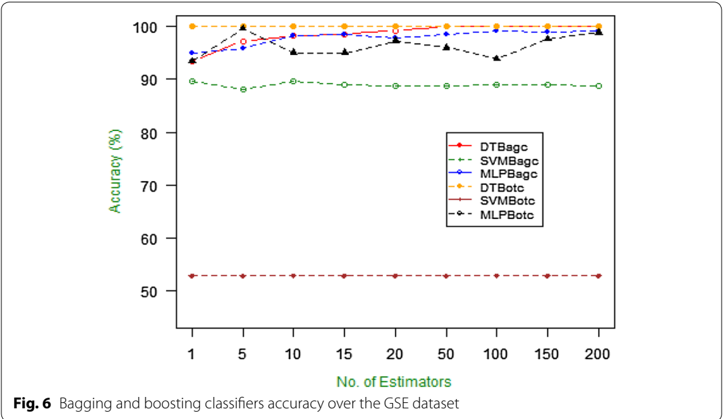
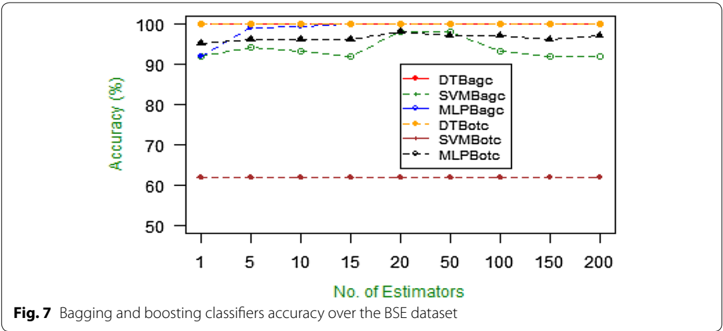
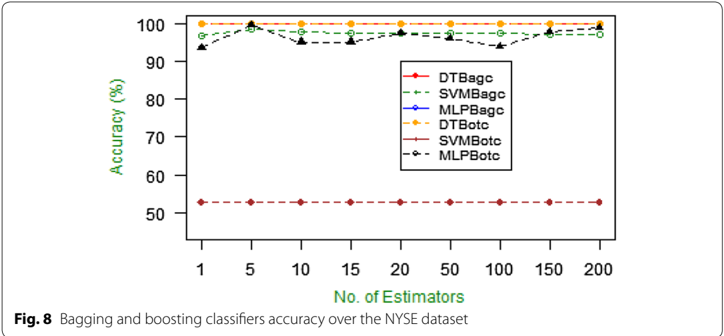
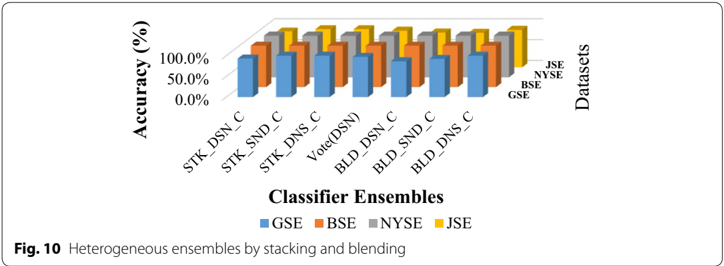
- Stacking outperformed all other combination techniques for ensemble classifiers and regressors; blending followed, then DT ensembles by boosting/bagging. DT ensemble classifiers by boosting and bagging obtained 99.98% accuracy with 10–200 estimators over GSE, BSE, and NYSE; DT boosting averaged 100% over NYSE, 95.09% over JSE, 98.52% over GSE, and 99.98% over BSE.
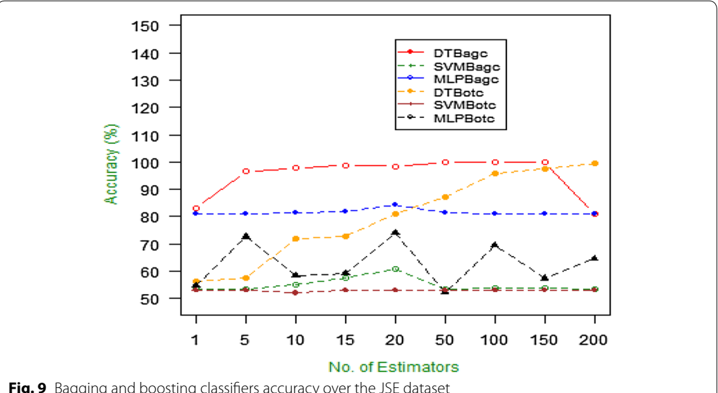
- MLP bagging classifier performed better than MLP boosting: MLP bagging recorded 100% over NYSE, 81.53% over JSE, 97.98% over GSE, and 98.93% over BSE, while MLP boosting recorded 96.32% over NYSE, 62.45% over JSE, 88.99% over GSE, and 96.45% over BSE. SVM ensemble classification was low, especially on JSE (54.98% bagging; 53.02% boosting), but SVM regression had better error metrics.
- Performance depended on dataset origin; stacking/blending were computationally expensive, while a DT ensemble of 50–100 estimators by boosting was suggested as a low-cost classifier baseline.
Methods
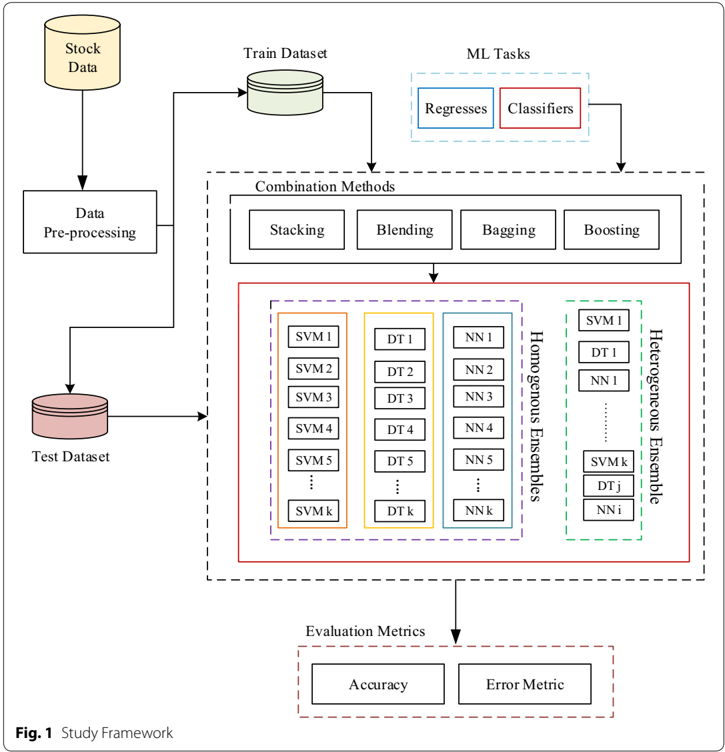
- Built 25 ensemble classifiers/regressors using DT, SVM, and MLP base learners with bagging, boosting, stacking, blending, and max voting; implemented with Scikit-learn, mlens, and Python.
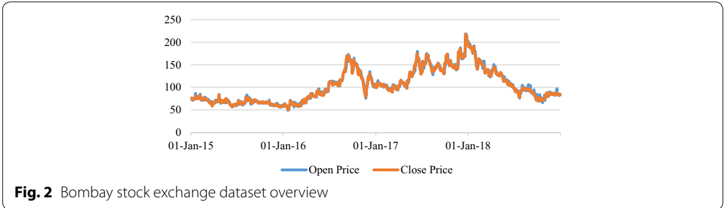
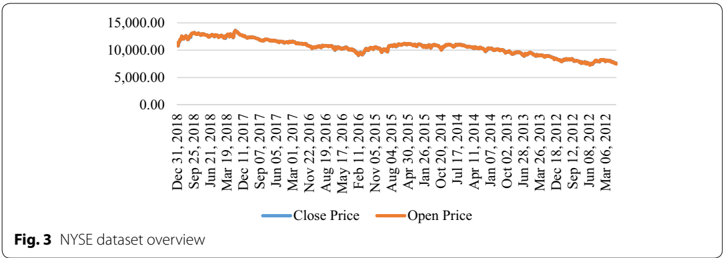
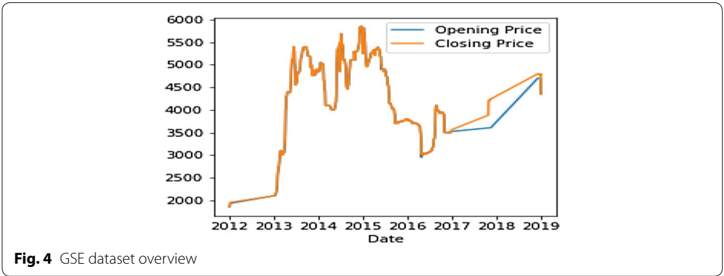
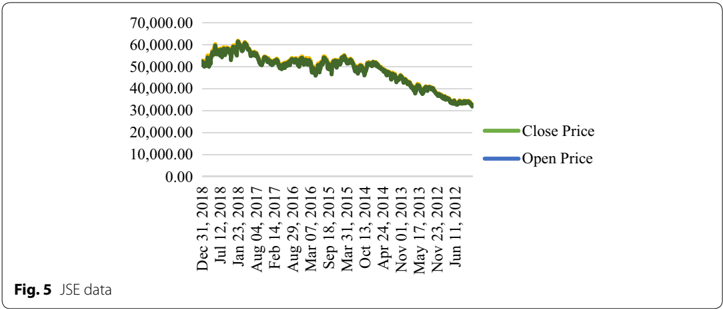
- Data: market indices from GSE, JSE, NYSE, and BSE-SENSEX; the abstract says January 2012–December 2018, while Table 2 lists GSE 1100 (Jan 2012–Dec 2017, 9 features), NYSE 1760 (Jan 03 2012–Dec 2018, 15 features), JSE 1749 (Jan 2012–Dec 2018, 7 features), and BSE 984 (Jan 2015–Dec 2018, 12 features). The study predicted 30-day-ahead closing price (regression) and price movement (classification).
- Preprocessing used wavelet transform denoising and min-max normalization; evaluation used 10-fold cross-validation, an 80/20 train/test split, and 12 accuracy/error metrics.
Limitations
- Stated: the study predicts stock market indices, not exact stock prices; authors propose future work on feature selection and SVM parameter optimization (e.g., GA, PCA).
- Stated: classical SVM assumes all features contribute equally and has difficulty choosing suitable parameters (C, σ, ε), affecting practicality; SVM ensemble classification was deficient with input variables and dataset sizes.
- Evident from the text: dataset periods in Table 2 do not fully match the abstract (GSE ends Dec 2017; BSE starts Jan 2015 vs abstract Jan 2012–Dec 2018), and some table entries appear inconsistent/OCR-corrupted (e.g., MLPBotc 150 mean reported as 0.135 in the BSE table), limiting reproducibility.
Model-written summary. Check it against the paper before relying on it.
Integrity signals
Registry
Cites
Statistics
Figures
Verification
Claims the paper makes
7 Valid · 4 Not valid · 15 Not checked · 120 Own results and interpretations
The sources with a verdict support this claim; the rest weren’t checked yet, have no full text we could read, or their verdicts aren’t rated yet.
In the paper
“Despite numerous works revealing the dominance of ensemble classifier over single classifier, most of these studies only ensemble a specific type of classifier or regressor for stock-market prediction, such as NN [18][19][20], DT [21,22] and SVM [12,23].”
§ A comprehensive evaluation of ensemble learning for stock-market prediction > Introduction
What the sources say
- Not matchedcites [18] 18. Macchiarulo A. Predicting and beating the stock market with machine learning and technical analysis. J Intern Bank Commer. 2018;23:1-22.
Its entry has no title and year that we can search by.
- Not matchedcites [21] 21. Weng B. Application of machine learning techniques for stock market prediction. Auburn: Auburn University; 2017.
We searched by its title and found no matching paper.
- Supportedcites [22] 22. Khaidem L, Saha S, Dey SR. Predicting the direction of stock market prices using random forest. Appl Math Financ. 2016;2016:1-20. source
The citation supports the decision-tree example in the citing sentence, not its broader claim about most previous studies. In Related Work (p. 2), the source describes its random forest as a multitude of decision trees whose outputs are combined. (LLM, conf=0.92)
- Not checked — no full text of the sourcecites [12] 12. Ballings M, Van den Poel D, Hespeels N, Gryp R. Evaluating multiple classifiers for stock price direction predic- tion. Expert Syst Appl. 2015;42:7046-56. https ://doi.org/10.1016/j.eswa.2015.05.013. source
- Not checked — no full text of the sourcecites [23] 23. Gonzalez TR, Padilha AC, Couto AD. Ensemble system based on genetic algorithm for stock market forecasting. In: 2015 IEEE congress on evolutionary computation. 2015. pp. 3102-8. source
plain- Asserted: passes — The authors put it forward as true.
- Checkable: passes — It can be checked against evidence.
- Load-bearing: passes — The paper’s conclusions depend on it.
- Based: passes — The paper gives a reason why it holds.
- Not matched
The cited sources support only part of this claim — read each source’s verdict below.
In the paper
“In all these applications, their reported accuracies support the argument that ensemble classifiers or regressors are often far more precise than the discrete classifiers or regressors.”
§ A comprehensive evaluation of ensemble learning for stock-market prediction > Introduction
What the sources say
- Partly supportedcites [14] 14. Bergquist SL, Brooks GA, Keating NL, Landrum MB, Rose S. Classifying lung cancer severity with ensemble machine learning in health care claims data. In: 2nd machine learning for healthcare conference. 2017. pp. 25-38.Experimental — accuracy not yet measured
The Results and Discussion sections do report ensemble superiority: the super learner 'improved substantially upon the clinical tree algorithm' (CV R2 0.405) and, versus the next best individual algorithm (GAM with C123), classified 1,034 more true positives and 1,034 more true negatives for a 14 percentage point accuracy gain — so the direction of the claim is supported for this one application. However, the same passages qualify 'far more precise': several individual algorithms, including regression-based ones, reached relative efficiencies of 94-98%, and the Discussion proposes an a priori 'improvement threshold' that more complex algorithms must beat. The paper is a single health-care-claims application (SEER-Medicare lung cancer staging), so it cannot carry the cross-sector generality or the 'often far more precise' magnitude the citing sentence attributes; that generalization is the citing authors' own conclusion. (LLM, conf=0.78)
- Not matchedcites [15] 15. Priya P, Muthaiah U, Balamurugan M. Predicting yield of the crop using machine learning algorithm. Int J Eng Sci Res Technol. 2018;7:1-7.
Its entry has no title and year that we can search by.
- Partly supportedcites [16] 16. Khairalla MA, Ning X, AL-Jallad NT, El-Faroug MO. Short-term forecasting for energy consumption through stack- ing heterogeneous ensemble learning model. Energies. 2018;11:1-21. https ://doi.org/10.3390/en110 61605 . sourceExperimental — accuracy not yet measured
Our copy clearly makes the ensemble-over-single argument, but only for regression/forecasting on energy (oil consumption) data: the Introduction (p.1) concludes from the reviewed literature that 'the hybrid regression models give preferred predictive accuracy over any single learner', and the Conclusions (Section 5) state that 'all ensemble models have been able to exceed the best performing individual models on single-ahead, as well as the multi-ahead horizon', with the Discussion (Section 4) noting 'the three ensemble methods mostly outperformed the single prediction models'. What is not supported is the classifier half of the claim and the cross-sector breadth implied by 'in all these applications': the paper's own comparisons cover only SVR/BPNN/LR/AR/bagging regressors on one oil-consumption data set (it even lists single-data-set evaluation as a limitation), and its treatment of classification is confined to generic background statements about bagging/Random Forest and AdaBoost rather than reported classification accuracies. The magnitude 'far more precise' also runs ahead of the paper's hedged wording ('mostly outperformed', 'preferred predictive accuracy'). (LLM, conf=0.72)
plainstates a cause- Asserted: passes — The authors put it forward as true.
- Checkable: passes — It can be checked against evidence.
- Load-bearing: passes — The paper’s conclusions depend on it.
- Based: passes — The paper gives a reason why it holds.
- Partly supported
The cited sources support only part of this claim — read each source’s verdict below.
In the paper
“most of the studies compared between ensemble classifiers [12, 18-20, 22, 23, 28] or regressors [21,30] machine learning algorithms, but not both.”
§ A comprehensive evaluation of ensemble learning for stock-market prediction > Related works evaluation
What the sources say
- Not checked — no full text of the sourcecites [12] 12. Ballings M, Van den Poel D, Hespeels N, Gryp R. Evaluating multiple classifiers for stock price direction predic- tion. Expert Syst Appl. 2015;42:7046-56. https ://doi.org/10.1016/j.eswa.2015.05.013. source
- Not matchedcites [18] 18. Macchiarulo A. Predicting and beating the stock market with machine learning and technical analysis. J Intern Bank Commer. 2018;23:1-22.
Its entry has no title and year that we can search by.
- Not checked — no full text of the sourcecites [19] 19. Mabu S, Obayashi M, Kuremoto T. Ensemble learning of rule-based evolutionary algorithm using multi-layer perceptron for supporting decisions in stock trading problems. Appl Soft Comput. 2015;36:357-67. https ://doi. org/10.1016/j.asoc.2015.07.020. source
- Could not verifycites [20] 20. Maknickiene N, Lapinskaite I, Maknickas A. Application of ensemble of recurrent neural networks for forecasting of stock market sentiments. Equilib Q J Econ Econ Policy. 2018;13:7-27. https ://doi.org/10.24136 /eq.2018.001. sourceExperimental — accuracy not yet measured
Our copy's Theoretical background surveys sentiment-forecasting models one by one — Wang et al. (2013) support vector regression, Wang et al. (2016) fuzzy classification, Antweiler and Frank (2004) Naive Bayes/SVM classifiers, Ho and Wang (2016) ANN (Theoretical background) — but it never compares ensemble classifiers against ensemble regressors, nor makes any 'but not both' gap statement. The paper's own contribution is a single stacking ensemble of 176 Evolino RNNs evaluated by overall classification accuracy (Research methodology; Estimating the accuracy of classification; Table 1), so it offers no basis for the attributed literature-wide comparison. Searched: 'ensemble classifiers compared with ensemble regressors', 'comparison of classifiers and regression models in previous research', 'literature gap ensemble methods'; the full text is not truncated, and no passage addresses the claim. (LLM, conf=0.62)
- Partly supportedcites [22] 22. Khaidem L, Saha S, Dey SR. Predicting the direction of stock market prices using random forest. Appl Math Financ. 2016;2016:1-20. sourceExperimental — accuracy not yet measured
Section 3.5 (p. 8) identifies the paper’s random forest as an ensemble classifier, and Section 7 (p. 16) compares its results with other classification models. It does not compare multiple ensemble classifiers, as the citing sentence suggests; the named comparators include logistic regression, discriminant analysis, and SVM. (LLM, conf=0.83)
- Not checked — no full text of the sourcecites [23] 23. Gonzalez TR, Padilha AC, Couto AD. Ensemble system based on genetic algorithm for stock market forecasting. In: 2015 IEEE congress on evolutionary computation. 2015. pp. 3102-8. source
- Not checked — no full text of the sourcecites [28] 28. Pulido M, Melin P, Castillo O. Particle swarm optimization of ensemble neural networks with fuzzy aggrega- tion for time series prediction of the Mexican Stock Exchange. Inf Sci (Ny). 2014;342:317-29. https ://doi. org/10.1007/978-3-319-32229 -2_23. source
- Not matchedcites [21] 21. Weng B. Application of machine learning techniques for stock market prediction. Auburn: Auburn University; 2017.
We searched by its title and found no matching paper.
- Not checked — no full text of the sourcecites [30] 30. Booth A, Gerding E, Mcgroarty F. Automated trading with performance weighted random forests and seasonal- ity. Expert Syst Appl. 2014;41:3651-61. https ://doi.org/10.1016/j.eswa.2013.12.009. source
plain- Asserted: passes — The authors put it forward as true.
- Checkable: passes — It can be checked against evidence.
- Load-bearing: passes — The paper’s conclusions depend on it.
- Based: passes — The paper gives a reason why it holds.
The cited sources that could be checked couldn’t confirm or dispute this claim.
In the paper
“These metrics were selected due to their appropriateness and effectiveness for classification and regression ML tasks in stock market prediction [1,27,62].”
§ A comprehensive evaluation of ensemble learning for stock-market prediction > Model evaluation
What the sources say
- Not checked — no full text of the sourcecites [1] 1. Nti IK, Adekoya AF, Weyori BA. A systematic review of fundamental and technical analysis of stock market predic- tions. Artif Intell Rev. 2019. https ://doi.org/10.1007/s1046 2-019-09754 -z. source
- Not checked — no full text of the sourcecites [27] 27. Jiang M, Liu J, Zhang L, Liu C. An improved Stacking framework for stock index prediction by leveraging tree- based ensemble models and deep learning algorithms. Phys Stat Mech Appl. 2019. https ://doi.org/10.1016/j.physa .2019.12227 2. source
- Could not verifycites [62] 62. Kamel SR, Yaghoubzadeh R, Kheirabadi M. Improving the performance of support-vector machine by selecting the best features by Gray Wolf algorithm to increase the accuracy of diagnosis of breast cancer. J Big Data. 2019. https :// doi.org/10.1186/s4053 7-019-0247-7. sourceExperimental — accuracy not yet measured
Our copy of Kamel et al. (2019) is entirely about breast-cancer diagnosis: the 'Preferences and criteria for comparison' section defines accuracy, recall, specificity, precision, F-measure, RMSE, MSE, MCC and Kappa (Eqs. 7-15) as the evaluation set for a GWO-SVM classifier on the UCI breast-cancer dataset (699 records, two classes), and ROC/AUC are discussed under 'Accuracy criterion'. No passage addresses stock market prediction or financial regression/classification tasks (searched: 'stock market prediction classification regression evaluation metrics', 'twelve evaluation criteria accuracy precision recall F-measure MAE'), so the paper neither supports nor contradicts the claim that these twelve metrics are appropriate for stock-market ML tasks. The citation appears to be borrowed for its metric list rather than for any stock-market finding. (LLM, conf=0.72)
plain- Asserted: passes — The authors put it forward as true.
- Checkable: passes — It can be checked against evidence.
- Load-bearing: passes — The paper’s conclusions depend on it.
- Based: passes — The paper gives a reason why it holds.
The sources with a verdict support this claim; the rest weren’t checked yet, have no full text we could read, or their verdicts aren’t rated yet.
In the paper
“Only a few [4,18,20,37] examined ensemble classifiers or regressors based on stacking or blending combinational technique.”
§ A comprehensive evaluation of ensemble learning for stock-market prediction > Related works evaluation
What the sources say
- Not checked — no full text of the sourcecites [4] 4. Wang Q, Xu W, Huang X, Yang K. Enhancing intraday stock price manipulation detection by leveraging recurrent neural networks with ensemble learning. Neurocomputing. 2019;347:46-58. https ://doi.org/10.1016/j.neuco m.2019.03.006. source
- Not matchedcites [18] 18. Macchiarulo A. Predicting and beating the stock market with machine learning and technical analysis. J Intern Bank Commer. 2018;23:1-22.
Its entry has no title and year that we can search by.
- Supportedcites [20] 20. Maknickiene N, Lapinskaite I, Maknickas A. Application of ensemble of recurrent neural networks for forecasting of stock market sentiments. Equilib Q J Econ Econ Policy. 2018;13:7-27. https ://doi.org/10.24136 /eq.2018.001. source
The Introduction (p. 1) states that the aim of the paper 'uses an Evolino RNN-based stacking ensemble prediction model', directly identifying it as a study built on a stacking ensemble. The Research methodology section reinforces this: 'The ensemble is composed of 176 Evolino RNNs predicting simultaneously', with outputs used for classification of growth/decline and sentiment (Table 1 reports overall classification accuracy), so the paper indeed examines an ensemble classifier/regressor based on a stacking combination technique. The citation is offered as an identification of such a study, and our copy shows this paper is that thing; it does not discuss 'blending', but the claim's alternative ('stacking or blending') is satisfied by stacking. (LLM, conf=0.85)
- Not checked — no full text of the sourcecites [37] 37. Pasupulety U, Abdullah Anees A, Anmol S, Mohan BR. Predicting stock prices using ensemble learning and sentiment analysis. In: Proceedings of IEEE 2nd international conference on artificial intelligence and knowledge engineering. AIKE; 2019. pp. 215-22. https ://doi.org/10.1109/aike.2019.00045 . source
plain- Asserted: passes — The authors put it forward as true.
- Checkable: passes — It can be checked against evidence.
- Load-bearing: passes — The paper’s conclusions depend on it.
- Based: passes — The paper gives a reason why it holds.
94 more claims
Create a free account to see all 146 claims and to verify the 1 reference still open.
- It may state two separate claims as one. 28
- Probably not a substantial claim. 19
- Borderline: one of the tests for a substantial claim is unclear. 1
- The quote only partly states this claim. 3
Claims other papers make about this one
Each is checked against this paper’s own text: does it say what the citing paper says it does?
The source backs part of the claim, not all of it — or backs it for a different population, condition or comparison.
In the citing paper
“Most ensemble classifiers and regressors are developed by combining decision trees, support vector machines, and neural networks (Nti et al. 2020).”
From Forecasting Stock Market Prices Using Machine Learning and Deep Learning Models: A Systematic Review, Performance Analysis and Discussion of Implications (2023) · cites this paper as Nti et al. 2020
Experimental — accuracy not yet measured
Self-check
Percentages, sums and reported differences re-computed from the paper’s own numbers.
Each contradiction between two passages listed here was confirmed by an independent check.
Rated minor: it would not touch a result — a value no result rests on, a p-value that stays on the same side of the significance level, or a conflict that is clerical, resolved elsewhere in the paper, or outside its own findings.
In the paper
§ A comprehensive evaluation of ensemble learning for stock-market prediction > Error metrics analysis of heterogeneous ensembled classifier by STK and BLD
“Oddly, stacking ensemble regressor (STK_DSN_R) outperformed all regressors by stacking and blending over all datasets.”
§ A comprehensive evaluation of ensemble learning for stock-market prediction > Additional information
“STK_DSN_R 0.074 0.061 0.993 0.993 0.057 0.014 0.279 0.004 STK_SND_R 0.210 0.157 0.942 0.942 0.128 0.042 5.945 0.001 STK_DNS_R 0.055 0.050 0.996 0.998 0.051 0.011 4.480 0.001”
Citations
Cites
Tikhonov Regularization and Total Least Squares
Golub, G. H., Hansen, P. C., & O'Leary, D. P. (1999) · SIAM Journal on Matrix Analysis and Applications · doi:10.1137/s0895479897326432 · Cited by 1,029
Chong, E., Han, C., & Park, F. C. (2017) · Expert Systems with Applications · doi:10.1016/j.eswa.2017.04.030 · Cited by 834
Deep neural networks, gradient-boosted trees, random forests: Statistical arbitrage on the S&P 500
Krauss, C., Do, X. A., & Huck, N. (2017) · European Journal of Operational Research · doi:10.1016/j.ejor.2016.10.031 · Cited by 750
Evaluating multiple classifiers for stock price direction prediction
Ballings, M., Van den Poel, D., Hespeels, N., & Gryp, R. (2015) · Expert Systems with Applications · doi:10.1016/j.eswa.2015.05.013 · Cited by 611
A systematic review of fundamental and technical analysis of stock market predictions
Nti, I. K., Adekoya, A. F., & Weyori, B. A. (2020) · Artificial Intelligence Review · doi:10.1007/s10462-019-09754-z · Cited by 547
Self-citationEnsemble methods for wind and solar power forecasting—A state-of-the-art review
Ren, Y., Suganthan, P. N., & Srikanth, N. (2015) · Renewable and Sustainable Energy Reviews · doi:10.1016/j.rser.2015.04.081 · Cited by 435
The Evolution of Boosting Algorithms: From Machine Learning to Statistical Modelling
Binder, H., Gefeller, O., Schmid, M., & Mayr, A. (2014) · Methods of Information in Medicine · doi:10.3414/me13-01-0122 · Cited by 412
Big Data: Deep Learning for financial sentiment analysis
Sohangir, S., Wang, D., Pomeranets, A., & Khoshgoftaar, T. M. (2018) · Journal of Big Data · doi:10.1186/s40537-017-0111-6 · Cited by 390
Chen, Y., & Hao, Y. (2017) · Expert Systems with Applications · doi:10.1016/j.eswa.2017.02.044 · Cited by 382
A deep learning ensemble approach for crude oil price forecasting
Zhao, Y., Li, J., & Yu, L. (2017) · Energy Economics · doi:10.1016/j.eneco.2017.05.023 · Cited by 380
Research works printed but not linked: 3
- 9. Pimprikar R, Ramachadran S, Senthilkumar K. Use of machine learning algorithms and twitter sentiment analysis for stock market prediction. Int J Pure Appl Math. 2017;115:521-6.
- 15. Priya P, Muthaiah U, Balamurugan M. Predicting yield of the crop using machine learning algorithm. Int J Eng Sci Res Technol. 2018;7:1-7.
- 52. Agarwal P, Bajpai S, Pathak A, Angira R. Stock market price trend forecasting using. Int J Res Appl Sci Eng Tech- nol. 2017;5:1673-6.
Cited by
A Survey of Ensemble Learning: Concepts, Algorithms, Applications, and Prospects
Mienye, I. D., & Sun, Y. (2022) · IEEE Access · doi:10.1109/access.2022.3207287 · Cited by 1,298
A comprehensive review on ensemble deep learning: Opportunities and challenges
Mohammed, A., & Kora, R. (2023) · Journal of King Saud University - Computer and Information Sciences · doi:10.1016/j.jksuci.2023.01.014 · Cited by 1,127
Rouf, N., Malik, M. B., Arif, T., Sharma, S., Singh, S., Aich, S., & Kim, H.-C. (2021) · Electronics · doi:10.3390/electronics10212717 · Cited by 273
Performance of Machine Learning Algorithms with Different K Values in K-fold CrossValidation
Department of Computer Science and Informatics, U. O. E. A. N. R., Nti, I. K., Nyarko-Boateng, O., & Aning, J. (2021) · International Journal of Information Technology and Computer Science · doi:10.5815/ijitcs.2021.06.05 · Cited by 270
Self-citationSonkavde, G., Dharrao, D. S., Bongale, A. M., Deokate, S. T., Doreswamy, D., & Bhat, S. K. (2023) · International Journal of Financial Studies · doi:10.3390/ijfs11030094 · Cited by 262
“Most ensemble classifiers and regressors are developed by combining decision trees, support vector machines, and neural networks (Nti et al. 2020).”
BackgroundSurvey of feature selection and extraction techniques for stock market prediction
Htun, H. H., Biehl, M., & Petkov, N. (2023) · Financial Innovation · doi:10.1186/s40854-022-00441-7 · Cited by 234
Technical analysis strategy optimization using a machine learning approach in stock market indices
Ayala, J., García-Torres, M., Noguera, J. L. V., Gómez-Vela, F., & Divina, F. (2021) · Knowledge-Based Systems · doi:10.1016/j.knosys.2021.107119 · Cited by 170
A mini-review of machine learning in big data analytics: Applications, challenges, and prospects
Nti, I. K., Quarcoo, J. A., Aning, J., & Fosu, G. K. (2022) · Big Data Mining and Analytics · doi:10.26599/bdma.2021.9020028 · Cited by 207
Self-citationA Random Forests Approach to Predicting Clean Energy Stock Prices
Sadorsky, P. (2021) · Journal of Risk and Financial Management · doi:10.3390/jrfm14020048 · Cited by 138
“…addition, the existing literature on stock price predictability shows that predicting stock price direction is more successful than predicting actual stock prices (Basak et al. 2019; Leung et al. 2000; Nyberg 2011; Nyberg and Pönkä 2016; Pönkä 2016; Ballings et al. 2015; Lohrmann and Luukka 2019).”
Kumar, M., Bajaj, K., Sharma, B., & Narang, S. K. (2021) · Big Data · doi:10.1089/big.2021.0257 · Cited by 125
Simhadri, C. G., Kondaveeti, H. K., Kumari, V. V., Mitra, A., & Ananthachari, P. (2024) · Information Processing in Agriculture · doi:10.1016/j.inpa.2024.04.006 · Cited by 192
Kazançoğlu, Y., Pala, M. Ö., Sezer, M. D., Luthra, S., & Kumar, A. (2021) · Journal of Enterprise Information Management · doi:10.1108/jeim-12-2020-0521 · Cited by 113
An Enhanced Ensemble Learning-Based Fault Detection and Diagnosis for Grid-Connected PV Systems
Dhibi, K., Mansouri, M. M., Bouzrara, K., Nounou, H. N., & Nounou, M. N. (2021) · IEEE Access · doi:10.1109/access.2021.3128749 · Cited by 94
A social CRM analytic framework for improving customer retention, acquisition, and conversion
Lamrhari, S., Ghazi, H. E., Oubrich, M., & Faker, A. E. (2021) · Technological Forecasting and Social Change · doi:10.1016/j.techfore.2021.121275 · Cited by 135
A Systematic Survey of AI Models in Financial Market Forecasting for Profitability Analysis
Khattak, B. H. A., Shafi, I., Khan, A. S., Flores, E. S., Lara, R. G., Samad, M. A., & Ashraf, I. (2023) · IEEE Access · doi:10.1109/access.2023.3330156 · Cited by 120
Wang, Y., Shi, W., & Wen, T. (2023) · Agricultural Water Management · doi:10.1016/j.agwat.2023.108140 · Cited by 84
A predictive analytics model for crop suitability and productivity with tree-based ensemble learning
Nti, I. K., Zaman, M. A. U., Nyarko‐Boateng, O., Adekoya, A. F., & Kyeremeh, F. (2023) · Decision Analytics Journal · doi:10.1016/j.dajour.2023.100311 · Cited by 68
Self-citationSingh, R. K., Agrawal, S., Sahu, A., & Kazançoğlu, Y. (2021) · The TQM Journal · doi:10.1108/tqm-02-2021-0051 · Cited by 74
El-Rashidy, N. M., Abuhmed, T., Alarabi, L., El-Bakry, H. M., Abdelrazek, S. M., Ali, F., & El–Sappagh, S. (2021) · Neural Computing and Applications · doi:10.1007/s00521-021-06631-1 · Cited by 66
Financial Forecasting with Machine Learning: Price Vs Return
Kamalov, F., Gurrib, I., & Rajab, K. D. (2021) · Journal of Computer Science · doi:10.3844/jcssp.2021.251.264 · Cited by 77
Informal governance in the digital transformation
Keller, J., Burkhardt, P., & Lasch, R. (2021) · International Journal of Operations & Production Management · doi:10.1108/ijopm-09-2020-0660 · Cited by 61
Dhibi, K., Mansouri, M. M., Bouzrara, K., Nounou, H. N., & Nounou, M. N. (2022) · Renewable Energy · doi:10.1016/j.renene.2022.05.082 · Cited by 55
An Ensemble-Based Machine Learning Model for Forecasting Network Traffic in VANET
Amiri, P. A. D., & Pierre, S. (2023) · IEEE Access · doi:10.1109/access.2023.3253625 · Cited by 53
Yang, C., Abedin, M. Z., Zhang, H., Weng, F., & Hájek, P. (2023) · Annals of Operations Research · doi:10.1007/s10479-023-05311-8 · Cited by 55
Auditor judgment and decision-making in big data environment: a proposed research framework
Hamdam, A., Jusoh, R., Yahya, Y., Jalil, A. A., & Abidin, N. H. Z. (2021) · Accounting Research Journal · doi:10.1108/arj-04-2020-0078 · Cited by 94
Ram, J., & Zhang, Z. (2021) · Journal of Business and Industrial Marketing · doi:10.1108/jbim-10-2020-0464 · Cited by 58
Pineda-Jaramillo, J., & Arbeláez-Arenas, Ó. (2022) · Journal of Urban Planning and Development · doi:10.1061/(asce)up.1943-5444.0000830 · Cited by 51
Evangelista, E. D. L. (2021) · International Journal of Emerging Technologies in Learning (iJET) · doi:10.3991/ijet.v16i24.26151 · Cited by 56
Daradkeh, M. K. (2022) · Electronics · doi:10.3390/electronics11020250 · Cited by 53
Bongomin, O., Nzila, C. K., Mwasiagi, J. I., & Maube, O. (2024) · International Journal of Energy Research · doi:10.1155/2024/6087208 · Cited by 57
Stock Market Prediction Using Machine Learning and Deep Learning Techniques: A Review
Saberironaghi, M., Ren, J., & Saberironaghi, A. (2025) · AppliedMath · doi:10.3390/appliedmath5030076 · Cited by 98
Stock Market Prediction using Supervised Machine Learning Techniques: An Overview
Lawal, Z. K., Yassin, H., & Zakari, R. Y. (2020) · IEEE Asia-Pacific Conference on Computer Science and Data Engineering (CSDE) · doi:10.1109/csde50874.2020.9411609 · Cited by 38
Sadorsky, P. (2022) · The North American Journal of Economics and Finance · doi:10.1016/j.najef.2022.101705 · Cited by 43
Machine and Deep Learning-based XSS Detection Approaches: A Systematic Literature Review
Thajeel, I. K., Samsudin, K. B., Hashim, S. J., & Hashim, F. (2023) · Journal of King Saud University - Computer and Information Sciences · doi:10.1016/j.jksuci.2023.101628 · Cited by 59
Ananthajothi, K., Karthikayani, K., & Prabha, R. (2022) · Data & Knowledge Engineering · doi:10.1016/j.datak.2022.102092 · Cited by 39
Ensemble Learning with Supervised Machine Learning Models to Predict Credit Card Fraud Transactions
Baker, M. R., Mahmood, Z. N., & Shaker, E. H. (2022) · Revue d intelligence artificielle · doi:10.18280/ria.360401 · Cited by 59
Cezar, B. G. D. S., & Maçada, A. C. G. (2021) · Aslib Journal of Information Management · doi:10.1108/ajim-01-2021-0015 · Cited by 58
Systematic Mapping Study of Sales Forecasting: Methods, Trends, and Future Directions
Ahaggach, H., Abrouk, L., & Lebon, E. (2024) · Forecasting · doi:10.3390/forecast6030028 · Cited by 62
Abedin, T., Xu, H., & Uddin, S. (2026) · Scientific Reports · doi:10.1038/s41598-026-37247-x · Cited by 69
Stock market decision support modeling with tree-based AdaBoost ensemble machine learning models
Ampomah, E. K., Qin, Z., Nyame, G., & Botchey, F. E. (2021) · Informatica · doi:10.31449/inf.v44i4.3159 · Cited by 39
Sawangwong, A., & Chaopaisarn, P. (2021) · Kybernetes · doi:10.1108/k-07-2021-0555 · Cited by 40
Mohapatra, S., Mukherjee, R., Roy, A., Sengupta, A., & Puniyani, A. R. (2022) · Journal of risk and financial management · doi:10.3390/jrfm15080350 · Cited by 42
Dhibi, K., Mansouri, M. M., Abodayeh, K., Bouzrara, K., Nounou, H. N., & Nounou, M. N. (2022) · IEEE Access · doi:10.1109/access.2022.3167147 · Cited by 31
A Novel Heuristic-Based Selective Ensemble Prediction Method for Digital Financial Fraud Risk
Xia, P., Zhu, X., Charles, V., Zhao, X., & Peng, M. (2024) · IEEE Transactions on Engineering Management · doi:10.1109/tem.2024.3385298 · Cited by 30
HIOC: a hybrid imputation method to predict missing values in medical datasets
Rani, P., Kumar, R., & Jain, A. (2021) · International Journal of Intelligent Computing and Cybernetics · doi:10.1108/ijicc-03-2021-0042 · Cited by 26
Stock Market Prediction Techniques: A Review Paper
Sharma, K., & Bhalla, R. (2021) · Advances in intelligent systems and computing · doi:10.1007/978-981-16-4641-6_15 · Cited by 27
John, A., Isnin, I. F., Madni, S. H. H., & Muchtar, F. (2024) · Intelligent Systems with Applications · doi:10.1016/j.iswa.2024.200442 · Cited by 34
Stability improvement of the PSS-connected power system network with ensemble machine learning tool
Shahriar, M. S., Shafiullah, M., Pathan, M. I., Sha’aban, Y. A., Bouchekara, H. R. E. H., Ramli, M. A. M., & Rahman, M. M. (2022) · Energy Reports · doi:10.1016/j.egyr.2022.08.225 · Cited by 31
Machine learning-based prediction of seismic response of steel diagrid systems
Jahangiri, V., Akbarzadeh, M. R., Shahamat, S. A., Asgari, A., Naeim, B., & Ranjbar, F. (2025) · Structures · doi:10.1016/j.istruc.2025.109791 · Cited by 28
Two-Stage Portfolio Optimization Integrating Optimal Sharp Ratio Measure and Ensemble Learning
Zhou, Z., Song, Z., Ren, T., & Yu, L. (2022) · IEEE Access · doi:10.1109/access.2022.3232281 · Cited by 36
Jin, H.-I., Zhao, Y., Pak, U., Zhen, Z., & So, K. (2024) · Geo-spatial Information Science · doi:10.1080/10095020.2024.2311261 · Cited by 27
Stacknet Based Decision Fusion Classifier for Network Intrusion Detection
Nti, I. K., Narko-Boateng, O., Adekoya, A. F., & Arjun, R. (2022) · The International Arab Journal of Information Technology · doi:10.34028/iajit/19/3a/8 · Cited by 23
Self-citationAnalyzing the Stock Exchange Markets of EU Nations: A Case Study of Brexit Social Media Sentiment
Maqsood, H., Maqsood, M., Yasmin, S., Mehmood, I., Moon, J., & Rho, S. (2022) · Systems · doi:10.3390/systems10020024 · Cited by 28
An ensemble learning model for forecasting water-pipe leakage
Warad, A. A. M., Wassif, K. T., & Ramadan, N. (2024) · Scientific Reports · doi:10.1038/s41598-024-60840-x · Cited by 26
Kim, H.-R., Soh, H. Y., Kwak, M.-T., & Han, S. (2022) · Water · doi:10.3390/w14121862 · Cited by 27
Artificial Intelligence Based Hybrid Models for Prediction of Stock Prices
Singh, H., & Malhotra, M. (2023) · International Conference for Innovation in Technology (INOCON) · doi:10.1109/inocon57975.2023.10101297 · Cited by 20
Adekoya, A. F. (2020) · Indian Journal of Science and Technology · doi:10.17485/ijst/v13i35.1180 · Cited by 26
Self-citationVerma, S., Sahu, S. P., & Sahu, T. P. (2023) · Computational Economics · doi:10.1007/s10614-023-10400-8 · Cited by 23
Selective transfer learning with adversarial training for stock movement prediction
Li, Y., Dai, H., & Zheng, Z. (2022) · Connection Science · doi:10.1080/09540091.2021.2021143 · Cited by 26
Short-Term Arrival Delay Time Prediction in Freight Rail Operations Using Data-Driven Models
Pineda-Jaramillo, J., Bigi, F., Bosi, T., Viti, F., & D’Ariano, A. (2023) · IEEE Access · doi:10.1109/access.2023.3275022 · Cited by 24
A comparative study of ensemble learning algorithms for high-frequency trading
Ferrouhi, E. M., & Bouabdallaoui, I. (2024) · Scientific African · doi:10.1016/j.sciaf.2024.e02161 · Cited by 46
Shaqrah, A. A., & Alzighaibi, A. R. (2021) · VINE Journal of Information and Knowledge Management Systems · doi:10.1108/vjikms-05-2020-0087 · Cited by 23
Wang, X., Pan, Y., & Chen, J. (2025) · Computer-Aided Civil and Infrastructure Engineering · doi:10.1111/mice.70049 · Cited by 25
Kim, S., Yoon, H. C., Lim, J.-T., Jeong, D., & Kim, K. H. (2022) · Gas Science and Engineering · doi:10.1016/j.jgsce.2023.204916 · Cited by 19
Vrugt, J. A. (2024) · Water Resources Research · doi:10.1029/2023wr036710 · Cited by 32
Khattak, B. H. A., Shafi, I., Rashid, C. H., Safran, M., Alfarhood, S., & Ashraf, I. (2024) · Journal Of Big Data · doi:10.1186/s40537-024-00908-7 · Cited by 25
A hybrid boosting ensemble model for predicting maternal mortality and sustaining reproductive
Nti, I. K., & Owusu-Boadu, B. (2022) · Smart Health · doi:10.1016/j.smhl.2022.100325 · Cited by 20
Self-citationEnhancing data-driven elderly appointment services in domestic care communities under COVID-19
Lam, H. Y., Ho, G. T. S., Mo, D. Y. W., & Tang, V. (2021) · Industrial Management & Data Systems · doi:10.1108/imds-07-2020-0392 · Cited by 19
Machine Learning vs. Survival Analysis Models: a study on right censored heart failure data
Srujana, B., Verma, D., & Naqvi, S. (2022) · Communications in Statistics - Simulation and Computation · doi:10.1080/03610918.2022.2060510 · Cited by 20
Stock complex networks based on the GA-LightGBM model: The prediction of firm performance
Huang, C., Cai, Y., Cao, J., & Deng, Y. (2024) · Information Sciences · doi:10.1016/j.ins.2024.121824 · Cited by 19
A Novel NLP-based Stock Market Price Prediction and Risk Analysis Framework
Ul-Abidden, Z., Ali, R. H., Zeeshan, A. I., & Khan, T. A. (2024) · Journal of Computer Science and Technology · doi:10.24215/16666038.24.e07 · Cited by 18
Academic Performance Modelling with Machine Learning Based on Cognitive and Non-Cognitive Features
Owusu-Boadu, B., Nti, I. K., Nyarko‐Boateng, O., Aning, J., & Boafo, V. (2021) · Applied Computer Systems · doi:10.2478/acss-2021-0015 · Cited by 23
Self-citationPlant Disease Detection Using Ensemble Learning
Kondaveeti, H. K., Ujini, K. G., Pavankumar, B. V. V., Tarun, B. S., & Gopi, S. C. (2023) · International Conference on Computational Systems and Communication (ICCSC) · doi:10.1109/iccsc56913.2023.10142982 · Cited by 20
Saravag, P. K., & Kumar, B. R. (2024) · IEEE Access · doi:10.1109/access.2024.3439721 · Cited by 17
A Time Series Analysis-Based Stock Price Prediction Framework Using Artificial Intelligence
Singh, H., & Malhotra, M. (2023) · Communications in computer and information science · doi:10.1007/978-3-031-48781-1_22 · Cited by 18
An empirical assessment of different kernel functions on the performance of support vector machines
Nti, I. K., Nyarko‐Boateng, O., Adekoya, A. F., & Weyori, B. A. (2021) · Bulletin of Electrical Engineering and Informatics · doi:10.11591/eei.v10i6.3046 · Cited by 19
Self-citationGradient boosting Bayesian neural networks via Langevin MCMC
Bai, G., & Chandra, R. (2023) · Neurocomputing · doi:10.1016/j.neucom.2023.126726 · Cited by 20
Mastering Stock Markets with Efficient Mixture of Diversified Trading Experts
Sun, S., Wang, X., Xue, W., Lou, X., & An, B. (2023) · Proceedings of the 29th ACM SIGKDD Conference on Knowledge Discovery and Data Mining · doi:10.1145/3580305.3599424 · Cited by 16
Pineda-Jaramillo, J. (2021) · Journal of Transport & Health · doi:10.1016/j.jth.2021.101110 · Cited by 26
Bouzekraoui, M. E., Elaloui, A., Krimissa, S., Abdelrahman, K. S., Kahal, A. Y., Hajji, S., Ismaili, M., Mondal, B. K., & Namous, M. (2024) · Land · doi:10.3390/land13122110 · Cited by 18
Sector influence aware stock trend prediction using 3D convolutional neural network
Sinha, S., Mishra, S., Mishra, V. K., & Ahmed, T. (2022) · Journal of King Saud University - Computer and Information Sciences · doi:10.1016/j.jksuci.2022.02.008 · Cited by 23
Sassi, I., Anter, S., & Bekkhoucha, A. (2021) · Journal Of Big Data · doi:10.1186/s40537-021-00485-z · Cited by 24
Rahman, A., Syeed, M. M. M., Karim, M. R., Fatema, K., Khan, R. H., & Uddin, M. F. (2025) · Applied Water Science · doi:10.1007/s13201-025-02450-0 · Cited by 20
Evangelista, E. D. L., & Sy, B. D. (2022) · International Journal of Power Electronics and Drive Systems/International Journal of Electrical and Computer Engineering · doi:10.11591/ijece.v12i5.pp5226-5235 · Cited by 27
Caraka, R. E., Hudaefi, F. A., Gio, P. U., Toharudin, T., Tyasti, A. E., Goldameir, N. E., & Chen, R.-C. (2021) · International Journal of Islamic and Middle Eastern Finance and Management · doi:10.1108/imefm-08-2020-0408 · Cited by 17
Performance Evaluation of Time Series Forecasting Methods in The Stock Market: A Comparative Study
Dael, F. A., Yavuz, U., & Almohammedi, A. A. (2022) · International Conference on Decision Aid Sciences and Applications (DASA) · doi:10.1109/dasa54658.2022.9765177 · Cited by 17
Loh, L., Kueh, H., Parikh, N., Chan, H., Ho, N., & Chua, M. C. H. (2022) · FinTech · doi:10.3390/fintech1020008 · Cited by 26
Emedo, C., Wada, O. Z., David-Olawade, A. C., Ling, J., Esan, D. T., Ijiwade, J. O., & Olawade, D. B. (2025) · Digital engineering. · doi:10.1016/j.dte.2025.100068 · Cited by 20
Gong, H., & Xing, H. (2024) · Applied Soft Computing · doi:10.1016/j.asoc.2024.112393 · Cited by 22
A Predictive Analytics Framework for Insider Trading Events
Seth, T., & Chaudhary, V. (2020) · IEEE International Conference on Big Data (BigData) · doi:10.1109/bigdata50022.2020.9377791 · Cited by 18
Analysing travel satisfaction of tourists towards a metro system from unstructured data
Pineda-Jaramillo, J., & Pineda-Jaramillo, D. (2021) · Research in Transportation Business & Management · doi:10.1016/j.rtbm.2021.100746 · Cited by 21
Ensemble Classifier for Stock Trading Recommendation
Worasucheep, C. (2021) · Applied Artificial Intelligence · doi:10.1080/08839514.2021.2001178 · Cited by 19
Deep-Reinforcement-Learning-Based Dynamic Ensemble Model for Stock Prediction
Lin, W., Xie, L., & Xu, H. (2023) · Electronics · doi:10.3390/electronics12214483 · Cited by 13
Buslim, N. (2023) · Journal of Applied Data Sciences · doi:10.47738/jads.v4i3.112 · Cited by 20
Techniques for Stock Market Prediction: A Review
Sable, R. Y., Goel, S., & Chatterjee, P. (2023) · International Journal on Recent and Innovation Trends in Computing and Communication · doi:10.17762/ijritcc.v11i5s.7056 · Cited by 14
Long Short-Term Memory Network for Predicting Exchange Rate of the Ghanaian Cedi
Adekoya, A. F., Nti, I. K., & Weyori, B. A. (2021) · FinTech · doi:10.3390/fintech1010002 · Cited by 14
Self-citationZhao, Y., Qin, S., Zhang, C., Yao, J., Xing, Z., Cao, J., & Zhang, R. (2024) · Environmental Science and Pollution Research · doi:10.1007/s11356-024-33287-w · Cited by 12
Gul, A. (2025) · Computational Economics · doi:10.1007/s10614-025-10979-0 · Cited by 19
Narayana, M. L., Kartha, A. J., Mandal, A. K., Roshini, P., Suresh, A., & Jose, A. C. (2025) · Journal of Intelligent Information Systems · doi:10.1007/s10844-025-00928-6 · Cited by 21
Metadata
- Authors
- Nti, I. K., Adekoya, A. F., & Weyori, B. A.
- Affiliations
- University of Energy and Natural Resources (GH)
- Corresponding author
- Nti, Isaac Kofi
- Venue
- Journal of Big Data
- Published
- 2020-03-11
- Volume
- 7
- Issue
- 1
- ISSN
- 2196-1115 (ISSN-L)
- OpenAlex
- W3013734981
- Cited by
- 329
- References
- 62
- Citations by year
- 2026: 28 · 2025: 69 · 2024: 69 · 2023: 55 · 2022: 52 · 2021: 48 · 2020: 8
- FWCI
- 25.91
- Type
- journal article
- Language
- en
- Open access
- gold
- doi.org
- Licence
- cc-by
- creativecommons.org/licenses/by/4.0 (tdm)
- creativecommons.org/licenses/by/4.0 (vor)
- Locations
- Journal Of Big Data (publishedVersion, cc-by)
- DOAJ (DOAJ: Directory of Open Access Journals) (submittedVersion, cc-by-sa)
- Topics
- Social Sciences › Decision Sciences › Management Science and Operations Research › Stock Market Forecasting Methods
- Social Sciences › Decision Sciences › Management Science and Operations Research › Forecasting Techniques and Applications
- Social Sciences › Economics, Econometrics and Finance › Finance › Financial Markets and Investment Strategies
- Keywords
- stock market prediction, ensemble learning, stacking, blending, bagging, boosting, decision tree, support vector machine, artificial neural networks, forecast accuracy comparison
About these checks
Registry, retraction, Cites and statistics results are computed, not judged, with one exception: a printed reference that no index lists is read once by a model before it counts as a citation error. Claims are extracted by a model and kept only when their quote appears verbatim in the text; each cited source is then checked, with a model’s help, for whether it says what the claim relies on. Those verdicts can be wrong — read the claim’s quote and the cited source before relying on one.
The claim verdicts this report counts are experimental: their accuracy is not yet measured.
A language model drew the claims from the paper on 2026-10-10, under version 3 of the claim definition (model deepseek-v4.1-flash, prompt extract-v3).
A second model labelled each claim on 2026-10-10 (model jev-1.13-20260917, definition revision gold-guideline-v0.2).
Cited sources are checked with a language model’s help (gpt-6-sol and qwen3.8-omni-flash).
Statistics and arithmetic are recomputed, not judged.
Confidence bands are shown only for fields calibrated on our annotated test set. None is calibrated yet, so no band is shown.
What counts as a claim ›How we measure confidence ›How we check this ›
Are you an author, or do you see a problem with this page? Request a review
Data sources
Bibliographic data: Semantic Scholar, OpenAlex, Crossref.
Contains information from the Semantic Scholar Academic Graph Datasets, made available under the ODC Attribution License (ODC-BY 1.0).
Semantic Scholar’s data is described in: Kinney, R., et al. (2023). The Semantic Scholar Open Data Platform. arXiv:2301.10140.
