

A comprehensive evaluation of ensemble learning for stock-market prediction
Open accessThe DOI matches its Crossref record; 62 of the 64 references it cites were found in a registry or an index; 10 of the 55 sources its claims cite were checked for support.
Abstract
Abstract Stock-market prediction using machine-learning technique aims at developing effective and efficient models that can provide a better and higher rate of prediction accuracy. Numerous ensemble regressors and classifiers have been applied in stock market predictions, using different combination techniques. However, three precarious issues come in mind when constructing ensemble classifiers and regressors. The first concerns with the choice of base regressor or classifier technique adopted. The second concerns the combination techniques used to assemble multiple regressors or classifiers and the third concerns with the quantum of regressors or classifiers to be ensembled. Subsequently, the number of relevant studies scrutinising these previously mentioned concerns are limited. In this study, we performed an extensive comparative analysis of ensemble techniques such as boosting, bagging, blending and super learners (stacking). Using Decision Trees (DT), Support Vector Machine (SVM) and Neural Network (NN), we constructed twenty-five (25) different ensembled regressors and classifiers. We compared their execution times, accuracy, and error metrics over stock-data from Ghana Stock Exchange (GSE), Johannesburg Stock Exchange (JSE), Bombay Stock Exchange (BSE-SENSEX) and New York Stock Exchange (NYSE), from January 2012 to December 2018. The study outcome shows that stacking and blending ensemble techniques offer higher prediction accuracies (90–100%) and (85.7–100%) respectively, compared with that of bagging (53–97.78%) and boosting (52.7–96.32%). Furthermore, the root means square error (RMSE) recorded by stacking (0.0001–0.001) and blending (0.002–0.01) shows a better fit of ensemble classifiers and regressors based on these two techniques in market analyses compared with bagging (0.01–0.11) and boosting (0.01–0.443). Finally, the results undoubtedly suggest that an innovative study in the domain of stock market direction prediction ought to include ensemble techniques in their sets of algorithms.
Overview
CoChat Summary
TL;DR
This paper compares bagging, boosting, stacking, blending, and max voting ensembles built from decision trees, SVM, and MLP for stock-market classification and regression across four exchanges. It reports that stacking and blending achieve the highest accuracy and lowest error, though at higher computational cost.
Key findings
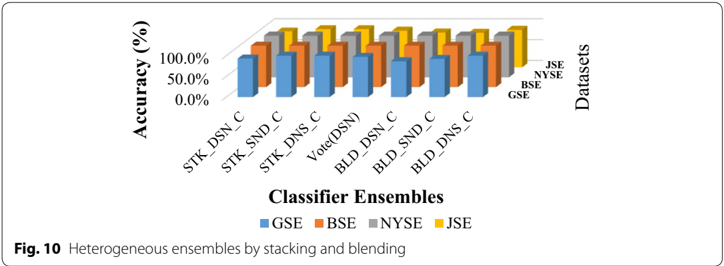
- Stacking and blending offered higher prediction accuracies: stacking 90–100%, blending 85.7–100%, compared with bagging 53–97.78% and boosting 52.7–96.32%; RMSE was stacking 0.0001–0.001, blending 0.002–0.01, bagging 0.01–0.11, and boosting 0.01–0.443.
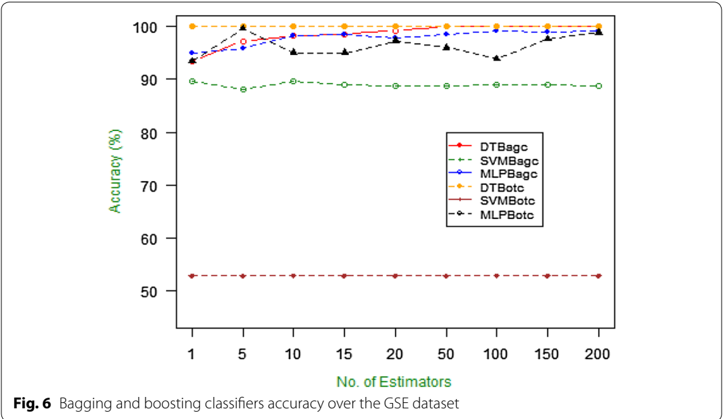
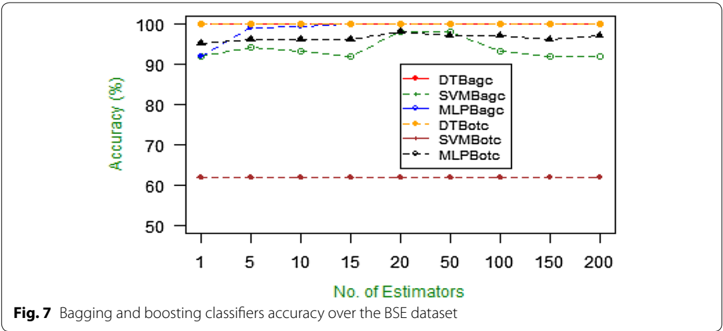
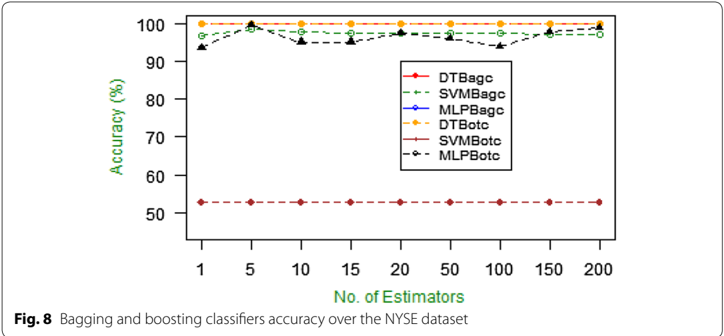
- Stacking outperformed all other combination techniques for ensemble classifiers and regressors; blending followed, then DT ensembles by boosting/bagging. DT ensemble classifiers by boosting and bagging obtained 99.98% accuracy with 10–200 estimators over GSE, BSE, and NYSE; DT boosting averaged 100% over NYSE, 95.09% over JSE, 98.52% over GSE, and 99.98% over BSE.
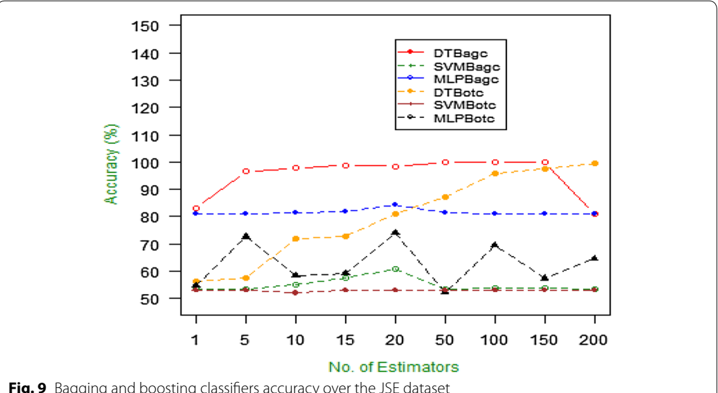
- MLP bagging classifier performed better than MLP boosting: MLP bagging recorded 100% over NYSE, 81.53% over JSE, 97.98% over GSE, and 98.93% over BSE, while MLP boosting recorded 96.32% over NYSE, 62.45% over JSE, 88.99% over GSE, and 96.45% over BSE. SVM ensemble classification was low, especially on JSE (54.98% bagging; 53.02% boosting), but SVM regression had better error metrics.
- Performance depended on dataset origin; stacking/blending were computationally expensive, while a DT ensemble of 50–100 estimators by boosting was suggested as a low-cost classifier baseline.
Methods
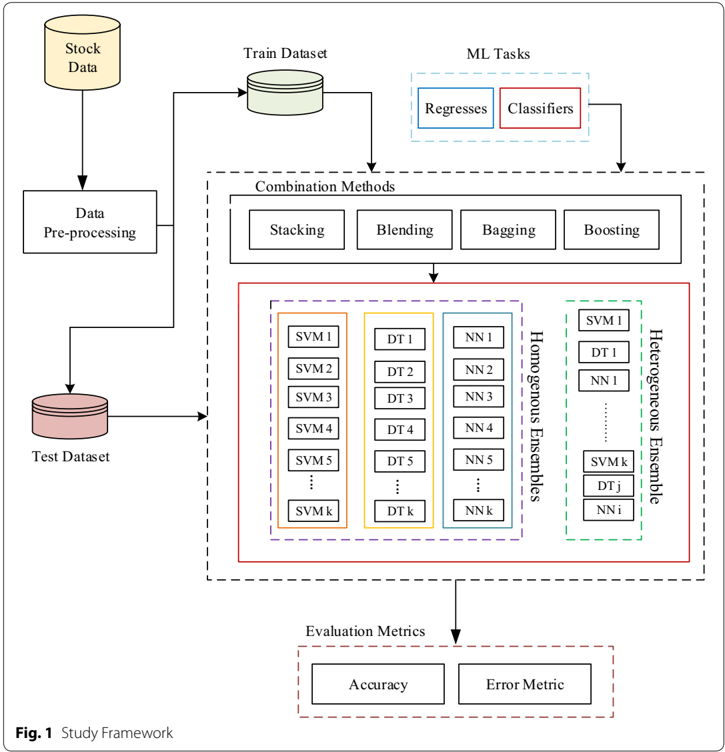
- Built 25 ensemble classifiers/regressors using DT, SVM, and MLP base learners with bagging, boosting, stacking, blending, and max voting; implemented with Scikit-learn, mlens, and Python.
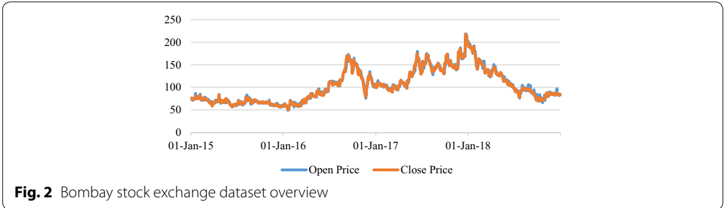
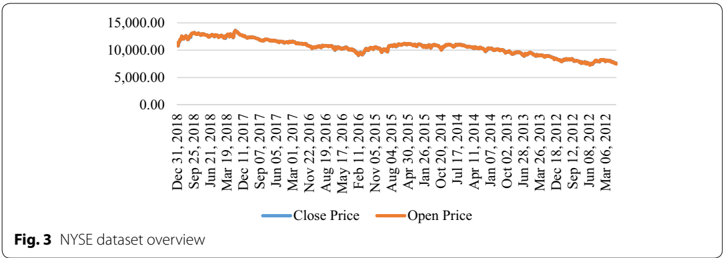
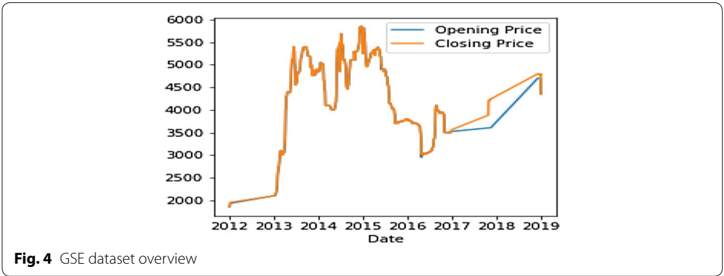
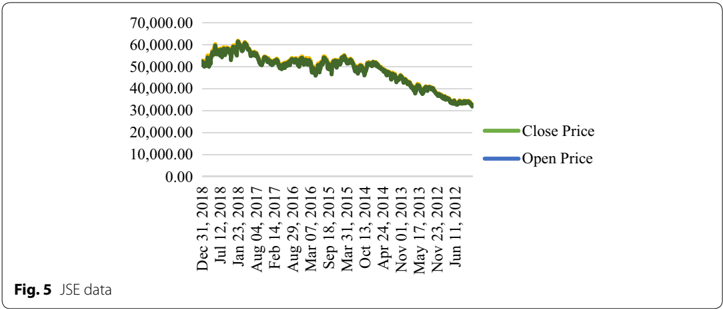
- Data: market indices from GSE, JSE, NYSE, and BSE-SENSEX; the abstract says January 2012–December 2018, while Table 2 lists GSE 1100 (Jan 2012–Dec 2017, 9 features), NYSE 1760 (Jan 03 2012–Dec 2018, 15 features), JSE 1749 (Jan 2012–Dec 2018, 7 features), and BSE 984 (Jan 2015–Dec 2018, 12 features). The study predicted 30-day-ahead closing price (regression) and price movement (classification).
- Preprocessing used wavelet transform denoising and min-max normalization; evaluation used 10-fold cross-validation, an 80/20 train/test split, and 12 accuracy/error metrics.
Limitations
- Stated: the study predicts stock market indices, not exact stock prices; authors propose future work on feature selection and SVM parameter optimization (e.g., GA, PCA).
- Stated: classical SVM assumes all features contribute equally and has difficulty choosing suitable parameters (C, σ, ε), affecting practicality; SVM ensemble classification was deficient with input variables and dataset sizes.
- Evident from the text: dataset periods in Table 2 do not fully match the abstract (GSE ends Dec 2017; BSE starts Jan 2015 vs abstract Jan 2012–Dec 2018), and some table entries appear inconsistent/OCR-corrupted (e.g., MLPBotc 150 mean reported as 0.135 in the BSE table), limiting reproducibility.
Model-written summary. Check it against the paper before relying on it.
Integrity signals
Registry
Cites
Statistics
Figures
Verification
Claims the paper makes
7 Valid · 4 Not valid · 15 Not checked · 120 Own results and interpretations
The sources with a verdict support this claim; the rest weren’t checked yet, have no full text we could read, or their verdicts aren’t rated yet.
In the paper
“Despite numerous works revealing the dominance of ensemble classifier over single classifier, most of these studies only ensemble a specific type of classifier or regressor for stock-market prediction, such as NN [18][19][20], DT [21,22] and SVM [12,23].”
§ A comprehensive evaluation of ensemble learning for stock-market prediction > Introduction
What the sources say
- Not matchedcites [18] 18. Macchiarulo A. Predicting and beating the stock market with machine learning and technical analysis. J Intern Bank Commer. 2018;23:1-22.
Its entry has no title and year that we can search by.
- Not matchedcites [21] 21. Weng B. Application of machine learning techniques for stock market prediction. Auburn: Auburn University; 2017.
We searched by its title and found no matching paper.
- Supportedcites [22] 22. Khaidem L, Saha S, Dey SR. Predicting the direction of stock market prices using random forest. Appl Math Financ. 2016;2016:1-20. source
The citation supports the decision-tree example in the citing sentence, not its broader claim about most previous studies. In Related Work (p. 2), the source describes its random forest as a multitude of decision trees whose outputs are combined. (LLM, conf=0.92)
- Not checked — no full text of the sourcecites [12] 12. Ballings M, Van den Poel D, Hespeels N, Gryp R. Evaluating multiple classifiers for stock price direction predic- tion. Expert Syst Appl. 2015;42:7046-56. https ://doi.org/10.1016/j.eswa.2015.05.013. source
- Not checked — no full text of the sourcecites [23] 23. Gonzalez TR, Padilha AC, Couto AD. Ensemble system based on genetic algorithm for stock market forecasting. In: 2015 IEEE congress on evolutionary computation. 2015. pp. 3102-8. source
plain- Asserted: passes — The authors put it forward as true.
- Checkable: passes — It can be checked against evidence.
- Load-bearing: passes — The paper’s conclusions depend on it.
- Based: passes — The paper gives a reason why it holds.
- Not matched
The cited sources support only part of this claim — read each source’s verdict below.
In the paper
“In all these applications, their reported accuracies support the argument that ensemble classifiers or regressors are often far more precise than the discrete classifiers or regressors.”
§ A comprehensive evaluation of ensemble learning for stock-market prediction > Introduction
What the sources say
- Partly supportedcites [14] 14. Bergquist SL, Brooks GA, Keating NL, Landrum MB, Rose S. Classifying lung cancer severity with ensemble machine learning in health care claims data. In: 2nd machine learning for healthcare conference. 2017. pp. 25-38.Experimental — accuracy not yet measured
The Results and Discussion sections do report ensemble superiority: the super learner 'improved substantially upon the clinical tree algorithm' (CV R2 0.405) and, versus the next best individual algorithm (GAM with C123), classified 1,034 more true positives and 1,034 more true negatives for a 14 percentage point accuracy gain — so the direction of the claim is supported for this one application. However, the same passages qualify 'far more precise': several individual algorithms, including regression-based ones, reached relative efficiencies of 94-98%, and the Discussion proposes an a priori 'improvement threshold' that more complex algorithms must beat. The paper is a single health-care-claims application (SEER-Medicare lung cancer staging), so it cannot carry the cross-sector generality or the 'often far more precise' magnitude the citing sentence attributes; that generalization is the citing authors' own conclusion. (LLM, conf=0.78)
- Not matchedcites [15] 15. Priya P, Muthaiah U, Balamurugan M. Predicting yield of the crop using machine learning algorithm. Int J Eng Sci Res Technol. 2018;7:1-7.
Its entry has no title and year that we can search by.
- Partly supportedcites [16] 16. Khairalla MA, Ning X, AL-Jallad NT, El-Faroug MO. Short-term forecasting for energy consumption through stack- ing heterogeneous ensemble learning model. Energies. 2018;11:1-21. https ://doi.org/10.3390/en110 61605 . sourceExperimental — accuracy not yet measured
Our copy clearly makes the ensemble-over-single argument, but only for regression/forecasting on energy (oil consumption) data: the Introduction (p.1) concludes from the reviewed literature that 'the hybrid regression models give preferred predictive accuracy over any single learner', and the Conclusions (Section 5) state that 'all ensemble models have been able to exceed the best performing individual models on single-ahead, as well as the multi-ahead horizon', with the Discussion (Section 4) noting 'the three ensemble methods mostly outperformed the single prediction models'. What is not supported is the classifier half of the claim and the cross-sector breadth implied by 'in all these applications': the paper's own comparisons cover only SVR/BPNN/LR/AR/bagging regressors on one oil-consumption data set (it even lists single-data-set evaluation as a limitation), and its treatment of classification is confined to generic background statements about bagging/Random Forest and AdaBoost rather than reported classification accuracies. The magnitude 'far more precise' also runs ahead of the paper's hedged wording ('mostly outperformed', 'preferred predictive accuracy'). (LLM, conf=0.72)
plainstates a cause- Asserted: passes — The authors put it forward as true.
- Checkable: passes — It can be checked against evidence.
- Load-bearing: passes — The paper’s conclusions depend on it.
- Based: passes — The paper gives a reason why it holds.
- Partly supported
The cited sources support only part of this claim — read each source’s verdict below.
In the paper
“most of the studies compared between ensemble classifiers [12, 18-20, 22, 23, 28] or regressors [21,30] machine learning algorithms, but not both.”
§ A comprehensive evaluation of ensemble learning for stock-market prediction > Related works evaluation
What the sources say
- Not checked — no full text of the sourcecites [12] 12. Ballings M, Van den Poel D, Hespeels N, Gryp R. Evaluating multiple classifiers for stock price direction predic- tion. Expert Syst Appl. 2015;42:7046-56. https ://doi.org/10.1016/j.eswa.2015.05.013. source
- Not matchedcites [18] 18. Macchiarulo A. Predicting and beating the stock market with machine learning and technical analysis. J Intern Bank Commer. 2018;23:1-22.
Its entry has no title and year that we can search by.
- Not checked — no full text of the sourcecites [19] 19. Mabu S, Obayashi M, Kuremoto T. Ensemble learning of rule-based evolutionary algorithm using multi-layer perceptron for supporting decisions in stock trading problems. Appl Soft Comput. 2015;36:357-67. https ://doi. org/10.1016/j.asoc.2015.07.020. source
- Could not verifycites [20] 20. Maknickiene N, Lapinskaite I, Maknickas A. Application of ensemble of recurrent neural networks for forecasting of stock market sentiments. Equilib Q J Econ Econ Policy. 2018;13:7-27. https ://doi.org/10.24136 /eq.2018.001. sourceExperimental — accuracy not yet measured
Our copy's Theoretical background surveys sentiment-forecasting models one by one — Wang et al. (2013) support vector regression, Wang et al. (2016) fuzzy classification, Antweiler and Frank (2004) Naive Bayes/SVM classifiers, Ho and Wang (2016) ANN (Theoretical background) — but it never compares ensemble classifiers against ensemble regressors, nor makes any 'but not both' gap statement. The paper's own contribution is a single stacking ensemble of 176 Evolino RNNs evaluated by overall classification accuracy (Research methodology; Estimating the accuracy of classification; Table 1), so it offers no basis for the attributed literature-wide comparison. Searched: 'ensemble classifiers compared with ensemble regressors', 'comparison of classifiers and regression models in previous research', 'literature gap ensemble methods'; the full text is not truncated, and no passage addresses the claim. (LLM, conf=0.62)
- Partly supportedcites [22] 22. Khaidem L, Saha S, Dey SR. Predicting the direction of stock market prices using random forest. Appl Math Financ. 2016;2016:1-20. sourceExperimental — accuracy not yet measured
Section 3.5 (p. 8) identifies the paper’s random forest as an ensemble classifier, and Section 7 (p. 16) compares its results with other classification models. It does not compare multiple ensemble classifiers, as the citing sentence suggests; the named comparators include logistic regression, discriminant analysis, and SVM. (LLM, conf=0.83)
- Not checked — no full text of the sourcecites [23] 23. Gonzalez TR, Padilha AC, Couto AD. Ensemble system based on genetic algorithm for stock market forecasting. In: 2015 IEEE congress on evolutionary computation. 2015. pp. 3102-8. source
- Not checked — no full text of the sourcecites [28] 28. Pulido M, Melin P, Castillo O. Particle swarm optimization of ensemble neural networks with fuzzy aggrega- tion for time series prediction of the Mexican Stock Exchange. Inf Sci (Ny). 2014;342:317-29. https ://doi. org/10.1007/978-3-319-32229 -2_23. source
- Not matchedcites [21] 21. Weng B. Application of machine learning techniques for stock market prediction. Auburn: Auburn University; 2017.
We searched by its title and found no matching paper.
- Not checked — no full text of the sourcecites [30] 30. Booth A, Gerding E, Mcgroarty F. Automated trading with performance weighted random forests and seasonal- ity. Expert Syst Appl. 2014;41:3651-61. https ://doi.org/10.1016/j.eswa.2013.12.009. source
plain- Asserted: passes — The authors put it forward as true.
- Checkable: passes — It can be checked against evidence.
- Load-bearing: passes — The paper’s conclusions depend on it.
- Based: passes — The paper gives a reason why it holds.
The cited sources that could be checked couldn’t confirm or dispute this claim.
In the paper
“These metrics were selected due to their appropriateness and effectiveness for classification and regression ML tasks in stock market prediction [1,27,62].”
§ A comprehensive evaluation of ensemble learning for stock-market prediction > Model evaluation
What the sources say
- Not checked — no full text of the sourcecites [1] 1. Nti IK, Adekoya AF, Weyori BA. A systematic review of fundamental and technical analysis of stock market predic- tions. Artif Intell Rev. 2019. https ://doi.org/10.1007/s1046 2-019-09754 -z. source
- Not checked — no full text of the sourcecites [27] 27. Jiang M, Liu J, Zhang L, Liu C. An improved Stacking framework for stock index prediction by leveraging tree- based ensemble models and deep learning algorithms. Phys Stat Mech Appl. 2019. https ://doi.org/10.1016/j.physa .2019.12227 2. source
- Could not verifycites [62] 62. Kamel SR, Yaghoubzadeh R, Kheirabadi M. Improving the performance of support-vector machine by selecting the best features by Gray Wolf algorithm to increase the accuracy of diagnosis of breast cancer. J Big Data. 2019. https :// doi.org/10.1186/s4053 7-019-0247-7. sourceExperimental — accuracy not yet measured
Our copy of Kamel et al. (2019) is entirely about breast-cancer diagnosis: the 'Preferences and criteria for comparison' section defines accuracy, recall, specificity, precision, F-measure, RMSE, MSE, MCC and Kappa (Eqs. 7-15) as the evaluation set for a GWO-SVM classifier on the UCI breast-cancer dataset (699 records, two classes), and ROC/AUC are discussed under 'Accuracy criterion'. No passage addresses stock market prediction or financial regression/classification tasks (searched: 'stock market prediction classification regression evaluation metrics', 'twelve evaluation criteria accuracy precision recall F-measure MAE'), so the paper neither supports nor contradicts the claim that these twelve metrics are appropriate for stock-market ML tasks. The citation appears to be borrowed for its metric list rather than for any stock-market finding. (LLM, conf=0.72)
plain- Asserted: passes — The authors put it forward as true.
- Checkable: passes — It can be checked against evidence.
- Load-bearing: passes — The paper’s conclusions depend on it.
- Based: passes — The paper gives a reason why it holds.
The sources with a verdict support this claim; the rest weren’t checked yet, have no full text we could read, or their verdicts aren’t rated yet.
In the paper
“Only a few [4,18,20,37] examined ensemble classifiers or regressors based on stacking or blending combinational technique.”
§ A comprehensive evaluation of ensemble learning for stock-market prediction > Related works evaluation
What the sources say
- Not checked — no full text of the sourcecites [4] 4. Wang Q, Xu W, Huang X, Yang K. Enhancing intraday stock price manipulation detection by leveraging recurrent neural networks with ensemble learning. Neurocomputing. 2019;347:46-58. https ://doi.org/10.1016/j.neuco m.2019.03.006. source
- Not matchedcites [18] 18. Macchiarulo A. Predicting and beating the stock market with machine learning and technical analysis. J Intern Bank Commer. 2018;23:1-22.
Its entry has no title and year that we can search by.
- Supportedcites [20] 20. Maknickiene N, Lapinskaite I, Maknickas A. Application of ensemble of recurrent neural networks for forecasting of stock market sentiments. Equilib Q J Econ Econ Policy. 2018;13:7-27. https ://doi.org/10.24136 /eq.2018.001. source
The Introduction (p. 1) states that the aim of the paper 'uses an Evolino RNN-based stacking ensemble prediction model', directly identifying it as a study built on a stacking ensemble. The Research methodology section reinforces this: 'The ensemble is composed of 176 Evolino RNNs predicting simultaneously', with outputs used for classification of growth/decline and sentiment (Table 1 reports overall classification accuracy), so the paper indeed examines an ensemble classifier/regressor based on a stacking combination technique. The citation is offered as an identification of such a study, and our copy shows this paper is that thing; it does not discuss 'blending', but the claim's alternative ('stacking or blending') is satisfied by stacking. (LLM, conf=0.85)
- Not checked — no full text of the sourcecites [37] 37. Pasupulety U, Abdullah Anees A, Anmol S, Mohan BR. Predicting stock prices using ensemble learning and sentiment analysis. In: Proceedings of IEEE 2nd international conference on artificial intelligence and knowledge engineering. AIKE; 2019. pp. 215-22. https ://doi.org/10.1109/aike.2019.00045 . source
plain- Asserted: passes — The authors put it forward as true.
- Checkable: passes — It can be checked against evidence.
- Load-bearing: passes — The paper’s conclusions depend on it.
- Based: passes — The paper gives a reason why it holds.
94 more claims
Create a free account to see all 146 claims and to verify the 1 reference still open.
- It may state two separate claims as one. 28
- Probably not a substantial claim. 19
- Borderline: one of the tests for a substantial claim is unclear. 1
- The quote only partly states this claim. 3
Claims other papers make about this one
Each is checked against this paper’s own text: does it say what the citing paper says it does?
The source backs part of the claim, not all of it — or backs it for a different population, condition or comparison.
In the citing paper
“Most ensemble classifiers and regressors are developed by combining decision trees, support vector machines, and neural networks (Nti et al. 2020).”
From Forecasting Stock Market Prices Using Machine Learning and Deep Learning Models: A Systematic Review, Performance Analysis and Discussion of Implications (2023) · cites this paper as Nti et al. 2020
Experimental — accuracy not yet measured
Self-check
Percentages, sums and reported differences re-computed from the paper’s own numbers.
Each contradiction between two passages listed here was confirmed by an independent check.
Rated minor: it would not touch a result — a value no result rests on, a p-value that stays on the same side of the significance level, or a conflict that is clerical, resolved elsewhere in the paper, or outside its own findings.
In the paper
§ A comprehensive evaluation of ensemble learning for stock-market prediction > Error metrics analysis of heterogeneous ensembled classifier by STK and BLD
“Oddly, stacking ensemble regressor (STK_DSN_R) outperformed all regressors by stacking and blending over all datasets.”
§ A comprehensive evaluation of ensemble learning for stock-market prediction > Additional information
“STK_DSN_R 0.074 0.061 0.993 0.993 0.057 0.014 0.279 0.004 STK_SND_R 0.210 0.157 0.942 0.942 0.128 0.042 5.945 0.001 STK_DNS_R 0.055 0.050 0.996 0.998 0.051 0.011 4.480 0.001”
Citations
Cites
Tikhonov Regularization and Total Least Squares
Golub, G. H., Hansen, P. C., & O'Leary, D. P. (1999) · SIAM Journal on Matrix Analysis and Applications · doi:10.1137/s0895479897326432 · Cited by 1,029
Chong, E., Han, C., & Park, F. C. (2017) · Expert Systems with Applications · doi:10.1016/j.eswa.2017.04.030 · Cited by 834
Deep neural networks, gradient-boosted trees, random forests: Statistical arbitrage on the S&P 500
Krauss, C., Do, X. A., & Huck, N. (2017) · European Journal of Operational Research · doi:10.1016/j.ejor.2016.10.031 · Cited by 750
Evaluating multiple classifiers for stock price direction prediction
Ballings, M., Van den Poel, D., Hespeels, N., & Gryp, R. (2015) · Expert Systems with Applications · doi:10.1016/j.eswa.2015.05.013 · Cited by 611
A systematic review of fundamental and technical analysis of stock market predictions
Nti, I. K., Adekoya, A. F., & Weyori, B. A. (2020) · Artificial Intelligence Review · doi:10.1007/s10462-019-09754-z · Cited by 547
Self-citationEnsemble methods for wind and solar power forecasting—A state-of-the-art review
Ren, Y., Suganthan, P. N., & Srikanth, N. (2015) · Renewable and Sustainable Energy Reviews · doi:10.1016/j.rser.2015.04.081 · Cited by 435
The Evolution of Boosting Algorithms: From Machine Learning to Statistical Modelling
Binder, H., Gefeller, O., Schmid, M., & Mayr, A. (2014) · Methods of Information in Medicine · doi:10.3414/me13-01-0122 · Cited by 412
Big Data: Deep Learning for financial sentiment analysis
Sohangir, S., Wang, D., Pomeranets, A., & Khoshgoftaar, T. M. (2018) · Journal of Big Data · doi:10.1186/s40537-017-0111-6 · Cited by 390
Chen, Y., & Hao, Y. (2017) · Expert Systems with Applications · doi:10.1016/j.eswa.2017.02.044 · Cited by 382
A deep learning ensemble approach for crude oil price forecasting
Zhao, Y., Li, J., & Yu, L. (2017) · Energy Economics · doi:10.1016/j.eneco.2017.05.023 · Cited by 380
Research works printed but not linked: 3
- 9. Pimprikar R, Ramachadran S, Senthilkumar K. Use of machine learning algorithms and twitter sentiment analysis for stock market prediction. Int J Pure Appl Math. 2017;115:521-6.
- 15. Priya P, Muthaiah U, Balamurugan M. Predicting yield of the crop using machine learning algorithm. Int J Eng Sci Res Technol. 2018;7:1-7.
- 52. Agarwal P, Bajpai S, Pathak A, Angira R. Stock market price trend forecasting using. Int J Res Appl Sci Eng Tech- nol. 2017;5:1673-6.
Cited by
Items 201–300 of 326
Gunawan, A. E. K., & Wibowo, A. (2023) · JOIV International Journal on Informatics Visualization · doi:10.62527/joiv.7.4.1640 · Cited by 2
Know Sure Thing based Machine Learning Strategy for Predicting Stock Trading Signals
(2022) · International journal of intelligent engineering and systems · doi:10.22266/ijies2022.0430.46 · Cited by 3
Image‐Based Deep Learning Models for Stock Predictions: Combining Line, Candlestick, and Bar Charts
Lin, W., Wang, M., Tsai, C., & Hsu, J.-P. (2026) · Journal of Forecasting · doi:10.1002/for.70099 · Cited by 3
Osoolian, M., & Koushki, A. (2020) · نشریه چشم انداز مدیریت مالی · doi:10.52547/jfmp.10.31.9 · Cited by 2
Owusu-Boadu, B. (2021) · International Journal of Technology · doi:10.52711/2231-3915.2021.00001 · Cited by 2
Enhanced Stock Price Prediction Using Machine Learning and Deep Learning Techniques
Reddy, B. P. V., Chandan, S., Tirumala, Y., & Devi, B. (2025) · International Conference on Advances in Modern Age Technologies for Health and Engineering Science (AMATHE) · doi:10.1109/amathe65477.2025.11081263 · Cited by 3
Satellite Image Price Prediction Based on Machine Learning
(2025) · doi:10.3390/rs17121960 · Cited by 2
Occupational Risk Prediction for Miners Based on Stacking Health Data Fusion
Zhang, X., Yang, W., Yang, W., Huang, B., Wang, Z., & Tian, S. (2025) · Applied Sciences · doi:10.3390/app15063129 · Cited by 6
Nikarika, Kukreja, V., Thapliyal, N., Aeri, M., & Sharma, R. (2024) · IEEE International Conference on Information Technology, Electronics and Intelligent Communication Systems (ICITEICS) · doi:10.1109/iciteics61368.2024.10624873 · Cited by 2
Wang, M., Chen, Y., & Yan, J. (2024) · Lecture notes in computer science · doi:10.1007/978-981-97-7181-3_26 · Cited by 1
PM2.5 Prediction using Heterogeneous Ensemble Learning
(2023) · doi:10.36548/jaicn.2023.4.003 · Cited by 1
Hemkiran, S., & Sadasivam, G. S. (2022) · Current Bioinformatics · doi:10.2174/1574893617666220329181607 · Cited by 1
Role of Machine Learning for Big Data Applications
Chaudhary, Y., & Pathak, H. (2025) · Advances in intelligent systems and computing · doi:10.1007/978-3-031-40905-9_23 · Cited by 1
-, S. T. A. M., & Raj, M. P. S. (2025) · International Conference on Pervasive Computational Technologies (ICPCT) · doi:10.1109/icpct64145.2025.10940764 · Cited by 1
Zubair, M., & Huang, Z. (2025) · Engineering Applications of Artificial Intelligence · doi:10.1016/j.engappai.2025.113565 · Cited by 3
Leadership Competencies of Pharmacists in the Manufacturing Sector of the Pharmaceutical Industry
Mayimele, N. N., Demana, P. H., & Keele, M. G. (2024) · SocioEconomic Challenges · doi:10.61093/sec.8(2).273-286.2024 · Cited by 1
Deciphering the Realities of Deep Learning in Business Analytics: A Bibliometric Analysis
Mukherjee, S., Chatterjee, A., & Dass, S. (2024) · Advances in business information systems and analytics book series · doi:10.4018/979-8-3693-1598-9.ch004 · Cited by 2
Predicting Period Stock Spread Ranking Using Revenue Indicators and Machine Learning Techniques
Chiu, C.-C., & Tsai, Y. (2021) · IOP Conference Series Earth and Environmental Science · doi:10.1088/1755-1315/704/1/012014 · Cited by 1
Predicting Stock Closing Prices: A Deep Learning Approach to Financial Forecasting
Elangovan, R., Santhi, B., Usha, J., & Ranjith, B. K. (2024) · IEEE International Conference for Women in Computing (InCoWoCo) · doi:10.1109/incowoco64194.2024.10861896 · Cited by 2
Hou, X., Luo, C., & Gao, B. (2024) · Journal of Intelligent & Fuzzy Systems · doi:10.3233/jifs-237087 · Cited by 2
Prediction of Stock Market Using Machine Learning and Cloud Computing
Kumar, P., Rani, P., S., R. T., Deebika, R., Harina, A. S., & Bhoopathy, V. (2025) · Advances in computational intelligence and robotics book series · doi:10.4018/979-8-3373-0781-7.ch016 · Cited by 1
Analysis of Molding Defection in IC Packaging and Testing Process
Chang, B. R., Tsai, H. F., & Chen, C. H. (2024) · Electronics · doi:10.3390/electronics13224356 · Cited by 3
Ensemble Method for Predicting Student Performance and Dropout Risk
Islam, M., Islam, M. M., Ali, M. S., Niloy, N. T., Chowdhury, A., & Avik, S. C. (2024) · Innovations in Sustainable Technologies and Computing · doi:10.1007/978-981-97-3485-6_21 · Cited by 1
Confident Stock Price Prediction using Markov Chains
Anand, A., & Srivastava, R. (2023) · International Conference for Emerging Technology (INCET) · doi:10.1109/incet57972.2023.10170592 · Cited by 1
MACHINE LEARNING BASED STOCK PREDICTION AND ANALYSIS
(2023) · doi:10.56726/irjmets38137 · Cited by 1
An Extensive Survey on the Prediction of Bankruptcy
Nayak, S. M., & Rout, M. (2022) · Wiley eBooks · doi:10.1002/9781119884392.ch18 · Cited by 1
Classificação de Interações com Indicadores de Engajamento dos Estudantes no Aprendizado Online
Pereira, A. J., Gomes, A. S., & Primo, T. T. (2024) · Anais do ... Simpósio Brasileiro de Informática na Educação/Anais do Simpósio Brasileiro de Informática na Educação · doi:10.5753/sbie.2024.242141 · Cited by 1
Klasifikasi Resiko Kehamilan Menggunakan Ensemble Learning berbasis Classification Tree
Hidayat, M. A. (2021) · INFORMAL Informatics Journal · doi:10.19184/isj.v6i3.28396 · Cited by 1
The disciplinary research landscape of data science reflected in data science journals
Hong, L., Moen, W. E., Yu, X., & Chen, J. (2020) · Information Discovery and Delivery · doi:10.1108/idd-06-2020-0071 · Cited by 1
Khansama, R. R., Priyadarshini, R., Nanda, S. K., & Barik, R. K. (2026) · FinTech · doi:10.3390/fintech5010004 · Cited by 2
A semi-heterogeneous ensemble forecasting method for stock returns based on sentiment analysis
Zhang, X., Liu, P., & Feng, J. (2025) · Information Sciences · doi:10.1016/j.ins.2025.122655 · Cited by 1
Stacking Ensemble Using Transformer Encoder and NeuralProphet for Indonesian Stock Price Prediction
Anggianto, A. S., Fendis, B., Theodore, N., Anderies, A., & Kurniadi, F. I. (2025) · International Conference on Computer Sciences, Engineering, and Technology Innovation (ICoCSETI) · doi:10.1109/icocseti63724.2025.11020351 · Cited by 1
Privacy-Preserving Ensemble Learning Using Fully Homomorphic Encryption
Sharma, T., Ratha, N., & Jutla, C. S. (2024) · Lecture notes in computer science · doi:10.1007/978-3-031-78107-0_13 · Cited by 2
Uncertain Fault Diagnosis of Grid-Connected PV Systems based Improved Data-Driven Paradigms
Dhibil, K., Mansouri, M. M., Bouzrara, K., Nounou, H. N., & Nounou, M. N. (2022) · International Multi-Conference on Systems, Signals & Devices (SSD) · doi:10.1109/ssd54932.2022.9955664 · Cited by 1
Classifying of VN-Index Bullishness by Bayesian Inference
Anh, D. N., & Dao, V. B. (2023) · Big Data · doi:10.1089/big.2021.0266 · Cited by 1
Zhou, M. (2024) · International Conference on Intelligent Computing in Data Sciences (ICDS) · doi:10.1109/icds62089.2024.10756474 · Cited by 1
HETEROGENEOUS TRADING STRATEGY ENSEMBLING FOR INTRADAY TRADING ALGORITHMS
Koegelenberg, D. J. C., & van Vuuren, J. H. (2023) · The South African Journal of Industrial Engineering · doi:10.7166/34-3-2951 · Cited by 2
Gude, V., & Hsiao, D. (2025) · Journal of risk and financial management · doi:10.3390/jrfm18060288 · Cited by 3
Prasodjo, I., Suyanto, S., Indiyati, D., & Atastina, I. (2025) · doi:10.1109/icoict66265.2025.11192904 · Cited by 1
Zheng, X. (2023) · Applied and Computational Engineering · doi:10.54254/2755-2721/17/20230926 · Cited by 1
Expert Aggregation for Financial ForecastingPreprint
Remlinger, C., Alasseur, C., Brière, M., & Mikael, J. (2023) · SSRN Electronic Journal · doi:10.2139/ssrn.4513503
The Evolution of Algorithmic Forecasting in Finance: From Traditional Models to AI-Driven Insights
Dahake, P. S., Dahake, P. P., Chandak, S. J., & Singh, D. K. (2026) · Advances in computational intelligence and robotics book series · doi:10.4018/979-8-3373-3053-2.ch005
Ensemble learning for time series forecasting using metaheuristic optimisationPreprint
Ranjan, R., Sethi, K. K., & Sinha, A. (2026) · Research Square · doi:10.21203/rs.3.rs-10360051/v1
From Regression Models to Machine Learning Methods: A Bibliometric Review on Stock Market Prediction
Chen, Z., Wang, S., & Wei, Y. (2026) · Journal of Economic Surveys · doi:10.1111/joes.70171
Stock price prediction using RNN LSTM based machine learning model
Ruchi, R. (2024) · AIP conference proceedings · doi:10.1063/5.0222232
Simulating Competitive Market Dynamics: Gaining an Edge Through Predictive Analytics
Dahake, P. S., Dahake, P. P., & Sao, R. N. (2025) · IGI Global eBooks · doi:10.4018/979-8-3373-3141-6.ch009
Varma, S., Rao, R. S., -, P. R. T., et al. (2026) · International Journal of Emerging Science and Engineering · doi:10.35940/ijese.f8335.14040326
Stock Open Price Prediction of Software Companies in the BSE SENSEX 50 Index
Sonar, C. D., & Hammadi, A. M. A. (2024) · Communications in computer and information science · doi:10.1007/978-3-031-72483-1_12
Ensemble deep learning models for stock price forecasting: evidence from the Saudi markets
Baamer, R., & Aljamaan, H. (2026) · PeerJ Computer Science · doi:10.7717/peerj-cs.4064
Kaushik, P., Joshi, G., Kumar, V. T. R. P., Lande, J., Sujitha, R., & Mekde, A. (2026) · International Conference on AI, Data Science, Cyber Security and Smart Manufacturing for Sustainable Development (ICADCS) · doi:10.1109/icadcs70036.2026.11583482
Ensemble Learning Paradigm for Stock Market Prediction
Ansari, N., Vakada, T., Mahato, A., Rawat, M., & Vakada, D. S. S. (2025) · International Conference on Advances in Computation, Communication and Information Technology (ICAICCIT) · doi:10.1109/icaiccit68829.2025.11434298
Stock market trends analysis using various machine learning techniques
Singh, S., & Khanna, D. (2024) · AIP conference proceedings · doi:10.1063/5.0229037
Hossain, M. N., & Ferdaus, A. A. (2025) · IEEE International Conference on Quantum Photonics, Artificial Intelligence & Networking (QPAIN) · doi:10.1109/qpain66474.2025.11171862 · Cited by 2
Short-Term Stock Price Prediction Based on Single and Stacking Machine Learning Models
Sun, W., Lim, C. Y., Guo, F., & Ang, S. L. (2026) · GATR Global Journal of Business Social Sciences Review · doi:10.35609/gjbssr.2026.14.1(2
Tata Motors Stock Price Prediction Using Predictive Artificial Intelligence
Shankar, M., Terence, S., Immaculate, J., Raj, M. M. A., & Ewards, V. (2024) · International Conference on Advanced Computing and Communication Systems (ICACCS) · doi:10.1109/icaccs60874.2024.10717037
Cross-stock information and stock price predictability: evidence from ensemble learning
Ngo, H. Q., Dieu, M. P., Thu, D. N. T., Tien, L. T., Khanh, H. N. T., & My, C. T. T. (2026) · Cogent Economics & Finance · doi:10.1080/23322039.2026.2700108
Baptista, G. C., & Rodrigues, C. A. (2024) · Escola Regional de Computação Bahia, Alagoas e Sergipe (ERBASE) · doi:10.5753/erbase.2024.4399
(2024) · Earth system science data · doi:10.5194/essd-2024-44-rc2
Creating Investment Strategies Based on Machine Learning Algorithms
Madmoun, H. (2022) · theses.fr (ABES) · doi:10.70675/962de834z68e9z416azb646z12a677eeeeb5
Tang, S. (2025) · Journal of Computer and Communications · doi:10.4236/jcc.2025.1312009
Kolmogorov–Arnold Networks for Robust Multivariate Forecasting of Indian Stock Indices
Sarkar, A., Ghosh, S., & Jana, N. D. (2025) · IEEE Conference on Information and Communication Technology (CICT) · doi:10.1109/cict67193.2025.11399203
Mansouri, M. M., Dhibi, K., Bouzrara, K., Nounou, H. N., & Nounou, M. N. (2022) · SSRN Electronic Journal · doi:10.2139/ssrn.4055327
Effective SegFormer Ensemble for Diabetic Foot Ulcer Segmentation
Kairys, A., & Raudonis, V. (2025) · IEEE International Conference on Intelligent Data Acquisition and Advanced Computing Systems: Technology and Applications (IDAACS) · doi:10.1109/idaacs68557.2025.11322072 · Cited by 3
Naumenkova, S., Mishchenko, S., & Ярич, Н. (2026) · Збірник наукових праць Державного податкового університету · doi:10.32782/2617-5940.1.2026.20
Predicting Stock Market Price Using Machine Learning Techniques
Nayak, P., Nihal, K. S., Ashish, Y. T., Bhargav, M. S., & Kumar, K. S. (2023) · Lecture notes in networks and systems · doi:10.1007/978-981-19-7615-5_56
Nithya, P., Nandakumar, C. D., & Srinivasan, S. (2025) · Springer proceedings in mathematics & statistics · doi:10.1007/978-3-031-51338-1_26
Associative networks for the daily prediction of opening and closing values of stock indices
(2023) · doi:10.37767/2468-9785(2023)004
Nivetha, S., & Sheshasaayee, A. (2024) · Lecture notes in electrical engineering · doi:10.1007/978-981-97-2839-8_30
Wang, M., & Guo, Z. (2026) · IFIP advances in information and communication technology · doi:10.1007/978-3-032-37199-7_12
Stock Price Prediction using LSTM
Mohmmad, S., Varma, U. R., Teja, T. S., Mithrasri, K., Sri, P. C., & Keerthan, J. (2025) · International Conference on Trends in Electronics and Informatics (ICOEI) · doi:10.1109/icoei65986.2025.11013311
A Machine Learning Approach for Model Selection of Social Aid Beneficiaries
(2023) · Journal of System and Management Sciences · doi:10.33168/jsms.2023.0614 · Cited by 5
Cho, S. E., Cho, S.-W., & Brand, A. S. (2026) · Cleaner Materials · doi:10.1016/j.clema.2026.100402 · Cited by 1
Osei, B., Osei_Dwomoh, E., Boatemaa, A., & Forkuo, G. O. (2026) · SSRN Electronic Journal · doi:10.21203/rs.3.rs-9419902/v1
Escalate the Returns With AI-Based Technical Analysis Before Investment in the Stock Market
Vishal, V., Kumar, V., Sharma, R. K., & Trehan, M. (2022) · Advances in finance, accounting, and economics book series · doi:10.4018/978-1-6684-5528-9.ch007
Harikumar, Y., & Muthumeenakshi, M. (2023) · Journal of Intelligent & Fuzzy Systems · doi:10.3233/jifs-233716
RetractedBoosting Accuracy of Machine Learning Classifiers for Heart Disease Forecasting
Jalligampala, D. L. S., Lalitha, R. V. S., Kumar, M., Akhila, N., Sujana, C., & Lakshmi, P. N. S. (2022) · Smart innovation, systems and technologies · doi:10.1007/978-981-16-6624-7_12 · Cited by 1
Metadata
- Authors
- Nti, I. K., Adekoya, A. F., & Weyori, B. A.
- Affiliations
- University of Energy and Natural Resources (GH)
- Corresponding author
- Nti, Isaac Kofi
- Venue
- Journal of Big Data
- Published
- 2020-03-11
- Volume
- 7
- Issue
- 1
- ISSN
- 2196-1115 (ISSN-L)
- OpenAlex
- W3013734981
- Semantic Scholar
- 8082a06bd2e5132dc4db1b2918dd823f236ffa4e
- Cited by
- 329
- References
- 62
- Citations by year
- 2026: 28 · 2025: 69 · 2024: 69 · 2023: 55 · 2022: 52 · 2021: 48 · 2020: 8
- FWCI
- 25.91
- Type
- journal article
- Language
- en
- Open access
- gold
- doi.org
- Licence
- cc-by
- creativecommons.org/licenses/by/4.0 (tdm)
- creativecommons.org/licenses/by/4.0 (vor)
- Locations
- Journal Of Big Data (publishedVersion, cc-by)
- DOAJ (DOAJ: Directory of Open Access Journals) (submittedVersion, cc-by-sa)
- Topics
- Social Sciences › Decision Sciences › Management Science and Operations Research › Stock Market Forecasting Methods
- Social Sciences › Decision Sciences › Management Science and Operations Research › Forecasting Techniques and Applications
- Social Sciences › Economics, Econometrics and Finance › Finance › Financial Markets and Investment Strategies
- Keywords
- stock market prediction, ensemble learning, stacking, blending, bagging, boosting, decision tree, support vector machine, artificial neural networks, forecast accuracy comparison
About these checks
Registry, retraction, Cites and statistics results are computed, not judged, with one exception: a printed reference that no index lists is read once by a model before it counts as a citation error. Claims are extracted by a model and kept only when their quote appears verbatim in the text; each cited source is then checked, with a model’s help, for whether it says what the claim relies on. Those verdicts can be wrong — read the claim’s quote and the cited source before relying on one.
The claim verdicts this report counts are experimental: their accuracy is not yet measured.
A language model drew the claims from the paper on 2026-10-10, under version 3 of the claim definition (model deepseek-v4.1-flash, prompt extract-v3).
A second model labelled each claim on 2026-10-10 (model jev-1.13-20260917, definition revision gold-guideline-v0.2).
Cited sources are checked with a language model’s help (gpt-6-sol and qwen3.8-omni-flash).
Statistics and arithmetic are recomputed, not judged.
Confidence bands are shown only for fields calibrated on our annotated test set. None is calibrated yet, so no band is shown.
What counts as a claim ›How we measure confidence ›How we check this ›
Are you an author, or do you see a problem with this page? Request a review
Data sources
Bibliographic data: Semantic Scholar, OpenAlex, Crossref.
Contains information from the Semantic Scholar Academic Graph Datasets, made available under the ODC Attribution License (ODC-BY 1.0).
Semantic Scholar’s data is described in: Kinney, R., et al. (2023). The Semantic Scholar Open Data Platform. arXiv:2301.10140.
