

The DOI matches its Crossref record; 186 of the 186 references it cites were found in a registry or an index.
Deep Learning applications for COVID-19
Open accessAbstract
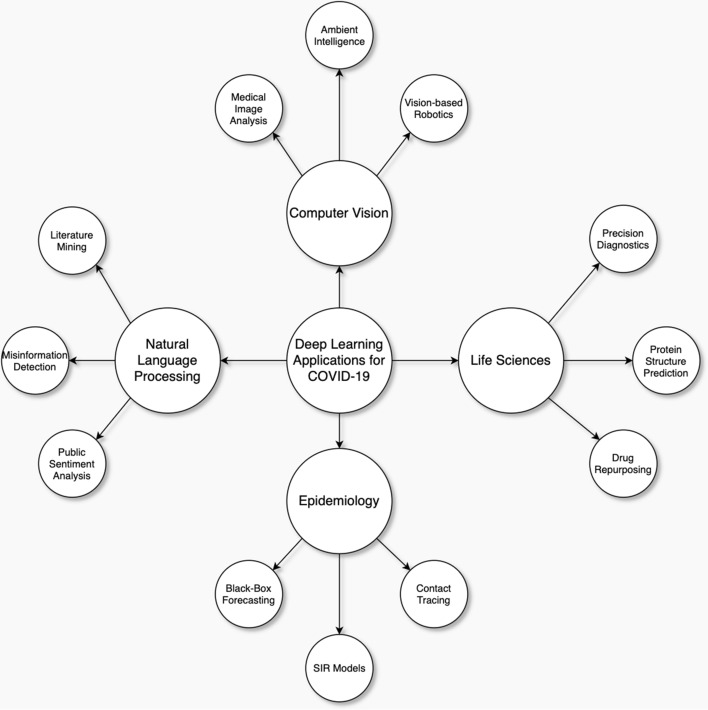
This survey explores how Deep Learning has battled the COVID-19 pandemic and provides directions for future research on COVID-19. We cover Deep Learning applications in Natural Language Processing, Computer Vision, Life Sciences, and Epidemiology. We describe how each of these applications vary with the availability of big data and how learning tasks are constructed. We begin by evaluating the current state of Deep Learning and conclude with key limitations of Deep Learning for COVID-19 applications. These limitations include Interpretability, Generalization Metrics, Learning from Limited Labeled Data, and Data Privacy. Natural Language Processing applications include mining COVID-19 research for Information Retrieval and Question Answering, as well as Misinformation Detection, and Public Sentiment Analysis. Computer Vision applications cover Medical Image Analysis, Ambient Intelligence, and Vision-based Robotics. Within Life Sciences, our survey looks at how Deep Learning can be applied to Precision Diagnostics, Protein Structure Prediction, and Drug Repurposing. Deep Learning has additionally been utilized in Spread Forecasting for Epidemiology. Our literature review has found many examples of Deep Learning systems to fight COVID-19. We hope that this survey will help accelerate the use of Deep Learning for COVID-19 research.
Overview
The claims and statistics of this paper haven’t been checked yet.
Free: it reads the open-access text and checks the first 5 claims that cite a source we can check. Create a free account to check every claim.
Integrity signals
Registry
Cites
Statistics
Figures








Verification
Claims the paper makes
The claims and statistics of this paper haven’t been checked yet.
Free: it reads the open-access text and checks the first 5 claims that cite a source we can check. Create a free account to check every claim.
Claims other papers make about this one
Each is checked against this paper’s own text: does it say what the citing paper says it does?
The source backs part of the claim, not all of it — or backs it for a different population, condition or comparison.
In the citing paper
“In 2020, DL is playing an increasingly vital role in early diagnosis of the novel coronavirus (COVID-19) [29, 46–48].”
From Review of deep learning: concepts, CNN architectures, challenges, applications, future directions (2021) · cites this paper as [29]
Experimental — accuracy not yet measured
Self-check
Percentages, sums and reported differences re-computed from the paper’s own numbers.
The self-check needs the paper’s full text.
Citations
Cites
Deep Residual Learning for Image Recognition
He, K., Zhang, X., Ren, S., & Sun, J. (2016) · 2016 IEEE Conference on Computer Vision and Pattern Recognition (CVPR) · doi:10.1109/cvpr.2016.90 · Cited by 235,474 · cited 6×
“This results in a 3% accuracy improvement over a more standard ResNet-50 architecture.”
MethodInfluentialVaswani, A., Shazeer, N., Parmar, N., Uszkoreit, J., Jones, L., Gomez, A. N., Kaiser, L., & Polosukhin, I. (2017) · arXiv · doi:10.48550/arxiv.1706.03762 · Cited by 120,404 · cited 2×
“NLP has seen a boom of interest due to the invention of the Transformer Neural Network architecture [21].”
BackgroundMethodImageNet classification with deep convolutional neural networks
Krizhevsky, A., Sutskever, I., & Hinton, G. E. (2017) · Communications of the ACM · doi:10.1145/3065386 · Cited by 112,155 · cited 8×
“AlexNet inspired further interest in Deep Neural Networks for Computer Vision.”
BackgroundInfluentialBERT: Pre-training of Deep Bidirectional Transformers for Language Understanding
Devlin, J., Chang, M.-W., Lee, K., & Toutanova, K. (2019) · Proceedings of the 2019 Conference of the North American Chapter of the Association for Computational Linguistics: Human Language Technologies, Volume 1 (Long and Short Papers) · doi:10.18653/v1/n19-1423 · Cited by 54,325
Densely Connected Convolutional Networks
Huang, G., Liu, Z., Van Der Maaten, L., & Weinberger, K. Q. (2017) · 2017 IEEE Conference on Computer Vision and Pattern Recognition (CVPR) · doi:10.1109/cvpr.2017.243 · Cited by 48,566
ImageNet Large Scale Visual Recognition Challenge
Russakovsky, O., Deng, J., Su, H., Krause, J., Satheesh, S., Ma, S., Huang, Z., Karpathy, A., Khosla, A., Bernstein, M., et al. (2015) · International Journal of Computer Vision · doi:10.1007/s11263-015-0816-y · Cited by 39,380 · cited 1×
“The success of Deep Computer Vision is largely attributed to the ImageNet dataset [82].”
Background(2008) · Journal of Machine Learning Research · Cited by 33,051
PyTorch: An Imperative Style, High-Performance Deep Learning Library
Paszke, A., Gross, S., Massa, F., Lerer, A., Bradbury, J., Chanan, G., Killeen, T., Lin, Z., Gimelshein, N., Antiga, L., et al. (2019) · arXiv · doi:10.48550/arxiv.1912.01703 · Cited by 31,473
Distributed Representations of Words and Phrases and their Compositionality
Mikolov, T., Sutskever, I., Chen, K., Corrado, G., & Dean, J. (2013) · arXiv · doi:10.48550/arxiv.1310.4546 · Cited by 24,533 · cited 1×
“A promising approach to this is the emphasis on evidence retrieval such as Retrieval-Augmented Generation [151].”
BackgroundLanguage Models are Few-Shot Learners
Brown, T. B., Mann, B., Ryder, N., Subbiah, M., Kaplan, J., Dhariwal, P., Neelakantan, A., Shyam, P., Sastry, G., Askell, A., et al. (2020) · arXiv · doi:10.48550/arxiv.2005.14165 · Cited by 23,372
Research works printed but not linked: 1
- Kingma D, Ba J. Adam: A method for stochastic optimization. In: International conference on learning representations; 2014.
Cited by
Review of deep learning: concepts, CNN architectures, challenges, applications, future directions
Alzubaidi, L., Zhang, J., Humaidi, A. J., Al-Dujaili, A., Duan, Y., Al-Shamma, O., Santamaría, J., Fadhel, M. A., Al-Amidie, M., & Farhan, L. (2021) · Journal of Big Data · doi:10.1186/s40537-021-00444-8 · Cited by 7,906
Machine learning: Algorithms, real-world applications and research directions
Sarker, I. H. (2021) · SN Computer Science · doi:10.1007/s42979-021-00592-x · Cited by 5,583
Text Data Augmentation for Deep Learning
Shorten, C., Khoshgoftaar, T. M., & Furht, B. (2021) · Journal of Big Data · doi:10.1186/s40537-021-00492-0 · Cited by 1,740
Self-citationAlzubaidi, L., Bai, J., Al-Sabaawi, A., Santamaría, J., Albahri, A. S., Al-dabbagh, B. S. N., Fadhel, M. A., Manoufali, M., Zhang, J., Al-Timemy, A. H., et al. (2023) · Journal of Big Data · doi:10.1186/s40537-023-00727-2 · Cited by 907
Machine Learning Methods for Small Data Challenges in Molecular Science
Dou, B., Zhu, Z., Merkurjev, E., Ke, L., Chen, L., Jiang, J., Zhu, Y., Liu, J., Zhang, B., & Wei, G.-W. (2023) · Chemical Reviews · doi:10.1021/acs.chemrev.3c00189 · Cited by 499
Metadata
- Authors
- Shorten, C., Khoshgoftaar, T. M., & Furht, B.
- Affiliations
- Florida Atlantic University (US)
- Corresponding author
- Shorten, Connor
- Venue
- Journal of Big Data
- Published
- 2021-01-11
- Volume
- 8
- Issue
- 1
- Pages
- 18-18
- ISSN
- 2196-1115 (ISSN-L)
- PMC
- PMC7797891
- OpenAlex
- W3121263745
- Cited by
- 350
- References
- 175
- Citations by year
- 2026: 10 · 2025: 42 · 2024: 54 · 2023: 92 · 2022: 100 · 2021: 52
- FWCI
- 39.32
- Type
- journal article
- Language
- en
- Open access
- gold
- doi.org
- Licence
- cc-by
- creativecommons.org/licenses/by/4.0 (tdm)
- creativecommons.org/licenses/by/4.0 (vor)
- Locations
- Journal Of Big Data (publishedVersion, cc-by)
- PubMed Central (publishedVersion, cc-by)
- PubMed (publishedVersion)
- DOAJ (DOAJ: Directory of Open Access Journals) (submittedVersion, cc-by-sa)
- Funders
- National Science Foundation (IIS-2027890)
- Topics
- Health Sciences › Medicine › Radiology, Nuclear Medicine and Imaging › COVID-19 diagnosis using AI
- Health Sciences › Medicine › Health Informatics › Artificial Intelligence in Healthcare and Education
- Physical Sciences › Computer Science › Information Systems › Healthcare during COVID-19 Pandemic
- Keywords
- COVID-19 pandemic, deep learning applications, natural language processing, computer vision, information retrieval, question answering, misinformation detection, sentiment analysis, medical image analysis, ambient intelligence, vision-based robotics, precision diagnostics, protein structure prediction, drug repurposing, interpretability, limited labeled data, data privacy
About these checks
Registry, retraction, Cites and statistics results are computed, not judged, with one exception: a printed reference that no index lists is read once by a model before it counts as a citation error. Claims are extracted by a model and kept only when their quote appears verbatim in the text; each cited source is then checked, with a model’s help, for whether it says what the claim relies on. Those verdicts can be wrong — read the claim’s quote and the cited source before relying on one.
Statistics and arithmetic are recomputed, not judged.
Confidence bands are shown only for fields calibrated on our annotated test set. None is calibrated yet, so no band is shown.
What counts as a claim ›How we measure confidence ›How we check this ›
Are you an author, or do you see a problem with this page? Request a review
How to cite
Cite CoChat for the checks on this page, and the paper for its own findings.
- This page
- CoChat. (2026). Citation check: Deep Learning applications for COVID-19. https://app.cochat.ai/papers/10.1186/s40537-020-00392-9
- The paper
- Shorten, C., Khoshgoftaar, T. M., & Furht, B. (2021). Deep Learning applications for COVID-19. Journal of Big Data. https://doi.org/10.1186/s40537-020-00392-9
Data sources
Bibliographic data: Semantic Scholar, OpenAlex, Crossref.
Contains information from the Semantic Scholar Academic Graph Datasets, made available under the ODC Attribution License (ODC-BY 1.0).
Semantic Scholar’s data is described in: Kinney, R., et al. (2023). The Semantic Scholar Open Data Platform. arXiv:2301.10140.
