

Review of deep learning: concepts, CNN architectures, challenges, applications, future directions
Open accessThe DOI matches its Crossref record; 360 of the 372 references it cites were found in a registry or an index; 139 of the 246 sources its claims cite were checked for support.
Abstract
In the last few years, the deep learning (DL) computing paradigm has been deemed the Gold Standard in the machine learning (ML) community. Moreover, it has gradually become the most widely used computational approach in the field of ML, thus achieving outstanding results on several complex cognitive tasks, matching or even beating those provided by human performance. One of the benefits of DL is the ability to learn massive amounts of data. The DL field has grown fast in the last few years and it has been extensively used to successfully address a wide range of traditional applications. More importantly, DL has outperformed well-known ML techniques in many domains, e.g., cybersecurity, natural language processing, bioinformatics, robotics and control, and medical information processing, among many others. Despite it has been contributed several works reviewing the State-of-the-Art on DL, all of them only tackled one aspect of the DL, which leads to an overall lack of knowledge about it. Therefore, in this contribution, we propose using a more holistic approach in order to provide a more suitable starting point from which to develop a full understanding of DL. Specifically, this review attempts to provide a more comprehensive survey of the most important aspects of DL and including those enhancements recently added to the field. In particular, this paper outlines the importance of DL, presents the types of DL techniques and networks. It then presents convolutional neural networks (CNNs) which the most utilized DL network type and describes the development of CNNs architectures together with their main features, e.g., starting with the AlexNet network and closing with the High-Resolution network (HR.Net). Finally, we further present the challenges and suggested solutions to help researchers understand the existing research gaps. It is followed by a list of the major DL applications. Computational tools including FPGA, GPU, and CPU are summarized along with a description of their influence on DL. The paper ends with the evolution matrix, benchmark datasets, and summary and conclusion.
Overview
CoChat Summary
## TL;DR
This paper is a broad review of deep learning that explains core concepts, classifies DL approaches, and surveys CNN architectures from AlexNet to HRNet. It also summarizes major challenges, applications, and computational platforms, with a heavy emphasis on medical imaging and CNN-based solutions.
## Key findings
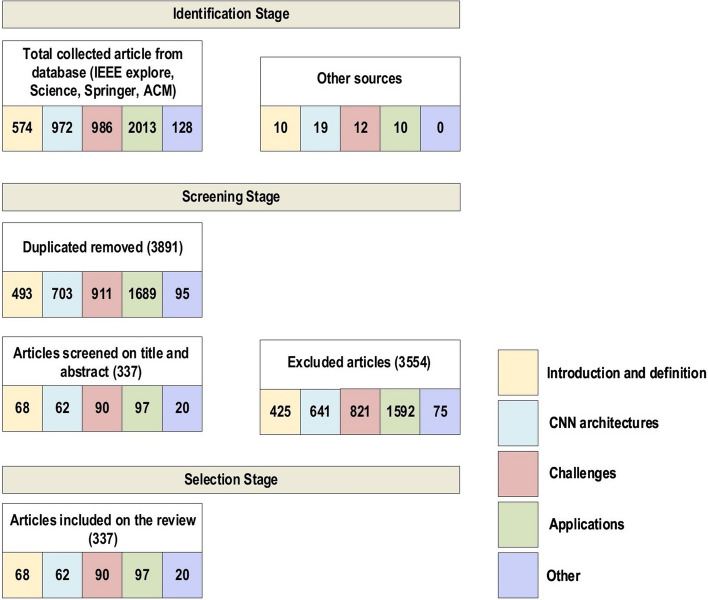
- The authors reviewed more than 300 papers on deep learning topics, with 108 papers from 2020, 76 from 2019, and 48 from 2018.
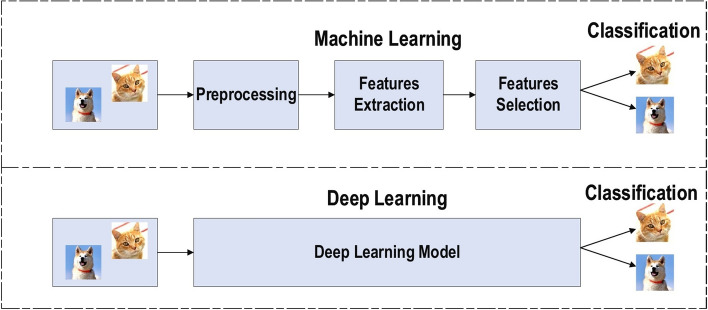
- They argue that DL can reduce manual feature engineering by learning features automatically and that it has already achieved strong results in tasks such as image classification, detection, segmentation, and registration.
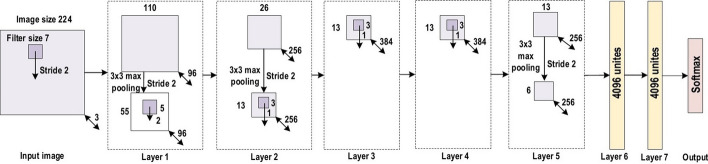
- The paper highlights that CNNs are the most used DL network type and reviews their architectural evolution from AlexNet (2012) to HRNet (2020).
- It identifies major DL challenges including lack of training data, imbalanced data, interpretability, uncertainty scaling, catastrophic forgetting, model compression, overfitting, vanishing/exploding gradients, and underspecification.
## Methods
- This is a survey/review paper, not an experimental study.
- The authors report reviewing literature from 2010–2020 (mainly 2020 and 2019, with some 2021 papers), drawing from publishers including IEEE, Elsevier, MDPI, Nature, ACM, and Springer, plus some arXiv papers.
- Their review was organized to cover DL approaches and network types, CNN architectures, challenges and solutions, applications, and computational approaches.
## Limitations
- The paper itself states that the review is not exhaustive for every topic; for example, in registration it says it is “out of the scope of this work to provide an extensive review of this topic.”
- The text also makes evident that some sections are descriptive rather than systematic: it summarizes many studies and architectures but does not report a formal meta-analysis or quantitative comparison across all included papers. (This is evident from the text.)
- Several sections are labeled only as headings or brief placeholders in the provided text, suggesting the supplied version is fragmentary/incomplete in places. (This is evident from the text.)
Model-written summary. Check it against the paper before relying on it.
Integrity signals
Registry
Cites
Statistics
Figures
Verification
Claims the paper makes
81 Valid · 72 Not valid · 63 Not checked · 158 Own results and interpretations
Some cited sources support this claim and some don’t — read each source’s verdict below.
In the paper
“Increase the depth (or width) of the model.”
§ Review of deep learning: concepts, CNN architectures, challenges, applications, future directions > Types of DL networks > Convolutional neural networks
What the sources say
- Disputedcites [86] Alzubaidi L Fadhel MA Al-Shamma O Zhang J Duan Y Deep learning models for classification of red blood cells in microscopy images to aid in sickle cell anemia diagnosis Electronics 2020 9 3 427 10.3390/electronics9030427 sourceExperimental — accuracy not yet measured
In the paper’s model-comparison discussion (page not available in our copy), the authors say they increased network depth to improve performance, but it did not help; Model 2 performed best. The cited passage therefore does not support recommending greater depth as a way to improve performance, and it gives no corresponding result for greater width. (LLM, conf=0.86)
Checked by a reasoning model — may be wrong.
- Supportedcites [87] Alzubaidi L Fadhel MA Al-Shamma O Zhang J Santamaría J Duan Y Oleiwi SR Towards a better understanding of transfer learning for medical imaging: a case study Appl Sci 2020 10 13 4523 10.3390/app10134523 source
Section 2.1 (CNNs in Image Classification) states that 'accuracy is increased as the model becomes deeper' and that 'as the depth is enlarged, accuracy is enhanced up to saturation level', and adds that recently proposed CNNs 'enhance[] performance by adding extra convolutional layers'. Section 2.2 (DCNNs) likewise says expanding 'depth' on AlexNet/VGG with a large dataset 'will efficiently enhance their model representation power', so the hedged 'may improve' is at least as strongly asserted by the source. The width side is carried by the same section's remark that alternatives such as Wide ResNet were developed to improve the ResNet architecture, while the source bounds the depth benefit with saturation/degradation ('it is not always a solution to just increase the depth by itself'), which the citing 'may' does not overstate. (LLM, conf=0.82)
- Partly supportedcites [88] Alzubaidi L Al-Shamma O Fadhel MA Farhan L Zhang J Duan Y Optimizing the performance of breast cancer classification by employing the same domain transfer learning from hybrid deep convolutional neural network model Electronics 2020 9 3 445 10.3390/electronics9030445 sourceExperimental — accuracy not yet measured
Section 3.5 (Proposed Model; page unavailable) says a deep CNN with improved feature extraction is needed for breast-biopsy classification and describes a multi-branch architecture. It does not establish that simply increasing a model’s depth or width improves CNN performance; the proposed model also uses residual links and other design choices. (LLM, conf=0.78)
plainstates a possible cause- Asserted: passes — The authors put it forward as true.
- Checkable: passes — It can be checked against evidence.
- Load-bearing: unclear — It is unclear whether the paper’s conclusions depend on it.
- Based: passes — The paper gives a reason why it holds.
- Disputed
The cited sources support only part of this claim — read each source’s verdict below.
In the paper
“The main benefit of CNN compared to its predecessors is that it automatically identifies the relevant features without any human supervision [76].”
§ Review of deep learning: concepts, CNN architectures, challenges, applications, future directions > Types of DL networks > Convolutional neural networks
What the sources say
- Partly supportedcites [76] Gu J Wang Z Kuen J Ma L Shahroudy A Shuai B Liu T Wang X Wang G Cai J Recent advances in convolutional neural networks Pattern Recogn 2018 77 354 377 10.1016/j.patcog.2017.10.013 sourceExperimental — accuracy not yet measured
The paper says CNNs learn features automatically rather than relying on handcrafted features (5.3, p. 22), supporting the feature-learning part of the claim. But it does not support “without any human supervision”: the Conclusions (p. 28) say training requires manually collected labeled data and identify unsupervised CNN learning as a goal for further work. (LLM, conf=0.88)
plainstates a cause- Asserted: passes — The authors put it forward as true.
- Checkable: passes — It can be checked against evidence.
- Load-bearing: unclear — It is unclear whether the paper’s conclusions depend on it.
- Based: passes — The paper gives a reason why it holds.
- Partly supported
The cited sources support only part of this claim — read each source’s verdict below.
In the paper
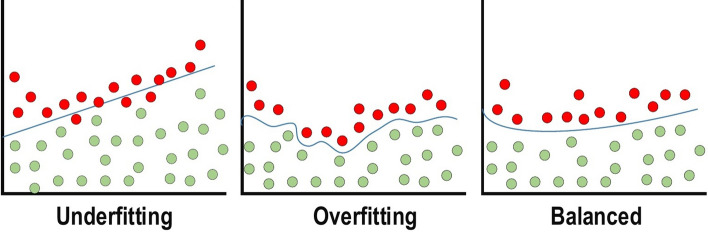
“Add regularization.”
§ Review of deep learning: concepts, CNN architectures, challenges, applications, future directions > Types of DL networks > Convolutional neural networks
What the sources say
- Supportedcites [86] Alzubaidi L Fadhel MA Al-Shamma O Zhang J Duan Y Deep learning models for classification of red blood cells in microscopy images to aid in sickle cell anemia diagnosis Electronics 2020 9 3 427 10.3390/electronics9030427 source
Section 3.2 (p. 8) says data augmentation enhances classification performance and helps prevent CNN overfitting. The paper thus supports the hedged claim that adding an overfitting-control technique may improve CNN performance, specifically in red-blood-cell classification. (LLM, conf=0.82)
- Partly supportedcites [87] Alzubaidi L Fadhel MA Al-Shamma O Zhang J Santamaría J Duan Y Oleiwi SR Towards a better understanding of transfer learning for medical imaging: a case study Appl Sci 2020 10 13 4523 10.3390/app10134523 sourceExperimental — accuracy not yet measured
Our copy places regularization among techniques for limiting overfitting (Sec. 5.2.4 Dropout: 'A limited number of solutions are used to reduce the risk of overfitting... Other techniques involve the use of regularization and enlargement of the training dataset'), and lists 'regularization strategies' among the attributes in which DCNNs advanced (Sec. 2.2). That supports regularization as a performance-related device, but the paper never states that adding regularization improves CNN performance; on the contrary, its only comparative statement favours the alternative: 'Compared to regularization, dropout performs well in accelerating the process of training, as well as reducing the overfitting risk' (Sec. 5.2.4). The claim's asserted benefit of adding regularization is therefore only partly carried by this source. (LLM, conf=0.68)
- Supportedcites [88] Alzubaidi L Al-Shamma O Fadhel MA Farhan L Zhang J Duan Y Optimizing the performance of breast cancer classification by employing the same domain transfer learning from hybrid deep convolutional neural network model Electronics 2020 9 3 445 10.3390/electronics9030445 source
Section 3.5 (Proposed Model; page unavailable) says the authors placed a dropout layer in their CNN to prevent overfitting. Dropout is a form of regularization, so this supports the qualified claim that adding regularization may improve CNN performance. (LLM, conf=0.85)
plainstates a possible cause- Asserted: passes — The authors put it forward as true.
- Checkable: passes — It can be checked against evidence.
- Load-bearing: unclear — It is unclear whether the paper’s conclusions depend on it.
- Based: passes — The paper gives a reason why it holds.
- Supported
Every source the paper cites for this claim was checked and supports it.
In the paper
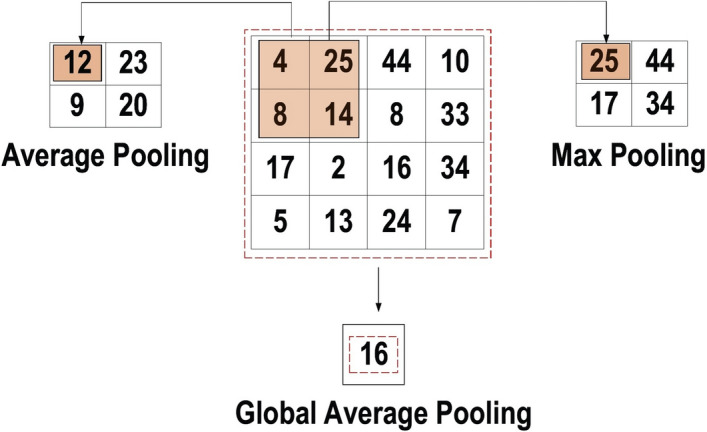
“As a substitution for a FC layer, the GAP is also employed, which represents the second novel concept and enables a significant reduction in the number of model parameters.”
§ Review of deep learning: concepts, CNN architectures, challenges, applications, future directions > CNN architectures > Network-in-network
What the sources say
- Supportedcites [94] Lin M, Chen Q, Yan S. Network in network; 2013. arXiv preprint arXiv:1312.4400. source
Section 3.2 (p. 4) proposes global average pooling as a replacement for fully connected layers and says the pooling layer has no parameters to optimize. Section 4.6 (p. 7) contrasts this with fully connected layers’ trainable dense transformation matrices, supporting the claimed reduction in parameters, though it does not quantify the reduction. (LLM, conf=0.90)
plainstates a cause- Asserted: passes — The authors put it forward as true.
- Checkable: passes — It can be checked against evidence.
- Load-bearing: unclear — It is unclear whether the paper’s conclusions depend on it.
- Based: passes — The paper gives a reason why it holds.
- Supported
Every source the paper cites for this claim was checked and supports it.
In the paper
“In 2015, Srivastava et al. [105] suggested a novel CNN architecture, called Highway Network, to overcome this issue.”
§ Review of deep learning: concepts, CNN architectures, challenges, applications, future directions > CNN architectures > Highway network
What the sources say
- Supportedcites [105] Srivastava RK, Greff K, Schmidhuber J. Highway networks; 2015. arXiv preprint arXiv:1505.00387. source
The Introduction (p. 1) presents highway networks as a novel architecture intended to make very deep networks easier to optimize. Section 2.1 (p. 2) describes convolutional highway layers, supporting the CNN characterization, although the architecture is not limited to CNNs. (LLM, conf=0.93)
plainstates a cause- Asserted: passes — The authors put it forward as true.
- Checkable: passes — It can be checked against evidence.
- Load-bearing: unclear — It is unclear whether the paper’s conclusions depend on it.
- Based: passes — The paper gives a reason why it holds.
- Rests on 2 assumptions not shown here.
- Supported
93 more claims · 31 with their cited sources checked
Create a free account to see all 374 claims and to verify the 23 references still open.
- Probably not a substantial claim. 224
- It may state two separate claims as one. 109
- The quote only partly states this claim. 2
Claims other papers make about this one
Each is checked against this paper’s own text: does it say what the citing paper says it does?
The source backs part of the claim, not all of it — or backs it for a different population, condition or comparison.
In the citing paper
“Previous methodologies, such as, artificial neural networks (NNs), and the more recent DL techniques, have been preferred in SOC estimation because of their applicability to depict more intricate correlation systems of input parameters and SOC [44].”
From Review Paper for SOC Estimation Techniques: Challenges and Future Areas for Improvement (2024) · cites this paper as [44]
Experimental — accuracy not yet measured
Self-check
Percentages, sums and reported differences re-computed from the paper’s own numbers.
Self-check results appear here once an independent check has confirmed them.
Cited works that were retracted
Works this paper cites that were later retracted, from the retraction notices publishers deposit. Major when the notice came out before this paper was published.
Rated major: it would touch a result — a value a result rests on, reported and recomputed p-values on opposite sides of the significance level, two passages that conflict with no sign which is right, or a cited work retracted before this paper was published.
In the paper
“Min Z. Public welfare organization management system based on FPGA and deep learning. Microprocess Microsyst. 2020;80:103333.”
Cited work 10.1016/j.micpro.2020.103333 · retracted 2021-02-01 · notice 10.1016/j.micpro.2020.103333 · this paper published 2021-03-31
Citations
Cites
1 retracted
RETRACTED: Public welfare organization management system based on FPGA and deep learning
Min, Z. (2020) · Microprocessors and Microsystems · doi:10.1016/j.micpro.2020.103333 · Cited by 16
RetractedDeep Residual Learning for Image Recognition
He, K., Zhang, X., Ren, S., & Sun, J. (2016) · 2016 IEEE Conference on Computer Vision and Pattern Recognition (CVPR) · doi:10.1109/cvpr.2016.90 · Cited by 235,474
Very Deep Convolutional Networks for Large-Scale Image Recognition
Simonyan, K., & Zisserman, A. (2014) · arXiv · doi:10.48550/arxiv.1409.1556 · Cited by 114,148
ImageNet classification with deep convolutional neural networks
Krizhevsky, A., Sutskever, I., & Hinton, G. E. (2017) · Communications of the ACM · doi:10.1145/3065386 · Cited by 112,155
U-Net: Convolutional Networks for Biomedical Image Segmentation
Ronneberger, O., Fischer, P., & Brox, T. (2015) · Lecture notes in computer science · doi:10.1007/978-3-319-24574-4_28 · Cited by 99,404
LeCun, Y., Bengio, Y., & Hinton, G. (2015) · Nature · doi:10.1038/nature14539 · Cited by 84,126
ImageNet: A large-scale hierarchical image database
Deng, J., Dong, W., Socher, R., Li, L.-J., Li, K., & Fei-Fei, L. (2009) · 2009 IEEE Conference on Computer Vision and Pattern Recognition · doi:10.1109/cvpr.2009.5206848 · Cited by 65,333
Densely Connected Convolutional Networks
Huang, G., Liu, Z., Van Der Maaten, L., & Weinberger, K. Q. (2017) · 2017 IEEE Conference on Computer Vision and Pattern Recognition (CVPR) · doi:10.1109/cvpr.2017.243 · Cited by 48,566
Going deeper with convolutions
Szegedy, C., Liu, W., Jia, Y., Sermanet, P., Reed, S., Anguelov, D., Erhan, D., Vanhoucke, V., & Rabinovich, A. (2015) · 2015 IEEE Conference on Computer Vision and Pattern Recognition (CVPR) · doi:10.1109/cvpr.2015.7298594 · Cited by 48,562
Squeeze-and-Excitation Networks
Hu, J., Shen, L., & Sun, G. (2018) · 2018 IEEE/CVF Conference on Computer Vision and Pattern Recognition · doi:10.1109/cvpr.2018.00745 · Cited by 35,667
Research works printed but not linked: 4
- Erhan D Bengio Y Courville A Vincent P Visualizing higher-layer features of a deep network Univ Montreal 2009 1341 3 1
- Ribeiro AH, Tiels K, Aguirre LA, Schön T. Beyond exploding and vanishing gradients: analysing RNN training using attractors and smoothness. In: International conference on artificial intelligence and statistics, PMLR; 2020. p. 2370–80.
- Zhao H, Han Z, Yang Z, Zhang Q, Yang F, Zhou L, Yang M, Lau FC, Wang Y, Xiong Y, et al. Hived: sharing a {GPU} cluster for deep learning with guarantees. In: 14th {USENIX} symposium on operating systems design and implementation ({OSDI} 20); 2020. p. 515–32.
- Rakotomamonyj A. Optimizing area under roc with SVMS. In: Proceedings of the European conference on artificial intelligence workshop on ROC curve and artificial intelligence (ROCAI 2004), 2004. p. 71–80.
Cited by
Items 6,101–6,200 of 7,963
Explainable Deep Learning for Computer-Aided Diagnosis of Diabetic Foot Ulcers
Thangaraj, R., Sindhu, P., Kavineswaran, P., Karuppusamy, S., Mani, C., & Kumar, D. K. (2025) · International Conference on Computational Intelligence and Communication Networks (CICN) · doi:10.1109/cicn67655.2025.11368159
Complex Event Detection on Images with Border Collie Optimization-Based Convolutional Neural Network
Sanas, S. P., & Sarode, T. (2025) · Algorithms for intelligent systems · doi:10.1007/978-981-96-1452-3_7
Garouani, M. (2022) · theses.fr (ABES) · doi:10.70675/cb2e6413z378fz4c89z8992z28f7c50414de · Cited by 5
Real-Time Crowd Detection for Overcrowding Management Using OpenCV and PyTTSx
Roopa, R., Thammisetty, S., Gajjala, S. S., Teja, P. R., Kumar, T. V. R., & Sanjana, K. (2026) · Communications in computer and information science · doi:10.1007/978-3-032-26683-5_36
Automated grading of embroidery assignments: a multi-region deep learning framework with ResNet-50
Lin, N., Wang, Y., Jin, G., Huang, J., Zhang, K., Xie, C., Han, Q., & Yu, Y. (2025) · BMC Medical Education · doi:10.1186/s12909-025-07828-x · Cited by 2
Lee, M.-Y., Lee, D., Bae, Y., et al. (2025) · IEEE Applied Power Electronics Conference and Exposition (APEC) · doi:10.1109/apec48143.2025.10977247
Physics-Informed CNN-LSTM Framework: An Approach for Temperature Prediction
Chen, Y., & Hu, E. (2025) · International Conference on Artificial Intelligence and Electromechanical Automation (AIEA) · doi:10.1109/aiea66061.2025.11159663
Gadacha, H., Bouzar-Benlabiod, L., & McIntyre, A. R. (2026) · IEEE International Systems Conference (SysCon) · doi:10.1109/syscon66367.2026.11503493
“Recent advances in deep learning for medical imaging [2] offer the promise of identifying subtle, presymptomatic markers of AD from volumetric MRI data.”
Cai, H., Fayer, S., & Stam, C. A. (2026) · SSRN Electronic Journal · doi:10.2139/ssrn.6546793
Hybrid DeepFake Detection Using Xception and XGBoost with Bayesian Optimization
Pacaldo, P. L., Matias, J. B., Jayoma, J. M., Abalorio, C. C., Gonzales, C. J., & Dalaorao, G. A. (2025) · International Artificial Intelligence and Data Processing Symposium (IDAP) · doi:10.1109/idap68205.2025.11222293
Innovative Currency Identifier for the Blind through Audio Output using Deep Learning
Maganti, R., Gutla, J., Mallimpalli, Y., et al. (2024) · doi:10.1109/autocom60220.2024.10486196
Channel State Information Classification based on Wireless Foundation Model
Xu, H., Guo, N., & Zhang, Y. (2026) · doi:10.1145/3801359.3801409
Deep Learning and Beyond: Innovations, Limitations, and the Road Ahead
Goyat, A., Maan, A., & Malhotra, V. (2025) · Lecture notes in networks and systems · doi:10.1007/978-3-032-06671-8_44
Enhancement in Dentistry using Machine Learning: A Systematic Review
Patil, A., Bhalekar, M. A., & Dhatrak, P. N. (2022) · International Conference on Emerging Trends in Engineering and Technology (ICETET) · doi:10.1109/icetet-sip-2254415.2022.9791585
Badri, Y., Dodd, G., Cater, J. E., & Hall, A. (2026) · The Journal of the Acoustical Society of America · doi:10.1121/10.0044148
Kallam, P., Rajaei, P., Garcia, B., Yadav, S., McInnes, A. N., Brown, B., Freedman, M., Bronstein, M. V., Goodman, M., Widge, A. S., et al. (2025) · Annual International Conference of the IEEE Engineering in Medicine and Biology Society (EMBC) · doi:10.1109/embc58623.2025.11253487 · Cited by 1
Interpretable knowledge distillation via symbolic regression for feedforward neural networks
Shmuel, A., Koren, N., Glickman, O., & Lazebnik, T. (2026) · Neural Computing and Applications · doi:10.1007/s00521-026-12067-2 · Cited by 5
Xiao, M., Wang, F., & Fang, S. (2025) · ICME International Conference on Complex Medical Engineering (CME) · doi:10.1109/cme67420.2025.11239369
Koç, S., & Kuş, Z. (2026) · Computers & Electrical Engineering · doi:10.1016/j.compeleceng.2026.111216
Flowers Classification with Low Carbon Footprint Using Deep Learning Pretrained Models
Ahmed, E., Darwish, A., & Hassanien, A. E. (2024) · Studies in systems, decision and control · doi:10.1007/978-3-031-63451-2_4
Duan, Y., Liu, X., Geng, Y., et al. (2025) · SSRN Electronic Journal · doi:10.2139/ssrn.5342406
Self-citationZhang, J., Dai, S., Zhao, D., Sovetbekov, B., & Guo, Y. (2026) · Accident Analysis & Prevention · doi:10.1016/j.aap.2026.108775
Self-citationLakshetty, V. K., Santosh, B. B., Suma, M., et al. (2026) · doi:10.1109/icicds70526.2026.11604952
DURUCA STRUKTUR-FORMASİYA ZONASININ FİLİZLƏRİNIN VƏ SÜXURLARININ MİNERAL TƏRKİBİ
Qədirova, T. Q. T. (2022) · PAHTEI-Procedings of Azerbaijan High Technical Educational Institutions · doi:10.36962/pahtei23122022-137
Real-time Neonatal Monitoring Using a Hybrid Deep Learning Model
Madhusudhan, R., Benz, P. J., & Rithesh, S. (2025) · Journal of Neonatology · doi:10.1177/09732179251403785
França, H. F. D. C., da Costa, A. F., Leal, A. G. F., et al. (2026) · Caderno Pedagógico · doi:10.54033/cadpedv23n1-121
Compact Convolutional Transformer for Landslide Susceptibility Mapping
Zhao, Z., Chen, T., & Li, J. (2023) · IEEE International Geoscience and Remote Sensing Symposium (IGARSS) · doi:10.1109/igarss52108.2023.10281512 · Cited by 1
Making a Better Logistic Regression Model Using Ensemble Learning
Verma, S. (2024) · International Journal for Research in Applied Science and Engineering Technology · doi:10.22214/ijraset.2024.61846
Arabzadeh, V., & Frank, R. (2024) · IEEE International Symposium on Power Electronics for Distributed Generation Systems (PEDG) · doi:10.1109/pedg61800.2024.10667367
A study on the model predictive control based on convolutional neural network
Wang, H. (2023) · Journal of Physics Conference Series · doi:10.1088/1742-6596/2580/1/012024
Eye Tracking System Using Convolutional Neural Network
Iskandar, S., Jaara, Z., Ali, M. A., et al. (2023) · International Conference on Computer and Applications (ICCA) · doi:10.1109/icca59364.2023.10401372
Harika, V. V. P., & Thangaraj, S. J. J. (2025) · AIP conference proceedings · doi:10.1063/5.0265451
Deep Learning-based Education Waste Classification for School Students
Susanto, N. A., & Yossy, E. H. (2026) · International Conference on ICT for Smart Society (ICISS) · doi:10.1109/iciss71466.2026.11715477
“Several studies have reported accuracies above 90% [5]. but most of the studies focus on the technological achievements in laboratories, without considering the ease of use of the systems and their impact on learning.”
Mateo-Romero, H. F., Hernández-Callejo, L., Rebollo, M. A. G., et al. (2026) · Technologies · doi:10.3390/technologies14080504
“Convolutional Neural Networks (CNNs) are the state-of-the-art method for dealing with images [21], even in the field of PVs [6].”
TNeXt: A convolutional neural network for remote harbor classification
Gürtürk, M., Doğan, Ş., & Tuncer, T. (2025) · Ain Shams Engineering Journal · doi:10.1016/j.asej.2025.103545
Development of a Prototype Solution for Reducing Soup Waste in an Institutional Canteen
Correia, A., Aidos, C., Caldeira, J. M. L. P., et al. (2024) · Applied Sciences · doi:10.3390/app14135729
Memetic differential evolution with niching strategy for efficient CNN architecture search
Ghosh, A., & Jana, N. D. (2026) · Memetic Computing · doi:10.1007/s12293-026-00522-5
“…convolution layers in [ 3 , 10 ] 4: Randomly choose number of pooling layers in [ 1 , 4 ] 5: Randomly choose number of fully connected layers in [ 1 , 3 ] 6: while convolution layers remain do 7: Select next layer type from {CL, PL} 8: if selected layer exceeds its allowed count then 9: Select…”
InfluentialPhotonic Tensor Cores: A Comprehensive Review on System Architecture and Device Design
Dhrubo, M. N. S. (2026) · IEEE Access · doi:10.1109/access.2026.3655405 · Cited by 1
Cardoso, V. M. B., Santana, C. R., Momente, G. J., Gomes, A. R., Silva, B. V., Amélio, C. P., Pietro, R. C. L. R., Carlos, I. Z., Favorin, L. A. C., dos Santos, J. L., et al. (2026) · Nanomedicine · doi:10.1080/17435889.2026.2725124
Analyzing spatiotemporal architectures in video classification: A deep dive into 3DCNNs
Pandya, D., & Rana, K. (2026) · Multimedia Tools and Applications · doi:10.1007/s11042-026-21799-1
Crop classification using non-fixed length multitemporal images base on deep learning
Leng, W., Li, W., Han, X., Zhang, H., & Sun, W. (2025) · International Conference on Remote Sensing and Digital Earth (RSDE) · doi:10.1117/12.3059111
Endoscopic Image Classification: Advancing AI-Based Gastrointestinal Diagnostics
Pan, J.-T., Rodoplu, D., & Solovchuk, M. (2025) · International Conference on Artificial Intelligence, Computer, Data Sciences and Applications (ACDSA) · doi:10.1109/acdsa65407.2025.11166143
A Self-updating Digital Model Method for Aero-Engines
Shi, S., Peng, C., Li, B., et al. (2025) · Lecture notes in electrical engineering · doi:10.1007/978-981-96-2204-7_26
Applications of Explainable AI
Kaur, K., Aarushi, & Afroz, Z. (2024) · International Conference on Advanced Computing & Communication Technologies (ICACCTech) · doi:10.1109/icacctech65084.2024.00013
A Lightweight Deep Attention-Guided Feature Learning Mechanism for Crop Disease Recognition
Haider, I., Zafar, A., Zikria, M., et al. (2026) · IEEE International Conference on Communication Systems and Network Technologies (CSNT) · doi:10.1109/csnt69054.2026.11502112
LRCN-based Tri Pramana learning activity classification from immersive virtual reality videos
Sindu, I. G. P., Sudarma, M., Permana, A. A. J., et al. (2026) · Multimedia Tools and Applications · doi:10.1007/s11042-026-21643-6
Capsule Networks and Innovation Performance in Resource-Based Firms
Ma, F., & Sun, S. (2025) · International Journal of Cognitive Informatics and Natural Intelligence · doi:10.4018/ijcini.370965
Detection of Pediatric Pneumonia Based on DenseFPN and Hybrid Channel Attention
Tian, Y., & Cheng, Z. (2025) · doi:10.1145/3777577.3777724
Kirupakaran, A. M., & Laskar, R. H. (2024) · Machine Vision and Applications · doi:10.1007/s00138-024-01555-x
Basak, C. K., Sarkar, G., & Kundu, P. K. (2026) · Nondestructive Testing And Evaluation · doi:10.1080/10589759.2026.2679107 · Cited by 2
An auto-scaling approach for serverless environments based on a multi-expert consensus mechanism
Kashaniyan, M., Ashtiani, M., & Ghassemi, A. (2026) · Journal of Ambient Intelligence and Smart Environments · doi:10.1177/18761364261459585
“Convolutional Neural Networks (CNN) extract local patterns from sliding windows of time-series inputs [36–39].”
Deep learning for COVID-19 by X-ray images Analysis and Designing Diagnostic Application
Khaleel, T., & Kalakech, A. (2023) · Tikrit Journal of Pure Science · doi:10.25130/tjps.v28i4.1398 · Cited by 1
Jin, W., Na, H., Lee, S., Choi, H., Lee, Y., & Lee, K. (2026) · Veterinary Radiology & Ultrasound · doi:10.1111/vru.70260
Analysis of CNN Digit Classifier Parameters
Thakur, R. S., Chatterjee, S., Yadav, R. N., et al. (2022) · Asian Conference on Innovation in Technology (ASIANCON) · doi:10.1109/asiancon55314.2022.9909081
U-LSTM: A Deep Learning Framework for Robust Noise Reduction in Photoacoustic SpectroscopyPreprint
Yin, X., Liu, L., Yang, X. X., et al. (2025) · SSRN Electronic Journal · doi:10.2139/ssrn.5735708
FM-Based Positioning via Deep LearningPreprint
Zheng, S., Hu, J., Zhang, L., et al. (2023) · doi:10.36227/techrxiv.24580956
Kadam, S. A., Madhuranthakam, S. K. S., & Sujatha, R. (2025) · Communications in computer and information science · doi:10.1007/978-3-031-82389-3_26
Design and Implementation of a Mobile Robot System for Road Crack Detection
Du, Y., Zhu, G., Yin, Y., et al. (2025) · China Automation Congress (CAC) · doi:10.1109/cac67268.2025.11487324
Data-driven solitons of higher-order and higher-dimensional nonlinear wave equations using DeepONet
Wang, X., Song, X., Zhao, D., & Yan, Z. (2026) · Nonlinear Dynamics · doi:10.1007/s11071-026-12611-8
“Among various deep learning approaches, methods including Convolutional Neural Networks (CNNs) [21], Recurrent Neural Networks (RNNs) [22], Generative Adversarial Networks (GANs) [23], Physics-Informed Neural Networks (PINNs) [24, 25], and two-stage initial-value iterative PINNs [26] have been…”
AET-YOLOv8: An Enhanced Detection Model for Strain Clamp X-ray Defects
Sun, J., Li, X., Li, M., et al. (2026) · International Annual Conference on Complex Systems and Intelligent Science (CSIS-IAC) · doi:10.1109/csis-iac70275.2026.11585135
“Convolutional Neural Network (CNN) [8], [9] based methods, particularly models from the YOLO series, achieve a favorable balance between detection accuracy and computational efficiency [10], [11].”
Modified Convolutional Neural Network for Fashion Classification
Mohanty, D. K., Gupta, P. D., Dey, R., & Pattnaik, S. (2022) · International Conference on Advancements in Smart, Secure and Intelligent Computing (ASSIC) · doi:10.1109/assic55218.2022.10088358
Xu, Y., Wang, T., & Zhang, T. (2025) · Conference proceedings/Conference proceedings - IEEE International Conference on Systems, Man, and Cybernetics · doi:10.1109/smc58881.2025.11343379
Optimization of Astronomical Images Using ResNet50 with Data Augmentation and Grad-CAM
Kagdelwar, A., Patel, S. K., & Kaur, R. (2026) · Lecture notes in networks and systems · doi:10.1007/978-3-032-18138-1_8
An enhanced YOLOv8 and its application for risk prevention in underground excavation operations
Liu, T., Li, K., Pu, Y., Zhu, H., & Yi, J. (2024) · International Conference on Signal Processing · doi:10.1109/icsp62129.2024.10846727
Vignesh, S., Sabarevason, D., & Sachin, A. R. (2025) · doi:10.1109/iceamst67459.2025.11336066
Using EEG Data to Classify Hand Motor Imagery in Stroke Patients
Shen, Y., Liu, J., Yang, Y., & Xie, W. (2024) · International Conference on Electronic Information Engineering and Computer Technology (EIECT) · doi:10.1109/eiect64462.2024.10866311
Automatic Image Evaluation of Doodling Game Using CNN Model
Amir, A. M., Primanita, A., Arsalan, O., & Rini, D. P. (2025) · International Conference on Artificial Intelligence and Technological Solutions (ICAITech) · doi:10.1109/icaitech66481.2025.11387208
Artificial Intelligence in Environmental Monitoring, Pollution Control, and Low-Carbon Management
Tan, J., Cai, H., Liu, Z., Yu, F., Lao, G., Liu, Y., Yang, Y., Xie, Z., Jiang, H., & Han, S. (2026) · Clean Technologies · doi:10.3390/cleantechnol8050160
Predicting early symptoms of lung disease through the CNN classifier in .html web page
Bhookya, J., Kumar, D. M., SriHari, P., et al. (2023) · IEEE India Council International Conference (INDICON) · doi:10.1109/indicon59947.2023.10440735
Zou, L., Chen, X., Ma, J. F., et al. (2026) · Applied Surface Science · doi:10.1016/j.apsusc.2026.167820
DƏRIN ÖYRƏNMƏ SÜNI İNTELLEKTİN ƏSAS SAHƏLƏRİNDƏN BİRİ KİMİ
Hüseynova, N. H. N. (2022) · PAHTEI-Procedings of Azerbaijan High Technical Educational Institutions · doi:10.36962/pahtei23122022-113
Bùi, T. X., & Ngo, L. T. (2026) · Lecture notes in networks and systems · doi:10.1007/978-3-032-18316-3_42
Learning Transferable PV Siting Logic from Urban Deployment Patterns with Explainable Deep LearningPreprint
Shen, J. F., Zheng, F., Deng, W., Chen, T., Xiong, S., Bellotti, A. G., Tesema, F. B., & Prasad, D. K. (2026) · SSRN Electronic Journal · doi:10.2139/ssrn.6661886
Data Protection of AMI Based on Oblivious Inference and Deep Learning
Liu, T., Xiaowei, C., Fang, J. H., Shaocheng, W., Qingsong, Z., & Yuan, P. (2021) · IEEE Sustainable Power and Energy Conference (iSPEC) · doi:10.1109/ispec53008.2021.9735598
An Exploration of Various Deep Learning Techniques for Soil Classification
Sikka, I., Rani, R., & Kalra, N. (2025) · International Conference on Signal Processing, Computing and Control (ISPCC) · doi:10.1109/ispcc66872.2025.11039424
Implications of Artificial Intelligence for Information Systems
Kantsepolsky, B., & Topor, L. (2026) · Springer eBooks · doi:10.1007/978-3-032-26223-3_6
Yapay Zekâ Temel İlkeleri ve Diş Hekimliğinde Kullanım Alanları
Dede, Y., & Dede, İ. H. (2026) · Doğal Yaşam Tıbbı Dergisi · doi:10.71051/jnlm.1970094 · Cited by 2
Augmentation of Additional Arabic Dataset for Jawi Writing and Classification Using Deep Learning
Razali, S., Muchtar, K., Rinaldi, M. H., Nurdin, Y., & Rahman, A. (2024) · Jurnal Rekayasa Elektrika · doi:10.17529/jre.v20i1.33722
Analysis of the Convolutional Neural Network Model in Detecting Brain Tumor
Rankins, D., Dixon, D. A., Kang, Y., & Kim, S. (2022) · International Journal of Computer and Information Technology(2279-0764) · doi:10.24203/ijcit.v11i4.252
Tripathy, P., Murtugudde, R. G., Chandel, V., Zope, P. E., & Ghosh, S. (2026) · Urban Climate · doi:10.1016/j.uclim.2026.102995 · Cited by 4
Automated System for Saree Putta Cutting and Rolling using Image Processing
Mouleeshuwarapprabu, R., Mrunalini, T., Devi, T. K., Arunraj, N., Gokul, S., & Madhuritha, E. (2024) · International Conference on Electronics, Communication and Aerospace Technology (ICECA) · doi:10.1109/iceca63461.2024.10800835
Improving Tomosynthesis Sinograms via Particle Swarm Optimization
Rosas-Ordaz, L. F., Muñoz, E., Martinez, S. Z., et al. (2025) · Lecture notes in computer science · doi:10.1007/978-3-032-09044-7_18
Dogotari, M., Kleinebecker, T., Becker, R., & Große‐Stoltenberg, A. (2026) · ISPRS Open Journal of Photogrammetry and Remote Sensing · doi:10.1016/j.ophoto.2026.100133
Enhanced Channel Estimation for RIS-assisted OTFS Systems by Introducing ELM NetworkPreprint
Qing, C., Liu, Z., Wang, L., et al. (2023) · Research Square · doi:10.21203/rs.3.rs-3657900/v1
Enhancing Environmental Adaptability and Decision Transparency for Connected and Autonomous Vehicles
Wu, M. (2024) · Carleton University's Institutional Repository (MacOdrum Library, Carleton University) · doi:10.22215/etd/2024-16016 · Cited by 1
Extracting Proxy Models from Side-Channel Insights to Enhance Adversarial Attacks on Black-Box DNNs
Chandrasekar, S., Anaparty, L., Lam, S.-K., & Chaturvedi, V. (2025) · ACM Workshop on Cyber-Physical System Security (CPSS) · doi:10.1145/3709017.3737712
Object Detection Based on Centernet Small Object Information Enhancement
Wang, B., Zhou, T., Bai, H., et al. (2025) · International Conference on Electronic Information Engineering and Computer Communication (EIECC) · doi:10.1109/eiecc67963.2025.11409590
Deep Neural Networks Driven Network Security Risk Analysis in Autonomous Driving
Li, J., Liu, D., & Kumar, N. (2026) · IEEE Transactions on Vehicular Technology · doi:10.1109/tvt.2026.3672820
“To comprehensively verify the effectiveness of ACGAN-CBAM on network datasets, this paper compared classic DNN models and models proposed in recent years, including CNN [32], CNN-LSTM [33], Deep-CNN [34] and BiLSTM [35].”
Hao, J., Yuan, J., Hu, S., Jiao, W., & Li, H. (2026) · Journal of Materials in Civil Engineering · doi:10.1061/jmcee7.mteng-22587 · Cited by 1
Handwriting Authentication Based on Pattern Recognition Using Deep Learning
Afzali, P. (2024) · Iranian Conference on Intelligent Systems (ICIS) · doi:10.1109/icis64839.2024.10887485
Wireless Channel Prediction in Different Locations Using Transfer Learning
Chen, J., Sawwan, A., Yang, S., & Wu, J. (2023) · ACM International Symposium on Theory, Algorithmic Foundations, and Protocol Design for Mobile Networks and Mobile Computing (MobiHoc) · doi:10.1145/3565287.3617634
LFOV-YOLO: A Small Object Detection Network for Large Field-of-View Scenario
Chu, H. (2025) · International Conference on Machine Learning and Computer Application (ICMLCA) · doi:10.1109/icmlca66850.2025.11336779
The Integration of Neuromorphic Computing in Autonomous Robotic Systems
Siddique, M. A. B. (2024) · Digital Commons - Michigan Tech (Michigan Technological University) · doi:10.37099/mtu.dc.etdr/1743 · Cited by 1
Park, S.-J., Park, D., Park, J. H., Jeong, J. Y., Jang, S. H., Shin, D. Y., Kim, G. W., Kim, N., Ryu, S., An, K., et al. (2026) · ACS Applied Materials & Interfaces · doi:10.1021/acsami.6c12267
Chen, W., Wang, L., Liu, C., Zhang, Z., & Tang, D. (2025) · Sensors · doi:10.3390/s25206480 · Cited by 3
Machine learning predictive model for lumbar disc reherniation following microsurgical discectomy
Mehandzhiyski, A. G., Yurukov, N. A., Ilkov, P., Miková, D., & Gabrovsky, N. (2024) · Brain and Spine · doi:10.1016/j.bas.2024.103918 · Cited by 3
Towards the Introduction of Quantum Machine Learning in Possible Epileptic Seizure Detection
Mercaldo, F., Schölnast, H., Eigner, O., Santone, A., Cesarelli, M., Martinelli, F., & Tavolato, P. (2026) · Lecture notes in networks and systems · doi:10.1007/978-3-032-21147-7_10 · Cited by 1
Geospatial analysis of drought impacts on maize millet and sorghum in Burkina FasoPreprint
Kouadio, M., OUEDRAOGO, B., Karambiri, M. D., et al. (2025) · Research Square · doi:10.21203/rs.3.rs-7308346/v1
Rong, P., Zheng, F., Ding, X., et al. (2026) · Additive Manufacturing Frontiers · doi:10.1016/j.amf.2026.200342
Metadata
- Authors
- Alzubaidi, L., Zhang, J., Humaidi, A. J., Al-Dujaili, A., Duan, Y., Al-Shamma, O., Santamaría, J., Fadhel, M. A., Al-Amidie, M., & Farhan, L.
- Affiliations
- Queensland University of Technology (AU)
- University of Technology - Iraq (IQ)
- Middle Technical University (IQ)
- University of Missouri (US)
- University of Information Technology and Communications (IQ)
- Universidad de Jaén (ES)
- University of Sumer (IQ)
- Manchester Metropolitan University (GB)
- Corresponding author
- Alzubaidi, Laith
- ORCID
- Venue
- Journal of Big Data
- Published
- 2021-03-31
- Volume
- 8
- Issue
- 1
- Pages
- 53-53
- ISSN
- 2196-1115 (ISSN-L)
- PMC
- PMC8010506
- OpenAlex
- W3140854437
- Semantic Scholar
- 0084f3cb0a1754272151c5268a783f24bf5676a0
- Cited by
- 7,906
- References
- 372
- Citations by year
- 2026: 1140 · 2025: 2146 · 2024: 2166 · 2023: 1583 · 2022: 719 · 2021: 152
- FWCI
- 414.94
- Type
- journal article
- Language
- en
- Open access
- gold
- doi.org
- Licence
- cc-by
- creativecommons.org/licenses/by/4.0 (tdm)
- creativecommons.org/licenses/by/4.0 (vor)
- Locations
- Journal Of Big Data (publishedVersion, cc-by)
- PubMed Central (publishedVersion, cc-by)
- PubMed (publishedVersion)
- RUJA. Institutional Repository of Scientific Production of the University of Jaén (University of Jaén) (publishedVersion, cc-by-nc-nd)
- QUT ePrints (Queensland University of Technology) (submittedVersion, cc-by)
- DOAJ (DOAJ: Directory of Open Access Journals) (submittedVersion, cc-by-sa)
- Funders
- Queensland University of Technology
- Topics
- Physical Sciences › Computer Science › Computer Vision and Pattern Recognition › Advanced Neural Network Applications
- Physical Sciences › Computer Science › Artificial Intelligence › Neural Networks and Applications
- Physical Sciences › Computer Science › Artificial Intelligence › Domain Adaptation and Few-Shot Learning
- Keywords
- deep learning, convolutional neural networks, convolutional neural network architecture, AlexNet, HRNet, deep learning applications, FPGA, graphics processing units, CPU, benchmark dataset
About these checks
Registry, retraction, Cites and statistics results are computed, not judged, with one exception: a printed reference that no index lists is read once by a model before it counts as a citation error. Claims are extracted by a model and kept only when their quote appears verbatim in the text; each cited source is then checked, with a model’s help, for whether it says what the claim relies on. Those verdicts can be wrong — read the claim’s quote and the cited source before relying on one.
The claim verdicts this report counts are experimental: their accuracy is not yet measured.
A language model drew the claims from the paper on 2026-09-28, under version 3 of the claim definition (model deepseek-v4.1-flash, prompt extract-v3).
A second model labelled each claim on 2026-09-28 (model jev-1.13-20260917, definition revision gold-guideline-v0.2).
Cited sources are checked with a language model’s help (gpt-6-sol and qwen3.8-omni-flash).
Statistics and arithmetic are recomputed, not judged.
Confidence bands are shown only for fields calibrated on our annotated test set. None is calibrated yet, so no band is shown.
What counts as a claim ›How we measure confidence ›How we check this ›
Are you an author, or do you see a problem with this page? Request a review
Data sources
Bibliographic data: Semantic Scholar, OpenAlex, Crossref.
Contains information from the Semantic Scholar Academic Graph Datasets, made available under the ODC Attribution License (ODC-BY 1.0).
Semantic Scholar’s data is described in: Kinney, R., et al. (2023). The Semantic Scholar Open Data Platform. arXiv:2301.10140.
