

Review of deep learning: concepts, CNN architectures, challenges, applications, future directions
Open accessThe DOI matches its Crossref record; 361 of the 372 references it cites were found in a registry or an index; 138 of the 246 sources its claims cite were checked for support.
Abstract
In the last few years, the deep learning (DL) computing paradigm has been deemed the Gold Standard in the machine learning (ML) community. Moreover, it has gradually become the most widely used computational approach in the field of ML, thus achieving outstanding results on several complex cognitive tasks, matching or even beating those provided by human performance. One of the benefits of DL is the ability to learn massive amounts of data. The DL field has grown fast in the last few years and it has been extensively used to successfully address a wide range of traditional applications. More importantly, DL has outperformed well-known ML techniques in many domains, e.g., cybersecurity, natural language processing, bioinformatics, robotics and control, and medical information processing, among many others. Despite it has been contributed several works reviewing the State-of-the-Art on DL, all of them only tackled one aspect of the DL, which leads to an overall lack of knowledge about it. Therefore, in this contribution, we propose using a more holistic approach in order to provide a more suitable starting point from which to develop a full understanding of DL. Specifically, this review attempts to provide a more comprehensive survey of the most important aspects of DL and including those enhancements recently added to the field. In particular, this paper outlines the importance of DL, presents the types of DL techniques and networks. It then presents convolutional neural networks (CNNs) which the most utilized DL network type and describes the development of CNNs architectures together with their main features, e.g., starting with the AlexNet network and closing with the High-Resolution network (HR.Net). Finally, we further present the challenges and suggested solutions to help researchers understand the existing research gaps. It is followed by a list of the major DL applications. Computational tools including FPGA, GPU, and CPU are summarized along with a description of their influence on DL. The paper ends with the evolution matrix, benchmark datasets, and summary and conclusion.
Overview
CoChat Summary
## TL;DR
This paper is a broad review of deep learning that explains core concepts, classifies DL approaches, and surveys CNN architectures from AlexNet to HRNet. It also summarizes major challenges, applications, and computational platforms, with a heavy emphasis on medical imaging and CNN-based solutions.
## Key findings
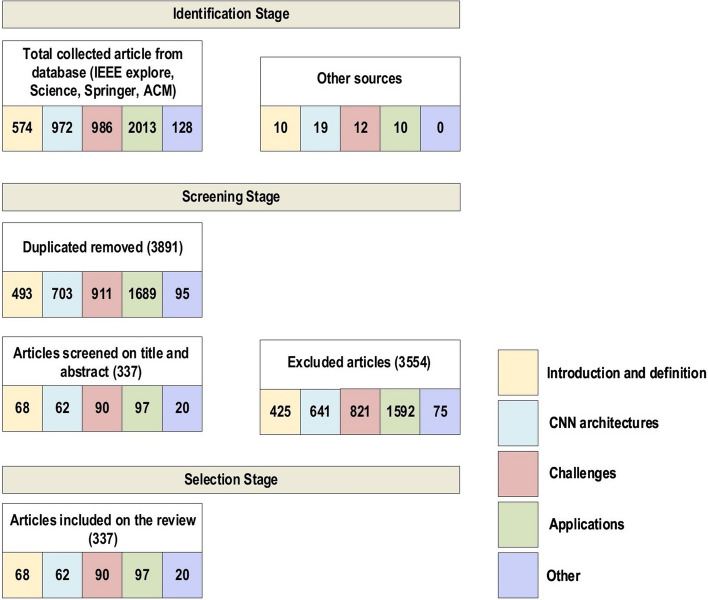
- The authors reviewed more than 300 papers on deep learning topics, with 108 papers from 2020, 76 from 2019, and 48 from 2018.
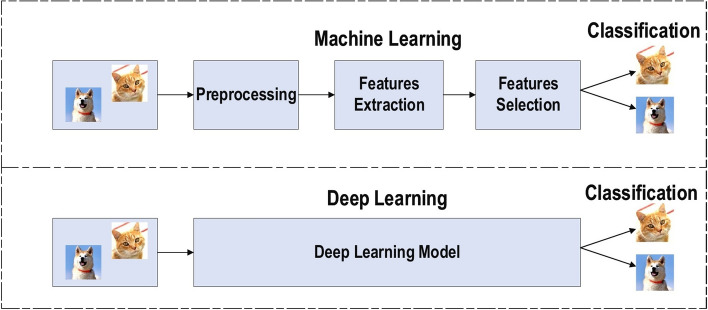
- They argue that DL can reduce manual feature engineering by learning features automatically and that it has already achieved strong results in tasks such as image classification, detection, segmentation, and registration.
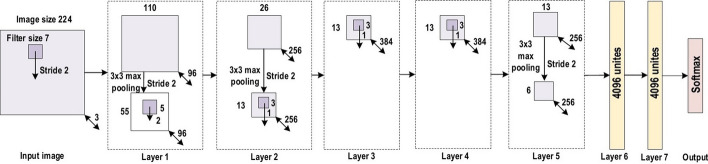
- The paper highlights that CNNs are the most used DL network type and reviews their architectural evolution from AlexNet (2012) to HRNet (2020).
- It identifies major DL challenges including lack of training data, imbalanced data, interpretability, uncertainty scaling, catastrophic forgetting, model compression, overfitting, vanishing/exploding gradients, and underspecification.
## Methods
- This is a survey/review paper, not an experimental study.
- The authors report reviewing literature from 2010–2020 (mainly 2020 and 2019, with some 2021 papers), drawing from publishers including IEEE, Elsevier, MDPI, Nature, ACM, and Springer, plus some arXiv papers.
- Their review was organized to cover DL approaches and network types, CNN architectures, challenges and solutions, applications, and computational approaches.
## Limitations
- The paper itself states that the review is not exhaustive for every topic; for example, in registration it says it is “out of the scope of this work to provide an extensive review of this topic.”
- The text also makes evident that some sections are descriptive rather than systematic: it summarizes many studies and architectures but does not report a formal meta-analysis or quantitative comparison across all included papers. (This is evident from the text.)
- Several sections are labeled only as headings or brief placeholders in the provided text, suggesting the supplied version is fragmentary/incomplete in places. (This is evident from the text.)
Model-written summary. Check it against the paper before relying on it.
Integrity signals
Registry
Cites
Statistics
Figures
Verification
Claims the paper makes
81 Valid · 72 Not valid · 63 Not checked · 158 Own results and interpretations
Some cited sources support this claim and some don’t — read each source’s verdict below.
In the paper
“Increase the depth (or width) of the model.”
§ Review of deep learning: concepts, CNN architectures, challenges, applications, future directions > Types of DL networks > Convolutional neural networks
What the sources say
- Disputedcites [86] Alzubaidi L Fadhel MA Al-Shamma O Zhang J Duan Y Deep learning models for classification of red blood cells in microscopy images to aid in sickle cell anemia diagnosis Electronics 2020 9 3 427 10.3390/electronics9030427 sourceExperimental — accuracy not yet measured
In the paper’s model-comparison discussion (page not available in our copy), the authors say they increased network depth to improve performance, but it did not help; Model 2 performed best. The cited passage therefore does not support recommending greater depth as a way to improve performance, and it gives no corresponding result for greater width. (LLM, conf=0.86)
Checked by a reasoning model — may be wrong.
- Not checked yetcites [87] Alzubaidi L Fadhel MA Al-Shamma O Zhang J Santamaría J Duan Y Oleiwi SR Towards a better understanding of transfer learning for medical imaging: a case study Appl Sci 2020 10 13 4523 10.3390/app10134523 source
Checked before — its earlier verdict is held back until a new check runs.
- Partly supportedcites [88] Alzubaidi L Al-Shamma O Fadhel MA Farhan L Zhang J Duan Y Optimizing the performance of breast cancer classification by employing the same domain transfer learning from hybrid deep convolutional neural network model Electronics 2020 9 3 445 10.3390/electronics9030445 sourceExperimental — accuracy not yet measured
Section 3.5 (Proposed Model; page unavailable) says a deep CNN with improved feature extraction is needed for breast-biopsy classification and describes a multi-branch architecture. It does not establish that simply increasing a model’s depth or width improves CNN performance; the proposed model also uses residual links and other design choices. (LLM, conf=0.78)
plainstates a possible cause- Asserted: passes — The authors put it forward as true.
- Checkable: passes — It can be checked against evidence.
- Load-bearing: unclear — It is unclear whether the paper’s conclusions depend on it.
- Based: passes — The paper gives a reason why it holds.
- Disputed
The cited sources support only part of this claim — read each source’s verdict below.
In the paper
“The main benefit of CNN compared to its predecessors is that it automatically identifies the relevant features without any human supervision [76].”
§ Review of deep learning: concepts, CNN architectures, challenges, applications, future directions > Types of DL networks > Convolutional neural networks
What the sources say
- Partly supportedcites [76] Gu J Wang Z Kuen J Ma L Shahroudy A Shuai B Liu T Wang X Wang G Cai J Recent advances in convolutional neural networks Pattern Recogn 2018 77 354 377 10.1016/j.patcog.2017.10.013 sourceExperimental — accuracy not yet measured
The paper says CNNs learn features automatically rather than relying on handcrafted features (5.3, p. 22), supporting the feature-learning part of the claim. But it does not support “without any human supervision”: the Conclusions (p. 28) say training requires manually collected labeled data and identify unsupervised CNN learning as a goal for further work. (LLM, conf=0.88)
plainstates a cause- Asserted: passes — The authors put it forward as true.
- Checkable: passes — It can be checked against evidence.
- Load-bearing: unclear — It is unclear whether the paper’s conclusions depend on it.
- Based: passes — The paper gives a reason why it holds.
- Partly supported
The cited sources support only part of this claim — read each source’s verdict below.
In the paper
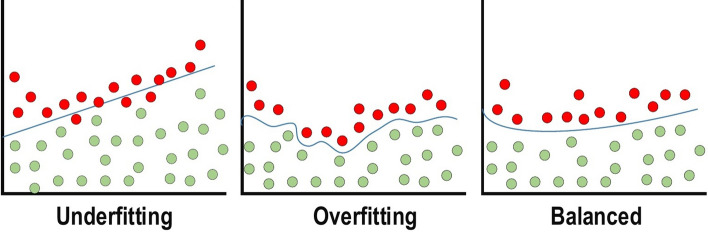
“Add regularization.”
§ Review of deep learning: concepts, CNN architectures, challenges, applications, future directions > Types of DL networks > Convolutional neural networks
What the sources say
- Supportedcites [86] Alzubaidi L Fadhel MA Al-Shamma O Zhang J Duan Y Deep learning models for classification of red blood cells in microscopy images to aid in sickle cell anemia diagnosis Electronics 2020 9 3 427 10.3390/electronics9030427 source
Section 3.2 (p. 8) says data augmentation enhances classification performance and helps prevent CNN overfitting. The paper thus supports the hedged claim that adding an overfitting-control technique may improve CNN performance, specifically in red-blood-cell classification. (LLM, conf=0.82)
- Partly supportedcites [87] Alzubaidi L Fadhel MA Al-Shamma O Zhang J Santamaría J Duan Y Oleiwi SR Towards a better understanding of transfer learning for medical imaging: a case study Appl Sci 2020 10 13 4523 10.3390/app10134523 sourceExperimental — accuracy not yet measured
Our copy places regularization among techniques for limiting overfitting (Sec. 5.2.4 Dropout: 'A limited number of solutions are used to reduce the risk of overfitting... Other techniques involve the use of regularization and enlargement of the training dataset'), and lists 'regularization strategies' among the attributes in which DCNNs advanced (Sec. 2.2). That supports regularization as a performance-related device, but the paper never states that adding regularization improves CNN performance; on the contrary, its only comparative statement favours the alternative: 'Compared to regularization, dropout performs well in accelerating the process of training, as well as reducing the overfitting risk' (Sec. 5.2.4). The claim's asserted benefit of adding regularization is therefore only partly carried by this source. (LLM, conf=0.68)
- Supportedcites [88] Alzubaidi L Al-Shamma O Fadhel MA Farhan L Zhang J Duan Y Optimizing the performance of breast cancer classification by employing the same domain transfer learning from hybrid deep convolutional neural network model Electronics 2020 9 3 445 10.3390/electronics9030445 source
Section 3.5 (Proposed Model; page unavailable) says the authors placed a dropout layer in their CNN to prevent overfitting. Dropout is a form of regularization, so this supports the qualified claim that adding regularization may improve CNN performance. (LLM, conf=0.85)
plainstates a possible cause- Asserted: passes — The authors put it forward as true.
- Checkable: passes — It can be checked against evidence.
- Load-bearing: unclear — It is unclear whether the paper’s conclusions depend on it.
- Based: passes — The paper gives a reason why it holds.
- Supported
Every source the paper cites for this claim was checked and supports it.
In the paper
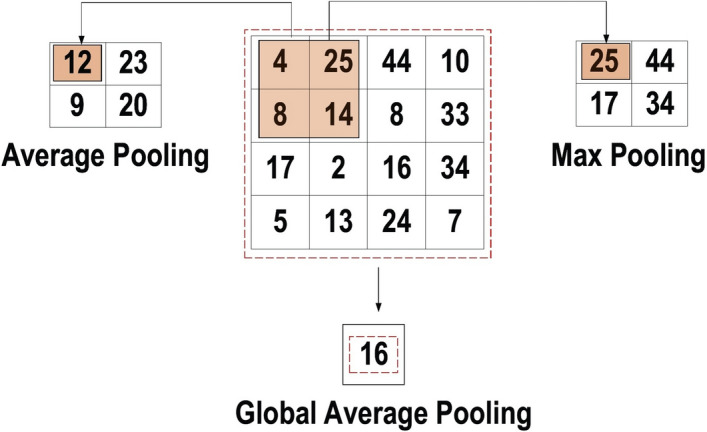
“As a substitution for a FC layer, the GAP is also employed, which represents the second novel concept and enables a significant reduction in the number of model parameters.”
§ Review of deep learning: concepts, CNN architectures, challenges, applications, future directions > CNN architectures > Network-in-network
What the sources say
- Supportedcites [94] Lin M, Chen Q, Yan S. Network in network; 2013. arXiv preprint arXiv:1312.4400. source
Section 3.2 (p. 4) proposes global average pooling as a replacement for fully connected layers and says the pooling layer has no parameters to optimize. Section 4.6 (p. 7) contrasts this with fully connected layers’ trainable dense transformation matrices, supporting the claimed reduction in parameters, though it does not quantify the reduction. (LLM, conf=0.90)
plainstates a cause- Asserted: passes — The authors put it forward as true.
- Checkable: passes — It can be checked against evidence.
- Load-bearing: unclear — It is unclear whether the paper’s conclusions depend on it.
- Based: passes — The paper gives a reason why it holds.
- Supported
Every source the paper cites for this claim was checked and supports it.
In the paper
“In 2015, Srivastava et al. [105] suggested a novel CNN architecture, called Highway Network, to overcome this issue.”
§ Review of deep learning: concepts, CNN architectures, challenges, applications, future directions > CNN architectures > Highway network
What the sources say
- Supportedcites [105] Srivastava RK, Greff K, Schmidhuber J. Highway networks; 2015. arXiv preprint arXiv:1505.00387. source
The Introduction (p. 1) presents highway networks as a novel architecture intended to make very deep networks easier to optimize. Section 2.1 (p. 2) describes convolutional highway layers, supporting the CNN characterization, although the architecture is not limited to CNNs. (LLM, conf=0.93)
plainstates a cause- Asserted: passes — The authors put it forward as true.
- Checkable: passes — It can be checked against evidence.
- Load-bearing: unclear — It is unclear whether the paper’s conclusions depend on it.
- Based: passes — The paper gives a reason why it holds.
- Rests on 2 assumptions not shown here.
- Supported
93 more claims · 31 with their cited sources checked
Create a free account to see all 374 claims and to verify the 24 references still open.
- Probably not a substantial claim. 224
- It may state two separate claims as one. 109
- The quote only partly states this claim. 2
Claims other papers make about this one
Each is checked against this paper’s own text: does it say what the citing paper says it does?
The source backs part of the claim, not all of it — or backs it for a different population, condition or comparison.
In the citing paper
“Previous methodologies, such as, artificial neural networks (NNs), and the more recent DL techniques, have been preferred in SOC estimation because of their applicability to depict more intricate correlation systems of input parameters and SOC [44].”
From Review Paper for SOC Estimation Techniques: Challenges and Future Areas for Improvement (2024) · cites this paper as [44]
Experimental — accuracy not yet measured
Self-check
Percentages, sums and reported differences re-computed from the paper’s own numbers.
Self-check results appear here once an independent check has confirmed them.
Cited works that were retracted
Works this paper cites that were later retracted, from the retraction notices publishers deposit. Major when the notice came out before this paper was published.
Rated major: it would touch a result — a value a result rests on, reported and recomputed p-values on opposite sides of the significance level, two passages that conflict with no sign which is right, or a cited work retracted before this paper was published.
In the paper
“Min Z. Public welfare organization management system based on FPGA and deep learning. Microprocess Microsyst. 2020;80:103333.”
Cited work 10.1016/j.micpro.2020.103333 · retracted 2021-02-01 · notice 10.1016/j.micpro.2020.103333 · this paper published 2021-03-31
Citations
Cites
1 retracted
RETRACTED: Public welfare organization management system based on FPGA and deep learning
Min, Z. (2020) · Microprocessors and Microsystems · doi:10.1016/j.micpro.2020.103333 · Cited by 16
RetractedDeep Residual Learning for Image Recognition
He, K., Zhang, X., Ren, S., & Sun, J. (2016) · 2016 IEEE Conference on Computer Vision and Pattern Recognition (CVPR) · doi:10.1109/cvpr.2016.90 · Cited by 235,474
Very Deep Convolutional Networks for Large-Scale Image Recognition
Simonyan, K., & Zisserman, A. (2014) · arXiv · doi:10.48550/arxiv.1409.1556 · Cited by 114,148
ImageNet classification with deep convolutional neural networks
Krizhevsky, A., Sutskever, I., & Hinton, G. E. (2017) · Communications of the ACM · doi:10.1145/3065386 · Cited by 112,155
U-Net: Convolutional Networks for Biomedical Image Segmentation
Ronneberger, O., Fischer, P., & Brox, T. (2015) · Lecture notes in computer science · doi:10.1007/978-3-319-24574-4_28 · Cited by 99,404
LeCun, Y., Bengio, Y., & Hinton, G. (2015) · Nature · doi:10.1038/nature14539 · Cited by 84,126
ImageNet: A large-scale hierarchical image database
Deng, J., Dong, W., Socher, R., Li, L.-J., Li, K., & Fei-Fei, L. (2009) · 2009 IEEE Conference on Computer Vision and Pattern Recognition · doi:10.1109/cvpr.2009.5206848 · Cited by 65,333
Densely Connected Convolutional Networks
Huang, G., Liu, Z., Van Der Maaten, L., & Weinberger, K. Q. (2017) · 2017 IEEE Conference on Computer Vision and Pattern Recognition (CVPR) · doi:10.1109/cvpr.2017.243 · Cited by 48,566
Going deeper with convolutions
Szegedy, C., Liu, W., Jia, Y., Sermanet, P., Reed, S., Anguelov, D., Erhan, D., Vanhoucke, V., & Rabinovich, A. (2015) · 2015 IEEE Conference on Computer Vision and Pattern Recognition (CVPR) · doi:10.1109/cvpr.2015.7298594 · Cited by 48,562
Squeeze-and-Excitation Networks
Hu, J., Shen, L., & Sun, G. (2018) · 2018 IEEE/CVF Conference on Computer Vision and Pattern Recognition · doi:10.1109/cvpr.2018.00745 · Cited by 35,667
Histograms of Oriented Gradients for Human Detection
Dalal, N., & Triggs, B. (2005) · 2005 IEEE Computer Society Conference on Computer Vision and Pattern Recognition (CVPR'05) · doi:10.1109/cvpr.2005.177 · Cited by 33,584
(2014) · Cited by 33,419
Rethinking the Inception Architecture for Computer Vision
Szegedy, C., Vanhoucke, V., Ioffe, S., Shlens, J., & Wojna, Z. (2016) · 2016 IEEE Conference on Computer Vision and Pattern Recognition (CVPR) · doi:10.1109/cvpr.2016.308 · Cited by 32,138
Human-level control through deep reinforcement learning
Mnih, V., Kavukcuoglu, K., Silver, D., Rusu, A. A., Veness, J., Bellemare, M. G., Graves, A., Riedmiller, M., Fidjeland, A. K., Ostrovski, G., et al. (2015) · Nature · doi:10.1038/nature14236 · Cited by 30,357
Batch Normalization: Accelerating Deep Network Training by Reducing Internal Covariate Shift
Ioffe, S., & Szegedy, C. (2015) · arXiv · doi:10.48550/arxiv.1502.03167 · Cited by 27,818
CBAM: Convolutional Block Attention Module
Woo, S., Park, J., Lee, J.-Y., & Kweon, I. S. (2018) · Lecture Notes in Computer Science · doi:10.1007/978-3-030-01234-2_1 · Cited by 25,853
Chen, L.-C., Papandreou, G., Kokkinos, I., Murphy, K., & Yuille, A. L. (2018) · IEEE Transactions on Pattern Analysis and Machine Intelligence · doi:10.1109/tpami.2017.2699184 · Cited by 22,392
Chen, L.-C., Papandreou, G., Kokkinos, I., Murphy, K., & Yuille, A. L. (2016) · arXiv · doi:10.48550/arxiv.1606.00915 · Cited by 22,392
Advances in neural information processing systems 7
Cios, K., & Shields, M. (1997) · Neurocomputing · doi:10.1016/s0925-2312(97)90018-7 · Cited by 22,059
An introduction to ROC analysis
Fawcett, T. (2006) · Pattern Recognition Letters · doi:10.1016/j.patrec.2005.10.010 · Cited by 21,879
Xception: Deep Learning with Depthwise Separable Convolutions
Chollet, F. (2017) · 2017 IEEE Conference on Computer Vision and Pattern Recognition (CVPR) · doi:10.1109/cvpr.2017.195 · Cited by 20,380
"Why Should I Trust You?": Explaining the Predictions of Any Classifier
Ribeiro, M. T., Singh, S., & Guestrin, C. (2016) · Proceedings of the 22nd ACM SIGKDD International Conference on Knowledge Discovery and Data Mining · doi:10.1145/2939672.2939778 · Cited by 17,555
Object recognition from local scale-invariant features
Lowe, D. G. (1999) · Proceedings of the Seventh IEEE International Conference on Computer Vision · doi:10.1109/iccv.1999.790410 · Cited by 16,472
Visualizing and understanding convolutional networks
Zeiler, M. D., & Fergus, R. (2014) · Lecture Notes in Computer Science · doi:10.1007/978-3-319-10590-1_53 · Cited by 15,839
A survey on deep learning in medical image analysis
Litjens, G., Kooi, T., Bejnordi, B. E., Setio, A. A. A., Ciompi, F., Ghafoorian, M., van der Laak, J. A. W. M., van Ginneken, B., & Sánchez, C. I. (2017) · Medical Image Analysis · doi:10.1016/j.media.2017.07.005 · Cited by 15,332
Dermatologist-level classification of skin cancer with deep neural networks
Esteva, A., Kuprel, B., Novoa, R. A., Ko, J., Swetter, S. M., Blau, H. M., & Thrun, S. (2017) · Nature · doi:10.1038/nature21056 · Cited by 14,362
Advances in neural information processing systems 7
(1996) · Computers & Mathematics with Applications · doi:10.1016/s0898-1221(96)90463-0 · Cited by 14,281
Batch Normalization: Accelerating Deep Network Training by Reducing Internal Covariate Shift
Ioffe, S. (2024) · arXiv (Cornell University) · doi:10.57702/o9raffed · Cited by 14,214
Distilling the Knowledge in a Neural Network
Hinton, G., Vinyals, O., & Dean, J. (2015) · arXiv · doi:10.48550/arxiv.1503.02531 · Cited by 14,204
(2010) · Cited by 14,134
Advances in Neural Information Processing Systems 29
Teymur, O., Zygalakis, K., & Calderhead, B. (2016) · Cited by 13,887
Receptive fields, binocular interaction and functional architecture in the cat’s visual cortex
Hubel, D. H., & Wiesel, T. N. (1962) · The Journal of Physiology · doi:10.1113/jphysiol.1962.sp006837 · Cited by 13,680
A survey on Image Data Augmentation for Deep Learning
Shorten, C., & Khoshgoftaar, T. M. (2019) · Journal of Big Data · doi:10.1186/s40537-019-0197-0 · Cited by 13,203
Aggregated Residual Transformations for Deep Neural Networks
Xie, S., Girshick, R., Dollar, P., Tu, Z., & He, K. (2017) · 2017 IEEE Conference on Computer Vision and Pattern Recognition (CVPR) · doi:10.1109/cvpr.2017.634 · Cited by 12,465
Squeeze-and-Excitation Networks
Hu, J., Shen, L., Albanie, S., Sun, G., & Wu, E. (2020) · IEEE Transactions on Pattern Analysis and Machine Intelligence · doi:10.1109/tpami.2019.2913372 · Cited by 12,157
V-Net: Fully Convolutional Neural Networks for Volumetric Medical Image Segmentation
Milletari, F., Navab, N., & Ahmadi, S.-A. (2016) · 2016 Fourth International Conference on 3D Vision (3DV) · doi:10.1109/3dv.2016.79 · Cited by 11,931
(2016) · Cited by 11,679
High-performance medicine: the convergence of human and artificial intelligence
Topol, E. J. (2019) · Nature Medicine · doi:10.1038/s41591-018-0300-7 · Cited by 10,450
Wide Residual NetworksPreprint
Zagoruyko, S., & Komodakis, N. (2016) · British Machine Vision Conference · doi:10.48550/arxiv.1605.07146 · Cited by 9,461
Zagoruyko, S., & Komodakis, N. (2016) · Procedings of the British Machine Vision Conference 2016 · doi:10.5244/c.30.87 · Cited by 7,244
U1 snRNP regulates cancer cell migration and invasion in vitro
Oh, J.-M., Venters, C. C., Di, C., Pinto, A. M., Wan, L., Younis, I., Cai, Z., Arai, C., So, B. R., Duan, J., et al. (2020) · Nature Communications · doi:10.1038/s41467-019-13993-7 · Cited by 7,157
Recursive Deep Models for Semantic Compositionality Over a Sentiment Treebank
Socher, R., Perelygin, A., Wu, J., Chuang, J., Manning, C. D., Ng, A., & Potts, C. (2013) · Proceedings of the 2013 Conference on Empirical Methods in Natural Language Processing · doi:10.18653/v1/d13-1170 · Cited by 6,878
“Why Should I Trust You?”: Explaining the Predictions of Any Classifier
Ribeiro, M., Singh, S., & Guestrin, C. (2016) · Proceedings of the 2016 Conference of the North American Chapter of the Association for Computational Linguistics: Demonstrations · doi:10.18653/v1/n16-3020 · Cited by 6,682
Recent advances in convolutional neural networks
Gu, J., Wang, Z., Kuen, J., Ma, L., Shahroudy, A., Shuai, B., Liu, T., Wang, X., Wang, G., Cai, J., et al. (2018) · Pattern Recognition · doi:10.1016/j.patcog.2017.10.013 · Cited by 6,576
Probabilistic Outputs for Support vector Machines and Comparisons to Regularized Likelihood Methods
Platt, J. C. (1999) · Cited by 6,472
Weiss, K., Khoshgoftaar, T. M., & Wang, D. (2016) · Journal of Big Data · doi:10.1186/s40537-016-0043-6 · Cited by 6,260
Large-Scale Machine Learning with Stochastic Gradient Descent
Bottou, L. (2010) · Proceedings of COMPSTAT'2010 · doi:10.1007/978-3-7908-2604-3_16 · Cited by 5,795
Object Detection With Deep Learning: A Review
Zhao, Z.-Q., Zheng, P., Xu, S.-T., & Wu, X. (2019) · IEEE Transactions on Neural Networks and Learning Systems · doi:10.1109/tnnls.2018.2876865 · Cited by 5,545
A guide to deep learning in healthcare
Esteva, A., Robicquet, A., Ramsundar, B., Kuleshov, V., DePristo, M., Chou, K., Cui, C., Corrado, G., Thrun, S., & Dean, J. (2019) · Nature Medicine · doi:10.1038/s41591-018-0316-z · Cited by 5,312
Jaderberg, M., Simonyan, K., Zisserman, A., & Kavukcuoglu, K. (2015) · arXiv · doi:10.48550/arxiv.1506.02025 · Cited by 5,137
An overview of gradient descent optimization algorithms
Ruder, S. (2016) · arXiv · doi:10.48550/arxiv.1609.04747 · Cited by 4,962
Deep High-Resolution Representation Learning for Visual Recognition
Wang, J., Sun, K., Cheng, T., Jiang, B., Deng, C., Zhao, Y., Liu, D., Mu, Y., Tan, M., Wang, X., et al. (2021) · IEEE Transactions on Pattern Analysis and Machine Intelligence · doi:10.1109/tpami.2020.2983686 · Cited by 4,894
Identifying Medical Diagnoses and Treatable Diseases by Image-Based Deep Learning
Kermany, D. S., Goldbaum, M., Cai, W., Valentim, C. C. S., Liang, H., Baxter, S. L., McKeown, A., Yang, G., Wu, X., Yan, F., et al. (2018) · Cell · doi:10.1016/j.cell.2018.02.010 · Cited by 4,842
Self-citationA Brief Survey of Deep Reinforcement Learning
Arulkumaran, K., Deisenroth, M. P., Brundage, M., & Bharath, A. A. (2017) · arXiv · doi:10.48550/arxiv.1708.05866 · Cited by 4,733
Deep Reinforcement Learning: A Brief Survey
Arulkumaran, K., Deisenroth, M. P., Brundage, M., & Bharath, A. A. (2017) · IEEE Signal Processing Magazine · doi:10.1109/msp.2017.2743240 · Cited by 4,733
Han, S., Mao, H., & Dally, W. J. (2015) · arXiv · doi:10.48550/arxiv.1510.00149 · Cited by 4,662
Inception-v4, Inception-ResNet and the Impact of Residual Connections on Learning
Szegedy, C., Ioffe, S., Vanhoucke, V., & Alemi, A. (2017) · Proceedings of the AAAI Conference on Artificial Intelligence · doi:10.1609/aaai.v31i1.11231 · Cited by 4,636
Wang, X., Peng, Y., Lu, L., Lu, Z., Bagheri, M., & Summers, R. M. (2017) · 2017 IEEE Conference on Computer Vision and Pattern Recognition (CVPR) · doi:10.1109/cvpr.2017.369 · Cited by 4,616
Dynamic Routing Between Capsules
Sabour, S., Frosst, N., & Hinton, G. E. (2017) · arXiv · doi:10.48550/arxiv.1710.09829 · Cited by 4,167
Axiomatic attribution for deep networks
Sundararajan, M., Taly, A., & Yan, Q. (2017) · arXiv · doi:10.48550/arxiv.1703.01365 · Cited by 4,087
Residual Attention Network for Image Classification
Wang, F., Jiang, M., Qian, C., Yang, S., Li, C., Zhang, H., Wang, X., & Tang, X. (2017) · 2017 IEEE Conference on Computer Vision and Pattern Recognition (CVPR) · doi:10.1109/cvpr.2017.683 · Cited by 4,073
iCaRL: Incremental Classifier and Representation Learning
Rebuffi, S.-A., Kolesnikov, A., Sperl, G., & Lampert, C. H. (2017) · 2017 IEEE Conference on Computer Vision and Pattern Recognition (CVPR) · doi:10.1109/cvpr.2017.587 · Cited by 3,988
Brain tumor segmentation with Deep Neural Networks
Havaei, M., Davy, A., Warde-Farley, D., Biard, A., Courville, A., Bengio, Y., Pal, C., Jodoin, P.-M., & Larochelle, H. (2017) · Medical Image Analysis · doi:10.1016/j.media.2016.05.004 · Cited by 3,278
Brain Tumor Segmentation with Deep Neural Networks
Havaei, M., Davy, A., Warde-Farley, D., Biard, A., Courville, A., Bengio, Y., Pal, C., Jodoin, P.-M., & Larochelle, H. (2015) · arXiv · doi:10.48550/arxiv.1505.03540 · Cited by 3,278
A survey of deep neural network architectures and their applications
Liu, W., Wang, Z., Liu, X., Zeng, N., Liu, Y., & Alsaadi, F. E. (2017) · Neurocomputing · doi:10.1016/j.neucom.2016.12.038 · Cited by 3,239
A Survey on Deep Transfer Learning
Tan, C., Sun, F., Kong, T., Zhang, W., Yang, C., & Liu, C. (2018) · Lecture Notes in Computer Science · doi:10.1007/978-3-030-01424-7_27 · Cited by 3,165
A survey of the recent architectures of deep convolutional neural networks
Khan, A., Sohail, A., Zahoora, U., & Qureshi, A. S. (2020) · Artificial Intelligence Review · doi:10.1007/s10462-020-09825-6 · Cited by 3,137
Continual lifelong learning with neural networks: A review
Parisi, G. I., Kemker, R., Part, J. L., Kanan, C., & Wermter, S. (2019) · Neural Networks · doi:10.1016/j.neunet.2019.01.012 · Cited by 3,117
Survey on deep learning with class imbalance
Johnson, J. M., & Khoshgoftaar, T. M. (2019) · Journal of Big Data · doi:10.1186/s40537-019-0192-5 · Cited by 3,032
The Vanishing Gradient Problem During Learning Recurrent Neural Nets and Problem Solutions
Hochreiter, S. (1998) · International Journal of Uncertainty, Fuzziness and Knowledge-Based Systems · doi:10.1142/s0218488598000094 · Cited by 2,939
Recent Trends in Deep Learning Based Natural Language Processing [Review Article]
Young, T., Hazarika, D., Poria, S., & Cambria, E. (2018) · IEEE Computational Intelligence Magazine · doi:10.1109/mci.2018.2840738 · Cited by 2,921
Understanding deep learning requires rethinking generalization
Zhang, C., Bengio, S., Hardt, M., Recht, B., & Vinyals, O. (2016) · arXiv · doi:10.48550/arxiv.1611.03530 · Cited by 2,838
Deep Convolutional and LSTM Recurrent Neural Networks for Multimodal Wearable Activity Recognition
Ordóñez, F., & Roggen, D. (2016) · Sensors · doi:10.3390/s16010115 · Cited by 2,761
Brain Tumor Segmentation Using Convolutional Neural Networks in MRI Images
Pereira, S., Pinto, A., Alves, V., & Silva, C. A. (2016) · IEEE Transactions on Medical Imaging · doi:10.1109/tmi.2016.2538465 · Cited by 2,735
A Review on Evaluation Metrics for Data Classification Evaluations
M, H., & M.N, S. (2015) · International Journal of Data Mining & Knowledge Management Process · doi:10.5121/ijdkp.2015.5201 · Cited by 2,693
Short-Term Residential Load Forecasting Based on LSTM Recurrent Neural Network
Kong, W., Dong, Z. Y., Jia, Y., Hill, D. J., Xu, Y., & Zhang, Y. (2019) · IEEE Transactions on Smart Grid · doi:10.1109/tsg.2017.2753802 · Cited by 2,645
Clinically applicable deep learning for diagnosis and referral in retinal disease
De Fauw, J., Ledsam, J. R., Romera-Paredes, B., Nikolov, S., Tomasev, N., Blackwell, S., Askham, H., Glorot, X., O’Donoghue, B., Visentin, D., et al. (2018) · Nature Medicine · doi:10.1038/s41591-018-0107-6 · Cited by 2,639
Deep learning applications and challenges in big data analytics
Najafabadi, M. M., Villanustre, F., Khoshgoftaar, T. M., Seliya, N., Wald, R., & Muharemagic, E. (2015) · Journal of Big Data · doi:10.1186/s40537-014-0007-7 · Cited by 2,594
Understanding deep learning (still) requires rethinking generalization
Zhang, C., Bengio, S., Hardt, M., Recht, B., & Vinyals, O. (2021) · Communications of the ACM · doi:10.1145/3446776 · Cited by 2,400
Predicting effects of noncoding variants with deep learning–based sequence model
Zhou, J., & Troyanskaya, O. G. (2015) · Nature Methods · doi:10.1038/nmeth.3547 · Cited by 2,338
Apostolopoulos, I. D., & Mpesiana, T. A. (2020) · Physical and Engineering Sciences in Medicine · doi:10.1007/s13246-020-00865-4 · Cited by 2,338
Opportunities and obstacles for deep learning in biology and medicine
Ching, T., Himmelstein, D. S., Beaulieu-Jones, B. K., Kalinin, A. A., Do, B. T., Way, G. P., Ferrero, E., Agapow, P.-M., Zietz, M., Hoffman, M. M., et al. (2018) · Journal of The Royal Society Interface · doi:10.1098/rsif.2017.0387 · Cited by 2,310
A Simple Generalisation of the Area Under the ROC Curve for Multiple Class Classification Problems
Hand, D. J., & Till, R. J. (2001) · Machine Learning · doi:10.1023/a:1010920819831 · Cited by 2,276
Empirical Evaluation of Rectified Activations in Convolutional Network
Xu, B., Wang, N., Chen, T., & Li, M. (2015) · arXiv · doi:10.48550/arxiv.1505.00853 · Cited by 2,264
Using AUC and accuracy in evaluating learning algorithms
Huang, J., & Ling, C. X. (2005) · IEEE Transactions on Knowledge and Data Engineering · doi:10.1109/tkde.2005.50 · Cited by 2,148
Deep Networks with Stochastic Depth
Huang, G., Sun, Y., Liu, Z., Sedra, D., & Weinberger, K. Q. (2016) · Lecture Notes in Computer Science · doi:10.1007/978-3-319-46493-0_39 · Cited by 2,104
An overview of deep learning in medical imaging focusing on MRI
Lundervold, A. S., & Lundervold, A. (2019) · Zeitschrift für Medizinische Physik · doi:10.1016/j.zemedi.2018.11.002 · Cited by 2,058
Review of Deep Learning Algorithms and Architectures
Shrestha, A., & Mahmood, A. (2019) · IEEE Access · doi:10.1109/access.2019.2912200 · Cited by 1,883
The rise of deep learning in drug discovery
Chen, H., Engkvist, O., Wang, Y., Olivecrona, M., & Blaschke, T. (2018) · Drug Discovery Today · doi:10.1016/j.drudis.2018.01.039 · Cited by 1,770
Text Data Augmentation for Deep Learning
Shorten, C., Khoshgoftaar, T. M., & Furht, B. (2021) · Journal of Big Data · doi:10.1186/s40537-021-00492-0 · Cited by 1,740
Building high-level features using large scale unsupervised learning
Le, Q. V. (2013) · 2013 IEEE International Conference on Acoustics, Speech and Signal Processing · doi:10.1109/icassp.2013.6639343 · Cited by 1,695
Deep Learning on Graphs: A Survey
Zhang, Z., Cui, P., & Zhu, W. (2018) · arXiv · doi:10.48550/arxiv.1812.04202 · Cited by 1,692
Deep Learning on Graphs: A Survey
Zhang, Z., Cui, P., & Zhu, W. (2022) · IEEE Transactions on Knowledge and Data Engineering · doi:10.1109/tkde.2020.2981333 · Cited by 1,633
A State-of-the-Art Survey on Deep Learning Theory and Architectures
Alom, M. Z., Taha, T. M., Yakopcic, C., Westberg, S., Sidike, P., Nasrin, M. S., Hasan, M., Van Essen, B. C., Awwal, A. A. S., & Asari, V. K. (2019) · Electronics · doi:10.3390/electronics8030292 · Cited by 1,620
Mitosis Detection in Breast Cancer Histology Images with Deep Neural Networks
Cireşan, D. C., Giusti, A., Gambardella, L. M., & Schmidhuber, J. (2013) · Lecture Notes in Computer Science · doi:10.1007/978-3-642-40763-5_51 · Cited by 1,536
Deep Learning Applications in Medical Image Analysis
Ker, J., Wang, L., Rao, J., & Lim, T. (2018) · IEEE Access · doi:10.1109/access.2017.2788044 · Cited by 1,481
Exploiting Linear Structure Within Convolutional Networks for Efficient Evaluation
Denton, R., Zaremba, W., Bruna, J., LeCun, Y., & Fergus, R. (2014) · arXiv · doi:10.48550/arxiv.1404.0736 · Cited by 1,414
Shi, F., Wang, J., Shi, J., Wu, Z., Wang, Q., Tang, Z., He, K., Shi, Y., & Shen, D. (2021) · IEEE Reviews in Biomedical Engineering · doi:10.1109/rbme.2020.2987975 · Cited by 1,404
A Survey on Deep Learning: Algorithms, Techniques, and Applications
Pouyanfar, S., Sadiq, S., Yan, Y., Tian, H., Tao, Y., Reyes, M. P., Shyu, M.-L., Chen, S.-C., & Iyengar, S. S. (2019) · ACM Computing Surveys · doi:10.1145/3234150 · Cited by 1,403
Improved Adam Optimizer for Deep Neural Networks
Zhang, Z. (2018) · 2018 IEEE/ACM 26th International Symposium on Quality of Service (IWQoS) · doi:10.1109/iwqos.2018.8624183 · Cited by 1,400
Recurrent Neural Networks for Time Series Forecasting: Current status and future directions
Hewamalage, H., Bergmeir, C., & Bandara, K. (2021) · International Journal of Forecasting · doi:10.1016/j.ijforecast.2020.06.008 · Cited by 1,371
Deep Convolutional Neural Networks and Data Augmentation for Environmental Sound Classification
Salamon, J., & Bello, J. P. (2017) · IEEE Signal Processing Letters · doi:10.1109/lsp.2017.2657381 · Cited by 1,364
A Survey of Deep Learning-Based Object Detection
Jiao, L., Zhang, F., Liu, F., Yang, S., Li, L., Feng, Z., & Qu, R. (2019) · IEEE Access · doi:10.1109/access.2019.2939201 · Cited by 1,323
Improving deep neural networks for LVCSR using rectified linear units and dropout
Dahl, G. E., Sainath, T. N., & Hinton, G. E. (2013) · 2013 IEEE International Conference on Acoustics, Speech and Signal Processing · doi:10.1109/icassp.2013.6639346 · Cited by 1,310
Sirinukunwattana, K., Raza, S. E. A., Tsang, Y.-W., Snead, D. R. J., Cree, I. A., & Rajpoot, N. M. (2016) · IEEE Transactions on Medical Imaging · doi:10.1109/tmi.2016.2525803 · Cited by 1,224
CheXNet: Radiologist-Level Pneumonia Detection on Chest X-Rays with Deep Learning
Rajpurkar, P., Irvin, J., Zhu, K., Yang, B., Mehta, H., Duan, T., Ding, D. Y., Bagul, A., Langlotz, C. P., Shpanskaya, K. S., et al. (2017) · arXiv (Cornell University) · doi:10.48550/arxiv.1711.05225 · Cited by 1,219
A Deep Learning System to Screen Novel Coronavirus Disease 2019 Pneumonia
Xu, X., Jiang, X., Ma, C., Du, P., Li, X., Lv, S., Yu, L., Ni, Q., Chen, Y., Su, J., et al. (2020) · Engineering · doi:10.1016/j.eng.2020.04.010 · Cited by 1,209
(2011) · Cited by 1,192
Recent Trends in Deep Learning Based Natural Language Processing
Young, T., Hazarika, D., Poria, S., & Cambria, E. (2017) · arXiv (Cornell University) · doi:10.48550/arxiv.1708.02709 · Cited by 1,192
Deep Learning for Single Image Super-Resolution: A Brief Review
Yang, W., Zhang, X., Tian, Y., Wang, W., Xue, J.-H., & Liao, Q. (2019) · IEEE Transactions on Multimedia · doi:10.1109/tmm.2019.2919431 · Cited by 1,154
Deep learning for brain MRI segmentation: state of the art and future directions
Akkus, Z., Galimzianova, A., Hoogi, A., Rubin, D. L., & Erickson, B. J. (2017) · Journal of Digital Imaging · doi:10.1007/s10278-017-9983-4 · Cited by 1,129
Convolutional neural network: a review of models, methodologies and applications to object detection
Dhillon, A., & Verma, G. K. (2020) · Progress in Artificial Intelligence · doi:10.1007/s13748-019-00203-0 · Cited by 1,119
Unsupervised Learning of Invariant Feature Hierarchies with Applications to Object Recognition
Ranzato, M., Huang, F. J., Boureau, Y.-L., & LeCun, Y. (2007) · 2007 IEEE Conference on Computer Vision and Pattern Recognition · doi:10.1109/cvpr.2007.383157 · Cited by 1,086
Deep convolutional neural network based medical image classification for disease diagnosis
Yadav, S. S., & Jadhav, S. M. (2019) · Journal of Big Data · doi:10.1186/s40537-019-0276-2 · Cited by 1,069
Multi-column deep neural network for traffic sign classification
Cireşan, D., Meier, U., Masci, J., & Schmidhuber, J. (2012) · Neural Networks · doi:10.1016/j.neunet.2012.02.023 · Cited by 1,057
Recent advances in deep learning for object detection
Wu, X., Sahoo, D., & Hoi, S. C. H. (2020) · Neurocomputing · doi:10.1016/j.neucom.2020.01.085 · Cited by 1,047
RETAIN: an interpretable predictive model for healthcare using reverse time attention mechanism
Choi, E., Bahadori, M. T., Kulas, J. A., Schuetz, A., Stewart, W. F., & Sun, J. (2016) · arXiv · doi:10.48550/arxiv.1608.05745 · Cited by 1,029
HigherHRNet: Scale-Aware Representation Learning for Bottom-Up Human Pose Estimation
Cheng, B., Xiao, B., Wang, J., Shi, H., Huang, T. S., & Zhang, L. (2020) · 2020 IEEE/CVF Conference on Computer Vision and Pattern Recognition (CVPR) · doi:10.1109/cvpr42600.2020.00543 · Cited by 1,023
An overview of deep learning in medical imaging focusing on MRI
Lundervold, A. S., & Lundervold, A. (2018) · NORA - Norwegian Open Research Archives · Cited by 1,012
Obtaining well calibrated probabilities using Bayesian binning
Pakdaman Naeini, M., Cooper, G., & Hauskrecht, M. (2015) · Proceedings of the AAAI Conference on Artificial Intelligence · doi:10.1609/aaai.v29i1.9602 · Cited by 991
Srivastava, R. K., Greff, K., & Schmidhuber, J. (2015) · arXiv · doi:10.48550/arxiv.1505.00387 · Cited by 912
Concurrent Spatial and Channel ‘Squeeze & Excitation’ in Fully Convolutional Networks
Roy, A. G., Navab, N., & Wachinger, C. (2018) · Lecture Notes in Computer Science · doi:10.1007/978-3-030-00928-1_48 · Cited by 869
Automatic Segmentation of MR Brain Images With a Convolutional Neural Network
Moeskops, P., Viergever, M. A., Mendrik, A. M., de Vries, L. S., Benders, M. J. N. L., & Isgum, I. (2016) · IEEE Transactions on Medical Imaging · doi:10.1109/tmi.2016.2548501 · Cited by 861
Stacked Sparse Autoencoder (SSAE) for Nuclei Detection on Breast Cancer Histopathology Images
Xu, J., Xiang, L., Liu, Q., Gilmore, H., Wu, J., Tang, J., & Madabhushi, A. (2016) · IEEE Transactions on Medical Imaging · doi:10.1109/tmi.2015.2458702 · Cited by 854
A deep learning framework for unsupervised affine and deformable image registration
de Vos, B. D., Berendsen, F. F., Viergever, M. A., Sokooti, H., Staring, M., & Išgum, I. (2019) · Medical Image Analysis · doi:10.1016/j.media.2018.11.010 · Cited by 818
Cheng, Y., Wang, D., Zhou, P., & Zhang, T. (2018) · IEEE Signal Processing Magazine · doi:10.1109/msp.2017.2765695 · Cited by 817
Wen, J., Thibeau-Sutre, E., Diaz-Melo, M., Samper-González, J., Routier, A., Bottani, S., Dormont, D., Durrleman, S., Burgos, N., & Colliot, O. (2020) · Medical Image Analysis · doi:10.1016/j.media.2020.101694 · Cited by 809
Deep learning for computational chemistry
Goh, G. B., Hodas, N. O., & Vishnu, A. (2017) · Journal of Computational Chemistry · doi:10.1002/jcc.24764 · Cited by 809
Khan, S., Islam, N., Jan, Z., Ud Din, I., & Rodrigues, J. J. P. C. (2019) · Pattern Recognition Letters · doi:10.1016/j.patrec.2019.03.022 · Cited by 785
A Novel Transfer Learning Based Approach for Pneumonia Detection in Chest X-ray Images
Chouhan, V., Singh, S. K., Khamparia, A., Gupta, D., Tiwari, P., Moreira, C., Damaševičius, R., & de Albuquerque, V. H. C. (2020) · Applied Sciences · doi:10.3390/app10020559 · Cited by 753
Deep neural network models for computational histopathology: A survey
Srinidhi, C. L., Ciga, O., & Martel, A. L. (2021) · Medical Image Analysis · doi:10.1016/j.media.2020.101813 · Cited by 749
Deep Pyramidal Residual Networks
Han, D., Kim, J., & Kim, J. (2017) · 2017 IEEE Conference on Computer Vision and Pattern Recognition (CVPR) · doi:10.1109/cvpr.2017.668 · Cited by 715
Deep learning in medical image registration: a survey
Haskins, G., Kruger, U., & Yan, P. (2020) · Machine Vision and Applications · doi:10.1007/s00138-020-01060-x · Cited by 704
Rahimzadeh, M., & Attar, A. (2020) · Informatics in Medicine Unlocked · doi:10.1016/j.imu.2020.100360 · Cited by 695
(2001) · Cited by 683
Deep learning in medical image registration: a review
Fu, Y., Lei, Y., Wang, T., Curran, W. J., Liu, T., & Yang, X. (2020) · Physics in Medicine & Biology · doi:10.1088/1361-6560/ab843e · Cited by 661
Regularizing Neural Networks by Penalizing Confident Output Distributions
Pereyra, G., Tucker, G., Chorowski, J., Kaiser, Ł., & Hinton, G. (2017) · arXiv · doi:10.48550/arxiv.1701.06548 · Cited by 655
(2014) · International Conference on Learning Representations · Cited by 634
Quicksilver: Fast predictive image registration – A deep learning approach
Yang, X., Kwitt, R., Styner, M., & Niethammer, M. (2017) · NeuroImage · doi:10.1016/j.neuroimage.2017.07.008 · Cited by 630
Explainable Deep Learning for Pulmonary Disease and Coronavirus COVID-19 Detection from X-rays
Brunese, L., Mercaldo, F., Reginelli, A., & Santone, A. (2020) · Computer Methods and Programs in Biomedicine · doi:10.1016/j.cmpb.2020.105608 · Cited by 623
Transfusion: Understanding Transfer Learning for Medical Imaging
Raghu, M., Zhang, C., Kleinberg, J. M., & Bengio, S. (2019) · arXiv (Cornell University) · doi:10.48550/arxiv.1902.07208 · Cited by 613
AggNet: Deep Learning From Crowds for Mitosis Detection in Breast Cancer Histology Images
Albarqouni, S., Baur, C., Achilles, F., Belagiannis, V., Demirci, S., & Navab, N. (2016) · IEEE Transactions on Medical Imaging · doi:10.1109/tmi.2016.2528120 · Cited by 606
Multi-scale Convolutional Neural Networks for Lung Nodule Classification
Shen, W., Zhou, M., Yang, F., Yang, C., & Tian, J. (2015) · Lecture Notes in Computer Science · doi:10.1007/978-3-319-19992-4_46 · Cited by 592
A review of object detection based on deep learning
Xiao, Y., Tian, Z., Yu, J., Zhang, Y., Liu, S., Du, S., & Lan, X. (2020) · Multimedia Tools and Applications · doi:10.1007/s11042-020-08976-6 · Cited by 584
Learning task-dependent distributed representations by backpropagation through structure
Goller, C., & Kuchler, A. (2002) · Proceedings of International Conference on Neural Networks (ICNN'96) · doi:10.1109/icnn.1996.548916 · Cited by 581
Incremental Learning of Object Detectors without Catastrophic Forgetting
Shmelkov, K., Schmid, C., & Alahari, K. (2017) · 2017 IEEE International Conference on Computer Vision (ICCV) · doi:10.1109/iccv.2017.368 · Cited by 559
Artificial Intelligence and COVID-19: Deep Learning Approaches for Diagnosis and Treatment
Jamshidi, M., Lalbakhsh, A., Talla, J., Peroutka, Z., Hadjilooei, F., Lalbakhsh, P., Jamshidi, M., Spada, L. L., Mirmozafari, M., Dehghani, M., et al. (2020) · IEEE Access · doi:10.1109/access.2020.3001973 · Cited by 551
Tree Induction for Probability-Based Ranking
Provost, F., & Domingos, P. (2003) · Machine Learning · doi:10.1023/a:1024099825458 · Cited by 541
Recalibrating Fully Convolutional Networks With Spatial and Channel “Squeeze and Excitation” Blocks
Roy, A. G., Navab, N., & Wachinger, C. (2019) · IEEE Transactions on Medical Imaging · doi:10.1109/tmi.2018.2867261 · Cited by 534
Mahmud, T., Rahman, M. A., & Fattah, S. A. (2020) · Computers in Biology and Medicine · doi:10.1016/j.compbiomed.2020.103869 · Cited by 525
A CNN Regression Approach for Real-Time 2D/3D Registration
Miao, S., Wang, Z. J., & Liao, R. (2016) · IEEE Transactions on Medical Imaging · doi:10.1109/tmi.2016.2521800 · Cited by 514
Hossain, E., Khan, I., Un-Noor, F., Sikander, S. S., & Sunny, M. S. H. (2019) · IEEE Access · doi:10.1109/access.2019.2894819 · Cited by 513
Survey of review spam detection using machine learning techniques
Crawford, M., Khoshgoftaar, T. M., Prusa, J. D., Richter, A. N., & Al Najada, H. (2015) · Journal of Big Data · doi:10.1186/s40537-015-0029-9 · Cited by 502
Efficient Learning of Deep Boltzmann Machines
Salakhutdinov, R., & Larochelle, H. (2010) · International Conference on Artificial Intelligence and Statistics · Cited by 499
FPGA-Based Accelerators of Deep Learning Networks for Learning and Classification: A Review
Shawahna, A., Sait, S. M., & El-Maleh, A. (2019) · IEEE Access · doi:10.1109/access.2018.2890150 · Cited by 496
Nagpal, K., Foote, D., Liu, Y., Chen, P.-H. C., Wulczyn, E., Tan, F., Olson, N., Smith, J. L., Mohtashamian, A., Wren, J. H., et al. (2019) · npj Digital Medicine · doi:10.1038/s41746-019-0112-2 · Cited by 495
Concurrence of big data analytics and healthcare: a systematic review
Mehta, N., & Pandit, A. (2018) · International Journal of Medical Informatics · doi:10.1016/j.ijmedinf.2018.03.013 · Cited by 494
Shin, H.-C., Orton, M. R., Collins, D. J., Doran, S. J., & Leach, M. O. (2013) · IEEE Transactions on Pattern Analysis and Machine Intelligence · doi:10.1109/tpami.2012.277 · Cited by 488
Data Augmentation Using Random Image Cropping and Patching for Deep CNNs
Takahashi, R., Matsubara, T., & Uehara, K. (2020) · IEEE Transactions on Circuits and Systems for Video Technology · doi:10.1109/tcsvt.2019.2935128 · Cited by 477
Deep Learning Based Imaging Data Completion for Improved Brain Disease Diagnosis
Li, R., Zhang, W., Suk, H.-I., Wang, L., Li, J., Shen, D., & Ji, S. (2014) · Lecture Notes in Computer Science · doi:10.1007/978-3-319-10443-0_39 · Cited by 469
A Noise-Robust Framework for Automatic Segmentation of COVID-19 Pneumonia Lesions From CT Images
Wang, G., Liu, X., Li, C., Xu, Z., Ruan, J., Zhu, H., Meng, T., Li, K., Huang, N., & Zhang, S. (2020) · IEEE Transactions on Medical Imaging · doi:10.1109/tmi.2020.3000314 · Cited by 469
Nair, T., Precup, D., Arnold, D. L., & Arbel, T. (2020) · Medical Image Analysis · doi:10.1016/j.media.2019.101557 · Cited by 451
Transfer learning for activity recognition: a survey
Cook, D., Feuz, K. D., & Krishnan, N. C. (2013) · Knowledge and Information Systems · doi:10.1007/s10115-013-0665-3 · Cited by 447
Deep residual learning for image steganalysis
Wu, S., Zhong, S., & Liu, Y. (2018) · Multimedia Tools and Applications · doi:10.1007/s11042-017-4440-4 · Cited by 442
Deep Learning-Based Image Segmentation on Multimodal Medical Imaging
Guo, Z., Li, X., Huang, H., Guo, N., & Li, Q. (2019) · IEEE Transactions on Radiation and Plasma Medical Sciences · doi:10.1109/trpms.2018.2890359 · Cited by 440
(1995) · Cited by 440
A review of Convolutional-Neural-Network-based action recognition
Yao, G., Lei, T., & Zhong, J. (2019) · Pattern Recognition Letters · doi:10.1016/j.patrec.2018.05.018 · Cited by 437
Residual and plain convolutional neural networks for 3D brain MRI classification
Korolev, S., Safiullin, A., Belyaev, M., & Dodonova, Y. (2017) · 2017 IEEE 14th International Symposium on Biomedical Imaging (ISBI 2017) · doi:10.1109/isbi.2017.7950647 · Cited by 435
Heidari, M., Mirniaharikandehei, S., Khuzani, A. Z., Danala, G., Qiu, Y., & Zheng, B. (2020) · International Journal of Medical Informatics · doi:10.1016/j.ijmedinf.2020.104284 · Cited by 423
Yu, H., Yang, L. T., Zhang, Q., Armstrong, D., & Deen, M. J. (2021) · Neurocomputing · doi:10.1016/j.neucom.2020.04.157 · Cited by 412
Kassem, M. A., Hosny, K. M., & Fouad, M. M. (2020) · IEEE Access · doi:10.1109/access.2020.3003890 · Cited by 407
Hybrid deep learning for detecting lung diseases from X-ray images
Bharati, S., Podder, P., & Mondal, M. R. H. (2020) · Informatics in Medicine Unlocked · doi:10.1016/j.imu.2020.100391 · Cited by 404
The skin cancer classification using deep convolutional neural network
Dorj, U.-O., Lee, K.-K., Choi, J.-Y., & Lee, M. (2018) · Multimedia Tools and Applications · doi:10.1007/s11042-018-5714-1 · Cited by 404
Deep learning in bioinformatics: Introduction, application, and perspective in the big data era
Li, Y., Huang, C., Ding, L., Li, Z., Pan, Y., & Gao, X. (2019) · Methods · doi:10.1016/j.ymeth.2019.04.008 · Cited by 401
Underspecification Presents Challenges for Credibility in Modern Machine Learning
D'Amour, A., Heller, K., Moldovan, D., Adlam, B., Alipanahi, B., Beutel, A., Chen, C., Deaton, J., Eisenstein, J., Hoffman, M. D., et al. (2020) · arXiv · doi:10.48550/arxiv.2011.03395 · Cited by 398
Muhammad, K., Khan, S., Ser, J. D., & Albuquerque, V. H. C. D. (2021) · IEEE Transactions on Neural Networks and Learning Systems · doi:10.1109/tnnls.2020.2995800 · Cited by 398
Equilibrated adaptive learning rates for non-convex optimizationPreprint
Dauphin, Y., de Vries, H., & Bengio, Y. (2015) · arXiv (Cornell University) · doi:10.48550/arxiv.1502.04390 · Cited by 389
A review on brain tumor segmentation of MRI images
Wadhwa, A., Bhardwaj, A., & Singh Verma, V. (2019) · Magnetic Resonance Imaging · doi:10.1016/j.mri.2019.05.043 · Cited by 374
Deep Learning applications for COVID-19
Shorten, C., Khoshgoftaar, T. M., & Furht, B. (2021) · Journal of Big Data · doi:10.1186/s40537-020-00392-9 · Cited by 350
Computer vision for behaviour-based safety in construction: A review and future directions
Fang, W., Love, P. E. D., Luo, H., & Ding, L. (2020) · Advanced Engineering Informatics · doi:10.1016/j.aei.2019.100980 · Cited by 346
Randomized controlled trial of a 12-week digital care program in improving low back pain
Shebib, R., Bailey, J. F., Smittenaar, P., Perez, D. A., Mecklenburg, G., & Hunter, S. (2019) · npj Digital Medicine · doi:10.1038/s41746-018-0076-7 · Cited by 341
Learning from simulation: An end-to-end deep-learning approach for computational ghost imaging
Wang, F., Wang, H., Wang, H., Li, G., & Situ, G. (2019) · Optics Express · doi:10.1364/oe.27.025560 · Cited by 332
Toraman, S., Alakus, T. B., & Turkoglu, I. (2020) · Chaos, Solitons & Fractals · doi:10.1016/j.chaos.2020.110122 · Cited by 327
Adegun, A., & Viriri, S. (2021) · Artificial Intelligence Review · doi:10.1007/s10462-020-09865-y · Cited by 321
Celik, Y., Talo, M., Yildirim, O., Karabatak, M., & Acharya, U. R. (2020) · Pattern Recognition Letters · doi:10.1016/j.patrec.2020.03.011 · Cited by 318
Nour, M., Cömert, Z., & Polat, K. (2020) · Applied Soft Computing · doi:10.1016/j.asoc.2020.106580 · Cited by 316
Skin cancer diagnosis based on optimized convolutional neural network
Zhang, N., Cai, Y.-X., Wang, Y.-Y., Tian, Y.-T., Wang, X.-L., & Badami, B. (2020) · Artificial Intelligence in Medicine · doi:10.1016/j.artmed.2019.101756 · Cited by 312
DeepSTORM3D: dense 3D localization microscopy and PSF design by deep learning
Nehme, E., Freedman, D., Gordon, R., Ferdman, B., Weiss, L. E., Alalouf, O., Naor, T., Orange, R., Michaeli, T., & Shechtman, Y. (2020) · Nature Methods · doi:10.1038/s41592-020-0853-5 · Cited by 311
Convolutional neural networks for multi-class brain disease detection using MRI images
Talo, M., Yildirim, O., Baloglu, U. B., Aydin, G., & Acharya, U. R. (2019) · Computerized Medical Imaging and Graphics · doi:10.1016/j.compmedimag.2019.101673 · Cited by 301
DEEPre: sequence-based enzyme EC number prediction by deep learning
Li, Y., Wang, S., Umarov, R., Xie, B., Fan, M., Li, L., & Gao, X. (2018) · Bioinformatics · doi:10.1093/bioinformatics/btx680 · Cited by 291
An encrusting kleptoparasite-host interaction from the early Cambrian
Zhang, Z., Strotz, L. C., Topper, T. P., Chen, F., Chen, Y., Liang, Y., Zhang, Z., Skovsted, C. B., & Brock, G. A. (2020) · Nature Communications · doi:10.1038/s41467-020-16332-3 · Cited by 287
Deep learning in medical image analysis: A third eye for doctors
Fourcade, A., & Khonsari, R. H. (2019) · Journal of Stomatology, Oral and Maxillofacial Surgery · doi:10.1016/j.jormas.2019.06.002 · Cited by 284
Breast Cancer Histopathology Image Classification Using an Ensemble of Deep Learning Models
Hameed, Z., Zahia, S., Garcia-Zapirain, B., Javier Aguirre, J., & María Vanegas, A. (2020) · Sensors · doi:10.3390/s20164373 · Cited by 277
DFUNet: Convolutional Neural Networks for Diabetic Foot Ulcer Classification
Goyal, M., Reeves, N. D., Davison, A. K., Rajbhandari, S., Spragg, J., & Yap, M. H. (2020) · IEEE Transactions on Emerging Topics in Computational Intelligence · doi:10.1109/tetci.2018.2866254 · Cited by 273
Skin Cancer Classification using Deep Learning and Transfer Learning
Hosny, K. M., Kassem, M. A., & Foaud, M. M. (2018) · 2018 9th Cairo International Biomedical Engineering Conference (CIBEC) · doi:10.1109/cibec.2018.8641762 · Cited by 273
Three Mechanisms of Weight Decay RegularizationPreprint
Zhang, G., Wang, C., Xu, B., & Grosse, R. (2018) · arXiv (Cornell University) · doi:10.48550/arxiv.1810.12281 · Cited by 267
Deep learning-based survival prediction for multiple cancer types using histopathology images
Wulczyn, E., Steiner, D. F., Xu, Z., Sadhwani, A., Wang, H., Flament-Auvigne, I., Mermel, C. H., Chen, P.-H. C., Liu, Y., & Stumpe, M. C. (2020) · PLOS ONE · doi:10.1371/journal.pone.0233678 · Cited by 266
A Deep Siamese Convolution Neural Network for Multi-Class Classification of Alzheimer Disease
Mehmood, A., Maqsood, M., Bashir, M., & Shuyuan, Y. (2020) · Brain Sciences · doi:10.3390/brainsci10020084 · Cited by 264
Theory of deep convolutional neural networks: Downsampling
Zhou, D.-X. (2020) · Neural Networks · doi:10.1016/j.neunet.2020.01.018 · Cited by 263
Pham, T. N., Tran, L. V., & Dao, S. V. T. (2020) · IEEE Access · doi:10.1109/access.2020.3031914 · Cited by 262
Research works printed but not linked: 4
- Erhan D Bengio Y Courville A Vincent P Visualizing higher-layer features of a deep network Univ Montreal 2009 1341 3 1
- Ribeiro AH, Tiels K, Aguirre LA, Schön T. Beyond exploding and vanishing gradients: analysing RNN training using attractors and smoothness. In: International conference on artificial intelligence and statistics, PMLR; 2020. p. 2370–80.
- Zhao H, Han Z, Yang Z, Zhang Q, Yang F, Zhou L, Yang M, Lau FC, Wang Y, Xiong Y, et al. Hived: sharing a {GPU} cluster for deep learning with guarantees. In: 14th {USENIX} symposium on operating systems design and implementation ({OSDI} 20); 2020. p. 515–32.
- Rakotomamonyj A. Optimizing area under roc with SVMS. In: Proceedings of the European conference on artificial intelligence workshop on ROC curve and artificial intelligence (ROCAI 2004), 2004. p. 71–80.
Cited by
Alzubaidi, L., Bai, J., Al-Sabaawi, A., Santamaría, J., Albahri, A. S., Al-dabbagh, B. S. N., Fadhel, M. A., Manoufali, M., Zhang, J., Al-Timemy, A. H., et al. (2023) · Journal of Big Data · doi:10.1186/s40537-023-00727-2 · Cited by 907
Self-citationDeep learning in computer vision: A critical review of emerging techniques and application scenarios
Chai, J., Zeng, H., Li, A., & Ngai, E. W. T. (2021) · Machine Learning with Applications · doi:10.1016/j.mlwa.2021.100134 · Cited by 754
Machine Learning for Structural Engineering: A State-of-the-Art Review
Thai, H.-T. (2022) · Structures · doi:10.1016/j.istruc.2022.02.003 · Cited by 748
Albahri, A. S., Duhaim, A. M., Fadhel, M. A., Alnoor, A., Baqer, N. S., Alzubaidi, L., Albahri, O. S., Alamoodi, A. H., Bai, J., Salhi, A., et al. (2023) · Information Fusion · doi:10.1016/j.inffus.2023.03.008 · Cited by 716
Self-citationQiu, S., Zhao, H., Jiang, N., Wang, Z., Liu, L., An, Y., Zhao, H., Miao, X., Liu, R., & Fortino, G. (2022) · Information Fusion · doi:10.1016/j.inffus.2021.11.006 · Cited by 671
Metadata
- Authors
- Alzubaidi, L., Zhang, J., Humaidi, A. J., Al-Dujaili, A., Duan, Y., Al-Shamma, O., Santamaría, J., Fadhel, M. A., Al-Amidie, M., & Farhan, L.
- Affiliations
- Queensland University of Technology (AU)
- University of Technology - Iraq (IQ)
- Middle Technical University (IQ)
- University of Missouri (US)
- University of Information Technology and Communications (IQ)
- Universidad de Jaén (ES)
- University of Sumer (IQ)
- Manchester Metropolitan University (GB)
- Corresponding author
- Alzubaidi, Laith
- ORCID
- Venue
- Journal of Big Data
- Published
- 2021-03-31
- Volume
- 8
- Issue
- 1
- Pages
- 53-53
- ISSN
- 2196-1115 (ISSN-L)
- PMC
- PMC8010506
- OpenAlex
- W3140854437
- Semantic Scholar
- 0084f3cb0a1754272151c5268a783f24bf5676a0
- Cited by
- 7,906
- References
- 372
- Citations by year
- 2026: 1140 · 2025: 2146 · 2024: 2166 · 2023: 1583 · 2022: 719 · 2021: 152
- FWCI
- 414.94
- Type
- journal article
- Language
- en
- Open access
- gold
- doi.org
- Licence
- cc-by
- creativecommons.org/licenses/by/4.0 (tdm)
- creativecommons.org/licenses/by/4.0 (vor)
- Locations
- Journal Of Big Data (publishedVersion, cc-by)
- PubMed Central (publishedVersion, cc-by)
- PubMed (publishedVersion)
- RUJA. Institutional Repository of Scientific Production of the University of Jaén (University of Jaén) (publishedVersion, cc-by-nc-nd)
- QUT ePrints (Queensland University of Technology) (submittedVersion, cc-by)
- DOAJ (DOAJ: Directory of Open Access Journals) (submittedVersion, cc-by-sa)
- Funders
- Queensland University of Technology
- Topics
- Physical Sciences › Computer Science › Computer Vision and Pattern Recognition › Advanced Neural Network Applications
- Physical Sciences › Computer Science › Artificial Intelligence › Neural Networks and Applications
- Physical Sciences › Computer Science › Artificial Intelligence › Domain Adaptation and Few-Shot Learning
- Keywords
- deep learning, convolutional neural networks, convolutional neural network architecture, AlexNet, HRNet, deep learning applications, FPGA, graphics processing units, CPU, benchmark dataset
About these checks
Registry, retraction, Cites and statistics results are computed, not judged, with one exception: a printed reference that no index lists is read once by a model before it counts as a citation error. Claims are extracted by a model and kept only when their quote appears verbatim in the text; each cited source is then checked, with a model’s help, for whether it says what the claim relies on. Those verdicts can be wrong — read the claim’s quote and the cited source before relying on one.
The claim verdicts this report counts are experimental: their accuracy is not yet measured.
A language model drew the claims from the paper on 2026-09-28, under version 3 of the claim definition (model deepseek-v4.1-flash, prompt extract-v3).
A second model labelled each claim on 2026-09-28 (model jev-1.13-20260917, definition revision gold-guideline-v0.2).
Cited sources are checked with a language model’s help (gpt-6-sol and qwen3.8-omni-flash).
Statistics and arithmetic are recomputed, not judged.
Confidence bands are shown only for fields calibrated on our annotated test set. None is calibrated yet, so no band is shown.
What counts as a claim ›How we measure confidence ›How we check this ›
Are you an author, or do you see a problem with this page? Request a review
Data sources
Bibliographic data: Semantic Scholar, OpenAlex, Crossref.
Contains information from the Semantic Scholar Academic Graph Datasets, made available under the ODC Attribution License (ODC-BY 1.0).
Semantic Scholar’s data is described in: Kinney, R., et al. (2023). The Semantic Scholar Open Data Platform. arXiv:2301.10140.
