

Procalcitonin: a promising diagnostic marker for sepsis and antibiotic therapy
Open accessThe DOI matches its Crossref record; 57 of the 57 references it cites were found in a registry or an index.
Abstract
BACKGROUND: Sepsis is a global healthcare problem, characterized by whole body inflammation in response to microbial infection, which leads to organ dysfunction. It is becoming a frequent complication in hospitalized patients. Early and differential diagnosis of sepsis is needed critically to avoid unnecessary usage of antimicrobial agents and for proper antibiotic treatments through the screening of biomarkers that sustains with diagnostic significance. MAIN BODY OF ABSTRACT: Current targeting conventional markers (C-reactive protein, white blood cell, tumour necrosis factor-α, interleukins, etc.) are non-specific for diagnosing sepsis. Procalcitonin (PCT), a member of the calcitonin super family could be a critical tool for the diagnosis of sepsis. But to distinguish between bacterial versus viral infections, procalcitonin alone may not be effective. Rapid elevation in the concentration of procalcitonin and other newly emerging biomarkers during an infection and its correlation with severity of illness makes it an ideal biomarker for bacterial infection. Beside this, the procalcitonin levels can be used for monitoring response to antimicrobial therapy, diagnosis of secondary inflammations, diagnosis of renal involvement in paediatric urinary tract infection, etc. The present article summarizes the relevance of procalcitonin in the diagnosis of sepsis and how it can be useful in determining the therapeutic approaches. CONCLUSION: Further studies are needed to better understand the application of PCT in the diagnosis of sepsis, differentiating between microbial and non-microbial infection cases and determining the therapeutic approaches for sepsis.
Overview
The claims and statistics of this paper haven’t been checked yet.
Free: it reads the open-access text and checks the first 5 claims that cite a source we can check. Create a free account to check every claim.
Integrity signals
Registry
Cites
Statistics
Figures
Verification
Claims the paper makes
The claims and statistics of this paper haven’t been checked yet.
Free: it reads the open-access text and checks the first 5 claims that cite a source we can check. Create a free account to check every claim.
Claims other papers make about this one
Each is checked against this paper’s own text: does it say what the citing paper says it does?
The cited source says what the claim attributes to it.
In the citing paper
“There-fore, procalcitonin is currently in clinical use as a biomarker for assessing risk of sepsis and septic shock (208).”
From The Activity of Peptides of the Calcitonin Family in Bone (2019) · cites this paper as [208]
Self-check
Percentages, sums and reported differences re-computed from the paper’s own numbers.
The self-check needs the paper’s full text.
Citations
Cites
Angus, D. C., Linde-Zwirble, W. T., Lidicker, J., Clermont, G., Carcillo, J., & Pinsky, M. R. (2001) · Critical Care Medicine · doi:10.1097/00003246-200107000-00002 · Cited by 8,503
Severe Sepsis and Septic Shock
Angus, D. C., & van der Poll, T. (2013) · New England Journal of Medicine · doi:10.1056/nejmra1208623 · Cited by 3,961
High serum procalcitonin concentrations in patients with sepsis and infection
Assicot, M., Bohuon, C., Gendrel, D., Raymond, J., Carsin, H., & Guilbaud, J. (1993) · The Lancet · doi:10.1016/0140-6736(93)90277-n · Cited by 2,197
Feldmann, H., & Geisbert, T. W. (2011) · The Lancet · doi:10.1016/s0140-6736(10)60667-8 · Cited by 1,374
Procalcitonin as a diagnostic marker for sepsis: A systematic review and meta-analysis.
Wacker, C., Prkno, A., Brunkhorst, F. M., & Schlattmann, P. (2013) · The Lancet Infectious Diseases · doi:10.1016/s1473-3099(12)70323-7 · Cited by 1,198
Calcitonin precursors are reliable markers of sepsis in a medical intensive care unit
Müller, B., Becker, K. L., Schächinger, H., Rickenbacher, P. R., Huber, P. R., Zimmerli, W., & Ritz, R. (2000) · Critical Care Medicine · doi:10.1097/00003246-200004000-00011 · Cited by 628
Use of Procalcitonin to Shorten Antibiotic Treatment Duration in Septic Patients
Nobre, V., Harbarth, S., Graf, J.-D., Rohner, P., & Pugin, J. (2008) · American Journal of Respiratory and Critical Care Medicine · doi:10.1164/rccm.200708-1238oc · Cited by 605 · cited 1×
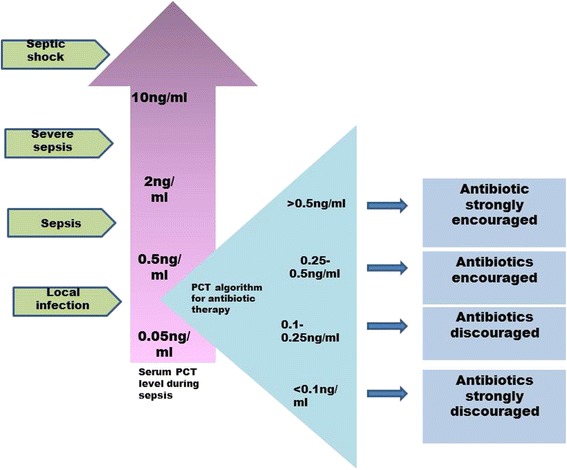
“Antibiotic treatment based on PCT monitoring is a sensitive way of antibiotic usage in ICU patient with severe sepsis and septic shock [52].”
BackgroundThe inflammatory response in sepsis
Bosmann, M., & Ward, P. A. (2013) · Trends in Immunology · doi:10.1016/j.it.2012.09.004 · Cited by 558
New Approaches to Sepsis: Molecular Diagnostics and Biomarkers
Reinhart, K., Bauer, M., Riedemann, N. C., & Hartog, C. S. (2012) · Clinical Microbiology Reviews · doi:10.1128/cmr.00016-12 · Cited by 533
Role of cytokines as a double-edged sword in sepsis.
Chaudhry, H. R., Zhou, J., Yin, Z., Ali, M. M., McGuire, F. R., Nagarkatti, P. S., & Nagarkatti, M. (2013) · PubMed · Cited by 526
Antibiotic Treatment of Exacerbations of COPD
Stolz, D., Christ-Crain, M., Bingisser, R., Leuppi, J., Miedinger, D., Müller, C., Huber, P., Müller, B., & Tamm, M. (2007) · Chest · doi:10.1378/chest.06-1500 · Cited by 521
Sepsis: definition, epidemiology, and diagnosis
Lever, A., & Mackenzie, I. (2007) · BMJ · doi:10.1136/bmj.39346.495880.ae · Cited by 510
Ubiquitous Expression of the Calcitonin-I Gene in Multiple Tissues in Response to Sepsis1
Müller, B., White, J. C., Nylén, E. S., Snider, R. H., Becker, K. L., & Habener, J. F. (2001) · The Journal of Clinical Endocrinology & Metabolism · doi:10.1210/jcem.86.1.7089 · Cited by 440
Müller, B., Harbarth, S., Stolz, D., Bingisser, R., Mueller, C., Leuppi, J., Nusbaumer, C., Tamm, M., & Christ-Crain, M. (2007) · BMC Infectious Diseases · doi:10.1186/1471-2334-7-10 · Cited by 411
Vital signs: improving antibiotic use among hospitalized patients.
Fridkin, S. K., Baggs, J. M., Fagan, R. P., Magill, S. S., Pollack, L. A., Malpiedi, P. J., Slayton, R. B., Khader, K., Rubin, M. A., Jones, M., et al. (2014) · PubMed Central · Cited by 401
Update on Procalcitonin Measurements
Meisner, M. (2014) · Annals of Laboratory Medicine · doi:10.3343/alm.2014.34.4.263 · Cited by 395
Evaluation of a newly identified soluble CD14 subtype as a marker for sepsis
Yaegashi, Y., Sato, N., Suzuki, Y., Kojika, M., Imai, S., Takahashi, G., Miyata, M., Endo, S., Shirakawa, K., & Furusako, S. (2005) · Journal of Infection and Chemotherapy · doi:10.1007/s10156-005-0400-4 · Cited by 319
Pathogenesis of the Viral Hemorrhagic Fevers
Paessler, S., & Walker, D. H. (2013) · Annual Review of Pathology: Mechanisms of Disease · doi:10.1146/annurev-pathol-020712-164041 · Cited by 309
Prkno, A., Wacker, C., Brunkhorst, F. M., & Schlattmann, P. (2013) · Critical Care · doi:10.1186/cc13157 · Cited by 260
The Surviving Sepsis Campaign: raising awareness to reduce mortality.
Slade, E., Tamber, P. S., & Vincent, J. (2003) · Critical Care · doi:10.1186/cc1876 · Cited by 240
Schroeder, S., Hochreiter, M., Koehler, T., Schweiger, A.-M., Bein, B., Keck, F. S., & von Spiegel, T. (2009) · Langenbeck's Archives of Surgery · doi:10.1007/s00423-008-0432-1 · Cited by 238 · cited 1×
“They observed that PCT-based algorithm reduces the use of antibiotic as well as the expense of treatment [49].”
BackgroundPathogenesis of Malaria and Clinically Similar Conditions
Clark, I. A., Alleva, L. M., Mills, A. C., & Cowden, W. B. (2004) · Clinical Microbiology Reviews · doi:10.1128/cmr.17.3.509-539.2004 · Cited by 209
Chirouze, C., Schuhmacher, H., Rabaud, C., Gil, H., Khayat, N., Estavoyer, J., May, T., & Hoen, B. (2002) · Clinical Infectious Diseases · doi:10.1086/341023 · Cited by 205
Immune Cell Phenotype and Function in Sepsis
Rimmelé, T., Payen, D., Cantaluppi, V., Marshall, J., Gomez, H., Gomez, A., Murray, P., & Kellum, J. A. (2016) · Shock · doi:10.1097/shk.0000000000000495 · Cited by 204
Biomarkers for pediatric sepsis and septic shock
Standage, S. W., & Wong, H. R. (2011) · Expert Review of Anti-infective Therapy · doi:10.1586/eri.10.154 · Cited by 198
Liu, D., Su, L., Han, G., Yan, P., & Xie, L. (2015) · PLOS ONE · doi:10.1371/journal.pone.0129450 · Cited by 191
Intensive Care in India: The Indian Intensive Care Case Mix and Practice Patterns Study
Singh, V., Todi, S. K., Sahu, S., Jani, C. K., Kulkarni, A. P., Samaddar, D. P., Amin, P. R., Kapadia, F. N., Mehta, S., Bande, B., et al. (2016) · Indian Journal of Critical Care Medicine · doi:10.4103/0972-5229.180042 · Cited by 186
Procalcitonin versus C-reactive protein: Usefulness as biomarker of sepsis in ICU patient
Nargis, W., Ibrahim, M., & Ahamed, B. U. (2014) · International Journal of Critical Illness and Injury Science · doi:10.4103/2229-5151.141356 · Cited by 176
Accuracy of Presepsin in Sepsis Diagnosis: A Systematic Review and Meta-Analysis
Wu, J., Hu, L., Zhang, G., Wu, F., & He, T. (2015) · PLOS ONE · doi:10.1371/journal.pone.0133057 · Cited by 158
Klouche, K., Cristol, J., Devin, J., Gilles, V., Kuster, N., Larcher, R., Amigues, L., Corne, P., Jonquet, O., & Dupuy, A. (2016) · Annals of Intensive Care · doi:10.1186/s13613-016-0160-6 · Cited by 148
Community Factors in the Development of Antibiotic Resistance
Larson, E. (2006) · Annual Review of Public Health · doi:10.1146/annurev.publhealth.28.021406.144020 · Cited by 139
Calcitonin Biosynthesis: Evidence for a Precursor
Fernando, M. O. Y. A., Nieto, A., & R-Candela, J. L. (1975) · European Journal of Biochemistry · doi:10.1111/j.1432-1033.1975.tb02176.x · Cited by 127
Appropriate antibiotic use and why it is important: the challenges of bacterial resistance
Lieberman, J. M. (2003) · The Pediatric Infectious Disease Journal · doi:10.1097/01.inf.0000101851.57263.63 · Cited by 114
Procalcitonin is a glycoprotein.
Jacobs, J. W., Lund, P. K., Potts, J. T., Bell, N. H., & Habener, J. F. (1981) · Journal of Biological Chemistry · doi:10.1016/s0021-9258(19)69685-7 · Cited by 110
de Guadiana‐Romualdo, L. G., Esteban-Torrella, P., González, M. V., Sánchez, R. J., Hernando‐Holgado, A., Ortín, A., Acebes, S. R., & Otón, M. D. A. (2014) · Clinical Biochemistry · doi:10.1016/j.clinbiochem.2014.02.011 · Cited by 106
Enguix-Armada, A., Escobar-Conesa, R., la Torre, A. G.-D., & de la Torre-Prados, M. V. (2015) · Clinical Chemistry and Laboratory Medicine (CCLM) · doi:10.1515/cclm-2015-0243 · Cited by 96
Lipopolysaccharide binding protein in a surgical intensive care unit: A marker of sepsis?*
Sakr, Y., Burgett, U., Nacul, F. E., Reinhart, K., & Brunkhorst, F. (2008) · Critical Care Medicine · doi:10.1097/ccm.0b013e31817b86e3 · Cited by 89
Evaluation of soluble CD14 subtype (presepsin) in burn sepsis
Madenci, Ö. Ç., Yakupoğlu, S., Benzonana, N., Yücel, N., Akbaba, D., & Orçun, A. (2013) · Burns · doi:10.1016/j.burns.2013.08.024 · Cited by 86
Camussi, G., Mariano, F., Biancone, L., Martino, A. D., Bussolati, B., Montrucchio, G., & Tobias, P. S. (1995) · The Journal of Immunology · doi:10.4049/jimmunol.155.1.316 · Cited by 84
Serum procalcitonin in viral and bacterial meningitis
Abd El-Azim, A., Alkholi, U., Abd Al-monem, N., & Sultan, M. (2011) · Journal of Global Infectious Diseases · doi:10.4103/0974-777x.77290 · Cited by 84
The Epidemiology of Sepsis in General Surgery Patients
Moore, L. J., McKinley, B. A., Turner, K. L., Todd, S., Sucher, J. F., Valdivia, A., Sailors, R. M., Kao, L. S., & Moore, F. A. (2011) · The Journal of Trauma: Injury, Infection, and Critical Care · doi:10.1097/ta.0b013e31820e7803 · Cited by 80
Kip, M. M. A., Kusters, R., IJzerman, M. J., & Steuten, L. (2015) · Journal of Medical Economics · doi:10.3111/13696998.2015.1064934 · Cited by 75
Chen, X.-H., Yin, Y., & Zhang, J. (2011) · World Journal of Emergency Medicine · doi:10.5847/wjem.j.1920-8642.2011.02.002 · Cited by 74
The Future Diagnostic Role of Procalcitonin Levels: The Need for Improved Sensitivity
Nylen, E., Muller, B., Becker, K. L., & Snider, R. (2003) · Clinical Infectious Diseases · doi:10.1086/368088 · Cited by 65
Role of presepsin for the evaluation of sepsis in the emergency department
Pizzolato, E., Ulla, M., Galluzzo, C., Lucchiari, M., Manetta, T., Lupia, E., Mengozzi, G., & Battista, S. (2014) · Clinical Chemistry and Laboratory Medicine (CCLM) · doi:10.1515/cclm-2014-0199 · Cited by 57
Leli, C., Ferranti, M., Marrano, U., Dhahab, Z. S. A., Bozza, S., Cenci, E., & Mencacci, A. (2016) · Journal of Medical Microbiology · doi:10.1099/jmm.0.000278 · Cited by 57
National Cancer Institute (2020) · Definitions · doi:10.32388/91aeaz · Cited by 48
Allison, J., Hall, L. N., MacIntyre, I. M., & CRAIG, R. K. (1981) · Biochemical Journal · doi:10.1042/bj1990725 · Cited by 45
Virulence Factors of Gram-Negative Bacteria in Sepsis with a Focus on Neisseria meningitidis
Livorsi, D. J., Stenehjem, E. A., & Stephens, D. S. (2011) · Contributions to microbiology · doi:10.1159/000324008 · Cited by 43
A Review of the Value of Procalcitonin as a Marker of Infection
Taylor, R. S., Jones, A., Kelly, S., Simpson, M., & Mabey, J. (2017) · Cureus · doi:10.7759/cureus.1148 · Cited by 42
Biomarkers for neonatal sepsis: recent developments
Hendricks‐Muñoz, K. D., Xu, J., & Mally, P. (2014) · Research and Reports in Neonatology · doi:10.2147/rrn.s48316 · Cited by 41
Use of presepsin and procalcitonin for prediction of SeptiFast results in critically ill patients
Mihajlović, D. M., Brkic, S. V., Uvelin, A., Draskovic, B. G., & Vrsajkov, V. (2017) · Journal of Critical Care · doi:10.1016/j.jcrc.2017.04.008 · Cited by 38
Liew, Y. X., Chlebicki, M. P., Lee, W., Hsu, L. Y., & Kwa, A. L. (2011) · European Journal of Clinical Microbiology & Infectious Diseases · doi:10.1007/s10096-011-1165-6 · Cited by 37
Cargnin, S., Jommi, C., Canonico, P. L., Genazzani, A. A., & Terrazzino, S. (2014) · Pharmacogenomics · doi:10.2217/pgs.14.52 · Cited by 33
Ko, Y. H., Ji, Y. S., Park, S.-Y., Kim, S. J., & Song, P. H. (2016) · International braz j urol · doi:10.1590/s1677-5538.ibju.2014.0465 · Cited by 29
Lavrentieva, A., Kontou, P., Soulountsi, V., Kioumis, J., Chrysou, O., & Bitzani, M. (2015) · Europe PMC (PubMed Central) · Cited by 19
Procalcitonin-guided antibiotics in severe sepsis
Simon, P., Milbrandt, E. B., & Emlet, L. L. (2008) · Critical Care · doi:10.1186/cc7124 · Cited by 13
Research works printed but not linked: 2
- Willey J Sherwood L Christopher JW Prescotts’s Microbiol 2011 8 97
- Katherine S Roma LH Proclacitonin: an emerging biomarker of bacterial sepsis Clin Microbiol Newsletter 2001 3 171 178
Cited by
The Pathogenesis of Sepsis and Potential Therapeutic Targets
Huang, M., Cai, S., & Su, J. (2019) · International Journal of Molecular Sciences · doi:10.3390/ijms20215376 · Cited by 776
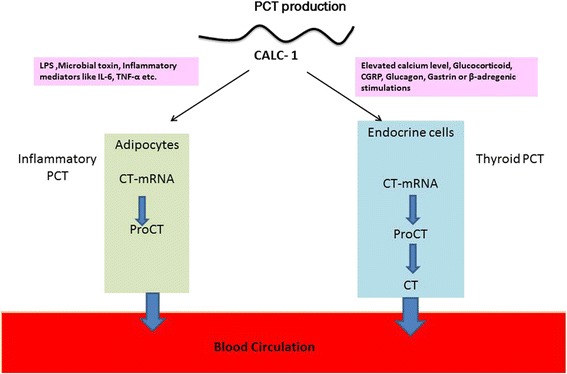
“During sepsis, PCT expression increased significantly within 2 to 6 h and peaked at 6 to 24 h [88].”
BackgroundPredictors of mortality in hospitalized COVID‐19 patients: A systematic review and meta‐analysis
Tian, W., Jiang, W., Yao, J., Nicholson, C. J., Li, R. H., Sigurslid, H. H., Wooster, L., Rotter, J. I., Guo, X., & Malhotra, R. (2020) · Journal of Medical Virology · doi:10.1002/jmv.26050 · Cited by 640
Vaid, A., Somani, S., Russak, A. J., De Freitas, J. K., Chaudhry, F. F., Paranjpe, I., Johnson, K. W., Lee, S. J., Miotto, R., Richter, F., et al. (2020) · Journal of Medical Internet Research · doi:10.2196/24018 · Cited by 228
Liu, X., Yang, X., Li, K., Liu, H., Xiao, R., Wang, W., Wang, C., & Wang, S. (2020) · Sensors and Actuators B Chemical · doi:10.1016/j.snb.2020.128350 · Cited by 171
Role of procalcitonin use in the management of sepsis
Gregoriano, C., Heilmann, E., Molitor, A., & Schuetz, P. (2020) · Journal of Thoracic Disease · doi:10.21037/jtd.2019.11.63 · Cited by 159
Metadata
- Authors
- Vijayan, A. L., Vanimaya, Ravindran, S., Saikant, R., Lakshmi, S., Kartik, R., & G, M.
- Affiliations
- HLL Lifecare (India) (IN)
- Venue
- Journal of Intensive Care
- Published
- 2017-08-03
- Volume
- 5
- Issue
- 1
- Pages
- 51-51
- ISSN
- 2052-0492 (ISSN-L)
- PMC
- PMC5543591
- OpenAlex
- W2744780151
- Cited by
- 477
- References
- 57
- Citations by year
- 2026: 37 · 2025: 47 · 2024: 69 · 2023: 72 · 2022: 79 · 2021: 70 · 2020: 59 · 2019: 29 · 2018: 13 · 2017: 2
- FWCI
- 3.73
- Type
- journal article
- Language
- en
- Open access
- gold
- doi.org
- Licence
- cc-by
- Locations
- Journal of Intensive Care (publishedVersion, cc-by)
- PubMed Central (publishedVersion, cc-by)
- PubMed (publishedVersion)
- DOAJ (DOAJ: Directory of Open Access Journals) (submittedVersion, cc-by-sa)
- Topics
- Health Sciences › Medicine › Critical Care and Intensive Care Medicine › Sepsis Diagnosis and Treatment
- Life Sciences › Immunology and Microbiology › Immunology › Inflammation biomarkers and pathways
- Health Sciences › Medicine › Nephrology › Acute Kidney Injury Research
- Keywords
- procalcitonin, sepsis, sepsis diagnosis, biomarkers, antibiotic stewardship, bacterial infection, C-reactive protein, inflammatory cytokines, pediatric urinary tract infection, secondary inflammation
About these checks
Registry, retraction, Cites and statistics results are computed, not judged, with one exception: a printed reference that no index lists is read once by a model before it counts as a citation error. Claims are extracted by a model and kept only when their quote appears verbatim in the text; each cited source is then checked, with a model’s help, for whether it says what the claim relies on. Those verdicts can be wrong — read the claim’s quote and the cited source before relying on one.
Statistics and arithmetic are recomputed, not judged.
Confidence bands are shown only for fields calibrated on our annotated test set. None is calibrated yet, so no band is shown.
What counts as a claim ›How we measure confidence ›How we check this ›
Are you an author, or do you see a problem with this page? Request a review
Data sources
Bibliographic data: Semantic Scholar, OpenAlex, Crossref.
Contains information from the Semantic Scholar Academic Graph Datasets, made available under the ODC Attribution License (ODC-BY 1.0).
Semantic Scholar’s data is described in: Kinney, R., et al. (2023). The Semantic Scholar Open Data Platform. arXiv:2301.10140.
