

A systematic literature review of personalized learning terms
Open accessThe DOI matches its Crossref record; 86 of the 87 references it cites were found in a registry or an index; 5 of the 33 sources its claims cite were checked for support.
Abstract
Abstract Learning is a natural human activity that is shaped by personal experiences, cognitive awareness, personal bias, opinions, cultural background, and environment. Learning has been defined as a stable and persistent change in what a person knows and can do. Learning is formed through an individual’s interactions, including the conveyance of knowledge and skills from others and experiences. So, learning is a personalized experience that allows one to expand their knowledge, perspective, skills, and understanding. Therefore, personalized learning models can help to meet individual needs and goals. Furthermore, to personalize the learning experience, technology integration can play a crucial role. This paper provides a review of the recent research literature on personalized learning as technology is changing how learning can be effectively personalized. The emphasis is on the terms used to characterize learning as those can suggest a framework for personalized and will eventually be used in meta-analyses of research on personalized learning, which is beyond the scope of this paper.
Overview
CoChat Summary
TL;DR
This systematic review analyzes the terms used for personalized learning—personalized learning, adaptive learning, individualized instruction, and customized learning—and finds no unified definition or agreed-upon set of components. It reports 56 relevant papers from 978 reviewed, with personalized learning (33) and adaptive learning (17) dominating the research literature.
Key findings
- The review found no unified agreement on what components should be included in personalized learning models, and the terms are often used interchangeably; personalized learning and adaptive learning are the most common in research.
- Of the 56 included papers, 33 used personalized learning, 17 used adaptive learning, 3 used individualized instruction, and 3 used customized learning as the main term.
- Individualized instruction was mostly associated with individualized educational plans (IEPs) for students with disabilities, while customized learning was less commonly used in research.
- Personalized learning models generally seek to adapt pace, instructional strategies, content, and activities to learners’ strengths, weaknesses, and interests, giving students control, differentiating instruction, and providing real-time feedback; technology integration is described as crucial.
Methods
- The review adapted Okoli’s eight-step framework for a systematic literature review and used four inclusion phases, ending with a qualitative synthesis of the selected papers.
- Searches covered Scopus, Science Direct, EBSCOhost, IEEE Xplore, JSTOR, and Web of Science, plus top Google Scholar h5-index “Educational Technology” journals; search terms were “personalized learning,” “adaptive learning,” “individualized instruction,” and “customized learning,” limited to 2010–2020, English-language journal articles addressing technology integration.
- The authors report reviewing 978 papers and ending with 56 relevant, high-quality papers; Table 4 reports the final distribution as 33 personalized learning, 17 adaptive learning, 3 individualized instruction, and 3 customized learning.
Limitations
- The paper states that the enormous number of published papers may mean some relevant papers were missed; keyword determination used snowballing, and limited time frame may have caused relevant information or keyword combinations to be overlooked.
- The paper states that selection criteria were limited to journal articles and English-language documents, so pertinent non-English and non-journal articles may not have been included.
- Evident from the text: the authors note they could not conduct a formal meta-analysis because too few published cases reported effect sizes and sample details, suggesting personalized learning in the digital era is still in its infancy; the text also contains some reporting inconsistencies (e.g., 978 papers reviewed versus Table 3’s total initial search of 534 for “personalized learning”).
Model-written summary. Check it against the paper before relying on it.
Integrity signals
Registry
Cites
Statistics
Figures
Verification
Claims the paper makes
5 Valid · 11 Not valid · 20 Not checked · 48 Own results and interpretations
Every source the paper cites for this claim was checked and supports it.
In the paper
“For this review, the guidelines published by Okoli to conducting a systematic literature review for Information Systems Research were adapted (Okoli, 2015).”
§ A systematic literature review of personalized learning terms > Research methodology
What the sources say
- Supportedcites Okoli, 2015 matched to “A Guide to Conducting a Standalone Systematic Literature Review” (2015) source
In the Introduction, Okoli describes the paper as a guide to conducting a systematic literature review tailored to information systems research. That supports identifying it as the guidelines the citing authors say they adapted; their adaptation is their own reported action, not a finding attributed to Okoli. (LLM, conf=0.93)
plain- Asserted: passes — The authors put it forward as true.
- Checkable: passes — It can be checked against evidence.
- Load-bearing: unclear — It is unclear whether the paper’s conclusions depend on it.
- Based: passes — The paper gives a reason why it holds.
- Supported
The cited sources support only part of this claim — read each source’s verdict below.
In the paper
“when it comes to academia, it is mostly adaptive learning and personalized learning being used interchangeably Rastegarmoghadam and Ziarati (2017)”
§ A systematic literature review of personalized learning terms > Discussion
What the sources say
- Partly supportedcites Rastegarmoghadam and Ziarati (2017) matched to “Improved modeling of intelligent tutoring systems using ant colony optimization” (2017) sourceExperimental — accuracy not yet measured
The Introduction says that adaptation to a person is also called personalization and describes an adaptive e-learning system as a personalized system. This supports the conceptual overlap, but the paper does not establish that academics mostly use the terms interchangeably. (LLM, conf=0.84)
plainstates an association- Asserted: passes — The authors put it forward as true.
- Checkable: passes — It can be checked against evidence.
- Load-bearing: unclear — It is unclear whether the paper’s conclusions depend on it.
- Based: passes — The paper gives a reason why it holds.
- Partly supported
A result the paper reports from its own data — it cites no other source for it, so there is none to check. The quote shows it is in the paper.
In the paper
“we found it challenging to find a sufficient number of published cases that reported effect sizes and details of the sample in order to conduct a formal meta-analysis.”
§ A systematic literature review of personalized learning terms > Introduction
plain- Asserted: passes — The authors put it forward as true.
- Checkable: passes — It can be checked against evidence.
- Load-bearing: passes — The paper’s conclusions depend on it.
- Based: passes — The paper gives a reason why it holds.
A result the paper states — it cites no source for it, so there is none to check. The quote shows it is in the paper.
In the paper
“While that outcome now seems achievable, it remains a largely unrealized opportunity according to this research review.”
§ A systematic literature review of personalized learning terms > Introduction
plain- Asserted: passes — The authors put it forward as true.
- Checkable: passes — It can be checked against evidence.
- Load-bearing: passes — The paper’s conclusions depend on it.
- Based: passes — The paper gives a reason why it holds.
- Rests on an assumption not shown here.
A result the paper states — it cites no source for it, so there is none to check. The quote shows it is in the paper.
In the paper
“So many different terms have been used in the replacement of 'personalized learning'.”
§ A systematic literature review of personalized learning terms > Introduction
plain- Asserted: passes — The authors put it forward as true.
- Checkable: passes — It can be checked against evidence.
- Load-bearing: passes — The paper’s conclusions depend on it.
- Based: passes — The paper gives a reason why it holds.
23 more claims
Create a free account to see all 84 claims and every source verdict.
- Probably not a substantial claim. 43
- It may state two separate claims as one. 23
Claims other papers make about this one
Each is checked against this paper’s own text: does it say what the citing paper says it does?
The source backs part of the claim, not all of it — or backs it for a different population, condition or comparison.
In the citing paper
“Personalized learning that aligns educational content with students' career goals could not only enhance engagement and efficiency [1, 5, 6]”
From GPTutor: Great Personalized Tutor with Large Language Models for Personalized Learning Content Generation (2024) · cites this paper as [6]
Experimental — accuracy not yet measured
Self-check
Percentages, sums and reported differences re-computed from the paper’s own numbers.
Rated minor: it would not touch a result — a value no result rests on, a p-value that stays on the same side of the significance level, or a conflict that is clerical, resolved elsewhere in the paper, or outside its own findings.
In the paper
“| TOTAL | 534 | 107 | 38 | 33 |”
§ A systematic literature review of personalized learning terms > Conclusions
Reported 38 · recomputed 39
Citations
Cites
International Journal of Educational Management
(2023) · International Journal of Educational Management · doi:10.1108/ijem · Cited by 2,899
Dewey, J. (2024) · doi:10.55094/holistence.497 · Cited by 1,484 · cited 1×
“…’ s personalized learning theories are inspired by educational philosophy from the progressive era in the previous century, especially John Dewey ’ s (1915, 1998) emphasis on experiential, learner-centered learning, social learning, extension of the curriculum, and fitting for a changing world.”
BackgroundA Guide to Conducting a Standalone Systematic Literature Review
Okoli, C. (2015) · Communications of the Association for Information Systems · doi:10.17705/1cais.03743 · Cited by 1,413 · cited 1×
“For this review, the guidelines published by Okoli to conducting a systematic literature review for Information Systems Research were adapted (Okoli, 2015).”
The design of personal mobile technologies for lifelong learning.
Sharples, M. (2000) · Computers & Education · doi:10.1016/s0360-1315(99)00044-5 · Cited by 1,092 · cited 1×
“It should be tailored to and continuously modified to an individual learner ’ s conditions, abilities, preferences, background knowledge, interests, and goals and adaptable to the learner ’ s evolving skills and knowledge (Sampson, Karagiannidis and Kinshuk, 2002; Sharples, 2000).”
BackgroundMcCombs, B. L., & Whisler, J. S. (1997) · Cited by 972
Education and Information Technologies
(2013) · Education and Information Technologies · doi:10.1007/10639.1573-7608 · Cited by 959
Xie, H., Chu, H.-C., Hwang, G.-J., & Wang, C.-C. (2019) · Computers & Education · doi:10.1016/j.compedu.2019.103599 · Cited by 713 · cited 1×
“Developing learning approaches that build on students ’ current ability and support efficacy beliefs by allowing autonomy with a proper challenge to promote academic attainment (Foshee, Elliott and Atkinson, 2016; Xie et al., 2019).”
BackgroundW2 - Adaptive and Intelligent Web-Based Education Systems
Peylo, C. (2000) · Lecture Notes in Computer Science · doi:10.1007/3-540-45108-0_86 · Cited by 627
(2014) · Educational Technology & Society · Cited by 598
Transforming American Education: Learning Powered by Technology
Peters, M. A., & Araya, D. (2011) · E-Learning and Digital Media · doi:10.2304/elea.2011.8.2.102 · Cited by 585
Research works printed but not linked: 4
- 11. Cavanagh, S. (2014). What is "personalized learning"? Educators seek clarity. Education Week, 34(9), S2-S4.
- 21. Dewey, J. (1998). Experience and education (60th anniversary edn.). West Lafayette: Kappa Delta.
- Ormrod, J. E. (2011). Human learning. London: Pearson Higher.
- 56. Yang, T. C., Hwang, G. J., & Yang, S. J. H. (2013). Development of an adaptive learning system with multiple perspectives based on students' learning styles and cognitive styles. Educational Technology & Society, 16(4), 185-200.
Cited by
Items 101–200 of 534
Sydorenko, T. (2024) · Futurity of Social Sciences. · doi:10.57125/fs.2023.12.20.04 · Cited by 16
Personalisation is not Guaranteed: The Challenges of Using Generative AI for Personalised Learning
Laak, K.-J., Abdelghani, R., & Aru, J. (2024) · Lecture notes in computer science · doi:10.1007/978-3-031-65881-5_5 · Cited by 28
Inclusive Learning and Assessment in the Era of AI
Nayak, R., Yassin, H., Ramesh, G., & Godishala, A. K. (2024) · SN Computer Science · doi:10.1007/s42979-024-03346-7 · Cited by 28
Aryanti, R. D., & Santosa, M. H. (2024) · The Art of Teaching English as a Foreign Language · doi:10.36663/tatefl.v5i1.718 · Cited by 13
Yusuf, A., Mouas, S., Al-khresheh, M. H., & Boudouaia, A. (2025) · Thinking Skills and Creativity · doi:10.1016/j.tsc.2025.101986 · Cited by 15
PERSONALIZED LEARNING THROUGH ADAPTIVE CONTENT MODIFICATION
Er-radi, H., Aammou, S., & Jdidou, A. (2023) · Conhecimento & Diversidade · doi:10.18316/rcd.v15i39.11153 · Cited by 12
ChatGPT in Higher Education: Design Teaching Model Involving ChatGPT
An, Y., Ouyang, W., & Fu, Z. (2023) · Lecture Notes in Education Psychology and Public Media · doi:10.54254/2753-7048/24/20230560 · Cited by 25
Dixit, A. S., & Jatav, S. (2024) · Journal of Management Development · doi:10.1108/jmd-01-2024-0009 · Cited by 28
Ghassoul, A., & Messaadia, M. (2023) · International Conference on Cyber Management and Engineering (CyMaEn) · doi:10.1109/cymaen57228.2023.10050941 · Cited by 24
“It is considered an “umbrella” term for discovering a set of digital technologies [6], [7].”
BackgroundTretow-Fish, T. A. B., & Khalid, M. S. (2023) · The Electronic Journal of e-Learning · doi:10.34190/ejel.21.5.3088 · Cited by 27
“While terms such as personalized learning, individualized learning, intelligent tutoring, and customized learning are sometimes used interchangeably, adaptive learning is the most used term (Shemshack and Spector, 2020).”
BackgroundEmpowering Teachers With Generative AI Tools and Support
Sipahioğlu, M. (2024) · Advances in educational technologies and instructional design book series · doi:10.4018/979-8-3693-1351-0.ch011 · Cited by 14
Personality psychology is getting personal: Advancing the field through personalization
Modersitzki, N., Phan, L. V., McDonald, S., Wright, A. G. C., & Renner, K. (2025) · European Journal of Personality · doi:10.1177/08902070251316915 · Cited by 19
“…lacks a clear and generally agreed-upon de fi nition due to its broad application encompassing a wide and multifaceted array of approaches (Bernacki et al., 2021; Chandra et al., 2022; Erikainen & Chan, 2019; Pokorska-Bocci et al., 2014; Shemshack & Spector, 2020; Vesanen, 2007; Zhang et al., 2020).”
Multi-Agentic LLMs for Personalizing STEM Texts
Vaccaro, M., Friday, M., & Zaghi, A. E. (2025) · Applied Sciences · doi:10.3390/app15137579 · Cited by 24
Bibliometric analysis and systematic literature review of the intelligent tutoring systems
Cuéllar-Rojas, O.-A., Hincapié, M., Contero, M., & Castorena, D. G. (2022) · Frontiers in Education · doi:10.3389/feduc.2022.1047853 · Cited by 25
“This learning process involves students using the aforementioned metacognitive process to evaluate their learning outcomes (Schildkamp et al., 2020; Shemshack and Spector, 2020).”
BackgroundChatGPT-4o for English language teaching and learning: Features, applications, and future prospectsPreprint
Pang, S., Nol, E., & Heng, K. (2024) · SSRN Electronic Journal · doi:10.2139/ssrn.4837988 · Cited by 11
Carreon, A., Mosher, M. A., Goldman, S. R., Smith, S. J., & Smith, B. (2025) · Journal of Special Education Technology · doi:10.1177/01626434251349414 · Cited by 13
“Personalized learning supports, increasingly possible through digital tools and solutions, often tailor educational experiences to meet the unique needs, preferences, and learning requirements of a student with speci fi c disabilities (Shemshack & Spector, 2020).”
Adaptive and Personalized Learning in Higher Education: An Artificial Intelligence-Based Approach
Hernández-Herrera, J. R., Ortiz-Bejar, J., & Ortiz-Bejar, J. (2026) · Education Sciences · doi:10.3390/educsci16010109 · Cited by 30
Do educational interventions reduce the gender gap in communication skills?- a systematic review
Driscoll, A. M., Suresh, R., Popa, G., Berglund, L., Azer, A., Hed, H. M. E., Duan, Y., Chu, A., & McGrath, A. M. (2024) · BMC Medical Education · doi:10.1186/s12909-024-05773-9 · Cited by 20
Toward an adaptive learning assessment pathway
Machkour, M., Jihaoui, M. E., Lamalif, L., Faris, S., & Mansouri, K. (2025) · Frontiers in Education · doi:10.3389/feduc.2025.1498233 · Cited by 21
Using ExamView to Create Questionnaires for Online Evaluation in VLEs
López-Chila, R., Llerena-Izquierdo, J., & Nacipucha, N. A. S. (2021) · International Conference on Information Systems and Software Technologies (ICI2ST) · doi:10.1109/ici2st51859.2021.00009 · Cited by 12
“Another environment which has been strengthened by VLEs is the Personal Learning Environment (PLE) [39],[40],[41], with either open or restricted access [42],[43],[44], in which a student pursues his or her own personal learning interests, [45],[46].”
BackgroundA duplex adaptation mechanism in the personalized learning environment
Wongwatkit, C., & Panjaburee, P. (2023) · Journal of Computers in Education · doi:10.1007/s40692-023-00292-w · Cited by 15
Aprendizaje adaptativo basado en Simuladores de Realidad Virtual
Vega, A. V., Madrigal, O. C., & Kugurakova, V. V. (2021) · Revista Cubana de Ciencias Informáticas · Cited by 43
Leveraging Generative Artificial Intelligence to Expedite UDL Implementation in Online Courses
Morgan, A. (2024) · Advances in educational technologies and instructional design book series · doi:10.4018/979-8-3693-1269-8.ch009 · Cited by 13
A Generative Artificial Intelligence Based Tutor for Personalized Learning
Bondé, L. (2024) · IEEE SmartBlock4Africa · doi:10.1109/smartblock4africa61928.2024.10779525 · Cited by 16
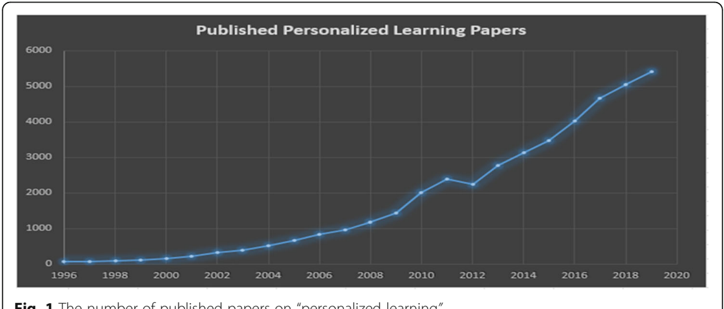
“A study conducted by Shemshack & Spector reveals that since 2008 there has been a significant increase in research and publications on personalized learning [6].”
Enhancing Learning Experiences Through Artificial Intelligence: Classroom 5.0
Coelho, L. P., & Reis, S. S. (2023) · Advances in higher education and professional development book series · doi:10.4018/978-1-6684-8656-6.ch008 · Cited by 11
Personalized Distillation: Empowering Open-Sourced LLMs with Adaptive Learning for Code Generation
Chen, H., Saha, A., Hoi, S. C. H., & Joty, S. (2023) · Conference on Empirical Methods in Natural Language Processing (EMNLP) · doi:10.18653/v1/2023.emnlp-main.417 · Cited by 38
Creating Inclusive Learning Environments
Singha, S. (2024) · Advances in educational technologies and instructional design book series · doi:10.4018/979-8-3693-0563-8.ch002 · Cited by 10
Faresta, R. A. (2024) · Path of Science · doi:10.22178/pos.104-19 · Cited by 36
Smart Campus and Student Learning Engagement
Chen, S., Li, Q., & Wang, T. (2024) · International Journal of Information and Communication Technology Education · doi:10.4018/ijicte.337611 · Cited by 9
Use of Generative AI Tools to Facilitate Personalized Learning in the Flipped Classroom
Zhen, H., & Yahaya, W. A. J. W. (2024) · Advances in educational technologies and instructional design book series · doi:10.4018/979-8-3693-1351-0.ch016 · Cited by 11
Using Generative AI to Promote the APA's Five Goals for Undergraduate Majors
Fortner, M., & Katzarska-Miller, I. I. (2024) · Teaching of Psychology · doi:10.1177/00986283241264793 · Cited by 9
“However, technological tools have long been recognized for their potential to scale personalized approaches (Huang & Shiu, 2012; Redding, 2014; Shemshack & Spector, 2020).”
Does personalization really help in improving learning achievement? A meta-analysis
Tlili, A., Salha, S. H., Wang, H., Huang, R., Rudolph, J., & Weidong, R. (2024) · IEEE International Conference on Advanced Learning Technologies (ICALT) · doi:10.1109/icalt61570.2024.00011 · Cited by 12
The Impact of Generative Artificial Intelligence on Education: A Comparative Study
Elmourabit, Z., Retbi, A., & Faddouli, N.-E. E. (2024) · European Conference on e-Learning · doi:10.34190/ecel.23.1.2975 · Cited by 21
“Effective content generation in education requires an understanding of the subject matter (Shemshack et al, 2020), pedagogical best practices, and diverse student learning styles.”
BackgroundWhy People Use Metaverse Education for Learning: An Extended Perspective of Task-Technology Fit
Zhang, G., Ali, J., Kim, D. W., Kim, S., & Kim, J. (2025) · International Journal of Technology and Human Interaction · doi:10.4018/ijthi.368805 · Cited by 13
“…learning systems typically use technology to enhance access to quality learning experiences for all learners, support educators in effective implementation practices, and enhance school-level technology infrastructure (e.g., digital platforms and online data systems) (Shemshack & Spector, 2020).”
Gao, L., Jong, M. S., Chai, C. S., & Li, K. (2025) · Computers & Education · doi:10.1016/j.compedu.2025.105504 · Cited by 19
Wang, J., Tigelaar, D. E. H., Ye, T., & Admiraal, W. (2025) · Journal of Computer Assisted Learning · doi:10.1002/jcal.70168 · Cited by 20
Mahdiannur, M. A., Erman, E., Martini, M., Nurita, T., & Rosdiana, L. (2022) · JURNAL TARBIYAH · doi:10.30829/tar.v29i2.1812 · Cited by 22
Optimal Knowledge Component Extracting Model for Knowledge-Concept Graph Completion in Education
Choi, H., Lee, H., & Lee, M.-J. (2023) · IEEE Access · doi:10.1109/access.2023.3244614 · Cited by 12
“In online learning environments, including MOOC platforms, The associate editor coordinating the review of this manuscript and approving it for publication was Tony Thomas. personalization of learning with computing technology may be considered [3], [4].”
BackgroundRonksley‐Pavia, M. (2023) · The Curriculum Journal · doi:10.1002/curj.235 · Cited by 11
Wanniarachchi, W., & Premadasa, H. K. S. (2024) · Asian Journal of Research in Computer Science · doi:10.9734/ajrcos/2024/v17i3422 · Cited by 11
Milić, T., Tomić, B., Marinković, S., & Jeremić, V. (2024) · The International Journal of Management Education · doi:10.1016/j.ijme.2024.101022 · Cited by 8
Fernández, R. G., Calderón-Garrido, D., & Piñol, C. M. (2023) · Revista de Educación a Distancia (RED) · doi:10.6018/red.526311 · Cited by 14
“Shemshack & Spector (2020) insightfully examined how personalised learning models mediated by technology – including social networks – helped to enhance knowledge, perspectives, skills and understanding in a way that satisfies individual needs.”
BackgroundNivTA: Towards a Naturally Interactable Edu-Metaverse Teaching Assistant for CAVE
Jia, Y., Sin, Z. P. T., Wang, X. E., Li, C., Ng, P. H. F., Huang, X. X., Dong, J., Wang, Y., Baciu, G., Cao, J., et al. (2024) · IEEE International Conference on Metaverse Computing, Networking and Applications (MetaCom) · doi:10.1109/metacom62920.2024.00023 · Cited by 10
“CL [19] and PL [20] are pedagogies that have been gaining traction in educational methodology research in recent years.”
BackgroundZhang, L., Carter, R. A., Bernacki, M. L., & Greene, J. A. (2024) · Exceptionality · doi:10.1080/09362835.2024.2446219 · Cited by 10
“It is worth noting that there are other terms used to describe personalization, such as adaptive learning, customized instruction, and blended instruction (Shemshack & Spector, 2020).”
Overcoming barriers: the potential of AI digital textbooks in multicultural middle school education
Elliott, R., & Kim, B. L. (2025) · Multicultural Education Review · doi:10.1080/2005615x.2025.2467765 · Cited by 11
“This criterion analysed AIDT’s ability to personalize learning experiences to meet the diverse needs of multicultural students (Lindner et al., 2019; Shemshack & Spector, 2020).”
Generative AI as a Tool for Personalized STEAM K-12 Education
Bougdira, A., & Murshidi, G. H. A. (2025) · Advances in computational intelligence and robotics book series · doi:10.4018/979-8-3693-7332-3.ch023 · Cited by 12
Chavez, O. J. F., & Palaoag, T. D. (2025) · The TQM Journal · doi:10.1108/tqm-09-2024-0359 · Cited by 16
Artificial Intelligence in Education: An Alternative to Traditional Learning
Devasena, R. (2024) · Journal of English Language Teaching · doi:10.66121/45wnfw13 · Cited by 30
Explorar los matices: aprendizaje personalizado y adaptativo en la educación digital
Vázquez, L. E., & Perales, J. N. (2024) · Revista Digital Universitaria · doi:10.22201/cuaieed.16076079e.2024.25.1.10 · Cited by 29
Integrating AI in Higher Education: Applications, Strategies, Ethical Considerations
Daraai, S. B. A., Maqrashi, M. A., Zakwani, M. A., & Shaikh, Z. A. (2024) · Advances in educational technologies and instructional design book series · doi:10.4018/979-8-3693-2145-4.ch008 · Cited by 10
Islam, M. T., Kumar, J., Konar, R., Amin, M., Ragavan, N. A., & Çobanoğlu, C. (2026) · Journal of Teaching in Travel & Tourism · doi:10.1080/15313220.2025.2611279 · Cited by 7
“Bhutoria (2022) and Shemshack and Spector (2020) highlighted how these systems enhance learner outcomes by aligning instruction with individual needs, fostering more profound understanding, and sustaining motivation.”
Halder, D., & Panda, S. (2026) · Smart Learning Environments · doi:10.1186/s40561-025-00428-8 · Cited by 16
“PL is not a new concept; for the past decades, it has been used by instructional designers and teachers for apprenticeship training and mentoring (Shemshack & Spector, 2020), increasing motivation (Jones et al., 2013), learner empowerment, and developing positive attitudes to learning (Higgins et…”
Konstantinidou, A., Nisiforou, E. A., & Vrasidas, C. (2026) · Interactive Learning Environments · doi:10.1080/10494820.2026.2619907 · Cited by 19
Khalifeh, F., Campión, R. S., & Palau, R. (2026) · Smart Learning Environments · doi:10.1186/s40561-026-00440-6 · Cited by 39
“…learning as the primary term, definitions converged on tailoring content, pacing, and support to individual learner needs, characteristics, and goals, consistently framing PL as learner-centered, goal-oriented, and flexible rather than uniform (Bernacki et al., 2021; Shemshack & Spector, 2020).”
InfluentialThe Effects of Video Lecture Design on Learners in Online Learning: A Systematic Review
Wang, T., Du, Z., & Liu, J. (2023) · Journal of Information & Knowledge Management · doi:10.1142/s0219649223500521 · Cited by 9
Equilibrio entre la privacidad y la ética en el uso de la inteligencia artificial en la educación
Peña, J. M., Moreno, O. B., Herrera, Á. L. O., & Moreno, T. (2024) · Sapiens International Multidisciplinary Journal · doi:10.71068/m4gqp119 · Cited by 6
Malykhin, O. V., Арістова, Н., & Melikova, S. (2023) · Environment Technology Resources Proceedings of the International Scientific and Practical Conference · doi:10.17770/etr2023vol2.7274 · Cited by 6
“The analysis of the relevant literature demonstrates that in order to meet interests, needs and preferences of students of different ages and to turn them into active and responsible lifelong learners, teachers should enhance their teaching with individualized instruction [14] – [18].”
BackgroundVanbecelaere, S., Schoors, R. V., Bhatt, S., Rajagopal, K., Debeer, D., & Depaepe, F. (2023) · Education and Information Technologies · doi:10.1007/s10639-023-11931-1 · Cited by 7
“As a consequence of the increased interest in DPL the term is often used in educational research literature, although the definitions of the term are rather ambiguous (Shemshack & Spector, 2020; Van Schoors et al., 2021).”
Enhancing EFL Learner Autonomy through Project-Based Learning: The Case of Secondary School Students
Khoudri, I., Khoudri, A., & Zeriouh, M. (2023) · Journal of English Language Teaching and Linguistics · doi:10.21462/jeltl.v8i3.1199 · Cited by 15
Higher Order Thinking Skills (HOTS) - Oriented Learning in Geography Learning
Yani, A., & Mulyadi, A. (2022) · JURNAL PENDIDIKAN ILMU SOSIAL · doi:10.17509/jpis.v31i1.47407 · Cited by 6
“(Shemshack and Spector, 2020) in his book Learning, Creating, and using Knowledge provides guidelines for the application of meaningful learning models.”
BackgroundUsing the digital platform in personalized student learning
Ospankulov, E., Abdigapbarova, U. M., Rakhimzhanova, L., Issabayeva, D., NAZARBEKOVA, K. T., & Issabayeva, Z. (2022) · International Conference on Frontiers of Educational Technologies (ICFET) · doi:10.1145/3545862.3545895 · Cited by 12
“The review of the recent research literature on personalized learning [14] showed that the emphasis is on the terms used to”
BackgroundAn approach to dealing with incremental concept drift in personalized learning systems
Allogmany, B., & Josyula, D. P. (2022) · IEEE International Conference on Cognitive Machine Intelligence (CogMI) · doi:10.1109/cogmi56440.2022.00029 · Cited by 10
“Number of papers in the field of personalized learning that have been published [14].”
BackgroundPrecision Education for Personalized Learning
Reid, J. R. (2023) · Journal of the American College of Radiology · doi:10.1016/j.jacr.2023.05.018 · Cited by 10
Estimating Unknown English Words From User Smartphone Reading Behaviors
Higashimura, R., Watanabe, K., Vargo, A. W., Iwata, M., Dengel, A. R., & Kise, K. (2024) · IEEE Access · doi:10.1109/access.2024.3457510 · Cited by 7
“Moreover, smartphone applications can adapt their services to individual learners, making language learning more efficient [8], [9], [10].”
BackgroundCappelli, M. A., & Akkari, A. (2024) · Education and Information Technologies · doi:10.1007/s10639-024-13200-1 · Cited by 10
“In contrast, “personalisation” means modifying or adapting a course to suit the individual’s conditions, skills, preferences, prior knowledge, interests, and objectives, and also adapting it as the learner’s skills and knowledge evolve (Sampson & Karagiannidis, 2002; Shemshack & Spector, 2020).”
Nyagope, T. S. (2024) · EDUCATIO Journal of Education · doi:10.29138/educatio.v9i1.1429 · Cited by 10
Microlearning as an Educational Technology: Information Requests and Bibliometric Analysis
Kuzminska, O. H., Морзе, Н., & Smyrnova‐Trybulska, E. (2022) · Springer eBooks · doi:10.1007/978-3-031-13359-6_2 · Cited by 5
Orbach, L., Fritz, A., Haase, V. G., Dowker, A., & Räsänen, P. (2023) · Frontiers in Education · doi:10.3389/feduc.2023.1083074 · Cited by 16
“org sufficient findings on their effectiveness, as the application of these technologies is still in its infancy (Shemshack and Spector, 2020).”
BackgroundBondie, R. S. (2023) · Online Learning · doi:10.24059/olj.v27i4.4018 · Cited by 7
Qiu, L., & Wang, L. (2024) · IEEE Transactions on Education · doi:10.1109/te.2024.3448532 · Cited by 15
Smart Recommendation System in E-Learning Using Machine Learning and Data Analytics
Dey, A., Ganguly, A., Banik, I. R., Bhuiya, S., Sengupta, S., & Das, R. (2025) · SN Computer Science · doi:10.1007/s42979-025-04249-x · Cited by 9
“Article [18] explores personalised learning research from various perspectives.”
Reconsidering learning in a socio-material world. A response to Fischer et al.'s contribution
Pargman, T. C. (2022) · International Journal of Information and Learning Technology · doi:10.1108/ijilt-07-2022-0143 · Cited by 8
Wang, L., & Nie, Z. (2023) · International Conference on Computer Science and Technologies in Education (CSTE) · doi:10.1109/cste59648.2023.00059 · Cited by 9
Kuzminov, I., Вохмин, А. А., Sharaeva, K., Likhanov, M. V., Markovnikova, A., Lyamin, A. V., & Kurushkin, M. (2023) · Journal of Chemical Education · doi:10.1021/acs.jchemed.3c00138 · Cited by 7
Towards inclusive teaching and learning practices: A guideline for commerce academics
Musundwa, S. (2024) · doi:10.4102/aosis.2024.bk454.07 · Cited by 5
Sachete, A. D. S., Gomes, R. S., Filho, A. B. D. C., et al. (2024) · RELATEC Revista Latinoamericana de Tecnología Educativa · doi:10.17398/1695-288x.23.2.69 · Cited by 5
“…adaptive learning are more concerned with describing the tools used to adapt learning (Fontaine et al., 2017; Zawacki - Richter et al., 2019; Martin et al., 2020 ; Li et al., 2021; Shemshack and Spector, 2020), than to uncover the set of learning indicators necessary for adaptive learning to occur.”
MethodArtificial Intelligence for Personalized Learning in K-12 Education. A Scoping Review
Pitrella, V., Perna, S., Allegra, M., Gentile, M., Ottaviano, S., Re, A., Tosto, C., & Città, G. (2024) · Communications in computer and information science · doi:10.1007/978-3-031-67351-1_25 · Cited by 9
Evaluating Learning Analytics of Adaptive Learning Systems: A Work in Progress Systematic Review
Tretow-Fish, T. A. B., & Khalid, M. S. (2022) · Lecture notes of the Institute for Computer Sciences, Social Informatics and Telecommunications Engineering · doi:10.1007/978-3-031-06675-7_3 · Cited by 8
Ouahi, M., Khoulji, S., & Kerkeb, M. L. (2024) · E3S Web of Conferences · doi:10.1051/e3sconf/202447700098 · Cited by 12
Tu, Y., Guo, X.-G., Fang, J.-W., Meng, X.-P., & Hwang, G. (2025) · Educational Technology Research and Development · doi:10.1007/s11423-025-10579-7 · Cited by 9
Ruzimboev, K. R., Avezmatov, I. D., & Shermatov, B. I. (2025) · International Conference on Computer Science and Engineering (UBMK) · doi:10.1109/ubmk67458.2025.11242231 · Cited by 6
“…of adaptation but carries it a step further with the consideration of a more integrative view of the student, recognizing the significant impact of variables like background experience, learning styles, and emotional-social context upon the method of presenting the teaching content [11][12].”
Fostering Learner Autonomy in AI-Mediated Language Learning Environments: A Review of Literature
YEŞİL, Ş. (2026) · Elt research journal · doi:10.71362/eltrj.1817405 · Cited by 6
Design and Development of a Chatbot for Personalized Learning in Higher Education
Algabri, H. K., Kamat, R. K., Kharade, K. G., & Muppalaneni, N. B. (2023) · Lecture notes in electrical engineering · doi:10.1007/978-981-99-6690-5_22 · Cited by 8
Intelligent Tutoring Systems: A Review
Hajjioui, Y., Zine, O., Benslimane, M., & Ibriz, A. (2024) · Lecture notes in networks and systems · doi:10.1007/978-3-031-74491-4_50 · Cited by 12
Hu, S., Ke, F., Vyortkina, D., Hu, P., Luby, S., & O’Shea, J. (2025) · Higher education · doi:10.1007/978-3-031-58698-9_13 · Cited by 8
ProgMate: An Intelligent Programming Assistant Based on LLM
Li, Y., Yang, R., Zhang, X., Shi, P. J., Yang, D., & Huang, X. (2024) · IEEE Frontiers in Education Conference (FIE) · doi:10.1109/fie61694.2024.10893312 · Cited by 8
Generative pre-trained transformers: ‘Ctrl+alt+create’ or ‘ctrl+alt+delete’ for IT education?
Abaddi, S. (2025) · Journal of Ethics in Entrepreneurship and Technology · doi:10.1108/jeet-12-2024-0047 · Cited by 8
Personalized Learning Path Recommendation Strategy Based on Subject Knowledge Graph
Zhao, S. (2024) · doi:10.1145/3722237.3722306 · Cited by 7
“Also, these methods may struggle to keep up with how fast consciousness changes, resulting in tips that don’t fulfil learners’ needs [ 4 ] .”
Shaikh, S. N., Sohu, J. M., Kherazi, F. Z., Qasim, S., Soomro, S., & Junejo, I. (2025) · Advances in computational intelligence and robotics book series · doi:10.4018/979-8-3693-8669-9.ch002 · Cited by 16
Liu, X., Shen, P., Xu, X., Ling, M., Ni, J., Lin, G., & Jiao, F. (2025) · Education and Information Technologies · doi:10.1007/s10639-025-13626-1 · Cited by 6
“The personalized learning theory emphasizes respect for the individual differences of students (Shemshack & Spector, 2020).”
Li, J. (2025) · International Journal of Knowledge Management · doi:10.4018/ijkm.385732 · Cited by 6
Choi, H., & Lee, M.-J. (2022) · Journal of Digital Contents Society · doi:10.9728/dcs.2022.23.6.1131 · Cited by 5
Gutiérrez-Aguilar, O., Aplugi, G., Ticona-Apaza, V., Calderón-Chávez, E. L., & Huanca, S. C. (2024) · Lecture notes in networks and systems · doi:10.1007/978-3-031-54256-5_35 · Cited by 5
Technologies and Innovations in the Educational Process: Experience of the University of the Future
Shabunina, V., Labenko, O., Horbachenko, A., Tsuprun, T., & Sydorenko, O. A. (2024) · Futurity Education · doi:10.57125/fed.2024.09.25.09 · Cited by 5
“Personalized learning was found to be one of the important components of efficient educational process (Shemshack & Spector, 2020).”
BackgroundEffects of Meaningful Choices in Serious Games for Meaningful Learning
Wong, Y.-L. R., Bothma, T., & Smith, A. (2024) · International Journal of Serious Games · doi:10.17083/ijsg.v11i3.745 · Cited by 11
Hu, S., Ke, F., Vyortkina, D., Hu, P., Luby, S., & O’Shea, J. (2024) · Higher education · doi:10.1007/978-3-031-51930-7_13-1 · Cited by 19
Artificial Intelligence in Education: Foundations, Trends, and Implications
Çela, E., Fonkam, M. M., Vajjhala, N. R., & Vedishchev, A. (2024) · Advances in educational technologies and instructional design book series · doi:10.4018/979-8-3693-7220-3.ch001 · Cited by 6
Hu, S., Ke, F., Vyortkina, D., Hu, P., Luby, S., & O’Shea, J. (2024) · Higher education · doi:10.1007/978-3-031-51930-7_13-2 · Cited by 5
Mehta, P. S., Doshi, S. T., Butle, S. N., Inamdar, S. C., & Shinde, S. D. (2025) · IGI Global eBooks · doi:10.4018/979-8-3693-6705-6.ch005 · Cited by 6
Question-Type Identification for Academic Questions in Online Learning Platform
Rabiee, A., Goel, A., D'Souza, J., & Khanwalkar, S. (2023) · International Conference on Signal, Image Processing and Multimedia (SIPM) · doi:10.5121/csit.2023.130922 · Cited by 4
Metadata
- Authors
- Shemshack, A., & Spector, J. M.
- Affiliations
- University of North Texas (US)
- Corresponding author
- Shemshack, Atikah
- Venue
- Smart Learning Environments
- Published
- 2020-10-23
- Volume
- 7
- Issue
- 1
- ISSN
- 2196-7091 (ISSN-L)
- OpenAlex
- W3093893125
- Semantic Scholar
- 305cab4fc3b72411132f87d3790b0469319b8824
- Cited by
- 740
- References
- 87
- Citations by year
- 2026: 147 · 2025: 205 · 2024: 233 · 2023: 96 · 2022: 45 · 2021: 11 · 2020: 1
- FWCI
- 6.74
- Type
- journal article
- Language
- en
- Open access
- gold
- doi.org
- Licence
- cc-by
- creativecommons.org/licenses/by/4.0 (tdm)
- creativecommons.org/licenses/by/4.0 (vor)
- Locations
- Smart Learning Environments (publishedVersion, cc-by)
- University of North Texas Digital Library (University of North Texas) (submittedVersion)
- DOAJ (DOAJ: Directory of Open Access Journals) (submittedVersion, cc-by-sa)
- Topics
- Social Sciences › Psychology › Developmental and Educational Psychology › Learning Styles and Cognitive Differences
- Social Sciences › Psychology › Developmental and Educational Psychology › Innovative Teaching and Learning Methods
- Physical Sciences › Computer Science › Artificial Intelligence › Intelligent Tutoring Systems and Adaptive Learning
- Keywords
- personalized learning, definition of learning, technology integration in learning, learning framework
About these checks
Registry, retraction, Cites and statistics results are computed, not judged, with one exception: a printed reference that no index lists is read once by a model before it counts as a citation error. Claims are extracted by a model and kept only when their quote appears verbatim in the text; each cited source is then checked, with a model’s help, for whether it says what the claim relies on. Those verdicts can be wrong — read the claim’s quote and the cited source before relying on one.
The claim verdicts this report counts are experimental: their accuracy is not yet measured.
A language model drew the claims from the paper on 2026-10-10, under version 3 of the claim definition (model deepseek-v4.1-flash, prompt extract-v3).
A second model labelled each claim on 2026-10-10 (model jev-1.13-20260917, definition revision gold-guideline-v0.2).
Cited sources are checked with a language model’s help (gpt-6-sol).
Statistics and arithmetic are recomputed, not judged.
Confidence bands are shown only for fields calibrated on our annotated test set. None is calibrated yet, so no band is shown.
What counts as a claim ›How we measure confidence ›How we check this ›
Are you an author, or do you see a problem with this page? Request a review
Data sources
Bibliographic data: Semantic Scholar, OpenAlex, Crossref.
Contains information from the Semantic Scholar Academic Graph Datasets, made available under the ODC Attribution License (ODC-BY 1.0).
Semantic Scholar’s data is described in: Kinney, R., et al. (2023). The Semantic Scholar Open Data Platform. arXiv:2301.10140.
