

A systematic literature review of personalized learning terms
Open accessThe DOI matches its Crossref record; 86 of the 87 references it cites were found in a registry or an index; 5 of the 33 sources its claims cite were checked for support.
Abstract
Abstract Learning is a natural human activity that is shaped by personal experiences, cognitive awareness, personal bias, opinions, cultural background, and environment. Learning has been defined as a stable and persistent change in what a person knows and can do. Learning is formed through an individual’s interactions, including the conveyance of knowledge and skills from others and experiences. So, learning is a personalized experience that allows one to expand their knowledge, perspective, skills, and understanding. Therefore, personalized learning models can help to meet individual needs and goals. Furthermore, to personalize the learning experience, technology integration can play a crucial role. This paper provides a review of the recent research literature on personalized learning as technology is changing how learning can be effectively personalized. The emphasis is on the terms used to characterize learning as those can suggest a framework for personalized and will eventually be used in meta-analyses of research on personalized learning, which is beyond the scope of this paper.
Overview
CoChat Summary
TL;DR
This systematic review analyzes the terms used for personalized learning—personalized learning, adaptive learning, individualized instruction, and customized learning—and finds no unified definition or agreed-upon set of components. It reports 56 relevant papers from 978 reviewed, with personalized learning (33) and adaptive learning (17) dominating the research literature.
Key findings
- The review found no unified agreement on what components should be included in personalized learning models, and the terms are often used interchangeably; personalized learning and adaptive learning are the most common in research.
- Of the 56 included papers, 33 used personalized learning, 17 used adaptive learning, 3 used individualized instruction, and 3 used customized learning as the main term.
- Individualized instruction was mostly associated with individualized educational plans (IEPs) for students with disabilities, while customized learning was less commonly used in research.
- Personalized learning models generally seek to adapt pace, instructional strategies, content, and activities to learners’ strengths, weaknesses, and interests, giving students control, differentiating instruction, and providing real-time feedback; technology integration is described as crucial.
Methods
- The review adapted Okoli’s eight-step framework for a systematic literature review and used four inclusion phases, ending with a qualitative synthesis of the selected papers.
- Searches covered Scopus, Science Direct, EBSCOhost, IEEE Xplore, JSTOR, and Web of Science, plus top Google Scholar h5-index “Educational Technology” journals; search terms were “personalized learning,” “adaptive learning,” “individualized instruction,” and “customized learning,” limited to 2010–2020, English-language journal articles addressing technology integration.
- The authors report reviewing 978 papers and ending with 56 relevant, high-quality papers; Table 4 reports the final distribution as 33 personalized learning, 17 adaptive learning, 3 individualized instruction, and 3 customized learning.
Limitations
- The paper states that the enormous number of published papers may mean some relevant papers were missed; keyword determination used snowballing, and limited time frame may have caused relevant information or keyword combinations to be overlooked.
- The paper states that selection criteria were limited to journal articles and English-language documents, so pertinent non-English and non-journal articles may not have been included.
- Evident from the text: the authors note they could not conduct a formal meta-analysis because too few published cases reported effect sizes and sample details, suggesting personalized learning in the digital era is still in its infancy; the text also contains some reporting inconsistencies (e.g., 978 papers reviewed versus Table 3’s total initial search of 534 for “personalized learning”).
Model-written summary. Check it against the paper before relying on it.
Integrity signals
Registry
Cites
Statistics
Figures
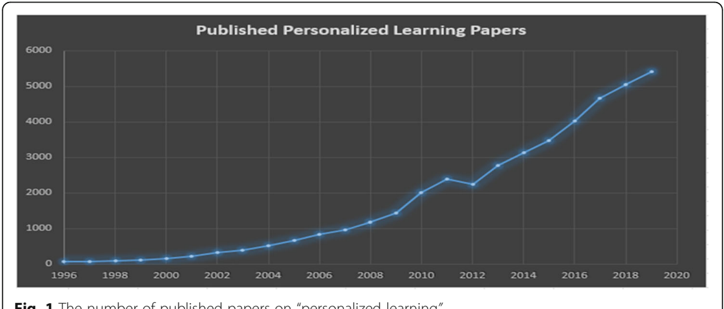
Verification
Claims the paper makes
5 Valid · 11 Not valid · 20 Not checked · 48 Own results and interpretations
Every source the paper cites for this claim was checked and supports it.
In the paper
“For this review, the guidelines published by Okoli to conducting a systematic literature review for Information Systems Research were adapted (Okoli, 2015).”
§ A systematic literature review of personalized learning terms > Research methodology
What the sources say
- Supportedcites Okoli, 2015 matched to “A Guide to Conducting a Standalone Systematic Literature Review” (2015) source
In the Introduction, Okoli describes the paper as a guide to conducting a systematic literature review tailored to information systems research. That supports identifying it as the guidelines the citing authors say they adapted; their adaptation is their own reported action, not a finding attributed to Okoli. (LLM, conf=0.93)
plain- Asserted: passes — The authors put it forward as true.
- Checkable: passes — It can be checked against evidence.
- Load-bearing: unclear — It is unclear whether the paper’s conclusions depend on it.
- Based: passes — The paper gives a reason why it holds.
- Supported
The cited sources support only part of this claim — read each source’s verdict below.
In the paper
“when it comes to academia, it is mostly adaptive learning and personalized learning being used interchangeably Rastegarmoghadam and Ziarati (2017)”
§ A systematic literature review of personalized learning terms > Discussion
What the sources say
- Partly supportedcites Rastegarmoghadam and Ziarati (2017) matched to “Improved modeling of intelligent tutoring systems using ant colony optimization” (2017) sourceExperimental — accuracy not yet measured
The Introduction says that adaptation to a person is also called personalization and describes an adaptive e-learning system as a personalized system. This supports the conceptual overlap, but the paper does not establish that academics mostly use the terms interchangeably. (LLM, conf=0.84)
plainstates an association- Asserted: passes — The authors put it forward as true.
- Checkable: passes — It can be checked against evidence.
- Load-bearing: unclear — It is unclear whether the paper’s conclusions depend on it.
- Based: passes — The paper gives a reason why it holds.
- Partly supported
A result the paper reports from its own data — it cites no other source for it, so there is none to check. The quote shows it is in the paper.
In the paper
“we found it challenging to find a sufficient number of published cases that reported effect sizes and details of the sample in order to conduct a formal meta-analysis.”
§ A systematic literature review of personalized learning terms > Introduction
plain- Asserted: passes — The authors put it forward as true.
- Checkable: passes — It can be checked against evidence.
- Load-bearing: passes — The paper’s conclusions depend on it.
- Based: passes — The paper gives a reason why it holds.
A result the paper states — it cites no source for it, so there is none to check. The quote shows it is in the paper.
In the paper
“While that outcome now seems achievable, it remains a largely unrealized opportunity according to this research review.”
§ A systematic literature review of personalized learning terms > Introduction
plain- Asserted: passes — The authors put it forward as true.
- Checkable: passes — It can be checked against evidence.
- Load-bearing: passes — The paper’s conclusions depend on it.
- Based: passes — The paper gives a reason why it holds.
- Rests on an assumption not shown here.
A result the paper states — it cites no source for it, so there is none to check. The quote shows it is in the paper.
In the paper
“So many different terms have been used in the replacement of 'personalized learning'.”
§ A systematic literature review of personalized learning terms > Introduction
plain- Asserted: passes — The authors put it forward as true.
- Checkable: passes — It can be checked against evidence.
- Load-bearing: passes — The paper’s conclusions depend on it.
- Based: passes — The paper gives a reason why it holds.
23 more claims
Create a free account to see all 84 claims and every source verdict.
- Probably not a substantial claim. 43
- It may state two separate claims as one. 23
Claims other papers make about this one
Each is checked against this paper’s own text: does it say what the citing paper says it does?
The source backs part of the claim, not all of it — or backs it for a different population, condition or comparison.
In the citing paper
“Personalized learning that aligns educational content with students' career goals could not only enhance engagement and efficiency [1, 5, 6]”
From GPTutor: Great Personalized Tutor with Large Language Models for Personalized Learning Content Generation (2024) · cites this paper as [6]
Experimental — accuracy not yet measured
Self-check
Percentages, sums and reported differences re-computed from the paper’s own numbers.
Rated minor: it would not touch a result — a value no result rests on, a p-value that stays on the same side of the significance level, or a conflict that is clerical, resolved elsewhere in the paper, or outside its own findings.
In the paper
“| TOTAL | 534 | 107 | 38 | 33 |”
§ A systematic literature review of personalized learning terms > Conclusions
Reported 38 · recomputed 39
Citations
Cites
International Journal of Educational Management
(2023) · International Journal of Educational Management · doi:10.1108/ijem · Cited by 2,899
Dewey, J. (2024) · doi:10.55094/holistence.497 · Cited by 1,484 · cited 1×
“…’ s personalized learning theories are inspired by educational philosophy from the progressive era in the previous century, especially John Dewey ’ s (1915, 1998) emphasis on experiential, learner-centered learning, social learning, extension of the curriculum, and fitting for a changing world.”
BackgroundA Guide to Conducting a Standalone Systematic Literature Review
Okoli, C. (2015) · Communications of the Association for Information Systems · doi:10.17705/1cais.03743 · Cited by 1,413 · cited 1×
“For this review, the guidelines published by Okoli to conducting a systematic literature review for Information Systems Research were adapted (Okoli, 2015).”
The design of personal mobile technologies for lifelong learning.
Sharples, M. (2000) · Computers & Education · doi:10.1016/s0360-1315(99)00044-5 · Cited by 1,092 · cited 1×
“It should be tailored to and continuously modified to an individual learner ’ s conditions, abilities, preferences, background knowledge, interests, and goals and adaptable to the learner ’ s evolving skills and knowledge (Sampson, Karagiannidis and Kinshuk, 2002; Sharples, 2000).”
BackgroundMcCombs, B. L., & Whisler, J. S. (1997) · Cited by 972
Education and Information Technologies
(2013) · Education and Information Technologies · doi:10.1007/10639.1573-7608 · Cited by 959
Xie, H., Chu, H.-C., Hwang, G.-J., & Wang, C.-C. (2019) · Computers & Education · doi:10.1016/j.compedu.2019.103599 · Cited by 713 · cited 1×
“Developing learning approaches that build on students ’ current ability and support efficacy beliefs by allowing autonomy with a proper challenge to promote academic attainment (Foshee, Elliott and Atkinson, 2016; Xie et al., 2019).”
BackgroundW2 - Adaptive and Intelligent Web-Based Education Systems
Peylo, C. (2000) · Lecture Notes in Computer Science · doi:10.1007/3-540-45108-0_86 · Cited by 627
(2014) · Educational Technology & Society · Cited by 598
Transforming American Education: Learning Powered by Technology
Peters, M. A., & Araya, D. (2011) · E-Learning and Digital Media · doi:10.2304/elea.2011.8.2.102 · Cited by 585
Research works printed but not linked: 4
- 11. Cavanagh, S. (2014). What is "personalized learning"? Educators seek clarity. Education Week, 34(9), S2-S4.
- 21. Dewey, J. (1998). Experience and education (60th anniversary edn.). West Lafayette: Kappa Delta.
- Ormrod, J. E. (2011). Human learning. London: Pearson Higher.
- 56. Yang, T. C., Hwang, G. J., & Yang, S. J. H. (2013). Development of an adaptive learning system with multiple perspectives based on students' learning styles and cognitive styles. Educational Technology & Society, 16(4), 185-200.
Cited by
Items 401–500 of 534
EDUCAÇÃO PARA CIDADANIA GLOBAL NO PROGRAMA RESIDÊNCIA PEDAGÓGICA
Iurko, V. C. F., Lara, C. D. M., de Oliveira, J. S., Oliveira, R. C. A., & Marcoccia, P. C. D. P. (2024) · doi:10.22533/at.ed.3422421055
A IMPORTÂNCIA DA DISCIPLINA DE LIBRAS NA FORMAÇÃO DOCENTE
Gonçalves, J. A. R., Pereira, M. E. D. S. S., dos Santos, F. S. M., de Souza, J. H., Almeida‐Bezerra, J. W., da Silva, G. S., Sousa, M. V. F. D., de Matos, Y. M. L. S., de Oliveira, E. C. C., dos Santos, M. A. F., et al. (2024) · doi:10.22533/at.ed.3422421057 · Cited by 1
A Systematic Review of Technology-Driven Interest-Based Learning EnvironmentsPreprint
Kulkarni, A., & Chu, S. L. (2024) · Research Square · doi:10.21203/rs.3.rs-4535584/v1
Teaching Twice-Exceptional Students: A Phenomenological InquiryPreprint
Domagonot, C., Saligumba, C. F. R., Tangil, G., et al. (2024) · SSRN Electronic Journal · doi:10.2139/ssrn.4859310
Ginesta, A., Rochera, M. J., Álvarez, R. M. C., & Remesal, A. (2024) · REDU Revista de Docencia Universitaria · doi:10.4995/redu.2024.20988
Optimizing Asynchronous Collaboration in Virtual Classrooms
Pei, C. Y., & Narayan, A. (2024) · IEEE Global Engineering Education Conference (EDUCON) · doi:10.1109/educon60312.2024.10578775 · Cited by 1
“Gamification [15], progress tracking, and personalized feedback can be employed to engage students [16] in the peer review process.”
BackgroundBerrocoso, J. V. (2024) · RELATEC Revista Latinoamericana de Tecnología Educativa · doi:10.17398/1695-288x.23.2.1
Beauchemin, N., Karran, A. J., Boasen, J., Tadson, B., Charland, P., Courtemanche, F., Sénécal, S., & Léger, P. (2024) · Lecture notes in information systems and organisation · doi:10.1007/978-3-031-58396-4_2 · Cited by 2
The Catalyst for Transformation in Education 5.0
Mahamarowi, N. H., Jamil, S. N. K. M., Leman, A. P., & Aruchunan, R. (2024) · Advances in chemical and materials engineering book series · doi:10.4018/979-8-3693-2814-9.ch017 · Cited by 1
Whitelaw, H., & Fovet, F. (2023) · Advances in educational technologies and instructional design book series · doi:10.4018/978-1-6684-4750-5.ch005
Fovet, F. (2023) · Advances in educational technologies and instructional design book series · doi:10.4018/978-1-6684-4750-5.ch007
Neuroeducación: Comprendiendo el cerebro para mejorar el aprendizaje
López, U. E. N. M., Vizuete, K. H. A., Vizuete, S. M. A., Vizuete, C. A. A., de Octubre, E. 1., Trávez, R. G. V., Maná, U. E. L., Alcívar, E. Y. P., & de Mayo, C. T. E. 1. (2024) · doi:10.16921/naciones.60
PERSONNALIZE LEARNING ACCORDING TO THE ADAPTIVE LEARNING MODEL IN HIGHER EDUCATION IN VIETNAM TODAY
Le, N. T. P., Loan, L. T., & Hang, V. (2024) · Tạp chí Khoa học Trường Đại học Vinh. Series C Khoa học và công nghệ giáo dục · doi:10.56824/vujs.2024.htkhgd92
WebWriter: Authoring and Remixing Explorables
Salmen, F., Roepke, R., & Schroeder, U. (2024) · Lecture notes in computer science · doi:10.1007/978-3-031-72312-4_35 · Cited by 2
Touch, Tap, Learn: Evaluating the Efficacy of Touch-Based Learning Tools in Early STEM Education
Asrifan, A., Arqam, A., Syawal, S., Widodo, S., & Syafryadin, S. (2024) · Advances in educational technologies and instructional design book series · doi:10.4018/979-8-3693-6210-5.ch008
Exploring the Fundamental Aspects of Artificial Intelligence: A Comprehensive Overview
Singh, A., Gulfisha, S., Koshta, A., & Mane, S. (2024) · BENTHAM SCIENCE PUBLISHERS eBooks · doi:10.2174/9789815305753124010005
Hayak, ., & Avidov‐Ungar, O. (2024) · IntechOpen eBooks · doi:10.5772/intechopen.1007797
Webb, J. (2024) · Newhouse Impact Journal · doi:10.14305/jn.29960819.2024.2.1.6
Issues that May Require Curricular Changes
Benbassat, J. (2024) · Springer eBooks · doi:10.1007/978-3-031-76845-3_9
Personalised and differentiated learning: The role of information environments in universities
Krasnopolskyi, V., Ткаченко, І. О., TSYPINA, D., et al. (2024) · Multidisciplinary Reviews · doi:10.31893/multirev.2024spe064
Juwita, R., Sukmawati, F., Santosa, E. B., Cahyono, B. T., Prihatin, R., & Suparmi, S. (2024) · JTP - Jurnal Teknologi Pendidikan · doi:10.21009/jtp.v26i3.49907 · Cited by 4
“It is the fundamental right of every child to be educated in an inclusive learning teaching environment, which emphasizes differentiation and personalization (Sharma et al., 2012; Shemshack & Spector, 2020).”
Aflatoony, L. (2025) · doi:10.31274/itaa.18744
“Hence, it's imperative to understand the learning behavior of students, and continuously adapt courses to suit students' varying learning capacities, prior knowledge, areas of interest, and objectives (İlçin et al., 2018; Shemshack & Spector, 2020).”
Personalizing Learning in The Chatgpt ERA
Nguyen, K. N. V. (2025) · Social Science and Humanities Journal · doi:10.18535/sshj.v9i01.1610
Sebopelo, P. (2025) · Review of Artificial Intelligence in Education · doi:10.37497/rev.artif.intell.educ.v6ii.36 · Cited by 1
EBSe 교과서 영어 프로그램의 현황 및 사용자 의견 분석
배, 은., & 맹은경 (2024) · Modern English Education · doi:10.18095/meeso.2024.25.1.376
Smith, C. J., Choromides, C., Clyde, A., & Stewart-Knight, F. (2025) · Frontiers in Education · doi:10.3389/feduc.2025.1536431 · Cited by 1
Adaptive Learning and Instruction with Augmented Reality: A Scoping Review
Krüger, J. M. (2025) · Communications in computer and information science · doi:10.1007/978-3-031-80475-5_11 · Cited by 4
(2025) · IGI Global eBooks · doi:10.4018/979-8-3693-7733-8.ch010
Virtual technologies in innovative educational practices
Yablokova, A., Kovalev, I. V., Voroshilova, A. A., & Kovalev, D. (2025) · AIP conference proceedings · doi:10.1063/5.0257170
Application of Artificial Intelligence to IELTS Learning
Hou, Y., Assim, M. I. S. A., & Taasim, S. I. (2025) · IEEE International Conference on Knowledge Innovation and Invention (ICKII) · doi:10.3390/engproc2025089020
The Influence of Problem-Based Learning and Motivation On Learning Outcomes
Herwidyatmono, T., Bachri, B. S., & Kristanto, A. (2024) · Jurnal Studi Guru dan Pembelajaran · doi:10.30605/jsgp.7.2.2024.4134
Animal Species Explorer Scanimals: An AI Integrated Mobile Application for Young Learners
Achuthan, A., Kiew, C. L. P., & Himel, G. M. S. (2025) · Advances in computational intelligence and robotics book series · doi:10.4018/979-8-3693-9811-1.ch004 · Cited by 1
Liang, H. (2025) · International Conference on Big Data, Computational Intelligence, and Applications (BDCIA) · doi:10.1117/12.3059788
“Faced with the rapid development of science and technology in modern society and the need to meet students' personalized learning requirements in daily learning, the existing teaching models have already shown obvious shortcomings [1,2].”
ADAPTIVE LEARNING IN TEACHING ENGLISH FOR SPECIFIC PURPOSES IN THE CONTEXT OF ONLINE EDUCATION
Василівна, Б. О., & Podorozhna, A. (2024) · Problems of engineer-pedagogical education · doi:10.26565/2074-8922-2024-83-19 · Cited by 2
Personalization – Differences in Teachers’ and Students’ Views
Kubincová, Z., & Miková, K. (2025) · Lecture notes in networks and systems · doi:10.1007/978-3-031-85561-0_18 · Cited by 1
Li, C., Xu, Z., & Jing, W. (2025) · Communications in computer and information science · doi:10.1007/978-981-96-3738-6_19
Contextual Teaching and Learning Model with Learning Motivation on Poetry Writing Skills
Rentiga, S., & Amir, A. (2025) · Journal of Education Research and Evaluation · doi:10.23887/jere.v9i1.84569
“…teachers can consider implementing a more personalized approach to learning, such as giving writing tasks tailored to students' interests or providing topic choices that allow students to express themselves more freely (Halverson, 2022; Shemshack & Spector, 2020; Tapalova & Zhiyenbayeva, 2022).”
Fitriani, C. D., & Insani, N. H. (2024) · International Journal of Elementary Education · doi:10.23887/ijee.v8i3.78934
“The selection of learning models should be tailored to the material being taught, thus it is expected to promote activity in learning activities (Shemshack & Spector, 2020; Siagian et al., 2019).”
Getting Students' Preferences Right: AI-Powered Macrolearning
Rof, A., Bikfalvi, A., & Marquès, P. (2025) · International Journal of Distance Education Technologies · doi:10.4018/ijdet.374214 · Cited by 2
“Extant reviews of published research on personalized learning have shown that different terms, including adaptive learning, individualized instruction, and customized learning, have been used interchangeably (Shemshack & Spector, 2020).”
Méndez-Vargas, Á. M., Chiappe, A., Soledad, M., & Rodríguez, D. F. B. (2025) · Cambridge Journal of Education · doi:10.1080/0305764x.2025.2494019 · Cited by 1
“While personalised learning has emerged more strongly in recent years, its development has been brewing over time, with authors who have contributed important lines to the current development of this concept (Shemshack & Spector, 2020).”
Sakili, M. H. (2025) · Journal of Education and Academic Settings · doi:10.62596/kje8tn87
Technology's Influence on English language learning: A Comprehensive Review
Mohammed, S. (2025) · International Journal of Social Science Exceptional Research · doi:10.54660/ijsser.2025.4.3.151-156
Chang, L. (2024) · International Conference on Information Science and Education (ICISE-IE) · doi:10.1109/icise-ie64355.2024.11025429 · Cited by 1
“[11] Personalized learning theory is based on constructivist learning theory, emphasizing that learners are active participants in knowledge construction, rather than passive recipients.”
A Study on a Personalized Learning Intervention Model Based on Learning Behavior Data Analysis
Cheng, C., & Ma, L. (2024) · International Conference on Information Science and Education (ICISE-IE) · doi:10.1109/icise-ie64355.2024.11025196
“Shemshack and Spector [2] highlighted the importance of integrating learning styles into effective teaching methods.”
Li, F., Ziegler, H., Gonzales, A., Galloway, E. P., & Wise, A. F. (2025) · Proceedings. · doi:10.22318/icls2025.112443
Peláez‐Sánchez, I. C., Rodríguez, S. A. A., & Glasserman‐Morales, L. D. (2025) · Institute for the Future of Education Conference (IFE) · doi:10.1109/ife63672.2025.11024961 · Cited by 1
Not All Bodies are Created Equal: Use of Generative AI in Physical Education
Evans, S., & Maddox, A. (2025) · Communications in computer and information science · doi:10.1007/978-3-031-95627-0_22 · Cited by 3
Gligorea, I., Oancea, R., & Gorski, A.-T. (2025) · International conference KNOWLEDGE-BASED ORGANIZATION · doi:10.2478/kbo-2025-0078 · Cited by 1
Valentin, C. R., & Zanuttini, J. Z. (2025) · Australasian Journal of Special and Inclusive Education · doi:10.1017/jsi.2025.10004 · Cited by 1
“Many of these are commonly mentioned in the existing literature (Bernacki et al., 2021; Shemshack & Spector, 2020; Tsai et al., 2020).”
Garg, P. (2025) · Asian Journal of Computer Science Engineering · doi:10.22377/ajcse.v10i2.233
Relevance of Artificial Intelligence in Assessment: A Balanced Approach
Dubey, P., Crevar, A. R., & Rischard, M. W. (2025) · Advances in computational intelligence and robotics book series · doi:10.4018/979-8-3373-2397-8.ch016 · Cited by 1
IoT for Smarter Students in Smarter Personalized Learning: Higher Education Context
Chasokela, D., Hlongwane, J., & Mathonsi-Tshuma, E. (2025) · IGI Global eBooks · doi:10.4018/979-8-3373-6013-3.ch005
Use cases of Internet of Things and Machine Learning in Education
Narayanaswamy, T., Shivasharana, A., Thamotharan, A., et al. (2025) · Advances in computational intelligence and robotics book series · doi:10.4018/979-8-3373-6018-8.ch015
Lee, D., Park, D., Lee, Y., et al. (2025) · The Journal of Korean Association of Computer Education · doi:10.32431/kace.2025.28.7.006
Who's the teacher now? Human-centered teaching in a digital worldPreprint
Coelho, J. V. (2025) · doi:10.36227/techrxiv.175502699.93328599/v1
Gamification with Personalized Learning Using Machine Learning Techniques
Abdeldaym, R., Abdelkader, H. M., & Sakr, A. (2025) · International Conference on Machine Intelligence and Smart Innovation (ICMISI) · doi:10.1109/icmisi65108.2025.11115259
““Personalized learning tailors educational content to individual needs, pace, and interests, using data analytics for optimization [3].”
Co-Creation in Generic Educational Activities: A Swarming Framework
Gasteratos, G., Vlachou, E., Gratsanis, P., & Karydis, I. (2025) · International Journal of Artificial Intelligence Tools · doi:10.1142/s0218213025400068
Designing and Testing AI-based Text Personalization Tools
Vaccaro, M., Friday, M., Akdemir, Z., & Zaghi, A. E. (2025) · ASEE Annual Conference & Exposition · doi:10.18260/1-2--56241 · Cited by 2
Adnans, A. A., Riantama, D., & Silalahi, A. D. K. (2025) · SSRN Electronic Journal · doi:10.2139/ssrn.5415322
Roy, A. P., Anand, K., Elangovan, N., & Halaswamy, D. (2025) · Lecture notes in networks and systems · doi:10.1007/978-981-96-6063-6_26
Yang, Q., Zhou, Y., Wu, W., Wu, W., & Yang, Y. (2025) · International Conference on Educational Digitalization and Computer Science in the Guangdong-Hong Kong-Macao Greater Bay Area · doi:10.1145/3746469.3746502
“From personalized learning [3] path design in intelligent tutoring systems [4] to classroom interaction analysis based on natural language processing [5], AI-enabled course teaching is breaking through the limitations of traditional education in terms of spatiotemporal constraints, resource…”
Aquaculture knowledge needs and accessibility among cage fish farmers in Mwanza, Tanzania
Nzaligo, U. C., Benard, R., & Mtega, W. P. (2025) · African Quarterly Social Science Review · doi:10.51867/aqssr.2.3.32 · Cited by 3
“This was proven with the study conducted by Shemshack & Spector (2020), who report that farming experience enables farmers to expand their understanding, perspectives, and knowledge on a particular farming activity.”
Dispositivo pedagógico smart: posibilidades, desafíos y tensiones
González, R. A. G., & Bonilla, M. H. S. (2025) · ETD - Educação Temática Digital · doi:10.20396/etd.v28i00.8676806
Theoretical and Practical Underpinnings of Smart Education in Language Learning
Mizab, M., & Attia, Y. (2025) · IGI Global eBooks · doi:10.4018/979-8-3373-3967-2.ch001
Bajaj, R., Singh, M. P., & Ahmed, T. (2025) · Lecture notes in networks and systems · doi:10.1007/978-3-032-03558-5_8
(2023) · Emerald Group Publishing Limited eBooks · doi:10.1108/979-8-88730-171-620251017
Understanding Students’ Behavior in Learning Management Systems Through Their Personality Traits
Alseitova, A., Oliveira, W., Li, Z., & Hamari, J. (2025) · Technology Knowledge and Learning · doi:10.1007/s10758-025-09931-w · Cited by 2
“…become a cornerstone of technology-enhanced learning, particularly in Computer Science Education, where diverse student backgrounds, prior programming experience, and cognitive styles influence learning outcomes (Ma et al., 2014; Huang et al., 2020 ; Shemshack & Spector, 2020 ; Li et al., 2023 ).”
Nurturing Educational Excellence: Treating Students as Valued Customers
Vhatkar, A., Pawar, V., & Chavan, P. (2025) · BENTHAM SCIENCE PUBLISHERS eBooks · doi:10.2174/9798898811297125060012
ПЕРСОНАЛИЗАЦИЯ РАЗВИТИЯ НАДПРОФЕССИОНАЛЬНЫХ КОМПЕТЕНЦИЙ СТУДЕНТОВ С ПРИМЕНЕНИЕМ ЦИФРОВОГО ПОРТФОЛИО
Чичерина, Н. В., & Сотова, В. А. (2025) · Bulletin of the Chuvash State Pedagogical University named after I Y Yakovlev · doi:10.37972/chgpu.2025.129.4.020
Comprehensive Infrastructure For Creating And Managing Personalized Competency Profiles
Vassileva, G., Blagoev, I., & Monov, V. V. (2025) · doi:10.1109/bdkcse67969.2025.11300512
“[3] • Skills Validation - multi-level assessment through tests, practical tasks, and managerial feedback.”
Blended Learning and Higher Education: Pros and Cons
Moletsane, R. I. (2026) · Smart innovation, systems and technologies · doi:10.1007/978-981-95-1361-1_3
Personalized Learning Paths in Microeconomics
Franco, J. C. A., & Pinto, P. C. S. (2026) · Springer eBooks · doi:10.1007/978-3-032-08213-8_7
Research on Personalized Cognitive Graph Based on Large Language Models (LLM) for Education
Li, Y., Gai, Y., Sun, L., et al. (2025) · 2022 IEEE Frontiers in Education Conference (FIE) · doi:10.1109/fie63693.2025.11328431
Monetization of a Multi-Sided Innovative Platform – A Case Study of the STEDDY Project
Dalton, S., & Džino, J. (2025) · International Conference on e-Learning (eLearning) · doi:10.46793/elearning2025.092d
Empowering Humans in a Smart Learning Environment
Sezgin, M. E. (2026) · Springer eBooks · doi:10.1007/978-981-95-4871-2_9 · Cited by 1
Hao, X., Lou, J., Jin, M., & Tian, Y. (2026) · Journal of Intelligence · doi:10.3390/jintelligence14010015 · Cited by 1
“(Rakesh et al., 2024; Shemshack & Spector, 2020).”
Zhang, P., Hao, G., Xu, M.-N., Wang, X., Ren, S., & Zhu, Y. (2026) · Communications in computer and information science · doi:10.1007/978-981-95-5294-8_5
Hwang, J., Jeon, K., & Tang, P. (2026) · ASCE International Conference on Computing in Civil Engineering (i3CE) · doi:10.1061/9780784486443.119
EDU-SENSE: AI-Driven Adaptive E-Learning System for Primary Education
Shanmugalingam, N., Maheshwaran, L., Rizvee, I., Roshni, R. J., Samarakoon, U., & Rajendran, K. (2025) · International Conference on Advancements in Computing (ICAC) · doi:10.1109/icac69156.2025.11361431
“However, many platforms still rely on predefined content structures and cumulative summaries, limiting real-time personalization and topic-specific feedback [11], [12].”
Li, J., Ahooie, N. N., Paananen, V., Visuri, A., Szabó, D., Kuutila, M., Yatani, K., Mäntylä, M., & Hosio, S. J. (2026) · Behaviour and Information Technology · doi:10.1080/0144929x.2026.2619100
“The concept is similar to the principles of personalised learning, where content and pedagogy should be customised to suit the uniqueness of different learners (Shemshack and Spector 2020; D. L. Taylor, Yeung, and Bashet 2021).”
A Hybrid Adaptive Learning Model for Mathematics Education: Integration of WFCAL and Q-Learning
Pan, H., Lin, Q., Zhu, W., & Li, B. (2026) · Journal of Circuits Systems and Computers · doi:10.1142/s0218126626501276
Dirgantoro, K. P. S., Martadiputra, B. A. P., & Jupri, A. (2026) · Multidisciplinary Reviews · doi:10.31893/multirev.2026382 · Cited by 1
“In addition to being a tool, ICT now serves as a learning ecosystem that enables adaptive, learner-centered learning experiences (Jones & McLean, 2012; Sharif & Uckelmann, 2024; Shemshack & Spector, 2020).”
Personalizing Learning Paths: Analyzing Student Interactions on Moodle Using the NooJ Platform
Abbes, A. K., Fehri, H., Ghorbel, L., et al. (2026) · Communications in computer and information science · doi:10.1007/978-3-032-17103-0_16
PADILLA, M. G. K., González, V. A., & Peña, C. R. (2026) · Revista de Comunicación · doi:10.26441/rc25.1-2026-4373
Adaptive English Learning System Using Reinforcement Learning for Curriculum Personalization
Sridevi, B., Immanuel, G., S.Durga, et al. (2025) · IEEE International Symposium on Sustainable Energy, Signal Processing and Cyber Security (iSSSC) · doi:10.1109/isssc66652.2025.11388868
“The importance of individualized learning in teaching language has been increasingly proven with teachers learning that learners are highly different in their learning pace, knowledge base, cognitive process and the level of interest in the study [1].”
Beyond Usage Statistics: Segmenting AI Adoption Behaviours in Teaching and Learning
Shaheen, S. S. M. A. S. (2026) · International Journal of Advanced Research in Science Communication and Technology · doi:10.48175/ijarsct-31256
Wang, R., & Xu, G. (2025) · International Conference on Educational Technology Management (ICETM) · doi:10.1109/icetm67477.2025.11413398
“Personalized learning is a learner-centered approach that tailors content, pathways, and pacing to diverse needs, interests, and abilities [1].”
Highly goal-oriented learning path recommendation with the forgetting curve
Yang, X., Luo, S., Zhou, J., & Pan, L. (2026) · Applied Soft Computing · doi:10.1016/j.asoc.2026.114988
Generative AI and Redefining Scope of Language Curriculum: TESOL Educators' Voices
Ahmed, R. A., Al-kadi, A. M. T., & Namusiginyi, B. (2026) · Advances in computational intelligence and robotics book series · doi:10.4018/979-8-3373-4521-5.ch009 · Cited by 1
Cao, J., Wang, S., Chen, X., & Schunn, C. D. (2026) · IEEE Transactions on Learning Technologies · doi:10.1109/tlt.2026.3675467 · Cited by 4
Ediyanto, E., Pradipta, R. F., Salsabila, N. A., et al. (2026) · Discourse and Communication for Sustainable Education · doi:10.2478/dcse-2026-0011
“Inclusive assessment values the process, effort, and individual development according to each student's capacity, besides being oriented towards final results (Shemshack & Spector, 2020).”
Zawadzka, E. (2026) · Studia z Teorii Wychowania · doi:10.5604/01.3001.0055.7041
Lemoine, B. (2024) · theses.fr (ABES) · doi:10.70675/bc482269zb844z4e79z9638z5813e92a0d8f · Cited by 1
Artificial Intelligence as a Catalyst for Curiosity in Teaching, Learning, and Education
Garner, B., & Snyder, T. (2026) · Advances in computational intelligence and robotics book series · doi:10.4018/407439
Lan, Y. (2026) · International Conference on Artificial Intelligence, Computer, Data Sciences and Applications (ACDSA) · doi:10.1109/acdsa67686.2026.11468109
“Recent discussions on personalized learning have increasingly shifted toward leveraging information and communication technologies (ICT) to enhance learning effectiveness ( Shemshack Spector, 2020 ) [3] .”
Implementing personality-developing technologies in teacher training for primary education
Syzdykova, L., Khasenova, A., Karabalaeva, G., kyzy, G. A., & Soodanbekova, A. (2026) · Acta Scientiarum Education · doi:10.4025/actascieduc.v48i1.77449
“Shemshack and Spector (2020) argued that it is necessary to select learning approaches based on the needs, level of knowledge, behavioural characteristics, level of culture, and pace of learning of students in the classroom.”
Adam, I., Shariman, T. P. N. T., & Siran, Z. (2026) · International Journal of Creative Multimedia · doi:10.33093/ijcm.2025.7.1.3
Personalized Adaptive Learning
Adebisi, R. O., & Ndoh, U. N. (2026) · Wiley eBooks · doi:10.1002/9781394335640.ch6 · Cited by 1
Metadata
- Authors
- Shemshack, A., & Spector, J. M.
- Affiliations
- University of North Texas (US)
- Corresponding author
- Shemshack, Atikah
- Venue
- Smart Learning Environments
- Published
- 2020-10-23
- Volume
- 7
- Issue
- 1
- ISSN
- 2196-7091 (ISSN-L)
- OpenAlex
- W3093893125
- Semantic Scholar
- 305cab4fc3b72411132f87d3790b0469319b8824
- Cited by
- 740
- References
- 87
- Citations by year
- 2026: 147 · 2025: 205 · 2024: 233 · 2023: 96 · 2022: 45 · 2021: 11 · 2020: 1
- FWCI
- 6.74
- Type
- journal article
- Language
- en
- Open access
- gold
- doi.org
- Licence
- cc-by
- creativecommons.org/licenses/by/4.0 (tdm)
- creativecommons.org/licenses/by/4.0 (vor)
- Locations
- Smart Learning Environments (publishedVersion, cc-by)
- University of North Texas Digital Library (University of North Texas) (submittedVersion)
- DOAJ (DOAJ: Directory of Open Access Journals) (submittedVersion, cc-by-sa)
- Topics
- Social Sciences › Psychology › Developmental and Educational Psychology › Learning Styles and Cognitive Differences
- Social Sciences › Psychology › Developmental and Educational Psychology › Innovative Teaching and Learning Methods
- Physical Sciences › Computer Science › Artificial Intelligence › Intelligent Tutoring Systems and Adaptive Learning
- Keywords
- personalized learning, definition of learning, technology integration in learning, learning framework
About these checks
Registry, retraction, Cites and statistics results are computed, not judged, with one exception: a printed reference that no index lists is read once by a model before it counts as a citation error. Claims are extracted by a model and kept only when their quote appears verbatim in the text; each cited source is then checked, with a model’s help, for whether it says what the claim relies on. Those verdicts can be wrong — read the claim’s quote and the cited source before relying on one.
The claim verdicts this report counts are experimental: their accuracy is not yet measured.
A language model drew the claims from the paper on 2026-10-10, under version 3 of the claim definition (model deepseek-v4.1-flash, prompt extract-v3).
A second model labelled each claim on 2026-10-10 (model jev-1.13-20260917, definition revision gold-guideline-v0.2).
Cited sources are checked with a language model’s help (gpt-6-sol).
Statistics and arithmetic are recomputed, not judged.
Confidence bands are shown only for fields calibrated on our annotated test set. None is calibrated yet, so no band is shown.
What counts as a claim ›How we measure confidence ›How we check this ›
Are you an author, or do you see a problem with this page? Request a review
Data sources
Bibliographic data: Semantic Scholar, OpenAlex, Crossref.
Contains information from the Semantic Scholar Academic Graph Datasets, made available under the ODC Attribution License (ODC-BY 1.0).
Semantic Scholar’s data is described in: Kinney, R., et al. (2023). The Semantic Scholar Open Data Platform. arXiv:2301.10140.
