

Sustaining pedagogical change via faculty learning community
Open accessThe DOI matches its Crossref record; 41 of the 43 references it cites were found in a registry or an index; 3 of the 22 sources its claims cite were checked for support.
Abstract
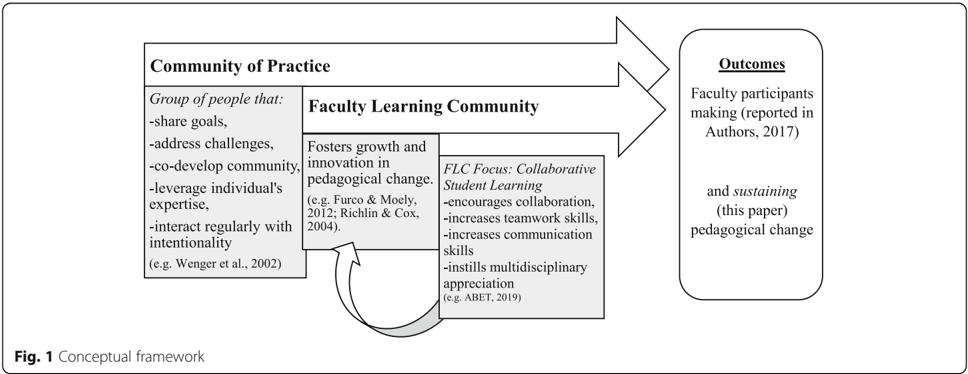
The necessity of a science, technology, engineering, and math (STEM) literate population continues to be a high priority worldwide. One approach to build and bolster a STEM-literate workforce is to explore approaches for strengthening the teaching of college-level STEM courses. The use of collaborative student learning pedagogy is broadly accepted as an effective approach to improve student learning outcomes over traditional methods, such as lecture. How to encourage and sustain the use of such evidence-based teaching practices in STEM fields is a critical topic. To achieve pedagogical change among college faculty, research supports a faculty learning community (FLC) structure. FLCs are a way to facilitate deeper understanding of a topic within a community of practice. Of particular interest for this paper is whether any FLC-supported pedagogical change was sustained by the faculty after the FLC ended and if so why. Engineering faculty found success in implementing paradigmatic pedagogical changes by engaging in an FLC that intentionally provided structures to promote a community of practice. This paper reports on the endurance of these pedagogical changes up to 2 years following conclusion of the FLC, with evidence summarizing reasons why many of the faculty had absorbed much of the once-new pedagogical approaches into their ongoing practices. FLC structures that faculty credit to their pedagogical change and the enduring impacts of those changes are described. These results offer evidence that it is possible to structure faculty support for them to make enduring pedagogical change, rather than temporary or one-time changes as part of a particular initiative. The findings, discussion, and conclusions of this study are likely to be of interest to faculty developers, innovative university leadership, or faculty exploring ways of sustaining a pedagogical change.
Overview
CoChat Summary
TL;DR
This qualitative follow-up study examined whether engineering faculty sustained collaborative student learning changes after participating in a year-long faculty learning community (FLC). It found that all 12 interviewed faculty continued using some aspect of the pedagogy, with FLC accountability, peer relationships, and observed student benefits credited for the endurance.
Key findings
- Twelve of the 12 interviewed FLC participants reported continuing to integrate some aspect of collaborative student learning techniques in their courses; many described these practices as becoming common or a “new normal.”
- Faculty identified FLC structures as critical to sustaining change: monthly face-to-face meetings and peer accountability, faculty peer relationships and peer observations, and resources such as the common book.
- Faculty reported benefits for themselves—real-time feedback, enriched student interactions, better teamwork instruction, and positive peer collaborations—and for students—improved attitudes/effort, thinking/understanding, and teamwork skills.
- All faculty participants indicated a desire to continue work in a similar FLC structure; there was a unanimous request that any follow-up be face-to-face rather than virtual.
Methods
- Qualitative follow-up of 12 faculty from two FLC cohorts (2014–2015 and 2015–2016) in an engineering school at a large urban university; 14 original participants, with 2 excluded because they did not embrace pedagogical change during the initial FLC.
- Semi-structured individual interviews lasting 30–60 min, conducted 1–2 years after completion of each participant’s FLC, transcribed and analyzed using consensual qualitative coding.
- Analysis followed a 3-step process—clustering data into domains, condensing into core ideas, and cross-analyzing to extract common themes—yielding 4 common themes.
Limitations
- Stated: participants were faculty already interested in improving teaching and self-selected into the FLC, so future participants not already receptive to pedagogical change may have different experiences and may not sustain change.
- Stated: pedagogical changes were self-reported rather than directly observed by researchers; the researchers were FLC facilitators with ongoing relationships with participants, though there was no incentive or penalty for inaccurate representations.
- Evident: the study is a small qualitative sample (12 faculty) from one engineering school at one university, with no comparison or control group, limiting generalizability.
Model-written summary. Check it against the paper before relying on it.
Integrity signals
Registry
Cites
Statistics
Figures
Verification
Claims the paper makes
3 Valid · 0 Not valid · 15 Not checked · 97 Own results and interpretations
Every source the paper cites for this claim was checked and supports it.
In the paper
“Among the faculty participants of the FLC, almost all were successful in initial implementation of collaborative student learning techniques.”
What the sources say
- Supportedcites Ralston et al., 2017 matched to “Implementing Collaborative Learning across the Engineering Curriculum” (2017) source
The Overcoming Challenges and Barriers section (p. 15) says the FLC helped 5 of its 6 participants implement collaborative learning techniques. The FLC implementation section (p. 5) describes participants putting collaborative activities into their courses, supporting the claim about initial implementation. (LLM, conf=0.93)
plain- Asserted: passes — The authors put it forward as true.
- Checkable: passes — It can be checked against evidence.
- Load-bearing: unclear — It is unclear whether the paper’s conclusions depend on it.
- Based: passes — The paper gives a reason why it holds.
- Supported
A result the paper reports from its own data — it cites no other source for it, so there is none to check. The quote shows it is in the paper.
In the paper
“This paper reports on the endurance of these pedagogical changes up to 2 years following conclusion of the FLC, with evidence summarizing reasons why many of the faculty had absorbed much of the once-new pedagogical approaches into their ongoing practices.”
plain- Asserted: passes — The authors put it forward as true.
- Checkable: passes — It can be checked against evidence.
- Load-bearing: passes — The paper’s conclusions depend on it.
- Based: passes — The paper gives a reason why it holds.
A result the paper reports from its own data — it cites no other source for it, so there is none to check. The quote shows it is in the paper.
In the paper
“The face-to-face, scheduled FLC structure with established deliverables at each meeting was very widely cited as critical for each individual to have made the efforts they did.”
boostedstates a cause- Asserted: passes — The authors put it forward as true.
- Checkable: passes — It can be checked against evidence.
- Load-bearing: passes — The paper’s conclusions depend on it.
- Based: passes — The paper gives a reason why it holds.
A result the paper reports from its own data — it cites no other source for it, so there is none to check. The quote shows it is in the paper.
In the paper
“faculty also reflected that the initial FLC required a lot of time and commitment for planning and modifying as the semester progressed.”
plain- Asserted: passes — The authors put it forward as true.
- Checkable: passes — It can be checked against evidence.
- Load-bearing: passes — The paper’s conclusions depend on it.
- Based: passes — The paper gives a reason why it holds.
A result the paper states — it cites no source for it, so there is none to check. The quote shows it is in the paper.
In the paper
“with adequate support and the willingness to invest time and energy up front, many faculty members realized enough benefits from their incorporation of collaborative student learning strategies that they continued to include those in subsequent iterations of their courses.”
plainstates a possible cause- Asserted: passes — The authors put it forward as true.
- Checkable: passes — It can be checked against evidence.
- Load-bearing: passes — The paper’s conclusions depend on it.
- Based: passes — The paper gives a reason why it holds.
55 more claims
Create a free account to see all 115 claims and to verify the 1 reference still open.
- It may state two separate claims as one. 31
- Probably not a substantial claim. 33
Self-check
Percentages, sums and reported differences re-computed from the paper’s own numbers.
Each contradiction between two passages listed here was confirmed by an independent check.
Rated minor: it would not touch a result — a value no result rests on, a p-value that stays on the same side of the significance level, or a conflict that is clerical, resolved elsewhere in the paper, or outside its own findings.
In the paper
§ Purpose of the study · p. 2
“The purpose of this study was to determine if an FLC experience focused on collaborative student learning can have sustainable impacts 2 -3 years after completion of the FLC.”
§ Data sources · p. 6
“These interviews occurred 1 -2 years after the completion of the participant ' s FLC experience and lasted for 30 -60 min each.”
Citations
Cites
Situated Learning: Legitimate Peripheral Participation.
Bloch, M., Lave, J., & Wenger, E. (1994) · Man · doi:10.2307/2804509 · Cited by 39,454
(1999) · Cited by 28,356
Communities of Practice: Learning, Meaning, and Identity
Wenger, E. (1998) · doi:10.1017/cbo9780511803932 · Cited by 23,500
Does Active Learning Work? A Review of the Research
Prince, M. (2004) · Journal of Engineering Education · doi:10.1002/j.2168-9830.2004.tb00809.x · Cited by 7,334 · cited 2×
“Collaborative teaching techniques have been shown to offer tremendous benefits to student learning for several decades (Johnson, Johnson, & Smith, 1998; Prince, 2004; Springer, Stanne, & Donovan, 1999).”
BackgroundDEWEY, J. M. (1910) · Cited by 6,801
Cultivating Communities of Practice: A Guide to Managing Knowledge
Wenger, É., & Snyder, W. M. (2002) · CERN Document Server (European Organization for Nuclear Research) · Cited by 5,461
Dewey, J. (1910) · D C Heath eBooks · doi:10.1037/10903-000 · Cited by 3,998
A Guide to Conducting Consensual Qualitative Research
Hill, C. E., Thompson, B. J., & Williams, E. N. (1997) · The Counseling Psychologist · doi:10.1177/0011000097254001 · Cited by 2,884
Consensual qualitative research: An update.
Hill, C. E., Knox, S., Thompson, B. J., Williams, E. N., Hess, S. A., & Ladany, N. (2005) · Journal of Counseling Psychology · doi:10.1037/0022-0167.52.2.196 · Cited by 2,841
Professional Learning Communities: A Review of the Literature
Stoll, L., Bolam, R., McMahon, A., Wallace, M., & Thomas, S. (2006) · Journal of Educational Change · doi:10.1007/s10833-006-0001-8 · Cited by 2,570
Research works printed but not linked: 2
- Cox, M. (2003). Fostering the scholarship of teaching and learning through faculty learning communities. Journal on Excellence in College Teaching, 14 (2/ 3), 161 -198.
- Fairweather, J. (2008). Linking evidence and promising practices in science, technology, engineering, and mathematics (STEM) undergraduate education . Washington, DC: Board of Science Education, National Research Council, The National Academies.
Cited by
Borda, E. J., Schumacher, E., Hanley, D., Geary, E., Warren, S., Ipsen, C., & Stredicke, L. (2020) · International Journal of STEM Education · doi:10.1186/s40594-020-0203-2 · Cited by 143
Change theory in STEM higher education: a systematic review
Reinholz, D. L., White, I., & Andrews, T. C. (2021) · International Journal of STEM Education · doi:10.1186/s40594-021-00291-2 · Cited by 147
Price, E., Lau, A. C., Goldberg, F., Turpen, C., Smith, P. S., Dancy, M., & Robinson, S. (2021) · International Journal of STEM Education · doi:10.1186/s40594-020-00268-7 · Cited by 60
Faculty online learning communities: A model for sustained teaching transformation
Dancy, M., Lau, A. C., Rundquist, A., & Henderson, C. (2019) · Physical Review Physics Education Research · doi:10.1103/physrevphyseducres.15.020147 · Cited by 53
Corrales, A., Goldberg, F. M., Price, E., & Turpen, C. (2020) · International Journal of STEM Education · doi:10.1186/s40594-020-00221-8 · Cited by 40
Salvatore, S., White, C., & Podowitz‐Thomas, S. (2024) · International Journal of STEM Education · doi:10.1186/s40594-024-00508-0 · Cited by 50
Asif, M., Thomas, G., Awan, M. U., & Din, A. M. (2020) · International Journal of Educational Management · doi:10.1108/ijem-10-2019-0375 · Cited by 54
Mathematics Training in Engineering Degrees: An Intervention from Teaching Staff to Students
López-Díaz, M. T., & Peña, M. (2021) · Mathematics · doi:10.3390/math9131475 · Cited by 29
Six years of development in promoting identity formation of STEM education as a distinct field
Li, Y. (2020) · International Journal of STEM Education · doi:10.1186/s40594-020-00257-w · Cited by 22
Lau, A. C., Martin, M. M., Corrales, A., Turpen, C., Goldberg, F. M., & Price, E. (2021) · International Journal of STEM Education · doi:10.1186/s40594-021-00301-3 · Cited by 17
The educational development of university teachers: mapping the landscape
Bélisle, M., Jean, V., & Fernández, N. (2024) · Frontiers in Education · doi:10.3389/feduc.2024.1376658 · Cited by 30
Martin, M. M., Goldberg, F. M., McKean, M., Price, E., & Turpen, C. (2022) · International Journal of STEM Education · doi:10.1186/s40594-022-00371-x · Cited by 15
Koretsky, M., Nolen, S. B., Galisky, J., Auby, H., & Grundy, L. S. (2024) · Journal of Engineering Education · doi:10.1002/jee.20586 · Cited by 12
Perrin-Stowe, T. I. N., Horner, M., Coon, J. J., Lynch, L. R., de Flamingh, A., Alexander, N. B., Golebie, E., Swartz, T. M., Bader, A. C., & Halsey, S. J. (2023) · Ecology and Evolution · doi:10.1002/ece3.9719 · Cited by 10
Lee, K. C. S., & Lim, A. (2022) · International Journal of Educational Leadership and Management · doi:10.17583/ijelm.8847 · Cited by 9
Johnson-Ojeda, V., Hill, L. B., Shin, S., York, A. M., & Frey, R. F. (2025) · CBE—Life Sciences Education · doi:10.1187/cbe.24-01-0016 · Cited by 12
Prunuske, A. J., Evans‐Anderson, H. J., Furniss, K. L., Goller, C., Mirowsky, J. E., Moore, M. E., Raut, S. A., Swamy, U., Wick, S., & Wolyniak, M. J. (2022) · Discover Education · doi:10.1007/s44217-022-00023-w · Cited by 12
Stefaniak, K. R., Winfrey, M. K., Curtis, A. C., & Kennedy, S. A. (2020) · Journal of Chemical Education · doi:10.1021/acs.jchemed.0c00487 · Cited by 8
Negrete, A. H., Mouavangsou, K. N., & Caporale, N. (2023) · Frontiers in Education · doi:10.3389/feduc.2023.1176913 · Cited by 10
Zaimi, I., Haas, D. B., Silverstein, M. J., & Shultz, G. V. (2024) · Chemistry Education Research and Practice · doi:10.1039/d4rp00093e · Cited by 6
Students’ resistance to learning mathematics through investigations
Calleja, J., & Buhagiar, M. A. (2021) · Journal of Curriculum Studies · doi:10.1080/00220272.2021.1981457 · Cited by 6
Mann, E. Z., Reese, A. N., Maden‐Jenkins, M., & Henkel, T. P. (2024) · The Journal of Academic Librarianship · doi:10.1016/j.acalib.2024.102888 · Cited by 7
Complexity of Faculty Pedagogical Development Within the Changing Higher Education Environment
Lester, J., Rosenberg, J. L., Nelson, J. K., & Shin, C. (2025) · Higher education · doi:10.1007/978-3-031-58698-9_12 · Cited by 9
Wu, W., Castronovo, F., Luo, Y., Liang, A., Gomez, F., Kassis, S., & Wolcott, A. (2025) · Computers & Education X Reality · doi:10.1016/j.cexr.2025.100096 · Cited by 4
Creating a Teaching Community with Graduate Teaching Assistants: A Scholarly Personal Narrative
Camarao, J., & Din, C. (2022) · International Journal for the Scholarship of Teaching and Learning · doi:10.20429/ijsotl.2022.160203 · Cited by 4
Supporting the evaluation of authentic assessment in environmental sciences: a case study
Hamel, P., & Lee, W. K. (2024) · Cogent Education · doi:10.1080/2331186x.2024.2399433 · Cited by 10
Apriani, T., Somantri, M., Kristiawan, M., & Hussin, Z. B. (2025) · Journal Evaluation in Education (JEE) · doi:10.37251/jee.v6i4.2092 · Cited by 3
Andrienko, T., Consten, J., Money, J., Broding, M., Dorman, L., Shepard, S., & Mousavi, O. (2023) · Filosofiya osvity Philosophy of Education · doi:10.31874/2309-1606-2023-29-1-4 · Cited by 6
Bauer, C. F., & Chan, J. Y. K. (2021) · The journal of college science teaching · doi:10.1080/0047231x.2021.12290528 · Cited by 3
Work in progress: Creating micromoments to develop a student’s entrepreneurial mindset
Morin, M., & Goldberg, R. (2024) · ASEE Annual Conference & Exposition · doi:10.18260/1-2--41445 · Cited by 6
Fovet, F. (2020) · Advances in higher education and professional development book series · doi:10.4018/978-1-7998-4036-7.ch007 · Cited by 4
What Teaching Excellence Means to Undergraduate Students on a STEM Programme
Matyjasiak, J., & THUMSER, A. E. A. (2021) · Springer eBooks · doi:10.1007/978-3-030-69158-5_2 · Cited by 3
“We're all like one big family”: How teacher-coaches' after-school PLC's influence STEM Club success
Swanson, K. J., Blanchard, M. R., & Gutierrez, K. S. (2023) · Learning Culture and Social Interaction · doi:10.1016/j.lcsi.2023.100739 · Cited by 2
Reworking the Recipe: Adding Inquiry and Reflection to College Science Labs
Din, C., & MacInnis, M. J. (2024) · The journal of college science teaching · doi:10.1080/0047231x.2024.2381418 · Cited by 4
Fuchs, S., Vasudevan, V. S., & Butcher, J. T. (2025) · Biomedical Engineering Education · doi:10.1007/s43683-025-00195-5 · Cited by 5
Jaiswal, A., Lyon, J. A., Perera, V., Magana, A. J., Gundlach, E., & Ward, M. D. (2024) · ASEE Annual Conference & Exposition · doi:10.18260/1-2--38152 · Cited by 2
Avdeenko, A. P., Sabirova, F. M., & Konyushenko, S. M. (2021) · International Journal of Web-Based Learning and Teaching Technologies · doi:10.4018/ijwltt.293281 · Cited by 2
Lessons from a cross-institutional online professional development pilot
Hughes, J. A., Martin, T. S., Gladwell, T. D., et al. (2023) · Currents in Pharmacy Teaching and Learning · doi:10.1016/j.cptl.2023.05.004 · Cited by 2
Kelley, J. (2025) · To improve the academy · doi:10.3998/tia.7488 · Cited by 1
Carli, M. (2025) · European Journal of Physics · doi:10.1088/1361-6404/adf785 · Cited by 1
Righting My Relationship With Teaching Mathematics: A Critical Reflection
Kostiuk, J. (2025) · IGI Global eBooks · doi:10.4018/979-8-3373-5337-1.ch001 · Cited by 1
Imamura, J. L., Mau, T. L., Wildy, E. L., Povich, J., de Haan, P. J., Hazlehurst, J. A., Herrlinger, T. J., & Winters, J. M. (2025) · Journal of Microbiology and Biology Education · doi:10.1128/jmbe.00015-25 · Cited by 4
Hrytsiuk, O. (2019) · Engineering and Educational Technologies · doi:10.30929/2307-9770.2019.07.04.05 · Cited by 1
Planning, Implementing, and Assessing an OER Faculty Learning Community: A Facilitator’s Lens
Orzech, M. J. (2021) · The Open/Technology in Education Society and Scholarship Association Journal · doi:10.18357/otessaj.2021.1.1.6 · Cited by 1
Nationwide inclusive facilitator training: Mindsets, practices, and growth
Codding, D., Yen, A. H., Lewis, H., Johnson-Ojeda, V., Frey, R. F., Hokanson, S. C., & Goldberg, B. B. (2024) · To improve the academy · doi:10.3998/tia.5109 · Cited by 6
Hintz, M. M., Tashiro, L. M., Kusnick, J., Solanki, S. M., Cyrenne, D. M., & Xu, D. (2025) · Journal of Research in Science Teaching · doi:10.1002/tea.22029 · Cited by 5
Building Bridges and Breaking Barriers: OER and Active Learning in Mathematics
Gagné, A., Wang, X., & Yusun, T. (2021) · The Open/Technology in Education Society and Scholarship Association Journal · doi:10.18357/otessaj.2021.1.1.5 · Cited by 4
Білоножко, О. (2022) · Pedagogical education theory and practice Psychology Pedagogy · doi:10.28925/2311-2409.2022.375
Prunuske, A. J., Evans‐Anderson, H. J., Furniss, K. L., Goller, C., Mirowsky, J. E., Moore, M. E., Raut, S. A., Swamy, U., Wick, S., & Wolyniak, M. J. (2022) · Research Square · doi:10.21203/rs.3.rs-2025854/v1
Tinnell, T. L. (2021) · ThinkIR: The University of Louisville's Institutional Repository (University of Louisville) · doi:10.18297/etd/3691 · Cited by 2
Self-citationAdopting a New Practice: Open Source Experiences in the Classroom
Dziallas, S., Fincher, S. A., Ellis, H. J. C., Postner, L., & Hislop, G. W. (2022) · IEEE Frontiers in Education Conference (FIE) · doi:10.1109/fie56618.2022.9962578 · Cited by 2
A Methodological Framework to Cultivate Transformative Learning in Faculty Development
Romano, A., & Fabbri, L. (2023) · Communications in computer and information science · doi:10.1007/978-3-031-29800-4_20
Contextualización de la enseñanza de las matemáticas en las carreras tecnológicas
López-Díaz, M. T. (2022) · UPCommons institutional repository (Universitat Politècnica de Catalunya) · doi:10.5821/dissertation-2117-371626
Morin, M., Goldberg, R., & Hutson, B. (2024) · ASEE Annual Conference & Exposition · doi:10.18260/1-2--44576
Louca, L. Τ., Skoulia, T., & Vryōnidēs, M. (2023) · Proceedings. · doi:10.22318/icls2023.468424
Prathibha, K. N., Upadhyaya, G., Jagadeesha, B. M., et al. (2024) · International Conference on Advances in Computing, Communication and Applied Informatics (ACCAI) · doi:10.1109/accai61061.2024.10601972
de Lyra, M. V. M., Dalal, M., Peña, K., & Perkins, J. (2024) · ASEE Annual Conference & Exposition · doi:10.18260/1-2--46683
Figard, R., Rivera, A. M., & de Lyra, M. V. M. (2024) · ASEE Annual Conference & Exposition · doi:10.18260/1-2--47817
Complexity of Faculty Pedagogical Development Within the Changing Higher Education Environment
Lester, J., Rosenberg, J. L., Nelson, J. K., & Shin, C. (2024) · Higher education · doi:10.1007/978-3-031-51930-7_12-1
Codding, D., Yen, A. H., Lewis, H., Johnson-Ojeda, V., Hokanson, S. C., & Goldberg, B. B. (2025) · bioRxiv (Cold Spring Harbor Laboratory) · doi:10.1101/2025.01.13.632844
Han, J., & Stieff, M. (2025) · Journal of Chemical Education · doi:10.1021/acs.jchemed.5c00688
Ran, F. X., & Bickerstaff, S. (2025) · Community College Journal of Research and Practice · doi:10.1080/10668926.2025.2546363 · Cited by 1
Characterizing faculty online learning community interactions using social network analysis
Bolger, E., Nwobi, M., & Caballero, M. D. (2025) · Physical Review Physics Education Research · doi:10.1103/n3yf-5h29 · Cited by 2
Covalent Bonds and Communities of Practice
Haarman, S., Feeney, E., Helquist, S., et al. (2024) · Emerald Group Publishing Limited eBooks · doi:10.1108/979-8-88730-446-520251009
Brame, C. J., Catania, E. H., Friedman, K. L., Johnson, H. J., Watkins, J., Badgandi, H., Claiborne, L. L., Clements, K. A., Creanza, N., Gilpin, J., et al. (2024) · Emerald Group Publishing Limited eBooks · doi:10.1108/979-8-88730-446-520251017
Marbach‐Ad, G., Bertke, M., Sheehan, P., Manyak-Davis, A., Heine, B., & Thompson, K. V. (2024) · Emerald Group Publishing Limited eBooks · doi:10.1108/979-8-88730-446-520251018
Kinzie, J. L., & Major, C. H. (2025) · Higher education · doi:10.1007/978-3-031-86738-5_10-1
Using Faculty Learning Communities to Create a Contemplative Community on Campus
Ahlers, J. C., Weigt, J., Basu, R., Thomas, M. D., Redela, P. M., & Pillai, R. (2024) · Emerald Group Publishing Limited eBooks · doi:10.1108/979-8-88730-600-120251020
Wachs, F. L., Barrios, D. M., Fuqua, J. L., Nissenson, P. M., Nguyen, C., Jones, B., & Nguyen, H. (2024) · Emerald Group Publishing Limited eBooks · doi:10.1108/979-8-88730-600-120251010
Implementing Change Strategies Through Faculty Learning Communities
Suarez, N. A., Wang, S., Sato, B. K., Aebersold, A., Brydges, S., & Lo, S. M. (2024) · Emerald Group Publishing Limited eBooks · doi:10.1108/979-8-88730-600-120251013
Vaden, J. M., Brooks, A. L., Dukes, A. A., Parrish, K., Nave, A. L. H., Landis, A. E., & Bilec, M. M. (2025) · Frontiers in Education · doi:10.3389/feduc.2025.1641993
Kinzie, J. L., & Major, C. H. (2026) · Higher education · doi:10.1007/978-3-032-05671-9_10 · Cited by 1
The Research and Engagement Academy: A Model for STEM Faculty Development
Buchbinder, O., Abrams, E., Britton, D., Bryce, J. G., Couse, L. J., McGaughy, J. A., & Rock, B. (2022) · Emerald Group Publishing Limited eBooks · doi:10.1108/979-8-88730-047-420251028
Nissim, Y., & Simon, E. (2026) · Cogent Education · doi:10.1080/2331186x.2026.2709898
Clarke, P., Reid, M., Bogle, S., Narasareddygari, M. R., Ramasamy, V., Fu, Y., & Jones, E. L. (2026) · ASEE Annual Conference & Exposition · doi:10.18260/1-2--59694
Building confidence about inclusive teaching through identity-focused professional development
Calkins, S., Johnson-Ojeda, V., Woods, S. E. O., Gillian‐Daniel, D. L., Dorizan, S., Kusano, S., & Frey, R. F. (2026) · Frontiers in Education · doi:10.3389/feduc.2026.1902183
TOPLab: sustaining innovation in physics labs through Faculty Learning Communities
Gabelli, L., & Carli, M. (2026) · Journal of Physics Conference Series · doi:10.1088/1742-6596/3280/1/012038
Metadata
- Authors
- Tinnell, T. L., Ralston, P. A. S., Tretter, T. R., & Mills, M. E.
- Affiliations
- University of Louisville (US)
- Corresponding author
- Tinnell, Teresa L.
- Venue
- International Journal of STEM Education
- Published
- 2019-08-13
- Volume
- 6
- Issue
- 1
- ISSN
- 2196-7822 (ISSN-L)
- OpenAlex
- W2969175149
- Cited by
- 87
- References
- 43
- Citations by year
- 2026: 7 · 2025: 16 · 2024: 21 · 2023: 7 · 2022: 15 · 2021: 13 · 2020: 6 · 2019: 2
- FWCI
- 24.28
- Type
- journal article
- Language
- en
- Open access
- gold
- doi.org
- Licence
- cc-by
- creativecommons.org/licenses/by/4.0 (tdm)
- creativecommons.org/licenses/by/4.0 (vor)
- Locations
- International Journal of STEM Education (publishedVersion, cc-by)
- DOAJ (DOAJ: Directory of Open Access Journals) (submittedVersion)
- Topics
- Social Sciences › Education › Evaluation of Teaching Practices
- Social Sciences › Education › Innovative Teaching Methods
- Social Sciences › Education › Teacher Education and Leadership Studies
- Keywords
- faculty learning communities, pedagogical change, engineering faculty, cooperative learning, communities of practice, evidence-based teaching practices, faculty development
About these checks
Registry, retraction, Cites and statistics results are computed, not judged, with one exception: a printed reference that no index lists is read once by a model before it counts as a citation error. Claims are extracted by a model and kept only when their quote appears verbatim in the text; each cited source is then checked, with a model’s help, for whether it says what the claim relies on. Those verdicts can be wrong — read the claim’s quote and the cited source before relying on one.
A language model drew the claims from the paper on 2026-10-10, under version 3 of the claim definition (model deepseek-v4.1-flash, prompt extract-v3).
A second model labelled each claim on 2026-10-10 (model jev-1.13-20260917, definition revision gold-guideline-v0.2).
Cited sources are checked with a language model’s help (gpt-6-sol).
Statistics and arithmetic are recomputed, not judged.
Confidence bands are shown only for fields calibrated on our annotated test set. None is calibrated yet, so no band is shown.
What counts as a claim ›How we measure confidence ›How we check this ›
Are you an author, or do you see a problem with this page? Request a review
Data sources
Bibliographic data: Semantic Scholar, OpenAlex, Crossref.
Contains information from the Semantic Scholar Academic Graph Datasets, made available under the ODC Attribution License (ODC-BY 1.0).
Semantic Scholar’s data is described in: Kinney, R., et al. (2023). The Semantic Scholar Open Data Platform. arXiv:2301.10140.
