

The relation of representational competence and conceptual knowledge in female and male undergraduates
Open accessThe DOI matches its Crossref record; 117 of the 117 references it cites were found in a registry or an index.
Abstract
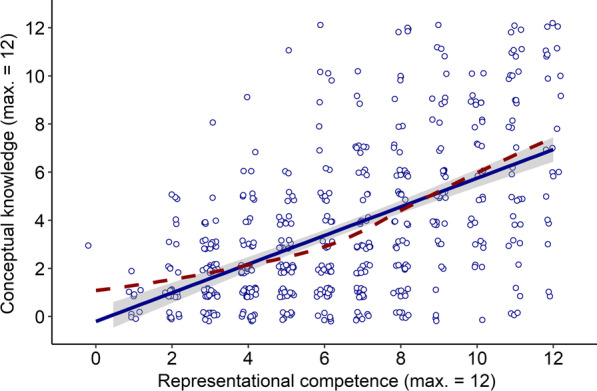
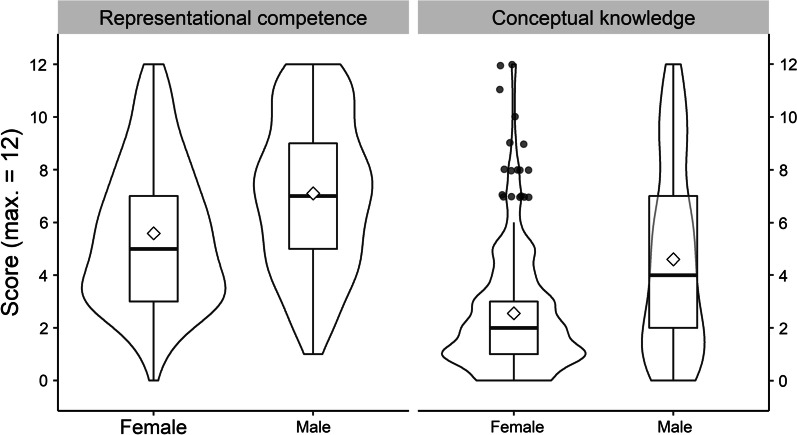
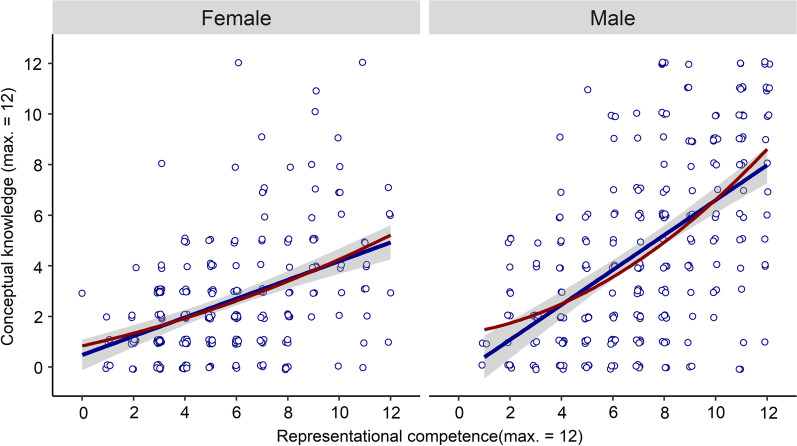
Background: Representational competence is commonly considered a prerequisite for the acquisition of conceptual knowledge, yet little exploration has been undertaken into the relation between these two constructs. Using an assessment instrument of representational competence with vector fields that functions without confounding topical context, we examined its relation with N = 515 undergraduates’ conceptual knowledge about electromagnetism. Results: Applying latent variable modeling, we found that students’ representational competence and conceptual knowledge are related yet clearly distinguishable constructs (manifest correlation: r = .54; latent correlation: r = .71). The relation was weaker for female than for male students, which could not be explained by measurement differences between the two groups. There were several students with high representational competence and low conceptual knowledge, but only few students with low representational competence and high conceptual knowledge. Conclusions: These results support the assumption that representational competence is a prerequisite, yet insufficient condition for the acquisition of conceptual knowledge. We provide suggestions for supporting learners in building representational competence, and particularly female learners in utilizing their representational competence to build conceptual knowledge.
Overview
The claims and statistics of this paper haven’t been checked yet.
Free: it reads the open-access text and checks the first 5 claims that cite a source we can check. Create a free account to check every claim.
Integrity signals
Registry
Cites
Statistics
Figures
Verification
Claims the paper makes
The claims and statistics of this paper haven’t been checked yet.
Free: it reads the open-access text and checks the first 5 claims that cite a source we can check. Create a free account to check every claim.
Claims other papers make about this one
Each is checked against this paper’s own text: does it say what the citing paper says it does?
The cited source says what the claim attributes to it.
In the citing paper
“To effectively learn from visual representations, Edelsbrunner and colleagues could show that students need to possess representational competence that allows them to extract information from visual representations and interpret them34.”
From On opportunities and challenges of large multimodal foundation models in education (2025) · cites this paper as [34]
Self-check
Percentages, sums and reported differences re-computed from the paper’s own numbers.
The self-check needs the paper’s full text.
Citations
Cites
R: A Language and Environment for Statistical Computing
R Core Team (2025) · doi:10.32614/r.manuals · Cited by 352,181
Principles and Practice of Structural Equation Modeling
Tabri, N., & Elliott, C. M. (2012) · Canadian Graduate Journal of Sociology and Criminology · doi:10.15353/cgjsc-rcessc.v1i1.25 · Cited by 38,891
Wickham, H., Averick, M., Bryan, J., Chang, W., McGowan, L., François, R., Grolemund, G., Hayes, A., Henry, L., Hester, J., et al. (2019) · Journal of Open Source Software · doi:10.21105/joss.01686 · Cited by 22,138 · cited 1×
“The tidyverse packages were used for data wrangling and visualization (Wickham et al., 2019).”
MethodThe Use of Cronbach’s Alpha When Developing and Reporting Research Instruments in Science Education
Taber, K. S. (2018) · Research in Science Education · doi:10.1007/s11165-016-9602-2 · Cited by 10,679 · cited 2×
“, 2022) and more specifically for conceptual knowledge (Stadler et al., 2021; Taber, 2018), it has been recently debated whether traditional latent variable models with this specific assumption regarding measurement error are useful.”
Background(2011) · Cited by 5,290
Longitudinal Structural Equation Modeling
Little, T. D. (2013) · Cited by 4,278
Human Cognitive Abilities: A Survey of Factor-Analytic Studies
Carroll, J. B. (1993) · doi:10.1017/cbo9780511571312 · Cited by 4,121
Dunn, T. J., Baguley, T., & Brunsden, V. (2014) · British Journal of Psychology · doi:10.1111/bjop.12046 · Cited by 3,596
Hestenes, D., Wells, M., & Swackhamer, G. (1992) · The Physics Teacher · doi:10.1119/1.2343497 · Cited by 3,235 · cited 3×
“(2013) found a strong positive correlation of upper secondary school students’ representational competence regarding visuo-spatial and symbolic representations with conceptual knowledge, both embedded in the context of Newtonian mechanics in the Force Concept Inventory (FCI; Hestenes et al., 1992).”
BackgroundEye Tracking: A comprehensive guide to methods and measures
Holmqvist, K., Nyström, M., Andersson, R., Dewhurst, R. J., Jarodzka, H. M., & van de Weijer, J. (2015) · Lund University Publications (Lund University) · Cited by 2,919
Research works printed but not linked: 7
- Hake, R. R. (2002). Relationship of individual student normalized learning gains in Mechanics with gender, highschool physics, and pretest scores on mathematics and spatial visualization. Poster session presented at the Physics Education Research Conference (PERC), Boise, Idaho.
- Halpern DF A cognitive-process taxonomy for sex differences in cognitive abilities Current Directions in Psychological Science 2004 13 4 135 139 10.1111/j.0963-7214.2004.00292 · doi:10.1111/j.0963-7214.2004.00292
- Lundberg I Johnson R Stewart BM What is your estimand? Defining the target quantity connects statistical evidence to theory American Sociological Review 2021 86 3 532 565 10.1177/0003122421100418 · doi:10.1177/0003122421100418
- Muthén, L. K., & Muthén, B. O. (1998–2021). Mplus User's Guide, 7th Edition. Muthén & Muthén.
- National Research Council A framework for K-12 science education: Practices, crosscutting concepts, and core ideas 2012 National Academies Press
- Osborn Popp, S. E., Meltzer, D. E., & Megowan-Romanowicz, C. (2011). Is the force concept inventory biased? Investigating differential item functioning on a test of conceptual learning in physics. In Annual meeting of the American Educational Research Association (Vol. 10, p. 2012). New Orleans. Retrieved September.
- Sherin BL Meta-representation: An introduction The Journal of Mathematical Behavior 2000 19 4 385 398 10.1016/S0732-3123(01)00051-7 · DOI · Paper page
Cited by
On opportunities and challenges of large multimodal foundation models in education
Küchemann, S., Avila, K. E., Dinc, Y., Hortmann, C., Revenga, N., Ruf, V., Stausberg, N., Steinert, S., Fischer, F., Fischer, M., et al. (2025) · npj Science of Learning · doi:10.1038/s41539-025-00301-w · Cited by 47
“To effectively learn from visual representations, Edelsbrunner and colleagues could show that students need to possess representational competence that allows them to extract information from visual representations and interpret them 34 .”
Self-citationMagana, A. J., Arigye, J., Udosen, A. N., Lyon, J. A., Joshi, P. P., & Pienaar, E. (2024) · International Journal of STEM Education · doi:10.1186/s40594-024-00494-3 · Cited by 39
Altindis, N., Bowe, K. A., Couch, B., Bauer, C. F., & Aikens, M. L. (2024) · International Journal of STEM Education · doi:10.1186/s40594-024-00492-5 · Cited by 25
Lessons learned from designing an open-source automated feedback system for STEM education
Steinert, S., Krupp, L., Avila, K. E., Janssen, A. S., Ruf, V., Dzsotjan, D., Schryver, C. D., Karolus, J., Ruzika, S., Joisten, K., et al. (2024) · Education and Information Technologies · doi:10.1007/s10639-024-13025-y · Cited by 25
Self-citationNelsen, I., Farheen, A., & Lewis, S. E. (2024) · Chemistry Education Research and Practice · doi:10.1039/d4rp00025k · Cited by 20
Metadata
- Authors
- Edelsbrunner, P. A., Malone, S., Hofer, S. I., Küchemann, S., Kuhn, J., Schmid, R., Altmeyer, K., Brünken, R., & Lichtenberger, A.
- Affiliations
- ETH Zurich (CH)
- Saarland University (DE)
- Ludwig-Maximilians-Universität München (DE)
- Corresponding author
- Edelsbrunner, Peter A.
- ORCID
- Venue
- International Journal of STEM Education
- Published
- 2023-06-21
- Volume
- 10
- Issue
- 1
- Pages
- 44-44
- ISSN
- 2196-7822 (ISSN-L)
- PMC
- PMC10285021
- OpenAlex
- W4381547747
- Semantic Scholar
- b73831d2baea4b7799da97c54326c9dc208553f2
- Cited by
- 19
- References
- 115
- Citations by year
- 2026: 4 · 2025: 4 · 2024: 9 · 2023: 2
- FWCI
- 14.03
- Type
- journal article
- Language
- en
- Open access
- gold
- doi.org
- Licence
- cc-by
- creativecommons.org/licenses/by/4.0 (tdm)
- creativecommons.org/licenses/by/4.0 (vor)
- Locations
- International Journal of STEM Education (publishedVersion, cc-by)
- PubMed Central (publishedVersion, cc-by)
- PubMed (publishedVersion)
- Open access LMU (Ludwid Maxmilian's Universitat Munchen) (submittedVersion, cc-by)
- DOAJ (DOAJ: Directory of Open Access Journals) (submittedVersion, cc-by-sa)
- Funders
- Schweizerischer Nationalfonds zur Förderung der Wissenschaftlichen Forschung (204987)
- Deutsche Forschungsgemeinschaft (471917560)
- Swiss Federal Institute of Technology Zurich
- Topics
- Social Sciences › Education › Science Education and Pedagogy
- Social Sciences › Psychology › Experimental and Cognitive Psychology › Visual and Cognitive Learning Processes
- Social Sciences › Education › Educational Methods and Outcomes
- Keywords
- representational competence, conceptual knowledge, electromagnetism, vector fields, gender differences, undergraduate students, prerequisite knowledge, conceptual understanding, physics education
About these checks
Registry, retraction, Cites and statistics results are computed, not judged, with one exception: a printed reference that no index lists is read once by a model before it counts as a citation error. Claims are extracted by a model and kept only when their quote appears verbatim in the text; each cited source is then checked, with a model’s help, for whether it says what the claim relies on. Those verdicts can be wrong — read the claim’s quote and the cited source before relying on one.
Statistics and arithmetic are recomputed, not judged.
Confidence bands are shown only for fields calibrated on our annotated test set. None is calibrated yet, so no band is shown.
What counts as a claim ›How we measure confidence ›How we check this ›
Are you an author, or do you see a problem with this page? Request a review
Data sources
Bibliographic data: Semantic Scholar, OpenAlex, Crossref.
Contains information from the Semantic Scholar Academic Graph Datasets, made available under the ODC Attribution License (ODC-BY 1.0).
Semantic Scholar’s data is described in: Kinney, R., et al. (2023). The Semantic Scholar Open Data Platform. arXiv:2301.10140.
