

The relation of representational competence and conceptual knowledge in female and male undergraduates
Open accessThe DOI matches its Crossref record; 117 of the 117 references it cites were found in a registry or an index.
Abstract
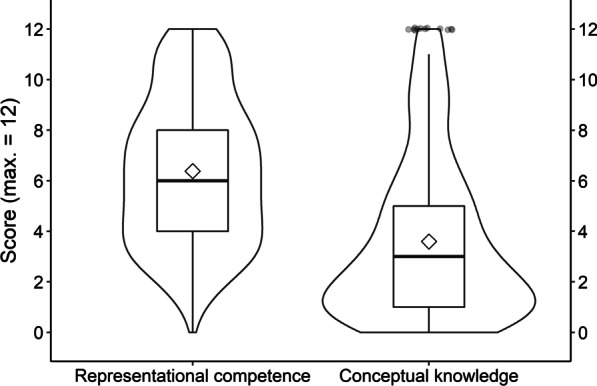
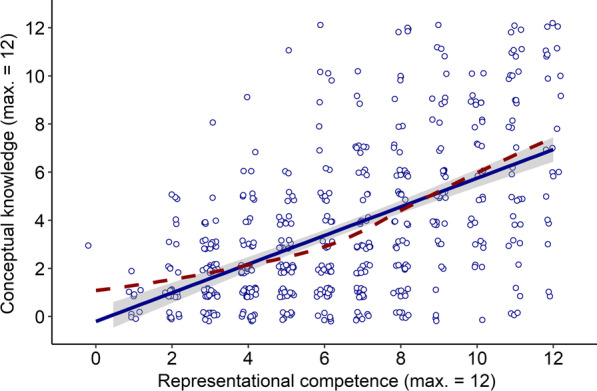
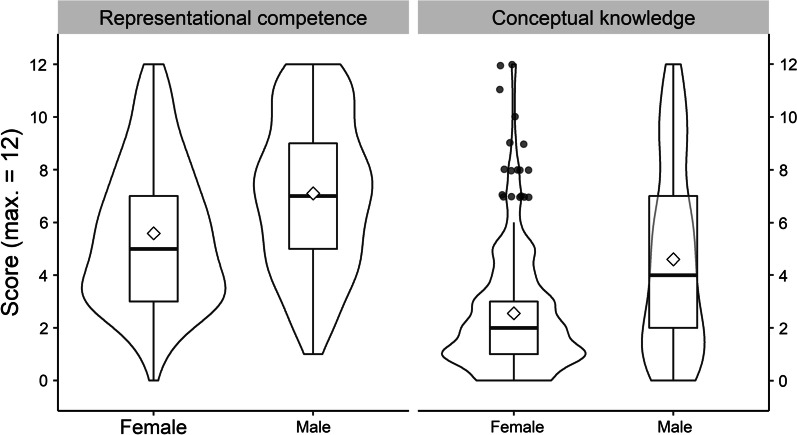
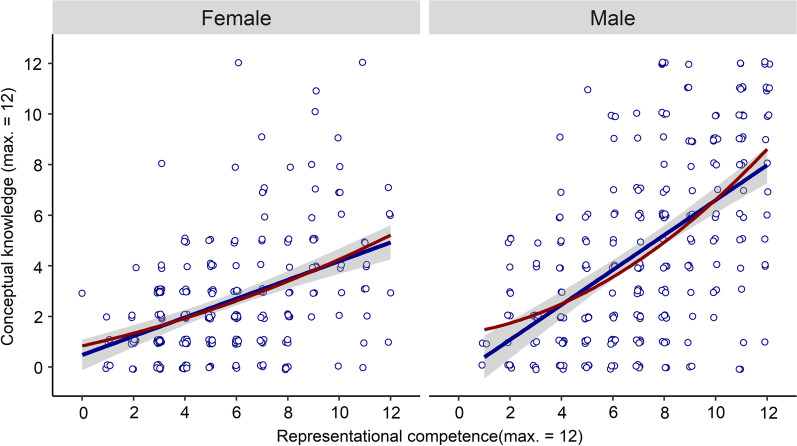
Background: Representational competence is commonly considered a prerequisite for the acquisition of conceptual knowledge, yet little exploration has been undertaken into the relation between these two constructs. Using an assessment instrument of representational competence with vector fields that functions without confounding topical context, we examined its relation with N = 515 undergraduates’ conceptual knowledge about electromagnetism. Results: Applying latent variable modeling, we found that students’ representational competence and conceptual knowledge are related yet clearly distinguishable constructs (manifest correlation: r = .54; latent correlation: r = .71). The relation was weaker for female than for male students, which could not be explained by measurement differences between the two groups. There were several students with high representational competence and low conceptual knowledge, but only few students with low representational competence and high conceptual knowledge. Conclusions: These results support the assumption that representational competence is a prerequisite, yet insufficient condition for the acquisition of conceptual knowledge. We provide suggestions for supporting learners in building representational competence, and particularly female learners in utilizing their representational competence to build conceptual knowledge.
Overview
The claims and statistics of this paper haven’t been checked yet.
Free: it reads the open-access text and checks the first 5 claims that cite a source we can check. Create a free account to check every claim.
Integrity signals
Registry
Cites
Statistics
Figures
Verification
Claims the paper makes
The claims and statistics of this paper haven’t been checked yet.
Free: it reads the open-access text and checks the first 5 claims that cite a source we can check. Create a free account to check every claim.
Claims other papers make about this one
Each is checked against this paper’s own text: does it say what the citing paper says it does?
The cited source says what the claim attributes to it.
In the citing paper
“To effectively learn from visual representations, Edelsbrunner and colleagues could show that students need to possess representational competence that allows them to extract information from visual representations and interpret them34.”
From On opportunities and challenges of large multimodal foundation models in education (2025) · cites this paper as [34]
Self-check
Percentages, sums and reported differences re-computed from the paper’s own numbers.
The self-check needs the paper’s full text.
Citations
Cites
R: A Language and Environment for Statistical Computing
R Core Team (2025) · doi:10.32614/r.manuals · Cited by 352,181
Principles and Practice of Structural Equation Modeling
Tabri, N., & Elliott, C. M. (2012) · Canadian Graduate Journal of Sociology and Criminology · doi:10.15353/cgjsc-rcessc.v1i1.25 · Cited by 38,891
Wickham, H., Averick, M., Bryan, J., Chang, W., McGowan, L., François, R., Grolemund, G., Hayes, A., Henry, L., Hester, J., et al. (2019) · Journal of Open Source Software · doi:10.21105/joss.01686 · Cited by 22,138 · cited 1×
“The tidyverse packages were used for data wrangling and visualization (Wickham et al., 2019).”
MethodThe Use of Cronbach’s Alpha When Developing and Reporting Research Instruments in Science Education
Taber, K. S. (2018) · Research in Science Education · doi:10.1007/s11165-016-9602-2 · Cited by 10,679 · cited 2×
“, 2022) and more specifically for conceptual knowledge (Stadler et al., 2021; Taber, 2018), it has been recently debated whether traditional latent variable models with this specific assumption regarding measurement error are useful.”
Background(2011) · Cited by 5,290
Longitudinal Structural Equation Modeling
Little, T. D. (2013) · Cited by 4,278
Human Cognitive Abilities: A Survey of Factor-Analytic Studies
Carroll, J. B. (1993) · doi:10.1017/cbo9780511571312 · Cited by 4,121
Dunn, T. J., Baguley, T., & Brunsden, V. (2014) · British Journal of Psychology · doi:10.1111/bjop.12046 · Cited by 3,596
Hestenes, D., Wells, M., & Swackhamer, G. (1992) · The Physics Teacher · doi:10.1119/1.2343497 · Cited by 3,235 · cited 3×
“(2013) found a strong positive correlation of upper secondary school students’ representational competence regarding visuo-spatial and symbolic representations with conceptual knowledge, both embedded in the context of Newtonian mechanics in the Force Concept Inventory (FCI; Hestenes et al., 1992).”
BackgroundEye Tracking: A comprehensive guide to methods and measures
Holmqvist, K., Nyström, M., Andersson, R., Dewhurst, R. J., Jarodzka, H. M., & van de Weijer, J. (2015) · Lund University Publications (Lund University) · Cited by 2,919
Ensuring Positiveness of the Scaled Difference Chi-square Test Statistic
Satorra, A., & Bentler, P. M. (2010) · Psychometrika · doi:10.1007/s11336-009-9135-y · Cited by 2,695
A checklist for testing measurement invariance
van de Schoot, R., Lugtig, P., & Hox, J. (2012) · European Journal of Developmental Psychology · doi:10.1080/17405629.2012.686740 · Cited by 2,064
The malleability of spatial skills: A meta-analysis of training studies.
Uttal, D. H., Meadow, N. G., Tipton, E., Hand, L. L., Alden, A. R., Warren, C., & Newcombe, N. S. (2013) · Psychological Bulletin · doi:10.1037/a0028446 · Cited by 1,899
The theoretical status of latent variables.
Borsboom, D., Mellenbergh, G. J., & van Heerden, J. (2003) · Psychological Review · doi:10.1037/0033-295x.110.2.203 · Cited by 1,566
Denzin, N. K. (2012) · Journal of Mixed Methods Research · doi:10.1177/1558689812437186 · Cited by 1,444 · cited 1×
“For the purpose of methodological triangulation (Denzin, 2012), future studies could also collect verbal data to improve the interpretation of gaze data.”
BackgroundHuman cognitive abilities: A survey of factor-analytic studies
Eysenck, H. J. (1994) · Personality and Individual Differences · doi:10.1016/0191-8869(94)90126-0 · Cited by 1,392
Why are some STEM fields more gender balanced than others?
Cheryan, S., Ziegler, S. A., Montoya, A. K., & Jiang, L. (2017) · Psychological Bulletin · doi:10.1037/bul0000052 · Cited by 1,259 · cited 1×
“Extensively researched reasons for the gender gap in some STEM fields such as physics and computer science (Cheryan et al., 2017) encompass gender differences in interest, motivation, self-concept (Jansen et al.”
BackgroundThe Gender-Equality Paradox in Science, Technology, Engineering, and Mathematics Education
Stoet, G., & Geary, D. C. (2018) · Psychological Science · doi:10.1177/0956797617741719 · Cited by 1,054
MplusAutomation: An R Package for Facilitating Large-Scale Latent Variable Analyses in M plus
Hallquist, M. N., & Wiley, J. F. (2018) · Structural Equation Modeling: A Multidisciplinary Journal · doi:10.1080/10705511.2017.1402334 · Cited by 871
Meece, J. L., Glienke, B. B., & Burg, S. (2006) · Journal of School Psychology · doi:10.1016/j.jsp.2006.04.004 · Cited by 743
Schneider, M., Beeres, K., Coban, L., Merz, S., Susan Schmidt, S., Stricker, J., & De Smedt, B. (2017) · Developmental Science · doi:10.1111/desc.12372 · Cited by 723
Surveying students’ conceptual knowledge of electricity and magnetism
Maloney, D. P., O’Kuma, T. L., Hieggelke, C. J., & Van Heuvelen, A. (2001) · American Journal of Physics · doi:10.1119/1.1371296 · Cited by 677
The role of experience in spatial test performance: A meta-analysis
Baenninger, M., & Newcombe, N. (1989) · Sex Roles · doi:10.1007/bf00287729 · Cited by 545 · cited 1×
“In the course of their educational path, males become increasingly superior with respect to their spatial intelligence due to biological and environmental factors (Baenninger & Newcombe, 1989).”
BackgroundMetarepresentation: Native Competence and Targets for Instruction
diSessa, A. A. (2004) · Cognition and Instruction · doi:10.1207/s1532690xci2203_2 · Cited by 543
Students Becoming Chemists: Developing Representationl Competence
Kozma, R., & Russell, J. (2005) · Visualization in Science Education · doi:10.1007/1-4020-3613-2_8 · Cited by 508
Parents explain more often to boys than to girls during shared scientific thinking
Crowley, K., Callanan, M. A., Tenenbaum, H. R., & Allen, E. (2001) · Psychological Science · doi:10.1111/1467-9280.00347 · Cited by 482
Svetina, D., Rutkowski, L., & Rutkowski, D. (2020) · Structural Equation Modeling: A Multidisciplinary Journal · doi:10.1080/10705511.2019.1602776 · Cited by 425
Parent-child conversations about science: The socialization of gender inequities?
Tenenbaum, H. R., & Leaper, C. (2003) · Developmental Psychology · doi:10.1037//0012-1649.39.1.34 · Cited by 415
Evaluating an electricity and magnetism assessment tool: Brief electricity and magnetism assessment
Ding, L., Chabay, R., Sherwood, B., & Beichner, R. (2006) · Physical Review Special Topics - Physics Education Research · doi:10.1103/physrevstper.2.010105 · Cited by 413
Factors versus Composites: Guidelines for Choosing the Right Structural Equation Modeling Method
Hair, J. F., & Sarstedt, M. (2019) · Project Management Journal · doi:10.1177/8756972819882132 · Cited by 408
The Educational Value of Multiple-representations when Learning Complex Scientific Concepts
Ainsworth, S. (2008) · Visualization: Theory and Practice in Science Education · doi:10.1007/978-1-4020-5267-5_9 · Cited by 352
Latent Variable Modeling Using R
Beaujean, A. A. (2014) · Routledge eBooks · doi:10.4324/9781315869780 · Cited by 346
Spatial Ability: Its Influence on Learning with Visualizations—a Meta-Analytic Review
Höffler, T. N. (2010) · Educational Psychology Review · doi:10.1007/s10648-010-9126-7 · Cited by 328
Outcome-Wide Longitudinal Designs for Causal Inference: A New Template for Empirical Studies
VanderWeele, T. J., Mathur, M. B., & Chen, Y. (2020) · Statistical Science · doi:10.1214/19-sts728 · Cited by 310
Uttal, D. H., Miller, D. I., & Newcombe, N. S. (2013) · Current Directions in Psychological Science · doi:10.1177/0963721413484756 · Cited by 297
Conditions for the Effectiveness of Multiple Visual Representations in Enhancing STEM Learning
Rau, M. A. (2017) · Educational Psychology Review · doi:10.1007/s10648-016-9365-3 · Cited by 281 · cited 2×
“Disciplinary representations, such as line graphs, reaction equations, or circuit schematics, for example, are considered tools for students’ conceptual development, concept-related reasoning, problem solving, and scientific communication (e.g., Hubber et al., 2010; Rau, 2017).”
BackgroundLohman, D. F. (1993) · Cited by 267
THE THEORY OF PATH COEFFICIENTS A REPLY TO NILES'S CRITICISM
Wright, S. (1923) · Genetics · doi:10.1093/genetics/8.3.239 · Cited by 258
Domain-specific prior knowledge and learning: A meta-analysis
Simonsmeier, B. A., Flaig, M., Deiglmayr, A., Schalk, L., & Schneider, M. (2022) · Educational Psychologist · doi:10.1080/00461520.2021.1939700 · Cited by 255
Associations of Number Line Estimation With Mathematical Competence: A Meta-analysis
Schneider, M., Merz, S., Stricker, J., De Smedt, B., Torbeyns, J., Verschaffel, L., & Luwel, K. (2018) · Child Development · doi:10.1111/cdev.13068 · Cited by 252
Learning with Animation: Research Implications for Design
Lowe, R., & Schnotz, W. (2007) · Cited by 247
Meta-representation: an introduction
diSessa, A. A., & Sherin, B. L. (2000) · The Journal of Mathematical Behavior · doi:10.1016/s0732-3123(01)00051-7 · Cited by 238
Borsboom, D. (2008) · Measurement: Interdisciplinary Research & Perspective · doi:10.1080/15366360802035497 · Cited by 224
Teaching and Learning about Force with a Representational Focus: Pedagogy and Teacher Change
Hubber, P., Tytler, R., & Haslam, F. (2010) · Research in Science Education · doi:10.1007/s11165-009-9154-9 · Cited by 217
Madsen, A., McKagan, S. B., & Sayre, E. C. (2013) · Physical Review Special Topics - Physics Education Research · doi:10.1103/physrevstper.9.020121 · Cited by 207
Relational categories as a bridge between cognitive and educational research.
Goldwater, M. B., & Schalk, L. (2016) · Psychological Bulletin · doi:10.1037/bul0000043 · Cited by 200
Reilly, D., Neumann, D. L., & Andrews, G. (2016) · Springer eBooks · doi:10.1007/978-3-319-44385-0_10 · Cited by 191
Can spatial training improve long-term outcomes for gifted STEM undergraduates?
Miller, D. I., & Halpern, D. F. (2013) · Learning and Individual Differences · doi:10.1016/j.lindif.2012.03.012 · Cited by 185
Buckley, J., Seery, N., & Canty, D. (2018) · Educational Psychology Review · doi:10.1007/s10648-018-9432-z · Cited by 179
Does spatial skills instruction improve STEM outcomes? The answer is ‘yes’
Sorby, S., Veurink, N., & Streiner, S. (2018) · Learning and Individual Differences · doi:10.1016/j.lindif.2018.09.001 · Cited by 179 · cited 1×
“Previous research showed that spatial training can reduce the gender gap regarding spatial abilities (Uttal et al., 2013a, 2013b), improve grades in physics courses (Miller & Halpern, 2013) and even increase the gender diversity in professional STEM fields (Sorby et al, 2018).”
BackgroundKnowledge as a formative construct: A good alpha is not always better
Stadler, M., Sailer, M., & Fischer, F. (2021) · New Ideas in Psychology · doi:10.1016/j.newideapsych.2020.100832 · Cited by 179
Confidence, Likelihood, Probability: Statistical Inference with Confidence Distributions
Schweder, T., & Hjort, N. L. (2016) · Cambridge University Press eBooks · doi:10.1017/cbo9781139046671 · Cited by 179
Misconceptions about the Particulate Nature of Matter. Using Animations To Close the Gender Gap
Yezierski, E. J., & Birk, J. P. (2006) · Journal of Chemical Education · doi:10.1021/ed083p954 · Cited by 178
Cordova, J. R., Sinatra, G. M., Jones, S. H., Taasoobshirazi, G., & Lombardi, D. (2014) · Contemporary Educational Psychology · doi:10.1016/j.cedpsych.2014.03.006 · Cited by 177
Gender study on the relationships between science interest and future career perspectives
Kang, J., Hense, J., Scheersoi, A., & Keinonen, T. (2018) · International Journal of Science Education · doi:10.1080/09500693.2018.1534021 · Cited by 176
Multiple Representations in Physics Education
Treagust, D. F., Duit, R. H., & Fischer, H. E. (2017) · Models and modeling in science education · doi:10.1007/978-3-319-58914-5 · Cited by 175
Tzuriel, D., & Egozi, G. (2010) · Child Development · doi:10.1111/j.1467-8624.2010.01482.x · Cited by 173
From problem solving to a knowledge structure: An example from the domain of electromagnetism
Bagno, E., & Eylon, B.-S. (1997) · American Journal of Physics · doi:10.1119/1.18642 · Cited by 169
Jansen, M., Schroeders, U., & Lüdtke, O. (2014) · Learning and Individual Differences · doi:10.1016/j.lindif.2013.12.003 · Cited by 158
Strongly and weakly directed approaches to teaching multiple representation use in physics
Kohl, P. B., Rosengrant, D., & Finkelstein, N. D. (2007) · Physical Review Special Topics - Physics Education Research · doi:10.1103/physrevstper.3.010108 · Cited by 157
Spatial Abilities and the Effects of Computer Animation on Short-Term and Long-Term Comprehension
Hays, T. A. (1996) · Journal of Educational Computing Research · doi:10.2190/60y9-bqg9-80hx-ueml · Cited by 155
Heo, M., & Toomey, N. (2020) · Computers & Education · doi:10.1016/j.compedu.2019.103747 · Cited by 147
Lüdtke, O., & Robitzsch, A. (2022) · Structural Equation Modeling: A Multidisciplinary Journal · doi:10.1080/10705511.2022.2065278 · Cited by 145
van Gog, T., & Jarodzka, H. (2013) · Springer international handbooks of education · doi:10.1007/978-1-4419-5546-3_10 · Cited by 137
Why Psychological Assessment Needs to Start Worrying About Model Fit
Greiff, S., & Heene, M. (2017) · European Journal of Psychological Assessment · doi:10.1027/1015-5759/a000450 · Cited by 137
The gender gap in highly prestigious international research awards, 2001–2020
Meho, L. I. (2021) · Quantitative Science Studies · doi:10.1162/qss_a_00148 · Cited by 131
Stereotype Threat and Group Differences in Test Performance: A Question of Measurement Invariance.
Wicherts, J. M., Dolan, C. V., & Hessen, D. J. (2005) · Journal of Personality and Social Psychology · doi:10.1037/0022-3514.89.5.696 · Cited by 126 · cited 3×
“This approach allows unbiased comparisons across genders despite moderate deviations (Wicherts et al., 2005).”
BackgroundGender fairness within the Force Concept Inventory
Traxler, A. L., Henderson, R. J., Stewart, J. C., Stewart, G., Papak, A., & Lindell, R. (2018) · Physical Review Physics Education Research · doi:10.1103/physrevphyseducres.14.010103 · Cited by 122
Quaiser‐Pohl, C., & Lehmann, W. (2002) · British Journal of Educational Psychology · doi:10.1348/000709902158874 · Cited by 119
Men, women and STEM: Why the differences and what should be done?
Stewart-Williams, S., & Halsey, L. G. (2021) · European Journal of Personality · doi:10.1177/0890207020962326 · Cited by 117
Hofer, S. I., Schumacher, R., Rubin, H., & Stern, E. (2018) · Journal of Educational Psychology · doi:10.1037/edu0000266 · Cited by 113
Self-citationUpper High School Students’ Understanding of Electromagnetism
Sağlam, M., & Millar, R. (2006) · International Journal of Science Education · doi:10.1080/09500690500339613 · Cited by 111
Student difficulties regarding symbolic and graphical representations of vector fields
Bollen, L., van Kampen, P., Baily, C., Kelly, M., & Cock, M. D. (2017) · Physical Review Physics Education Research · doi:10.1103/physrevphyseducres.13.020109 · Cited by 104
Modeling Latent Change Score Analysis and Extensions in Mplus: A Practical Guide for Researchers
Klopack, E. T., & Wickrama, K. (. A. S. ). (2020) · Structural Equation Modeling: A Multidisciplinary Journal · doi:10.1080/10705511.2018.1562929 · Cited by 102 · cited 1×
“…constructs during such a phase (for example by means of random intercept-, lag2 cross-lagged-, change-, our outcome-wide approaches and study designs; Klopack & Wickrama, 2020; Lüdtke & Robitzsch, 2022; VanderWeele et al., 2020) might yield insights into their longer-term developmental interplay.”
BackgroundBeyond ball-and-stick: Students' processing of novel STEM visualizations
Hinze, S. R., Rapp, D. N., Williamson, V. M., Shultz, M. J., Deslongchamps, G., & Williamson, K. C. (2013) · Learning and Instruction · doi:10.1016/j.learninstruc.2012.12.002 · Cited by 99
Assessment of representational competence in kinematics
Klein, P., Müller, A., & Kühn, J. (2017) · Physical Review Physics Education Research · doi:10.1103/physrevphyseducres.13.010132 · Cited by 98
Nitz, S., Ainsworth, S. E., Nerdel, C., & Prechtl, H. (2014) · Learning and Instruction · doi:10.1016/j.learninstruc.2013.12.003 · Cited by 94
Gender Differences in Science: An Expertise Perspective
Taasoobshirazi, G., & Carr, M. (2008) · Educational Psychology Review · doi:10.1007/s10648-007-9067-y · Cited by 79
Yoon, S. Y., & Mann, E. L. (2017) · Gifted Child Quarterly · doi:10.1177/0016986217722614 · Cited by 75
Chen, C., Sonnert, G., & Sadler, P. M. (2019) · Science Education · doi:10.1002/sce.21551 · Cited by 73
A Reappraisal of the Threshold Hypothesis of Creativity and Intelligence
Weiss, S., Steger, D., Schroeders, U., & Wilhelm, O. (2020) · Journal of Intelligence · doi:10.3390/jintelligence8040038 · Cited by 73
Reinhold, F., Hofer, S. I., Berkowitz, M., Strohmaier, A., Scheuerer, S., Loch, F., Vogel‐Heuser, B., & Reiss, K. M. (2020) · Mathematics Education Research Journal · doi:10.1007/s13394-020-00331-0 · Cited by 72
Self-citationStructural Equation Modeling with Heavy Tailed Distributions
Yuan, K.-H., Bentler, P. M., & Chan, W. (2004) · Psychometrika · doi:10.1007/bf02295644 · Cited by 70
Electromagnetic Concepts in Mathematical Representation of Physics
Albe, V., Venturini, P., & Lascours, J. (2001) · Journal of Science Education and Technology · doi:10.1023/a:1009429400105 · Cited by 70
Tam, Y. P., Wong, T. T., & Chan, W. W. L. (2018) · Contemporary Educational Psychology · doi:10.1016/j.cedpsych.2018.10.007 · Cited by 68
Assessing students’ conceptual knowledge of electricity and magnetism
McColgan, M. W., Finn, R., Broder, D. L., & Hassel, G. E. (2017) · Physical Review Physics Education Research · doi:10.1103/physrevphyseducres.13.020121 · Cited by 66
Developmental sex differences in global-local perceptual bias.
Kramer, J. H., Ellenberg, L., Leonard, J., & Share, L. J. (1996) · Neuropsychology · doi:10.1037/0894-4105.10.3.402 · Cited by 63
Understanding and Enhancing the Use of Multiple External Representations in Chemistry Education
Corradi, D., Elen, J., & Clarebout, G. (2012) · Journal of Science Education and Technology · doi:10.1007/s10956-012-9366-z · Cited by 60
A multidimensional Rasch analysis of gender differences in PISA mathematics.
Liu, O. L., Wilson, M. R., & Paek, I. (2008) · PubMed · Cited by 58
Sketching, not representational competence, predicts improved science learning
Stieff, M., & DeSutter, D. (2020) · Journal of Research in Science Teaching · doi:10.1002/tea.21650 · Cited by 57
Variable control and conceptual change: A large-scale quantitative study in elementary school
Edelsbrunner, P. A., Schalk, L., Schumacher, R., & Stern, E. (2018) · Learning and Individual Differences · doi:10.1016/j.lindif.2018.02.003 · Cited by 54
Self-citationSolving graphics tasks: Gender differences in middle-school students
Lowrie, T. J., & Diezmann, C. M. (2009) · Learning and Instruction · doi:10.1016/j.learninstruc.2009.11.005 · Cited by 52
Model-Robust Regression and a Bayesian `Sandwich' EstimatorPreprint
Szpiro, A. A., Rice, K. M., & Lumley, T. (2010) · Cited by 48
Equally prepared for life? How 15-year-old boys and girls perform in school
OECD (2009) · Programme for international student assessment/Internationale Schulleistungsstudie · doi:10.1787/9789264064072-en · Cited by 47
Students’ representational competence with drawing technology across two domains of science
Chang, H. (2018) · Science Education · doi:10.1002/sce.21457 · Cited by 44
Gender disparities in students’ motivational experiences in high school science classrooms
Patall, E. A., Steingut, R. R., Freeman, J. L., Pituch, K. A., & Vasquez, A. C. (2018) · Science Education · doi:10.1002/sce.21461 · Cited by 43
Model-robust regression and a Bayesian “sandwich” estimator
Szpiro, A. A., Rice, K. M., & Lumley, T. (2010) · The Annals of Applied Statistics · doi:10.1214/10-aoas362 · Cited by 42
Inscriptions Becoming Representations in Representational Practices
Medina, R., & Suthers, D. D. (2012) · Journal of the Learning Sciences · doi:10.1080/10508406.2012.737390 · Cited by 42
Gender bias in the force concept inventory?
Dietz, R. D., Pearson, R. H., Semak, M., Willis, C. W., Rebello, N. S., Engelhardt, P. V., & Singh, C. (2012) · AIP conference proceedings · doi:10.1063/1.3680022 · Cited by 42
Holster, T., & Lake, J. (2016) · Language Assessment Quarterly · doi:10.1080/15434303.2016.1160096 · Cited by 42
Scheid, J., Müller, A., Hettmannsperger, R., & Schnotz, W. (2019) · Physical Review Physics Education Research · doi:10.1103/physrevphyseducres.15.010142 · Cited by 42
Inventory for the assessment of representational competence of vector fields
Küchemann, S., Malone, S., Edelsbrunner, P. A., Lichtenberger, A., Stern, E., Schumacher, R., Brünken, R., Vaterlaus, A., & Kühn, J. (2021) · Physical Review Physics Education Research · doi:10.1103/physrevphyseducres.17.020126 · Cited by 39
Self-citationMcCullough, L. (2002) · The Physics Teacher · doi:10.1119/1.1457312 · Cited by 33
Hofer, S. I., Schumacher, R., & Rubin, H. (2017) · International Journal of STEM Education · doi:10.1186/s40594-017-0080-5 · Cited by 32
Self-citationSurvey of classroom use of representations: development, field test and multilevel analysis
Nitz, S., Prechtl, H., & Nerdel, C. (2014) · Learning Environments Research · doi:10.1007/s10984-014-9166-x · Cited by 30
A model and its fit lie in the eye of the beholder: Long live the sum score
Edelsbrunner, P. A. (2022) · Frontiers in Psychology · doi:10.3389/fpsyg.2022.986767 · Cited by 29
Self-citationCognitive and maths-specific predictors of fraction conceptual knowledge
Stelzer, F., Richard’s, M. M., Andrés, M. L., Vernucci, S., & Introzzi, I. M. (2019) · Educational Psychology · doi:10.1080/01443410.2019.1693508 · Cited by 28
Nieminen, P., Savinainen, A., & Viiri, J. (2012) · International Journal of Science and Mathematics Education · doi:10.1007/s10763-012-9363-y · Cited by 27
Representational Competence in Science Education: From Theory to Assessment
Scheid, J., Müller, A., Hettmannsperger, R., & Schnotz, W. (2018) · Models and modeling in science education · doi:10.1007/978-3-319-89945-9_13 · Cited by 24
Visuospatial pathways to mathematical achievement
Chan, W. W. L., & Wong, T. T. (2019) · Learning and Instruction · doi:10.1016/j.learninstruc.2019.03.001 · Cited by 24
Fisher, C. R., Brookes, R. H., & Thompson, C. D. (2021) · Research in Science Education · doi:10.1007/s11165-021-09995-5 · Cited by 20
White, M., Edelsbrunner, P. A., & Thurn, C. (2024) · Assessment in Education Principles Policy and Practice · doi:10.1080/0969594x.2024.2368252 · Cited by 14
Self-citationEquilibrium Causal Models: Connecting Dynamical Systems Modeling and Cross-Sectional Data AnalysisPreprint
Ryan, O., & Dablander, F. (2022) · PsyArXiv (OSF Preprints) · doi:10.31234/osf.io/q4d9g · Cited by 8
Edelsbrunner, P. A., & Hofer, S. I. (2023) · Frontiers in Education · doi:10.3389/feduc.2023.1046492 · Cited by 7
Self-citationEquilibrium Causal Models: Connecting Dynamical Systems Modeling and Cross-Sectional Data Analysis
Ryan, O., & Dablander, F. (2025) · Multivariate Behavioral Research · doi:10.1080/00273171.2025.2522733 · Cited by 7
How to understand a research question—a challenging first step in setting up a statistical model
Edelsbrunner, P. A., Sebben, S., Frisch, L. K., Schüttengruber, V., Protzko, J., & Thurn, C. (2022) · Religion Brain & Behavior · doi:10.1080/2153599x.2022.2070258 · Cited by 5
Self-citationWhite, M., Edelsbrunner, P. A., & Thurn, C. (2022) · doi:10.31219/osf.io/zksbt · Cited by 4
Self-citation
Research works printed but not linked: 7
- Hake, R. R. (2002). Relationship of individual student normalized learning gains in Mechanics with gender, highschool physics, and pretest scores on mathematics and spatial visualization. Poster session presented at the Physics Education Research Conference (PERC), Boise, Idaho.
- Halpern DF A cognitive-process taxonomy for sex differences in cognitive abilities Current Directions in Psychological Science 2004 13 4 135 139 10.1111/j.0963-7214.2004.00292 · doi:10.1111/j.0963-7214.2004.00292
- Lundberg I Johnson R Stewart BM What is your estimand? Defining the target quantity connects statistical evidence to theory American Sociological Review 2021 86 3 532 565 10.1177/0003122421100418 · doi:10.1177/0003122421100418
- Muthén, L. K., & Muthén, B. O. (1998–2021). Mplus User's Guide, 7th Edition. Muthén & Muthén.
- National Research Council A framework for K-12 science education: Practices, crosscutting concepts, and core ideas 2012 National Academies Press
- Osborn Popp, S. E., Meltzer, D. E., & Megowan-Romanowicz, C. (2011). Is the force concept inventory biased? Investigating differential item functioning on a test of conceptual learning in physics. In Annual meeting of the American Educational Research Association (Vol. 10, p. 2012). New Orleans. Retrieved September.
- Sherin BL Meta-representation: An introduction The Journal of Mathematical Behavior 2000 19 4 385 398 10.1016/S0732-3123(01)00051-7 · DOI · Paper page
Cited by
On opportunities and challenges of large multimodal foundation models in education
Küchemann, S., Avila, K. E., Dinc, Y., Hortmann, C., Revenga, N., Ruf, V., Stausberg, N., Steinert, S., Fischer, F., Fischer, M., et al. (2025) · npj Science of Learning · doi:10.1038/s41539-025-00301-w · Cited by 47
“To effectively learn from visual representations, Edelsbrunner and colleagues could show that students need to possess representational competence that allows them to extract information from visual representations and interpret them 34 .”
Self-citationMagana, A. J., Arigye, J., Udosen, A. N., Lyon, J. A., Joshi, P. P., & Pienaar, E. (2024) · International Journal of STEM Education · doi:10.1186/s40594-024-00494-3 · Cited by 39
Altindis, N., Bowe, K. A., Couch, B., Bauer, C. F., & Aikens, M. L. (2024) · International Journal of STEM Education · doi:10.1186/s40594-024-00492-5 · Cited by 25
Lessons learned from designing an open-source automated feedback system for STEM education
Steinert, S., Krupp, L., Avila, K. E., Janssen, A. S., Ruf, V., Dzsotjan, D., Schryver, C. D., Karolus, J., Ruzika, S., Joisten, K., et al. (2024) · Education and Information Technologies · doi:10.1007/s10639-024-13025-y · Cited by 25
Self-citationNelsen, I., Farheen, A., & Lewis, S. E. (2024) · Chemistry Education Research and Practice · doi:10.1039/d4rp00025k · Cited by 20
Metadata
- Authors
- Edelsbrunner, P. A., Malone, S., Hofer, S. I., Küchemann, S., Kuhn, J., Schmid, R., Altmeyer, K., Brünken, R., & Lichtenberger, A.
- Affiliations
- ETH Zurich (CH)
- Saarland University (DE)
- Ludwig-Maximilians-Universität München (DE)
- Corresponding author
- Edelsbrunner, Peter A.
- ORCID
- Venue
- International Journal of STEM Education
- Published
- 2023-06-21
- Volume
- 10
- Issue
- 1
- Pages
- 44-44
- ISSN
- 2196-7822 (ISSN-L)
- PMC
- PMC10285021
- OpenAlex
- W4381547747
- Semantic Scholar
- b73831d2baea4b7799da97c54326c9dc208553f2
- Cited by
- 19
- References
- 115
- Citations by year
- 2026: 4 · 2025: 4 · 2024: 9 · 2023: 2
- FWCI
- 14.03
- Type
- journal article
- Language
- en
- Open access
- gold
- doi.org
- Licence
- cc-by
- creativecommons.org/licenses/by/4.0 (tdm)
- creativecommons.org/licenses/by/4.0 (vor)
- Locations
- International Journal of STEM Education (publishedVersion, cc-by)
- PubMed Central (publishedVersion, cc-by)
- PubMed (publishedVersion)
- Open access LMU (Ludwid Maxmilian's Universitat Munchen) (submittedVersion, cc-by)
- DOAJ (DOAJ: Directory of Open Access Journals) (submittedVersion, cc-by-sa)
- Funders
- Schweizerischer Nationalfonds zur Förderung der Wissenschaftlichen Forschung (204987)
- Deutsche Forschungsgemeinschaft (471917560)
- Swiss Federal Institute of Technology Zurich
- Topics
- Social Sciences › Education › Science Education and Pedagogy
- Social Sciences › Psychology › Experimental and Cognitive Psychology › Visual and Cognitive Learning Processes
- Social Sciences › Education › Educational Methods and Outcomes
- Keywords
- representational competence, conceptual knowledge, electromagnetism, vector fields, gender differences, undergraduate students, prerequisite knowledge, conceptual understanding, physics education
About these checks
Registry, retraction, Cites and statistics results are computed, not judged, with one exception: a printed reference that no index lists is read once by a model before it counts as a citation error. Claims are extracted by a model and kept only when their quote appears verbatim in the text; each cited source is then checked, with a model’s help, for whether it says what the claim relies on. Those verdicts can be wrong — read the claim’s quote and the cited source before relying on one.
Statistics and arithmetic are recomputed, not judged.
Confidence bands are shown only for fields calibrated on our annotated test set. None is calibrated yet, so no band is shown.
What counts as a claim ›How we measure confidence ›How we check this ›
Are you an author, or do you see a problem with this page? Request a review
Data sources
Bibliographic data: Semantic Scholar, OpenAlex, Crossref.
Contains information from the Semantic Scholar Academic Graph Datasets, made available under the ODC Attribution License (ODC-BY 1.0).
Semantic Scholar’s data is described in: Kinney, R., et al. (2023). The Semantic Scholar Open Data Platform. arXiv:2301.10140.
