

Firearm purchasing and firearm violence during the coronavirus pandemic in the United States: a cross-sectional study
Open accessPublished version of a preprint
The DOI matches its Crossref record; 54 of the 55 references it cites were found in a registry or an index.
Abstract
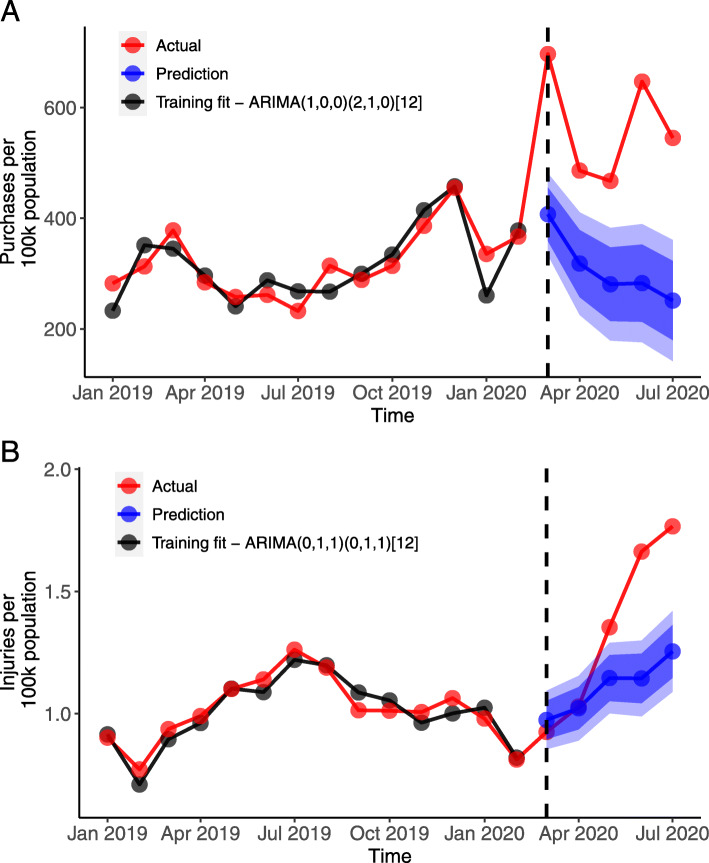
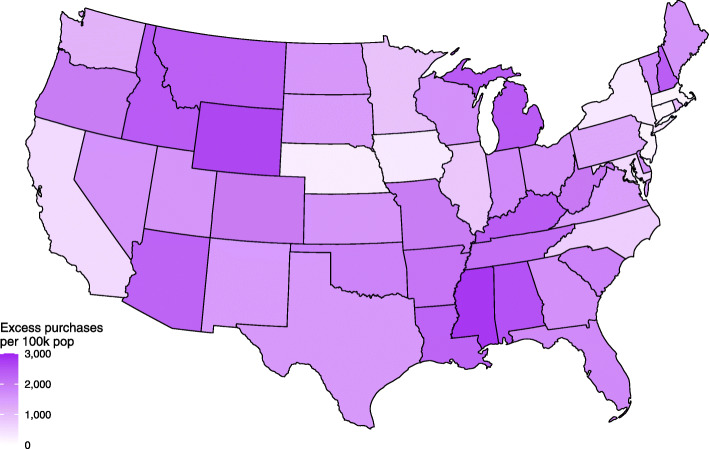
Background: Firearm violence is a significant public health problem in the United States. A surge in firearm purchasing following the onset of the coronavirus pandemic may have contributed to an increase in firearm violence. We sought to estimate the state-level association between firearm purchasing and interpersonal firearm violence during the pandemic. Methods: Cross-sectional study of the 48 contiguous states and the District of Columbia from January 2018 through July 2020. Data were obtained from the National Instant Criminal Background Check System (a proxy for firearm purchasing) and the Gun Violence Archive. Using negative binomial regression models, we estimated the association between cumulative excess firearm purchases in March through July 2020 (measured as the difference between observed rates and those expected from autoregressive integrated moving average models) and injuries (including nonfatal and fatal) from intentional, interpersonal firearm violence (non-domestic and domestic violence). Results: We estimated that there were 4.3 million excess firearm purchases nationally from March through July 2020 and a total of 4075 more firearm injuries than expected from April through July. We found no relationship between state-level excess purchasing and non-domestic firearm violence, e.g., each excess purchase per 100 population was associated with a rate ratio (RR) of firearm injury from non-domestic violence of 0.76 (95% CI: 0.50–1.02) in April; 0.99 (95% CI: 0.72–1.25) in May; 1.10 (95% CI: 0.93–1.32) in June; and 0.98 (95% CI: 0.85–1.12) in July. Excess firearm purchasing within states was associated with an increase in firearm injuries from domestic violence in April (RR: 2.60; 95% CI: 1.32–5.93) and May (RR: 1.79; 95% CI: 1.19–2.91), though estimates were sensitive to model specification. Conclusions: Nationwide, firearm purchasing and firearm violence increased substantially during the first months of the coronavirus pandemic. At the state level, the magnitude of the increase in purchasing was not associated with the magnitude of the increase in firearm violence. Increases in purchasing may have contributed to additional firearm injuries from domestic violence in April and May. Results suggest much of the rise in firearm violence during our study period was attributable to other factors, indicating a need for additional research.
Overview
The claims and statistics of this paper haven’t been checked yet.
Free: it reads the open-access text and checks the first 5 claims that cite a source we can check. Create a free account to check every claim.
Integrity signals
Registry
Cites
Statistics
Figures
Verification
Claims the paper makes
The claims and statistics of this paper haven’t been checked yet.
Free: it reads the open-access text and checks the first 5 claims that cite a source we can check. Create a free account to check every claim.
Claims other papers make about this one
Each is checked against this paper’s own text: does it say what the citing paper says it does?
The cited source says what the claim attributes to it.
In the citing paper
“Although the new data are consistent with other evidence that firearm violence has increased during the Covid-19 pandemic,5”
From Current Causes of Death in Children and Adolescents in the United States (2022) · cites this paper as [5]
Self-check
Percentages, sums and reported differences re-computed from the paper’s own numbers.
The self-check needs the paper’s full text.
Citations
Cites
Controlling the False Discovery Rate: A Practical and Powerful Approach to Multiple Testing
Benjamini, Y., & Hochberg, Y. (1995) · Journal of the Royal Statistical Society Series B: Statistical Methodology · doi:10.1111/j.2517-6161.1995.tb02031.x · Cited by 109,482 · cited 2×
“Benjamini Y, Hochberg Y. Controlling the false discovery rate: a practical and powerful approach to multiple testing.”
MethodTime Series Analysis: Forecasting and Control
Geurts, M., Box, G. E. P., & Jenkins, G. M. (1977) · Journal of Marketing Research · doi:10.2307/3150485 · Cited by 19,186
Biases in dynamic models with fixed effects
Nickell, S. (1981) · Econometrica · doi:10.2307/1911408 · Cited by 8,735 · cited 1×
“While the combination of lagged dependent variable and state fixed effects can generate bias, this bias is inversely proportional to the number of time periods and is likely small in our case (Nickell, 1981).”
BackgroundThe Environment and Disease: Association or Causation?
Hill, A. B. (1965) · Proceedings of the Royal Society of Medicine · doi:10.1177/003591576505800503 · Cited by 6,974
Time Series Analysis Forecasting and Control.
Bartholomew, D. J., Box, G. E. P., & Jenkins, G. M. (1971) · Operational Research Quarterly (1970-1977) · doi:10.2307/3008255 · Cited by 6,716
On a measure of lack of fit in time series models
LJUNG, G. M., & BOX, G. E. P. (1978) · Biometrika · doi:10.1093/biomet/65.2.297 · Cited by 6,668
Automatic Time Series Forecasting: The forecast Package for R
Hyndman, R. J., & Khandakar, Y. (2008) · Journal of Statistical Software · doi:10.18637/jss.v027.i03 · Cited by 3,511
The Dimensions of Residential Segregation
Massey, D. S., & Denton, N. A. (1988) · Social Forces · doi:10.1093/sf/67.2.281 · Cited by 3,483
The outbreak of COVID-19 coronavirus and its impact on global mental health
Torales, J., O’Higgins, M., Castaldelli-Maia, J. M., & Ventriglio, A. (2020) · International Journal of Social Psychiatry · doi:10.1177/0020764020915212 · Cited by 3,013
Designing Difference in Difference Studies: Best Practices for Public Health Policy Research
Wing, C., Simon, K., & Bello-Gomez, R. A. (2018) · Annual Review of Public Health · doi:10.1146/annurev-publhealth-040617-013507 · Cited by 1,470
Research works printed but not linked: 1
- Sequist TD. The disproportionate impact of Covid-19 on communities of color. NEJM Catal Innov Care Deliv. 2020; https://catalyst.nejm.org/doi/full/10.1056/ CAT.20.0370. · doi:10.1056/cat.20.0370
Cited by
Items 101–179 of 179
Logan, T., & Lynch, K. R. (2021) · Violence and Gender · doi:10.1089/vio.2021.0013 · Cited by 4
Wintemute, G. J., Crawford, A., Robinson, S. L., Tomsich, E. A., Reeping, P. M., Schleimer, J. P., & Pear, V. A. (2023) · doi:10.31235/osf.io/h7ksv · Cited by 4
Self-citationBock, J. E., Daruwala, S. E., Tucker, R. P., Foster, S. D., Bandel, S. L., Gunn, J. F., & Anestis, M. D. (2024) · Psychological Reports · doi:10.1177/00332941241255323 · Cited by 6
“Thus, understanding the motivations of individuals who purchased a fi rearm during the pandemic may help curb the increase in COVID-19-related fi rearm violence (Schleimer et al., 2021).”
Densley, J. A., & Peterson, J. (2024) · Journal of Crime and Justice · doi:10.1080/0735648x.2024.2426502 · Cited by 3
States’ COVID-19 policy contexts and suicide rates among US working-age adults
Wiemers, E., Monnat, S. M., Wolf, D. A., Montez, J. K., Grove, J., Gutin, I., & Grossman, E. R. (2025) · Health Affairs Scholar · doi:10.1093/haschl/qxaf024 · Cited by 5
“54,55 This study assessed associations between US states’ COVID-19 physical-distancing and economic support policy contexts and suicide rates among US adults ages 25–64 years, thereby contributing to our understanding of pandemic-era suicide trends.”
An investigation of the impact of the pandemic era on shooting victimizations in Detroit, Michigan
Biasi, A. D., Circo, G. M., Krupa, J. M., Rzotkiewicz, A., & Liebler, J. (2022) · Journal of Crime and Justice · doi:10.1080/0735648x.2022.2148712 · Cited by 4
“…during the pandemic era as legitimate alternatives to monetary attainment become blocked.2 While prior research largely does not support an association between unemployment and firearm violence, one study conducted during the pandemic era has found a positive association (Schleimer et al. 2021).”
BackgroundMcKay, T., Gastineau, K. A. B., Wrenn, J. O., Han, J. H., & Storrow, A. B. (2023) · Injury Prevention · doi:10.1136/ip-2023-044852 · Cited by 7
Call to Action: The Rise of Pediatric Gun Violence During the COVID-19 Pandemic
Schauss, E., Zettler, H. R., Hawes, K., Rashed, J., Roberts, S., Ahern, B., Bartelli, D., Li, C., Burgess, M., & Williams, R. F. (2023) · Journal of Child & Adolescent Trauma · doi:10.1007/s40653-023-00568-4 · Cited by 3
“For example, there was a 27% increase in the number of firearm injuries and death cases in the U.S. between April 2020 and July 2020, resulting in 4075 more injuries than the same months in the prior year (Schleimer et al., 2021).”
Narratives of Outbreak and Survival in English-Language Cinema Prior to COVID-19
Wade, L. D. (2022) · Socius Sociological Research for a Dynamic World · doi:10.1177/23780231221078242 · Cited by 7
“Recordbreaking firearm purchases in 2020 are consistent with this messaging (Brauer 2020; Schleimer et al. 2021), with 71 percent of respondents reporting that they bought firearms to protect themselves from other people (Lyons et al. 2021).”
BackgroundTraumatic pediatric firearm injuries during the COVID-19 pandemic
Crichton, K. G., Brink, F. W., Patterson, K. N., & Michaels, N. L. (2022) · Journal of Applied Research on Children Informing Policy for Children at Risk · doi:10.58464/2155-5834.1479 · Cited by 2
Bock, J. E., Daruwala, S. E., Tucker, R. P., Foster, S. D., Bandel, S. L., Gunn, J. F., & Anestis, M. D. (2022) · doi:10.31234/osf.io/w4udc · Cited by 3
Pediatric Homicides: Not Just a Teenage Problem
Wolf, A., Callier, K. M., Littau, M. J., Cirone, J. M., Henry, M. C. W., & Hampton, D. (2024) · Journal of Surgical Research · doi:10.1016/j.jss.2024.07.086 · Cited by 2
Beyond the Index: Family Fragility as a Geographic Risk Factor for Pediatric Firearm Injuries
Rempson, C. M., Pracht, E. E., Green, A., Chandler, N. M., & Snyder, C. W. (2025) · Journal of Pediatric Surgery · doi:10.1016/j.jpedsurg.2025.162337 · Cited by 2
van Schalkwyk, M. C., Hawkins, B. R., Maani, N., & Petticrew, M. P. (2025) · Globalization and Health · doi:10.1186/s12992-025-01106-7 · Cited by 2
“A surge in firearm purchases during the Covid-19 pandemic has resulted in approximately 30 million children now living in households with firearms [11].”
Paul, M., Kahan, A. M., & Coakley, B. A. (2023) · Journal of Pediatric Surgery · doi:10.1016/j.jpedsurg.2023.12.016 · Cited by 3
Pandemic as an additional criminality factor
Готчина, Л., Kokin, D. M., Semenova, V. V., Serdyuk, L. V., & Serdyuk, P. L. (2021) · SHS Web of Conferences · doi:10.1051/shsconf/202110803014 · Cited by 3
Spatiotemporal patterns of firearm acquisition in the United States in different presidential terms
Wang, X., Sipahi, R., & Porfiri, M. (2022) · Chaos An Interdisciplinary Journal of Nonlinear Science · doi:10.1063/5.0096773 · Cited by 3
Shift in Prehospital Mode of Transportation for Trauma Patients During the COVID-19 Pandemic
Mooney, C. M., Banks, K. C., Borthwell, R. M., Victorino, K., Coutu, S., Browder, T. D., & Victorino, G. P. (2023) · Journal of Surgical Research · doi:10.1016/j.jss.2023.02.002 · Cited by 2
“It is likely the cause of this increase is multifactorial due to various aspects such as socioeconomic changes and a demonstrated rise in firearm purchases during this time.(13,14) Interestingly, we identified some changes consistent with the idea of a protective effect associated with private transportation.”
Tomas, C. W., Flynn‐O’Brien, K. T., Harris, J., Kostelac, C. A., Moore, R. J., Cassidy, L., & deRoon‐Cassini, T. A. (2023) · Trauma · doi:10.1177/14604086231165127 · Cited by 3
“26 Further examination of the current dataset indicated for falls and MVCs Hispanic or Latino and Black patients were predominantly male and signi fi cantly younger compared to White patients (Online Supplementary Material Table S3).”
Attridge, M. M., Heffernan, M. E., Bendelow, A. C., Menker, C. G., Davis, M. M., & Sheehan, K. (2023) · Injury Epidemiology · doi:10.1186/s40621-023-00444-7 · Cited by 2
“While not necessarily a limitation, these results were collected during the COVID-19 pandemic during which firearm sales rose rapidly (Schleimer et al. 2021), and more children experienced behavioral health concerns (Theberath et al. 2022).”
ResultRohit, G., Hariprasad, C. P., Kumar, A., Kishor, S., Kumar, D., & Paswan, S. S. (2020) · International Journal of Surgery Case Reports · doi:10.1016/j.ijscr.2020.10.077 · Cited by 2
The Mediating Effects of Personality on COVID-19 Anxiety and Rumination
Bueno, R., Sandoval, C., & Lilienthal, K. K. (2021) · Journal of Research in Psychology · doi:10.31580/jrp.v3i2.2051 · Cited by 2
What Is a Family? Issues in Defining Family
Settles, B. H. (2023) · Springer eBooks · doi:10.1007/978-3-031-31549-7_1 · Cited by 1
Trends in Domestic Violence and Firearm Domestic Violence During COVID-19 in Five US Cities
Tomsich, E. A., Schleimer, J. P., McCort, C. D., & Wintemute, G. J. (2023) · Journal of Family Violence · doi:10.1007/s10896-023-00613-8 · Cited by 2
“One exception includes Schleimer et al. (2021), who found an association between excess state-level firearm purchases and firearm DV injuries in April and May of 2020.”
InfluentialSelf-citationFormative reasons for state-to-state influences on firearm acquisition in the U.S.
Wang, X., Macinko, J. A., Porfiri, M., & Sipahi, R. (2024) · SSM - Population Health · doi:10.1016/j.ssmph.2024.101680 · Cited by 1
Laqueur, H. S., Smirniotis, C., & McCort, C. D. (2024) · Journal of Urban Health · doi:10.1007/s11524-024-00909-0 · Cited by 1
“This rise in homicides coincided with record-high firearm sales, which researchers have linked to increased gun violence [3,4].”
Self-citationKoong, A. J., Henson-García, M., Malthaner, L., Jetelina, K. K., Hernandez, B., & McKay, S. (2025) · Health Promotion Practice · doi:10.1177/15248399251323898 · Cited by 1
“Against the backdrop of a firearm purchasing surge—in which first-time ownership is disproportionately increasing across purchasing segments (Schleimer et al., 2021)—findings highlight the promise of standardized programs leveraging point-of-sale relationships to effectively and responsibly reach…”
Widening Gaps: Racial and Ethnic Disparities in Adolescent Trauma Trends From 2017 to 2022
Shen, C., Li, N., Zhou, S., Sekhar, D. L., Schubart, J. R., & Oh, J. S. (2025) · Journal of Adolescent Health · doi:10.1016/j.jadohealth.2025.06.030 · Cited by 1
The Influence of Firearm Dealer Openings and Closings on Local Shootings in the U.S.
Semenza, D. C., Silver, I. A., Stansfield, R., & Savage, B. (2025) · American Journal of Preventive Medicine · doi:10.1016/j.amepre.2025.108079 · Cited by 1
Maternal homicide rates among 15 United States
Bright, M. A., Amendola, A., Harris, D. R., & Delcher, C. (2025) · BMC Public Health · doi:10.1186/s12889-025-24818-2 · Cited by 1
“Furthermore, excess firearm purchasing was positively associated with domestic violence-related firearm injuries and death, especially during April and May 2020 [16].”
Preventing firearm-related deaths and the public good: a contingent valuation study in California
Kravitz‐Wirtz, N., Lund, J. J., Aubel, A. J., Shev, A. B., & Wintemute, G. J. (2025) · Health Affairs Scholar · doi:10.1093/haschl/qxaf249 · Cited by 1
Self-citationNon-fatal firearm injuries in Chicago: description and analysis by neighbourhood health equity zone
Wolf, A. E., Offstein, M. L., Metrick, R., Saiyed, N. S., King, N., Panahikarvand, A., & Gutierrez‐Kapheim, M. (2026) · Injury Prevention · doi:10.1136/ip-2025-046009 · Cited by 1
“20 Another factor to consider is the reliability of intent documentation by hospital staff.”
Larson, R. P., Densley, J. A., Peterson, J., Manchi, J., Santaularia, N. J., Robertson, C. E., & Uggen, C. (2026) · Journal of Quantitative Criminology · doi:10.1007/s10940-026-09653-x · Cited by 1
Fazel‐Zarandi, M. M., & Barnett, A. I. (2024) · Risk Analysis · doi:10.1111/risa.14271 · Cited by 1
“The role of guns The widespread availability of handguns in the United States has long been considered central to its relatively high homicide rate (Cook & Donohue, 2017; Crifasi et al., 2018; Schleimer et al., 2021; Siegel et al., 2017; Siegel et al., 2013).”
Domestic firearm violence against women (2018–2021)
Shipley, J. H., Donnelly, M., Kuza, C. M., Grigorian, A., Swentek, L., Chin, T. L., Brown, N. J., Nguyen, N. T., & Nahmias, J. T. (2024) · Surgery Open Science · doi:10.1016/j.sopen.2024.01.010 · Cited by 2
“Furthermore, the rate of firearm purchases during the COVID-19 pandemic is at an all-time high, as there were over 4.3 million estimated firearm purchases between March and July 2020 alone, an 85 % increase in the expected amount calculated from previous years [10,11].”
BackgroundInfluentialRapp-McCall, L., & Lucio, R. (2024) · Advances in Social Work · doi:10.18060/27395 · Cited by 1
“In 2018, there were approximately 393 million firearms in the U.S. (Ingraham, 2018) and firearm purchases escalated by 4.3 million or 64.3% more than typical purchases during the Covid pandemic (Schleimer et al., 2021).”
BackgroundInfluentialThe Impact of COVID-19 on Patterns of Fractures Presenting to Pediatric Emergency Departments
Ruest, S. M., Hanson, H. R., Kiragu, A. W., Lee, L. K., Zonfrillo, M. R., & Pomerantz, W. J. (2024) · Pediatric Emergency Care · doi:10.1097/pec.0000000000003294 · Cited by 1
Scrushy, M. G., Abbe, M., Wang, S., Stone, G., Pandya, S. R., & Ryan, M. (2024) · Journal of Surgical Research · doi:10.1016/j.jss.2024.10.027 · Cited by 1
Firearm access, storage practices, and suicide risk factors among Colorado adults during 2020–2022
Barnard, L. M., Perng, W., Brooks‐Russell, A., Spark, T. L., Betz, M. E., & DiGuiseppi, C. G. (2025) · Academia Mental Health and Well-Being · doi:10.20935/mhealthwellb8023 · Cited by 1
Pursuing an Evidence-Informed Approach to the Prevention of Gun Violence
Rajan, S. (2022) · American Journal of Public Health · doi:10.2105/ajph.2022.306799 · Cited by 1
The Application of Time Series Analysis to Injury Epidemiology Data
Lundstrom, E. W. (2023) · The Research Repository @ WVU (West Virginia University) · doi:10.33915/etd.11869 · Cited by 2
COVID-19 and Firearms: Public Health Considerations
Silver, E. M. (2021) · Journal of Legal Medicine · doi:10.1080/01947648.2021.1914491
Adapting Hospital-based Intimate Partner Violence Programs to the COVID-19 Pandemic
Olson, C., Aboutanos, M. B., Thomson, N. D., Vincent, A., & Kevorkian, S. S. (2022) · Panamerican Journal of Trauma Critical Care & Emergency Surgery · doi:10.5005/jp-journals-10030-1375
Teen firearm access during COVID: a repeated cross-sectional analysis of Pennsylvania families
Wallace, L. N. (2022) · Safer Communities · doi:10.1108/sc-05-2022-0018
Linking COVID-19 and Firearm Violence
Sakae, C., Rockne, W. Y., Donnelly, M., Clark, S., Swentek, L., & Nahmias, J. T. (2022) · Springer eBooks · doi:10.1007/978-3-030-98711-4_153-1
The Perfect Storm? Political Instability and Background Checks During COVID-19
Anisin, A. (2023) · International Journal of Criminology and Sociology · doi:10.6000/1929-4409.2023.12.02
Bashar, M., & Sheikh, N. A. (2023) · Indian Journal of Community Health · doi:10.47203/ijch.2023.v35i01.025
Upsurge in firearm related deaths among children and adolescent in United States: An alarming trend
Bashar, M. (2023) · The Journal of Community Health Management · doi:10.18231/j.jchm.2023.017
Personal Pandemonium: Stress and Mental Health
Burns, R. B. (2023) · Springer eBooks · doi:10.1007/978-981-99-1710-5_8 · Cited by 1
Linking COVID-19 and Firearm Violence
Sakae, C., Rockne, W. Y., Donnelly, M., Clark, S., Swentek, L., & Nahmias, J. T. (2023) · Springer eBooks · doi:10.1007/978-3-031-31547-3_153
Roess, A., Henderson, L. F., Adams, L. M., & Renshaw, K. D. (2023) · AJPM Focus · doi:10.1016/j.focus.2023.100171 · Cited by 1
Drawve, G. R., & Harris, C. T. (2023) · Police Practice and Research · doi:10.1080/15614263.2023.2292048 · Cited by 2
“…tensions created by the COVID-19 lockdowns (Kim & McCarty, 2022), declining trust in police following the George Floyd protests (Pryce & Gainey, 2022), turnover in law enforcement (Mourtgos et al., 2022), and the continued proliferation of firearms across the nation (Schleimer et al., 2021).”
InfluentialSo, M., Baassiri, M. G. E., Price, M. D., Byrne, J. P., Haut, E. R., & Nasr, I. W. (2024) · Research Square · doi:10.21203/rs.3.rs-4534823/v1 · Cited by 1
“This was likely due to increased �rearm purchases, reduced law enforcement presence, economic instability, increased incidences of domestic violence due to closer living proximities and increased interpersonal con�icts (22).”
BackgroundMcLone, S. G., Pamplin, J. R., Pappu, J. D., Gradus, J. L., & Jay, J. S. (2024) · Injury Epidemiology · doi:10.1186/s40621-024-00515-3
Firearm violence and the 'reopening phenomenon' in Turkey
Özkan, A., Ferhatlar, E., & Algın, A. (2024) · Injury · doi:10.1016/j.injury.2024.111962 · Cited by 1
Forced migration and gun violence: What do we know?
Reidy, D. E., Whitaker, D. J., O’Connor, M. H., Topalli, V., & Thomson, N. D. (2024) · Elsevier eBooks · doi:10.1016/b978-0-323-95272-9.00030-9
Back to Basics: What Descriptive Epidemiology Can Teach Us About the Recent Rise in Firearm Homicide
Pear, V. A., & Schleimer, J. P. (2024) · Epidemiology · doi:10.1097/ede.0000000000001827
Self-citationFunctional limitations and firearm purchases among low-income U.S. military veterans
Testa, A. M., & Tsai, J. (2024) · Injury Epidemiology · doi:10.1186/s40621-024-00553-x
Urban scaling with censored data
Figueira, I., Succar, R., Ventura, R. B., & Porfiri, M. (2025) · PLOS complex systems. · doi:10.1371/journal.pcsy.0000029
A Tale of Three (Major) Cities: Trends in Covid-19 Firearm Deaths Pre- vs. Post-PandemicPreprint
Cardone, C., Kilpatrick, A., Bunker, S., Ledet, R., Duran, M., Coello-Sanchez, C., D’Amico, M., & Richman, M. J. (2025) · medRxiv · doi:10.1101/2025.04.28.25326367
Ameden, L. M., Alpern, E. R., Goyal, M. K., Cook, L. J., & Donnelly, K. A. (2025) · Pediatric Emergency Care · doi:10.1097/pec.0000000000003426
Kim, L. Y. (2025) · Undergraduate Journal of Public Health · doi:10.3998/ujph.7620
Carter, P., Zimmerman, M. A., & Sokol, R. L. (2021) · The Conversation · doi:10.64628/aai.vut99pj7a · Cited by 1
An expert on trends in gun sales and gun violence in pandemic America
Wintemute, G. J. (2022) · doi:10.64628/aai.dmpgtfr36
Self-citationPediatric facial trauma: how social determinants of health impact injury patterns
Berezovsky, A. N., Thomas, A. B., Adams, J. A., Luo, J., Friedland, D. R., & Shay, S. (2025) · International Journal of Pediatric Otorhinolaryngology · doi:10.1016/j.ijporl.2025.112572
Oliphant, S. N., Hans, Z., Austin, A. E., & Sokol, R. L. (2025) · American Journal of Preventive Medicine · doi:10.1016/j.amepre.2025.108130
Job-related problems among 2021 nurse suicides
Agarwal, S., James, K. E., Armenion, K. L., Clapp, C., Makhija, H., Zisook, S., & Davidson, J. E. (2025) · Nursing Management · doi:10.1097/nmg.0000000000000299
Early exposure: rising assault-related firearm injuries in school-aged children during COVID years
Shen, C., Li, N., & Oh, J. S. (2025) · BMC Research Notes · doi:10.1186/s13104-025-07548-x
“Meanwhile, the social and political unrest felt during the pandemic further fueled this trend, with private gun purchases rising markedly [23].”
Additional file 1 of Changes in suicide in California from 2017 to 2021: a population-based study
Lund, J. J., Tomsich, E. A., Schleimer, J. P., & Pear, V. A. (2024) · Figshare · doi:10.6084/m9.figshare.26577974
Self-citationValek, R. A., Ward, J. A., Jones, V., & Crifasi, C. K. (2024) · Figshare · doi:10.6084/m9.figshare.26962520
Effect of COVID-19 on orthopedic injuries due to firearm violence
Kozlowski, K. A., Rick, T., Kucharski, D., Wadhwani, A., Mendel, R., Ryan, T., Pawlowski, G., & Lutnick, E. (2025) · Journal of Orthopaedic Reports · doi:10.1016/j.jorep.2025.100860
Chavez, S., Ugalde, I. T., Ulrich, M. R., Adepoju, O. E., Xu, T., & Liaw, W. R. (2026) · The Lancet Regional Health - Americas · doi:10.1016/j.lana.2025.101343 · Cited by 1
Gun Violence: A Decade of Experience at a Free-Standing Children’s Hospital
Wilson, C., Brown, M. F., & White, P. C. (2026) · Clinical Pediatrics · doi:10.1177/00099228251404291
“14 The research suggests other factors include the financial strain on families and the change in access to school and extracurricular activities.”
Visualizing the Rise and Seasonality of Mass Shootings in the United States
Bridges, T. S., Tober, T. L., Tyberg, S., & Munday, L. (2026) · Socius Sociological Research for a Dynamic World · doi:10.1177/23780231261425279
Interconexões Criminais e Socioeconômicas: Análise Empírica sobre a Violência contra a Pessoa
Rodrigues, A. X., Ferreira, M. A. M., Bastos, E. D. M., & Teixeira, M. B. (2026) · Revista de Administração Contemporânea · doi:10.1590/1982-7849rac2026240336.por
Firearm Safety in a Country of Arms
Metzl, J. M. (2026) · Milbank Quarterly · doi:10.1111/1468-0009.70091 · Cited by 1
“123,124 127 Meanwhile, mistrust—of governments, mandates, police, crim-inals, or others—taps into larger social and economic fault lines in ways that render the kinds of community participation vital for many public health interventions difficult.”
Verona, E., Chen, H. I., Stall, L. M., McCarthy, A., & Jankovsky, A. (2026) · Research Square · doi:10.21203/rs.3.rs-9784494/v1
Pedestrian stops and shootings: a system GMM analysis by stop initiation type and victim fatality
Kim, D.-Y. (2026) · Journal of Experimental Criminology · doi:10.1007/s11292-026-09769-x
Non-fatal firearm violence across 17 US cities using police dashboard data, 2020–2025
Benjamins, M. R., Huerta, C. D. L., Saiyed, N. S., Offstein, M. L., Gutierrez‐Kapheim, M., & Wolf, A. (2026) · Preventive Medicine Reports · doi:10.1016/j.pmedr.2026.103587
“Additionally, firearm purchasing, leading to firearm access and carrying, both risk factors for injury, increased during the COVID-19 pandemic, but decreased substantially over the 2020 – 2025 time period (Miller et al., 2024; Schleimer et al., 2021).”
Metadata
- Authors
- Schleimer, J. P., McCort, C. D., Shev, A. B., Pear, V. A., Tomsich, E., De Biasi, A., Buggs, S., Laqueur, H. S., & Wintemute, G. J.
- Affiliations
- University of California, Davis (US)
- Corresponding author
- Schleimer, Julia P.
- ORCID
- Venue
- Injury Epidemiology
- Published
- 2021-07-05
- Volume
- 8
- Issue
- 1
- Pages
- 43-43
- ISSN
- 2197-1714 (ISSN-L)
- PMC
- PMC8256207
- OpenAlex
- W3182189940
- Cited by
- 179
- References
- 55
- Citations by year
- 2026: 10 · 2025: 20 · 2024: 30 · 2023: 46 · 2022: 43 · 2021: 22
- FWCI
- 19.43
- Type
- journal article
- Language
- en
- Open access
- gold
- doi.org
- Licence
- cc-by
- creativecommons.org/licenses/by/4.0 (tdm)
- creativecommons.org/licenses/by/4.0 (vor)
- Locations
- Injury Epidemiology (publishedVersion, cc-by)
- medRxiv (acceptedVersion)
- PubMed Central (publishedVersion, cc-by)
- PubMed (publishedVersion)
- DOAJ (DOAJ: Directory of Open Access Journals) (submittedVersion, cc-by-sa)
- eScholarship (California Digital Library) (submittedVersion)
- Funders
- Joyce Foundation (42400)
- Heising-Simons Foundation (2019-1728)
- University of California Firearm Violence Research Center
- Topics
- Social Sciences › Health › Gun Ownership and Violence Research
- Social Sciences › Sociology and Political Science › Homicide, Infanticide, and Child Abuse
- Social Sciences › Sociology and Political Science › Crime Patterns and Interventions
- Keywords
- gun violence, COVID-19 pandemic, domestic violence, firearm injuries, state-level analysis
About these checks
Registry, retraction, Cites and statistics results are computed, not judged, with one exception: a printed reference that no index lists is read once by a model before it counts as a citation error. Claims are extracted by a model and kept only when their quote appears verbatim in the text; each cited source is then checked, with a model’s help, for whether it says what the claim relies on. Those verdicts can be wrong — read the claim’s quote and the cited source before relying on one.
Statistics and arithmetic are recomputed, not judged.
Confidence bands are shown only for fields calibrated on our annotated test set. None is calibrated yet, so no band is shown.
What counts as a claim ›How we measure confidence ›How we check this ›
Are you an author, or do you see a problem with this page? Request a review
Data sources
Bibliographic data: Semantic Scholar, OpenAlex, Crossref.
Contains information from the Semantic Scholar Academic Graph Datasets, made available under the ODC Attribution License (ODC-BY 1.0).
Semantic Scholar’s data is described in: Kinney, R., et al. (2023). The Semantic Scholar Open Data Platform. arXiv:2301.10140.
