

Exploratory studies to decide whether and how to proceed with full-scale evaluations of public health interventions: a systematic review of guidance
Open accessThe DOI matches its Crossref record; 43 of the 44 references it cites were found in a registry or an index; 99 of the 260 sources its claims cite were checked for support.
Abstract
BACKGROUND: Evaluations of complex interventions in public health are frequently undermined by problems that can be identified before the effectiveness study stage. Exploratory studies, often termed pilot and feasibility studies, are a key step in assessing the feasibility and value of progressing to an effectiveness study. Such studies can provide vital information to support more robust evaluations, thereby reducing costs and minimising potential harms of the intervention. This systematic review forms the first phase of a wider project to address the need for stand-alone guidance for public health researchers on designing and conducting exploratory studies. The review objectives were to identify and examine existing recommendations concerning when such studies should be undertaken, questions they should answer, suitable methods, criteria for deciding whether to progress to an effectiveness study and appropriate reporting. METHODS: We searched for published and unpublished guidance reported between January 2000 and November 2016 via bibliographic databases, websites, citation tracking and expert recommendations. Included papers were thematically synthesized. RESULTS: The search retrieved 4095 unique records. Thirty papers were included, representing 25 unique sources of guidance/recommendations. Eight themes were identified: pre-requisites for conducting an exploratory study, nomenclature, guidance for intervention assessment, guidance surrounding any future evaluation study design, flexible versus fixed design, progression criteria to a future evaluation study, stakeholder involvement and reporting of exploratory studies. Exploratory studies were described as being concerned with the intervention content, the future evaluation design or both. However, the nomenclature and endorsed methods underpinning these aims were inconsistent across papers. There was little guidance on what should precede or follow an exploratory study and decision-making surrounding this. CONCLUSIONS: Existing recommendations are inconsistent concerning the aims, designs and conduct of exploratory studies, and guidance is lacking on the evidence needed to inform when to proceed to an effectiveness study. TRIAL REGISTRATION: PROSPERO 2016, CRD42016047843.
Overview
CoChat Summary
TL;DR
This systematic review synthesizes existing guidance on exploratory studies intended to inform whether and how to proceed with full-scale public health intervention evaluations. It finds inconsistent terminology, aims, methods, progression criteria, and reporting recommendations, with little guidance on key decision-making.
Key findings
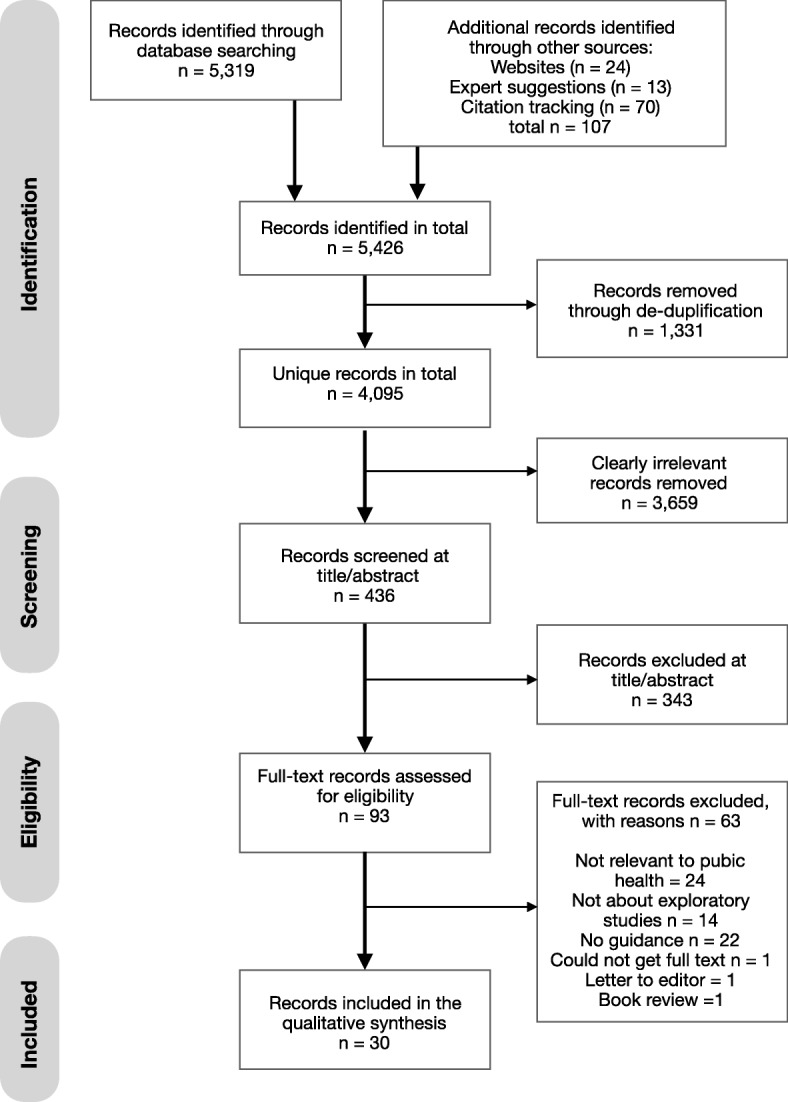
- The search retrieved 4,095 unique records; 30 papers were included, representing 25 unique sources of guidance/recommendations.
- Eight themes were identified: pre-requisites, nomenclature, intervention assessment, future evaluation design, flexible vs. fixed design, progression criteria, stakeholder involvement, and reporting.
- Nomenclature and endorsed methods were inconsistent: “pilot trial/study” appeared in 16 sources, “feasibility trial/study” in 8, and “feasibility and piloting stage” in 5.
- Guidance was lacking on what should precede or follow an exploratory study and on how to decide whether to progress to an effectiveness study.
Methods
- Systematic review reported according to PRISMA, registered on PROSPERO (CRD42016047843), searching published and unpublished guidance from January 2000 to November 2016 via bibliographic databases, websites, citation tracking, and expert recommendations.
- Eligibility covered guidance on exploratory/pilot/feasibility/phase II/proof-of-concept studies relevant to public health; 30 documents were included after screening.
- Included papers were thematically synthesized using an a priori coding framework in NVivo, with a 10% sample of coded papers checked by a second reviewer.
Limitations
- The authors state that guidance from other social intervention areas (e.g., education, social work, business) may not have been captured; few public health worked examples were found; and treating sources as independent does not reflect how recommendations developed over time.
- The authors note that included documents represent one element in a complex research production system and may not fully reflect actual conduct of exploratory studies.
- The text makes evident that quality assessment was not applicable because included publications were expert guidance or methodological discussion papers.
Model-written summary. Check it against the paper before relying on it.
Integrity signals
Registry
Cites
Statistics
Figures
Verification
Claims the paper makes
36 Valid · 1 Not valid · 69 Not checked · 77 Own results and interpretations
The sources with a verdict support this claim; the rest weren’t checked yet, have no full text we could read, or their verdicts aren’t rated yet.
In the paper
“Guidance for exploratory studies prior to a full evaluation have, however, often been framed as relevant only where the main evaluation is to be an RCT [13, 15].”
§ Exploratory studies to decide whether and how to proceed with full-scale evaluations of public health interventions: a systematic review of guidance > Background
What the sources say
- Not checked yetcites [13] Medical Research Council A framework for the development and evaluation of RCTs for complex interventions to improve health 2000 London Medical Research Council
- Supportedcites [15] O’Cathain A, Hoddinott P, Lewin S, Thomas KJ, Young B, Adamson J, et al. Maximising the impact of qualitative research in feasibility studies for randomised controlled trials: guidance for researchers. Pilot Feasibility Stud. 2015;1(1):32. PMC5154038 27965810 source
The Introduction section on the need for guidance explicitly frames this paper as guidance for qualitative research in feasibility studies for randomised controlled trials. It therefore supports the citing sentence as an example of guidance framed around a planned RCT; this single source does not, by itself, establish how often guidance is framed that way. (LLM, conf=0.91)
plain- Asserted: passes — The authors put it forward as true.
- Checkable: passes — It can be checked against evidence.
- Load-bearing: passes — The paper’s conclusions depend on it.
- Based: passes — The paper gives a reason why it holds.
The cited sources support only part of this claim — read each source’s verdict below.
In the paper
“Within the research literature, there is considerable divergence over what exploratory studies should be called, what they should achieve, what they should entail, whether and how they should determine progression to future studies and how they should be reported [7, 8, 19–21].”
§ Exploratory studies to decide whether and how to proceed with full-scale evaluations of public health interventions: a systematic review of guidance > Background
What the sources say
- Partly supportedcites [7] Eldridge SM Chan CL Campbell MJ Bond CM Hopewell S Thabane L CONSORT 2010 statement: extension to randomised pilot and feasibility trials Pilot Feasibility Stud. 2016 2 64 10.1186/s40814-016-0105-8 27965879 PMC5154046 sourceExperimental — accuracy not yet measured
The Scope of this paper section (page unavailable) documents varied terminology for pilot and feasibility trials and identifies weaknesses in their conduct and reporting. The Methods section (page unavailable) also discusses different ways to use criteria for progression to a definitive trial. The source focuses on randomised pilot and feasibility trials, however, and does not establish considerable divergence across all the claimed aspects of exploratory studies generally. (LLM, conf=0.82)
- Partly supportedcites [8] Eldridge SM Lancaster GA Campbell MJ Thabane L Hopewell S Coleman CL Defining feasibility and pilot studies in preparation for randomised controlled trials: development of a conceptual framework PLoS One 2016 11 e0150205 10.1371/journal.pone.0150205 26978655 PMC4792418 sourceExperimental — accuracy not yet measured
The Introduction and Discussion describe disagreement over the terms ‘pilot’ and ‘feasibility,’ unclear objectives, weaknesses in conduct and reporting, and difficulty telling whether a future RCT was planned. But the Discussion says there is ‘general agreement in the literature’ about these studies’ purpose. The paper does not establish the claimed divergence over whether and how such studies should determine progression to future studies. (LLM, conf=0.84)
- Supportedcites [19] Arain M, Campbell, MJ, Cooper CL, Lancaster GA. What is a pilot or feasibility study? A review of current practice and editorial policy BMC Med Res Methodol. 2010;10:67. PMC2912920 20637084 source
The Conclusions (page unavailable) say that definitions of pilot and feasibility studies vary and that their requirements and reporting need clarification. The Discussion (page unavailable) describes differing purposes and practices, including whether a pilot leads to a larger study and the need for explicit criteria for abandoning one. Together these support the attributed summary of divergence. (LLM, conf=0.90)
- Supportedcites [20] Lancaster GA Pilot and feasibility studies come of age! Pilot Feasibility Stud. 2015 1 1 10.1186/2055-5784-1-1 29611687 PMC5842886 source
The Guidelines for the conduct and reporting section explicitly notes a lack of consensus on the terms ‘pilot’ and ‘feasibility’ and little guidance on reporting. The Key objectives section describes confusion about study aims, debate over statistical analysis, unclear criteria for success, and inadequate discussion of whether findings will lead to a larger study. Together, these passages support the broad claim about divergence in the literature. (LLM, conf=0.88)
- Partly supportedcites [21] Shanyinde M, Pickering RM, Weatherall M. Questions asked and answered in pilot and feasibility randomized controlled trials. BMC Med Res Methodol. 2011;11:117. PMC3170294 21846349 sourceExperimental — accuracy not yet measured
The Background (page unavailable) describes differing definitions and objectives for pilot and feasibility studies, and the Discussion contrasts published trials with those definitions. The paper also discusses whether authors planned subsequent trials and mentions a reporting checklist, but the passages do not establish divergence over criteria for progressing to future studies or over how studies should be reported. (LLM, conf=0.84)
plain- Asserted: passes — The authors put it forward as true.
- Checkable: passes — It can be checked against evidence.
- Load-bearing: passes — The paper’s conclusions depend on it.
- Based: passes — The paper gives a reason why it holds.
- Partly supported
The sources with a verdict support this claim; the rest weren’t checked yet, have no full text we could read, or their verdicts aren’t rated yet.
In the paper
“Sources of guidance endorsed exploratory studies having formative purposes (i.e. refining the intervention and addressing uncertainties related to intervention implementation [13, 15, 29, 31, 39]) as well as summative goals (i.e. assessing the potential impact of an intervention or its promise [6, 13, 39]).”
§ Exploratory studies to decide whether and how to proceed with full-scale evaluations of public health interventions: a systematic review of guidance > Results > Narrative description of themes
What the sources say
- Supportedcites [6] Wight D, Wimbush E, Jepson R, Doi L. Six steps in quality intervention development (6SQuID). J Epidemiol Community Health. 2015;70:520–5. PMC4853546 26573236 source
In step 6, the paper recommends collecting initial evidence that an intervention is working and achieving short-term outcomes before investing in rigorous evaluation. It also says an exploratory trial can estimate likely effect sizes, supporting the claim that exploratory work may assess an intervention’s promise. (LLM, conf=0.92)
- Not checked yetcites [13] Medical Research Council A framework for the development and evaluation of RCTs for complex interventions to improve health 2000 London Medical Research Council
- Supportedcites [39] Bowen DJ Kreuter M Spring B Cofta-Woerpel L Linnan L Weiner D How we design feasibility studies Am J Prev Med 2009 36 452 457 10.1016/j.amepre.2009.02.002 19362699 PMC2859314 source
In “Appropriate Areas of Focus,” the paper endorses limited-efficacy testing as a focus of feasibility studies, including tests with intermediate outcomes or limited statistical power. “Does It Work?” also describes small-scale trials that estimate an intervention’s effect before a full trial. These support the attributed summative goal of assessing an intervention’s potential impact or promise. (LLM, conf=0.92)
plain- Asserted: passes — The authors put it forward as true.
- Checkable: passes — It can be checked against evidence.
- Load-bearing: passes — The paper’s conclusions depend on it.
- Based: passes — The paper gives a reason why it holds.
- Supported
The sources with a verdict support this claim; the rest weren’t checked yet, have no full text we could read, or their verdicts aren’t rated yet.
In the paper
“For example, some described pilot studies as a smaller version of a future RCT to run in miniature [7, 8, 19, 29, 32–34] and was sometimes associated with a randomised design [32, 34], but not always [7, 8].”
§ Exploratory studies to decide whether and how to proceed with full-scale evaluations of public health interventions: a systematic review of guidance > Results > Narrative description of themes
What the sources say
- Supportedcites [7] Eldridge SM Chan CL Campbell MJ Bond CM Hopewell S Thabane L CONSORT 2010 statement: extension to randomised pilot and feasibility trials Pilot Feasibility Stud. 2016 2 64 10.1186/s40814-016-0105-8 27965879 PMC5154046 source
The Scope of this paper section defines a pilot study as one in which a future definitive RCT, or part of it, is conducted on a smaller scale. It also says such a study might or might not be randomised, matching the cited sentence’s qualification. No page number is provided in our copy. (LLM, conf=0.94)
- Supportedcites [8] Eldridge SM Lancaster GA Campbell MJ Thabane L Hopewell S Coleman CL Defining feasibility and pilot studies in preparation for randomised controlled trials: development of a conceptual framework PLoS One 2016 11 e0150205 10.1371/journal.pone.0150205 26978655 PMC4792418 source
The Introduction reports an NIHR definition of a pilot study as a main study ‘run in miniature’ and its later wording as ‘a smaller version of the main study.’ The Results section also defines a pilot study as conducting a future study, or part of it, on a smaller scale; in this paper, the future study is an RCT. (LLM, conf=0.94)
- Supportedcites [19] Arain M, Campbell, MJ, Cooper CL, Lancaster GA. What is a pilot or feasibility study? A review of current practice and editorial policy BMC Med Res Methodol. 2010;10:67. PMC2912920 20637084 source
The Results section defines a pilot study as a version of the main study run in miniature. The Portfolio database review adds that most pilot and feasibility studies ran the whole study in miniature, with or without randomization; the Literature survey specifically discusses pilots for future RCTs. Page numbers are not provided in our copy. (LLM, conf=0.93)
- Supportedcites [29] Fletcher A Jamal F Moore G Evans RE Murphy S Bonell C Realist complex intervention science: applying realist principles across all phases of the Medical Research Council framework for developing and evaluating complex interventions Evaluation 2016 22 286 303 10.1177/1356389016652743 27478401 PMC4946011 source
In “Complex intervention science phases,” the paper says pilot studies may be smaller versions of the main trial, implementing the intervention and trial on a smaller scale. The “Realist feasibility and pilot studies” section also discusses pilot RCTs before larger trials. No page number is provided in our copy. (LLM, conf=0.93)
- Not checked yetcites [32] National Institute for Health Research. Feasibility and pilot studies. Available from: http://www.nihr.ac.uk/CCF/RfPB/FAQs/Feasibility_and_pilot_studies.pdf. Accessed 14 Oct 2016.
- Not checked yetcites [33] National Institute for Health Research. Glossary | Pilot studies 2015 http://www.nets.nihr.ac.uk/glossary?result_1655_result_page=P. Accessed 14 Oct 2016.
- Not checked yetcites [34] Taylor RS Ukoumunne OC Warren FC Richards DA Hallberg IR How to use feasibility and pilot trials to test alternative methodologies and methodological procedures proir to full-scale trials Complex interventions in health: an overview of research methods 2015 New York Routledge
plain- Asserted: passes — The authors put it forward as true.
- Checkable: passes — It can be checked against evidence.
- Load-bearing: unclear — It is unclear whether the paper’s conclusions depend on it.
- Based: passes — The paper gives a reason why it holds.
- Supported
The sources with a verdict support this claim; the rest weren’t checked yet, have no full text we could read, or their verdicts aren’t rated yet.
In the paper
“Sources of guidance endorsed exploratory studies having formative purposes (i.e. refining the intervention and addressing uncertainties related to intervention implementation [13, 15, 29, 31, 39]) as well as summative goals (i.e. assessing the potential impact of an intervention or its promise [6, 13, 39]).”
§ Exploratory studies to decide whether and how to proceed with full-scale evaluations of public health interventions: a systematic review of guidance > Results > Narrative description of themes
What the sources say
- Not checked yetcites [13] Medical Research Council A framework for the development and evaluation of RCTs for complex interventions to improve health 2000 London Medical Research Council
- Supportedcites [15] O’Cathain A, Hoddinott P, Lewin S, Thomas KJ, Young B, Adamson J, et al. Maximising the impact of qualitative research in feasibility studies for randomised controlled trials: guidance for researchers. Pilot Feasibility Stud. 2015;1(1):32. PMC5154038 27965810 source
The guidance’s table of possible feasibility-study questions includes refining or adapting an intervention (Review, “The guidance,” Table 2). The same section recommends identifying key uncertainties and describes modifying the intervention and resolving implementation difficulties during a feasibility study. These passages support the formative purpose attributed to the source. (LLM, conf=0.92)
- Supportedcites [29] Fletcher A Jamal F Moore G Evans RE Murphy S Bonell C Realist complex intervention science: applying realist principles across all phases of the Medical Research Council framework for developing and evaluating complex interventions Evaluation 2016 22 286 303 10.1177/1356389016652743 27478401 PMC4946011 source
The “Formative case studies” section recommends research before piloting to explore intervention delivery and context. The “Pragmatic process evaluations” section recommends formative evaluation to refine delivery methods and examine barriers and facilitators of implementation. (LLM, conf=0.91)
- Supportedcites [31] Levati S Campbell P Frost R Dougall N Wells M Donaldson C Optimisation of complex health interventions prior to a randomised controlled trial: a scoping review of strategies used Pilot Feasibility Stud. 2016 2 1 10.1186/s40814-016-0058-y 27965837 PMC5153688 source
The Background describes frameworks that guide pre-trial testing and seek to limit suboptimal intervention design and implementation failure. The Results (‘Methods adopted’) describe exploratory strategies that address feasibility and implementation problems, including changes made during a pilot; the Discussion describes using those strategies to refine the intervention. (LLM, conf=0.88)
- Supportedcites [39] Bowen DJ Kreuter M Spring B Cofta-Woerpel L Linnan L Weiner D How we design feasibility studies Am J Prev Med 2009 36 452 457 10.1016/j.amepre.2009.02.002 19362699 PMC2859314 source
In “Employing Feasibility Studies,” the paper says feasibility research can identify what needs modification in an intervention’s methods or protocols and how changes might occur. “Appropriate Areas of Focus” also identifies implementation and adaptation as feasibility-study concerns. These support the attributed formative purposes. (LLM, conf=0.91)
plain- Asserted: passes — The authors put it forward as true.
- Checkable: passes — It can be checked against evidence.
- Load-bearing: passes — The paper’s conclusions depend on it.
- Based: passes — The paper gives a reason why it holds.
69 more claims · 8 with their cited sources checked
Create a free account to see all 183 claims and to verify the 161 references still open.
- Probably not a substantial claim. 98
- It may state two separate claims as one. 30
Claims other papers make about this one
Each is checked against this paper’s own text: does it say what the citing paper says it does?
The cited source says what the claim attributes to it.
In the citing paper
“Specifically, non-hybrid pilot studies can maximise the applicability of study findings for future definitive trials by employing methods to directly test trial methods such as recruitment or retention strategies [17], enabling estimates of implementation strategies effects [56] or capturing data to explicitly test logic models or strategy mechanisms.”
From Guidance for conducting feasibility and pilot studies for implementation trials (2020) · cites this paper as [17]
The cited source says what the claim attributes to it.
In the citing paper
“Due to the complexity of influencing behaviour change, the role of feasibility and pilot studies of implementation may also extend to identifying potential causal mechanisms of change and facilitate an iterative process of refining intervention strategies and optimising their impact [16, 17].”
From Guidance for conducting feasibility and pilot studies for implementation trials (2020) · cites this paper as [17]
Citations
Cites
Preferred Reporting Items for Systematic Reviews and Meta-Analyses: the PRISMA statement
Moher, D., Liberati, A., Tetzlaff, J., Altman, D. G., & for the PRISMA Group (2009) · BMJ · doi:10.1136/bmj.b2535 · Cited by 83,823
Preferred Reporting Items for Systematic Reviews and Meta-Analyses: The PRISMA Statement
Moher, D., Liberati, A., Tetzlaff, J., Altman, D. G., & The PRISMA Group (2009) · PLoS Medicine · doi:10.1371/journal.pmed.1000097 · Cited by 64,042 · cited 1×
“This review is reported in accordance with the PRISMA (Preferred Reporting Items for Systematic Reviews and Meta-Analyses) statement [22] as evidenced in the PRISMA checklist (see Additional file 1: Table S1).”
Preferred reporting items for systematic reviews and meta-analyses: the PRISMA Statement.
(2009) · PubMed Central · Cited by 44,859
Wang, G., Ma, R., Qiao, G., Wada, K., Aizawa, Y., & Satoh, T. (2015) · Integrative Medicine International · doi:10.1159/000368408 · Cited by 18,657
Developing and evaluating complex interventions: the new Medical Research Council guidance
Craig, P., Dieppe, P., Macintyre, S., Michie, S., Nazareth, I., & Petticrew, M. (2008) · BMJ · doi:10.1136/bmj.a1655 · Cited by 10,995
Self-citationQualitative research practice: a guide for social science students and researchers
(2003) · Choice Reviews Online · doi:10.5860/choice.41-1319 · Cited by 10,543
How we design feasibility studies
Bowen, D. J., Kreuter, M., Spring, B., Cofta-Woerpel, L., Linnan, L., Weiner, D., Bakken, S., Kaplan, C. P., Squiers, L., Fabrizio, C., et al. (2009) · American Journal of Preventive Medicine · doi:10.1016/j.amepre.2009.02.002 · Cited by 4,021 · cited 8×
“Several sources of guidance discussed the need to understand the impact of the intervention, including harms, benefits or unintended consequences [6, 7, 15, 29, 39].”
BackgroundMethodInfluentialFramework for design and evaluation of complex interventions to improve health
Campbell, M. (2000) · BMJ · doi:10.1136/bmj.321.7262.694 · Cited by 3,474 · cited 8×
“The importance of thoroughly establishing the feasibility of intervention and evaluation plans prior to embarking on an expensive, fully powered evaluation was indicated in the Medical Research Council’s (MRC) framework for the development and evaluation of complex interventions to improve health [9, 10].”
BackgroundMethodInfluentialCONSORT 2010 statement: extension to randomised pilot and feasibility trials
on behalf of the PAFS consensus group, Eldridge, S. M., Chan, C. L., Campbell, M. J., Bond, C. M., Hopewell, S., Thabane, L., & Lancaster, G. A. (2016) · Pilot and Feasibility Studies · doi:10.1186/s40814-016-0105-8 · Cited by 2,843
Design and analysis of pilot studies: recommendations for good practice
Lancaster, G. A., Dodd, S., & Williamson, P. R. (2004) · Journal of Evaluation in Clinical Practice · doi:10.1111/j..2002.384.doc.x · Cited by 2,572 · cited 6×
“Consistent with past reviews which adopted a narrower focus on studies with randomised designs [21] or in preparation for a randomised trial [8, 36] and limited searches of guidance in medical journals [19, 36], terms to describe exploratory studies were inconsistent, with a distinction sometimes made between pilot an…”
BackgroundResultInfluential
Research works printed but not linked: 2
- Medical Research Council A framework for the development and evaluation of RCTs for complex interventions to improve health 2000 London Medical Research Council
- Dixon-Woods M Agarwal S Jones D Intergrative approaches to qualitative and quantitative evidence 2004 London Health Development Agency
Cited by
Items 201–268 of 268
Deniz, F. E., Örki, H., & Yüksel, M. Y. (2025) · Turkish Journal of Family Medicine & Primary Care · doi:10.21763/tjfmpc.1488837
XIA, W., Alwie, A., & Taasim, S. I. (2025) · International Journal of Academic Research in Business and Social Sciences · doi:10.6007/ijarbss/v15-i6/25820
Holmqvist, M., Ros, A., Thor, J., & Johansson, L. (2025) · Pilot and Feasibility Studies · doi:10.1186/s40814-025-01661-1
“However, there remains limited guidance on how to establish such criteria in feasibility studies [22].”
Jayman, M., & Rodden, S. (2025) · Youth · doi:10.3390/youth5030084 · Cited by 1
Elbeshausen, H., & Demir, A. (2025) · Social Communications Theory and Practice · doi:10.51423/2524-0471-2025-17-1-10
Boedt, T., Willaert, N., Fong, S. L., Dancet, E. A. F., Raes, F., & der Gucht, K. V. (2025) · Psychologica Belgica · doi:10.5334/pb.1375
Managing fatigue in Parkinson's disease: Preparing for a randomized controlled trial
Alizadeh, N. S., Packer, T. L., Sturkenboom, I. H. W. M., Warner, G., & Rigby, H. (2025) · Journal of Parkinson s Disease · doi:10.1177/1877718x251388329
Larsson-Lund, M., Sundbaum, J. K., Lexell, E. M., & Spinord, L. (2025) · BMJ Open · doi:10.1136/bmjopen-2025-102026
Malek, T. M. M. B. T., Yusof, P., & Ahmad, A. B. (2025) · Korean Journal of Family Medicine · doi:10.4082/kjfm.25.0035
“This study aimed to develop new interventions for family well-being to improve full-scale evaluations [55,56].”
Canjuga, I., Vuković, D., Kolarić, V., Rahelić, D., Kozina, G., Mijoč, V., Sajko, M., Uršulin-Trstenjak, N., Kranjčević-Ščurić, M., & Kelečić, I. L. (2025) · Nursing Reports · doi:10.3390/nursrep15110408
“However, this finding should be interpreted as exploratory, and confirmation would require a larger, balanced study [55].”
Grabowska, I., & Wójcik, S. (2025) · Kwartalnik Pedagogiczny · doi:10.31338/2657-6007.kp.2025-2.3
Pell, B., Hawkins, J. L., Cannings-John, R., Charles, J. M., Hallingberg, B., Moore, G., Roberts, J., van Sluijs, E. M. F., & Morgan, K. (2022) · Figshare · doi:10.6084/m9.figshare.17799965
Self-citationAdditional file 2 of Guidance for conducting feasibility and pilot studies for implementation trials
Pearson, N., Naylor, P.-J., Ashe, M. C., Fernandez, M., Yoong, S. L., & Wolfenden, L. (2020) · Figshare · doi:10.6084/m9.figshare.13173941
Greidanus, M. A., de Rijk, A. E., de Boer, A. G. E. M., Bos, M. E. M. M., Plaisier, P. W., Smeenk, R. M., Frings‐Dresen, M. H. W., & Tamminga, S. J. (2021) · Figshare · doi:10.6084/m9.figshare.15033382
Greidanus, M. A., de Rijk, A. E., de Boer, A. G. E. M., Bos, M. E. M. M., Plaisier, P. W., Smeenk, R. M., Frings‐Dresen, M. H. W., & Tamminga, S. J. (2021) · Figshare · doi:10.6084/m9.figshare.15033379
Aschbrenner, K. A., Kruse, G. R., Gallo, J. J., & Clark, V. P. (2022) · Figshare · doi:10.6084/m9.figshare.21211348
Greidanus, M. A., de Boer, A. G. E. M., de Rijk, A. E., Frings‐Dresen, M. H. W., & Tamminga, S. J. (2020) · Figshare · doi:10.6084/m9.figshare.12211370
Healy, G. N., WINKLER, E. A. H., & Goode, A. D. (2021) · Figshare · doi:10.6084/m9.figshare.16851430
The Effect of Mindfulness-Based Programmes on Work Performance
Vainre, M. (2023) · Apollo (University of Cambridge) · doi:10.17863/cam.106794
Development of a complex intervention providing cognitive care after stroke
Hobden, G. (2024) · Oxford University Research Archive (ORA) (University of Oxford) · doi:10.5287/ora-wrxxbz2vp
McQuinn, S., Belton, S., Staines, A., & Sweeney, M. R. (2022) · Figshare · doi:10.6084/m9.figshare.20745393
Healy, G. N., WINKLER, E. A. H., & Goode, A. D. (2021) · Figshare · doi:10.6084/m9.figshare.16851439
Additional file 1 of Recommendations for optimising pilot and feasibility work in surgery
Fairhurst, K., Potter, S., Blazeby, J. M., & Avery, K. N. L. (2024) · Figshare · doi:10.6084/m9.figshare.25649289
Bäck, A., Hasson, H., & Bergström, A. (2022) · Figshare · doi:10.6084/m9.figshare.20681623
Healy, G. N., WINKLER, E. A. H., & Goode, A. D. (2021) · Figshare · doi:10.6084/m9.figshare.16851436
Additional file 1 of Guidance for conducting feasibility and pilot studies for implementation trials
Pearson, N., Naylor, P.-J., Ashe, M. C., Fernandez, M., Yoong, S. L., & Wolfenden, L. (2020) · Figshare · doi:10.6084/m9.figshare.13173938
Pell, B., Hawkins, J. L., Cannings-John, R., Charles, J. M., Hallingberg, B., Moore, G., Roberts, J., van Sluijs, E. M. F., & Morgan, K. (2022) · Figshare · doi:10.6084/m9.figshare.17799962
Self-citationPell, B., Hawkins, J. L., Cannings-John, R., Charles, J. M., Hallingberg, B., Moore, G., Roberts, J., van Sluijs, E. M. F., & Morgan, K. (2022) · Figshare · doi:10.6084/m9.figshare.17799959
Self-citationMellor, K. (2022) · Oxford University Research Archive (ORA) (University of Oxford) · doi:10.5287/ora-ovzgwyejr
McQuinn, S., Belton, S., Staines, A., & Sweeney, M. R. (2022) · Figshare · doi:10.6084/m9.figshare.20745396
Healy, G. N., WINKLER, E. A. H., & Goode, A. D. (2021) · Figshare · doi:10.6084/m9.figshare.16851433
McQuinn, S., Belton, S., Staines, A., & Sweeney, M. R. (2022) · Figshare · doi:10.6084/m9.figshare.20745399
McQuinn, S., Belton, S., Staines, A., & Sweeney, M. R. (2022) · Figshare · doi:10.6084/m9.figshare.20745402
McQuinn, S. (2022) · Dublin City University Open Access Institutional Repository (Dublin City University)
Benidir, A. (2022) · Papyrus : Institutional Repository (Université de Montréal) · doi:10.71781/6506
Perceptions of Health and Wellness Among Transit Industrial Workers
Singleton, B. M. (2024) · eScholarship (California Digital Library)
Teachers’ Experience with the Implementation of Response to Intervention
Gamboa, L. L. (2024) · ScholarWorks (Walden University) · Cited by 1
Reducing Sedentary Behaviour in the Workplace: A Theory-led Multicomponent Intervention
Nicolson, G. (2021) · Arrow@dit (Dublin Institute of Technology)
Edlund, K. (2025) · DiVA (Digitala Vetenskapliga Arkivet)
Integrating AI in BPM of Russian Medium-Sized Furniture Manufacturing Companies
Korotkov, V. (2025) · Theseus (Ammattikorkeakoulujen)
Alotibi, F. S. M. (2025) · Nottingham ePrints (University of Nottingham) · Cited by 1
McCoy, A. (2020) · Oxford University Research Archive (ORA) (University of Oxford) · doi:10.5287/ora-zrdv8paqk
Buskbjerg, C. R., Johannsen, M., Nørskov, C. S., Jensen, A. B., Frederiksen, Y., Egerod, I., Guastaferro, K., Johansen, C., von Heymann, A., Speckens, A. E. M., et al. (2025) · Scandinavian Journal of Psychology · doi:10.1111/sjop.70063
Audiological Symptoms Experienced by Taxi Drivers at Two Taxi Ranks in Johannesburg, South Africa
Moroe, N. (2025) · Noise and Health · doi:10.4103/nah.nah_149_25
“[19] In this study, 86 participants were enrolled.”
Alexander, K. E., Farley, M. J., Scanlon, B., & Duff, J. S. (2026) · Frontiers in Genetics · doi:10.3389/fgene.2025.1717520
Olaogun, M. O., Balogun, J. A., Ogundele, A. O., Komolafe, M. A., & Akande, M. A. (2026) · Springer eBooks · doi:10.1007/978-3-031-86558-9_20
The use of electrically assisted bicycles for promoting active transport and health
Bourne, J. E. (2021) · Bristol Research (University of Bristol) · Cited by 4
Sivasamy, S., Chaly, P. E., Asokan, S., Munusamy, T., Mahendra, J., Jayaraman, S., & Kannappan, K. (2026) · Journal of Indian Association of Public Health Dentistry · doi:10.4103/jiaphd.jiaphd_246_25
Collin, C., Alberti, C., Martin, P., Moore, G., Eyraud, C., & Roux, É. L. (2026) · Journal of Medical Internet Research · doi:10.2196/82611
“With regard to phase selection, the boundaries defining what each phase entails have been reported to be insufficiently delineated for the development [2], feasibility [3], and implementation [4] phases, respectively, resulting in blurred distinctions and reduced transparency in reporting [5].”
Self-citationA Collaborative Intervention for Autistic Children and Their Siblings: An Exploratory Study
Wright, B. M., & Benigno, J. P. (2026) · Communication Disorders Quarterly · doi:10.1177/15257401261443532
“Exploratory studies are carried out for the purpose of determining the efficacy of an intervention, and are beneficial for laying the groundwork for further, more rigorous investigations in the future (Hallingberg et al., 2018).”
Andreoli, M. (2026) · CINECA IRIS Institutional Research Information System (University of Basilicata)
Harper, K. L., Kelton, K., Livingston, N. A., Iverson, K. M., Sloan, C. A., Batchelder, A., & Marx, B. P. (2026) · Contemporary Clinical Trials Communications · doi:10.1016/j.conctc.2026.101650
“Consistent with recommendations for pilots, the purpose of the pilot trial is to examine feasibility and acceptability of the study design and intervention to inform the design of a future, fully powered efficacy trial [56,57].”
Mandatory Reporting: What’s the Empirical Evidence Base? A Systematic Scoping Review
Black, C. F. D., Phillips, C. M., Sanders, I. A., & Sajjad, S. A. (2026) · Child Maltreatment · doi:10.1177/10775595261448548
Grew, J., Gøtzsche, N., Broberg, L., & Schiøtz, M. L. (2026) · BMC Pediatrics · doi:10.1186/s12887-026-07172-z
“The selection of feasibility domains, outcomes, instruments, and progression criteria was informed by published guidance on feasibility and pilot studies in public health interventions [13, 22, 23, 28].”
Jaipuriyar, V., Behari, K., Rashkovsky, K. T., Girard, R., Sherman, A. L., Chasten, N. T., Epshteyn, G., Lee, J., Helminen, E. C., & Scheer, J. R. (2026) · Contemporary Clinical Trials Communications · doi:10.1016/j.conctc.2026.101666
“For Aim 2, recent methodological guidance discourages using pilot trials to establish efficacy or generate definitive effect size estimates [137].”
Using Mathematical Models to Analyse Basketball Team Dynamics through Social Networks
Gama, J., Mendes, R., Albuquerque, I., Marques, J., & Dias, G. (2026) · Journal of Sports Pedagogy and Research · doi:10.47863/qujp1741
Sajnani, N. L., Laegreid, E., Stapleton, S., Bailey, C., Daridan, C., Fatani, A., Paris, Z., & Richards, G. (2026) · BMJ Open · doi:10.1136/bmjopen-2026-116194
Lunat, F. A. (2026) · CLOK (University of Central Lancashire) · doi:10.17030/uclan.thesis.00060284
Ahmed, K. Y., Blystad, A., Fadnes, L. T., Kumar, B., Hasha, W., & Díaz, E. (2026) · International Journal of Environmental Research and Public Health · doi:10.3390/ijerph23101275
“Pilot evaluations can o ff er critical insights into aspects such as fi delity [25] and contextual factors that shape delivery and effectiveness [26,27].”
Ristolainen, H. (2022) · UEF eRepo (University of Eastern Finland) · Cited by 16
Sipamla, N. (2022) · UWC Research Repository (University of the Western Cape)
Goldhorn, L. (2026) · Logos Verlag Berlin eBooks · doi:10.30819/6146
AN EVALUATION OF THE IMPORTANCE OF EFFECTIVE LEADERSHIP AT
NGCWEMBE, S. (2024) · Nelson Mandela University Research Repository
Development and feasibility of a gaze-contingent eye-tracking battery for joint attention in autism
Yoon, C. D. (2024) · Illinois Digital Environment for Access to Learning and Scholarship (University of Illinois at Urbana-Champaign) · Cited by 1
Deliwe, M. (2025) · Nelson Mandela University Research Repository
Rap and critical consciousness: Cultural relevancy for social-emotional functioning
Schwartz, J. (2023) · Illinois Digital Environment for Access to Learning and Scholarship (University of Illinois at Urbana-Champaign)
Andreoli, M., Cozzi, M., Romano, S., Exel, J. V., & Viccaro, M. (2026) · Aestimum · doi:10.36253/aestim-20564
“This study adopts an exploratory pilot research design (Aschbrenner et al., 2022; Hallingberg et al., 2018; Malmqvist, 2019) and follows in the footsteps of studies that, in recent years, have proposed an integrated approach to measuring well-being, combining objective data and subjective…”
An exploration of the lived experiences of non-binary students at institutions of higher education
Moletsane, J. (2026) · UWC Research Repository (University of the Western Cape)
Metadata
- Authors
- Hallingberg, B., Turley, R., Segrott, J., Wight, D., Craig, P., Moore, L., Murphy, S., Robling, M., Simpson, S. A., & Moore, G.
- Affiliations
- Centre for the Development and Evaluation of Complex Interventions for Public Health Improvement (GB)
- MRC/CSO Social and Public Health Sciences Unit (GB)
- Corresponding author
- Hallingberg, Britt
- ORCID
- Venue
- Pilot and Feasibility Studies
- Published
- 2018-05-28
- Volume
- 4
- Issue
- 1
- Pages
- 104-104
- ISSN
- 2055-5784 (ISSN-L)
- PMC
- PMC5971430
- OpenAlex
- W2802822800
- Cited by
- 248
- References
- 44
- Citations by year
- 2026: 16 · 2025: 37 · 2024: 28 · 2023: 25 · 2022: 34 · 2021: 38 · 2020: 61 · 2019: 6 · 2018: 3
- FWCI
- 4.92
- Type
- journal article
- Language
- en
- Open access
- gold
- doi.org
- Licence
- cc-by
- creativecommons.org/licenses/by/4.0/ (tdm)
- Locations
- Pilot and Feasibility Studies (publishedVersion, cc-by)
- PubMed Central (publishedVersion, cc-by)
- PubMed (publishedVersion)
- ORCA Online Research @Cardiff (Cardiff University) (acceptedVersion)
- ENLIGHTEN (Jurnal Bimbingan dan Konseling Islam) (acceptedVersion, cc-by-sa)
- Minerva Access (University of Melbourne) (submittedVersion, cc-by)
- DOAJ (DOAJ: Directory of Open Access Journals) (submittedVersion, cc-by-sa)
- Cardiff Metropolitan Research Repository (Cardiff Metropolitan University) (submittedVersion)
- Funders
- MRC/NIHR Methodology Research Panel (MR/NO15843/1)
- Medical Research Council (MC_UU_12017/14, MC_UU_12017/15)
- Chief Scientist Office (SPHSU15, SPHSU14)
- United Kingdom Clinical Research Collaboration (MR/KO232331/1)
- Topics
- Health Sciences › Health Professions › General Health Professions › Health Policy Implementation Science
- Social Sciences › Public Administration › Evaluation and Performance Assessment
- Health Sciences › Medicine › Public Health, Environmental and Occupational Health › Public Health Policies and Education
- Keywords
- exploratory research, pilot study, feasibility study, public health interventions, complex interventions, effectiveness evaluation, intervention evaluation, stakeholder engagement, nomenclature
About these checks
Registry, retraction, Cites and statistics results are computed, not judged, with one exception: a printed reference that no index lists is read once by a model before it counts as a citation error. Claims are extracted by a model and kept only when their quote appears verbatim in the text; each cited source is then checked, with a model’s help, for whether it says what the claim relies on. Those verdicts can be wrong — read the claim’s quote and the cited source before relying on one.
The claim verdicts this report counts are experimental: their accuracy is not yet measured.
A language model drew the claims from the paper on 2026-10-05, under version 3 of the claim definition (model deepseek-v4.1-flash, prompt extract-v3).
A second model labelled each claim on 2026-10-05 (model jev-1.13-20260917, definition revision gold-guideline-v0.2).
Cited sources are checked with a language model’s help (gpt-6-sol).
Statistics and arithmetic are recomputed, not judged.
Confidence bands are shown only for fields calibrated on our annotated test set. None is calibrated yet, so no band is shown.
What counts as a claim ›How we measure confidence ›How we check this ›
Are you an author, or do you see a problem with this page? Request a review
Data sources
Bibliographic data: Semantic Scholar, OpenAlex, Crossref.
Contains information from the Semantic Scholar Academic Graph Datasets, made available under the ODC Attribution License (ODC-BY 1.0).
Semantic Scholar’s data is described in: Kinney, R., et al. (2023). The Semantic Scholar Open Data Platform. arXiv:2301.10140.
