

Acceptance and Commitment Therapy to support medication decision-making and quality of life in women with breast cancer: protocol for a pilot randomised controlled trial
Open accessPublished version of a preprint
The DOI matches its Crossref record; 63 of the 63 references it cites were found in a registry or an index; 46 of the 81 sources its claims cite were checked for support.
Abstract
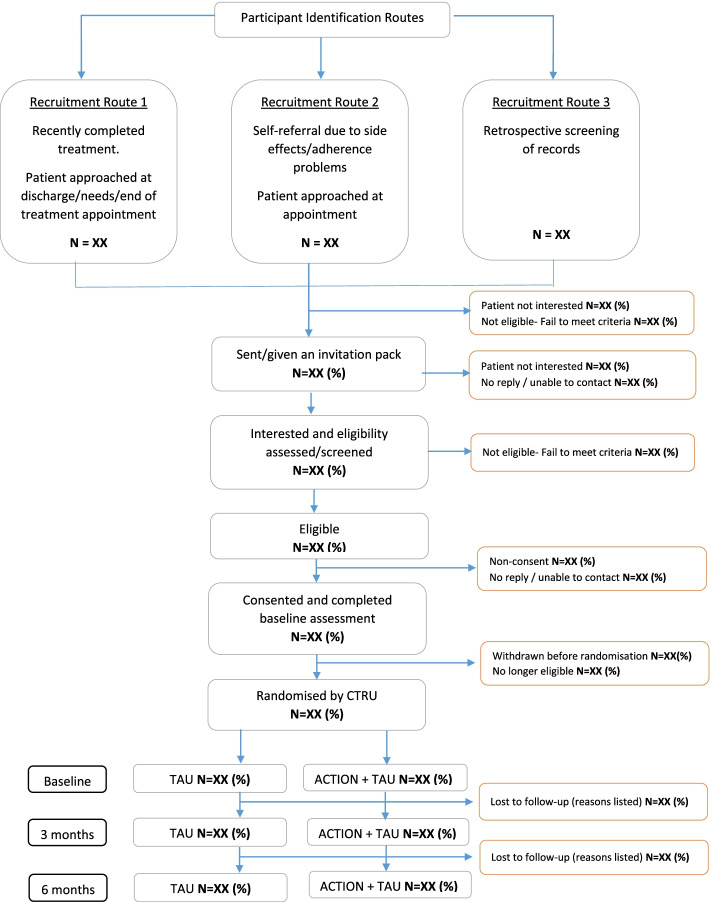
Background: Adherence to adjuvant endocrine therapy is affected by medication side-effects and associated distress. Previous interventions focused on educating women to enhance adherence have proved minimally effective. We co-designed an Acceptance and Commitment Therapy (ACT) intervention to enhance medication decision-making and quality of life by targeting a broader range of factors, including side-effect management and psychological flexibility. This study aims to establish key trial parameters, assess the acceptability of the intervention and the extent to which it can be delivered with fidelity, and to demonstrate “proof of principle” regarding its efficacy on primary and process outcomes. Methods: The ACTION intervention includes an individual 1:1 ACT session followed by three group sessions involving 8–10 women and two practitioner psychologists. Participants are also provided with access to a website containing evidence-based methods for self-managing side-effects. The ACT sessions were adapted during the COVID-19 pandemic to be remotely delivered via video conferencing software. To evaluate the feasibility and acceptability of this intervention, a multi-site, exploratory, two-arm, individually randomised external pilot trial with a nested qualitative study will be undertaken. Eighty women with early stage breast cancer prescribed adjuvant endocrine therapy will be randomised (1:1) to receive treatment as usual or treatment as usual plus the ACTION intervention. The planned future primary outcome is medication adherence assessed by the ASK-12 measure. Progression to a phase III RCT will be based on criteria related to recruitment and follow-up rates, acceptability to patients, competency and fidelity of delivery, and proof of principle for change in medication adherence. Discussion: This external pilot trial will be used to ascertain the feasibility of undertaking a future phase III RCT to definitively evaluate an ACT-based intervention to support medication taking behaviour and quality of life in women with early stage breast cancer on adjuvant endocrine therapy. Trial registration: ISRCTN: 12027752. Registered 24 December 2020, https://doi.org/10.1186/ISRCTN12027752 © 2022, The Author(s).
Overview
CoChat Summary
TL;DR
This is a protocol for a multi-site, two-arm external pilot RCT of a remotely delivered Acceptance and Commitment Therapy (ACT) intervention (“ACTION”) plus treatment as usual versus treatment as usual alone for women with early-stage breast cancer on adjuvant endocrine therapy. The study is designed to test feasibility, acceptability, therapist fidelity, and preliminary “proof of principle” for medication adherence and quality of life, not to provide definitive efficacy results.
Key findings
- The planned sample is 80 women with early-stage breast cancer prescribed adjuvant endocrine therapy, randomized 1:1 to treatment as usual or treatment as usual plus ACTION.
- ACTION consists of one 1-hour individual ACT session followed by three 90-minute group sessions with 8–10 women and two practitioner psychologists, plus a website and participant manual.
- The pilot will use ASK-12 as the planned future primary outcome; proof-of-principle will be assessed by the mean change from baseline in 3- and 6-month ASK-12 scores with confidence intervals.
- The sample-size section states that, allowing for 25% loss to follow-up, a sample of 80 patients would allow detection of an effect size of 0.432 with 65% power using a 1-sided t test at 20% significance.
Methods
- Design: Multi-site, exploratory, individually randomized external pilot RCT with a nested qualitative study; progression to phase III depends on recruitment/follow-up, acceptability, fidelity, and proof-of-principle criteria.
- Data/sample: Women over 18 with early-stage (1 to 3a) breast cancer taking tamoxifen, raloxifene, anastrozole, letrozole, or exemestane; recruited from oncology services at NHS hospitals in Yorkshire, UK.
- Analysis: Primarily descriptive statistics and confidence intervals, with analyses on the intention-to-treat population; interviews will be analyzed using thematic analysis.
Limitations
- The paper explicitly states this is a pilot and is not powered for a precise estimate of clustering by therapist effects; it is also not attempting to evaluate efficacy definitively.
- The discussion notes that remote delivery may create problems such as harder therapeutic relationships, technical challenges, and exclusion of women without internet access or a private space; this is an interpretation from the text.
- As a protocol, the paper provides no outcome results yet, so any effectiveness findings are not stated in the paper.
Model-written summary. Check it against the paper before relying on it.
Integrity signals
Registry
Cites
Statistics
Figures
Verification
Claims the paper makes
26 Valid · 0 Not valid · 4 Not checked · 23 Own results and interpretations
Every source the paper cites for this claim was checked and supports it.
In the paper
“Previous interventions focused on educating women to enhance adherence have proved minimally effective.”
- Also stated in: § Background · plain
“Adherence interventions evaluated so far have largely been ineffective [23–25].”
§ Acceptance and Commitment Therapy to support medication decision-making and quality of life in women with breast cancer: protocol for a pilot randomised controlled trial > Abstract > Background
What the sources say
- Supportedcites [23] Hurtado-de-Mendoza A, Cabling ML, Lobo T, Dash C, Sheppard VB. Behavioral interventions to enhance adherence to hormone therapy in breast cancer survivors: a systematic literature review. Clin Breast Cancer. 2016;16(4):247–255.e3. source
The Discussion reports that all five reviewed interventions included educational materials and that none significantly improved adherence in its primary analysis. The Conclusion likewise describes the limited success of these interventions for adjuvant hormonal therapy in breast cancer survivors. (LLM, conf=0.93)
- Supportedcites [24] Finitsis DJ, Vose BA, Mahalak JG, Salner AL. Interventions to promote adherence to endocrine therapy among breast cancer survivors: a meta-analysis. Psychooncology. 2019;28(2):255–63. source
The Abstract reports that interventions relying only on one-way information provision did not significantly improve adherence (k = 4; d = -0.03, 95% CI -0.27 to 0.20). Section 4.1 likewise says educational materials are not effective as a stand-alone means of engaging patients. The supplied passages do not give page numbers. (LLM, conf=0.93)
- Supportedcites [25] Heiney SP, Parker PD, Felder TM, Adams SA, Omofuma OO, Hulett JM. A systematic review of interventions to improve adherence to endocrine therapy. Breast Cancer Res Treat. 2019;173(3):499–510. source
The Results section (‘Impact of Interventions to Improve ET Adherence’) reports that education was the most frequent intervention strategy and that educational interventions generally had no significant effect on adherence, with an exception in Sweden and Finland. The Discussion likewise says educational-only interventions in randomized trials did not significantly improve adherence, apart from a country-specific finding. (LLM, conf=0.92)
plain- Asserted: passes — The authors put it forward as true.
- Checkable: passes — It can be checked against evidence.
- Load-bearing: passes — The paper’s conclusions depend on it.
- Based: passes — The paper gives a reason why it holds.
- Also stated in: § Background · plain
The cited sources support only part of this claim — read each source’s verdict below.
In the paper
“However, non-adherence is common with up to three-quarters of women prescribed adjuvant endocrine therapy (HT) taking < 80% of prescribed therapy and similar proportions discontinuing prematurely [4].”
§ Acceptance and Commitment Therapy to support medication decision-making and quality of life in women with breast cancer: protocol for a pilot randomised controlled trial > Background
What the sources say
- Partly supportedcites [4] Murphy CC, Bartholomew LK, Carpentier MY, Bluethmann SM, Vernon SW. Adherence to adjuvant hormonal therapy among breast cancer survivors in clinical practice: a systematic review. Breast Cancer Res Treat. 2012;134(2):459–78. sourceExperimental — accuracy not yet measured
The Results section defines adherence most often as a medication possession ratio of at least 80%. Its Prevalence of Adherence and Discontinuation subsection reports adherence as low as 41%, implying nonadherence of up to 59%—not three-quarters. The same subsection reports discontinuation of up to 73%, which supports the citing sentence’s separate point about premature discontinuation. Page numbers are not available in our copy. (LLM, conf=0.88)
plain- Asserted: passes — The authors put it forward as true.
- Checkable: passes — It can be checked against evidence.
- Load-bearing: passes — The paper’s conclusions depend on it.
- Based: passes — The paper gives a reason why it holds.
- Partly supported
The cited sources support only part of this claim — read each source’s verdict below.
In the paper
“Low adherence and early cessation of AET are associated with an increased risk of breast cancer recurrence and all-cause mortality [5–12].”
§ Acceptance and Commitment Therapy to support medication decision-making and quality of life in women with breast cancer: protocol for a pilot randomised controlled trial > Background
What the sources say
- Partly supportedcites [5] Makubate B, Donnan PT, Dewar JA, Thompson AM, McCowan C. Cohort study of adherence to adjuvant endocrine therapy, breast cancer recurrence and mortality. Br J Cancer. 2013;108(7):1515–24. sourceExperimental — accuracy not yet measured
The Results report that low adherence was associated with higher all-cause mortality, while the Conclusion associates fewer years of high adherence with recurrence. The Abstract Results explicitly say low adherence over the treatment period was not significantly associated with recurrence; the paper reports early cessation but does not establish its separate association with both outcomes. No page numbers are available in our copy. (LLM, conf=0.88)
- Supportedcites [6] McCowan C, Wang S, Thompson AM, Makubate B, Petrie DJ. The value of high adherence to tamoxifen in women with breast cancer: a community-based cohort study. Br J Cancer. 2013;109(5):1172–80. source
The Results report that low tamoxifen adherence was associated with a significantly shorter time to recurrence. The introduction reports that not completing the recommended five-year treatment was associated with increased mortality risk, and that adherence below 80% was associated with increased all-cause mortality. The paper’s own finding for other-cause mortality was not statistically significant; the mortality support comes from studies it reports. (LLM, conf=0.87)
- Not checked — no full text of the sourcecites [7] Dezentjé VO, van Blijderveen NJC, Gelderblom H, Putter H, van Herk-Sukel MPP, Casparie MK, et al. Effect of concomitant CYP2D6 inhibitor use and tamoxifen adherence on breast cancer recurrence in early-stage breast cancer. J Clin Oncol. 2010;28(14):2423–9. source
- Not checked — no full text of the sourcecites [8] Ma AMT, Barone J, Wallis AE, Wu NJ, Garcia LB, Estabrook A, et al. Noncompliance with adjuvant radiation, chemotherapy, or hormonal therapy in breast cancer patients. Am J Surg. 2008;196(4):500–4. source
- Not checked — no full text of the sourcecites [9] Ulcickas Yood M, Owusu C, Buist DSM, Geiger AM, Field TS, Thwin SS, et al. Mortality impact of less-than-standard therapy in older breast cancer patients. J Am Coll Surg. 2008;206(1):66–75. source
- Not checked — no full text of the sourcecites [10] Winn AN, Dusetzina SB. The association between trajectories of endocrine therapy adherence and mortality among women with breast cancer. Pharmacoepidemiol Drug Saf. 2016;25(8):953–9. source
- Partly supportedcites [11] Chirgwin JH, Giobbie-Hurder A, Coates AS, Price KN, Ejlertsen B, Debled M, et al. Treatment adherence and its impact on disease-free survival in the Breast International Group 1-98 Trial of tamoxifen and letrozole, alone and in sequence. J Clin Oncol. 2016;34(21):2452–9. sourceExperimental — accuracy not yet measured
The Results and Discussion report that low compliance and early treatment cessation were associated with worse disease-free survival. Statistical Methods defines that composite outcome to include recurrence and death from any cause, but the paper does not report separate associations with breast cancer recurrence and all-cause mortality as the claim implies. (LLM, conf=0.88)
- Partly supportedcites [12] McCowan C, Shearer J, Donnan PT, Dewar JA, Crilly M, Thompson AM, et al. Cohort study examining tamoxifen adherence and its relationship to mortality in women with breast cancer. Br J Cancer. 2008;99(11):1763–8. sourceExperimental — accuracy not yet measured
The Discussion links low adherence to tamoxifen with increased all-cause mortality, and the Conclusion says longer use is associated with a lower risk of death. But the study examined tamoxifen rather than AET generally, and the Discussion explicitly says breast cancer recurrence was omitted as an outcome. (LLM, conf=0.88)
plainstates an association- Asserted: passes — The authors put it forward as true.
- Checkable: passes — It can be checked against evidence.
- Load-bearing: passes — The paper’s conclusions depend on it.
- Based: passes — The paper gives a reason why it holds.
- Partly supported
The cited sources support only part of this claim — read each source’s verdict below.
In the paper
“The interventions largely focussed on educating patients regarding AET and did not consistently address the range psychological factors that contribute to non-adherence.”
§ Acceptance and Commitment Therapy to support medication decision-making and quality of life in women with breast cancer: protocol for a pilot randomised controlled trial > Background
What the sources say
- Partly supportedcites [23] Hurtado-de-Mendoza A, Cabling ML, Lobo T, Dash C, Sheppard VB. Behavioral interventions to enhance adherence to hormone therapy in breast cancer survivors: a systematic literature review. Clin Breast Cancer. 2016;16(4):247–255.e3. sourceExperimental — accuracy not yet measured
The Discussion (page unavailable) says all five interventions included educational materials and that their strategies combined education with reminders. The Conclusion (page unavailable) calls for interventions targeting other adherence-related components, including doctor–patient communication and social support. This supports the broad point that the interventions had a narrow focus, but the paper does not specifically characterize the omitted range as psychological factors. (LLM, conf=0.84)
- Supportedcites [24] Finitsis DJ, Vose BA, Mahalak JG, Salner AL. Interventions to promote adherence to endocrine therapy among breast cancer survivors: a meta-analysis. Psychooncology. 2019;28(2):255–63. source
The intervention-characteristics passage reports that half the reviewed interventions used one-way informational or educational approaches. The Study limitations section says most did not cite a behavior-change theory, while the Background identifies several psychological factors relevant to AET adherence. Together, these support the claim that education was a substantial focus and psychological factors were not consistently addressed. (LLM, conf=0.86)
- Partly supportedcites [25] Heiney SP, Parker PD, Felder TM, Adams SA, Omofuma OO, Hulett JM. A systematic review of interventions to improve adherence to endocrine therapy. Breast Cancer Res Treat. 2019;173(3):499–510. sourceExperimental — accuracy not yet measured
The Results (Impact of Interventions to Improve ET Adherence; page unavailable) identify patient education as the most frequent single strategy, and the Discussion reports that the randomized trials used education-only interventions. But education accounted for five of sixteen studies, alongside communication, navigation, and financial strategies. The paper notes limited evidence on psychosocial and behavioral factors (Introduction), but does not assess whether the interventions addressed the full range of psychological factors contributing to non-adherence. (LLM, conf=0.82)
plain- Asserted: passes — The authors put it forward as true.
- Checkable: passes — It can be checked against evidence.
- Load-bearing: passes — The paper’s conclusions depend on it.
- Based: passes — The paper gives a reason why it holds.
- Partly supported
Every source the paper cites for this claim was checked and supports it.
In the paper
“However, non-adherence is common with up to three-quarters of women prescribed adjuvant endocrine therapy (HT) taking < 80% of prescribed therapy and similar proportions discontinuing prematurely [4].”
§ Acceptance and Commitment Therapy to support medication decision-making and quality of life in women with breast cancer: protocol for a pilot randomised controlled trial > Background
What the sources say
- Supportedcites [4] Murphy CC, Bartholomew LK, Carpentier MY, Bluethmann SM, Vernon SW. Adherence to adjuvant hormonal therapy among breast cancer survivors in clinical practice: a systematic review. Breast Cancer Res Treat. 2012;134(2):459–78. source
The Discussion reports that discontinuation in clinical practice ranged from 31–73%, supporting the claim that a proportion approaching three-quarters discontinued prematurely. The Results section likewise reports discontinuation rates of 32–73% by the end of five years in studies examining both tamoxifen and aromatase inhibitors. (LLM, conf=0.92)
plain- Asserted: passes — The authors put it forward as true.
- Checkable: passes — It can be checked against evidence.
- Load-bearing: passes — The paper’s conclusions depend on it.
- Based: passes — The paper gives a reason why it holds.
- Supported
20 more claims · 15 with their cited sources checked
Create a free account to see all 53 claims and every source verdict.
- Probably not a substantial claim. 25
- It may state two separate claims as one. 8
Claims other papers make about this one
Each is checked against this paper’s own text: does it say what the citing paper says it does?
The source backs part of the claim, not all of it — or backs it for a different population, condition or comparison.
In the citing paper
“Targeting a broader range of factors associated with adherence, including mood and QoL could more effectively support AET decision -making. 14,15”
From A pilot randomised controlled trial of acceptance and commitment therapy for medication decision-making and quality of life in women with breast cancer: The ACTION trial (2024) · cites this paper as [15]
Experimental — accuracy not yet measured
Citations
Cites
Using thematic analysis in psychology
Braun, V., & Clarke, V. (2006) · Qualitative Research in Psychology · doi:10.1191/1478088706qp063oa · Cited by 194,414
A Brief Measure for Assessing Generalized Anxiety Disorder: The GAD-7
Spitzer, R. L., Kroenke, K., Williams, J. B. W., & Löwe, B. (2006) · Archives of Internal Medicine · doi:10.1001/archinte.166.10.1092 · Cited by 31,765 · cited 1×
“Generalised Anxiety Disorder questionnaire (GAD‐7) [52] The GAD-7 is a 7-item self-report anxiety”
BackgroundHoffmann, T. C., Glasziou, P. P., Boutron, I., Milne, R., Perera, R., Moher, D., Altman, D. G., Barbour, V., Macdonald, H., Johnston, M., et al. (2014) · BMJ · doi:10.1136/bmj.g1687 · Cited by 10,548 · cited 1×
“The intervention being evaluated is described using the TIDieR checklist [42] (Appendix 1).”
MethodSpitzer, R. L. (1999) · JAMA · doi:10.1001/jama.282.18.1737 · Cited by 9,802
SPIRIT 2013 Statement: Defining Standard Protocol Items for Clinical Trials
Chan, A.-W., Tetzlaff, J. M., Altman, D. G., Laupacis, A., Gøtzsche, P. C., Krleža-Jerić, K., Hróbjartsson, A., Mann, H., Dickersin, K., Berlin, J. A., et al. (2013) · Annals of Internal Medicine · doi:10.7326/0003-4819-158-3-201302050-00583 · Cited by 7,363 · cited 3×
“Chan A-W, Tetzlaff JM, Altman DG, Laupacis A, Gøtzsche PC, Krleža-Jerić K, et al. SPIRIT 2013 statement: defining standard protocol items for clinical trials.”
MethodCONSORT 2010 statement: extension to randomised pilot and feasibility trials.
Eldridge, S. M., Chan, C. L., Campbell, M. J., Bond, C. M., Hopewell, S., Thabane, L., & Lancaster, G. A. (2016) · BMJ · doi:10.1136/bmj.i5239 · Cited by 3,404
CONSORT 2010 statement: extension to randomised pilot and feasibility trials
on behalf of the PAFS consensus group, Eldridge, S. M., Chan, C. L., Campbell, M. J., Bond, C. M., Hopewell, S., Thabane, L., & Lancaster, G. A. (2016) · Pilot and Feasibility Studies · doi:10.1186/s40814-016-0105-8 · Cited by 2,843 · cited 1×
“The study is presented according to recommendations of the SPIRIT [40] and CONSORT extension for pilot and feasibility trials [41] (Appendix 1).”
MethodDesign and analysis of pilot studies: recommendations for good practice
Lancaster, G. A., Dodd, S., & Williamson, P. R. (2004) · Journal of Evaluation in Clinical Practice · doi:10.1111/j..2002.384.doc.x · Cited by 2,572
The Work and Social Adjustment Scale: a simple measure of impairment in functioning
Mundt, J. C., Marks, I. M., Shear, M. K., & Greist, J. M. (2002) · British Journal of Psychiatry · doi:10.1192/bjp.180.5.461 · Cited by 2,515 · cited 4×
“The Work and Social Adjustment Scale: a simple measure of impairment in functioning.”
BackgroundInfluentialWhitehead, A. L., Julious, S. A., Cooper, C. L., & Campbell, M. J. (2016) · Statistical Methods in Medical Research · doi:10.1177/0962280215588241 · Cited by 1,936
Cited by
Green, S. M. C., French, D., Graham, C. D., Hall, L., Rousseau, N. S., Foy, R., Clark, J., Parbutt, C., Raine, E., Gardner, B., et al. (2022) · BMC Health Services Research · doi:10.1186/s12913-022-08243-4 · Cited by 38
“This decision will also be guided by the results of a separate pilot trial testing a group-based ACT intervention currently being undertaken by the authors (LH, SS, CG, JC) [155], alongside qualitative feedback within our planned process evaluation.”
MethodSelf-citationAnagnostopoulos, F., Paraponiari, A., & Kafetsios, K. G. (2022) · Journal of Clinical Psychology in Medical Settings · doi:10.1007/s10880-022-09921-5 · Cited by 32
Nikrah, N., Bahari, F., & Shiri, A. (2023) · Applied Nursing Research · doi:10.1016/j.apnr.2023.151723 · Cited by 22
Motivational Interviewing Counseling to Increase Endocrine Therapy Adherence in Diverse Patients
Wheeler, S. B., Spencer, J. C., Drier, S., Fray, N., & Reeder-Hayes, K. E. (2023) · Cancers · doi:10.3390/cancers15071973 · Cited by 14
Graham, C. D., Ellison, R., Hall, L. H., Clark, J., McNaught, E., Green, S. M. C., Wilkes, H., Robson, G., Lorentz, I., Holmes, L., et al. (2024) · Psycho-Oncology · doi:10.1002/pon.6349 · Cited by 8
“14,15 The intervention was co - designed prior to the COVID - 19 pandemic.”
BackgroundMethodInfluentialSelf-citation
Metadata
- Authors
- Smith, S. G., Ellison, R., Hall, L., Clark, J., Hartley, S., Mason, E., Metherell, J., Olivier, C., Napp, V., Naik, J., Buckley, S., Hirst, C., Hartup, S., Neal, R. D., Velikova, G., Farrin, A., Collinson, M., & Graham, C. D.
- Affiliations
- University of Leeds (GB)
- St James's University Hospital (GB)
- Harrogate and District NHS Foundation Trust (GB)
- Mid Yorkshire Hospitals NHS Trust (GB)
- Queen's University Belfast (GB)
- Corresponding author
- Smith, Samuel G.
- ORCID
- Venue
- Pilot and Feasibility Studies
- Published
- 2022-02-08
- Volume
- 8
- Issue
- 1
- Pages
- 33-33
- ISSN
- 2055-5784 (ISSN-L)
- PMC
- PMC8822728
- OpenAlex
- W4225985130
- Cited by
- 17
- References
- 62
- Citations by year
- 2026: 1 · 2025: 2 · 2024: 2 · 2023: 8 · 2022: 4
- FWCI
- 1.67
- Type
- journal article
- Language
- en
- Open access
- gold
- doi.org
- Licence
- cc-by
- creativecommons.org/licenses/by/4.0 (tdm)
- creativecommons.org/licenses/by/4.0 (vor)
- Locations
- Pilot and Feasibility Studies (publishedVersion, cc-by)
- Research Square (acceptedVersion, cc-by)
- PubMed Central (publishedVersion, cc-by)
- PubMed (publishedVersion)
- White Rose Research Online (University of Leeds, The University of Sheffield, University of York) (acceptedVersion)
- Strathprints: The University of Strathclyde institutional repository (University of Strathclyde) (acceptedVersion)
- DOAJ (DOAJ: Directory of Open Access Journals) (submittedVersion, cc-by-sa)
- White Rose Research Online (University of Leeds, The University of Sheffield, University of York) (submittedVersion)
- Research Portal (Queen's University Belfast) (submittedVersion, cc-by)
- Funders
- yorkshire cancer research (L417)
- Topics
- Health Sciences › Medicine › Oncology › Cancer survivorship and care
- Social Sciences › Psychology › Clinical Psychology › Mindfulness and Compassion Interventions
- Health Sciences › Medicine › Family Practice › Medication Adherence and Compliance
- Keywords
- acceptance and commitment therapy, adjuvant endocrine therapy, breast cancer, medication adherence, medication decision-making, quality of life, psychological flexibility, treatment acceptability, feasibility, early breast cancer
About these checks
Registry, retraction, Cites and statistics results are computed, not judged, with one exception: a printed reference that no index lists is read once by a model before it counts as a citation error. Claims are extracted by a model and kept only when their quote appears verbatim in the text; each cited source is then checked, with a model’s help, for whether it says what the claim relies on. Those verdicts can be wrong — read the claim’s quote and the cited source before relying on one.
The claim verdicts this report counts are experimental: their accuracy is not yet measured.
A language model drew the claims from the paper on 2026-10-11, under version 3 of the claim definition (model deepseek-v4.1-flash, prompt extract-v3).
A second model labelled each claim on 2026-10-11 (model jev-1.13-20260917, definition revision gold-guideline-v0.2).
Cited sources are checked with a language model’s help (gpt-6-sol).
Statistics and arithmetic are recomputed, not judged.
Confidence bands are shown only for fields calibrated on our annotated test set. None is calibrated yet, so no band is shown.
What counts as a claim ›How we measure confidence ›How we check this ›
Are you an author, or do you see a problem with this page? Request a review
How to cite
Cite CoChat for the checks on this page, and the paper for its own findings.
- This page
- CoChat. (2026). Citation check: Acceptance and Commitment Therapy to support medication decision-making and quality of life in women with breast cancer: protocol for a pilot randomised controlled trial. https://app.cochat.ai/papers/10.1186/s40814-022-00985-6
- The paper
- Smith, S. G., Ellison, R., Hall, L., Clark, J., Hartley, S., Mason, E., Metherell, J., Olivier, C., Napp, V., Naik, J., Buckley, S., Hirst, C., Hartup, S., Neal, R. D., Velikova, G., Farrin, A., Collinson, M., & Graham, C. D. (2022). Acceptance and Commitment Therapy to support medication decision-making and quality of life in women with breast cancer: protocol for a pilot randomised controlled trial. Pilot and Feasibility Studies. https://doi.org/10.1186/s40814-022-00985-6
Data sources
Bibliographic data: Semantic Scholar, OpenAlex, Crossref.
Contains information from the Semantic Scholar Academic Graph Datasets, made available under the ODC Attribution License (ODC-BY 1.0).
Semantic Scholar’s data is described in: Kinney, R., et al. (2023). The Semantic Scholar Open Data Platform. arXiv:2301.10140.
