

Socioeconomic disparity in adult mortality in India: estimations using the orphanhood method
Open accessThe DOI matches its Crossref record; 54 of the 57 references it cites were found in a registry or an index.
Abstract
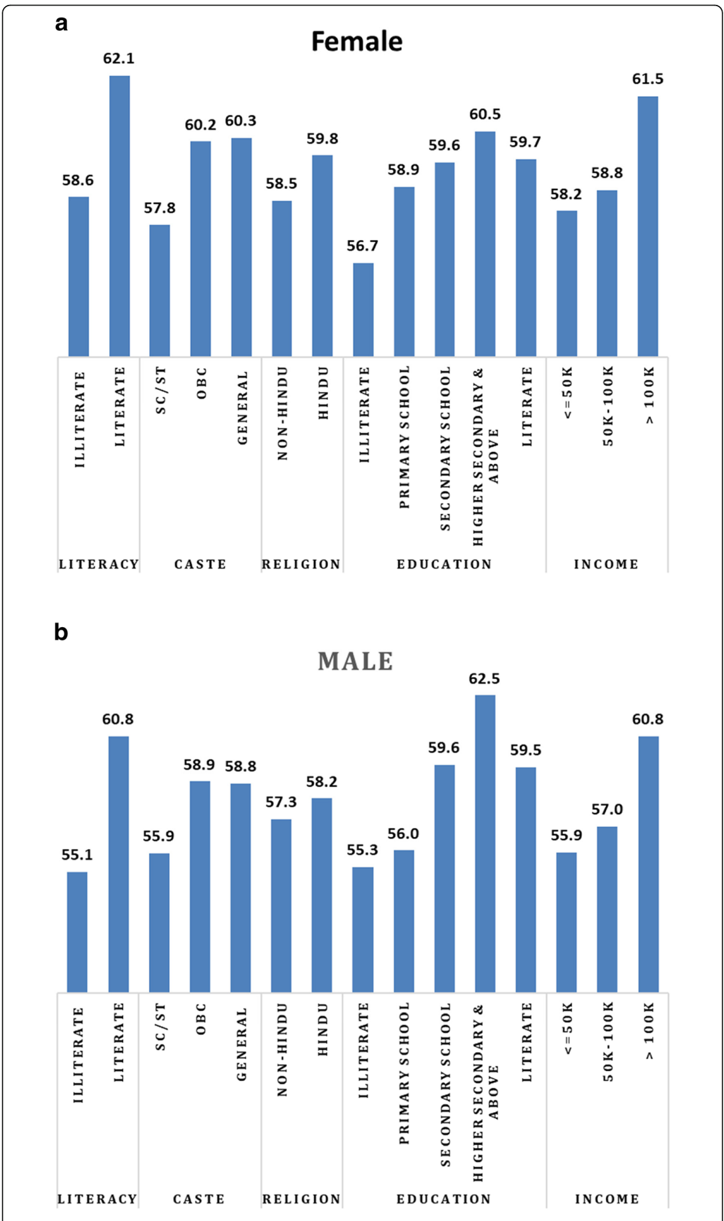
Due to a lack of data, no study has yet documented differences in adult life expectancy in India by education, caste, and religion. To examine disparities in socioeconomic status (SES) in the adult mortality rate ( 40 q 30 ) and life expectancy at age 15 ( e 15 ) in India. We estimated adult mortality by SES with the orphanhood method to analyze information related to the survival of respondents’ parents. We used data from the India Human Development Survey 2011–2012. SES was measured by education, caste, religion, and income of the either deceased adults or their offspring. A consistency analysis between orphanhood estimates and official statistics confirmed the robustness of the estimates. Mortality is higher among adults who are illiterate, belong to deprived castes or tribes, have children with a low level of education, and have a low level of household income. The adult mortality rate varies marginally by religion in India. Life expectancy at 15 ( e 15 ) is about 3.50 and 5.7 years shorter for illiterate men and women, respectively, compared with literate men and women. The parameter e 15 also varies significantly by educational attainment of offspring. On average, parents of children educated to higher secondary level (and above) gain an extra 3.8–4.6 years of adult life compared to parents of illiterate children. Disparity in e 15 by caste and religion is smaller than disparity by education or income. The adult mortality burden falls disproportionately on illiterate adults and adults with less educated offspring. Thus, educational disparity in adult mortality appears to be prominent in Indian context. In the absence of adult mortality statistics by SES in India, we recommend that large-scale surveys should continue collecting data to allow indirect techniques to be applied to estimate mortality and life expectancy in the country.
Overview
The claims and statistics of this paper haven’t been checked yet.
Free: it reads the open-access text and checks the first 5 claims that cite a source we can check. Create a free account to check every claim.
Integrity signals
Registry
Cites
Statistics
Figures
Verification
Claims the paper makes
The claims and statistics of this paper haven’t been checked yet.
Free: it reads the open-access text and checks the first 5 claims that cite a source we can check. Create a free account to check every claim.
Claims other papers make about this one
Each is checked against this paper’s own text: does it say what the citing paper says it does?
In the citing paper
“In India, an eight-year gap was noted between the richest and poorest quintiles in 2011–12,75 and in Indonesia, a four-year difference in life expectancy at age 30 between 2007–2015.76”
From Global health 2050: the path to halving premature death by mid-century (2024) · cites this paper as [75]
Self-check
Percentages, sums and reported differences re-computed from the paper’s own numbers.
The self-check needs the paper’s full text.
Citations
Cites
Journal of the National Medical Association
(2010) · Journal of the National Medical Association · doi:10.1016/s0027-9684(15)30622-2 · Cited by 5,325
Indicators of socioeconomic position (part 1): Figure 1
Galobardes, B., Shaw, M., Lawlor, D. A., Lynch, J. W., & Davey Smith, G. (2006) · Journal of Epidemiology and Community Health · doi:10.1136/jech.2004.023531 · Cited by 2,867
Rising morbidity and mortality in midlife among white non-Hispanic Americans in the 21st century
Case, A., & Deaton, A. (2015) · Proceedings of the National Academy of Sciences · doi:10.1073/pnas.1518393112 · Cited by 2,759
Measuring Social Class in US Public Health Research: Concepts, Methodologies, and Guidelines
Krieger, N., Williams, D. R., & Moss, N. E. (1997) · Annual Review of Public Health · doi:10.1146/annurev.publhealth.18.1.341 · Cited by 2,696 · cited 1×
“Therefore, the SES of an individual can be measured by different social and economic factors that influence what positions individuals or groups hold within the structure of a society (Krieger et al. 1997; Lynch and Kaplan 2000).”
Socioeconomic Disparities In Health: Pathways And Policies
Adler, N. E., & Newman, K. (2002) · Health Affairs · doi:10.1377/hlthaff.21.2.60 · Cited by 2,104
Coimbra Jr., C. E. A. (1992) · Cadernos de Saúde Pública · doi:10.1590/s0102-311x1992000400016 · Cited by 1,198
Measurement of socioeconomic status in health disparities research.
Shavers, V. L. (2007) · PubMed · doi:10.13016/avw3-9cvx · Cited by 956 · cited 1×
“A vast body of literature in western countries has documented that SES can be measured through occupation, education, and income (Galobardes et al. 2006; Shavers 2007).”
Howe, L. D., Galobardes, B., Matijasevich, A., Gordon, D., Johnston, D., Onwujekwe, O., Patel, R., Webb, E. A., Lawlor, D. A., & Hargreaves, J. R. (2012) · International Journal of Epidemiology · doi:10.1093/ije/dys037 · Cited by 611
Inequalities in longevity by education in OECD countries: Insights from new OECD estimates
Murtin, F., Mackenbach, J., Jasilionis, D., & Mira d'Ercole, M. (2017) · OECD Statistics Working Papers · doi:10.1787/6b64d9cf-en · Cited by 532 · cited 2×
“This extent is consistent with previous studies conducted in advanced countries of the world (Luy et al. 2011; Murtin et al. 2017).”
Disease and Mortality in Sub-Saharan Africa: Second Edition
(2006) · World Bank, Washington, DC eBooks · doi:10.1596/978-0-8213-6397-3 · Cited by 514
Research works printed but not linked: 5
- Bhat, P. N. M. (1998). Demographic estimates for post-independence India: a new integration. Demography India, 27(1), 23-57.
- IIPS, & Macro, O. R. C. (2007). National Family Health Survey (NFHS-3), 2005-2006. Mumbai: IIPS.
- Lynch, J., & Kaplan, G. (2000). Socioeconomic position (Vol. 2000, pp. 13-35). Social epidemiology. New York: Oxford University Press.
- Moultrie, T. A., Dorrington, R. E., Hill, A. G., Hill, K., Timæus, I. M., & Zaba, B. (2013). Tools for demographic estimation: international union for the scientific study of population. Paris: International Union for the Scientific Study of Population.
- United Nations, Department of International Economic and Social Affairs. (1982). Model life tables for developing countries. New York: United Nations.
Cited by
Global health 2050: the path to halving premature death by mid-century
Jamison, D. T., Summers, L. H., Chang, A. Y., Karlsson, O., Mao, W., Norheim, O. F., Ogbuoji, O., Schäferhoff, M., Watkins, D., Adeyi, O., et al. (2024) · The Lancet · doi:10.1016/s0140-6736(24)01439-9 · Cited by 125
Wirayuda, A. A. B., & Chan, M. F. (2021) · Asia Pacific Journal of Public Health · doi:10.1177/1010539520983671 · Cited by 53
Large and Persistent Life Expectancy Disparities between India's Social Groups
Gupta, A., & Sudharsanan, N. (2022) · Population and Development Review · doi:10.1111/padr.12489 · Cited by 38
Raushan, R., Acharya, S. S., & Raushan, M. R. (2022) · CASTE / A Global Journal on Social Exclusion · doi:10.26812/caste.v3i2.450 · Cited by 30
“The findings are in the line of previous studies and strengthen the findings of the study (Saikia et al., 2019).”
BackgroundResultThoma, B., Sudharsanan, N., Karlsson, O., Joe, W., Subramanian, S. V., & Neve, J. D. (2020) · Population Studies · doi:10.1080/00324728.2020.1775873 · Cited by 23
Mulcahy, P., Mahal, A. S., McPake, B., Kane, S. S., Ghosh, P. K., & Lee, J. T. (2021) · Social Science & Medicine · doi:10.1016/j.socscimed.2021.114149 · Cited by 22
Meshram, S. S. (2020) · IEEE Bombay Section Signature Conference (IBSSC) · doi:10.1109/ibssc51096.2020.9332159 · Cited by 14
“According to [13], in India, adults which belong to deprived castes/tribes or have children with a low level of education are mainly illiterate.”
BackgroundAssociation of greenness with COVID-19 deaths in India: An ecological study at district level
Sikarwar, A., Rani, R., Duthé, G., & Golaz, V. (2022) · Environmental Research · doi:10.1016/j.envres.2022.114906 · Cited by 14
“• Socio-economic inequalities may present a differential mortality risk for population (Saikia et al., 2019).”
Caste Differences in Child Growth: Disentangling Endowment and Investment Effects
Cummins, J., Guo, J., Agarwal, N., Aiyar, A., Jain, V., & Bergmann, A. (2024) · World Development · doi:10.1016/j.worlddev.2024.106598 · Cited by 10
Sharma, D., Kiran, T., Goel, K., Junaid, K. P., Rajagopal, V., Gupta, M., Kaundal, H., Sharma, S., & Bahl, A. (2022) · Frontiers in Medicine · doi:10.3389/fmed.2022.1046072 · Cited by 7
“Several studies conducted in developing countries have indicated the presence of a strong association between low socio-economic status, poor health, and inaccessible health care facilities (3).”
BackgroundPai, M., Kumar, C., Singh, L., & Singh, P. K. (2024) · Educational Gerontology · doi:10.1080/03601277.2024.2321046 · Cited by 9
“…the considerable generational disparities in educational attainment and the proportion of joint families in the country (Breton, 2019; Esteve & Liu, 2017), older Indians may be particularly well-situated to reap the cognitive health dividends of educating the next generation (Saikia et al., 2019).”
BackgroundPawar, S., Chougule, M., & Channaveer, R. M. (2025) · Frontiers in Sustainability · doi:10.3389/frsus.2025.1562033 · Cited by 8
The burden of premature adult mortality associated with lack of access to electricity in India
Hejjaji, V., Barbhaya, D., Rahimian, A., Yamparala, A., Yakkali, S., & Khetan, A. K. (2024) · PLoS ONE · doi:10.1371/journal.pone.0297463 · Cited by 5
Torrisi, O., Banda, J., Reniers, G., & Helleringer, S. (2024) · Field Methods · doi:10.1177/1525822x241248906 · Cited by 3
Torrisi, O., Banda, J., Reniers, G., & Helleringer, S. (2024) · Field Methods · doi:10.1177/1525822x241237042 · Cited by 4
“1 This module has been included in prior large-scale household surveys in LMICs (Hirschman et al. 1995; Saikia et al. 2019).”
Dhakad, M., & Saikia, N. (2023) · Sustainable development goals series · doi:10.1007/978-981-99-0002-2_7 · Cited by 3
Self-citationImproving old-age mortality estimation with parental survival histories in surveys
Masquelier, B., Menashe‐Oren, A., Schlüter, B.-S., Fall, A., & Helleringer, S. (2024) · Demographic Research · doi:10.4054/demres.2024.51.45 · Cited by 2
“Deriving mortality estimates from the summary data currently collected requires tabulating proportions of surviving parents by age of respondents and converting these proportions into mortality indices using the indirect orphanhood approach (Timæus 1992; Saikia, Bora, and Luy 2019).”
Socio-economic influences from egg to exit: Emerging biology
Jylhä, M. K., & Finch, C. E. (2026) · Ageing Research Reviews · doi:10.1016/j.arr.2026.103104 · Cited by 2
Subramanian, S. (2023) · Journal of Human Development and Capabilities · doi:10.1080/19452829.2023.2214725 · Cited by 1
An Analysis of Time-Series Models for Age-Specific Mortality Rates in India
Sen, A., & Dutta, S. (2020) · International Journal of Innovative Science and Research Technology (IJISRT) · doi:10.38124/ijisrt20aug755
Directions For Prevention Of Social Orphanhood In Russia In Modern Economic Conditions
Aleksandrovna, K. E., Yurievna, R. Y., Кожевникова, Т. М., Vladimirovna, K. E., & Chekudaev, K. V. (2020) · The European Proceedings of Social & Behavioural Sciences · doi:10.15405/epsbs.2020.10.05.404
Socioeconomic Inequalities in Adult Mortality in India, 1998–1999, 2015–2016, and 2019–2021
Dhakad, M., & Saikia, N. (2023) · Sustainable development goals series · doi:10.1007/978-981-99-0002-2_5
Self-citationInsights on Poverty-based Inequality in Old-age Mortality in India
Rashmi, R., & Paul, R. (2024) · Discover Public Health · doi:10.1186/s12982-024-00223-9 · Cited by 2
Trends in adult mortality rates in India, 1970 to 2018: age–period–cohort analysis
Misra, S., Singh, A., Goli, S., & James, K. S. (2024) · Journal of Biosocial Science · doi:10.1017/s0021932024000270
Social and economic inequalities in adult mortality in India
Moradhvaj, & Saikia, N. (2026) · Demographic Research · doi:10.4054/demres.2026.55.16
Self-citation
Metadata
- Authors
- Saikia, N., Bora, J. K., & Luy, M.
- Affiliations
- International Institute for Applied Systems Analysis (AT)
- Austrian Academy of Sciences (AT)
- Corresponding author
- Saikia, Nandita
- Venue
- Genus
- Published
- 2019-02-04
- Volume
- 75
- Issue
- 1
- ISSN
- 0016-6987 (ISSN-L)
- 2035-5556
- OpenAlex
- W2914370634
- Cited by
- 25
- References
- 57
- Citations by year
- 2026: 2 · 2025: 1 · 2024: 9 · 2023: 3 · 2022: 4 · 2021: 2 · 2020: 4
- FWCI
- 5.67
- Type
- journal article
- Language
- en
- Open access
- gold
- doi.org
- Licence
- cc-by
- creativecommons.org/licenses/by/4.0 (tdm)
- Locations
- Genus (publishedVersion, cc-by)
- IIASA PURE (International Institute of Applied Systems Analysis) (acceptedVersion)
- DOAJ (DOAJ: Directory of Open Access Journals) (submittedVersion, cc-by-sa)
- Topics
- Social Sciences › Demography › Insurance, Mortality, Demography, Risk Management
- Social Sciences › Health › Health disparities and outcomes
- Health Sciences › Medicine › Pediatrics, Perinatology and Child Health › Global Maternal and Child Health
- Keywords
- adult mortality, socioeconomic disparities, educational attainment, caste, household income, India, India Human Development Survey, indirect mortality estimation, gender differences in mortality
About these checks
Registry, retraction, Cites and statistics results are computed, not judged, with one exception: a printed reference that no index lists is read once by a model before it counts as a citation error. Claims are extracted by a model and kept only when their quote appears verbatim in the text; each cited source is then checked, with a model’s help, for whether it says what the claim relies on. Those verdicts can be wrong — read the claim’s quote and the cited source before relying on one.
Statistics and arithmetic are recomputed, not judged.
Confidence bands are shown only for fields calibrated on our annotated test set. None is calibrated yet, so no band is shown.
What counts as a claim ›How we measure confidence ›How we check this ›
Are you an author, or do you see a problem with this page? Request a review
Data sources
Bibliographic data: Semantic Scholar, OpenAlex, Crossref.
Contains information from the Semantic Scholar Academic Graph Datasets, made available under the ODC Attribution License (ODC-BY 1.0).
Semantic Scholar’s data is described in: Kinney, R., et al. (2023). The Semantic Scholar Open Data Platform. arXiv:2301.10140.
