

Socioeconomic disparity in adult mortality in India: estimations using the orphanhood method
Open accessThe DOI matches its Crossref record; 54 of the 57 references it cites were found in a registry or an index.
Abstract
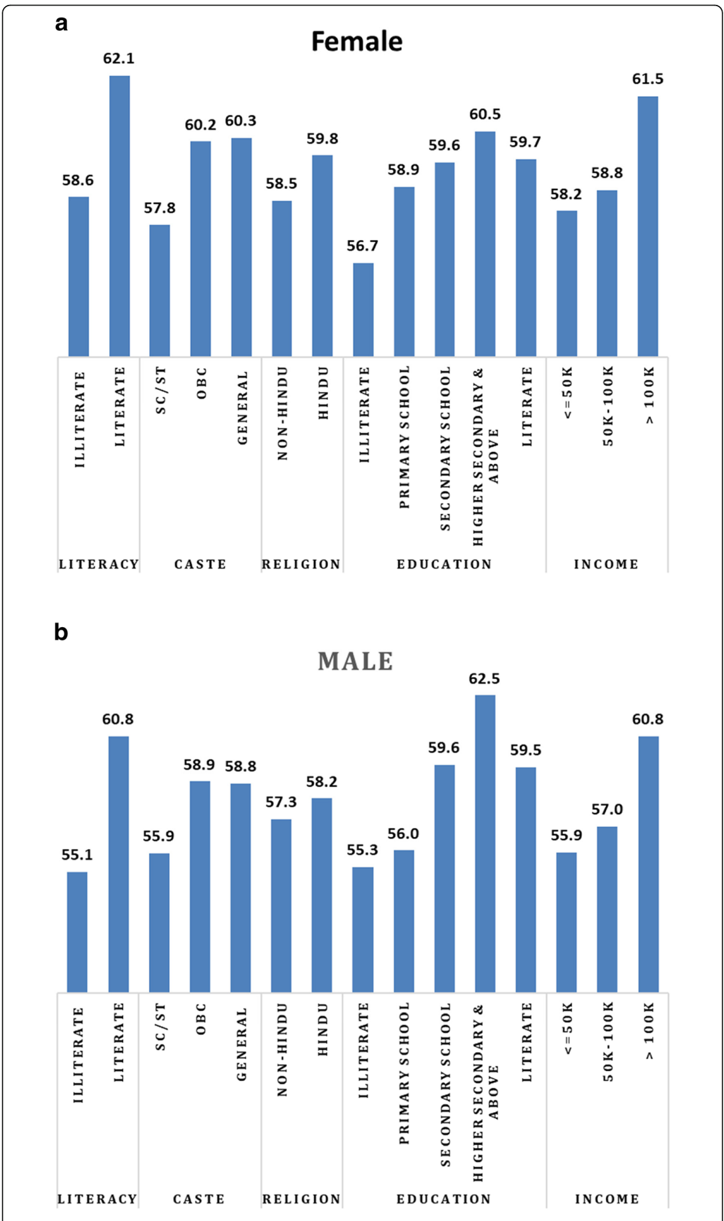
Due to a lack of data, no study has yet documented differences in adult life expectancy in India by education, caste, and religion. To examine disparities in socioeconomic status (SES) in the adult mortality rate ( 40 q 30 ) and life expectancy at age 15 ( e 15 ) in India. We estimated adult mortality by SES with the orphanhood method to analyze information related to the survival of respondents’ parents. We used data from the India Human Development Survey 2011–2012. SES was measured by education, caste, religion, and income of the either deceased adults or their offspring. A consistency analysis between orphanhood estimates and official statistics confirmed the robustness of the estimates. Mortality is higher among adults who are illiterate, belong to deprived castes or tribes, have children with a low level of education, and have a low level of household income. The adult mortality rate varies marginally by religion in India. Life expectancy at 15 ( e 15 ) is about 3.50 and 5.7 years shorter for illiterate men and women, respectively, compared with literate men and women. The parameter e 15 also varies significantly by educational attainment of offspring. On average, parents of children educated to higher secondary level (and above) gain an extra 3.8–4.6 years of adult life compared to parents of illiterate children. Disparity in e 15 by caste and religion is smaller than disparity by education or income. The adult mortality burden falls disproportionately on illiterate adults and adults with less educated offspring. Thus, educational disparity in adult mortality appears to be prominent in Indian context. In the absence of adult mortality statistics by SES in India, we recommend that large-scale surveys should continue collecting data to allow indirect techniques to be applied to estimate mortality and life expectancy in the country.
Overview
The claims and statistics of this paper haven’t been checked yet.
Free: it reads the open-access text and checks the first 5 claims that cite a source we can check. Create a free account to check every claim.
Integrity signals
Registry
Cites
Statistics
Figures
Verification
Claims the paper makes
The claims and statistics of this paper haven’t been checked yet.
Free: it reads the open-access text and checks the first 5 claims that cite a source we can check. Create a free account to check every claim.
Claims other papers make about this one
Each is checked against this paper’s own text: does it say what the citing paper says it does?
In the citing paper
“In India, an eight-year gap was noted between the richest and poorest quintiles in 2011–12,75 and in Indonesia, a four-year difference in life expectancy at age 30 between 2007–2015.76”
From Global health 2050: the path to halving premature death by mid-century (2024) · cites this paper as [75]
Self-check
Percentages, sums and reported differences re-computed from the paper’s own numbers.
The self-check needs the paper’s full text.
Citations
Cites
Journal of the National Medical Association
(2010) · Journal of the National Medical Association · doi:10.1016/s0027-9684(15)30622-2 · Cited by 5,325
Indicators of socioeconomic position (part 1): Figure 1
Galobardes, B., Shaw, M., Lawlor, D. A., Lynch, J. W., & Davey Smith, G. (2006) · Journal of Epidemiology and Community Health · doi:10.1136/jech.2004.023531 · Cited by 2,867
Rising morbidity and mortality in midlife among white non-Hispanic Americans in the 21st century
Case, A., & Deaton, A. (2015) · Proceedings of the National Academy of Sciences · doi:10.1073/pnas.1518393112 · Cited by 2,759
Measuring Social Class in US Public Health Research: Concepts, Methodologies, and Guidelines
Krieger, N., Williams, D. R., & Moss, N. E. (1997) · Annual Review of Public Health · doi:10.1146/annurev.publhealth.18.1.341 · Cited by 2,696 · cited 1×
“Therefore, the SES of an individual can be measured by different social and economic factors that influence what positions individuals or groups hold within the structure of a society (Krieger et al. 1997; Lynch and Kaplan 2000).”
Socioeconomic Disparities In Health: Pathways And Policies
Adler, N. E., & Newman, K. (2002) · Health Affairs · doi:10.1377/hlthaff.21.2.60 · Cited by 2,104
Coimbra Jr., C. E. A. (1992) · Cadernos de Saúde Pública · doi:10.1590/s0102-311x1992000400016 · Cited by 1,198
Measurement of socioeconomic status in health disparities research.
Shavers, V. L. (2007) · PubMed · doi:10.13016/avw3-9cvx · Cited by 956 · cited 1×
“A vast body of literature in western countries has documented that SES can be measured through occupation, education, and income (Galobardes et al. 2006; Shavers 2007).”
Howe, L. D., Galobardes, B., Matijasevich, A., Gordon, D., Johnston, D., Onwujekwe, O., Patel, R., Webb, E. A., Lawlor, D. A., & Hargreaves, J. R. (2012) · International Journal of Epidemiology · doi:10.1093/ije/dys037 · Cited by 611
Inequalities in longevity by education in OECD countries: Insights from new OECD estimates
Murtin, F., Mackenbach, J., Jasilionis, D., & Mira d'Ercole, M. (2017) · OECD Statistics Working Papers · doi:10.1787/6b64d9cf-en · Cited by 532 · cited 2×
“This extent is consistent with previous studies conducted in advanced countries of the world (Luy et al. 2011; Murtin et al. 2017).”
Disease and Mortality in Sub-Saharan Africa: Second Edition
(2006) · World Bank, Washington, DC eBooks · doi:10.1596/978-0-8213-6397-3 · Cited by 514
Marital status, health and mortality
Robards, J., Evandrou, M., Falkingham, J., & Vlachantoni, A. (2012) · Maturitas · doi:10.1016/j.maturitas.2012.08.007 · Cited by 371
Schell, C. O., Reilly, M., Rosling, H., Peterson, S., & Mia Ekström, A. (2007) · Scandinavian Journal of Public Health · doi:10.1080/14034940600979171 · Cited by 312 · cited 1×
“…studies have assessed socioeconomic gradients in population health, including indicators related to child mortality, nutrition, immunization coverage, morbidities, and access to maternal and child health-care services (Caldwell and McDonald 1982 Wang 2003; Schell et al. 2007; Vikram et al. 2012).”
Marital status and longevity in the United States population
Kaplan, R. M., & Kronick, R. G. (2006) · Journal of Epidemiology and Community Health · doi:10.1136/jech.2005.037606 · Cited by 297
Manual X: Indirect Techniques for Demographic Estimation
Ewbank, D. C. (1985) · Journal of the American Statistical Association · doi:10.2307/2288514 · Cited by 270 · cited 1×
“As the underlying adult mortality levels and patterns are unknown in developing countries, the transformation is based on theoretical population models (Hill et al. 1983; Moultrie et al. 2013).”
Linkages between maternal education and childhood immunization in India
Vikram, K., Vanneman, R., & Desai, S. (2012) · Social Science & Medicine · doi:10.1016/j.socscimed.2012.02.043 · Cited by 262
Influence of maternal education on infant and child mortality: Levels and causes
Caldwell, J., & McDonald, P. (1982) · Health Policy and Education · doi:10.1016/0165-2281(82)90012-1 · Cited by 218
Houweling, T. A. J., & Kunst, A. E. (2010) · British Medical Bulletin · doi:10.1093/bmb/ldp048 · Cited by 209
Determinants of child mortality in LDCs
Wang, L. (2003) · Health Policy · doi:10.1016/s0168-8510(03)00039-3 · Cited by 208 · cited 1×
“…studies have assessed socioeconomic gradients in population health, including indicators related to child mortality, nutrition, immunization coverage, morbidities, and access to maternal and child health-care services (Caldwell and McDonald 1982 Wang 2003; Schell et al. 2007; Vikram et al. 2012).”
Scandinavian Journal of Social Medicine: Continuation and Change
Bygren, L. O., Foldspang, A., & Mœland, J. G. (1995) · Scandinavian Journal of Social Medicine · doi:10.1177/140349489502300101 · Cited by 198
Hurt, L. S., Ronsmans, C., & Thomas, S. L. (2006) · Population Studies · doi:10.1080/00324720500436011 · Cited by 184
The Decline of Arranged Marriage? Marital Change and Continuity in India
Allendorf, K., & Pandian, R. K. (2016) · Population and Development Review · doi:10.1111/j.1728-4457.2016.00149.x · Cited by 184 · cited 1×
“…can be a proxy for a parent’s own economic condition because the majority of Indian marriages are either arranged marriages or marriages collectively decided by daughters and their parents with a focus on matching caste, income, education, food preferences, etc. (Allendorf and Pandian, 2016).”
DOBLHAMMER, G. (2000) · Population Studies · doi:10.1080/713779087 · Cited by 178 · cited 1×
“Most importantly, orphanhood estimates refer exclusively to parous women and men (with surviving children) whose lower mortality compared to their nulliparous counterparts has been frequently described (e.g., Green et al. 1988; Doblhammer 2000; Hurt et al. 2006).”
Dowd, J. B., & Todd, M. (2011) · The Journals of Gerontology: Series B · doi:10.1093/geronb/gbr050 · Cited by 174
Mortality in women in relation to their childbearing history.
Green, A., Beral, V., & Moser, K. (1988) · BMJ · doi:10.1136/bmj.297.6645.391 · Cited by 162
The Schooling of Offspring and the Survival of Parents
Friedman, E. M., & Mare, R. D. (2014) · Demography · doi:10.1007/s13524-014-0303-z · Cited by 154
Adult mortality in sub-Saharan Africa: Evidence from demographic and health surveys
Timæus, I. M., & Jasseh, M. (2004) · Demography · doi:10.1353/dem.2004.0037 · Cited by 151
Mackenbach, J. P., Bopp, M., Deboosere, P., Kovács, K., Leinsalu, M., Martikainen, P., Menvielle, G., Regidor, E., & de Gelder, R. (2017) · Health & Place · doi:10.1016/j.healthplace.2017.07.005 · Cited by 149
Lazzarino, A. I., Hamer, M., Stamatakis, E., & Steptoe, A. (2013) · Psychosomatic Medicine · doi:10.1097/psy.0b013e3182898e6d · Cited by 140
Death by survey: Estimating adult mortality without selection bias from sibling survival data
Gakidou, E., & King, G. (2006) · Demography · doi:10.1353/dem.2006.0024 · Cited by 109
Joubert, J., Rao, C., Bradshaw, D., Vos, T., & López, A. D. (2013) · PLoS ONE · doi:10.1371/journal.pone.0064592 · Cited by 78
Luy, M., Wegner-Siegmundt, C., Wiedemann, A., & Spijker, J. (2015) · Comparative Population Studies · doi:10.12765/cpos-2015-16 · Cited by 75
Self-citationRam, U., Jha, P., Gerland, P., Hum, R. J., Rodriguez, P., Suraweera, W., Kumar, K., Kumar, R., Dikshit, R., Xavier, D., et al. (2015) · The Lancet Global Health · doi:10.1016/s2214-109x(15)00091-1 · Cited by 61
Offspring schooling associated with increased parental survival in rural KwaZulu-Natal, South Africa
Neve, J. D., & Harling, G. (2017) · Social Science & Medicine · doi:10.1016/j.socscimed.2017.01.015 · Cited by 59
Trends and geographic differentials in mortality under age 60 in India
Saikia, N., Jasilionis, D., Ram, F., & Shkolnikov, V. M. (2011) · Population Studies · doi:10.1080/00324728.2010.534642 · Cited by 52
Self-citationSocio-economic disparities in mortality among the elderly in China
Luo, W., & Xie, Y. (2014) · Population Studies · doi:10.1080/00324728.2014.934908 · Cited by 49
Luy, M., Giulio, P. D., & Caselli, G. (2011) · Population Studies · doi:10.1080/00324728.2011.568192 · Cited by 48
Self-citationLevels and Trends of Adult Mortality
Bradshaw, D., & Timæus, I. M. (2006) · LSHTM Research Online (London School of Hygiene and Tropical Medicine) · Cited by 35
Future Mortality in Low Mortality Countries
Caselli, G., Drefahl, S., Wegner-Siegmundt, C., & Luy, M. (2014) · World Population and Human Capital in the Twenty-First Century · doi:10.1093/acprof:oso/9780198703167.003.0005 · Cited by 35
Self-citationDETERMINANTS OF ADULT MORTALITY IN INDIA
Saikia, N., & Ram, F. (2010) · Asian Population Studies · doi:10.1080/17441730.2010.494441 · Cited by 34
Self-citationEconomic Status and Adult Mortality in India: Is the Relationship Sensitive to Choice of Indicators?
Barik, D., Desai, S., & Vanneman, R. D. (2017) · World Development · doi:10.1016/j.worlddev.2017.10.018 · Cited by 33 · cited 3×
“Barik et al. (2018) found a strong negative relationship between economic status (measured by income, consumption, and ownership of consumer durables) and adult mortality.”
Bicego, G. T. (1997) · ANU Open Research (Australian National University) · Cited by 32
Trends and Socioeconomic Gradients in Adult Mortality around the Developing World
de Walque, D., & Filmer, D. P. (2013) · Population and Development Review · doi:10.1111/j.1728-4457.2013.00571.x · Cited by 30
Luy, M., Wegner-Siegmundt, C., Wiedemann, A., & Spijker, J. (2015) · Dipòsit Digital de Documents de la UAB (Universitat Autònoma de Barcelona) · doi:10.12765/cpos-2015-16en · Cited by 29 · cited 1×
“…leads to lower adult mortality, studies for industrialized populations have shown that the magnitude of socioeconomic disparity varies immensely from one population to another (Caselli et al. 2017) or from one socioeconomic indicator to another within the same population (Luy et al. 2015).”
Self-citationThe estimation of adult mortality in Africa from data on orphanhood
Blacker, J. G. C. (1977) · Population Studies · doi:10.1080/00324728.1977.10412750 · Cited by 28 · cited 1×
“…ways: (1) by applying indirect demographic methods such as the sibling survival method (Bicego 1997; Gakidou and King 2006), the orphanhood method (Blacker 1977; Timaeus 1991; Timæus and Jasseh 2004), the widowhood method (Malaker 1986; Saikia et al. 2013), or other census-based methods (Bhat…”
Ashenafi, W., Eshetu, F., Assefa, N., Oljira, L., Gishu, M. D., Zelalem, D., Baraki, N., & Demena, M. (2017) · Population Health Metrics · doi:10.1186/s12963-017-0144-2 · Cited by 27
Estimating Adult Mortality with Maternal Orphanhood Data: Analysis of Sensitivity of the Techniques
Palloni, A., Massagli, M. P., & Marcotte, J. C. (1984) · Population Studies · doi:10.1080/00324728.1984.10410289 · Cited by 25
Estimation of Adult Mortality From Orphanhood Before and Since Marriage
Timæus, I. M. (1991) · Population Studies · doi:10.1080/0032472031000145636 · Cited by 24 · cited 1×
“…applying indirect demographic methods such as the sibling survival method (Bicego 1997; Gakidou and King 2006), the orphanhood method (Blacker 1977; Timaeus 1991; Timæus and Jasseh 2004), the widowhood method (Malaker 1986; Saikia et al. 2013), or other census-based methods (Bhat 1998; Bradshaw…”
MORTALITY IN INDIA: LEVELS, TRENDS AND PATTERNS
Bhat, M. (1987) · Scholarly Commons (University of Pennsylvania) · Cited by 22
Luy, M. (2012) · Demography · doi:10.1007/s13524-012-0101-4 · Cited by 20 · cited 1×
“Theoretically, orphanhood-based estimates of life expectancy should be higher than the estimates for the total population for several reasons (Luy 2012).”
Self-citationDivergent Paths for Adult Mortality in Russia and Central Asia: Evidence from Kyrgyzstan
Guillot, M., Gavrilova, N. S., Torgasheva, L., & Денисенко, М. Б. (2013) · PLoS ONE · doi:10.1371/journal.pone.0075314 · Cited by 17
Adult Male Mortality in India: An application of the widowhood method
Saikia, N., Singh, A., & Ram, F. (2013) · Asian Population Studies · doi:10.1080/17441730.2013.785720 · Cited by 16
Self-citationGender differentials in adult mortality in India - with notes on rural-urban contrastsPreprint
Krishnaji, N., & James, K. S. (2002) · RePEc: Research Papers in Economics · Cited by 10
Estimation of adult mortality in India: 1971-81.
Cr, M. (1986) · Demography India · Cited by 10
Nikoi, C., & Odimegwu, C. O. (2013) · Oman Medical Journal · doi:10.5001/omj.2013.27 · Cited by 9
Research works printed but not linked: 5
- Bhat, P. N. M. (1998). Demographic estimates for post-independence India: a new integration. Demography India, 27(1), 23-57.
- IIPS, & Macro, O. R. C. (2007). National Family Health Survey (NFHS-3), 2005-2006. Mumbai: IIPS.
- Lynch, J., & Kaplan, G. (2000). Socioeconomic position (Vol. 2000, pp. 13-35). Social epidemiology. New York: Oxford University Press.
- Moultrie, T. A., Dorrington, R. E., Hill, A. G., Hill, K., Timæus, I. M., & Zaba, B. (2013). Tools for demographic estimation: international union for the scientific study of population. Paris: International Union for the Scientific Study of Population.
- United Nations, Department of International Economic and Social Affairs. (1982). Model life tables for developing countries. New York: United Nations.
Cited by
Global health 2050: the path to halving premature death by mid-century
Jamison, D. T., Summers, L. H., Chang, A. Y., Karlsson, O., Mao, W., Norheim, O. F., Ogbuoji, O., Schäferhoff, M., Watkins, D., Adeyi, O., et al. (2024) · The Lancet · doi:10.1016/s0140-6736(24)01439-9 · Cited by 125
Wirayuda, A. A. B., & Chan, M. F. (2021) · Asia Pacific Journal of Public Health · doi:10.1177/1010539520983671 · Cited by 53
Large and Persistent Life Expectancy Disparities between India's Social Groups
Gupta, A., & Sudharsanan, N. (2022) · Population and Development Review · doi:10.1111/padr.12489 · Cited by 38
Raushan, R., Acharya, S. S., & Raushan, M. R. (2022) · CASTE / A Global Journal on Social Exclusion · doi:10.26812/caste.v3i2.450 · Cited by 30
“The findings are in the line of previous studies and strengthen the findings of the study (Saikia et al., 2019).”
BackgroundResultThoma, B., Sudharsanan, N., Karlsson, O., Joe, W., Subramanian, S. V., & Neve, J. D. (2020) · Population Studies · doi:10.1080/00324728.2020.1775873 · Cited by 23
Metadata
- Authors
- Saikia, N., Bora, J. K., & Luy, M.
- Affiliations
- International Institute for Applied Systems Analysis (AT)
- Austrian Academy of Sciences (AT)
- Corresponding author
- Saikia, Nandita
- Venue
- Genus
- Published
- 2019-02-04
- Volume
- 75
- Issue
- 1
- ISSN
- 0016-6987 (ISSN-L)
- 2035-5556
- OpenAlex
- W2914370634
- Cited by
- 25
- References
- 57
- Citations by year
- 2026: 2 · 2025: 1 · 2024: 9 · 2023: 3 · 2022: 4 · 2021: 2 · 2020: 4
- FWCI
- 5.67
- Type
- journal article
- Language
- en
- Open access
- gold
- doi.org
- Licence
- cc-by
- creativecommons.org/licenses/by/4.0 (tdm)
- Locations
- Genus (publishedVersion, cc-by)
- IIASA PURE (International Institute of Applied Systems Analysis) (acceptedVersion)
- DOAJ (DOAJ: Directory of Open Access Journals) (submittedVersion, cc-by-sa)
- Topics
- Social Sciences › Demography › Insurance, Mortality, Demography, Risk Management
- Social Sciences › Health › Health disparities and outcomes
- Health Sciences › Medicine › Pediatrics, Perinatology and Child Health › Global Maternal and Child Health
- Keywords
- adult mortality, socioeconomic disparities, educational attainment, caste, household income, India, India Human Development Survey, indirect mortality estimation, gender differences in mortality
About these checks
Registry, retraction, Cites and statistics results are computed, not judged, with one exception: a printed reference that no index lists is read once by a model before it counts as a citation error. Claims are extracted by a model and kept only when their quote appears verbatim in the text; each cited source is then checked, with a model’s help, for whether it says what the claim relies on. Those verdicts can be wrong — read the claim’s quote and the cited source before relying on one.
Statistics and arithmetic are recomputed, not judged.
Confidence bands are shown only for fields calibrated on our annotated test set. None is calibrated yet, so no band is shown.
What counts as a claim ›How we measure confidence ›How we check this ›
Are you an author, or do you see a problem with this page? Request a review
Data sources
Bibliographic data: Semantic Scholar, OpenAlex, Crossref.
Contains information from the Semantic Scholar Academic Graph Datasets, made available under the ODC Attribution License (ODC-BY 1.0).
Semantic Scholar’s data is described in: Kinney, R., et al. (2023). The Semantic Scholar Open Data Platform. arXiv:2301.10140.
