

The impact of AI errors in a human-in-the-loop process
Open accessThe DOI matches its Crossref record; 39 of the 39 references it cites were found in a registry or an index.
Abstract
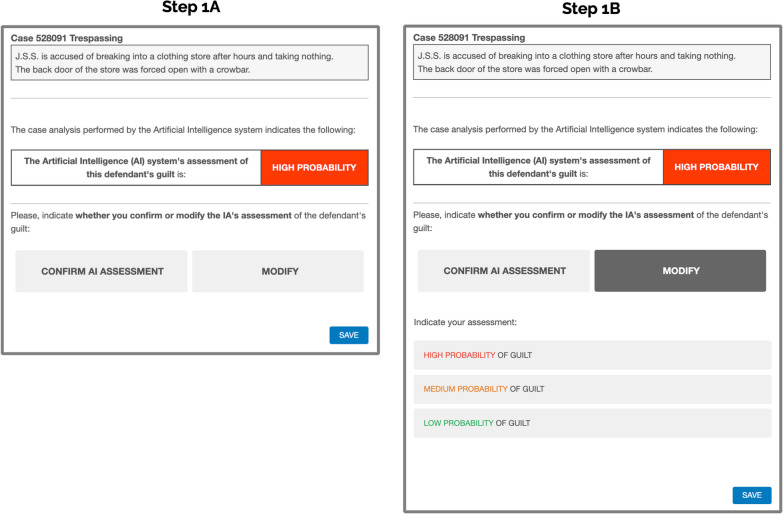
Automated decision-making is becoming increasingly common in the public sector. As a result, political institutions recommend the presence of humans in these decision-making processes as a safeguard against potentially erroneous or biased algorithmic decisions. However, the scientific literature on human-in-the-loop performance is not conclusive about the benefits and risks of such human presence, nor does it clarify which aspects of this human–computer interaction may influence the final decision. In two experiments, we simulate an automated decision-making process in which participants judge multiple defendants in relation to various crimes, and we manipulate the time in which participants receive support from a supposed automated system with Artificial Intelligence (before or after they make their judgments). Our results show that human judgment is affected when participants receive incorrect algorithmic support, particularly when they receive it before providing their own judgment, resulting in reduced accuracy. The data and materials for these experiments are freely available at the Open Science Framework: https://osf.io/b6p4z/ Experiment 2 was preregistered.
Overview
The claims and statistics of this paper haven’t been checked yet.
Free: it reads the open-access text and checks the first 5 claims that cite a source we can check. Create a free account to check every claim.
Integrity signals
Registry
Cites
Statistics
Figures



Verification
Claims the paper makes
The claims and statistics of this paper haven’t been checked yet.
Free: it reads the open-access text and checks the first 5 claims that cite a source we can check. Create a free account to check every claim.
Claims other papers make about this one
Each is checked against this paper’s own text: does it say what the citing paper says it does?
The source backs part of the claim, not all of it — or backs it for a different population, condition or comparison.
In the citing paper
“Agudo et al. conducted empirical studies examining how AI errors propagate through human-in-the-loop processes, finding that humans often fail to detect and correct AI mistakes even when they have the knowledge and ability to do so [11].”
From Human-in-the-Loop Artificial Intelligence: A Systematic Review of Concepts, Methods, and Applications (2026) · cites this paper as [11]
Experimental — accuracy not yet measuredThe source backs part of the claim, not all of it — or backs it for a different population, condition or comparison.
In the citing paper
“The study also revealed that the rate of error detection reduces when individuals adapt to high accuracy levels of AI, which means that AI’s success could be its own failure in terms of requiring human oversight.”
From Human-in-the-Loop Artificial Intelligence: A Systematic Review of Concepts, Methods, and Applications (2026) · cites this paper as [11]
Experimental — accuracy not yet measuredThe cited source says what the claim attributes to it.
In the citing paper
“Critically, the institutional mechanisms most commonly proposed to counteract this shift may be less effective than assumed (Green 2022;Agudo et al. 2024;Coskun and Leidner 2024;Stevenson and Doleac 2024).”
From Limits of Interventions in AI-Assisted Decision Making (2026) · cites this paper as Agudo et al. 2024
The check wasn’t confident either way, so it gives no verdict — never disputed.
In the citing paper
“Trust calibration refers to the alignment between a user’s confidence in an AI system and the system’s actual reliability [11].”
From Human-in-the-Loop Artificial Intelligence: A Systematic Review of Concepts, Methods, and Applications (2026) · cites this paper as [11]
Experimental — accuracy not yet measured
Self-check
Percentages, sums and reported differences re-computed from the paper’s own numbers.
The self-check needs the paper’s full text.
Citations
Cites
Tversky, A., & Kahneman, D. (1974) · Science · doi:10.1126/science.185.4157.1124 · Cited by 28,810 · cited 1×
“Anchoring bias is the tendency to over-rely on a piece of information we initially receive (the anchor) so that then we tend to adjust our final judgment based on that starting point or anchor (Epley & Gilovich, 2006; Tversky & Kahneman, 1974).”
BackgroundJudgment under Uncertainty: Heuristics and Biases
Tversky, A., & Kahneman, D. (1975) · Utility, Probability, and Human Decision Making · doi:10.1007/978-94-010-1834-0_8 · Cited by 22,650
Dissecting racial bias in an algorithm used to manage the health of populations
Obermeyer, Z., Powers, B., Vogeli, C., & Mullainathan, S. (2019) · Science · doi:10.1126/science.aax2342 · Cited by 7,137
(2016) · Cited by 2,334
Proceedings of the 2020 CHI Conference on Human Factors in Computing Systems
(2020) · doi:10.1145/3313831 · Cited by 1,951
(2018) · Cited by 1,167
Buçinca, Z., Malaya, M. B., & Gajos, K. Z. (2021) · arXiv · doi:10.48550/arxiv.2102.09692 · Cited by 1,124 · cited 3×
“…the time at which the system support is received, or that have presented algorithmic support at different points in the decision process (Buçinca et al., 2021; Echterhoff et al., 2022; Green & Chen, 2019b; Rastogi et al., 2022; Vicente & Matute, 2023) to study whether this support can…”
BackgroundMethodIn AI we trust? Perceptions about automated decision-making by artificial intelligence
Araujo, T., Helberger, N., Kruikemeier, S., & de Vreese, C. H. (2020) · AI & SOCIETY · doi:10.1007/s00146-019-00931-w · Cited by 1,038
The Anchoring-and-Adjustment Heuristic: Why the Adjustments Are Insufficient
Epley, N., & Gilovich, T. (2006) · Psychological Science · doi:10.1111/j.1467-9280.2006.01704.x · Cited by 920 · cited 1×
“Anchoring bias is the tendency to over-rely on a piece of information we initially receive (the anchor) so that then we tend to adjust our final judgment based on that starting point or anchor (Epley & Gilovich, 2006; Tversky & Kahneman, 1974).”
BackgroundAlon-Barkat, S., & Busuioc, M. (2023) · Journal of Public Administration Research and Theory · doi:10.1093/jopart/muac007 · Cited by 469
Research works printed but not linked: 2
- Parasuraman, R., & Mustapha, M. (1996). Automation and human performance. CRC Press.
- Ponce, J. (2022). Reserva de humanidad y supervisión humana de la Inteligencia artificial. El Cronista Del Estado Social y Democrático De Derecho, 100, 58–67.
Cited by
Exploring automation bias in human–AI collaboration: a review and implications for explainable AI
Romeo, G., & Conti, D. (2026) · AI & SOCIETY · doi:10.1007/s00146-025-02422-7 · Cited by 209
“This bias leads decision-makers to seek evidence that confirms the AI initial suggestion (Gaube et al. 2021; Nourani et al. 2022), especially when incorrect AI guidance is provided before they form their own judgment (Agudo et al. 2024).”
InfluentialLazaros, K., Vrahatis, A. G., & Kotsiantis, S. (2026) · Entropy · doi:10.3390/e28040377 · Cited by 50
Beyond A Reasonable Doubt? Audiovisual Evidence, AI Manipulation, Deepfakes, and the Law
Apolo, Y. M., & Michael, K. (2024) · IEEE Transactions on Technology and Society · doi:10.1109/tts.2024.3427816 · Cited by 47
“…to predictive identification practices within the EU and is likely to apply only in the context of automated processing (articles 2 and 3(52), respectively); thus, discounting the impact of “automation biases” that persist notwithstanding the requirement for their being a “human in the loop” [54].”
BackgroundMetacognitive sensitivity: The key to calibrating trust and optimal decision making with AI
Lee, D., Pruitt, J., Zhou, T., Du, J., & Odegaard, B. (2025) · PNAS Nexus · doi:10.1093/pnasnexus/pgaf133 · Cited by 43
“When the mechanisms and reliabilities of AI’s decision-making processes are unknown, it can become difficult for individuals to decide whether or not they should trust the outputs of such systems, especially because many AI systems still err in specific judgments (19 – 21 ).”
Cyber-Creativity: A Decalogue of Research Challenges
Corazza, G. E., Agnoli, S., Jorge Artigau, A., Beghetto, R. A., Bonnardel, N., Coletto, I., Faiella, A., Gerardini, K., Gilhooly, K., Glăveanu, V. P., et al. (2025) · Journal of Intelligence · doi:10.3390/jintelligence13080103 · Cited by 14
Metadata
- Authors
- Agudo, U., Liberal, K. G., Arrese, M., & Matute, H.
- Affiliations
- Universidad de Deusto (ES)
- Corresponding author
- Matute, Helena
- Venue
- Cognitive Research: Principles and Implications
- Published
- 2024-01-07
- Volume
- 9
- Issue
- 1
- Pages
- 1-1
- ISSN
- 2365-7464 (ISSN-L)
- PMC
- PMC10772030
- OpenAlex
- W4390655872
- Cited by
- 66
- References
- 38
- Citations by year
- 2026: 30 · 2025: 27 · 2024: 9
- FWCI
- 31.31
- Type
- journal article
- Language
- en
- Open access
- gold
- doi.org
- Licence
- cc-by
- creativecommons.org/licenses/by/4.0 (tdm)
- creativecommons.org/licenses/by/4.0 (vor)
- Locations
- Cognitive Research Principles and Implications (publishedVersion, cc-by)
- PubMed Central (publishedVersion, cc-by)
- PubMed (publishedVersion)
- DeustoTeka (submittedVersion, cc-by-nc-nd)
- DOAJ (DOAJ: Directory of Open Access Journals) (submittedVersion, cc-by-sa)
- Funders
- Ministerio de Ciencia e Innovación (PID2021-126320NB-I00/MCIN/AEI/10.13039/501100011033/ERDF, EU)
- Eusko Jaurlaritza (IT1696-22)
- Topics
- Social Sciences › Human Factors and Ergonomics › Human-Automation Interaction and Safety
- Physical Sciences › Computer Science › Artificial Intelligence › Ethics and Social Impacts of AI
- Social Sciences › Law › Artificial Intelligence in Law
- Keywords
- human-in-the-loop decision making, AI errors, automated decision support, algorithmic bias, human-computer interaction, public sector decision-making
- MeSH terms
- Artificial Intelligence, Crime, Humans, Judgment, Public Sector
About these checks
Registry, retraction, Cites and statistics results are computed, not judged, with one exception: a printed reference that no index lists is read once by a model before it counts as a citation error. Claims are extracted by a model and kept only when their quote appears verbatim in the text; each cited source is then checked, with a model’s help, for whether it says what the claim relies on. Those verdicts can be wrong — read the claim’s quote and the cited source before relying on one.
Statistics and arithmetic are recomputed, not judged.
Confidence bands are shown only for fields calibrated on our annotated test set. None is calibrated yet, so no band is shown.
What counts as a claim ›How we measure confidence ›How we check this ›
Are you an author, or do you see a problem with this page? Request a review
How to cite
Cite CoChat for the checks on this page, and the paper for its own findings.
- This page
- CoChat. (2026). Citation check: The impact of AI errors in a human-in-the-loop process. https://app.cochat.ai/papers/10.1186/s41235-023-00529-3
- The paper
- Agudo, U., Liberal, K. G., Arrese, M., & Matute, H. (2024). The impact of AI errors in a human-in-the-loop process. Cognitive Research: Principles and Implications. https://doi.org/10.1186/s41235-023-00529-3
Data sources
Bibliographic data: Semantic Scholar, OpenAlex, Crossref.
Contains information from the Semantic Scholar Academic Graph Datasets, made available under the ODC Attribution License (ODC-BY 1.0).
Semantic Scholar’s data is described in: Kinney, R., et al. (2023). The Semantic Scholar Open Data Platform. arXiv:2301.10140.
