

The impact of AI errors in a human-in-the-loop process
Open accessThe DOI matches its Crossref record; 39 of the 39 references it cites were found in a registry or an index.
Abstract
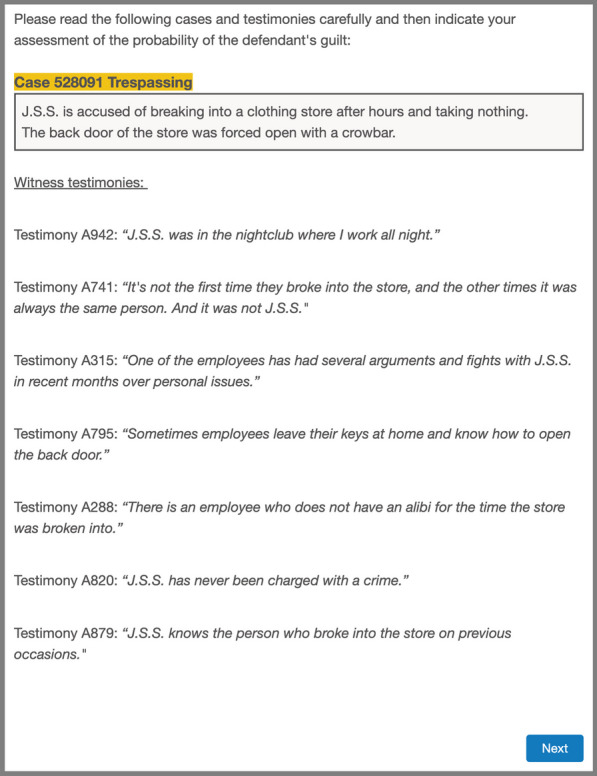
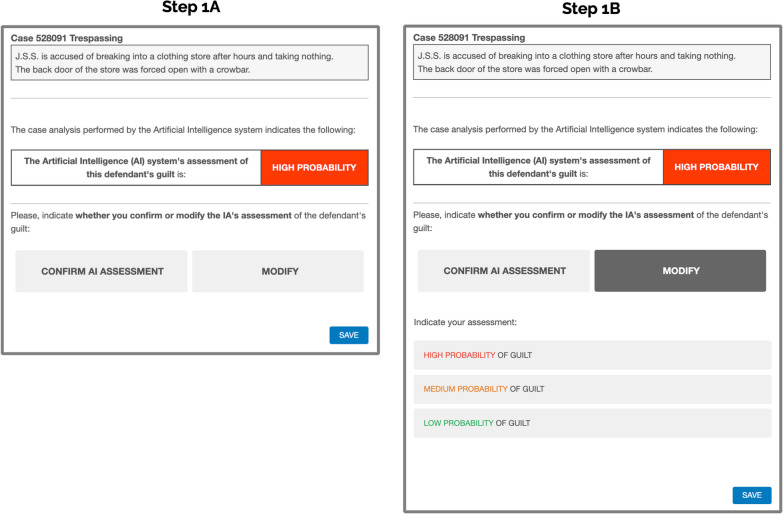
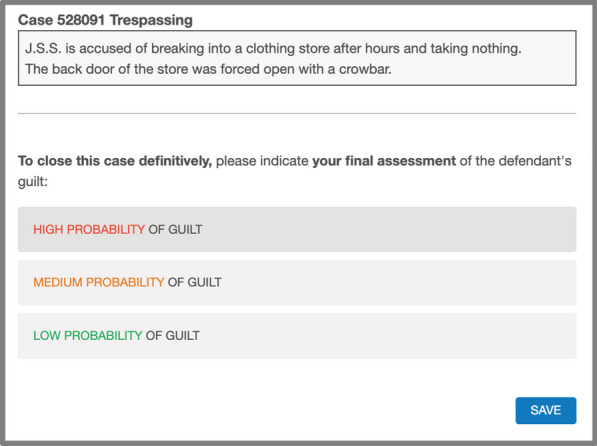
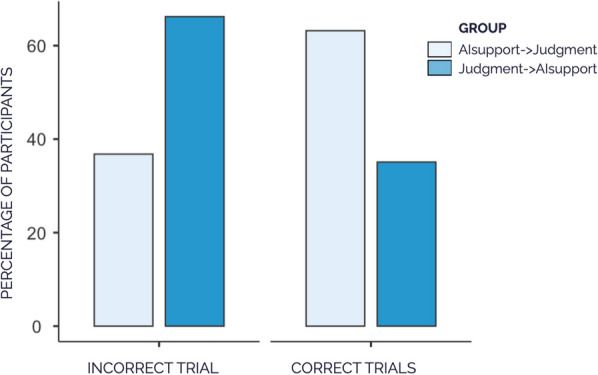
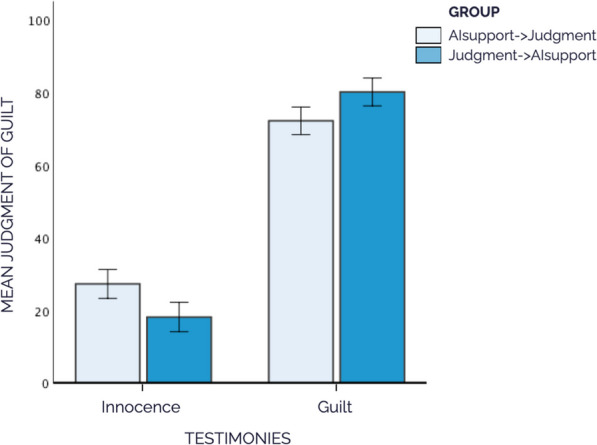
Automated decision-making is becoming increasingly common in the public sector. As a result, political institutions recommend the presence of humans in these decision-making processes as a safeguard against potentially erroneous or biased algorithmic decisions. However, the scientific literature on human-in-the-loop performance is not conclusive about the benefits and risks of such human presence, nor does it clarify which aspects of this human–computer interaction may influence the final decision. In two experiments, we simulate an automated decision-making process in which participants judge multiple defendants in relation to various crimes, and we manipulate the time in which participants receive support from a supposed automated system with Artificial Intelligence (before or after they make their judgments). Our results show that human judgment is affected when participants receive incorrect algorithmic support, particularly when they receive it before providing their own judgment, resulting in reduced accuracy. The data and materials for these experiments are freely available at the Open Science Framework: https://osf.io/b6p4z/ Experiment 2 was preregistered.
Overview
The claims and statistics of this paper haven’t been checked yet.
Free: it reads the open-access text and checks the first 5 claims that cite a source we can check. Create a free account to check every claim.
Integrity signals
Registry
Cites
Statistics
Figures
Verification
Claims the paper makes
The claims and statistics of this paper haven’t been checked yet.
Free: it reads the open-access text and checks the first 5 claims that cite a source we can check. Create a free account to check every claim.
Claims other papers make about this one
Each is checked against this paper’s own text: does it say what the citing paper says it does?
The source backs part of the claim, not all of it — or backs it for a different population, condition or comparison.
In the citing paper
“Agudo et al. conducted empirical studies examining how AI errors propagate through human-in-the-loop processes, finding that humans often fail to detect and correct AI mistakes even when they have the knowledge and ability to do so [11].”
From Human-in-the-Loop Artificial Intelligence: A Systematic Review of Concepts, Methods, and Applications (2026) · cites this paper as [11]
Experimental — accuracy not yet measuredThe source backs part of the claim, not all of it — or backs it for a different population, condition or comparison.
In the citing paper
“The study also revealed that the rate of error detection reduces when individuals adapt to high accuracy levels of AI, which means that AI’s success could be its own failure in terms of requiring human oversight.”
From Human-in-the-Loop Artificial Intelligence: A Systematic Review of Concepts, Methods, and Applications (2026) · cites this paper as [11]
Experimental — accuracy not yet measuredThe cited source says what the claim attributes to it.
In the citing paper
“Critically, the institutional mechanisms most commonly proposed to counteract this shift may be less effective than assumed (Green 2022;Agudo et al. 2024;Coskun and Leidner 2024;Stevenson and Doleac 2024).”
From Limits of Interventions in AI-Assisted Decision Making (2026) · cites this paper as Agudo et al. 2024
The check wasn’t confident either way, so it gives no verdict — never disputed.
In the citing paper
“Trust calibration refers to the alignment between a user’s confidence in an AI system and the system’s actual reliability [11].”
From Human-in-the-Loop Artificial Intelligence: A Systematic Review of Concepts, Methods, and Applications (2026) · cites this paper as [11]
Experimental — accuracy not yet measured
Self-check
Percentages, sums and reported differences re-computed from the paper’s own numbers.
The self-check needs the paper’s full text.
Citations
Cites
Tversky, A., & Kahneman, D. (1974) · Science · doi:10.1126/science.185.4157.1124 · Cited by 28,810 · cited 1×
“Anchoring bias is the tendency to over-rely on a piece of information we initially receive (the anchor) so that then we tend to adjust our final judgment based on that starting point or anchor (Epley & Gilovich, 2006; Tversky & Kahneman, 1974).”
BackgroundJudgment under Uncertainty: Heuristics and Biases
Tversky, A., & Kahneman, D. (1975) · Utility, Probability, and Human Decision Making · doi:10.1007/978-94-010-1834-0_8 · Cited by 22,650
Dissecting racial bias in an algorithm used to manage the health of populations
Obermeyer, Z., Powers, B., Vogeli, C., & Mullainathan, S. (2019) · Science · doi:10.1126/science.aax2342 · Cited by 7,137
(2016) · Cited by 2,334
Proceedings of the 2020 CHI Conference on Human Factors in Computing Systems
(2020) · doi:10.1145/3313831 · Cited by 1,951
(2018) · Cited by 1,167
Buçinca, Z., Malaya, M. B., & Gajos, K. Z. (2021) · arXiv · doi:10.48550/arxiv.2102.09692 · Cited by 1,124 · cited 3×
“…the time at which the system support is received, or that have presented algorithmic support at different points in the decision process (Buçinca et al., 2021; Echterhoff et al., 2022; Green & Chen, 2019b; Rastogi et al., 2022; Vicente & Matute, 2023) to study whether this support can…”
BackgroundMethodIn AI we trust? Perceptions about automated decision-making by artificial intelligence
Araujo, T., Helberger, N., Kruikemeier, S., & de Vreese, C. H. (2020) · AI & SOCIETY · doi:10.1007/s00146-019-00931-w · Cited by 1,038
The Anchoring-and-Adjustment Heuristic: Why the Adjustments Are Insufficient
Epley, N., & Gilovich, T. (2006) · Psychological Science · doi:10.1111/j.1467-9280.2006.01704.x · Cited by 920 · cited 1×
“Anchoring bias is the tendency to over-rely on a piece of information we initially receive (the anchor) so that then we tend to adjust our final judgment based on that starting point or anchor (Epley & Gilovich, 2006; Tversky & Kahneman, 1974).”
BackgroundAlon-Barkat, S., & Busuioc, M. (2023) · Journal of Public Administration Research and Theory · doi:10.1093/jopart/muac007 · Cited by 469
Automation bias and verification complexity: a systematic review
Lyell, D., & Coiera, E. (2017) · Journal of the American Medical Informatics Association · doi:10.1093/jamia/ocw105 · Cited by 451
The Principles and Limits of Algorithm-in-the-Loop Decision Making
Green, B., & Chen, Y. (2019) · Proceedings of the ACM on Human-Computer Interaction · doi:10.1145/3359152 · Cited by 392 · cited 6×
“Although in this research we have used accuracy as a measure to assess the human-in-the-loop process, decisions in the field of justice must be fair, correctable, and ethical among other things, in addition to being accurate (Green & Chen, 2019b).”
BackgroundMethodResultInfluentialAutomation and Human Performance: Theory and Applications
(2018) · Routledge eBooks · doi:10.1201/9781315137957 · Cited by 307
Disparate Interactions: An Algorithm-in-the-Loop Analysis of Fairness in Risk Assessments
Green, B., & Chen, Y. (2019) · Proceedings of the Conference on Fairness, Accountability, and Transparency · doi:10.1145/3287560.3287563 · Cited by 275 · cited 6×
“Although in this research we have used accuracy as a measure to assess the human-in-the-loop process, decisions in the field of justice must be fair, correctable, and ethical among other things, in addition to being accurate (Green & Chen, 2019b).”
BackgroundMethodResultInfluentialAutomation Bias in Intelligent Time Critical Decision Support Systems
Cummings, M. (2004) · AIAA 1st Intelligent Systems Technical Conference · doi:10.2514/6.2004-6313 · Cited by 269 · cited 2×
“…compliance when the system’s assessment is erroneous is often referred to in the engineering and artificial intelligence fields as automation bias (Cummings, 2004; Lyell & Coiera, 2017; Mosier & Manzey, 2019; Parasuraman & Mustapha, 1996), and this effect has been documented in domains as…”
BackgroundThe flaws of policies requiring human oversight of government algorithms
Green, B. (2022) · Computer Law & Security Review · doi:10.1016/j.clsr.2022.105681 · Cited by 263 · cited 4×
“Importantly, it has been noted that, it is more difficult for humans to supervise and judge the accuracy of an algorithm’s prediction than to make their own assessments and predictions (Green, 2022).”
BackgroundInfluentialChong, L., Zhang, G., Goucher-Lambert, K., Kotovsky, K., & Cagan, J. (2022) · Computers in Human Behavior · doi:10.1016/j.chb.2021.107018 · Cited by 262 · cited 2×
“Next, we asked participants about their degree of confidence, both in their own ability and in the AI system, given that these two factors could affect the acceptance or rejection of algorithmic support, as noted by some researchers (Chong et al., 2022; Green & Chen, 2019a).”
BackgroundThe Flaws of Policies Requiring Human Oversight of Government Algorithms
Green, B. (2021) · doi:10.2139/ssrn.3921216 · Cited by 259
Deciding Fast and Slow: The Role of Cognitive Biases in AI-assisted Decision-making
Rastogi, C., Zhang, Y., Wei, D., Varshney, K. R., Dhurandhar, A., & Tomsett, R. (2022) · Proceedings of the ACM on Human-Computer Interaction · doi:10.1145/3512930 · Cited by 216 · cited 2×
“One example of this possible influence would be the anchoring bias (Rastogi et al., 2022).”
BackgroundDual-process cognitive interventions to enhance diagnostic reasoning: a systematic review
Lambe, K. A., O'Reilly, G., Kelly, B. D., & Curristan, S. (2016) · BMJ Quality & Safety · doi:10.1136/bmjqs-2015-004417 · Cited by 215 · cited 3×
“This cognitive forcing function would force users of decision support systems to think more analytically and disrupt the fast and heuristic reasoning that may lead them to show compliance (Lambe et al., 2016).”
BackgroundInfluentialHumans inherit artificial intelligence biases
Vicente, L., & Matute, H. (2023) · Scientific Reports · doi:10.1038/s41598-023-42384-8 · Cited by 158 · cited 1×
“…support at different points in the decision process (Buçinca et al., 2021; Echterhoff et al., 2022; Green & Chen, 2019b; Rastogi et al., 2022; Vicente & Matute, 2023) to study whether this support can cause an anchoring effect on the human decision or in any way affect the final decision.”
BackgroundSelf-citationLiable, but not in control? Ensuring meaningful human agency in automated decision-making systems
Wagner, B. (2019) · Policy & Internet · doi:10.1002/poi3.198 · Cited by 136 · cited 1×
“…the responsibility and agency they have, their motivation and incentives, etc., that can turn human-in-the-loop processes into “quasi-automate” processes where the human contributes almost nothing (Wagner, 2019) and even provides a false sense of security (Ponce, 2022), as our results suggest.”
ResultHuman Decision Making with Machine Assistance: An Experiment on Bailing and Jailing
Grgić-Hlača, N., Engel, C., & Gummadi, K. P. (2019) · Proceedings of the ACM on Human-Computer Interaction · doi:10.1145/3359280 · Cited by 113 · cited 3×
“This result, which is in the line with more recent work on this topic (De-Arteaga et al., 2020; Grgic-Hlaca et al., 2019; Portela et al., 2022), contrasts with the high compliance that some automated systems, such as RisCanvi, show outside the laboratory (above 95%; Saura & Aragó, 2021.”
MethodResultAutomation bias in electronic prescribing
Lyell, D., Magrabi, F., Raban, M. Z., Pont, L. G., Baysari, M. T., Day, R. O., & Coiera, E. (2017) · BMC Medical Informatics and Decision Making · doi:10.1186/s12911-017-0425-5 · Cited by 103 · cited 2×
“An example of this automation bias is found in Lyell et al. (2017).”
BackgroundImpact of risk assessment on judges’ fairness in sentencing relatively poor defendants
Skeem, J., Scurich, N., & Monahan, J. (2020) · Law and Human Behavior · doi:10.1037/lhb0000360 · Cited by 70 · cited 1×
“On the other hand, several empirical studies using similar forensic AI models, seem to suggest the opposite results (Green & Chen, 2019a, 2019b, 2021; Grgic-Hlaca et al., 2019; Portela et al., 2022; Skeem et al., 2020).”
ResultGreen, B., & Chen, Y. (2021) · Proceedings of the ACM on Human-Computer Interaction · doi:10.1145/3479562 · Cited by 69 · cited 2×
“This decision, in addition to facilitating recruitment, was supported by previous work on automated decision systems in justice, which states that the behavior of laypeople and professionals does not differ (Green & Chen, 2021).”
ResultHumans and Automated Decision Aids: A Match Made in Heaven?
Mosier, K. L., & Manzey, D. (2019) · CRC Press eBooks · doi:10.1201/9780429458330-2 · Cited by 66 · cited 2×
“…intelligence fields as automation bias (Cummings, 2004; Lyell & Coiera, 2017; Mosier & Manzey, 2019; Parasuraman & Mustapha, 1996), and this effect has been documented in domains as diverse as aviation, healthcare, military, and process control (see meta-analysis by Mosier & Manzey, 2019).”
BackgroundIs that your final decision? Multi-stage profiling, selective effects, and Article 22 of the GDPR
Binns, R., & Veale, M. (2021) · International Data Privacy Law · doi:10.1093/idpl/ipab020 · Cited by 65
The Algorithmic Automation Problem: Prediction, Triage, and Human Effort
Raghu, M., Blumer, K., Corrado, G., Kleinberg, J., Obermeyer, Z., & Mullainathan, S. (2019) · arXiv · doi:10.48550/arxiv.1903.12220 · Cited by 58
The influence of algorithms on political and dating decisions
Agudo, U., & Matute, H. (2021) · PLOS ONE · doi:10.1371/journal.pone.0249454 · Cited by 57 · cited 1×
“As has already been shown, the influence of algorithmic support and recommendation on human decisions, both public and private, is often underestimated (Agudo & Matute, 2021).”
BackgroundSelf-citationEficacia predictiva de la valoración policial del riesgo de la violencia de género
López-Ossorio, J. J., González-Álvarez, J. L., & Andrés-Pueyo, A. (2016) · Psychosocial Intervention · doi:10.1016/j.psi.2015.10.002 · Cited by 52
AI-Moderated Decision-Making: Capturing and Balancing Anchoring Bias in Sequential Decision Tasks
Echterhoff, J. M., Yarmand, M., & McAuley, J. (2022) · CHI Conference on Human Factors in Computing Systems · doi:10.1145/3491102.3517443 · Cited by 30 · cited 1×
“…which the system support is received, or that have presented algorithmic support at different points in the decision process (Buçinca et al., 2021; Echterhoff et al., 2022; Green & Chen, 2019b; Rastogi et al., 2022; Vicente & Matute, 2023) to study whether this support can cause an anchoring…”
BackgroundA comparative user study of human predictions in algorithm-supported recidivism risk assessment
Portela, M., Castillo, C., Tolan, S., Karimi-Haghighi, M., & Pueyo, A. A. (2024) · Artificial Intelligence and Law · doi:10.1007/s10506-024-09393-y · Cited by 24 · cited 2×
“This result, which is in the line with more recent work on this topic (De-Arteaga et al., 2020; Grgic-Hlaca et al., 2019; Portela et al., 2022), contrasts with the high compliance that some automated systems, such as RisCanvi, show outside the laboratory (above 95%; Saura & Aragó, 2021.”
ResultUsing Dreyfus’ legacy to understand justice in algorithm-based processes
Casacuberta, D., & Guersenzvaig, A. (2018) · AI & Society · doi:10.1007/s00146-018-0803-2 · Cited by 17
Solans, D., Beretta, A., Portela, M., Castillo, C., & Monreale, A. (2022) · arXiv (Cornell University) · doi:10.48550/arxiv.2203.15514 · Cited by 10 · cited 1×
“Specifically, this process usually follows the following sequence (Chong et al., 2022; Solans et al., 2022): First, the system evaluates the available information and shows its assessment; then, the human is given just a few options: to validate, or to modify the system assessment.”
BackgroundErrores conceptuales en la estimación de riesgo de reincidencia
Garay, L. M. (2016) · Revista Española de Investigación Criminológica · doi:10.46381/reic.v14i0.97 · Cited by 8 · cited 2×
“…recent general report published on the performance of this system, RisCanvi has a positive predictive capacity of 18%, that is, only two inmates out of ten end up confirming the system’s prediction and reoffending after being classified as high risk (Capdevila et al., 2015; Martínez-Garay, 2016).”
BackgroundMethodInfluentialPolicy-makers’ Processing of AI Algorithmic Advice: ‘Automation Bias’ versus Selective Adherence
Alon Barkat, S., & Busuioc, M. (2020) · SSRN Electronic Journal · doi:10.2139/ssrn.3794660 · Cited by 6
Supporting Better Decisions: How Order Effects Influence Decision Support System Alignment
Marquardson, J., & Grimes, G. M. (2018) · Interacting with Computers · doi:10.1093/iwc/iwy022 · Cited by 4 · cited 1×
“…and that the system support is received at the beginning of the process, establishing an order in the presentation of information that is likely to influence the processing of decision-relevant information by the human decision-maker (Marquardson & Grimes, 2018) and affect compliance and accuracy.”
BackgroundValdivia, A., Hyde-Vaamonde, C., & García-Marcos, J. (2022) · arXiv (Cornell University) · doi:10.48550/arxiv.2203.03723 · Cited by 3 · cited 1×
“…information provided by the system (Ponce, 2022; Portela & Álvarez, 2022), can understand how these systems work, and are able to disa-gree with the automated system’s decision (Green, 2022) in the event of a conflict between human judgment and algorithmic recommendation (Valdivia et al., 2022).”
Background
Research works printed but not linked: 2
- Parasuraman R Mustapha M Automation and human performance 1996 CRC Press
- Ponce J Reserva de humanidad y supervisión humana de la Inteligencia artificial El Cronista Del Estado Social y Democrático De Derecho 2022 100 58 67
Cited by
Exploring automation bias in human–AI collaboration: a review and implications for explainable AI
Romeo, G., & Conti, D. (2026) · AI & SOCIETY · doi:10.1007/s00146-025-02422-7 · Cited by 209
“This bias leads decision-makers to seek evidence that confirms the AI initial suggestion (Gaube et al. 2021; Nourani et al. 2022), especially when incorrect AI guidance is provided before they form their own judgment (Agudo et al. 2024).”
InfluentialLazaros, K., Vrahatis, A. G., & Kotsiantis, S. (2026) · Entropy · doi:10.3390/e28040377 · Cited by 50
Beyond A Reasonable Doubt? Audiovisual Evidence, AI Manipulation, Deepfakes, and the Law
Apolo, Y. M., & Michael, K. (2024) · IEEE Transactions on Technology and Society · doi:10.1109/tts.2024.3427816 · Cited by 47
“…to predictive identification practices within the EU and is likely to apply only in the context of automated processing (articles 2 and 3(52), respectively); thus, discounting the impact of “automation biases” that persist notwithstanding the requirement for their being a “human in the loop” [54].”
BackgroundMetacognitive sensitivity: The key to calibrating trust and optimal decision making with AI
Lee, D., Pruitt, J., Zhou, T., Du, J., & Odegaard, B. (2025) · PNAS Nexus · doi:10.1093/pnasnexus/pgaf133 · Cited by 44
“When the mechanisms and reliabilities of AI’s decision-making processes are unknown, it can become difficult for individuals to decide whether or not they should trust the outputs of such systems, especially because many AI systems still err in specific judgments (19 – 21 ).”
Cyber-Creativity: A Decalogue of Research Challenges
Corazza, G. E., Agnoli, S., Jorge Artigau, A., Beghetto, R. A., Bonnardel, N., Coletto, I., Faiella, A., Gerardini, K., Gilhooly, K., Glăveanu, V. P., et al. (2025) · Journal of Intelligence · doi:10.3390/jintelligence13080103 · Cited by 14
Metadata
- Authors
- Agudo, U., Liberal, K. G., Arrese, M., & Matute, H.
- Affiliations
- Universidad de Deusto (ES)
- Corresponding author
- Matute, Helena
- Venue
- Cognitive Research: Principles and Implications
- Published
- 2024-01-07
- Volume
- 9
- Issue
- 1
- Pages
- 1-1
- ISSN
- 2365-7464 (ISSN-L)
- PMC
- PMC10772030
- OpenAlex
- W4390655872
- Cited by
- 66
- References
- 38
- Citations by year
- 2026: 30 · 2025: 27 · 2024: 9
- FWCI
- 31.31
- Type
- journal article
- Language
- en
- Open access
- gold
- doi.org
- Licence
- cc-by
- creativecommons.org/licenses/by/4.0 (tdm)
- creativecommons.org/licenses/by/4.0 (vor)
- Locations
- Cognitive Research Principles and Implications (publishedVersion, cc-by)
- PubMed Central (publishedVersion, cc-by)
- PubMed (publishedVersion)
- DeustoTeka (submittedVersion, cc-by-nc-nd)
- DOAJ (DOAJ: Directory of Open Access Journals) (submittedVersion, cc-by-sa)
- Funders
- Ministerio de Ciencia e Innovación (PID2021-126320NB-I00/MCIN/AEI/10.13039/501100011033/ERDF, EU)
- Eusko Jaurlaritza (IT1696-22)
- Topics
- Social Sciences › Human Factors and Ergonomics › Human-Automation Interaction and Safety
- Physical Sciences › Computer Science › Artificial Intelligence › Ethics and Social Impacts of AI
- Social Sciences › Law › Artificial Intelligence in Law
- Keywords
- human-in-the-loop decision making, AI errors, automated decision support, algorithmic bias, human-computer interaction, public sector decision-making
- MeSH terms
- Artificial Intelligence, Crime, Humans, Judgment, Public Sector
About these checks
Registry, retraction, Cites and statistics results are computed, not judged, with one exception: a printed reference that no index lists is read once by a model before it counts as a citation error. Claims are extracted by a model and kept only when their quote appears verbatim in the text; each cited source is then checked, with a model’s help, for whether it says what the claim relies on. Those verdicts can be wrong — read the claim’s quote and the cited source before relying on one.
Statistics and arithmetic are recomputed, not judged.
Confidence bands are shown only for fields calibrated on our annotated test set. None is calibrated yet, so no band is shown.
What counts as a claim ›How we measure confidence ›How we check this ›
Are you an author, or do you see a problem with this page? Request a review
Data sources
Bibliographic data: Semantic Scholar, OpenAlex, Crossref.
Contains information from the Semantic Scholar Academic Graph Datasets, made available under the ODC Attribution License (ODC-BY 1.0).
Semantic Scholar’s data is described in: Kinney, R., et al. (2023). The Semantic Scholar Open Data Platform. arXiv:2301.10140.
