

Blended learning effectiveness: the relationship between student characteristics, design features and outcomes
Open accessThe DOI matches its Crossref record; 57 of the 62 references it cites were found in a registry or an index, and 1 are not checked yet; 3 of the 33 sources its claims cite were checked for support.
Abstract
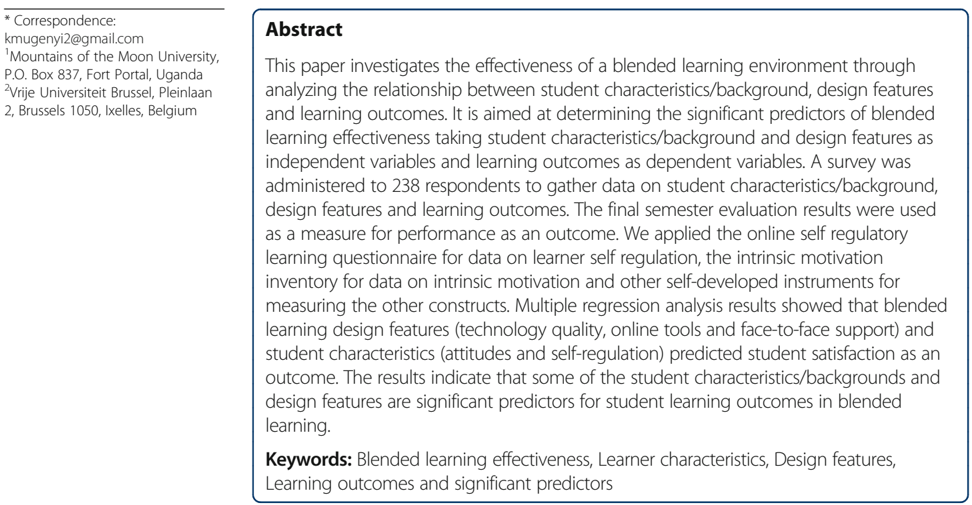
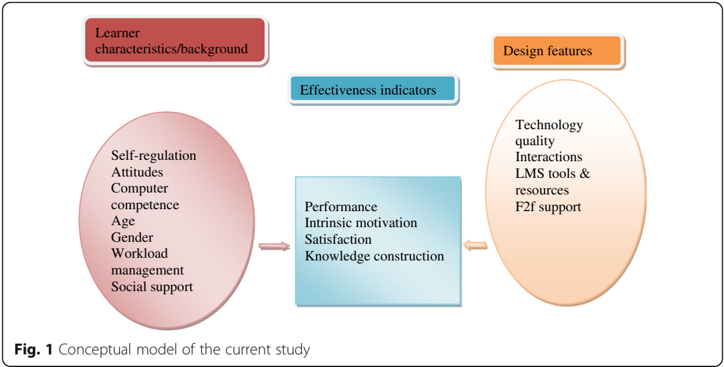
This paper investigates the effectiveness of a blended learning environment through analyzing the relationship between student characteristics/background, design features and learning outcomes. It is aimed at determining the significant predictors of blended learning effectiveness taking student characteristics/background and design features as independent variables and learning outcomes as dependent variables. A survey was administered to 238 respondents to gather data on student characteristics/background, design features and learning outcomes. The final semester evaluation results were used as a measure for performance as an outcome. We applied the online self regulatory learning questionnaire for data on learner self regulation, the intrinsic motivation inventory for data on intrinsic motivation and other self-developed instruments for measuring the other constructs. Multiple regression analysis results showed that blended learning design features (technology quality, online tools and face-to-face support) and student characteristics (attitudes and self-regulation) predicted student satisfaction as an outcome. The results indicate that some of the student characteristics/backgrounds and design features are significant predictors for student learning outcomes in blended learning.
Verified 2026-11-22 · 1 reference not checked yet
Overview
CoChat Summary
TL;DR
This study surveyed 238 learners in a Ugandan university blended learning course and used multiple regression to test whether learner characteristics and design features predict satisfaction, knowledge construction, intrinsic motivation, and performance. It found several design and learner variables predicted satisfaction, knowledge construction, and intrinsic motivation, but none predicted final examination performance.
Key findings
- Multiple regression showed technology quality, online tools, face-to-face support, attitudes, and self-regulation predicted satisfaction; technology quality, interactions, social support, and self-regulation predicted knowledge construction; technology quality, online tools, interactions, and self-regulation predicted intrinsic motivation; none of the independent variables predicted performance/grade. R² = 0.525, meaning the independent variables explained about 53% of the variance in overall satisfaction, motivation, and knowledge construction.
- Male learners performed slightly better (M = 62.5) than female learners (M = 61.1), but the difference was not statistically significant (t = 1.569, df = 228, p = 0.05, one-tailed; d = 0.18). Age groups differed significantly in performance (F(1,236) = 8.498, p < .001), with means of 62% for ages 20–30 and 67% for ages 31–39.
- Learners reported high intrinsic motivation: interest/enjoyment 83.7%, perceived competence 70.2%, effort/importance 80%, pressure/tension 54%, and value/usefulness 91%. Satisfaction was reported at 81%, knowledge construction at 78%, and final examination performance averaged a pass of 62% (SD = 7.5).
- Design-feature results included technology quality rated at 69%, face-to-face support attitudes at 88%, and LMS effectiveness at 79%; blog and wiki were rarely used, while email, forum, chat, and calendar were often used.
Methods
- Quantitative planning evaluation design in a 17-week semester: face-to-face study at the beginning, online teaching/learning in the second half, then face-to-face review and final semester examinations; Moodle was used as the learning management system.
- Cluster sampling selected 238 learners from three schools and one postgraduate directorate at a Ugandan university; the sample comprised 139 male students (58.4%) and 99 female students (41.6%), with an average age of 24 years.
- Measures included end-of-semester results for performance, the online self-regulated learning questionnaire, the intrinsic motivation inventory, and self-developed instruments for other constructs. Analysis used descriptive statistics, Shapiro-Wilk normality testing, skewness/kurtosis, independent samples t-test, one-way ANOVA, and multiple regression.
Limitations
- The paper states that none of the independent variables were identified as significant predictors of student performance and that these gaps are open for further investigation. It also notes the sample came from three schools out of five and one postgraduate directorate at one Ugandan university, and that the age analysis covered only young and middle-aged groups (20–30 and 31–39), unlike studies including old above 45 years.
- Evident from the text: the single-institution planning evaluation and survey design limit generalizability, and many constructs were measured with self-developed instruments, although the paper reports acceptable Cronbach’s alpha reliability.
Model-written summary. Check it against the paper before relying on it.
Integrity signals
Registry
Cites
Statistics
Figures
Verification
Claims the paper makes
3 Valid · 3 Not valid · 28 Not checked · 159 Own results and interpretations
Every source the paper cites for this claim was checked and supports it.
In the paper
“Among the blended learning design features, only learner interaction was a significant factor to learner satisfaction and knowledge construction.”
§ Blended learning effectiveness: the relationship between student characteristics, design features and outcomes > Introduction
What the sources say
- Supportedcites Kintu and Zhu (2016)
The Abstract states directly: 'Among the design elements, regression results showed only learner interactions as significant predictors of knowledge construction and satisfaction.' The Results section 'Factors predicting blended learning outcomes' reports the same with statistics (learner interactions significant for satisfaction β=.23, t=2.42, p<.05 and knowledge construction β=.21, t=2.12, p<.05, while all other design features were non-significant, p>.05), and Section 7.3 reiterates that knowledge construction's significant factors include learner interactions. Other significant predictors in the paper (learner attitudes, management of workload) are learner characteristics/background rather than design features, so the claim's restriction to design features holds. (LLM, conf=0.93)
plainstates an association- Asserted: passes — The authors put it forward as true.
- Checkable: passes — It can be checked against evidence.
- Load-bearing: unclear — It is unclear whether the paper’s conclusions depend on it.
- Based: passes — The paper gives a reason why it holds.
- Supported
The cited sources support only part of this claim — read each source’s verdict below.
In the paper
“Research shows that absence of learner interaction causes failure and eventual drop-out in online courses (Willging & Johnson, 2009) and the lack of learner connectedness was noted as an internal factor leading to learner drop-out in online courses (Zielinski, 2000).”
§ Blended learning effectiveness: the relationship between student characteristics, design features and outcomes > Blended learning design features
What the sources say
- Partly supportedcites Willging & Johnson, 2009 matched to “FACTORS THAT INFLUENCE STUDENTS’ DECISION TO DROPOUT OF ONLINE COURSES” (2009) sourceExperimental — accuracy not yet measured
In “Reasons for Leaving an Online Program” (page unavailable), one respondent named lack of interaction with students and instructors as a main reason for leaving. The Summary and Conclusions (page unavailable) says there was no evidence that lack of human interaction was a primary reason students left. The paper does not establish that absent interaction causes failure and eventual dropout. (LLM, conf=0.88)
plainstates a cause- Asserted: passes — The authors put it forward as true.
- Checkable: passes — It can be checked against evidence.
- Load-bearing: unclear — It is unclear whether the paper’s conclusions depend on it.
- Based: passes — The paper gives a reason why it holds.
- Partly supported
A result the paper reports from its own data — it cites no other source for it, so there is none to check. The quote shows it is in the paper.
In the paper
“This revealed a significant difference in performance (F(1,236 = 8.498, p < .001).”
§ Blended learning effectiveness: the relationship between student characteristics, design features and outcomes > Student characteristics, blended learning design features and learning outcomes (RQ1)
plain- Asserted: passes — The authors put it forward as true.
- Checkable: passes — It can be checked against evidence.
- Load-bearing: unclear — It is unclear whether the paper’s conclusions depend on it.
- Based: passes — The paper gives a reason why it holds.
A result the paper reports from its own data — it cites no other source for it, so there is none to check. The quote shows it is in the paper.
In the paper
“An independent t-test revealed that the difference between the performances was not statistically significant (t = 1.569, df = 228, p = 0.05, one tailed).”
§ Blended learning effectiveness: the relationship between student characteristics, design features and outcomes > Student characteristics, blended learning design features and learning outcomes (RQ1)
plain- Asserted: passes — The authors put it forward as true.
- Checkable: passes — It can be checked against evidence.
- Load-bearing: unclear — It is unclear whether the paper’s conclusions depend on it.
- Based: passes — The paper gives a reason why it holds.
A result the paper reports from its own data — it cites no other source for it, so there is none to check. The quote shows it is in the paper.
In the paper
“Results show that learner self-regulation was good enough at 72.3% in all the sub-scales of goal setting, environment structuring, task strategies, time management, help-seeking and self-evaluation among learners.”
§ Blended learning effectiveness: the relationship between student characteristics, design features and outcomes > Student characteristics, blended learning design features and learning outcomes (RQ1)
plain- Asserted: passes — The authors put it forward as true.
- Checkable: passes — It can be checked against evidence.
- Load-bearing: unclear — It is unclear whether the paper’s conclusions depend on it.
- Based: passes — The paper gives a reason why it holds.
115 more claims
Create a free account to see all 193 claims and every source verdict.
- It may state two separate claims as one. 52
- Probably not a substantial claim. 29
Self-check
Percentages, sums and reported differences re-computed from the paper’s own numbers.
Each contradiction between two passages listed here was confirmed by an independent check.
Rated major: it would touch a result — a value a result rests on, reported and recomputed p-values on opposite sides of the significance level, two passages that conflict with no sign which is right, or a cited work retracted before this paper was published.
In the paper
§ Blended learning effectiveness: the relationship between student characteristics, design features and outcomes > Student characteristics, blended learning design features and learning outcomes (RQ1)
“This revealed a significant difference in performance (F(1,236 = 8.498, p < .001).”
§ Blended learning effectiveness: the relationship between student characteristics, design features and outcomes > Significant predictors of blended learning effectiveness
“In line with Coldwell et al. (2008), no statistically significant differences exist between age groups.”
Rated minor: it would not touch a result — a value no result rests on, a p-value that stays on the same side of the significance level, or a conflict that is clerical, resolved elsewhere in the paper, or outside its own findings.
In the paper
§ Blended learning effectiveness: the relationship between student characteristics, design features and outcomes > Abstract
“Multiple regression analysis results showed that blended learning design features (technology quality, online tools and face-to-face support) and student characteristics (attitudes and self-regulation) predicted student satisfaction as an outcome.”
§ Blended learning effectiveness: the relationship between student characteristics, design features and outcomes > Significant predictors of blended learning effectiveness (RQ 2)
“From the table above, design features (technology quality and online tools and resources), and learner characteristics (attitudes to blended learning, self-regulation) were significant predictors of learner satisfaction in blended learning.”
Citations
Cites
From dissertation abstracts international
(1974) · ACM SIGGRAPH Computer Graphics · doi:10.1145/988616.988619 · Cited by 12,099
The DeLone and McLean Model of Information Systems Success: A Ten-Year Update
(2003) · Journal of Management Information Systems · doi:10.1080/07421222.2003.11045748 · Cited by 11,791
Blended learning: Uncovering its transformative potential in higher education
Garrison, D. R., & Kanuka, H. (2004) · The Internet and Higher Education · doi:10.1016/j.iheduc.2004.02.001 · Cited by 4,849
Evaluating professional development
Guskey, T. R. (1999) · CERN Document Server (European Organization for Nuclear Research) · Cited by 2,421
The Theory and Practice of Online Learning
(2008) · Athabasca University Press eBooks · doi:10.15215/aupress/9781897425084.01 · Cited by 1,841
Piccoli, G., Ahmad, R., & Ives, B. (2001) · MIS Quarterly · doi:10.2307/3250989 · Cited by 1,587
Instructional Media and Technologies for Learning
Heinich, R. (1996) · Cited by 1,146
Improving online learning: Student perceptions of useful and challenging characteristics
Song, L., Singleton, E. S., Hill, J. R., & Koh, M. H. (2004) · The Internet and Higher Education · doi:10.1016/j.iheduc.2003.11.003 · Cited by 1,132 · cited 4×
“Technical problems with regard to instructional design were a challenge to online learners thus not indicating effectiveness (Song et al., 2004), though the authors also indicated that descriptive statistics to a tune of 75% and time management (62%) impact on success of online learning.”
BackgroundResultInfluentialCritical success factors for e-learning acceptance: Confirmatory factor models
Selim, H. M. (2007) · Computers & Education · doi:10.1016/j.compedu.2005.09.004 · Cited by 1,055 · cited 4×
“In addition, studies by Leidner, Jarvenpaa, Dillon and Gunawardena as cited in Selim (2007) have noted three main factors that affect e-learning and blended learning effectiveness as instructor characteristics, technology and student characteristics.”
BackgroundInfluentialSwan, K. (2001) · Distance Education · doi:10.1080/0158791010220208 · Cited by 1,016
Research works printed but not linked: 5
- 6. Astleitner, H. (2000) Dropout and distance education. A review of motivational and emotional strategies to reduce dropout in web-based distance education. In Neuwe Medien in Unterricht, Aus-und Weiterbildung Waxmann Munster, New York.
- 10. Blocker, J. M., & Tucker, G. (2001). Using constructivist principles in designing and integrating online collaborative interactions. In F. Fuller & R. McBride (Eds.), Distance education. Proceedings of the Society for Information Technology & Teacher Education International Conference (pp. 32-36). ERIC Document Reproduction Service No. ED 457 822.
- 11. Cohen, K. E., Stage, F. K., Hammack, F. M., & Marcus, A. (2012). Persistence of master' s students in the United States: Developing and testing of a conceptual model. USA: PhD Dissertation, New York University.
- 41. Oxford Group, (2013). Blended learning-current use, challenges and best practices. From http://www.kineo.com/m/0/ blended-learning-report-202013.pdf. Accessed on 17 Mar 2016.
- 43. Pallant, J. (2010). SPSS Survival Mannual (4th ed.). Maidenhead: OUP McGraw-Hill.
Cited by
Items 201–300 of 760
Blended Learning Implementation and Impact in Vocational Schools
Handayani, T., Maulida, E., & Sugiyanta, L. (2020) · Teknodika · doi:10.20961/teknodika.v18i2.42032 · Cited by 16
Rahmayanti, P., Suwastini, N. K. A., Dantes, G. R., & Kultsum, U. (2022) · Journal of Education Technology · doi:10.23887/jet.v6i1.41561 · Cited by 16
TELL, CALL, and MALL: Approaches to Bridge the Language Gap
Palacios-Hidalgo, F. J. (2019) · Advances in linguistics and communication studies · doi:10.4018/978-1-7998-1219-7.ch008 · Cited by 14
Enhancing Blended Learning Materials using Cognitive Load Theory
Sithole, S. T. M. (2019) · Journal of Modern Accounting and Auditing · doi:10.17265/1548-6583/2019.01.004 · Cited by 12
Cai, Q. (2025) · International Journal of Educational Research · doi:10.1016/j.ijer.2025.102587 · Cited by 17
Wahjono, H., Wiyono, B. B., Maisyaroh, & Mustiningsih (2021) · Information · doi:10.3390/info12120511 · Cited by 9
Younas, M., El‐Dakhs, D. A. S., & Jiang, Y. (2025) · Frontiers in Education · doi:10.3389/feduc.2025.1626609 · Cited by 20
Halim, A. (2022) · SOSIOEDUKASI JURNAL ILMIAH ILMU PENDIDIKAN DAN SOSIAL · doi:10.36526/sosioedukasi.v11i1.1950 · Cited by 30
Li, W., Wei, K., Xu, T., & Wang, J. (2025) · Education and Information Technologies · doi:10.1007/s10639-024-13304-8 · Cited by 18
Zhao, L., Zhu, R., Cai, X., & Zhang, J. (2023) · Sustainability · doi:10.3390/su15075668 · Cited by 15
Alammary, A. S. (2024) · Sustainability · doi:10.3390/su16124923 · Cited by 19
Blended Learning to Improve the Physical Examination Ability of Nursing Students
Supriatin, S., Rithpho, P., Asiah, A., & Hikhmat, R. (2022) · International Journal of Educational Qualitative Quantitative Research · doi:10.58418/ijeqqr.v1i2.20 · Cited by 14
Exploration of employability perceptions with blended multi-criteria decision-making methods
Castro-López, A., Monteiro, S. C., Bernardo, A. B., & Almeida, L. S. (2021) · Education + Training · doi:10.1108/et-07-2021-0296 · Cited by 13
Effect of blended teaching on college students' EFL acquisition
Tao, Y., Yu, L., Luo, L., & Hai, Z. (2024) · Frontiers in Education · doi:10.3389/feduc.2024.1264573 · Cited by 18
Bazelais, P., Breuleux, A., Doleck, T., & |, |. (2022) · Knowledge Management & E-Learning An International Journal · doi:10.34105/j.kmel.2022.14.021 · Cited by 17
A Review on State of the Art in Flipped Classroom Technology A Blended E-Learning
(2021) · International Journal of Emerging Trends in Engineering Research · doi:10.30534/ijeter/2021/22972021 · Cited by 14
Ma'rufa, I. M. U., & Mustofa, M. (2021) · INTERNATIONAL JOURNAL OF LANGUAGE TEACHING AND EDUCATION · doi:10.22437/ijolte.v5i1.13772 · Cited by 13
Entrepreneurship Education and Gamification: An Analysis of Students’ Learning Outcomes
Bagheri, A., Alinezhad, A., & Sajadi, S. M. (2020) · Emerald Group Publishing Limited eBooks · doi:10.1108/978-1-78973-507-920201005 · Cited by 12
Sustaining Thai Government Agency Innovation through Design Thinking Learning Effectiveness
Promsiri, T., Sukavejworakit, K., Keerativutisest, V., Virasa, T., & Kampanthong, K. (2022) · Sustainability · doi:10.3390/su14127427 · Cited by 10
Wu, X., & Xu, C. (2024) · Education and Information Technologies · doi:10.1007/s10639-024-13062-7 · Cited by 13
Kecerdasan Logis Matematis dan Linguistik sebagai Prediktor Hasil Belajar Matematika
Rahmawati, L., & Ibrahim, I. (2021) · Mosharafa Jurnal Pendidikan Matematika · doi:10.31980/mosharafa.v10i2.906 · Cited by 14
McCarthy, S., Palmer, E., & Falkner, N. (2025) · Higher Education Research & Development · doi:10.1080/07294360.2025.2510660 · Cited by 20
Determinants of nursing students’ satisfaction with blended learning
Hassan, E. A., Mohamed, A. M., Eltaib, F. A., & Khaled, A. M. S. (2024) · BMC Nursing · doi:10.1186/s12912-024-02393-y · Cited by 25
Digital distractions during blended learning and its negative repercussions: an empirical analysis
Kumar, C., Rangappa, K. B., Suchitra, S., & Gowda, H. N. (2024) · AAOU Journal/AAOU journal · doi:10.1108/aaouj-02-2023-0024 · Cited by 18
Yang, Y., Dibyamandala, J., & Mangkhang, C. (2022) · Journal of Curriculum and Teaching · doi:10.5430/jct.v11n5p1 · Cited by 16
Learners’ Differences in Blended Learner-Centric Approach for a Common Programming Subject
Cao, Q. P., Seow, C. K., Lim, L. H. I., Keoh, S. L., Dale, V. H. M., Honeychurch, S., Tasler, N., & Bremner, D. J. (2023) · International Journal of Information and Education Technology · doi:10.18178/ijiet.2023.13.6.1886 · Cited by 8
Mutya, R. C., & MASUHAY, A.-R. L. (2023) · Turkish Online Journal of Distance Education · doi:10.17718/tojde.1107412 · Cited by 12
Wahyuningsih, S. E., & Afandi, M. (2023) · International Journal of Learning Teaching and Educational Research · doi:10.26803/ijlter.22.3.13 · Cited by 17
Pramesworo, I. S., Fathurrochman, I., Sembing, D., Bangkara, B. M. A. S. A., & Sudrajat, D. (2023) · Jurnal Kependidikan Jurnal Hasil Penelitian dan Kajian Kepustakaan di Bidang Pendidikan Pengajaran dan Pembelajaran · doi:10.33394/jk.v9i3.8320 · Cited by 54
The flipped university: exploring student progression in football coaching and development
Griffiths, R., Probert, J., & Cropley, B. (2018) · Education + Training · doi:10.1108/et-12-2017-0186 · Cited by 13
The Role of Machine Learning in E-Learning Using the Web and AI-Enabled Mobile Applications
Gazzawe, F., Mayouf, M., Lock, R., & Alturki, R. (2022) · Mobile Information Systems · doi:10.1155/2022/3696140 · Cited by 13
RetractedSuwendra, I. W., Suarnaya, I. P., Widiana, I. W., & Asli, L. (2022) · Journal of Education and e-Learning Research · doi:10.20448/jeelr.v10i1.4342 · Cited by 9
Fitriyana, N., Ikhsan, J., & Satria, A. (2023) · Journal of Engineering Education Transformations · doi:10.16920/jeet/2024/v37i3/24005 · Cited by 12
Lakhal, S. (2019) · Canadian Journal of Learning and Technology · doi:10.21432/cjlt27813 · Cited by 11
Fideli, H., & Aliazas, J. V. (2022) · International Journal of Educational Management and Development Studies · doi:10.53378/352931 · Cited by 10
Wardani, F. Y. K., Suparmi, S., & Aminah, N. S. (2019) · Journal of Physics Conference Series · doi:10.1088/1742-6596/1155/1/012029 · Cited by 7
Implementing blended first-year chemistry in a developing country using online resources
Reyes, C. T., Kyne, S. H., Lawrie, G. A., & Thompson, C. D. (2022) · Online Learning · doi:10.24059/olj.v26i1.2508 · Cited by 14
Moodle as e-learning media in physics class
(2020) · doi:10.1088/1742-6596/1567/3/032075 · Cited by 7
Dahliani, L. (2023) · Jurnal Penelitian Tindakan Kelas · doi:10.61650/jptk.v1i3.295 · Cited by 32
Diržytė, A., Vijaikis, A., Perminas, A., Rimasiute-Knabikiene, R., Kaminskis, L., & Žebrauskas, G. (2021) · Brain Sciences · doi:10.3390/brainsci11091205 · Cited by 11
Muñoz, I. A., Fonseca-Argüello, M., Majano-Benavides, J., & Ugalde-Villalobos, M. E. (2018) · Revista Electrónica Educare · doi:10.15359/ree.23-1.6 · Cited by 8
Promoting quality education through blended learning during and post COVID-19 pandemic
Dei, D.-G. J. (2024) · Quality Education for All · doi:10.1108/qea-10-2023-0011 · Cited by 13
Blended Learning Effectiveness in Higher Education
Tulasi, B., & Suchithra, R. (2020) · International Journal of Engineering and Advanced Technology · doi:10.35940/ijeat.c4801.029320 · Cited by 9
SPOC online video learning clustering analysis: Identifying learners' group behavior characteristics
Li, F., Lü, Y., Ma, Q., Gao, J., Wang, Z., & Bai, L. (2023) · Computer Applications in Engineering Education · doi:10.1002/cae.22624 · Cited by 8
Deploying Blended Learning in the New Normal Pedagogy
Khan, M. E. I. (2021) · International Journal of Asian Education · doi:10.46966/ijae.v2i4.215 · Cited by 8
Efektivitas ice breaking dalam mengurangi kejenuhan peserta didik mempelajari Bahasa Arab
Desmidar, D., Ritonga, M., & Halim, S. (2021) · HUMANIKA · doi:10.21831/hum.v21i2.41941 · Cited by 18
Integrating Technology into Education: Students' Attitudes toward Online Learning
Mahyiddin, M., & Amin, F. M. (2022) · Tadris Jurnal Keguruan dan Ilmu Tarbiyah · doi:10.24042/tadris.v7i1.11634 · Cited by 10
Blended learning in students’ view
Siregar, N., Siregar, T. M., & Siregar, B. (2019) · Journal of Physics Conference Series · doi:10.1088/1742-6596/1188/1/012099 · Cited by 9
Rafi, A., Anwar, M. I., Younas, A., & Manzoor, S. (2022) · F1000Research · doi:10.12688/f1000research.74779.2 · Cited by 10
Yu, J. (2023) · Asia Pacific Journal of Education · doi:10.1080/02188791.2023.2251706 · Cited by 14
Mailani, T., Zulfarina, & Syafii, W. (2020) · Journal of Physics Conference Series · doi:10.1088/1742-6596/1655/1/012054 · Cited by 9
Design, Development, and Evaluation of a Mobile Learning Application for Geography Education
Arrasyid, R., Ruhimat, M., Setiawan, I., Ihsan, H. M., Darmawan, W., Mulyana, A., Isya, H. R. M., & Darmawanto, R. A. (2024) · Journal of Advanced Research in Applied Sciences and Engineering Technology · doi:10.37934/araset.38.1.109134 · Cited by 19
Contribution of Blended Learning Technologies and Teaching Practices to Student Success
Dankers, P., Stoltenkamp, J., & Nelson, M.-C. (2022) · International Journal of Technology in Education · doi:10.46328/ijte.220 · Cited by 10
Brown, B. A., Mbewe, A., & Forcheh, N. (2023) · South African Journal of Higher Education · doi:10.20853/37-3-4848 · Cited by 8
Shaame, A. A., Nabahany, U. E., Yunus, S. A. S., Kondo, T. S., & Maro, W. (2023) · African Journal of Science Technology Innovation and Development · doi:10.1080/20421338.2023.2213597 · Cited by 13
Institut Latihan Kementerian Kesihatan Malaysia Sultan Azlan Shah, K. K. M., Tan, K. F., Sabari, M. A., Institut Latihan Kementerian Kesihatan Malaysia Sultan Azlan Shah, K. K. M., Osran, S. A., Institut Latihan Kementerian Kesihatan Malaysia Sultan Azlan Shah, K. K. M., Noh, N., Institut Latihan Kementerian Kesihatan Malaysia Sultan Azlan Shah, K. K. M., Fuad, A. A. A., & Institut Latihan Kementerian Kesihatan Malaysia Sultan Azlan Shah, K. K. M. (2023) · Education in Medicine Journal · doi:10.21315/eimj2023.15.3.1 · Cited by 10
Designing for vibrant and robust Communities of Practice in blended learning environments
Batchelor, J. (2020) · Perspectives in Education · doi:10.18820/2519593x/pie.v38i1.1 · Cited by 7
Effectiveness evaluation indicators of organizational E-learning courses
Zareisaroukolaei, M., Shams, G., Rezaei-Zadeh, M., & Ghahramani, M. (2024) · Computers in Human Behavior Reports · doi:10.1016/j.chbr.2024.100432 · Cited by 21
Parenting Styles and Teachers' Teaching Styles impact on Students' Values Development
Dallasheh, W. (2024) · Journal of Ecohumanism · doi:10.62754/joe.v3i4.3671 · Cited by 6
Peteros, E. D. L. (2024) · Journal of Education and Learning (EduLearn) · doi:10.11591/edulearn.v18i2.21074 · Cited by 6
Lorenza, V. (2022) · Tanwir Arabiyyah Arabic As Foreign Language Journal · doi:10.31869/aflj.v2i1.3157 · Cited by 8
Ara, S. J. S., Tanuja, R., Manjula, S. H., & Venugopal, K. R. (2023) · Journal of Educational Technology Systems · doi:10.1177/00472395231185843 · Cited by 12
Utilization of Digital Books in Increasing Students' Reading Interest
Wirdiyana, A. A., Sunaengsih, C., & Syahid, A. A. (2024) · PEDAGOGIA Jurnal Pendidikan · doi:10.21070/pedagogia.v13i1.1632 · Cited by 26
The Correlation between Student Perception and Learning Motivation: Blended Learning Strategy
Abednego, A., Nuniary, S., Rumahlewang, E., & Batlolona, J. R. (2023) · AL-ISHLAH Jurnal Pendidikan · doi:10.35445/alishlah.v15i2.3850 · Cited by 11
Blended Learning on Physics Using Augmented Reality
Aisyah, A., Bukit, N., & Derlina, D. (2020) · Journal of Physics Conference Series · doi:10.1088/1742-6596/1485/1/012004 · Cited by 11
Huang, L., & Lee, M.-H. (2023) · SAGE Open · doi:10.1177/21582440231201374 · Cited by 10
Métodos de enseñanza, compromiso y metas del profesorado en modalidad b-learning
Sanchez-Cortes, I., & Riveiro, J. M. S. (2019) · Aula Abierta · doi:10.17811/rifie.48.3.2019.311-320 · Cited by 13
Yang, S., & Zhu, S. (2025) · Education and Information Technologies · doi:10.1007/s10639-025-13405-y · Cited by 6
Inusah, N., & Debrah, O. (2021) · International Journal of Learning and Development · doi:10.5296/ijld.v12i1.19804 · Cited by 8
Nazneen, A., Alsulimani, T. S., & Sharma, R. (2020) · Marketing and Management of Innovations · doi:10.21272/mmi.2020.2-17 · Cited by 8
The influence of students’ ability on the continuous intention of blended learning
Liu, Y., & Wang, S. (2022) · SN Social Sciences · doi:10.1007/s43545-022-00499-1 · Cited by 6
Is blended learning a magic potion for increasing the entrepreneurial intention of students?
Bertrand, G., Meunier, L., & Lesage, X. (2022) · Revue de l’Entrepreneuriat · doi:10.3917/entre.213.0105 · Cited by 8
Designing Physics Learning Based on Local Potential During New Normal Era
Budiarti, I., Winarti, W., & Viyanti, V. (2022) · Journal of Innovation in Educational and Cultural Research · doi:10.46843/jiecr.v3i1.53 · Cited by 14
Kangwa, D., Msafiri, M. M., Wan, X., & Fute, A. Z. (2024) · Discover Education · doi:10.1007/s44217-024-00216-5 · Cited by 23
Oh, S. (2025) · Frontiers in Psychology · doi:10.3389/fpsyg.2025.1524777 · Cited by 18
Widarto, W., Sutopo, S., Nurtanto, M., Cahyani, P. A., & Honggonegoro, T. (2020) · Journal of Physics Conference Series · doi:10.1088/1742-6596/1700/1/012006 · Cited by 5
Emerging Use of Technologies in Education
Asare, C., Arko-Cole, N., Yomboi, J., & Tijani, A. (2023) · BENTHAM SCIENCE PUBLISHERS eBooks · doi:10.2174/9789815124750123010009 · Cited by 6
Rafi, A., Anwar, M. I., Younas, A., et al. (2022) · F1000Research · doi:10.12688/f1000research.74779.1 · Cited by 5
Ahmed, Z., Khan, S. K. A. A., & Akhtar, R. N. (2022) · Pakistan Journal of Humanities and Social Sciences · doi:10.52131/pjhss.2022.1004.0304 · Cited by 15
Stem Education in Science Learning: Systematic Literature Review
Pranata, R., Syahril, S., & Ruth Rize Paas Megahati, S. (2023) · Jurnal Penelitian Pendidikan IPA · doi:10.29303/jppipa.v9i8.4655 · Cited by 10
E-Learning and Blended Learning in the Opinions of Polish Students
Chrost, M., & Chrost, S. (2021) · Journal of Preschool and Elementary School Education/Multidisciplinary Journal of School Education · doi:10.35765/mjse.2021.1020.13 · Cited by 5
FACTORES DETERMINANTES DEL USO DE DISPOSITIVOS MÓVILES EN LA FORMACIÓN INICIAL DOCENTE DE URUGUAY
García, C. M., Yot‐Domínguez, C., Zidán, E. R., & Salgador, J. P. Z. (2020) · Educação em Revista · doi:10.1590/0102-4698216356 · Cited by 11
Pengembangan Bibliokonseling untuk Meningkatkan Motivasi Belajar Siswa
Sari, E. K. W. (2023) · Edu Consilium Jurnal Bimbingan dan Konseling Pendidikan Islam · doi:10.19105/ec.v4i2.9462 · Cited by 7
Blended Learning Environments: A Systematic Review of Effective Strategies in Educational Settings
Fionasari, R. (2024) · International Journal of Multidisciplinary Approach Sciences and Technologies · doi:10.62207/gn00ce77 · Cited by 17
Adoption of Blended Learning in Indonesian Science Classrooms
Herliani, Subagiyo, L., & Sukemi (2023) · Jurnal Penelitian Pendidikan IPA · doi:10.29303/jppipa.v9i8.4735 · Cited by 6
Heart, T., Finklestein, E., & Cohen, M. (2021) · Quality Assurance in Education · doi:10.1108/qae-12-2020-0169 · Cited by 8
Metadata
- Authors
- Kintu, M. J., Zhu, C., & Kagambe, E.
- Affiliations
- Vrije Universiteit Brussel (BE)
- Mountains of the Moon University (UG)
- Corresponding author
- Kintu, Mugenyi Justice
- Venue
- International Journal of Educational Technology in Higher Education
- Published
- 2017-02-06
- Volume
- 14
- Issue
- 1
- ISSN
- 2365-9440 (ISSN-L)
- OpenAlex
- W2587142401
- Cited by
- 764
- References
- 62
- Citations by year
- 2026: 38 · 2025: 65 · 2024: 122 · 2023: 132 · 2022: 146 · 2021: 109 · 2020: 82 · 2019: 42 · 2018: 24 · 2017: 4
- FWCI
- 148.30
- Type
- journal article
- Language
- en
- Open access
- diamond
- doi.org
- Locations
- International Journal of Educational Technology in Higher Education (publishedVersion, cc-by)
- Redalyc (Universidad Autónoma del Estado de México) (submittedVersion)
- VUBIR (Vrije Universiteit Brussel) (submittedVersion)
- Greater South Information System
- Topics
- Social Sciences › Education › Online and Blended Learning
- Physical Sciences › Computer Science › Information Systems › Educational Technology and E-Learning
- Social Sciences › Education › English Language Learning and Teaching
- Keywords
- blended learning, learning effectiveness, student characteristics, learning outcomes, student satisfaction, student self-regulation, intrinsic motivation, technological quality, web-based tool, face-to-face support, higher education
About these checks
Registry, retraction, Cites and statistics results are computed, not judged, with one exception: a printed reference that no index lists is read once by a model before it counts as a citation error. Claims are extracted by a model and kept only when their quote appears verbatim in the text; each cited source is then checked, with a model’s help, for whether it says what the claim relies on. Those verdicts can be wrong — read the claim’s quote and the cited source before relying on one.
The claim verdicts this report counts are experimental: their accuracy is not yet measured.
A language model drew the claims from the paper on 2026-10-10, under version 3 of the claim definition (model deepseek-v4.1-flash, prompt extract-v3).
A second model labelled each claim on 2026-10-10 (model jev-1.13-20260917, definition revision gold-guideline-v0.2).
Cited sources are checked with a language model’s help (qwen3.8-omni-flash and gpt-6-sol).
Statistics and arithmetic are recomputed, not judged.
Confidence bands are shown only for fields calibrated on our annotated test set. None is calibrated yet, so no band is shown.
What counts as a claim ›How we measure confidence ›How we check this ›
Are you an author, or do you see a problem with this page? Request a review
Data sources
Bibliographic data: Semantic Scholar, OpenAlex, Crossref.
Contains information from the Semantic Scholar Academic Graph Datasets, made available under the ODC Attribution License (ODC-BY 1.0).
Semantic Scholar’s data is described in: Kinney, R., et al. (2023). The Semantic Scholar Open Data Platform. arXiv:2301.10140.
