

Blended learning effectiveness: the relationship between student characteristics, design features and outcomes
Open accessThe DOI matches its Crossref record; 57 of the 62 references it cites were found in a registry or an index, and 1 are not checked yet; 3 of the 33 sources its claims cite were checked for support.
Abstract
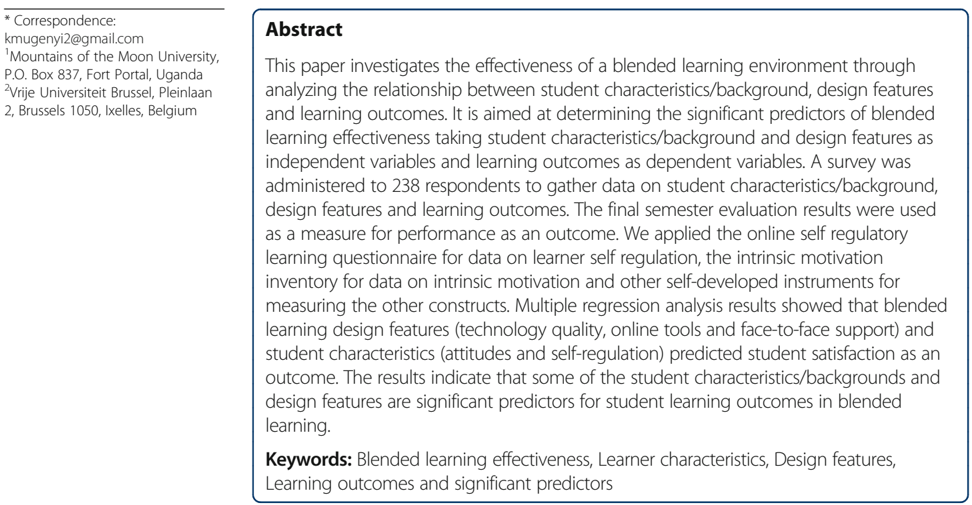
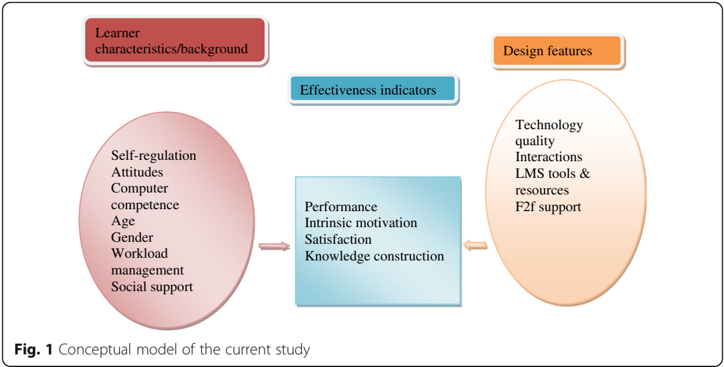
This paper investigates the effectiveness of a blended learning environment through analyzing the relationship between student characteristics/background, design features and learning outcomes. It is aimed at determining the significant predictors of blended learning effectiveness taking student characteristics/background and design features as independent variables and learning outcomes as dependent variables. A survey was administered to 238 respondents to gather data on student characteristics/background, design features and learning outcomes. The final semester evaluation results were used as a measure for performance as an outcome. We applied the online self regulatory learning questionnaire for data on learner self regulation, the intrinsic motivation inventory for data on intrinsic motivation and other self-developed instruments for measuring the other constructs. Multiple regression analysis results showed that blended learning design features (technology quality, online tools and face-to-face support) and student characteristics (attitudes and self-regulation) predicted student satisfaction as an outcome. The results indicate that some of the student characteristics/backgrounds and design features are significant predictors for student learning outcomes in blended learning.
Verified 2026-11-22 · 1 reference not checked yet
Overview
CoChat Summary
TL;DR
This study surveyed 238 learners in a Ugandan university blended learning course and used multiple regression to test whether learner characteristics and design features predict satisfaction, knowledge construction, intrinsic motivation, and performance. It found several design and learner variables predicted satisfaction, knowledge construction, and intrinsic motivation, but none predicted final examination performance.
Key findings
- Multiple regression showed technology quality, online tools, face-to-face support, attitudes, and self-regulation predicted satisfaction; technology quality, interactions, social support, and self-regulation predicted knowledge construction; technology quality, online tools, interactions, and self-regulation predicted intrinsic motivation; none of the independent variables predicted performance/grade. R² = 0.525, meaning the independent variables explained about 53% of the variance in overall satisfaction, motivation, and knowledge construction.
- Male learners performed slightly better (M = 62.5) than female learners (M = 61.1), but the difference was not statistically significant (t = 1.569, df = 228, p = 0.05, one-tailed; d = 0.18). Age groups differed significantly in performance (F(1,236) = 8.498, p < .001), with means of 62% for ages 20–30 and 67% for ages 31–39.
- Learners reported high intrinsic motivation: interest/enjoyment 83.7%, perceived competence 70.2%, effort/importance 80%, pressure/tension 54%, and value/usefulness 91%. Satisfaction was reported at 81%, knowledge construction at 78%, and final examination performance averaged a pass of 62% (SD = 7.5).
- Design-feature results included technology quality rated at 69%, face-to-face support attitudes at 88%, and LMS effectiveness at 79%; blog and wiki were rarely used, while email, forum, chat, and calendar were often used.
Methods
- Quantitative planning evaluation design in a 17-week semester: face-to-face study at the beginning, online teaching/learning in the second half, then face-to-face review and final semester examinations; Moodle was used as the learning management system.
- Cluster sampling selected 238 learners from three schools and one postgraduate directorate at a Ugandan university; the sample comprised 139 male students (58.4%) and 99 female students (41.6%), with an average age of 24 years.
- Measures included end-of-semester results for performance, the online self-regulated learning questionnaire, the intrinsic motivation inventory, and self-developed instruments for other constructs. Analysis used descriptive statistics, Shapiro-Wilk normality testing, skewness/kurtosis, independent samples t-test, one-way ANOVA, and multiple regression.
Limitations
- The paper states that none of the independent variables were identified as significant predictors of student performance and that these gaps are open for further investigation. It also notes the sample came from three schools out of five and one postgraduate directorate at one Ugandan university, and that the age analysis covered only young and middle-aged groups (20–30 and 31–39), unlike studies including old above 45 years.
- Evident from the text: the single-institution planning evaluation and survey design limit generalizability, and many constructs were measured with self-developed instruments, although the paper reports acceptable Cronbach’s alpha reliability.
Model-written summary. Check it against the paper before relying on it.
Integrity signals
Registry
Cites
Statistics
Figures
Verification
Claims the paper makes
3 Valid · 3 Not valid · 28 Not checked · 159 Own results and interpretations
Every source the paper cites for this claim was checked and supports it.
In the paper
“Among the blended learning design features, only learner interaction was a significant factor to learner satisfaction and knowledge construction.”
§ Blended learning effectiveness: the relationship between student characteristics, design features and outcomes > Introduction
What the sources say
- Supportedcites Kintu and Zhu (2016)
The Abstract states directly: 'Among the design elements, regression results showed only learner interactions as significant predictors of knowledge construction and satisfaction.' The Results section 'Factors predicting blended learning outcomes' reports the same with statistics (learner interactions significant for satisfaction β=.23, t=2.42, p<.05 and knowledge construction β=.21, t=2.12, p<.05, while all other design features were non-significant, p>.05), and Section 7.3 reiterates that knowledge construction's significant factors include learner interactions. Other significant predictors in the paper (learner attitudes, management of workload) are learner characteristics/background rather than design features, so the claim's restriction to design features holds. (LLM, conf=0.93)
plainstates an association- Asserted: passes — The authors put it forward as true.
- Checkable: passes — It can be checked against evidence.
- Load-bearing: unclear — It is unclear whether the paper’s conclusions depend on it.
- Based: passes — The paper gives a reason why it holds.
- Supported
The cited sources support only part of this claim — read each source’s verdict below.
In the paper
“Research shows that absence of learner interaction causes failure and eventual drop-out in online courses (Willging & Johnson, 2009) and the lack of learner connectedness was noted as an internal factor leading to learner drop-out in online courses (Zielinski, 2000).”
§ Blended learning effectiveness: the relationship between student characteristics, design features and outcomes > Blended learning design features
What the sources say
- Partly supportedcites Willging & Johnson, 2009 matched to “FACTORS THAT INFLUENCE STUDENTS’ DECISION TO DROPOUT OF ONLINE COURSES” (2009) sourceExperimental — accuracy not yet measured
In “Reasons for Leaving an Online Program” (page unavailable), one respondent named lack of interaction with students and instructors as a main reason for leaving. The Summary and Conclusions (page unavailable) says there was no evidence that lack of human interaction was a primary reason students left. The paper does not establish that absent interaction causes failure and eventual dropout. (LLM, conf=0.88)
plainstates a cause- Asserted: passes — The authors put it forward as true.
- Checkable: passes — It can be checked against evidence.
- Load-bearing: unclear — It is unclear whether the paper’s conclusions depend on it.
- Based: passes — The paper gives a reason why it holds.
- Partly supported
A result the paper reports from its own data — it cites no other source for it, so there is none to check. The quote shows it is in the paper.
In the paper
“This revealed a significant difference in performance (F(1,236 = 8.498, p < .001).”
§ Blended learning effectiveness: the relationship between student characteristics, design features and outcomes > Student characteristics, blended learning design features and learning outcomes (RQ1)
plain- Asserted: passes — The authors put it forward as true.
- Checkable: passes — It can be checked against evidence.
- Load-bearing: unclear — It is unclear whether the paper’s conclusions depend on it.
- Based: passes — The paper gives a reason why it holds.
A result the paper reports from its own data — it cites no other source for it, so there is none to check. The quote shows it is in the paper.
In the paper
“An independent t-test revealed that the difference between the performances was not statistically significant (t = 1.569, df = 228, p = 0.05, one tailed).”
§ Blended learning effectiveness: the relationship between student characteristics, design features and outcomes > Student characteristics, blended learning design features and learning outcomes (RQ1)
plain- Asserted: passes — The authors put it forward as true.
- Checkable: passes — It can be checked against evidence.
- Load-bearing: unclear — It is unclear whether the paper’s conclusions depend on it.
- Based: passes — The paper gives a reason why it holds.
A result the paper reports from its own data — it cites no other source for it, so there is none to check. The quote shows it is in the paper.
In the paper
“Results show that learner self-regulation was good enough at 72.3% in all the sub-scales of goal setting, environment structuring, task strategies, time management, help-seeking and self-evaluation among learners.”
§ Blended learning effectiveness: the relationship between student characteristics, design features and outcomes > Student characteristics, blended learning design features and learning outcomes (RQ1)
plain- Asserted: passes — The authors put it forward as true.
- Checkable: passes — It can be checked against evidence.
- Load-bearing: unclear — It is unclear whether the paper’s conclusions depend on it.
- Based: passes — The paper gives a reason why it holds.
115 more claims
Create a free account to see all 193 claims and every source verdict.
- It may state two separate claims as one. 52
- Probably not a substantial claim. 29
Self-check
Percentages, sums and reported differences re-computed from the paper’s own numbers.
Each contradiction between two passages listed here was confirmed by an independent check.
Rated major: it would touch a result — a value a result rests on, reported and recomputed p-values on opposite sides of the significance level, two passages that conflict with no sign which is right, or a cited work retracted before this paper was published.
In the paper
§ Blended learning effectiveness: the relationship between student characteristics, design features and outcomes > Student characteristics, blended learning design features and learning outcomes (RQ1)
“This revealed a significant difference in performance (F(1,236 = 8.498, p < .001).”
§ Blended learning effectiveness: the relationship between student characteristics, design features and outcomes > Significant predictors of blended learning effectiveness
“In line with Coldwell et al. (2008), no statistically significant differences exist between age groups.”
Rated minor: it would not touch a result — a value no result rests on, a p-value that stays on the same side of the significance level, or a conflict that is clerical, resolved elsewhere in the paper, or outside its own findings.
In the paper
§ Blended learning effectiveness: the relationship between student characteristics, design features and outcomes > Abstract
“Multiple regression analysis results showed that blended learning design features (technology quality, online tools and face-to-face support) and student characteristics (attitudes and self-regulation) predicted student satisfaction as an outcome.”
§ Blended learning effectiveness: the relationship between student characteristics, design features and outcomes > Significant predictors of blended learning effectiveness (RQ 2)
“From the table above, design features (technology quality and online tools and resources), and learner characteristics (attitudes to blended learning, self-regulation) were significant predictors of learner satisfaction in blended learning.”
Citations
Cites
From dissertation abstracts international
(1974) · ACM SIGGRAPH Computer Graphics · doi:10.1145/988616.988619 · Cited by 12,099
The DeLone and McLean Model of Information Systems Success: A Ten-Year Update
(2003) · Journal of Management Information Systems · doi:10.1080/07421222.2003.11045748 · Cited by 11,791
Blended learning: Uncovering its transformative potential in higher education
Garrison, D. R., & Kanuka, H. (2004) · The Internet and Higher Education · doi:10.1016/j.iheduc.2004.02.001 · Cited by 4,849
Evaluating professional development
Guskey, T. R. (1999) · CERN Document Server (European Organization for Nuclear Research) · Cited by 2,421
The Theory and Practice of Online Learning
(2008) · Athabasca University Press eBooks · doi:10.15215/aupress/9781897425084.01 · Cited by 1,841
Piccoli, G., Ahmad, R., & Ives, B. (2001) · MIS Quarterly · doi:10.2307/3250989 · Cited by 1,587
Instructional Media and Technologies for Learning
Heinich, R. (1996) · Cited by 1,146
Improving online learning: Student perceptions of useful and challenging characteristics
Song, L., Singleton, E. S., Hill, J. R., & Koh, M. H. (2004) · The Internet and Higher Education · doi:10.1016/j.iheduc.2003.11.003 · Cited by 1,132 · cited 4×
“Technical problems with regard to instructional design were a challenge to online learners thus not indicating effectiveness (Song et al., 2004), though the authors also indicated that descriptive statistics to a tune of 75% and time management (62%) impact on success of online learning.”
BackgroundResultInfluentialCritical success factors for e-learning acceptance: Confirmatory factor models
Selim, H. M. (2007) · Computers & Education · doi:10.1016/j.compedu.2005.09.004 · Cited by 1,055 · cited 4×
“In addition, studies by Leidner, Jarvenpaa, Dillon and Gunawardena as cited in Selim (2007) have noted three main factors that affect e-learning and blended learning effectiveness as instructor characteristics, technology and student characteristics.”
BackgroundInfluentialSwan, K. (2001) · Distance Education · doi:10.1080/0158791010220208 · Cited by 1,016
Research works printed but not linked: 5
- 6. Astleitner, H. (2000) Dropout and distance education. A review of motivational and emotional strategies to reduce dropout in web-based distance education. In Neuwe Medien in Unterricht, Aus-und Weiterbildung Waxmann Munster, New York.
- 10. Blocker, J. M., & Tucker, G. (2001). Using constructivist principles in designing and integrating online collaborative interactions. In F. Fuller & R. McBride (Eds.), Distance education. Proceedings of the Society for Information Technology & Teacher Education International Conference (pp. 32-36). ERIC Document Reproduction Service No. ED 457 822.
- 11. Cohen, K. E., Stage, F. K., Hammack, F. M., & Marcus, A. (2012). Persistence of master' s students in the United States: Developing and testing of a conceptual model. USA: PhD Dissertation, New York University.
- 41. Oxford Group, (2013). Blended learning-current use, challenges and best practices. From http://www.kineo.com/m/0/ blended-learning-report-202013.pdf. Accessed on 17 Mar 2016.
- 43. Pallant, J. (2010). SPSS Survival Mannual (4th ed.). Maidenhead: OUP McGraw-Hill.
Cited by
Vallée, A., Blacher, J., Cariou, A., & Sorbets, E. (2020) · Journal of Medical Internet Research · doi:10.2196/16504 · Cited by 663
Tang, Y. M., Chen, P. C., Law, K. M. Y., Wu, C. H., Lau, Y.-Y., Guan, J., He, D., & Ho, G. T. S. (2021) · Computers & Education · doi:10.1016/j.compedu.2021.104211 · Cited by 538
du Plooy, E., Casteleijn, D., & Franzsen, D. (2024) · Heliyon · doi:10.1016/j.heliyon.2024.e39630 · Cited by 310
Vadakalu Elumalai, K., P Sankar, J., R, K., Ann John, J., Menon, N., Salem M Alqahtani, M., & Abdulaziz Abumelha, M. (2020) · Journal of Information Technology Education: Research · doi:10.28945/4628 · Cited by 243
Yustina, Y., Syafii, W., & Vebrianto, R. (2020) · Jurnal Pendidikan IPA Indonesia · doi:10.15294/jpii.v9i3.24706 · Cited by 223
“The use of blended learning in improving student characteristics and design features has a significant category for student learning outcomes (Kintu et al., 2017).”
BackgroundHo, I. M. K., Cheong, K. Y., & Weldon, A. (2021) · PLOS ONE · doi:10.1371/journal.pone.0249423 · Cited by 208
Integrating MOOCs in traditionally taught courses: achieving learning outcomes with blended learning
Bralić, A., & Divjak, B. (2018) · International Journal of Educational Technology in Higher Education · doi:10.1186/s41239-017-0085-7 · Cited by 187
Integrating students’ perspectives about online learning: a hierarchy of factors
Wart, M. V., Ni, A. Y., Medina, P. S., Canelón, J., Kordrostami, M., Zhang, J., & Liu, Y. (2020) · International Journal of Educational Technology in Higher Education · doi:10.1186/s41239-020-00229-8 · Cited by 241
Dr., C. A., Harahap, F., Nasution, N. E. A., M.Pd., B. E. D., Manurung, B., & Prof. Dr. rer. nat., B. D. (2019) · International Journal of Instruction · doi:10.29333/iji.2019.12134a · Cited by 147
Cross-cultural differences in the adoption of social media
AlSaleh, D., Elliott, M. T., Fu, F. Q., & Thakur, R. (2019) · Journal of Research in Interactive Marketing · doi:10.1108/jrim-10-2017-0092 · Cited by 211
Precision education with statistical learning and deep learning: a case study in Taiwan.
Tsai, S.-C., Chen, C.-H., Shiao, Y.-T., Ciou, J.-S., & Wu, T.-N. (2020) · International Journal of Educational Technology in Higher Education · doi:10.1186/s41239-020-00186-2 · Cited by 139
“Although Kintu, Zhu, and Kagambe ’ s (2017) study did not use AI algorithms, they investigated the effectiveness of a blended learning environment supported by a learning management system, Moodle, through exploring the relationships among student characteristics/backgrounds and academic…”
BackgroundThe four phases of the digital natives debate
Evans, C., & Robertson, W. (2020) · Human Behavior and Emerging Technologies · doi:10.1002/hbe2.196 · Cited by 134
Jovanović, J., Saqr, M., Joksimović, S., & Gašević, D. (2021) · Computers & Education · doi:10.1016/j.compedu.2021.104251 · Cited by 122
Factors Affecting Students’ Preferences for Online and Blended Learning: Motivational vs. Cognitive
Keskin, S., & Yurdugül, H. (2020) · European Journal of Open Distance and E-Learning · doi:10.2478/eurodl-2019-0011 · Cited by 171
ESL Teachers’ Challenges in Implementing E-learning during COVID-19
Lukas, B. A., & Yunus, M. M. (2021) · International Journal of Learning Teaching and Educational Research · doi:10.26803/ijlter.20.2.18 · Cited by 112
Florenthal, B. (2019) · Journal of Research in Interactive Marketing · doi:10.1108/jrim-05-2018-0064 · Cited by 197
Singh, A., Sharma, S., & Paliwal, M. (2021) · Interactive Technology and Smart Education · doi:10.1108/itse-05-2020-0070 · Cited by 108
Virtual reality for teaching and learning in crime scene investigation
Mayne, R., & Green, H. E. (2020) · Science & Justice · doi:10.1016/j.scijus.2020.07.006 · Cited by 114
Students’ adoption towards behavioral intention of digital learning platform
Songkram, N., Chootongchai, S., Osuwan, H., Chuppunnarat, Y., & Songkram, N. (2023) · Education and Information Technologies · doi:10.1007/s10639-023-11637-4 · Cited by 93
“In the case of digital learning platforms, learners will likely have a positive attitude after completing a course, resulting in a continued willingness to use digital learning platforms (Ilyas & Zaman, 2020; Kintu et al., 2017).”
BackgroundTaghizadeh, M., & Hajhosseini, F. (2020) · The Asia-Pacific Education Researcher · doi:10.1007/s40299-020-00531-z · Cited by 140
Halasa, S., Abusalim, N., Rayyan, M., Constantino, R. E., Nassar, O. S., Amre, H., Sharab, M., & Qadri, I. (2020) · Nursing Open · doi:10.1002/nop2.492 · Cited by 127
Polhun, K., Крамаренко, Т. Г., Малоіван, М. В., & Томіліна, А. О. (2021) · Journal of Physics Conference Series · doi:10.1088/1742-6596/1840/1/012053 · Cited by 89
Müller, F. A., & Wulf, T. (2020) · International Journal of Educational Technology in Higher Education · doi:10.1186/s41239-020-00226-x · Cited by 120
Yahiaoui, F., Aichouche, R., Chergui, K. A., Brika, S. K., Almezher, M., Musa, A. A., & Lamari, I. A. (2022) · Frontiers in Psychology · doi:10.3389/fpsyg.2022.874181 · Cited by 112
Umar, M., & Ko, I. (2022) · Sustainability · doi:10.3390/su14031724 · Cited by 143
Wu, X.-Y. (2024) · System · doi:10.1016/j.system.2024.103498 · Cited by 156
Wei, Z. (2023) · Journal of the Knowledge Economy · doi:10.1007/s13132-023-01522-3 · Cited by 136
RetractedEdward, C. N., Asirvatham, D. A. L., & Johar, M. G. M. (2018) · Education and Information Technologies · doi:10.1007/s10639-018-9732-4 · Cited by 94
Online Learning Challenges during Pandemic COVID-19 in Malaysian Higher Learning Institution
Ismail, N. S., Bakar, N. M. A., & Wafa, S. W. (2020) · Universal Journal of Educational Research · doi:10.13189/ujer.2020.081282 · Cited by 74
Essaying the design, development and validation processes of a new digital literacy scale
Reddy, P., Chaudhary, K., Sharma, B. N., & Hussein, S. (2022) · Online Information Review · doi:10.1108/oir-10-2021-0532 · Cited by 101
Adinda, D., & Mohib, N. (2020) · The Electronic Journal of e-Learning · doi:10.34190/ejel.20.18.2.005 · Cited by 97
Shakeel, S. I., Mamun, M. A. A., & Haolader, M. F. A. (2022) · Education and Information Technologies : Official Journal of the IFIP technical committee on Education · doi:10.1007/s10639-022-11471-0 · Cited by 119
Hongsuchon, T., Emary, I. M. M. E., Hariguna, T., & Qhal, E. M. A. (2022) · Sustainability · doi:10.3390/su14052570 · Cited by 114
Dindar, M., Suorsa, A. R., Hermes, J., Karppinen, P., & Näykki, P. (2021) · Journal of Computer Assisted Learning · doi:10.1111/jcal.12552 · Cited by 106
Goh, C. F., & Ong, E. T. (2019) · Currents in Pharmacy Teaching and Learning · doi:10.1016/j.cptl.2019.02.025 · Cited by 71
Gamification and entrepreneurial intentions
Ruiz-Alba, J., Soares, A., Molina, M. Á. R., & Banoun, A. (2019) · Journal of Small Business and Enterprise Development · doi:10.1108/jsbed-09-2018-0266 · Cited by 72
Students’ readiness for blended learning in a leading Malaysian private higher education institution
Adams, D., Tan, M. H. J., & Sumintono, B. (2020) · Interactive Technology and Smart Education · doi:10.1108/itse-03-2020-0032 · Cited by 95
Onofrei, G., & Ferry, P. (2020) · International Journal of Educational Management · doi:10.1108/ijem-12-2019-0418 · Cited by 72
Ulla, M. B., & Perales, W. F. (2021) · Journal of Interactive Media in Education · doi:10.5334/jime.617 · Cited by 84
Integrated STEM Approaches and Associated Outcomes of K-12 Student Learning: A Systematic Review
Chung, L. H., Nguyen, V. H., & Nguyen, T. L. (2023) · Education Sciences · doi:10.3390/educsci13030297 · Cited by 141
Zamecnik, A., Kovanović, V., Joksimovíc, S., & Liu, L. (2022) · Computers and Education Artificial Intelligence · doi:10.1016/j.caeai.2022.100051 · Cited by 90
Effectiveness of Blended Learning Model Based on Problem-Based Learning in Islamic Studies Course
Assoc, P., Hamzah, H., Tambak, S., Universitas Islam Riau, I., Hamzah, M. L., Universitas Islam Negeri Sultan Syarif Kasim Riau, I., Purwati, A. A., Irawan, Y., STMIK Hang Tuah, I., Umam, M. I. H., et al. (2022) · International Journal of Instruction · doi:10.29333/iji.2022.15242a · Cited by 99
THE IMPACT OF A FLIPPED CLASSROOM MODEL OF LEARNING ON A LARGE UNDERGRADUATE STATISTICS CLASS
Nielsen, P. L., Bean, N. W., & Larsen, R. (2018) · Statistics Education Research Journal · doi:10.52041/serj.v17i1.179 · Cited by 68
Online Learning Tools in the Era of m-Learning: Utility and Attitudes in Accounting College Students
Herrador-Alcaide, T. C., Solís, M. H., & Caballero, J. F. H. (2020) · Sustainability · doi:10.3390/su12125171 · Cited by 66
Akugizibwe, E., & Ahn, J.-Y. (2019) · Education and Information Technologies · doi:10.1007/s10639-019-09995-z · Cited by 56
PLATONOVA, R. I., Orekhovskaya, N. A., Dautova, S. B., Martynenko, E. V., Kryukova, N. I., & Demir, S. (2022) · Frontiers in Education · doi:10.3389/feduc.2022.957199 · Cited by 75
The Role of Experiential Learning and Engineering Design Process in K-12 Stem Education
Long, N. T., Yen, N. T. H., & Hanh, N. V. (2020) · International Journal of Education and Practice · doi:10.18488/journal.61.2020.84.720.732 · Cited by 68
Adams, D., Tan, M. H. J., Sumintono, B., & Oh, S. P. (2020) · Malaysian Journal of Learning and Instruction · doi:10.32890/mjli2020.17.1.6 · Cited by 73
Ng, S. F., Azlan, M. A. K., Kamal, A. N. A., & Manion, A. (2020) · Education and Information Technologies · doi:10.1007/s10639-020-10191-7 · Cited by 61
Müller, F. A., & Wulf, T. (2021) · The International Journal of Management Education · doi:10.1016/j.ijme.2021.100530 · Cited by 62
Blended learning in higher education: the integrated and distributed model and a thematic analysis
Starčič, A. I. (2024) · Discover Education · doi:10.1007/s44217-024-00239-y · Cited by 103
Katsarou, E. (2021) · Journal of Education and e-Learning Research · doi:10.20448/journal.509.2021.82.158.172 · Cited by 40
Tupas, F. P., & Linas-Laguda, M. (2020) · Universal Journal of Educational Research · doi:10.13189/ujer.2020.081154 · Cited by 89
Riandi, M. H., Respati, H., & Hidayatullah, S. (2021) · International Journal of Research in Engineering Science and Management · doi:10.47607/ijresm.2021.466 · Cited by 59
The implementation of blended learning to improve understanding of mathematics
Fitri, S., & Zahari, C. L. (2019) · Journal of Physics Conference Series · doi:10.1088/1742-6596/1188/1/012109 · Cited by 47
Wang, C., Zhang, Y.-Y., & Chen, S. (2021) · Frontiers in Psychology · doi:10.3389/fpsyg.2021.573590 · Cited by 55
Revealing the regulation of learning strategies of MOOC retakers: A learning analytic study
Fan, Y., Jovanović, J., John, S., Jiang, Y., Wang, Q., & Gašević, D. (2021) · Computers & Education · doi:10.1016/j.compedu.2021.104404 · Cited by 42
Alsalhi, N. R., Al-Qatawneh, S. S., Eltahir, M. E., & Aqel, K. Z. (2021) · Eurasia Journal of Mathematics Science and Technology Education · doi:10.29333/ejmste/10781 · Cited by 60
Blended Learning of Physics in the Context of the Professional Development of Teachers
Krasnova, L. A., & Shurygin, V. (2019) · International Journal of Emerging Technologies in Learning (iJET) · doi:10.3991/ijet.v14i23.11084 · Cited by 46
Blended learning environments and learning outcomes: The mediating role of flow experience
Müller, F. A., & Wulf, T. (2022) · The International Journal of Management Education · doi:10.1016/j.ijme.2022.100694 · Cited by 54
Diržytė, A., Vijaikis, A., Perminas, A., & Rimasiute-Knabikiene, R. (2021) · International Journal of Environmental Research and Public Health · doi:10.3390/ijerph18179158 · Cited by 48
The trends of blended learning in South East Asia
(2020) · doi:10.1007/s10639-020-10140-4 · Cited by 36
The Blended Learning Approach and Its Application in Language Teaching
Tawil, H. A. (2018) · International Journal of Language & Linguistics · doi:10.30845/ijll.v5n4p6 · Cited by 54
Influence of blended instruction on students’ learning effectiveness: the role of Flow
Tang, Q. G., Zhang, T., & Jiang, L. (2022) · Education and Information Technologies · doi:10.1007/s10639-022-11224-z · Cited by 57
Chan, J. I. L., & Muthuveloo, R. (2019) · Studies in Higher Education · doi:10.1080/03075079.2019.1703131 · Cited by 59
Kamid, K., Rohati, R., Rahmalisa, Y., Anggo, M., Septi, S. E., Azzahra, M. Z., & Nawahdani, A. M. (2021) · Cypriot Journal of Educational Sciences · doi:10.18844/cjes.v16i6.6500 · Cited by 51
Blended Learning in Rural Primary ESL Classroom: Do or Don’t
Jerry, M., & Yunus, M. M. (2021) · International Journal of Learning Teaching and Educational Research · doi:10.26803/ijlter.20.2.9 · Cited by 32
Butt, S., Mahmood, A., & Saleem, S. (2022) · PLoS ONE · doi:10.1371/journal.pone.0269609 · Cited by 45
Handoyo, S. (2024) · The International Journal of Management Education · doi:10.1016/j.ijme.2024.100998 · Cited by 72
Blended workplace learning: the value of human interaction
Hewett, S., Becker, K. L., & Bish, A. J. (2018) · Education + Training · doi:10.1108/et-01-2017-0004 · Cited by 52
Tran, T. T., & Herzig, C. (2023) · Journal of Accounting Education · doi:10.1016/j.jaccedu.2023.100842 · Cited by 40
Ohanu, I. B., Shodipe, T. O., Ohanu, C. M.-G., & Anene-Okeakwa, J. E. (2022) · E-Learning and Digital Media · doi:10.1177/20427530221108031 · Cited by 39
Evenhouse, D., Lee, Y., Berger, E., Rhoads, J. F., & DeBoer, J. J. (2023) · International Journal of STEM Education · doi:10.1186/s40594-023-00406-x · Cited by 39
Secure Fog-Based E-Learning Scheme
Amor, A. B., Abid, M., & Meddeb, A. (2020) · IEEE Access · doi:10.1109/access.2020.2973325 · Cited by 36
A Structural Equation Model of Blended Learning Culture in the Classroom
Long, N. T., & Hanh, N. V. (2020) · International Journal of Higher Education · doi:10.5430/ijhe.v9n4p99 · Cited by 35
Using Blended Learning to Support the Teaching of English as a Foreign Language
Sheerah, H. A. H. (2020) · Arab World English Journal · doi:10.24093/awej/call6.13 · Cited by 42
Learning Analytics Lens: Improving Quality of Higher Education
Hooda, M. (2020) · International Journal of Emerging Trends in Engineering Research · doi:10.30534/ijeter/2020/24852020 · Cited by 30
Exploring Students’ Readiness on English Language Blended Learning
Hamzah, F., Phong, S. Y., Sharifudin, M. A. S., Zain, Z. M., & Rahim, M. (2021) · Asian Journal of University Education · doi:10.24191/ajue.v16i4.11948 · Cited by 47
Hua, M., Wang, L., & Jun, L. (2024) · Frontiers in Psychology · doi:10.3389/fpsyg.2023.1278827 · Cited by 68
Thamrin, T., Hutasuhut, S., Aditia, R., & Putri, F. R. (2022) · IJORER International Journal of Recent Educational Research · doi:10.46245/ijorer.v3i1.178 · Cited by 55
Moral, S. V., & Crosetti, B. D. B. (2021) · Journal of New Approaches in Educational Research · doi:10.7821/naer.2021.7.646 · Cited by 40
ElSayad, G. (2024) · Education and Information Technologies · doi:10.1007/s10639-024-12466-9 · Cited by 57
Understanding intention and use of digital elements in higher education teaching
Müller, W., & Leyer, M. (2023) · Education and Information Technologies · doi:10.1007/s10639-023-11798-2 · Cited by 43
Enterprise application integration for high school students using blended learning system
Lubis, M., Fauzi, R., & Lubis, A. R. (2018) · MATEC Web of Conferences · doi:10.1051/matecconf/201821804016 · Cited by 32
Argyriou, P., Benamar, K., & Nikolajeva, M. (2022) · Psychology Learning & Teaching · doi:10.1177/14757257221091512 · Cited by 52
Gyasi, J. F., Zheng, L., & Zhou, Y. (2021) · Sustainability · doi:10.3390/su13168828 · Cited by 35
Butt, S., Mahmood, A., Saleem, S., Murtaza, S. A., Hassan, S., & Molnár, E. (2023) · Sustainability · doi:10.3390/su15021348 · Cited by 35
Koraneekij, P., & Khlaisang, J. (2019) · International Journal of Emerging Technologies in Learning (iJET) · doi:10.3991/ijet.v14i02.8288 · Cited by 35
Android Based Animation Video Using Millealab Virtual Reality Application for Elementary School
Zulherman, Z., Aji, G. B., & Supriansyah, S. (2021) · JPI (Jurnal Pendidikan Indonesia) · doi:10.23887/jpi-undiksha.v10i4.29429 · Cited by 35
Nguyen‐Viet, B., Nguyen-Duy, C., & Nguyen-Viet, B. (2024) · Interactive Learning Environments · doi:10.1080/10494820.2024.2414356 · Cited by 55
Metode Pelatihan dan Persistensi Berpengaruh terhadap Kompetensi Pedagogik Guru PAUD
Ciptaningtyas, A., Yetti, E., & Hartati, S. (2020) · Jurnal Obsesi Jurnal Pendidikan Anak Usia Dini · doi:10.31004/obsesi.v4i2.440 · Cited by 50
Hung, J.-L., Rice, K., Kepka, J., & Yang, J. (2020) · Information Discovery and Delivery · doi:10.1108/idd-02-2020-0019 · Cited by 24
Transforming Education and Learning through Chat GPT: A Systematic Literature Review
Prananta, A. W., Ruth Rize Paas Megahati, S., Susanto, N., & Raule, J. H. (2023) · Jurnal Penelitian Pendidikan IPA · doi:10.29303/jppipa.v9i11.5468 · Cited by 45
Han, X. (2024) · Education and Information Technologies · doi:10.1007/s10639-024-13246-1 · Cited by 61
The development of homogeneity psycho cognition learning strategy in physical education learning
Fenanlampir, A., Leasa, M., & Batlolona, J. R. (2021) · International Journal of Evaluation and Research in Education (IJERE) · doi:10.11591/ijere.v10i3.21713 · Cited by 58
Implementation and Development of Qur’an Learning Method in Malaysia and Indonesia: An Analysis
Ramli, A. J., Munawir, K., & Hamzah, M. I. (2017) · Khalifa Journal of Islamic Education · doi:10.24036/kjie.v1i1.6 · Cited by 30
Metadata
- Authors
- Kintu, M. J., Zhu, C., & Kagambe, E.
- Affiliations
- Vrije Universiteit Brussel (BE)
- Mountains of the Moon University (UG)
- Corresponding author
- Kintu, Mugenyi Justice
- Venue
- International Journal of Educational Technology in Higher Education
- Published
- 2017-02-06
- Volume
- 14
- Issue
- 1
- ISSN
- 2365-9440 (ISSN-L)
- OpenAlex
- W2587142401
- Cited by
- 764
- References
- 62
- Citations by year
- 2026: 38 · 2025: 65 · 2024: 122 · 2023: 132 · 2022: 146 · 2021: 109 · 2020: 82 · 2019: 42 · 2018: 24 · 2017: 4
- FWCI
- 148.30
- Type
- journal article
- Language
- en
- Open access
- diamond
- doi.org
- Locations
- International Journal of Educational Technology in Higher Education (publishedVersion, cc-by)
- Redalyc (Universidad Autónoma del Estado de México) (submittedVersion)
- VUBIR (Vrije Universiteit Brussel) (submittedVersion)
- Greater South Information System
- Topics
- Social Sciences › Education › Online and Blended Learning
- Physical Sciences › Computer Science › Information Systems › Educational Technology and E-Learning
- Social Sciences › Education › English Language Learning and Teaching
- Keywords
- blended learning, learning effectiveness, student characteristics, learning outcomes, student satisfaction, student self-regulation, intrinsic motivation, technological quality, web-based tool, face-to-face support, higher education
About these checks
Registry, retraction, Cites and statistics results are computed, not judged, with one exception: a printed reference that no index lists is read once by a model before it counts as a citation error. Claims are extracted by a model and kept only when their quote appears verbatim in the text; each cited source is then checked, with a model’s help, for whether it says what the claim relies on. Those verdicts can be wrong — read the claim’s quote and the cited source before relying on one.
The claim verdicts this report counts are experimental: their accuracy is not yet measured.
A language model drew the claims from the paper on 2026-10-10, under version 3 of the claim definition (model deepseek-v4.1-flash, prompt extract-v3).
A second model labelled each claim on 2026-10-10 (model jev-1.13-20260917, definition revision gold-guideline-v0.2).
Cited sources are checked with a language model’s help (qwen3.8-omni-flash and gpt-6-sol).
Statistics and arithmetic are recomputed, not judged.
Confidence bands are shown only for fields calibrated on our annotated test set. None is calibrated yet, so no band is shown.
What counts as a claim ›How we measure confidence ›How we check this ›
Are you an author, or do you see a problem with this page? Request a review
Data sources
Bibliographic data: Semantic Scholar, OpenAlex, Crossref.
Contains information from the Semantic Scholar Academic Graph Datasets, made available under the ODC Attribution License (ODC-BY 1.0).
Semantic Scholar’s data is described in: Kinney, R., et al. (2023). The Semantic Scholar Open Data Platform. arXiv:2301.10140.
