

Online teaching in response to student protests and campus shutdowns: academics’ perspectives
Open accessThe DOI matches its Crossref record; 22 of the 22 references it cites were found in a registry or an index.
Abstract
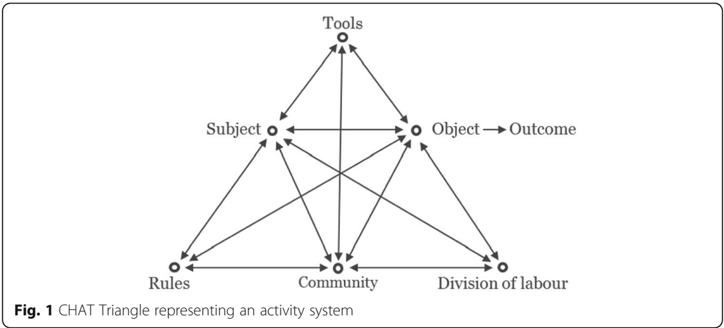
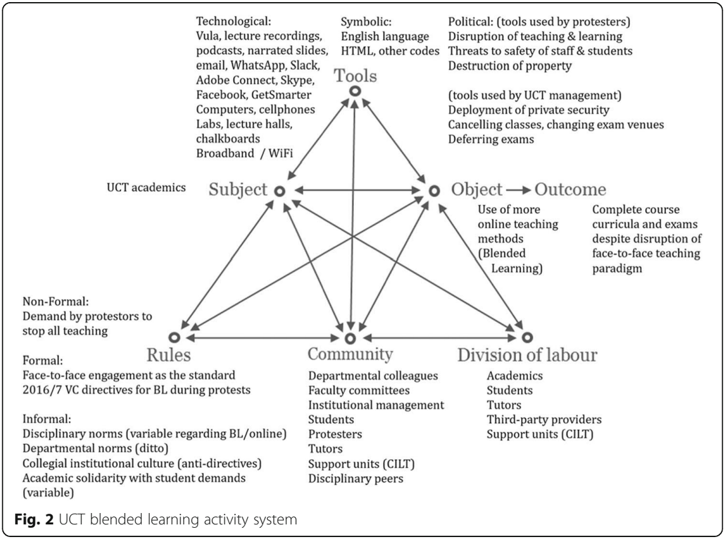
During the period 2015–2017, student protests and university shutdowns rocked the higher education sector in South Africa, with key issues being raised regarding student exclusion based on financial, epistemological and cultural grounds. In this highly politicised and contested environment, some universities decided to use blended and online delivery as a strategy to enable the academic year to be completed and all curriculum to be covered, despite the disruptions. This was a controversial decision politically and a challenging one practically. From the perspective of the academics at the University of Cape Town (UCT), this paper draws on interviews with educators in three broad disciplinary areas to explore their views, practices, and experiences regarding the use of online materials in these unique circumstances. Activity Theory provides a framework to consider the issues systemically and to identify the tensions and contradictions in the system.
Overview
The claims and statistics of this paper haven’t been checked yet.
Free: it reads the open-access text and checks the first 5 claims that cite a source we can check. Create a free account to check every claim.
Integrity signals
Registry
Cites
Statistics
Figures
Verification
Claims the paper makes
The claims and statistics of this paper haven’t been checked yet.
Free: it reads the open-access text and checks the first 5 claims that cite a source we can check. Create a free account to check every claim.
Claims other papers make about this one
Each is checked against this paper’s own text: does it say what the citing paper says it does?
The cited source says what the claim attributes to it.
In the citing paper
“Similarly, Czerniewicz et al. (2019) used CHAT to study online teaching during student protests and campus closures in South Africa, emphasizing the institutional and political dimensions of online teaching in addressing challenges posed by student activism.”
From Transforming Online Teacher Training Through Expansive Learning: A Case Study Applying Cultural-Historical Activity Theory and the Change Laboratory Method (2025) · cites this paper as Czerniewicz et al., 2019
Self-check
Percentages, sums and reported differences re-computed from the paper’s own numbers.
The self-check needs the paper’s full text.
Citations
Cites
Learning by Expanding: An Activity-Theoretical Approach to Developmental Research
Engeström, Y. (2014) · Cambridge University Press eBooks · doi:10.1017/cbo9781139814744 · Cited by 4,991
Twitter activism and youth in South Africa: the case of #RhodesMustFall
Bosch, T. (2017) · Information, Communication & Society · doi:10.1080/1369118x.2016.1162829 · Cited by 293 · cited 1×
“While there has been an academic interest in the role of social media and the student protests (e.g. Bosch, 2016), research has not focused on the nature and implications of online education to deal with the impact of institutional disruptions.”
BackgroundAs by Fire: The End of the South African University
Jansen, J. D. (2017) · Cited by 275
As by Fire: The End of the South African University
Neethling, T. (2018) · Politikon · doi:10.1080/02589346.2018.1390057 · Cited by 182 · cited 4×
“intensity, and, in the course of time, violence” (Jansen, 2017).”
BackgroundInfluentialCzerniewicz, L., & Brown, C. (2009) · Computers & Education · doi:10.1016/j.compedu.2009.01.006 · Cited by 176
Self-citationHodes, R. (2016) · African Affairs · doi:10.1093/afraf/adw072 · Cited by 122 · cited 1×
“Their studies and employment had been influenced by protest actions and by institutional responses” (Hodes, 2016).”
BackgroundAdam, T. (2019) · Learning, Media and Technology · doi:10.1080/17439884.2019.1640740 · Cited by 113 · cited 1×
“In South Africa, there is also scholarship theorising how new technologies are implicated in new forms of digital neocolonialism linking colonial pasts and neoliberal futures (Adam, 2019).”
BackgroundA call for promoting ownership, equity, and agency in faculty development via connected learning
Bali, M., & Caines, A. (2018) · International Journal of Educational Technology in Higher Education · doi:10.1186/s41239-018-0128-8 · Cited by 107 · cited 1×
“…the digital sphere and online pedagogy, in order to “cultivate connected, participatory educational development that crosses institutional and national boundaries, and which takes equity, social justice and power differences into consideration, promoting educator agency” (Bali & Caines, 2018).”
BackgroundBlended Learning for Academic Resilience in Times of Disaster or Crisis
Mackey, J., Gilmore, F., Dabner, N., Breeze, D., & Buckley, P. (2012) · UC Research Repository (University of Canterbury) · Cited by 100
Fees Must Fall: Student revolt, decolonisation and governance in South Africa
Booysen, S., Godsell, G., Chikane, R., Mpofu-Walsh, S., Ntshingila, O., & Lepere, R. (2010) · Cited by 98
What Would Paulo Freire Think of Blackboard: Critical Pedagogy in an Age of Online Learning
Boyd, D. (2016) · The international journal of critical pedagogy · Cited by 74
Hayes, S., & Jandrić, P. (2014) · Open Review of Educational Research · doi:10.1080/23265507.2014.989899 · Cited by 63
To care or not to care - reflections on the ethics of blended learning in times of disruption
Swartz, B., Gachago, D., & Belford, C. C. (2018) · South African Journal of Higher Education · doi:10.20853/32-6-2659 · Cited by 60
Social media and e-learning in response to seismic events: Resilient practices
Tull, S., Dabner, N., & Ayebi-Arthur, K. (2020) · Journal of Open Flexible and Distance Learning · doi:10.61468/jofdl.v24i1.405 · Cited by 46
Lessons Learnt from Teaching and Learning During Disruptions
Potgieter, M., Pilcher, L. A., Tekane, R., Louw, I., & Fletcher, L. (2019) · Springer eBooks · doi:10.1007/978-981-13-6998-8_6 · Cited by 42
Seeking Impact and Visibility: Scholarly Communication in Southern Africa
Trotter, H., Kell, C., Willmers, M., Gray, E. H., & King, T. K. C. (2014) · African Minds eBooks · doi:10.47622/978-1-920677-51-0 · Cited by 36
Self-citationA Lifeline to learning: leveraging mobile technology to support education for refugees
UNESCO (2018) · UNESCO eBooks · doi:10.54675/ultw4494 · Cited by 26
We are no longer at ease the struggle for #FeesMustFall
Ngcaweni, W., & Ngcaweni, B. (2018) · Cited by 13
Hoover, M., Dopson, S. A., & Drehobl, P. (2010) · American Journal of Health Education · doi:10.1080/19325037.2010.10599136 · Cited by 8
Tekane, R., Louw, I., & Potgieter, M. (2018) · Alternation Interdisciplinary Journal for the Study of the Arts and Humanities in Southern Africa · doi:10.29086/2519-5476/2018/v25n2a7 · Cited by 7
BETWEEN A ROCK AND A HARD PLACE: UNIVERSITY MANAGEMENT AND THE #FEESMUSTFALL CAMPAIGN
FitzGerald, P., & Seale, O. J. J. (2018) · Wits University Press eBooks · doi:10.18772/22016109858.16 · Cited by 6
#FEESMUSTFALL : science teaching during student unrest
Tekane, R., Louw, I., & Potgieter, M. (2018) · UpSpace Institutional Repository (University of Pretoria) · Cited by 2
Research works printed but not linked: 3
- Habib, A. (2019). Rebels and rage: Reflecting on #FeesMustFall. Johannesburg: Jonathan Ball.
- Ray, M. (2016). Free fall: Why south African universities are in a race against time. Johannesburg: Bookstorm.
- Tauson, M. & Stannard, L. (2018). EdTech for learning in emergencies and displaced settings: A rigorous review and narrative synthesis. London: Save the Children. Available at https://resourcecentre.savethechildren.net/sites/default/files/ documents/edtech-learning.pdf.
Cited by
Johnson, N., Veletsianos, G., & Seaman, J. (2020) · Online Learning · doi:10.24059/olj.v24i2.2285 · Cited by 632
Designing Quality E-Learning Environments for Emergency Remote Teaching in Coronavirus Crisis
Affouneh, S. J., Salha, S. H., & Khlaif, Z. N. (2020) · DOAJ (DOAJ: Directory of Open Access Journals) · doi:10.30476/ijvlms.2020.86120.1033 · Cited by 321
Gelles, L. A., Lord, S. M., Hoople, G. D., Chen, D. A., & Mejia, J. A. (2020) · Education Sciences · doi:10.3390/educsci10110304 · Cited by 277
Emergency remote learning during COVID-19 crisis: Students’ engagement
Khlaif, Z. N., Salha, S., & Kouraichi, B. (2021) · Education and Information Technologies · doi:10.1007/s10639-021-10566-4 · Cited by 240
The Impact of COVID-19 on Education: A Meta-Narrative Review
Bozkurt, A., Karakaya, K., Turk, M., Karakaya, Ö., & Castellanos-Reyes, D. (2022) · TechTrends · doi:10.1007/s11528-022-00759-0 · Cited by 232
Metadata
- Authors
- Czerniewicz, L., Trotter, H., & Haupt, G.
- Affiliations
- University of Cape Town (ZA)
- Corresponding author
- Czerniewicz, Laura
- Venue
- International Journal of Educational Technology in Higher Education
- Published
- 2019-12
- Volume
- 16
- Issue
- 1
- ISSN
- 2365-9440 (ISSN-L)
- OpenAlex
- W2995450334
- Cited by
- 127
- References
- 22
- Citations by year
- 2026: 8 · 2025: 11 · 2024: 18 · 2023: 13 · 2022: 33 · 2021: 24 · 2020: 19 · 2019: 1
- FWCI
- 51.94
- Type
- journal article
- Language
- en
- Open access
- diamond
- doi.org
- Licence
- cc-by
- creativecommons.org/licenses/by/4.0 (tdm)
- creativecommons.org/licenses/by/4.0 (vor, 19 d)
- Locations
- International Journal of Educational Technology in Higher Education (publishedVersion, cc-by)
- DOAJ (DOAJ: Directory of Open Access Journals) (submittedVersion, cc-by-sa)
- Open University of Cape Town (University of Cape Town) (submittedVersion)
- Funders
- Carnegie Corporation of New York (tbc)
- Topics
- Social Sciences › Education › Online and Blended Learning
- Social Sciences › Education › Education during COVID-19 pandemic
- Social Sciences › Education › Digital Transformation of Higher Education
- Keywords
- online learning, student protest, higher education disruption, blended learning, online learning materials, school exclusion, financial exclusion, cultural exclusion, University of Cape Town, activity theory, South Africa
About these checks
Registry, retraction, Cites and statistics results are computed, not judged, with one exception: a printed reference that no index lists is read once by a model before it counts as a citation error. Claims are extracted by a model and kept only when their quote appears verbatim in the text; each cited source is then checked, with a model’s help, for whether it says what the claim relies on. Those verdicts can be wrong — read the claim’s quote and the cited source before relying on one.
Statistics and arithmetic are recomputed, not judged.
Confidence bands are shown only for fields calibrated on our annotated test set. None is calibrated yet, so no band is shown.
What counts as a claim ›How we measure confidence ›How we check this ›
Are you an author, or do you see a problem with this page? Request a review
Data sources
Bibliographic data: Semantic Scholar, OpenAlex, Crossref.
Contains information from the Semantic Scholar Academic Graph Datasets, made available under the ODC Attribution License (ODC-BY 1.0).
Semantic Scholar’s data is described in: Kinney, R., et al. (2023). The Semantic Scholar Open Data Platform. arXiv:2301.10140.
