

Online teaching in response to student protests and campus shutdowns: academics’ perspectives
Open accessThe DOI matches its Crossref record; 22 of the 22 references it cites were found in a registry or an index.
Abstract
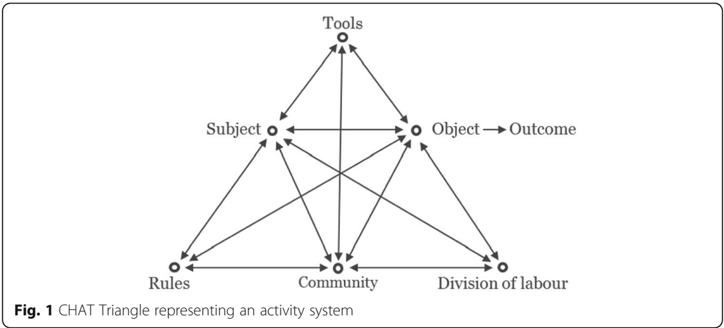
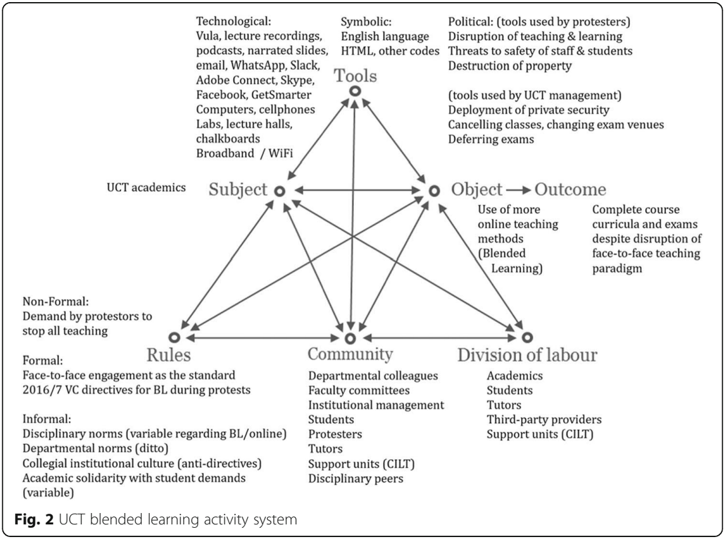
During the period 2015–2017, student protests and university shutdowns rocked the higher education sector in South Africa, with key issues being raised regarding student exclusion based on financial, epistemological and cultural grounds. In this highly politicised and contested environment, some universities decided to use blended and online delivery as a strategy to enable the academic year to be completed and all curriculum to be covered, despite the disruptions. This was a controversial decision politically and a challenging one practically. From the perspective of the academics at the University of Cape Town (UCT), this paper draws on interviews with educators in three broad disciplinary areas to explore their views, practices, and experiences regarding the use of online materials in these unique circumstances. Activity Theory provides a framework to consider the issues systemically and to identify the tensions and contradictions in the system.
Overview
The claims and statistics of this paper haven’t been checked yet.
Free: it reads the open-access text and checks the first 5 claims that cite a source we can check. Create a free account to check every claim.
Integrity signals
Registry
Cites
Statistics
Figures
Verification
Claims the paper makes
The claims and statistics of this paper haven’t been checked yet.
Free: it reads the open-access text and checks the first 5 claims that cite a source we can check. Create a free account to check every claim.
Claims other papers make about this one
Each is checked against this paper’s own text: does it say what the citing paper says it does?
The cited source says what the claim attributes to it.
In the citing paper
“Similarly, Czerniewicz et al. (2019) used CHAT to study online teaching during student protests and campus closures in South Africa, emphasizing the institutional and political dimensions of online teaching in addressing challenges posed by student activism.”
From Transforming Online Teacher Training Through Expansive Learning: A Case Study Applying Cultural-Historical Activity Theory and the Change Laboratory Method (2025) · cites this paper as Czerniewicz et al., 2019
Self-check
Percentages, sums and reported differences re-computed from the paper’s own numbers.
The self-check needs the paper’s full text.
Citations
Cites
Learning by Expanding: An Activity-Theoretical Approach to Developmental Research
Engeström, Y. (2014) · Cambridge University Press eBooks · doi:10.1017/cbo9781139814744 · Cited by 4,991
Twitter activism and youth in South Africa: the case of #RhodesMustFall
Bosch, T. (2017) · Information, Communication & Society · doi:10.1080/1369118x.2016.1162829 · Cited by 293 · cited 1×
“While there has been an academic interest in the role of social media and the student protests (e.g. Bosch, 2016), research has not focused on the nature and implications of online education to deal with the impact of institutional disruptions.”
BackgroundAs by Fire: The End of the South African University
Jansen, J. D. (2017) · Cited by 275
As by Fire: The End of the South African University
Neethling, T. (2018) · Politikon · doi:10.1080/02589346.2018.1390057 · Cited by 182 · cited 4×
“intensity, and, in the course of time, violence” (Jansen, 2017).”
BackgroundInfluentialCzerniewicz, L., & Brown, C. (2009) · Computers & Education · doi:10.1016/j.compedu.2009.01.006 · Cited by 176
Self-citationHodes, R. (2016) · African Affairs · doi:10.1093/afraf/adw072 · Cited by 122 · cited 1×
“Their studies and employment had been influenced by protest actions and by institutional responses” (Hodes, 2016).”
BackgroundAdam, T. (2019) · Learning, Media and Technology · doi:10.1080/17439884.2019.1640740 · Cited by 113 · cited 1×
“In South Africa, there is also scholarship theorising how new technologies are implicated in new forms of digital neocolonialism linking colonial pasts and neoliberal futures (Adam, 2019).”
BackgroundA call for promoting ownership, equity, and agency in faculty development via connected learning
Bali, M., & Caines, A. (2018) · International Journal of Educational Technology in Higher Education · doi:10.1186/s41239-018-0128-8 · Cited by 107 · cited 1×
“…the digital sphere and online pedagogy, in order to “cultivate connected, participatory educational development that crosses institutional and national boundaries, and which takes equity, social justice and power differences into consideration, promoting educator agency” (Bali & Caines, 2018).”
BackgroundBlended Learning for Academic Resilience in Times of Disaster or Crisis
Mackey, J., Gilmore, F., Dabner, N., Breeze, D., & Buckley, P. (2012) · UC Research Repository (University of Canterbury) · Cited by 100
Fees Must Fall: Student revolt, decolonisation and governance in South Africa
Booysen, S., Godsell, G., Chikane, R., Mpofu-Walsh, S., Ntshingila, O., & Lepere, R. (2010) · Cited by 98
Research works printed but not linked: 3
- Habib, A. (2019). Rebels and rage: Reflecting on #FeesMustFall. Johannesburg: Jonathan Ball.
- Ray, M. (2016). Free fall: Why south African universities are in a race against time. Johannesburg: Bookstorm.
- Tauson, M. & Stannard, L. (2018). EdTech for learning in emergencies and displaced settings: A rigorous review and narrative synthesis. London: Save the Children. Available at https://resourcecentre.savethechildren.net/sites/default/files/ documents/edtech-learning.pdf.
Cited by
Johnson, N., Veletsianos, G., & Seaman, J. (2020) · Online Learning · doi:10.24059/olj.v24i2.2285 · Cited by 632
Designing Quality E-Learning Environments for Emergency Remote Teaching in Coronavirus Crisis
Affouneh, S. J., Salha, S. H., & Khlaif, Z. N. (2020) · DOAJ (DOAJ: Directory of Open Access Journals) · doi:10.30476/ijvlms.2020.86120.1033 · Cited by 321
Gelles, L. A., Lord, S. M., Hoople, G. D., Chen, D. A., & Mejia, J. A. (2020) · Education Sciences · doi:10.3390/educsci10110304 · Cited by 277
Emergency remote learning during COVID-19 crisis: Students’ engagement
Khlaif, Z. N., Salha, S., & Kouraichi, B. (2021) · Education and Information Technologies · doi:10.1007/s10639-021-10566-4 · Cited by 240
The Impact of COVID-19 on Education: A Meta-Narrative Review
Bozkurt, A., Karakaya, K., Turk, M., Karakaya, Ö., & Castellanos-Reyes, D. (2022) · TechTrends · doi:10.1007/s11528-022-00759-0 · Cited by 232
Online teaching self-efficacy during COVID-19: Changes, its associated factors and moderators
Ma, K., Chutiyami, M., Zhang, Y., & Nicoll, S. (2021) · Education and Information Technologies · doi:10.1007/s10639-021-10486-3 · Cited by 218
Shin, M., & Hickey, K. (2021) · Journal of Further and Higher Education · doi:10.1080/0309877x.2020.1847261 · Cited by 203
“Besides, our participants enunciated a great need to stay connected as a whole learning community, as articulated in previous research (Czerniewicz, Trotter, and Haupt 2019: Lorenzo 2008).”
BackgroundInfluentialStudent engagement declines in stem undergraduates during COVID-19-driven remote learning
Wester, E. R., Walsh, L. L., Arango-Caro, S., & Callis-Duehl, K. L. (2021) · Journal of Microbiology & Biology Education · doi:10.1128/jmbe.v22i1.2385 · Cited by 182
“We predicted that these abrupt and drastic changes would decrease student emotional and behavioral engagement in spring 2020 courses.”
InfluentialThe Covid-19 epidemic: teachers’ responses to school closure in developing countries
Khlaif, Z. N., Salha, S. H., Affouneh, S. J., Rashed, H., & ElKimishy, L. A. (2020) · Technology Pedagogy and Education · doi:10.1080/1475939x.2020.1851752 · Cited by 175
“For example, the educational system in Libya, Afghanistan and Palestine has been negatively impacted many times in the last 10 years due to the political situation (Czerniewicz et al., 2019; Shraim & Khlaif, 2010; Traxler et al., 2019).”
BackgroundLee, K., Fanguy, M., Bligh, B., & Lu, X. S. (2021) · Educational Review · doi:10.1080/00131911.2021.1978401 · Cited by 177
Francom, G. M., Lee, S. J., & Pinkney, H. (2021) · TechTrends · doi:10.1007/s11528-021-00625-5 · Cited by 160
Lee, J., & Jung, I. (2021) · International Journal of Educational Technology in Higher Education · doi:10.1186/s41239-021-00286-7 · Cited by 77
Higher Education for Good: Teaching and Learning Futures
Czerniewicz, L., & Cronin, C. M. G. (2023) · Open Book Publishers · doi:10.11647/obp.0363 · Cited by 77
Self-citationYeboah, A. K., & Amponsah, S. (2023) · British Journal of Educational Technology · doi:10.1111/bjet.13299 · Cited by 74
Conflicting logics of online higher education
Ivancheva, M. P., Swartz, R., Morris, N. P., Walji, S., Swinnerton, B. J., Coop, T., & Czerniewicz, L. (2020) · British Journal of Sociology of Education · doi:10.1080/01425692.2020.1784707 · Cited by 72
Self-citationNdebele, C., & Mbodila, M. (2022) · Education Sciences · doi:10.3390/educsci12010054 · Cited by 71
Faculty as reflective practitioners in emergency online teaching: an autoethnography
Jung, I., Omori, S., Dawson, W. P., Yamaguchi, T., & Lee, S. J. (2021) · International Journal of Educational Technology in Higher Education · doi:10.1186/s41239-021-00261-2 · Cited by 69
Walsh, L. L., Arango‐Caro, S., Wester, E. R., & Callis-Duehl, K. L. (2021) · CBE—Life Sciences Education · doi:10.1187/cbe.20-12-0277 · Cited by 63
“Higher education researchers face difficulties collecting data because of the tumultuous events that coincide with ERT (e.g., McNaught, 2004; Czerniewicz et al. , 2019).”
Impact of natural disasters on student enrollment in higher education programs: A systematic review
Wang, J. (2024) · Heliyon · doi:10.1016/j.heliyon.2024.e27705 · Cited by 56
“Existing research has highlighted the impact of natural disasters on the infrastructure of educational institutions [25 – 27], academic funtions [10,28,29], and students and staff ’ s mental health [12,30 – 33].”
BackgroundAn International Perspective: Teaching Chemistry and Engaging Students During the COVID-19 Pandemic
Tigaa, R. A., & Sonawane, S. L. (2020) · Journal of Chemical Education · doi:10.1021/acs.jchemed.0c00554 · Cited by 55
Medical education and COVID-19 pandemic: a crisis management model towards an evolutionary pathway
Karimian, Z., Farrokhi, M. R., Moghadami, M., Zarifsanaiey, N., Mehrabi, M., Khojasteh, L., & Salehi, A. (2021) · Education and Information Technologies · doi:10.1007/s10639-021-10697-8 · Cited by 56
“, Palestine, Syria, Afghanistan, and South of Africa) that used e-learning in emergency situations, currently planning to shift towards online education after the pandemic (Burki, 2020; Czerniewicz et al., 2019; Shraim & Khlaif, 2010; Traxler et al., 2019).”
BackgroundRomero‐Hall, E., & Cherrez, N. V. J. (2022) · Innovations in Education and Teaching International · doi:10.1080/14703297.2022.2030782 · Cited by 51
“Disruptions, including armed conflicts, local crisis, and natural disasters (Czerniewicz et al., 2019; Sinclair, 2007; Watson et al., 2011), have significantly affected educational systems previously.”
BackgroundSouth African universities in a time of increasing disruption
Coetzee, J., Neneh, B. N., Stemmet, K., Lamprecht, J., Motsitsi, C., & Sereeco, W. (2021) · South African Journal of Economic and Management Sciences · doi:10.4102/sajems.v24i1.3739 · Cited by 43
Molise, H. V., & Dube, B. (2020) · International Journal of Learning Teaching and Educational Research · doi:10.26803/ijlter.19.6.23 · Cited by 41
“…to hit the ground running and save the academic year, while the Department ignores the challenges teachers face with regard to online teaching – despite calls by governments that EOT must be carefully designed and planned to facilitate learning (Czerniewicz et al., 2019; Krishnakumar & Rana, 2020).”
BackgroundButtler, T., George, D., & Bruggemann, K. (2021) · International Journal of Educational Research Open · doi:10.1016/j.ijedro.2021.100036 · Cited by 32
Gunčaga, J., Lopúchová, J., Ferdiánová, V., Žáček, M., & Ashimov, Y. (2022) · Education Sciences · doi:10.3390/educsci12070458 · Cited by 32
Minichiello, A., Lawanto, O., Goodridge, W., Iqbal, A., & Asghar, M. (2022) · Project Leadership and Society · doi:10.1016/j.plas.2022.100043 · Cited by 30
The vulnerable insider: navigating power, positionality and being in educational technology research
Tshuma, N. (2021) · Learning Media and Technology · doi:10.1080/17439884.2021.1867572 · Cited by 29
A Case Study Approach to Exploring Resilient Pedagogy During Times of Crisis
Clum, K., Ebersole, L., Wicks, D., & Shea, M. (2022) · Online Learning · doi:10.24059/olj.v26i2.2695 · Cited by 27
Factors affecting the retention of millennial academics
Marozva, R. R., Barkhuizen, E. N., & Mageza-Mokhethi, M. E. (2024) · SA Journal of Human Resource Management · doi:10.4102/sajhrm.v22i0.2301 · Cited by 23
Ahrens, B., Beaton-Thome, M., & Rütten, A. (2021) · The Journal of Specialised Translation · doi:10.26034/cm.jostrans.2021.043 · Cited by 21
Remote Teaching of General Chemistry for Nonscience Majors during COVID-19
Njoki, P. N. (2020) · Journal of Chemical Education · doi:10.1021/acs.jchemed.0c00864 · Cited by 20
Pivoting Open? Pandemic Pedagogy and the Search for Openness in the Viral Learning Environment
Havemann, L., & Roberts, V. (2021) · Journal of Interactive Media in Education · doi:10.5334/jime.676 · Cited by 21
Burcă-Voicu, M. I., Cramarenco, R. E., & Dabija, D. (2022) · International Journal of Environmental Research and Public Health · doi:10.3390/ijerph191811563 · Cited by 20
Ghoulam, K., Bouikhalene, B., Babori, A., & Falih, N. (2024) · Advances in Mobile Learning Educational Research · doi:10.25082/amler.2024.02.001 · Cited by 17
“To address this challenge, developers must prioritise responsive design principles and compatibility testing to ensure their applications function effectively across various devices, including smartphones, tablets, and assistive technologies (Czerniewicz et al., 2019).”
BackgroundO’Donoghue, J. (2020) · Journal of Chemical Education · doi:10.1021/acs.jchemed.0c00636 · Cited by 16
Egan, K., & Crotty, Y. (2020) · International Journal for Transformative Research · doi:10.2478/ijtr-2020-0001 · Cited by 19
“Although the additional layer of political disharmony must be taken into account, the study by Czerniewicz et al. (2019), offers insight into the tensions between the stakeholders due to a forced pivot to blended learning.”
BackgroundTeacher-Guardian Collaboration for Emergency Remote Learning in the COVID-19 Crisis
Gui, X., Li, Y., & Wu, Y. (2021) · Proceedings of the ACM on Human-Computer Interaction · doi:10.1145/3479543 · Cited by 16
“For instance, researchers documented the students and professors’ experiences of blended learning at the University of Cape Town and the University of Pretoria, South Africa, when the universities were shut down for several periods from days to weeks at a time due to student-led protests, and the universities were for…”
BackgroundDeters, J. R., Leydens, J. A., Case, J., & Cowell, M. M. (2024) · Journal of Engineering Education · doi:10.1002/jee.20594 · Cited by 16
“…education, previous research has investigated how higher education institutions have responded to crises, like natural disasters (Schuh & Santos Laanan, 2006), war and conflict (Czerniewicz et al., 2019; SchWeber, 2008), and the H1N1 influenza virus (Santibañez et al., 2009; Van et al., 2010).”
BackgroundTeaching and Learning in Higher Education in the Time of COVID-19
Mkhize, N., Ndimande-Hlongwa, N., Ramrathan, L., & Smit, J. (2020) · CSALL Publishers (Pty) LtD eBooks · doi:10.29086/978-0-9869936-4-0/2020/aasbs03 · Cited by 15
Trotter, H., Huang, C.-W., & Czerniewicz, L. (2022) · Higher Learning Research Communications · doi:10.18870/hlrc.v12i0.1280 · Cited by 15
“It also had some experience during the 2015 – 2017 #FeesMustFall student protests of supporting blended/online learning, although this was erratic, uneven, and contested (Czerniewicz et al., 2019).”
BackgroundSelf-citationNdimande-Hlongwa, N. (2020) · CSALL Publishers (Pty) LtD eBooks · doi:10.29086/978-0-9869936-1-9/2020/aasbs02 · Cited by 16
Martins, H. R., Manjate, J. L. S., Tinga, I. C., Matusse, A. P. X., & Sitoe, L. C. A. (2021) · Interactive Learning Environments · doi:10.1080/10494820.2021.1969954 · Cited by 15
“hard to implement on these circumstances (Czerniewicz et al., 2019; Lassoued et al., 2020).”
BackgroundInvestigating the Impact of COVID-19 on E-Learning: Country Development and COVID-19 Response
Bach, M. P., Jaković, B., Jajić, I., & Meško, M. (2023) · Mathematics · doi:10.3390/math11061520 · Cited by 14
Chatta, B. S., Haque, M. I., & Rao, M. M. S. (2022) · Arab World English Journal · doi:10.24093/awej/covid2.17 · Cited by 12
“The context of Czerniewicz et al. (2019) is quite similar to the present study because both studies are done during the crisis.”
BackgroundResultTransitioning to Online Learning amid COVID-19: Perspectives in a Civil Engineering Program
Maraqa, M. A., Hamouda, M. A., El-Hassan, H., El-Dieb, A., & Hassan, A. A. (2022) · Online Learning · doi:10.24059/olj.v26i3.2616 · Cited by 11
“Nevertheless, emergency remote teaching (i.e., the Online Learning Journal – Volume 26 Issue 3 – September 2022 171 unplanned version of OL) has been touted as a viable alternative for HEIs during emergencies and as a disaster response (Czerniewicz et al., 2019; Mackey et al., 2012).”
BackgroundOmodan, B. I. (2023) · Transformation in Higher Education · doi:10.4102/the.v8i0.273 · Cited by 11
Open Access Publication Status of Educational Technology with The Bibliometrics Approach
(2021) · İlköğretim Online · doi:10.17051/ilkonline.2021.03.50 · Cited by 10
Robertson, L., Porter, E., Smith, M. A., & Jacobs, S. (2021) · International Journal of Higher Education · doi:10.5430/ijhe.v10n7p96 · Cited by 10
Fijian Students’ Reactions to Required Fully Online Courses during Covid-19
Chand, S. P., Devi, R., & Tagimaucia, V. (2022) · International Journal of Instruction · doi:10.29333/iji.2022.15246a · Cited by 10
Equity-Driven Curriculum Design: Blended Learning for Inclusive Education in the Global South
Dubazana, Y. (2025) · IGI Global eBooks · doi:10.4018/979-8-3373-1000-8.ch010 · Cited by 9
Amjad, A. I., Nomaan, S., Aslam, S., Alanazi, A. A., & Khasawneh, M. A. S. (2025) · International Journal of Innovative Research and Scientific Studies · doi:10.53894/ijirss.v8i4.8120 · Cited by 9
Rising to the occasion: Exploring the changing emphasis on educational design during COVID-19
Bellaby, A., Sankey, M., & Albert, L. R. (2020) · Annual Conference of the Australasian Society for Computers in Learning in Tertiary Education (ASCILITE) · doi:10.14742/ascilite2020.0137 · Cited by 9
Aplicación de las tecnologías de la información en el proceso educativo bajo la ley marcial
Chykurova, O., Boiaryshcheva, T., Herych, M., Kviatkovska, А., & Tymoshchuk, O. (2022) · Apuntes Universitarios · doi:10.17162/au.v13i1.1325 · Cited by 9
Boshoff-Knoetze, A., & du Toit, Y. (2022) · South African Journal of Higher Education · doi:10.20853/36-5-4666 · Cited by 9
(2020) · Issues in Information Systems · doi:10.48009/1_iis_2020_281-289 · Cited by 9
The Use of Information Technology in the Educational Process during Martial Law
Patyk, R., Benyakh, N., Yakymova, O., Yefimova, A. V., & Danylyuk, S. S. (2022) · Revista de la Universidad del Zulia · doi:10.46925//rdluz.38.38 · Cited by 9
Sihotang, C., Saragih, A. H., & Abdul Hamid, K. (2020) · Budapest International Research and Critics in Linguistics and Education (BirLE) Journal · doi:10.33258/birle.v3i2.1051 · Cited by 8
Zhao, Y., Yong-fang, T., Liu, F., Peng, Z., Jie, K., Huang, J., & Tong, Z. (2021) · International Journal of Electrical Engineering Education · doi:10.1177/0020720920985048 · Cited by 8
Waligóra, A. (2021) · Kultura i Edukacja · doi:10.15804/kie.2021.03.06 · Cited by 9
Challenges and opportunities: Videoconferencing, innovation and development
Gatrell, D. (2022) · doi:10.21428/8c225f6e.f347ddf1 · Cited by 7
Wester, E. R., Walsh, L. L., Arango‐Caro, S., Speth, E. B., & Callis-Duehl, K. L. (2024) · Journal of Microbiology and Biology Education · doi:10.1128/jmbe.00093-24 · Cited by 8
“Students most overwhelmed by an emergency disruption to learning are less likely to participate in voluntary pedagogical research (49), and fewer students completed the post-survey.”
Omodan, B. I. (2022) · Journal of Culture and Values in Education · doi:10.46303/jcve.2022.2 · Cited by 8
“Hence, university management has faced many challenges when dealing with student unrest situations, including disruption to the academic process, violation of human rights, and low visibility due to internet connection (Czerniewicz et al., 2019).”
BackgroundArango‐Caro, S., Walsh, L. L., Wester, E. R., & Callis-Duehl, K. L. (2022) · Methods in physiology · doi:10.1007/978-3-030-95633-2_15 · Cited by 7
Ma, Y. (2022) · Springer eBooks · doi:10.1007/978-3-030-87055-3_5 · Cited by 7
Emergency Remote Education in Nigeria: Challenges and Design Opportunities
Nicholson, R., Strachan, R., Dele-Ajayi, O., & Fasae, K. (2024) · CHI Conference on Human Factors in Computing Systems · doi:10.1145/3613904.3641921 · Cited by 6
“Where it was considered, this was primarily remote learning in response to disruptions, such as studies carried out in South Africa documenting teachers’ experiences of moving learning online during university closures in response to student-led protests [20, 66].”
BackgroundMalco, J. M. E. (2024) · PhilPapers (PhilPapers Foundation) · doi:10.5281/zenodo.14293448 · Cited by 7
Bóte-Vericad, J.-J., Urbano, C., Argudo, S., Dreisiebner, S., Feldvari, K., Softić, S. K., Santos-Hermosa, G., & Todorova, T. Y. (2023) · Open Information Science · doi:10.1515/opis-2022-0159 · Cited by 6
Enabling Design: Creating an Equity-Focused Framework for Blended Learning
Hamman, N., Hodgkinson‐Williams, C., Karassellos, L. T., Nwanze, I., & Small, J. (2025) · Progressio South African Journal for Open and Distance Learning Practice · doi:10.25159/2663-5895/16177 · Cited by 6
Legg-Jack, D. W., & Ndebele, C. (2022) · E-Journal of Humanities Arts and Social Sciences · doi:10.38159/ehass.2022364 · Cited by 6
Sengupta, S., & Vaish, A. (2020) · Social Network Analysis and Mining · doi:10.1007/s13278-020-00701-3 · Cited by 6
“A study based on South Africa addressed this issue to develop a theory that provided a framework to consider the problems in a systematic way of identifying the contradictions and tensions in the educational institutions (Czerniewicz et al. 2019).”
BackgroundChen, K.-Z., Tseng, J.-Y., & Oakley, B. (2025) · The Asia-Pacific Education Researcher · doi:10.1007/s40299-024-00954-y · Cited by 5
“Similarly, Czerniewicz et al. (2019) used CHAT to study online teaching during student protests and campus closures in South Africa, emphasizing the institutional and political dimensions of online teaching in addressing challenges posed by student activism.”
Transformative Practices in ODeL: Advancing Higher Education Teaching and Learning
Tabe, H. T., Motala, S., & Chiramba, O. (2025) · Progressio South African Journal for Open and Distance Learning Practice · doi:10.25159/2663-5895/17450 · Cited by 5
Exploring the Impact of Mobile Devices in E-Learning: A case Study Evaluating its Effectiveness
Ghoulam, K., & Bouikhalene, B. (2024) · Educational Challenges · doi:10.34142/2709-7986.2024.29.2.06 · Cited by 5
“To address this challenge, developers must prioritize responsive design principles and compatibility testing to ensure that their applications function effectively across a wide range of devices, including smartphones, tablets, and assistive technologies (Czerniewicz et al., 2019).”
BackgroundTuran, R. (2022) · International online journal of education and teaching · Cited by 5
(Re) Learning to Teach in Contexts of Crises
(2021) · Alternation eBooks · doi:10.29086/978-0-9869936-6-4/2021/aasbs08 · Cited by 5
Resilience in a VUCA world: Reflections on teaching, learning and health in turbulent times
Beukes, J., Biernot, D., Bredell, S., Kollege, H., Johannisen, J., Kollege, H., Lombaard, C. J. S., Kabongo, K. T. L., Potgieter, A., Kollege, H., et al. (2022) · HTS religion & society series · doi:10.4102/aosis.2022.bk354 · Cited by 5
Coughlan, T., Goshtasbpour, F., Mwoma, T. B., Makoe, M., Aubrey-Smith, F., & Tanglang, N. (2023) · Trends in Higher Education · doi:10.3390/higheredu2010008 · Cited by 5
“Where [24] highlighted contradictions between the rules set by university management and those argued for by protesters, in the pandemic response, even the policies of the institution could become contradictory.”
BackgroundMethodWhen disruption strikes the curriculum: Towards a crisis-curriculum analysis framework
Govender, L., & de Villiers, M. (2021) · Medical Teacher · doi:10.1080/0142159x.2021.1887839 · Cited by 5
“the ripple effects of protest action on academic training (Mayosi 2016; Czerniewicz et al. 2019).”
BackgroundInfluentialCondiciones psicológicas para la eficacia de la educación a distancia
Зінченко, О. В., Sherudylo, A. V., Zhuravel, A. V., Mozul, I. V., & Іhnatenkо, О. (2022) · Apuntes Universitarios · doi:10.17162/au.v12i2.1046 · Cited by 5
Saliba, R. (2023) · Lancaster EPrints (Lancaster University) · doi:10.17635/lancaster/thesis/1891 · Cited by 7
Impact of Electronic Learning in Rural Universities: A Case of WSU Ibika Campus
Lubanyana, N., Matobobo, C., & Risinamhodzi, D. T. (2022) · IEEE World Engineering Education Conference (EDUNINE) · doi:10.1109/edunine53672.2022.9782318 · Cited by 4
Virtual exchanges in Israel: Faculty experiences of implementing a transformative pedagogy
Dovrat, L. (2023) · doi:10.21428/8c225f6e.4530bc4d · Cited by 4
“…teaching and learning during Covid-19 or political unrest, which reports negative effect on learning due to the complexity of rapidly moving to online learning from face to face learning, despite best efforts to maintain educational continuity (Czerniewicz et al., 2019; Madyarov & Taef, 2012).”
BackgroundZeng, L. M. (2024) · Assessment & Evaluation in Higher Education · doi:10.1080/02602938.2024.2370425 · Cited by 4
“…floods (e.g. Fillmore et al. 2011; Bird, Ling, and Haynes 2012), extreme weathers (e.g. DiCarlo et al. 2007; Capasso and Adler 2016), large-scale protests or social unrests (e.g. Czerniewicz, Trotter, and Haupt 2019), public health crisis (e.g. Van et al. 2010) or wars (e.g. Andrusiak et al. 2022).”
Teacher education in a flexible higher education environment: Considerations for the future
Jacobs, L., & Ferreira‐Meyers, K. (2024) · Teacher Education through Flexible Learning in Africa (TETFLE) · doi:10.35293/tetfle.v5i1.5076 · Cited by 4
The Role of Metaverse Technology in Education: A Framework for Implementation and Future Research
Sineka., P., Jothikumar, K., M, N. V., Luckshika, M. K., Priyadharshini, P., & G, J. R. S. (2024) · Students Conference on Engineering and Systems · doi:10.1109/sces61914.2024.10652380 · Cited by 4
“L. H. Czerniewicz et al. [20] conducted interviews with 16 academics at the University of Cape Town during student protests, analyzing the adoption and challenges of blended learning as a response to disruptions using Cultural-Historical Activity Theory.”
BackgroundXaba, G. G. (2021) · International Journal of African Higher Education · doi:10.6017/ijahe.v8i3.14159 · Cited by 4
Remote Online Teaching (ROT) in response to COVID‑19 pandemic: Exploring instructors’ experience
Shakeeb, S. (2020) · The Maldives National Journal of Research · doi:10.62338/dvfnpj73 · Cited by 4
“During this period, online learning was adopted as a solution to combat the disruption to educational continuity (Czerniewicz et al., 2019).”
MethodCawood, K. W. (2021) · Open University of Cape Town (University of Cape Town) · Cited by 4
Forschungsimpulse für die Hochschulentwicklung im Kontext hybrider Lehre
Barnat, M., Bosse, E., & Szczyrba, B. (2021) · doi:10.57684/cos-947 · Cited by 5
New Learner Model for Intelligent And Adaptive E-learning System
(2023) · International Conference on Innovations in Intelligent Systems and Applications (INISTA) · doi:10.1109/inista59065.2023.10310323 · Cited by 3
“Besides, the universities of South Africa were closed between 2015 and 2017 [17].”
BackgroundShumba, T., Munkuli, T., & Saruchera, F. (2025) · Progressio South African Journal for Open and Distance Learning Practice · doi:10.25159/2663-5895/17437 · Cited by 3
Learning with Low Tech: Challenges of Moving to Remote Learning in a Time of Disruption
Krull, G. (2022) · Inclusive learning and educational equity · doi:10.1007/978-3-031-12718-2_4 · Cited by 4
Remote Electronic Engineering Teaching during Lockdown: Lessons Learned
Jiménez-Martín, A., Dominguez, J. J. G., Pérez, M. C., Alonso, Á. H., García, J. C., Carrizo, J. M. V., & Ureña, J. (2021) · Conference on Online Teaching for Mobile Education (OT4ME) · doi:10.1109/ot4me53559.2021.9638848 · Cited by 3
Yarmand, M., Li, H., & Weibel, N. (2025) · CHI Conference on Human Factors in Computing Systems · doi:10.1145/3706598.3713995 · Cited by 2
“While COVID-19 was the most recent and significant instance of a global-scale transition in education at all levels, ERT had previously shaped mainstream education, such as during the protests in South Africa between 2015 and 2016 [29] and the spread of the SARS virus in Hong Kong in 2003 [43].”
Alsalhi, N. R., Eltahir, M. E., Gharaibeh, F. A., & Qusef, A. D. (2026) · Contemporary Educational Technology · doi:10.30935/cedtech/18057 · Cited by 2
Towards a brain-compatible approach for online programming education through CHAT
Mdunyelwa, V., Futcher, L. A., & van Niekerk, J. (2023) · European Conference on e-Learning · doi:10.34190/ecel.22.1.1895 · Cited by 2
“Continuously assessing and evaluating learning outcomes helps refine instructional strategies and improve the learning experience (Czerniewicz, Trotter and Haupt, 2019).”
BackgroundMethodInfluentialRice, M. F. (2022) · Online Learning · doi:10.24059/olj.v26i3.3621 · Cited by 2
Course Crafting in the Pandemic: Examination of Students’ Positive Experiences
Narayanan, L., Nasser, R. N., Menon, S., & Wallace, B. (2024) · Education Sciences · doi:10.3390/educsci14020131 · Cited by 2
Metadata
- Authors
- Czerniewicz, L., Trotter, H., & Haupt, G.
- Affiliations
- University of Cape Town (ZA)
- Corresponding author
- Czerniewicz, Laura
- Venue
- International Journal of Educational Technology in Higher Education
- Published
- 2019-12
- Volume
- 16
- Issue
- 1
- ISSN
- 2365-9440 (ISSN-L)
- OpenAlex
- W2995450334
- Cited by
- 127
- References
- 22
- Citations by year
- 2026: 8 · 2025: 11 · 2024: 18 · 2023: 13 · 2022: 33 · 2021: 24 · 2020: 19 · 2019: 1
- FWCI
- 51.94
- Type
- journal article
- Language
- en
- Open access
- diamond
- doi.org
- Licence
- cc-by
- creativecommons.org/licenses/by/4.0 (tdm)
- creativecommons.org/licenses/by/4.0 (vor, 19 d)
- Locations
- International Journal of Educational Technology in Higher Education (publishedVersion, cc-by)
- DOAJ (DOAJ: Directory of Open Access Journals) (submittedVersion, cc-by-sa)
- Open University of Cape Town (University of Cape Town) (submittedVersion)
- Funders
- Carnegie Corporation of New York (tbc)
- Topics
- Social Sciences › Education › Online and Blended Learning
- Social Sciences › Education › Education during COVID-19 pandemic
- Social Sciences › Education › Digital Transformation of Higher Education
- Keywords
- online learning, student protest, higher education disruption, blended learning, online learning materials, school exclusion, financial exclusion, cultural exclusion, University of Cape Town, activity theory, South Africa
About these checks
Registry, retraction, Cites and statistics results are computed, not judged, with one exception: a printed reference that no index lists is read once by a model before it counts as a citation error. Claims are extracted by a model and kept only when their quote appears verbatim in the text; each cited source is then checked, with a model’s help, for whether it says what the claim relies on. Those verdicts can be wrong — read the claim’s quote and the cited source before relying on one.
Statistics and arithmetic are recomputed, not judged.
Confidence bands are shown only for fields calibrated on our annotated test set. None is calibrated yet, so no band is shown.
What counts as a claim ›How we measure confidence ›How we check this ›
Are you an author, or do you see a problem with this page? Request a review
Data sources
Bibliographic data: Semantic Scholar, OpenAlex, Crossref.
Contains information from the Semantic Scholar Academic Graph Datasets, made available under the ODC Attribution License (ODC-BY 1.0).
Semantic Scholar’s data is described in: Kinney, R., et al. (2023). The Semantic Scholar Open Data Platform. arXiv:2301.10140.
