

Prerequisites for artificial intelligence in further education: identification of drivers, barriers, and business models of educational technology companies
Open accessThe DOI matches its Crossref record; 63 of the 67 references it cites were found in a registry or an index.
Abstract
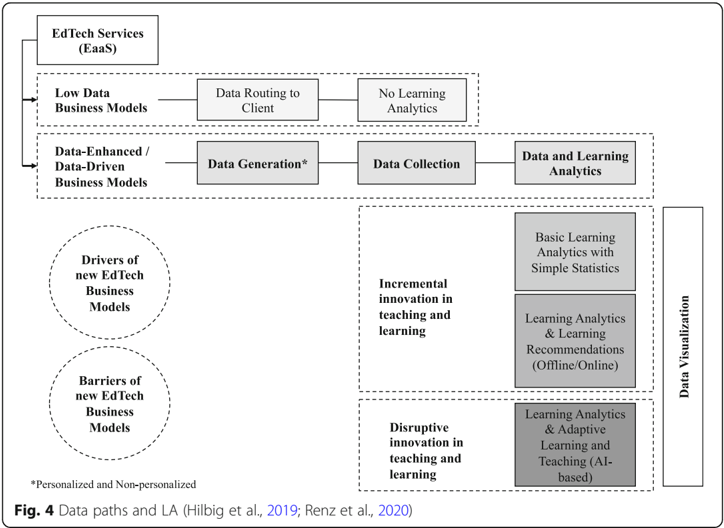
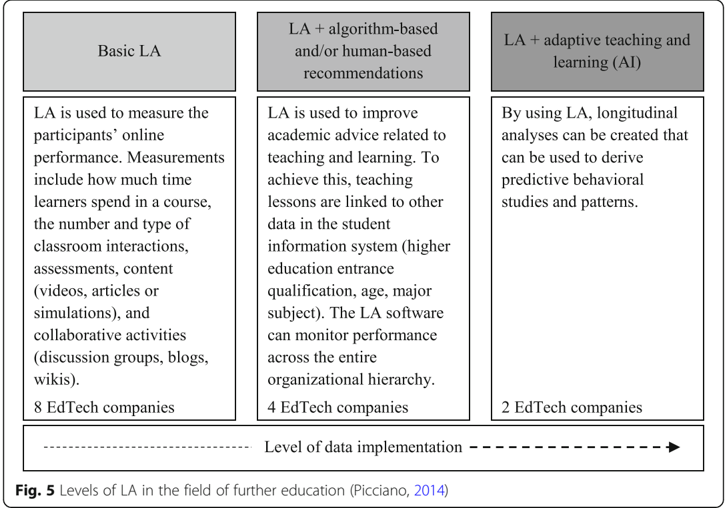
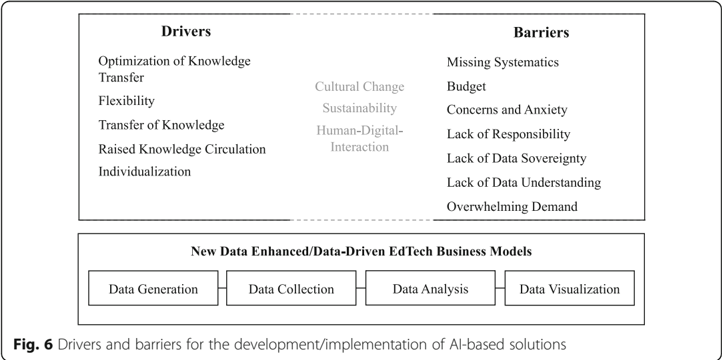
The ongoing datafication of our social reality has resulted in the emergence of new data-based business models. This development is also reflected in the education market. An increasing number of educational technology (EdTech) companies are entering the traditional education market with data-based teaching and learning solutions, and they are permanently transforming the market. However, despite the current market dynamics, there are hardly any business models that implement the possibilities of Learning Analytics (LA) and Artificial Intelligence (AI) to create adaptive teaching and learning paths. This paper focuses on EdTech companies and the drivers and barriers that currently affect data-based teaching and learning paths. The results show that LA especially are integrated into the current business models of EdTech companies on three levels, which are as follows: basic Learning Analytics, Learning Analytics and algorithmic or human-based recommendations, and Learning Analytics and adaptive teaching and learning (AI based). The discourse analysis reveals a diametrical relationship between the traditional educational ideal and the futuristic idea of education and knowledge transfer. While the desire for flexibility and individualization drives the debate on AI-based learning systems, a lack of data sovereignty, uncertainty and a lack of understanding of data are holding back the development and implementation of appropriate solutions at the same time.
Overview
The claims and statistics of this paper haven’t been checked yet.
Free: it reads the open-access text and checks the first 5 claims that cite a source we can check. Create a free account to check every claim.
Integrity signals
Registry
Cites
Statistics
Figures
Verification
Claims the paper makes
The claims and statistics of this paper haven’t been checked yet.
Free: it reads the open-access text and checks the first 5 claims that cite a source we can check. Create a free account to check every claim.
Claims other papers make about this one
Each is checked against this paper’s own text: does it say what the citing paper says it does?
In the citing paper
“The use of AI in differentiated learning enables personalized learning, which was not possible in the past when teaching large classes (Renz & Hilbig, 2020).”
From Teachers’ AI digital competencies and twenty-first century skills in the post-pandemic world (2023) · doi:10.1007/s11423-023-10203-6 · cites this paper as Renz & Hilbig, 2020
Self-check
Percentages, sums and reported differences re-computed from the paper’s own numbers.
The self-check needs the paper’s full text.
Citations
Cites
(1984) · Cited by 81,983
Case Study Research: Design and Methods
Chaiklin, H. (1991) · The Journal of Nervous and Mental Disease · doi:10.1097/00005053-199102000-00025 · Cited by 39,535
Artificial intelligence: a modern approach
(1995) · Choice Reviews Online · doi:10.5860/choice.33-1577 · Cited by 21,974
Artificial intelligence: A modern approach
Nilsson, N. J. (1996) · Artificial Intelligence · doi:10.1016/0004-3702(96)00007-0 · Cited by 10,583
Business models, business strategy and innovation
Teece, D. J. (2010) · Long Range Planning · doi:10.1016/j.lrp.2009.07.003 · Cited by 8,335
Zawacki-Richter, O., Marín, V. I., Bond, M., & Gouverneur, F. (2019) · International Journal of Educational Technology in Higher Education · doi:10.1186/s41239-019-0171-0 · Cited by 7,242 · cited 2×
“Although studies by Zawacki-Richter et al. (2019) and Viberg et al. (2018) have extensively analyzed existing research on LA and AIED, there is no clear differentiation regarding the degree to which LA and AI are implemented in teaching and learning processes.”
BackgroundThe Research Act: A Theoretical Introduction to Sociological Methods
Fox, W. S., & Denzin, N. K. (1979) · Contemporary Sociology · doi:10.2307/2065439 · Cited by 6,284
(2011) · Cited by 5,203
The business model: Recent developments and future research
Zott, C., Amit, R., & Massa, L. (2011) · Journal of Management · doi:10.1177/0149206311406265 · Cited by 4,790 · cited 1×
“The business model concept is becoming increasingly important in science and practice (Baden-Fuller & Mangematin, 2015; Ritter & Lettl, 2017; Zott, Amit, & Massa, 2011).”
BackgroundThe Research Act: A Theoretical Introduction to Sociological Methods
Krause, D., & Denzin, N. K. (1989) · Teaching Sociology · doi:10.2307/1318434 · Cited by 2,564
Research works printed but not linked: 17
- Bitkom. (2015). Big data und Geschäftsmodell-Innovationen in der Praxis: 40+ Beispiele, Berlin. https://www.bitkom.org/ Bitkom/Publikationen/Big-Data-und-Geschaeftsmodell-Innovationen-in-der-Praxis-40-Beispiele.html. Accessed 10 Oct 2019.
- Buschbacher, J. (2019). EdTech -Zukunft der Bildung: Wie die Bildung der Zukunft durch neue Technologien unterstützt und verändert wird und welche Kompetenzen Bildungsexperten unbedingt aufbauen sollten. Ludwigsburg: Eigenverlag.
- Collins, A., & Halverson, R. (2009). Rethinking education in the age of technology: The digital revolution and the schools. New York: Teachers College Press.
- Deutscher Bildungserver. (2019). Gesamtüberblick zum deutschen Bildungssystem, URL: https://www.bildungsserver.de/ Gesamtueberblick-zum-deutschen-Bildungssystem-506-de.html. Accessed 01 Aug 2019.
- Dräger, J., & Müller-Eiselt, R. (2017). Die digitale Bildungsrevolution: Der radikale Wandel des Lernens und wie wir ihn gestalten können. München: DVA Verlag.
- EdTechXGlobal (2016). EdTechXGlobal report 2016-Global EdTech industry report: a map for the future of education and work. http://ecosystem.edtechxeurope.com/2016-edtech-report. Accessed 04 Dec 2019.
- Gartner (2012). What is big data? Gartner IT glossary-big data. https://www.gartner.com/it-glossary/big-data/. Accessed 11 May 2018.
- Hilbig, R., Estiwah, B., & Hecht, S. (2018). Berlin start-ups-the rise of data-driven business models. In ISPIM Connects Fukuoka - Building on Innovation Tradition, 2-5 December, (pp. 1-19). Fukuoka.
- Hilbig, R., Renz, A., & Schildhauer, T. (2019). Data analytics: The future of innovative teaching and learning. In ISPIM Conference Proceedings, The International Society for Professional Innovation Management (ISPIM), (pp. 1-16). Florence.
- voll-ständig überarbeitete Auflage. Münster: Unrast (Edition DISS, Bd. 3).
- Loop, J. (2016). The empowered learner. White paper. https://www.looop.co/wp-content/uploads/2015/09/The-Empowered- Learner-White-Paper.pdf. Accessed 31 Jul 2019.
- Mayring, P. (2010). Qualitative Inhaltsanalyse. Grundlagen und Techniken. 11. aktualisierte und überarbeitete Version. Weinheim und Basel: Beltz Verlag.
- Newland, B., Martin, L., & Ringan, N. (2015). Learning analytics, in UK HE 2015. A HeLF Survey Report, https://drive.google. com/file/%20d/0Bz7E74T5Am22UEM1c0FxRjVpMzA/view. Accessed 31 July 2019.
- Rittelmeyer, C. (2017). Digitale Bildung -ein Widerspruch: Erziehungswissenschaftliche Analysen der schulbezogenen Debatten (Pädagogik: Perspektiven und Theorien, Band 29). Oberhausen: Athena Verlag.
- Sclater, N., Peasgood, A., & Mullan, J. (2016). Learning analytics in higher education: A review of UK and international practice. Bristol: JISC.
- Startup Genome. (2018). Global Startup Ecosystem Report 2018-Succeeding in the New Era of Technology. https:// startupgenome.com/all-report-thank-you/?file=2018. Accessed 25 Mar 2019.
- Startup Genome. (2019). Global Startup Ecosystem Report 2019-Succeeding in the New Era of Technology. https:// startupgenome.com/reports/global-startup-ecosystem-report-2019. Accessed 22 Nov 2019.
Cited by
Items 101–200 of 217
Toward Managing Technology Challenges for Agriculture Technology Start-ups
Kulkarni, P. M., Gokhale, P., Appasaba, L. V., Lakshminarayana, K., & Tigadi, B. S. (2022) · Lecture notes in networks and systems · doi:10.1007/978-981-19-5221-0_56 · Cited by 4
Digital Disparity in The Technological Era of Big Data and Artificial Intelligence
Dhar, S., Shyam, H. S., Tomar, S., & Rani, M. (2023) · International Conference on Advanced Computing and Communication Systems (ICACCS) · doi:10.1109/icaccs57279.2023.10113094 · Cited by 4
“professional instructors and trainers, learners develop sector knowledge and expand their talents [15].”
BackgroundAI in Education: Educational Technology and AI
Renz, A. (2023) · Springer eBooks · doi:10.1007/978-3-658-40232-7_39 · Cited by 6
Self-citationArtificial Intelligence-Based Adaptive E-learning Environments
Benkhalfallah, F., & Laouar, M. R. (2023) · Lecture notes in networks and systems · doi:10.1007/978-3-031-44097-7_6 · Cited by 10
Arqam, A., & Asrifan, A. (2024) · Journal of English Education and Teaching · doi:10.33369/jeet.8.3.586-608 · Cited by 17
Menkhoff, T., & Teo, Y. Q. L. (2022) · International Conference on Information System and Data Mining (ICISDM) · doi:10.1145/3546157.3546175 · Cited by 11
Holistic transfer educational learning approach for higher education
Li, H., Wang, J., & Wang, Y. (2023) · Computer Applications in Engineering Education · doi:10.1002/cae.22600 · Cited by 6
Botelho, C. C., da Rocha, L. T. V., Fernandes, R. M., da Silva, J. M. N., & Martins, V. W. B. (2025) · Journal of Applied Research in Higher Education · doi:10.1108/jarhe-04-2025-0268 · Cited by 6
AI Integration in Indonesian Education: Trends, Outcomes, and Challenges - A Comprehensive Review
Riski, A., Paais, R. L., Komariah, A., Novebri, N., Alang, L. P., Ataupah, W. V., Yurihana, Z., Bety, M. V., Ramadhan, D., Syarifudin, A., et al. (2026) · F1000Research · doi:10.12688/f1000research.188536.1 · Cited by 2
The Influence of Artificial Intelligence on Smart Learning: An Overview
Hassan, A. (2022) · Studies in computational intelligence · doi:10.1007/978-3-030-93921-2_31 · Cited by 5
Tian, R., & Tang, Y. (2022) · Wireless Communications and Mobile Computing · doi:10.1155/2022/9636452 · Cited by 3
“To this end, this paper explores the connotation of “B5G+network education” and uses the B5G model [1].”
MethodRetractedAplicação da Inteligência Artificial no Ensino Superior: Áreas e Características
Cavalcanti, W. M., Tavares, E. M., & Júnior, J. L. C. P. (2021) · Revista ADM.MADE/Adm.MADE · doi:10.5935/2237-51392020v25n1p040061 · Cited by 7
Developing Customer-Based Education Strategic Guidelines for Promoting a Software Product
Hamtini, T. M. (2023) · TEM Journal · doi:10.18421/tem124-30 · Cited by 9
Adoption of Artificial Intelligence for Manufacturing Companies
Lakshminarayana, K., Kulkarni, P. M., Gokhale, P., Appasaba, L. V., & Tigadi, B. S. (2023) · Lecture notes in electrical engineering · doi:10.1007/978-981-99-7622-5_17 · Cited by 3
Harmanto, H., Ghofur, M. A., Sukardani, P. S., Prahanı, B. K., & Saphıra, H. V. (2022) · International Journal of Emerging Research and Review · doi:10.56707/ijoerar.v1i4.50 · Cited by 8
“…for shaping positive attitudes and wise behaviors in the digital world, including in the context of using technology for educational purposes (Gabriel et al., 2022; Harrison & Polizzi, 2022; Rahmatullah, 2022; Renz & Hilbig, 2020; Sharma et al., 2022; Smith & Sevensma, 2019; Velander et al., 2023).”
BackgroundBertash, M., Polishchuk, S., Burdun, V., Ivanyshyn, N., & Zhulkovskyi, V. V. (2024) · Journal of Curriculum and Teaching · doi:10.5430/jct.v13n3p147 · Cited by 3
Examination of students’ success in the use of artificial intelligence
Uaidullakyzy, E., Oralbekova, A. K., Dosbenbetova, A., Yerubay, B., Nauryzbayev, B. A., & Turmanov, R. A. (2024) · South African Journal of Education · doi:10.15700/saje.v44n4a2542 · Cited by 6
“Artificial intelligence brings risks as well as opportunities (Renz & Hilbig, 2020).”
Kaur, H., Reddy, C. K. K., Reddy, D., & Hanafiah, M. M. (2025) · Springer eBooks · doi:10.1007/978-981-96-2355-6_13 · Cited by 10
Rahman, M. M., Chung, C. C., Shanana, A., Hua, S., Thiviyashree, & Elleyajasmin (2025) · International Journal of Online and Biomedical Engineering (iJOE) · doi:10.3991/ijoe.v21i07.54227 · Cited by 6
Manideep, A. S., Pasupuleti, R. S., Tulimelli, J., Dokku, Y., Chen, W.-K., & Nalluri, V. (2025) · IEEE International Conference on Social Sciences and Intelligence Management (SSIM) · doi:10.3390/engproc2025098012 · Cited by 5
Analysis of Pre-existing Investment Behavior and Influence of Trading Apps
Guddati, A., & Bhat, D. (2021) · Journal of Student Research · doi:10.47611/jsrhs.v10i4.2212 · Cited by 6
Qiu, Z. (2022) · Wireless Communications and Mobile Computing · doi:10.1155/2022/9993183 · Cited by 3
“Intelligent teaching system provides students with various teaching resources and shares good teachers, which greatly improves the quality of teaching and learning [3].”
BackgroundRetractedTeaching Experiential Data Analytics Using an Election Simulation
Arinze, B. (2022) · Journal of Statistics and Data Science Education · doi:10.1080/26939169.2022.2138799 · Cited by 3
“Renz and Hilbig (2020) however identify the entry of EdTech companies into the data curriculum by providing platforms, for example, cloud, and specialized software, such as IBM’s Watson.”
BackgroundUtilization of Artificial Intelligence Technology in Higher Education Management
Wang, L. (2023) · Adult and Higher Education · doi:10.23977/aduhe.2023.051916 · Cited by 3
Suyitno, S., Wahyuningsih, Y., Febrianti, D., Anisah, A. K., & Wardana, A. W. (2024) · Jurnal Pengabdian kepada Masyarakat Nusantara · doi:10.55338/jpkmn.v5i1.2863 · Cited by 13
“Dengan kemampuannya yang luar biasa, AI membuka jalan bagi peneliti untuk mengeksplorasi dimensi baru dalam penyusunan karya ilmiah, memungkinkan penciptaan metodologi yang lebih efisien dan efektif (Renz & Hilbig, 2020).”
BackgroundIdentifying the Obstacles and Challenges of Launching Startups in the Education Industry
Mashayekhi, M., Abili, K., & Hosseini, S. R. (2024) · doi:10.61838/kman.ijimob.4.2.2 · Cited by 3
Putra, A. B. N. R., Mu'arifin, M., Subandi, M. S., Susanto, H., Hakim, G. R. U., & Basuki, I. A. (2021) · doi:10.1109/icet53279.2021.9575090 · Cited by 6
Kayahan, S., Günel, K., & Nuriyev, U. G. (2022) · Bilişim Teknolojileri Dergisi · doi:10.17671/gazibtd.1026142 · Cited by 2
Seufert, S., & Meier, C. (2023) · Springer eBooks · doi:10.1007/978-3-658-40079-8_16 · Cited by 5
Versteijlen, M., & Groesbeek, M. J. (2024) · Sustainable development · doi:10.5772/intechopen.1005117 · Cited by 5
Wang, W., Wan, Q., Cui, J., & Liu, L. (2024) · Transactions on Economics Business and Management Research · doi:10.62051/hg27d451 · Cited by 2
Promoting Accessibility and Personalizing Learning Experiences Through AI
Elshazly, E. (2024) · Advances in educational technologies and instructional design book series · doi:10.4018/979-8-3693-5538-1.ch005 · Cited by 9
Shan, H. (2025) · Journal of Education and Educational Policy Studies · doi:10.54254/3049-7248/2025.20523 · Cited by 8
“— Academic outcomes will be measured by grades, test scores, and other measurable measures [9].”
Nababan, K., Siregar, D. M., Kuendo, W. A. C., Baluntu, W., Said, A. P., & Gulo, W. (2024) · Jurnal Ilmiah Sekolah Dasar · doi:10.23887/jisd.v8i4.85902 · Cited by 2
“In line with these conditions, a study by Renz and Hilbig in the International Journal of Educational Technology in Higher Education stated that many primary school teachers in Indonesia still feel less confident in using digital technology to support the learning process (Renz & Hilbig, 2020) .”
Artificial Intelligence in the DigiCraft Educational Program
González, M. C., & Martín, S. C. (2021) · Advances in human and social aspects of technology book series · doi:10.4018/978-1-7998-4156-2.ch005 · Cited by 2
Framework of smart learning technology in supporting quality of higher education in Indonesia
Ritonga, A. W., & Desrani, A. (2022) · International Journal of Multidisciplinary Research and Growth Evaluation · doi:10.54660/anfo.2022.3.6.11 · Cited by 4
Automated System for Cognitive Load Analyzing in the Blended Learning
Kotova, E. E., & Pisarev, I. A. (2022) · International Conference "Quality Management, Transport and Information Security, Information Technologies" (IT&QM&IS) · doi:10.1109/itqmis56172.2022.9976727 · Cited by 2
“Both learning analytics and AI face challenges due to the lack of a theoretical framework and evidence-based business models to facilitate their use [7].”
BackgroundToth, A. (2024) · ACM Conference on User Modeling, Adaptation and Personalization (UMAP) · doi:10.1145/3631700.3664914 · Cited by 4
“Behind this lack of trust is mainly a lack of understanding of how AI algorithms work and the fear of losing full human control of the learning process [19].”
BackgroundUlatowska, R., Sułkowski, Ł., & Bilan, S. (2024) · Research Square · doi:10.21203/rs.3.rs-4390507/v1 · Cited by 4
Ding, P., Gao, F., & Tian, J. (2024) · International Symposium on Big Data and Artificial Intelligence (ISBDAI) · doi:10.1145/3723366.3723374 · Cited by 1
“The experimental dataset was derived from the behavioral data of the labor education course, including parameters such as operation duration, task completion status, student self-assessment, and teacher feedback [5].”
Artificial Intelligence in Education Higher Education in the Business Area
Rosário, A. T. (2025) · Advances in computational intelligence and robotics book series · doi:10.4018/979-8-3373-4576-5.ch007 · Cited by 2
AI Innovations in Higher Education and Management of Students
Kumar, S., Thakur, K., & Kumar, A. D. (2025) · Advances in computational intelligence and robotics book series · doi:10.4018/979-8-3373-2150-9.ch002 · Cited by 1
Leveraging AI in Higher Education Teaching and Learning: Opportunities and Challenges Ahead
Srivastava, N., Srivastava, A., & Rao, P. (2025) · Emerald Group Publishing Limited eBooks · doi:10.1108/978-1-83662-066-220251007 · Cited by 1
ОСОБЛИВОСТІ ЦИФРОВОЇ ТРАНСФОРМАЦІЇ В УПРАВЛІННІ ЗАКЛАДАМИ ВИЩОЇ ОСВІТИ УКРАЇНИ
Кизим, М. О., & Юрченко, О. (2025) · Економіка та суспільство · doi:10.32782/2524-0072/2025-82-61 · Cited by 1
Learning Analytics, Artificial Intelligence, and the Future of Democratic Curricular Governance
Carrión, J., Jaramillo, C., & Villarreal, S. N. C. (2026) · Advances in computational intelligence and robotics book series · doi:10.4018/979-8-3373-4480-5.ch015 · Cited by 1
Mrayhi, S., Khribi, M. K., & Jemni, M. (2026) · IEEE Revista Iberoamericana de Tecnologias del Aprendizaje · doi:10.1109/rita.2026.3668415 · Cited by 2
“Cross-cultural replications, multilingual deployments, and cost / feasibility analyses should be prioritized to test scalability and equity across diverse learner populations [128], [129], [130].”
Niu, S. J., Niemi, H., Li, X., Luo, J., & Lu, Y. (2026) · Springer eBooks · doi:10.1007/978-3-032-12174-5_18 · Cited by 1
Charles, K., Lucy, A. C., Irene, E. C., & Fobi, S. (2026) · Educational Point · doi:10.71176/edup/19172 · Cited by 2
“However, it should be mentioned that there were not many articles about professional development of teachers, and the use of automatic feedback might be unnecessary for experienced teachers (Renz & Hilbig, 2020; Trisnawati et al., 2023).”
Wang, S. (2021) · International Conference on Aviation Safety and Information Technology (ICASIT) · doi:10.1145/3510858.3510936 · Cited by 1
“In terms of teaching materials, educational content and teaching methods, we all strive to introduce advanced computer network technology, and the developed education system better reflects the development trend of multimedia, networking, automation, and socialization [5-6].”
BackgroundThe Model Framework of College Students’ Entrepreneurial Team Formation Based on Relevance Algorithm
Hu, G., & Li, X. (2022) · Scientific Programming · doi:10.1155/2022/9487978 · Cited by 1
OKOYE, K. O. (2022) · International Conference on Emerging Trends in Electrical, Electronic and Communications Engineering (ELECOM) · doi:10.1109/elecom54934.2022.9965251 · Cited by 1
“…developed in line with the goal of achieving a scalable and sustainable learning environments (Education 4.0) by taking into account strategic-planning and reimaging of delivery of education through approaches/models that supports Institutional Rethink or Business Intelligence [42], [45], [46].”
BackgroundInfluentialKulkarni, P. M., Gokhale, P., Appasaba, L. V., Lakshminarayana, K., & Tigadi, B. S. (2022) · Lecture notes in electrical engineering · doi:10.1007/978-981-19-5482-5_15 · Cited by 1
Incidence Response, Disaster Recovery, and Business Continuity Planning
McAliney, P. J., Albertini, G. J., & Ramsaywak, S. D. (2023) · Advances in educational technologies and instructional design book series · doi:10.4018/978-1-6684-6092-4.ch003 · Cited by 1
AI in Student as Manager Model-Future Directions of Business Studies
Nallaluthan, K., Jizat, J. E. M., Suhaimi, S., Govindarajo, N. S., Dileep Kumar, M., & Ghouri, A. M. (2023) · International Conference on Disruptive Technologies (ICDT) · doi:10.1109/icdt57929.2023.10150897 · Cited by 4
“…access to large amounts of data, which may be difficult to obtain in Malaysia due to privacy concerns and limited data collection practices [19]. e) Resistance to Change: Many educators and administrators may be resistant to change and may prefer to stick to traditional teaching methods…”
BackgroundPramono, R. A., Saputra, F. O., & Trisnapradika, G. A. (2024) · Dinamika Rekayasa · doi:10.20884/1.dinarek.2024.20.1.11 · Cited by 1
Lin, P.-H., Chen, S.-Y., Lai, Y.-H., & Wu, H. (2024) · Journal of Organizational and End User Computing · doi:10.4018/joeuc.337796 · Cited by 3
“To better align trainees with AI in their learning processes and future careers, it is essential to start designing and implementing relevant courses from the foundational level (Renz & Hilbig, 2020).”
BackgroundThe Role of Artificial Intelligence in Supply Chain Management
Singh, S., Madaan, G., Swapna, H. R., Kaur, P., Pandey, D., & Dadheech, P. (2024) · Advances in logistics, operations, and management science book series · doi:10.4018/979-8-3693-3593-2.ch003 · Cited by 1
Teacher education: the key to quality education for future generations
Feszterová, M. (2024) · R&E-SOURCE · doi:10.53349/resource.2024.is1.a1242 · Cited by 9
“Higher education's content, quality, and efficiency are influenced not only by the level of scientific and technical knowledge and dynamically developing production technologies, but above all by the requirements of social and production practice (Renz, Hilbig, 2020).”
BackgroundSuleiman, Y. (2024) · Journal of Education in Black Sea Region · doi:10.31578/jebs.v9i2.318 · Cited by 8
“Career services can also play a role in helping students build self-esteem by providing guidance and resources for future career goals (Raffaghelli et al., 2022; Renz & Hilbig, 2020).”
BackgroundGong, Y. (2024) · Salud Ciencia y Tecnología - Serie de Conferencias · doi:10.56294/sctconf2024.1150 · Cited by 1
Perspectives and Challenges of Family Firms in Emerging Economies
Thanasi-Boçe, M., Dyrmishi, I., & Kurtishi-Kastrati, S. (2024) · Emerald Group Publishing Limited eBooks · doi:10.1108/978-1-83753-934-520241002 · Cited by 1
Liang, K., & You, J. (2024) · International Signal Processing, Communications and Engineering Management Conference (ISPCEM) · doi:10.1109/ispcem64498.2024.00143 · Cited by 1
“In addition to collaborative filtering, content-based recommendation algorithms represent another prevalent approach [7].”
Chen, N. (2025) · Springer eBooks · doi:10.1007/978-3-031-82243-8_2 · Cited by 5
Karafli, K. E. (2025) · Advances in computational intelligence and robotics book series · doi:10.4018/979-8-3373-1827-1.ch014 · Cited by 2
The Application of Artificial Intelligence to Business Models: A Systematic Literature Review
Ranaldo, S., Dell’Atti, V., & Turco, M. (2021) · SIDREA series in accounting and business administration · doi:10.1007/978-3-030-80737-5_22 · Cited by 3
Laboratory Information Management System Design for Food Practice Course Education
Wu, D., Cheng, H., Yang, L., Wu, X., Shiguo, C., Qihe, C., & Donghong, L. (2021) · Advances in Social Science, Education and Humanities Research/Advances in social science, education and humanities research · doi:10.2991/assehr.k.211011.002
“With the development of informatization in modern society, higher education has gradually entered the age of online, big data and intelligence, especially in epidemic situation of COVID-19 [15-18], including the informatization of talent training, experimental teaching and laboratory management [19-21].”
BackgroundЗАСТОСУВАННЯ ІНФОРМАЦІЙНИХ ТЕХНОЛОГІЙ У ПРОЦЕСІ ВИКЛАДАННЯ ТЕОРІЇ І ПРАКТИКИ ФІЗИЧНОЇ ТЕРАПІЇ
Копочинська, Ю. В., Dmitriieva, N. S., & Глиняна, О. (2022) · Перспективи та інновації науки · doi:10.52058/2786-4952-2022-1(6)-203-211
University Teaching Innovation in the COVID-19 Dra: A Systematic Literature Review
González-Padilla, P., González‐Torres, T., & del Valle, I. D. (2022) · Advances in higher education and professional development book series · doi:10.4018/978-1-6684-4441-2.ch002
»Digitale Souveränität« als Kontrolle: Ihre zentralen Formen und ihr Verhältnis zueinander
Tretter, M. (2022) · Politik in der digitalen Gesellschaft · doi:10.14361/9783839458273-004 · Cited by 4
The IAFOR Conference on Educational Research & Innovation: 2023 Official Conference Proceedings
(2023) · IAFOR Conference on Educational Research & Innovation official conference proceedings · doi:10.22492/issn.2435-1202.2023 · Cited by 13
(2023) · دراسات تربوية ونفسية مجلة کلية التربية بالزقازيق · doi:10.21608/sec.2023.335163
The Effects of Artificial Intelligence on Supply Chain Management
Singh, S., Madaan, G., Swapna, H. R., Lakshmi, L., Mahajan, R. D., & George, A. S. (2024) · Advances in logistics, operations, and management science book series · doi:10.4018/979-8-3693-3593-2.ch005
Lv, L. (2023) · BCP Education & Psychology · doi:10.54691/n2m1sp95
“Digital media not only provide more educational resources and interactive methods, but also have the ability to disseminate cultural information, including traditional cultural elements, on a global scale [2][6].”
BackgroundA INTELIGÊNCIA ARTIFICIAL NOS DISCURSOS DAS EDTECHS NO BRASIL
Lima, G. D. M. (2024) · doi:10.17771/pucrio.acad.66386
Understanding University Students' Concerns Regarding Automated Learning Assessment Tools
Toth, A., Ábrahám, Z., & Zimmermann, V. (2024) · ACM Conference on User Modeling, Adaptation and Personalization (UMAP) · doi:10.1145/3631700.3664881 · Cited by 1
“Difficulties to understand how AI algorithms work and the fear of losing human control are the main reasons of this lack of trust[23].”
BackgroundYulistia, T., Risdianto, E., Putri, D. H., & Kurniaty, R. (2024) · Kasuari Physics Education Journal (KPEJ) · doi:10.37891/kpej.v7i1.496 · Cited by 7
“Teknologi saat ini yang sudang ada pada bidang pendidikan seperti media aplikasi pembelajaran (Renz & Hilbig, 2020).”
BackgroundPAVLYUKEVICH, E. D., & Садов, К. С. (2024) · Economic Analysis Theory and Practice · doi:10.24891/ea.23.7.1240
Sidik, S., Wahyuari, W., Laratmase, A. J., & Suhendar, B. (2024) · Premium Insurance Business Journal · doi:10.35904/premium.v11i1.57 · Cited by 2
WHAT ARE EDTECHS? A SYSTEMATIC LITERATURE REVIEW
Lopes, Y., & Meirelles, D. S. E. (2024) · REAd Revista Eletrônica de Administração (Porto Alegre) · doi:10.1590/1413-2311.405.135580 · Cited by 3
Innovation Plans for the Use of Artificial Intelligence in Higher Education
(2024) · Advances in higher education and professional development book series · doi:10.4018/979-8-3693-4074-5.ch006
Innovations of AI in Primary School's Learning: A Systematic Review
Sin, A. C. K., & Barkhaya, N. M. M. (2024) · Advances in educational technologies and instructional design book series · doi:10.4018/979-8-3693-7255-5.ch006 · Cited by 2
Li, Y. (2024) · Applied Mathematics and Nonlinear Sciences · doi:10.2478/amns-2024-3547
A Need to Balance Between Human Behaviour & Artificial Intelligence
Priyanka (2024) · International Journal For Multidisciplinary Research · doi:10.36948/ijfmr.2024.v06i06.34018 · Cited by 1
AI in the Lecture Room: Analysing Two Use Cases in the Context of Higher Education
Alén‐Savikko, A., Mäihäniemi, B., & Pasvenskienė, A. (2025) · Law, governance and technology series · doi:10.1007/978-3-031-80111-2_11 · Cited by 3
GPTs im Personalmanagement: Lessons learned aus dem KI-HR-Lab
Hilbig, R., Neyer, A., Fichtner, U., & Fischer, S. (2024) · Springer eBooks · doi:10.1007/978-3-658-46481-3_20
Self-citationRenz, A. (2024) · Springer eBooks · doi:10.1007/978-3-658-46481-3_10
Self-citationRevolutionizing Educational Assessments With AI Technology
Parmar, K. J., Palaniappan, D., Premavathi, T., & Jain, R. (2025) · Advances in computational intelligence and robotics book series · doi:10.4018/979-8-3693-9062-7.ch011 · Cited by 3
Li, C., Xu, Z., & Jing, W. (2025) · Communications in computer and information science · doi:10.1007/978-981-96-3738-6_19
Mukashova, A., Tussupov, J., Mukhanova, A., Bekmanova, G., Omarbekova, A., Nazyrova, A., & Barlybayev, A. (2025) · SSRN Electronic Journal · doi:10.2139/ssrn.5235022
Cheng, H. (2025) · International Journal of High Speed Electronics and Systems · doi:10.1142/s0129156425405650
Yang, D., Zhang, Y., Hoel, T., & Yuan, L. Y. (2025) · Communications in computer and information science · doi:10.1007/978-3-031-99261-2_23
yolanda, F., Elizar, & Mahendra, Y. (2025) · International Journal of Elementary Education · doi:10.23887/ijee.v9i2.93441 · Cited by 8
Roy, A. P., Anand, K., Elangovan, N., & Halaswamy, D. (2025) · Lecture notes in networks and systems · doi:10.1007/978-981-96-6063-6_26
Artificial Intelligence in Education: SWOT Analysis
Panja, S. K. (2025) · Bulletin of Science Technology & Society · doi:10.1177/02704676251371993 · Cited by 4
“…higher educational institutions Luan et al. (2020) Challenges of AIED Popenici and Kerr (2017) Technology adoption for academic and administration Renz and Hilbig (2020) Proliferations of EdTech companies Shalini and Tewari (2020) Challenges of incorporating AI in the Indian educational system…”
Александровна, К. А. (2025) · Вестник Южно-Уральского государственного университета. Серия: Образование. Педагогические науки · doi:10.14529/ped250308 · Cited by 2
Balancing AI and Pedagogy: The Future of Technology in Education
Manoj Kumar, A. (2025) · Advances in computational intelligence and robotics book series · doi:10.4018/979-8-3373-2185-1.ch012
Use of artificial intelligence in education: potential, challenge or opportunity
Simonova, I. V., Pachevska, A. V., Biloshytska, A., & Istoshyn, V. M. (2025) · Reports of Vinnytsia National Medical University · doi:10.31393/reports-vnmedical-2025-29(3)-18 · Cited by 3
Karaman, M. R., & Göksu, İ. (2025) · Buca eğitim fakültesi dergisi (Online)/Buca Eğitim Fakültesi dergisi · doi:10.53444/deubefd.1779666
The Role of Artificial Intelligence in Medical Education
Golahmadi, A. K., Rad, A. A., & Athanasiou, T. (2026) · Biomedical visualization · doi:10.1007/978-3-032-06520-9_6 · Cited by 1
Assaf, M. (2026) · EDPACS · doi:10.1080/07366981.2026.2617759 · Cited by 1
Metadata
- Authors
- Renz, A., & Hilbig, R.
- Affiliations
- Weizenbaum Institute (DE)
- Corresponding author
- Renz, André
- ORCID
- Renz, André
- Venue
- International Journal of Educational Technology in Higher Education
- Published
- 2020-04-06
- Volume
- 17
- Issue
- 1
- ISSN
- 2365-9440 (ISSN-L)
- OpenAlex
- W3028852563
- Semantic Scholar
- f379aefd566aab5bfefb99a3a921d36e46d059a0
- Cited by
- 218
- References
- 67
- Citations by year
- 2026: 24 · 2025: 46 · 2024: 58 · 2023: 24 · 2022: 39 · 2021: 21 · 2020: 6
- FWCI
- 20.67
- Type
- journal article
- Language
- en
- Update notices
- correction (2021-02-24)
- Open access
- diamond
- doi.org
- Licence
- cc-by
- creativecommons.org/licenses/by/4.0 (tdm)
- creativecommons.org/licenses/by/4.0 (vor)
- Locations
- International Journal of Educational Technology in Higher Education (publishedVersion, cc-by)
- DOAJ (DOAJ: Directory of Open Access Journals) (submittedVersion, cc-by-sa)
- Funders
- Bundesministerium für Bildung und Forschung (16DII111)
- Topics
- Physical Sciences › Computer Science › Computer Science Applications › Online Learning and Analytics
- Social Sciences › Education › Artificial Intelligence in Education
- Social Sciences › Education › Digital Education and Society
- Keywords
- artificial intelligence in education, educational technology companies, business models, learning analytics, adaptive learning, further education, drivers and barriers, data sovereignty, algorithmic recommendation, personalized learning, datafication of education
About these checks
Registry, retraction, Cites and statistics results are computed, not judged, with one exception: a printed reference that no index lists is read once by a model before it counts as a citation error. Claims are extracted by a model and kept only when their quote appears verbatim in the text; each cited source is then checked, with a model’s help, for whether it says what the claim relies on. Those verdicts can be wrong — read the claim’s quote and the cited source before relying on one.
Statistics and arithmetic are recomputed, not judged.
Confidence bands are shown only for fields calibrated on our annotated test set. None is calibrated yet, so no band is shown.
What counts as a claim ›How we measure confidence ›How we check this ›
Are you an author, or do you see a problem with this page? Request a review
Data sources
Bibliographic data: Semantic Scholar, OpenAlex, Crossref.
Contains information from the Semantic Scholar Academic Graph Datasets, made available under the ODC Attribution License (ODC-BY 1.0).
Semantic Scholar’s data is described in: Kinney, R., et al. (2023). The Semantic Scholar Open Data Platform. arXiv:2301.10140.
