

Prerequisites for artificial intelligence in further education: identification of drivers, barriers, and business models of educational technology companies
Open accessThe DOI matches its Crossref record; 63 of the 67 references it cites were found in a registry or an index.
Abstract
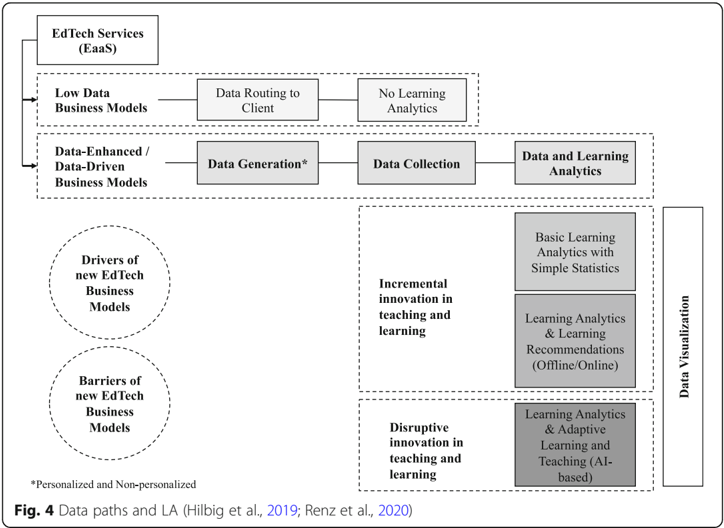
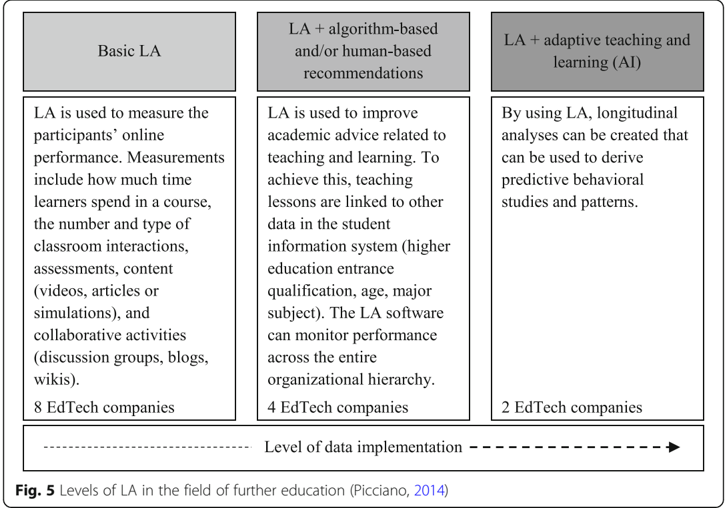
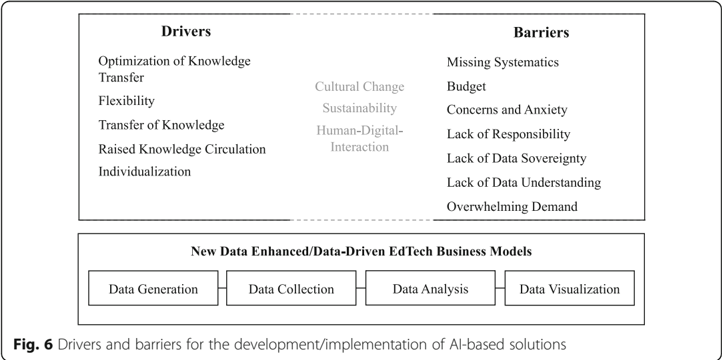
The ongoing datafication of our social reality has resulted in the emergence of new data-based business models. This development is also reflected in the education market. An increasing number of educational technology (EdTech) companies are entering the traditional education market with data-based teaching and learning solutions, and they are permanently transforming the market. However, despite the current market dynamics, there are hardly any business models that implement the possibilities of Learning Analytics (LA) and Artificial Intelligence (AI) to create adaptive teaching and learning paths. This paper focuses on EdTech companies and the drivers and barriers that currently affect data-based teaching and learning paths. The results show that LA especially are integrated into the current business models of EdTech companies on three levels, which are as follows: basic Learning Analytics, Learning Analytics and algorithmic or human-based recommendations, and Learning Analytics and adaptive teaching and learning (AI based). The discourse analysis reveals a diametrical relationship between the traditional educational ideal and the futuristic idea of education and knowledge transfer. While the desire for flexibility and individualization drives the debate on AI-based learning systems, a lack of data sovereignty, uncertainty and a lack of understanding of data are holding back the development and implementation of appropriate solutions at the same time.
Overview
The claims and statistics of this paper haven’t been checked yet.
Free: it reads the open-access text and checks the first 5 claims that cite a source we can check. Create a free account to check every claim.
Integrity signals
Registry
Cites
Statistics
Figures
Verification
Claims the paper makes
The claims and statistics of this paper haven’t been checked yet.
Free: it reads the open-access text and checks the first 5 claims that cite a source we can check. Create a free account to check every claim.
Claims other papers make about this one
Each is checked against this paper’s own text: does it say what the citing paper says it does?
In the citing paper
“The use of AI in differentiated learning enables personalized learning, which was not possible in the past when teaching large classes (Renz & Hilbig, 2020).”
From Teachers’ AI digital competencies and twenty-first century skills in the post-pandemic world (2023) · doi:10.1007/s11423-023-10203-6 · cites this paper as Renz & Hilbig, 2020
Self-check
Percentages, sums and reported differences re-computed from the paper’s own numbers.
The self-check needs the paper’s full text.
Citations
Cites
(1984) · Cited by 81,983
Case Study Research: Design and Methods
Chaiklin, H. (1991) · The Journal of Nervous and Mental Disease · doi:10.1097/00005053-199102000-00025 · Cited by 39,535
Artificial intelligence: a modern approach
(1995) · Choice Reviews Online · doi:10.5860/choice.33-1577 · Cited by 21,974
Artificial intelligence: A modern approach
Nilsson, N. J. (1996) · Artificial Intelligence · doi:10.1016/0004-3702(96)00007-0 · Cited by 10,583
Business models, business strategy and innovation
Teece, D. J. (2010) · Long Range Planning · doi:10.1016/j.lrp.2009.07.003 · Cited by 8,335
Zawacki-Richter, O., Marín, V. I., Bond, M., & Gouverneur, F. (2019) · International Journal of Educational Technology in Higher Education · doi:10.1186/s41239-019-0171-0 · Cited by 7,242 · cited 2×
“Although studies by Zawacki-Richter et al. (2019) and Viberg et al. (2018) have extensively analyzed existing research on LA and AIED, there is no clear differentiation regarding the degree to which LA and AI are implemented in teaching and learning processes.”
BackgroundThe Research Act: A Theoretical Introduction to Sociological Methods
Fox, W. S., & Denzin, N. K. (1979) · Contemporary Sociology · doi:10.2307/2065439 · Cited by 6,284
(2011) · Cited by 5,203
The business model: Recent developments and future research
Zott, C., Amit, R., & Massa, L. (2011) · Journal of Management · doi:10.1177/0149206311406265 · Cited by 4,790 · cited 1×
“The business model concept is becoming increasingly important in science and practice (Baden-Fuller & Mangematin, 2015; Ritter & Lettl, 2017; Zott, Amit, & Massa, 2011).”
BackgroundThe Research Act: A Theoretical Introduction to Sociological Methods
Krause, D., & Denzin, N. K. (1989) · Teaching Sociology · doi:10.2307/1318434 · Cited by 2,564
Research works printed but not linked: 17
- Bitkom. (2015). Big data und Geschäftsmodell-Innovationen in der Praxis: 40+ Beispiele, Berlin. https://www.bitkom.org/ Bitkom/Publikationen/Big-Data-und-Geschaeftsmodell-Innovationen-in-der-Praxis-40-Beispiele.html. Accessed 10 Oct 2019.
- Buschbacher, J. (2019). EdTech -Zukunft der Bildung: Wie die Bildung der Zukunft durch neue Technologien unterstützt und verändert wird und welche Kompetenzen Bildungsexperten unbedingt aufbauen sollten. Ludwigsburg: Eigenverlag.
- Collins, A., & Halverson, R. (2009). Rethinking education in the age of technology: The digital revolution and the schools. New York: Teachers College Press.
- Deutscher Bildungserver. (2019). Gesamtüberblick zum deutschen Bildungssystem, URL: https://www.bildungsserver.de/ Gesamtueberblick-zum-deutschen-Bildungssystem-506-de.html. Accessed 01 Aug 2019.
- Dräger, J., & Müller-Eiselt, R. (2017). Die digitale Bildungsrevolution: Der radikale Wandel des Lernens und wie wir ihn gestalten können. München: DVA Verlag.
- EdTechXGlobal (2016). EdTechXGlobal report 2016-Global EdTech industry report: a map for the future of education and work. http://ecosystem.edtechxeurope.com/2016-edtech-report. Accessed 04 Dec 2019.
- Gartner (2012). What is big data? Gartner IT glossary-big data. https://www.gartner.com/it-glossary/big-data/. Accessed 11 May 2018.
- Hilbig, R., Estiwah, B., & Hecht, S. (2018). Berlin start-ups-the rise of data-driven business models. In ISPIM Connects Fukuoka - Building on Innovation Tradition, 2-5 December, (pp. 1-19). Fukuoka.
- Hilbig, R., Renz, A., & Schildhauer, T. (2019). Data analytics: The future of innovative teaching and learning. In ISPIM Conference Proceedings, The International Society for Professional Innovation Management (ISPIM), (pp. 1-16). Florence.
- voll-ständig überarbeitete Auflage. Münster: Unrast (Edition DISS, Bd. 3).
- Loop, J. (2016). The empowered learner. White paper. https://www.looop.co/wp-content/uploads/2015/09/The-Empowered- Learner-White-Paper.pdf. Accessed 31 Jul 2019.
- Mayring, P. (2010). Qualitative Inhaltsanalyse. Grundlagen und Techniken. 11. aktualisierte und überarbeitete Version. Weinheim und Basel: Beltz Verlag.
- Newland, B., Martin, L., & Ringan, N. (2015). Learning analytics, in UK HE 2015. A HeLF Survey Report, https://drive.google. com/file/%20d/0Bz7E74T5Am22UEM1c0FxRjVpMzA/view. Accessed 31 July 2019.
- Rittelmeyer, C. (2017). Digitale Bildung -ein Widerspruch: Erziehungswissenschaftliche Analysen der schulbezogenen Debatten (Pädagogik: Perspektiven und Theorien, Band 29). Oberhausen: Athena Verlag.
- Sclater, N., Peasgood, A., & Mullan, J. (2016). Learning analytics in higher education: A review of UK and international practice. Bristol: JISC.
- Startup Genome. (2018). Global Startup Ecosystem Report 2018-Succeeding in the New Era of Technology. https:// startupgenome.com/all-report-thank-you/?file=2018. Accessed 25 Mar 2019.
- Startup Genome. (2019). Global Startup Ecosystem Report 2019-Succeeding in the New Era of Technology. https:// startupgenome.com/reports/global-startup-ecosystem-report-2019. Accessed 22 Nov 2019.
Cited by
A Review of Artificial Intelligence (AI) in Education from 2010 to 2020
Zhai, X., Chu, X., Chai, C. S., Jong, M. S. Y., Istenic, A., Spector, M., Liu, J.-B., Yuan, J., & Li, Y. (2021) · Complexity · doi:10.1155/2021/8812542 · Cited by 1,364
“…research development in recent twenty years Ulum [ [106] Constructing guidelines to apply data mining techniques to predict student success Renz and Hilbig [107] Analyzing the drivers and barriers that currently affect data-based teaching and learning paths from the perspective of EdTech companies”
MethodChiu, T. K. F., Xia, Q., Zhou, X., Chai, C. S., & Cheng, M. (2023) · Computers and Education: Artificial Intelligence · doi:10.1016/j.caeai.2022.100118 · Cited by 1,181
The promises and challenges of artificial intelligence for teachers: A systematic review of research
Celik, I., Dindar, M., Muukkonen, H., & Järvelä, S. (2022) · TechTrends · doi:10.1007/s11528-022-00715-y · Cited by 984
“The availability of AI technologies and of educational software companies to create AI-based applications is increasing rapidly all over the world (Renz & Hilbig, 2020).”
BackgroundTeachers’ AI digital competencies and twenty-first century skills in the post-pandemic world
(2023) · doi:10.1007/s11423-023-10203-6 · Cited by 734
Challenges and Future Directions of Big Data and Artificial Intelligence in Education
Luan, H., Geczy, P., Lai, H., Gobert, J., Yang, S. J. H., Ogata, H., Baltes, J., Guerra, R., Li, P., & Tsai, C.-C. (2020) · Frontiers in Psychology · doi:10.3389/fpsyg.2020.580820 · Cited by 667
Tang, K.-Y., Chang, C.-Y., & Hwang, G.-J. (2023) · Interactive Learning Environments · doi:10.1080/10494820.2021.1875001 · Cited by 324
“These fi elds generally lack computer science/engineering experts to design and develop AI-based learning systems, as indicated by several researchers (e.g. Hamada, 2019; Renz & Hilbig, 2020).”
BackgroundZhang, J., & Zhang, Z. (2024) · Journal of Computer Assisted Learning · doi:10.1111/jcal.12988 · Cited by 263
Okoye, K., Hussein, H., Arrona-Palacios, A., Quintero, H. N., Ortega, L. O. P., Sanchez, A. L., Ortiz, E. A., Escamilla, J., & Hosseini, S. (2023) · Education and Information Technologies · doi:10.1007/s10639-022-11214-1 · Cited by 251
“There still exists the issue of idiosyncratically and pedagogical transformation of the educational ecosystem at large (Boninger et al., 2019, 2020; Cuban, 2020, 2021; Mercader & Gairín, 2020; Molnar & Boninger, 2020; Renz & Hilbig, 2020).”
BackgroundCox, A. M. (2021) · International Journal of Educational Technology in Higher Education · doi:10.1186/s41239-020-00237-8 · Cited by 199
AI-driven business model innovation: A systematic review and research agenda
Jorzik, P., Klein, S. P., Kanbach, D. K., & Kraus, S. (2024) · Journal of Business Research · doi:10.1016/j.jbusres.2024.114764 · Cited by 176
Crafting personalized learning paths with AI for lifelong learning: a systematic literature review
Bayly-Castaneda, K., Ramirez-Montoya, M.-S., & Morita-Alexander, A. (2024) · Frontiers in Education · doi:10.3389/feduc.2024.1424386 · Cited by 156
The Impact of AI on Teaching and Learning in Higher Education Technology
Singh, S. V., & Hiran, K. K. (2022) · Journal of Higher Education Theory and Practice · doi:10.33423/jhetp.v22i13.5514 · Cited by 134
How Artificial Intelligence Drives Sustainable Frugal Innovation: A Multitheoretical Perspective
Govindan, K. (2024) · IEEE Transactions on Engineering Management · doi:10.1109/tem.2021.3116187 · Cited by 128
“Renz and Hilbig [80] studied the application of AI in the education sector by analyzing the drivers, barriers, and existing business models.”
BackgroundAbbasi, B. N., Wu, Y., & Luo, Z. (2024) · Education and Information Technologies · doi:10.1007/s10639-024-13113-z · Cited by 219
“Furthermore, the disparity in access to AI resources and education between different regions and socioeconomic groups poses a significant challenge to the equitable implementation of AI in global higher education curricula (Bucea-Manea-Ț oniş et al., 2022; Renz & Hilbig, 2020).”
Ethical artificial intelligence for teaching-learning in higher education
Airaj, M. (2024) · Education and Information Technologies · doi:10.1007/s10639-024-12545-x · Cited by 115
“…by AI-Robot (Hrastinski et al., 2019 ), resistance to innovation and new-technology (Bates et al., 2020; de Souza et al., 2021 ), lack of communication and collaboration between educators and AI developers (Luckin & Cukurova, 2019 ), concerns and anxiety, and lack of funding (Renz & Hilbig, 2020 ).”
Okoye, K., Arrona-Palacios, A., Camacho-Zuñiga, C., Achem, J. A. G., Escamilla, J., & Hosseini, S. (2022) · Education and Information Technologies · doi:10.1007/s10639-021-10751-5 · Cited by 112
Ethical issues in the development of artificial intelligence: recognizing the risks
Kamila, M. K., & Jasrotia, S. S. (2025) · International Journal of Ethics and Systems · doi:10.1108/ijoes-05-2023-0107 · Cited by 102
Glasze, G., Odzuck, E. H., & Staples, R. (2022) · Politik in der digitalen Gesellschaft · doi:10.1515/9783839458273 · Cited by 131
Khan, M. A., Khojah, M., & Vivek (2022) · Education Research International · doi:10.1155/2022/1263555 · Cited by 98
RetractedTecnologías avanzadas para afrontar el reto de la innovación educativa
Prendes Espinosa, M. P., & Cerdán Cartagena, F. (2020) · RIED. Revista Iberoamericana de Educación a Distancia · doi:10.5944/ried.24.1.28415 · Cited by 45
Flores, F. A. I., Sanchez, D. L. C., Urbina, R. O. E., Valles-Coral, M. A., Medrano, S. E. V., & Gonzáles, D. G. E. (2021) · Apuntes Universitarios · doi:10.17162/au.v12i1.974 · Cited by 152
Pokrivcakova, S. (2023) · Journal of language and cultural education · doi:10.2478/jolace-2023-0031 · Cited by 81
Rodríguez-Ortiz, M. Á., Santana-Mancilla, P. C., & Anido, L. (2025) · Applied Sciences · doi:10.3390/app15158679 · Cited by 172
Niu, S. J., Luo, J., Niemi, H., Li, X., & Lu, Y. (2022) · Education Sciences · doi:10.3390/educsci12120858 · Cited by 104
Learning assessment in the age of big data: Learning analytics in higher education
Caspari-Sadeghi, S. (2023) · Cogent Education · doi:10.1080/2331186x.2022.2162697 · Cited by 74
“Drawing on Picciano’s (2014), Renz and Hilbig (2020) indicated that with increasing data collection and analysis, the functional levels of LA in the optimization of teaching and learning will also increase.”
BackgroundReinvigorating the Discourse on Human-Centered Artificial Intelligence in Educational Technologies
Renz, A., & Vladova, G. (2021) · Technology Innovation Management Review · doi:10.22215/timreview/1438 · Cited by 73
“Although AI-based EdTech applications are innovation rich for the business models of providers and users, still very few EdTech companies have implemented AI technology (Renz & Hilbig, 2020).”
BackgroundSelf-citationIntelligent educational technologies in individual learning: a systematic literature review
Kerimbayev, N., Akramova, А., Shadiev, R., & Altınay, Z. (2025) · Smart Learning Environments · doi:10.1186/s40561-024-00360-3 · Cited by 143
“Through the integration of artificial intelligence in education researchers aim to enhance the quality of learning experiences (Abichandani et al., 2023) catering to diverse learning preferences (Ou & Chen, 2024; Renz & Hilbig, 2020).”
ARTIFICIAL INTELLIGENCE IN MARKETING EDUCATION PROGRAMS
Elhajjar, S., Karam, S., & Borna, S. (2020) · Marketing Education Review · doi:10.1080/10528008.2020.1835492 · Cited by 106
Newaz, M. T., Ershadi, M., Carothers, L., Jefferies, M. C., & Davis, P. R. (2021) · Safety Science · doi:10.1016/j.ssci.2021.105618 · Cited by 80
Stakeholder Perspectives on the Ethics of AI in Distance-Based Higher Education
Holmes, W., Iniesto, F., Anastopoulou, S., & Boticario, J. G. (2023) · The International Review of Research in Open and Distributed Learning · doi:10.19173/irrodl.v24i2.6089 · Cited by 67
“Participants also noted an asymmetry between HE institutions and the AI companies about the benefits that AI might genuinely bring, and about the implications—a disparity that needs to be negotiated (Renz & Hilbig, 2020).”
Gupta, A., Atef, Y., Mills, A., & Bali, M. (2024) · Open Praxis · doi:10.55982/openpraxis.16.1.631 · Cited by 87
IDEAS for Transforming Higher Education: An Overview of Ongoing Trends and Challenges
Ortiz, L. G., Clougher, D., Anderson, T. D., & Maina, M. F. (2021) · The International Review of Research in Open and Distributed Learning · doi:10.19173/irrodl.v22i2.5206 · Cited by 110
“Both learning analytics and AI face challenges due to the lack of theoretical background and evidence-based business models promoting their use (Renz & Hilbig, 2020).”
BackgroundDigital transformation in the management of higher education institutions
Carmo, J. E. S., Lacerda, D. P., Klingenberg, C. O., & Piran, F. S. (2025) · Sustainable Futures · doi:10.1016/j.sftr.2025.100692 · Cited by 175
Electricity demand forecasting methodologies and applications: a review
Ugbehe, P. O., Diemuodeke, O. E., & Aikhuele, D. O. (2025) · Sustainable Energy Research · doi:10.1186/s40807-025-00149-z · Cited by 84
“Over 20% of the reviewed studies used regular deterministic models that are relatively poor in effectively managing unstructured data (Renz & Hilbig, 2020), and big data (e.g., huge consumption data) in estimating and evaluating electricity consumption.”
Seven HCI Grand Challenges Revisited: Five-Year Progress
Stephanidis, C., Salvendy, G., Antona, M., Duffy, V. G., Gao, Q., Karwowski, W., Konomi, S., Nah, F. F., Ntoa, S., Rau, P. P., et al. (2025) · International Journal of Human-Computer Interaction · doi:10.1080/10447318.2025.2450411 · Cited by 70
“…on education is becoming increasingly important, along with new challenges for the development of digital teaching and learning, such as worries about data sovereignty, lack of technical understanding, fear of control, and general ignorance of technical potentials (Renz & Hilbig, 2020).”
Recalde, J. M., Palau, R., Agustí, M. F., & Cebrián, G. (2021) · Learning Environments Research · doi:10.1007/s10984-021-09398-3 · Cited by 109
“It is anticipated that learning analytics and artificial intelligence will provide data from learning processes to adapt solutions for every moment and student to create adaptive teaching and learning paths; however, to date, solutions need to be improved (Renz & Hilbig, 2020).”
BackgroundArtificial Intelligence Technologies for Teaching and Learning in Higher Education
Chang, Q., Pan, X., Manikandan, N., & Ramesh, S. (2022) · International Journal of Reliability Quality and Safety Engineering · doi:10.1142/s021853932240006x · Cited by 73
Ullrich, A., Vladova, G., Eigelshoven, F., & Renz, A. (2022) · Discover Artificial Intelligence · doi:10.1007/s44163-022-00031-7 · Cited by 41
“There is a lack of long-term observations of AI-enabled teaching in HEI [42].”
BackgroundSelf-citationLiu, T., Gao, Z., & Guan, H. (2021) · Complexity · doi:10.1155/2021/5588650 · Cited by 54
RetractedIsmail, I. A., & Ahmad, D. J. A. S. (2024) · Advances in educational marketing, administration, and leadership book series · doi:10.4018/979-8-3693-5443-8.ch008 · Cited by 68
Unlocking the power of machine learning in big data: a scoping survey
Surur, F. M., Mamo, A. A., Gebresilassie, B. G., Mekonen, K. A., Golda, A., Behera, R. K., & Kumar, K. S. K. (2025) · Data Science and Management · doi:10.1016/j.dsm.2025.02.004 · Cited by 64
Gellai, D. B. (2023) · ECNU Review of Education · doi:10.1177/20965311221143798 · Cited by 38
“Learning analytics is part of EdTech companies ’ business models, but they are not fully adopted and developed yet due to questions about data and “ data sovereignty ” (Renz & Hilbig, 2020).”
BackgroundInclusive learning using industry 4.0 technologies: addressing student diversity in modern education
Ahmad, I., Sharma, S., Singh, R., Gehlot, A., Gupta, L. R., Thakur, A. K., Priyadarshi, N., & Twala, B. (2024) · Cogent Education · doi:10.1080/2331186x.2024.2330235 · Cited by 83
Topali, P., Haelermans, C., Molenaar, I., & Segers, E. (2025) · British Educational Research Journal · doi:10.1002/berj.4200 · Cited by 69
Experts’ View on Challenges and Needs for Fairness in Artificial Intelligence for Education
Fenu, G., Galici, R., & Marras, M. (2022) · Lecture Notes in Computer Science · doi:10.1007/978-3-031-11644-5_20 · Cited by 36
“Creating AI-based educational systems raises many unique challenges not commonly faced with intelligent systems in other domains [16].”
The Future of AI in Education: Predictions and Emerging Trends
Kayyali, M. (2024) · Advances in educational technologies and instructional design book series · doi:10.4018/979-8-3693-7220-3.ch013 · Cited by 37
Virtual Tutor, Digital Natives and AI: Analyzing the impact of ChatGPT on academia in Indonesia
Margono, H., Saud, M., & Falahat, M. (2024) · Social Sciences & Humanities Open · doi:10.1016/j.ssaho.2024.101069 · Cited by 26
Inteligencia artificial y condición humana: ¿Entidades contrapuestas o fuerzas complementarias?
Arbeláez-Campillo, D. F., Espinoza, J. J. V., & Rojas-Bahamón, M. J. (2021) · doi:10.31876/rcs.v27i2.35937 · Cited by 86
“Del mismo modo, la investigación de André y Romy (2020) aportó luces en la elucidación de los requisitos previos de la inserción de IA en los procesos de enseñanza-aprendizaje en educación superior, contentivos al estudio de nuevos modelos de negocios en empresas de tecnología EdTech .”
BackgroundTeaching and Learning with AI in Higher Education: A Scoping Review
Kuka, L., Hörmann, C., & Sabitzer, B. (2022) · Lecture notes in networks and systems · doi:10.1007/978-3-031-04286-7_26 · Cited by 49
Teaching and Learning With Artificial Intelligence
Shen, L., Chen, I. L., Grey, A. E., & Su, A. (2020) · Advances in educational technologies and instructional design book series · doi:10.4018/978-1-7998-4763-2.ch005 · Cited by 24
ChatGPT in Brazilian K-12 science education
Monteiro, F. F., Souza, P. V. S., da Silva, M. C., Maia, J. R., da Silva, W. F., & Girardi, D. (2024) · Frontiers in Education · doi:10.3389/feduc.2024.1321547 · Cited by 41
Educational Technology Market Analysis
Timchenko, V. V., Trapitsin, S. Y., & Валерьевна, А. З. (2020) · International Conference "Quality Management, Transport and Information Security, Information Technologies" (IT&QM&IS) · doi:10.1109/itqmis51053.2020.9322982 · Cited by 20
Collin, S. M., Lepage, A., & Nebel, L. (2024) · Canadian Journal of Learning and Technology · doi:10.21432/cjlt28448 · Cited by 44
Docter, M. W., de Vries, T. N. D., Nguyen, H. D., & van Keulen, H. (2024) · Education Sciences · doi:10.3390/educsci14050540 · Cited by 30
“They could develop a feeling of alienation or ignorance [61] and turn away from AI and VR.”
BackgroundXAI for learning: Narrowing down the digital divide between “new” and “old” experts
Simkute, A., Surana, A., Luger, E. A., Evans, M., & Jones, R. (2022) · Nordic Conference on Human-Computer Interaction · doi:10.1145/3547522.3547678 · Cited by 24
Digital Transformation in Higher Education: Intelligence in Systems and Business Models
Rof, A., Bikfalvi, A., & Marquès, P. (2022) · Lecture notes in networks and systems · doi:10.1007/978-3-031-16598-6_18 · Cited by 23
Data-Driven Learning Analytics and Artificial Intelligence in Higher Education: A Systematic Review
González-Pérez, L. I., García‐Peñalvo, F. J., & Argüelles-Cruz, A.-J. (2025) · IEEE Revista Iberoamericana de Tecnologias del Aprendizaje · doi:10.1109/rita.2025.3615512 · Cited by 29
“This empirical predominance underscores the need to validate, through evidence, the implementations that integrate LA with AI models in teaching and learning contexts [1].”
Yavuz, M., Balat, Ş., & Kayalı, B. (2025) · Open Praxis · doi:10.55982/openpraxis.17.2.811 · Cited by 27
Penerapan Media Chat GPT pada Pembelajaran Manajemen Pendidikan terhadap Kemandirian Mahasiswa
Murcahyanto, H. (2023) · EDUMATIC Jurnal Pendidikan Informatika · doi:10.29408/edumatic.v7i1.14073 · Cited by 60
“Perkembangan teknologi dalam dunia pendidikan memiliki makna yang sangat penting bagi perkembangan mahasiswa, karena mahasiswa merupakan generasi muda calon pemimpin bangsa di masa depan (Meke et al., 2022; Merdeka, 2020; Renz & Hilbig, 2020).”
BackgroundEnabling Education Everywhere: How artificial intelligence empowers ubiquitous and lifelong learning
Masrek, M. N., Susantari, T., Mutia, F., Yuwinanto, H. P., & Atmi, R. T. (2024) · Environment-Behaviour Proceedings Journal · doi:10.21834/e-bpj.v9isi18.5462 · Cited by 36
Ishmuradova, I. I., Chistyakov, A. A., Brodskaya, T. A., Kosarenko, N. N., Savchenko, N. V., & Shindryaeva, N. N. (2025) · Contemporary Educational Technology · doi:10.30935/cedtech/15907 · Cited by 19
Zakaria, N. Y. K., & Hashim, H. B. (2024) · International Journal of Academic Research in Business and Social Sciences · doi:10.6007/ijarbss/v14-i5/21584 · Cited by 32
“Furthermore, AI has the capability to automate administrative tasks that can be burdensome for educators (Renz & Hilbig, 2020).”
BackgroundInfluentialEthics and Equity in AI-Driven Education
Wang, V. (2025) · Advances in computational intelligence and robotics book series · doi:10.4018/979-8-3373-0502-8.ch010 · Cited by 16
Revolutionizing Education: The Power of Technology
Denga, E. M., & Denga, S. W. (2024) · Advances in systems analysis, software engineering, and high performance computing book series · doi:10.4018/979-8-3693-1974-1.ch010 · Cited by 13
Adopting AI in Education: Technical Challenges and Ethical Constraints
Kaddouri, M., Mhamdi, K., Chniete, I., Marhraoui, M., Khaldi, M., & Jmad, S. (2024) · Advances in educational technologies and instructional design book series · doi:10.4018/979-8-3693-7255-5.ch002 · Cited by 22
Jabbour, J., Kleinbard, K., Miller, O., Haussman, R., & Reddi, V. J. (2025) · Workshop on Computer Architecture Education (WCAE) · doi:10.1145/3743646.3750010 · Cited by 27
“Traditional models face limits in scalability, while AI raises concerns around privacy, data governance, and overreliance, which may hinder critical thinking and human connection [45, 46, 47].”
OXREF: Open XR for Education Framework
Abeywardena, I. S. (2023) · The International Review of Research in Open and Distributed Learning · doi:10.19173/irrodl.v24i3.7109 · Cited by 24
“Layer 3 deals with scalability and sustainability, which remain major barriers to the wider adoption of modern educational technologies (Renz & Hilbig, 2020), through the lenses of OEP, technology infrastructure, and operationalization strategy.”
Acuña, J. C. R., & Vila, M. (2021) · American Journal of Distance Education · doi:10.1080/08923647.2021.1954839 · Cited by 22
“Una mejora o futuro proyecto podría incluir la adaptación inteligente y en tiempo real del EVA al estudiante, complementado con alertas preventivas (Renz & Hilbig, 2020).”
BackgroundWang, S., Xiaomei, Z., & Lin, D. (2022) · Computational Intelligence and Neuroscience · doi:10.1155/2022/7406716 · Cited by 22
As capacidades dinâmicas e o sucesso das empresas edtech no mercado de startups
Silva, R. D. S. V., de Noronha, M. E. S., & Ferraro, D. M. J. (2023) · Review of Artificial Intelligence in Education · doi:10.37497/rev.artif.intell.educ.v4i00.16 · Cited by 13
Artificial Intelligence in Education: Transforming Learning Landscapes
Kujundziski, A. P., & Bojadjiev, J. (2024) · Advances in educational technologies and instructional design book series · doi:10.4018/979-8-3693-4310-4.ch001 · Cited by 23
Infrastructure and Investment Needs for AI Implementation in Education
Sayari, K. T. (2024) · Advances in educational technologies and instructional design book series · doi:10.4018/979-8-3373-1017-6.ch005 · Cited by 18
Learning Analytics Desconectada: Um Estudo de Caso em Análise de Produções Textuais
Freitas, E., Batista, H. H. N., Barbosa, G. A., Filho, M. W. D. S., Portela, C., Isotani, S., Cordeiro, T., Bittencourt, I. I., Yasojima, E. K. K., Sobrinho, Á., et al. (2022) · doi:10.5753/wapla.2022.226823 · Cited by 11
“Além disso, vários estudos apresentam possibilidades de direcionamento futuro para lidar com esse problema [Tlili et al. 2021, Renz and Hilbig 2020].”
BackgroundAkram, W., Adeel, S., Tabassum, M., Jiang, Y., Chandio, A. A., & Yasmin, I. (2020) · doi:10.33774/coe-2020-ql1w6 · Cited by 17
“Further, Renz & Hilbig (2020) have concluded that the increasing number of tech companies has revamped the traditional learning with the help of software.”
BackgroundRenz, A., & Hilbig, R. (2021) · International Journal of Educational Technology in Higher Education · doi:10.1186/s41239-021-00245-2 · Cited by 10
Self-citationВоронцова, А., Тарасенко, С., Duranowski, W., Durasiewicz, A., Soss, J., & Біловол, А. (2025) · Problems and Perspectives in Management · doi:10.21511/ppm.23(1).2025.08 · Cited by 14
Technological Frontiers in Education: Exploring the Impact of AI and Immersive Learning
Müller-Csernetzky, P., Malakhatka, E., Thuvander, L., Kragić, D., & Kabo, J. (2025) · Springer series in adaptive environments · doi:10.1007/978-3-031-78357-9_10 · Cited by 15
Bajahzar, A. (2024) · SN Computer Science · doi:10.1007/s42979-024-03038-2 · Cited by 8
RetractedMultiple Users’ Experiences of an AI-Aided Educational Platform for Teaching and Learning
Niu, S. J., Li, X., & Luo, J. (2022) · Springer eBooks · doi:10.1007/978-3-031-09687-7_13 · Cited by 8
Automation in education: trending issues concerning Artificial Intelligence
Lima, G. D. M., Ferreira, G. M. D. S., & Carvalho, J. D. S. (2024) · Educação e Pesquisa · doi:10.1590/s1678-4634202450273857en · Cited by 19
Automação na educação: caminhos da discussão sobre a inteligência artificial
Lima, G. D. M., Ferreira, G. M. D. S., & Carvalho, J. D. S. (2024) · Educação e Pesquisa · doi:10.1590/s1678-4634202450273857por · Cited by 85
Costa, M. F. B., Tinoco, G. O., Corrêa, N. D. S. F., Botelho, P. C., & Fontainha, T. C. (2025) · Avaliação Revista da Avaliação da Educação Superior (Campinas) · doi:10.1590/1982-57652025v30id286435 · Cited by 34
KI in der Bildung: Educational Technology und KI
Renz, A. (2021) · Springer eBooks · doi:10.1007/978-3-658-35779-5_39 · Cited by 6
Self-citationWang, X., Liu, C., Su, M., Li, F., & Dong, M. (2023) · Soft Computing · doi:10.1007/s00500-023-08392-6 · Cited by 7
RetractedEmpowering Education: Harnessing Artificial Intelligence for Adaptive E-Learning Excellence
Benkhalfallah, F., Laouar, M. R., & Benkhalfallah, M. S. (2024) · Lecture notes in networks and systems · doi:10.1007/978-3-031-71429-0_4 · Cited by 19
Moran, N., & Ackerman, D. S. (2023) · Journal of Education for Business · doi:10.1080/08832323.2023.2275205 · Cited by 13
“…research is beginning to discuss the role of AI in higher education curriculum (Malinka et al., 2023; Ouyang et al., 2022; Page & Gehlbach, 2017; Renz & Hilbig, 2020; Zeide, 2019), this study provides an important contribution by identifying the reasons why students may be more or less…”
BackgroundThe Impact and Future of AI-Enhanced Teaching Methods in the Use of Business Simulations
Martins, H. F. (2024) · Advances in educational technologies and instructional design book series · doi:10.4018/979-8-3693-2728-9.ch014 · Cited by 7
Generative pre-trained transformers: ‘Ctrl+alt+create’ or ‘ctrl+alt+delete’ for IT education?
Abaddi, S. (2025) · Journal of Ethics in Entrepreneurship and Technology · doi:10.1108/jeet-12-2024-0047 · Cited by 8
Costa, M. F. B., Tinoco, G. O., Corrêa, N. D. S. F., Botelho, P. C., & Fontainha, T. C. (2025) · Avaliação Revista da Avaliação da Educação Superior (Campinas) · doi:10.1590/1982-57652025v30id2864353 · Cited by 6
Bridging Gaps: AI-Driven Accessibility in Language Education
Asrifan, A., Shafa, S., Pratiwi, W. R., Bahri, A., Siregar, S. R., & Ingilan, S. S. (2025) · Advances in computational intelligence and robotics book series · doi:10.4018/979-8-3693-7260-9.ch006 · Cited by 7
de Souza, S. P., & Taylor, L. (2025) · Big Data & Society · doi:10.1177/20539517251330191 · Cited by 11
“It also leads teachers and schools into trajectories of engagement with proprietary cloud and software services which then hollow out local provision and make other education levels and data fl ows more amenable to capture by for-pro fi t service providers (Renz and Hilbig, 2020).”
Technology in Training Delivery of Education Management: AI in ELT Approach
Politeknik Negeri Media Kreatif, I., Simamora, B., Tenrisanna, R., & Politeknik Negeri Media Kreatif, I. (2023) · International Journal of Current Science Research and Review · doi:10.47191/ijcsrr/v6-i8-64 · Cited by 8
“AI can provide as a wide-ranging branch of computer science concerned with building smart machines capable of performing tasks that typically require human intelligence (Kuleto et al., 2021; Renz & Hilbig, 2020; Anderson, 2019).”
Osorio, J., & Banzato, M. (2022) · IFIP advances in information and communication technology · doi:10.1007/978-3-030-97986-7_24 · Cited by 9
Integrating AI Tools to Enhance Learning Outcomes in Modern Education Systems
Madanchian, M., Drazenovic, G., Ramzani, S. R., & Taherdoost, H. (2025) · Procedia Computer Science · doi:10.1016/j.procs.2025.07.062 · Cited by 16
Dewi, E. M. P., Razak, A. Z. A., & Tetteng, B. (2026) · Quality Education for All · doi:10.1108/qea-07-2025-0069 · Cited by 7
AI and BDA impact on Stakeholders' Responses to Education Technology Adoption
Elshamly, A., & Gameel, Z. A. A. (2023) · MIGRATION LETTERS · doi:10.59670/ml.v20i8.5738 · Cited by 10
“…2018; Colchester et al., 2016; Goksel & Bozkurt, 2019; Guan et al., 2020; Joshi et al., 2021; Luan et al., 2020; Nye, 2014; Popenici & Kerr, 2017; Renz & Hilbig, 2020; Renz et al., 2020; Smutny & Schreiberova, 2020; Starčič, 2019; Tsai et al., 2020; Webb et al., 2020; Zawacki-Richter et al.,…”
BackgroundMethodInfluentialData Science and AI for Sustainable Futures: Opportunities and Challenges
Shaddick, G., Topping, D. O., Hales, T. C., Kadri, U., Patterson, J. L., Pickett, J. A., Petri, I., Taylor, S. H., Li, P., Sharma, A. S., et al. (2025) · Sustainability · doi:10.3390/su17052019 · Cited by 10
“The significant resources required in AI development, particularly in the development of foundational models and ‘flagship’ frameworks, is well documented [67–70].”
Not Plug-and-Play: Successful Adoption of an AI-Based Learning Experience Platform
Eggmann, N. (2022) · Advances in analytics for learning and teaching · doi:10.1007/978-3-031-14489-9_13 · Cited by 4
Capacidades Digitais Aplicáveis ao Setor Educacional
Silva, R. D. S. V., de Noronha, M. E. S., Sampaio, M. G. E., Rodrigues, C. D., & Amatucci, M. (2022) · Administração Ensino e Pesquisa · doi:10.13058/raep.2022.v23n1.2145 · Cited by 8
AI in classrooms: Impact on teacher identity and autonomy
Puja, T., Farswan, D. S., Anjana, B., & Rakhi, T. (2025) · i-manager s Journal on School Educational Technology · doi:10.26634/jsch.20.4.21964 · Cited by 14
Metadata
- Authors
- Renz, A., & Hilbig, R.
- Affiliations
- Weizenbaum Institute (DE)
- Corresponding author
- Renz, André
- ORCID
- Renz, André
- Venue
- International Journal of Educational Technology in Higher Education
- Published
- 2020-04-06
- Volume
- 17
- Issue
- 1
- ISSN
- 2365-9440 (ISSN-L)
- OpenAlex
- W3028852563
- Cited by
- 218
- References
- 67
- Citations by year
- 2026: 24 · 2025: 46 · 2024: 58 · 2023: 24 · 2022: 39 · 2021: 21 · 2020: 6
- FWCI
- 20.67
- Type
- journal article
- Language
- en
- Update notices
- correction (2021-02-24)
- Open access
- diamond
- doi.org
- Licence
- cc-by
- creativecommons.org/licenses/by/4.0 (tdm)
- creativecommons.org/licenses/by/4.0 (vor)
- Locations
- International Journal of Educational Technology in Higher Education (publishedVersion, cc-by)
- DOAJ (DOAJ: Directory of Open Access Journals) (submittedVersion, cc-by-sa)
- Funders
- Bundesministerium für Bildung und Forschung (16DII111)
- Topics
- Physical Sciences › Computer Science › Computer Science Applications › Online Learning and Analytics
- Social Sciences › Education › Artificial Intelligence in Education
- Social Sciences › Education › Digital Education and Society
- Keywords
- artificial intelligence in education, educational technology companies, business models, learning analytics, adaptive learning, further education, drivers and barriers, data sovereignty, algorithmic recommendation, personalized learning, datafication of education
About these checks
Registry, retraction, Cites and statistics results are computed, not judged, with one exception: a printed reference that no index lists is read once by a model before it counts as a citation error. Claims are extracted by a model and kept only when their quote appears verbatim in the text; each cited source is then checked, with a model’s help, for whether it says what the claim relies on. Those verdicts can be wrong — read the claim’s quote and the cited source before relying on one.
Statistics and arithmetic are recomputed, not judged.
Confidence bands are shown only for fields calibrated on our annotated test set. None is calibrated yet, so no band is shown.
What counts as a claim ›How we measure confidence ›How we check this ›
Are you an author, or do you see a problem with this page? Request a review
Data sources
Bibliographic data: Semantic Scholar, OpenAlex, Crossref.
Contains information from the Semantic Scholar Academic Graph Datasets, made available under the ODC Attribution License (ODC-BY 1.0).
Semantic Scholar’s data is described in: Kinney, R., et al. (2023). The Semantic Scholar Open Data Platform. arXiv:2301.10140.
