

Prerequisites for artificial intelligence in further education: identification of drivers, barriers, and business models of educational technology companies
Open accessThe DOI matches its Crossref record; 63 of the 67 references it cites were found in a registry or an index.
Abstract
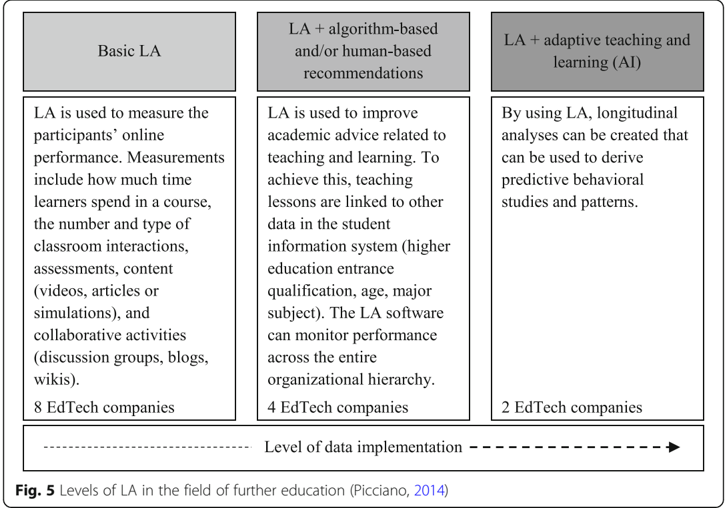
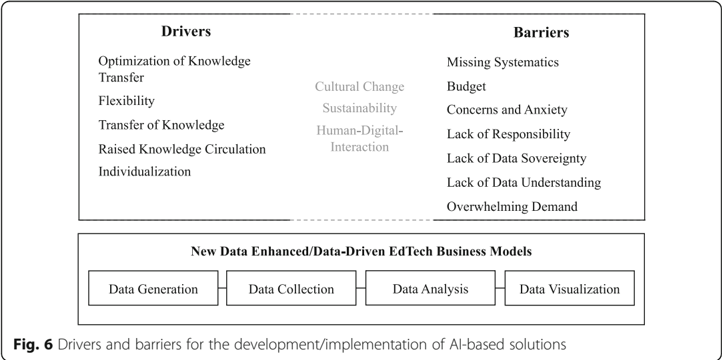
The ongoing datafication of our social reality has resulted in the emergence of new data-based business models. This development is also reflected in the education market. An increasing number of educational technology (EdTech) companies are entering the traditional education market with data-based teaching and learning solutions, and they are permanently transforming the market. However, despite the current market dynamics, there are hardly any business models that implement the possibilities of Learning Analytics (LA) and Artificial Intelligence (AI) to create adaptive teaching and learning paths. This paper focuses on EdTech companies and the drivers and barriers that currently affect data-based teaching and learning paths. The results show that LA especially are integrated into the current business models of EdTech companies on three levels, which are as follows: basic Learning Analytics, Learning Analytics and algorithmic or human-based recommendations, and Learning Analytics and adaptive teaching and learning (AI based). The discourse analysis reveals a diametrical relationship between the traditional educational ideal and the futuristic idea of education and knowledge transfer. While the desire for flexibility and individualization drives the debate on AI-based learning systems, a lack of data sovereignty, uncertainty and a lack of understanding of data are holding back the development and implementation of appropriate solutions at the same time.
Overview
The claims and statistics of this paper haven’t been checked yet.
Free: it reads the open-access text and checks the first 5 claims that cite a source we can check. Create a free account to check every claim.
Integrity signals
Registry
Cites
Statistics
Figures
Verification
Claims the paper makes
The claims and statistics of this paper haven’t been checked yet.
Free: it reads the open-access text and checks the first 5 claims that cite a source we can check. Create a free account to check every claim.
Claims other papers make about this one
Each is checked against this paper’s own text: does it say what the citing paper says it does?
In the citing paper
“The use of AI in differentiated learning enables personalized learning, which was not possible in the past when teaching large classes (Renz & Hilbig, 2020).”
From Teachers’ AI digital competencies and twenty-first century skills in the post-pandemic world (2023) · doi:10.1007/s11423-023-10203-6 · cites this paper as Renz & Hilbig, 2020
Self-check
Percentages, sums and reported differences re-computed from the paper’s own numbers.
The self-check needs the paper’s full text.
Citations
Cites
(1984) · Cited by 81,983
Case Study Research: Design and Methods
Chaiklin, H. (1991) · The Journal of Nervous and Mental Disease · doi:10.1097/00005053-199102000-00025 · Cited by 39,535
Artificial intelligence: a modern approach
(1995) · Choice Reviews Online · doi:10.5860/choice.33-1577 · Cited by 21,974
Artificial intelligence: A modern approach
Nilsson, N. J. (1996) · Artificial Intelligence · doi:10.1016/0004-3702(96)00007-0 · Cited by 10,583
Business models, business strategy and innovation
Teece, D. J. (2010) · Long Range Planning · doi:10.1016/j.lrp.2009.07.003 · Cited by 8,335
Zawacki-Richter, O., Marín, V. I., Bond, M., & Gouverneur, F. (2019) · International Journal of Educational Technology in Higher Education · doi:10.1186/s41239-019-0171-0 · Cited by 7,242 · cited 2×
“Although studies by Zawacki-Richter et al. (2019) and Viberg et al. (2018) have extensively analyzed existing research on LA and AIED, there is no clear differentiation regarding the degree to which LA and AI are implemented in teaching and learning processes.”
BackgroundThe Research Act: A Theoretical Introduction to Sociological Methods
Fox, W. S., & Denzin, N. K. (1979) · Contemporary Sociology · doi:10.2307/2065439 · Cited by 6,284
(2011) · Cited by 5,203
The business model: Recent developments and future research
Zott, C., Amit, R., & Massa, L. (2011) · Journal of Management · doi:10.1177/0149206311406265 · Cited by 4,790 · cited 1×
“The business model concept is becoming increasingly important in science and practice (Baden-Fuller & Mangematin, 2015; Ritter & Lettl, 2017; Zott, Amit, & Massa, 2011).”
BackgroundThe Research Act: A Theoretical Introduction to Sociological Methods
Krause, D., & Denzin, N. K. (1989) · Teaching Sociology · doi:10.2307/1318434 · Cited by 2,564
Exploring the impact of artificial intelligence on teaching and learning in higher education
Popenici, S. A. D., & Kerr, S. (2017) · Research and Practice in Technology Enhanced Learning · doi:10.1186/s41039-017-0062-8 · Cited by 2,019 · cited 5×
“The foundation for this is a corresponding hardware component that drives everything (Lorenz & Saslow, 2019; Popenici & Kerr, 2017).”
BackgroundInfluentialPenetrating the Fog: Analytics in Learning and Education.
Siemens, G., & Long, P. (2011) · Adelaide Research & Scholarship (AR&S) (University of Adelaide) · Cited by 1,752
(2016) · Open Research Online (The Open University) · Cited by 1,410
Learning analytics: drivers, developments and challenges
Ferguson, R. (2012) · International Journal of Technology Enhanced Learning · doi:10.1504/ijtel.2012.051816 · Cited by 1,354 · cited 2×
“In this context, Buckingham Shum and Ferguson (2012) suggest that the aim of LA should always be to improve the learning process rather than reflect the performance of the past.”
BackgroundConstructivism and computer‐mediated communication in distance education
Jonassen, D., Davidson, M., Collins, M., Campbell, J., & Haag, B. B. (1995) · American Journal of Distance Education · doi:10.1080/08923649509526885 · Cited by 1,117 · cited 1×
“Intelligent virtual reality can be used to create authentic virtual realities and playful learning environments or to have learners supervised by virtual tutors (Jonassen et al., 1995; Perez et al., 2017).”
BackgroundLearning Analytics: Ethical Issues and Dilemmas
Slade, S., & Prinsloo, P. (2013) · American Behavioral Scientist · doi:10.1177/0002764213479366 · Cited by 1,078 · cited 3×
“Thus, Macfadyen et al. (2014) note that education can no longer avoid the use of LA, while Slade and Prinsloo (2013) maintain, “ Ignoring information that might actively help to pursue an institution ’ s goals seems shortsighted to the extreme.”
BackgroundEducational Data Mining and Learning Analytics
Baker, R. S., & Inventado, P. S. (2014) · Learning Analytics · doi:10.1007/978-1-4614-3305-7_4 · Cited by 1,029
(2019) · Open Research Online (The Open University) · Cited by 1,004
The current landscape of learning analytics in higher education
Viberg, O., Hatakka, M., Bälter, O., & Mavroudi, A. (2018) · Computers in Human Behavior · doi:10.1016/j.chb.2018.07.027 · Cited by 766 · cited 9×
“Furthermore, the analysis of Viberg et al. (2018) shows that research in LA is still in its infancy.”
BackgroundInfluentialShum, S. B., & Ferguson, R. (2012) · OPUS - Open Publications of UTS Scholars (University of Technology Sydney) · Cited by 730
Bond, M., Marín, V. I., Dolch, C., Bedenlier, S., & Zawacki-Richter, O. (2018) · International Journal of Educational Technology in Higher Education · doi:10.1186/s41239-018-0130-1 · Cited by 701 · cited 1×
“In this context, authors like Bond et al., (2018) and Collins and Halverson (2009) have already stated that technology as the sole driver of innovation in education is not enough.”
BackgroundGašević, D., Dawson, S., Rogers, T., & Gasevic, D. (2016) · The Internet and Higher Education · doi:10.1016/j.iheduc.2015.10.002 · Cited by 683 · cited 1×
“In this vein, Gasevic et al., (2016) observe that instructional conditions, study subjects, and participants influence the success of studies using online learning systems and algorithm-based predictions.”
BackgroundEducational Data Mining and Learning Analytics
Baker, R., & Siemens, G. (2014) · The Cambridge Handbook of the Learning Sciences · doi:10.1017/cbo9781139519526.016 · Cited by 490 · cited 1×
“Although research in LA and its close field of AI has demonstrated high potential for understanding and optimizing learning behavior and processes (Baker & Siemens, 2014), few studies deal with the acceptance or barriers of LA and AI in the specific field of further education.”
BackgroundCapturing value from big data – a taxonomy of data-driven business models used by start-up firms
Hartmann, P. M., Zaki, M., Feldmann, N., & Neely, A. (2016) · International Journal of Operations & Production Management · doi:10.1108/ijopm-02-2014-0098 · Cited by 411 · cited 1×
“Following causality, data are also increasingly becoming a key resource in the field of education (Hartmann et al., 2016; Hilbig, Estiwah, & Hecht, 2018; Schüritz, See-bacher, & Dorner, 2017).”
MethodNunn, S., Avella, J. T., Kanai, T., & Kebritchi, M. (2016) · Online Learning · doi:10.24059/olj.v20i2.790 · Cited by 395 · cited 2×
“Avella et al., (2016) illustrate how the use of Big Data is beneficial for a wide range of higher education contexts.”
BackgroundEDUCAUSE Horizon Report: 2019 Higher Education Edition.
Alexander, B., Ashford-Rowe, K., Barajas-Murphy, N., Dobbin, G., Knott, J. L., McCormack, M., Pomerantz, J., Seilhamer, R. M., & Weber, N. L. (2019) · QUT ePrints (Queensland University of Technology) · Cited by 316
The wider implications of business-model research
Ritter, T., & Lettl, C. (2018) · Long Range Planning · doi:10.1016/j.lrp.2017.07.005 · Cited by 296 · cited 1×
“The business model concept is becoming increasingly important in science and practice (Baden-Fuller & Mangematin, 2015; Ritter & Lettl, 2017; Zott, Amit, & Massa, 2011).”
BackgroundA review on application of artificial intelligence in teaching and learning in educational contexts
Fahimirad, M., & Kotamjani, S. S. (2018) · International Journal of Learning and Development · doi:10.5296/ijld.v8i4.14057 · Cited by 240 · cited 1×
“At the next level, AI models human-like processes based on LA (Fahimirad & Kotamjani, 2018; Lorenz & Saslow, 2019).”
MethodWilliamson, B. (2018) · International Journal of Educational Technology in Higher Education · doi:10.1186/s41239-018-0094-1 · Cited by 225 · cited 1×
“The potential of AI-based learning and teaching, which requires the analysis of large amounts of data, promotes the development of new, refined smart learning tools, algorithm software, and predictive modeling (Mayer-Schonberger & Cukier, 2014; Williamson, 2018).”
MethodLearning Analytics in Higher Education
Lester, J., Klein, C., Rangwala, H., & Johri, A. (2017) · ASHE Higher Education Report · doi:10.1002/aehe.20121 · Cited by 216
The Future of MOOCs: Adaptive Learning or Business Model?
Daniel, S. J., Cano, E. V., & Cervera, M. G. (2015) · RUSC Universities and Knowledge Society Journal · doi:10.7238/rusc.v12i1.2475 · Cited by 214 · cited 1×
“In combination with digital tools, these promote data-driven business model innovations (Daniel, Vázquez Cano, & Gisbert, 2015; Prifti et al., 2017).”
MethodTsai, Y.-S., & Gasevic, D. (2017) · Proceedings of the Seventh International Learning Analytics & Knowledge Conference · doi:10.1145/3027385.3027400 · Cited by 211 · cited 3×
“Tsai and Gasevic (2017) identify six general challenges — shortages of leadership, equal engagement, pedagogy-based approaches, sufficient training, studies empirically validating the influence by LA, and LA-specific policies — related to the strategic planning and implementation of LA in…”
BackgroundInfluentialMacfadyen, L. P., Dawson, S., Pardo, A., & Gašević, D. (2014) · Research & Practice in Assessment · Cited by 207
Diskursforschung : eine Einführung für SozialwissenschaftlerInnen
Keller, R. (2004) · Cited by 193
Demystifying Learning Analytics in Personalised Learning
Maseleno, A., Sabani, N., Huda, M., Ahmad, R., Jasmi, K. A., & Basiron, B. B. (2018) · International Journal of Engineering & Technology · doi:10.14419/ijet.v7i3.9789 · Cited by 186 · cited 1×
“Maseleno et al. (2018) accentuate the potentials that LA can assume in the context of individualized learning.”
BackgroundWhere is the evidence?: a call to action for learning analytics
Ferguson, R., & Clow, D. (2017) · Proceedings of the Seventh International Learning Analytics & Knowledge Conference · doi:10.1145/3027385.3027396 · Cited by 162 · cited 3×
“With reference to Ferguson and Clow (2017), the evidence of LA can currently only be vaguely proved; in addition, the discourse operates mainly in the area of university education.”
BackgroundInfluentialInnovative Teaching and Learning
Kalyani, D., & Rajasekaran, K. (2018) · Journal of Applied and Advanced Research · doi:10.21839/jaar.2018.v3is1.162 · Cited by 142 · cited 1×
“Today, innovative teaching and learning methods can be combined with digital technology, such as virtual and augmented reality; cloud computing; and digital media, such as images, video, or audio (Kalyani & Rajasekaran, 2018; Trifilova, Bessant, & Alexander, 2016).”
BackgroundColvin, C., Rogers, T., Wade, A. T., Dawson, S., Gašević, D., Shum, S. B., Nelson, K. J., Alexander, S., Lockyer, L., Kennedy, G. E., et al. (2015) · Edinburgh Research Explorer (University of Edinburgh) · Cited by 127
Huda, M., Jasmi, K. A., Mustari, I., Basiron, B. B., & Sabani, N. (2017) · SAGE Open · doi:10.1177/2158244017697160 · Cited by 120 · cited 2×
“With this finding, our study again distinguishes itself and supports previous research by Huda et al. (2017) and Seyda et al. (2018).”
BackgroundResultCapturing Value from Data: Revenue Models for Data-Driven Services
Schüritz, R., Seebacher, S., & Dorner, R. (2017) · Hawaii International Conference on System Sciences (HICSS) · doi:10.24251/hicss.2017.648 · Cited by 108
Keller, R. (2010) · VS Verlag für Sozialwissenschaften eBooks · doi:10.1007/978-3-531-92085-6 · Cited by 104
Big Data and Learning Analytics in Blended Learning Environments: Benefits and Concerns
Picciano, A. G. (2014) · International Journal of Interactive Multimedia and Artificial Intelligence · doi:10.9781/ijimai.2014.275 · Cited by 97 · cited 1×
“Based on our empirical data and a study by Picciano (2014), we identified three different levels of so-called LA in the field of further education: Figure 5 shows that, with increasing data collection and implementation of data in the optimization of teaching and learning solutions, the level of LA…”
MethodIdentifying Productive Inquiry in Virtual Labs Using Sequence Mining
Perez, S., Massey-Allard, J., Butler, D., Ives, J., Bonn, D., Yee, N., & Roll, I. (2017) · Lecture Notes in Computer Science · doi:10.1007/978-3-319-61425-0_24 · Cited by 79 · cited 1×
“Intelligent virtual reality can be used to create authentic virtual realities and playful learning environments or to have learners supervised by virtual tutors (Jonassen et al., 1995; Perez et al., 2017).”
BackgroundWeller, M. (2018) · Open Research Online - ORO (The Open University) · Cited by 73
Renz, A., Krishnaraja, S., & Gronau, E. (2020) · International Journal of Learning Analytics and Artificial Intelligence for Education (iJAI) · doi:10.3991/ijai.v2i1.12675 · Cited by 66 · cited 10×
“Although the relevance of AIED is continuously increasing, Renz et al. (2020) note that there are only a few examples in the current discourse that have already implemented AIED successfully and sustainably in higher education.”
BackgroundMethodInfluentialSelf-citationA Social Work Education Outcome Measure: The Evaluation Self-Efficacy Scale–II
Holden, G., Barker, K., Kuppens, S., & Rosenberg, G. (2017) · Sage Open · doi:10.1177/2158244017728323 · Cited by 61
Intelligent Agent–Supported Online Education
Li, X. (2007) · Decision Sciences Journal of Innovative Education · doi:10.1111/j.1540-4609.2007.00143.x · Cited by 52 · cited 1×
“In particular, data-protection concerns arising from the handling of users ’ private information and ethical challenges in the use of data need to be further pursued (Li, 2007).”
BackgroundIfenthaler, D., & Yau, J. Y.-K. (2019) · International Journal of Learning Analytics and Artificial Intelligence for Education (iJAI) · doi:10.3991/ijai.v1i1.10978 · Cited by 49 · cited 3×
“A major reason for this is the missing evidence for the application and effect of the terms in education (Ifenthaler & Yau, 2019; Renz, Krishnaraja, & Gronau, 2020; Sclater, Peasgood, & Mullan, 2016).”
BackgroundPrinsloo, P., Slade, S., & Galpin, F. (2012) · International Conference on Learning Analytics and Knowledge (LAK) · doi:10.1145/2330601.2330635 · Cited by 41 · cited 1×
“Following Prinsloo, Slade, and Galpin ’ s (2012) argumentation, the identity of participants is to be viewed as a combination of permanent and dynamic attributes.”
BackgroundIntroduction: Business Models and Modelling Business Models
Baden‐Fuller, C. W. F., & Mangematin, V. (2015) · Emerald Group Publishing Limited eBooks · doi:10.1108/s0742-332220150000033013 · Cited by 40 · cited 1×
“The business model concept is becoming increasingly important in science and practice (Baden-Fuller & Mangematin, 2015; Ritter & Lettl, 2017; Zott, Amit, & Massa, 2011).”
BackgroundPrifti, L., Knigge, M., Löffler, A., Hecht, S., & Krcmar, H. (2017) · International Journal of Engineering Pedagogy (iJEP) · doi:10.3991/ijep.v7i3.7337 · Cited by 30 · cited 2×
“In combination with digital tools, these promote data-driven business model innovations (Daniel, Vázquez Cano, & Gisbert, 2015; Prifti et al., 2017).”
BackgroundMethodSelf, J. T. (2015) · International Journal of Artificial Intelligence in Education · doi:10.1007/s40593-015-0040-5 · Cited by 27 · cited 1×
“Motivated to understand the profound association between education and AI in terms of knowledge presentation, reasoning, and learning, the first research projects in the field of AIED were already initiated in the early 1970s (Self, 2016).”
BackgroundAnalyzing the relationships between learning analytics, educational data mining and AI for education
Labarthe, H., Luengo, V., & Bouchet, F. (2018) · HAL · Cited by 25
THE IMPACT OF THE VIRTUAL ASSISTANT (VA) ON LANGUAGE CLASSES
Istrate, A. M. (2019) · eLearning and Software for Education · doi:10.12753/2066-026x-19-040 · Cited by 22 · cited 1×
“AIED can support collaborative learning by organizing the online collaboration of a learning group, representing the teacher, or establishing teams and building a personal connection with each student (Istrate, 2019).”
BackgroundAbdelkafi, N., Hilbig, R., & Laudien, S. M. (2018) · International Journal of Technology Management · doi:10.1504/ijtm.2018.091716 · Cited by 21
Self-citationCompetition between platform ecosystems: a longitudinal study of MOOC platforms
Rothe, H., Täuscher, K., & Basole, R. C. (2018) · Research Explorer (The University of Manchester) · Cited by 10
Weiterbildung 4.0 - Digitalisierung als Treiber und Innovator betrieblicher Weiterbildung
Seyda, S., Meinhard, D. B., & Placke, B. (2018) · Econstor (Econstor) · doi:10.2373/1864-810x.18-01-06 · Cited by 9 · cited 2×
“With this finding, our study again distinguishes itself and supports previous research by Huda et al. (2017) and Seyda et al. (2018).”
ResultLaudien, S. M., Abdelkafi, N., & Hilbig, R. (2018) · International Journal of Technology Management · doi:10.1504/ijtm.2018.10012939 · Cited by 8 · cited 3×
“digitization (Abdelkafi et al., 2018; Hilbig, 2019). With our research, we contribute an important impulse for a better understanding of market dynamics in the EdTech sector and mapping the current status of the implementation and application of LA- and AIbased teaching and learning systems. With the help of digital p…”
BackgroundMethodSelf-citationInternationale Geschäftsmodelle von Berufsbildungsdienstleistern
Hilbig, R. (2018) · Springer eBooks · doi:10.1007/978-3-658-24525-2 · Cited by 7 · cited 2×
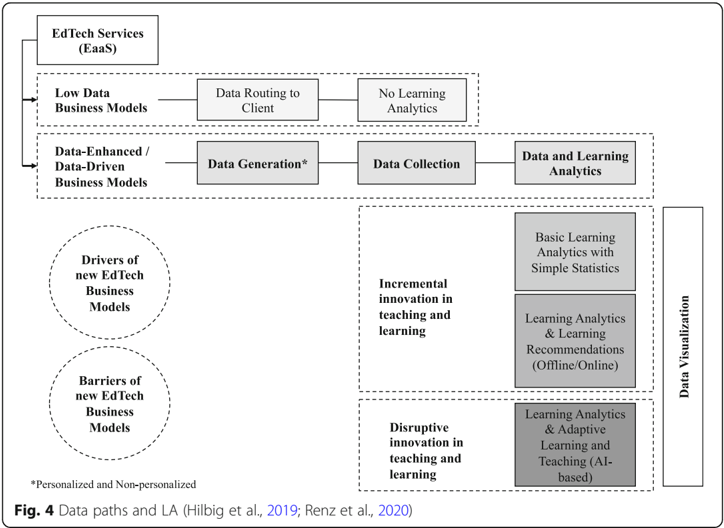
“4 Data paths and LA (Hilbig et al., 2019; Renz et al., 2020) Renz and Hilbig International Journal of Educational Technology in Higher Education (2020) 17:14 determined by the EdTech companies having access to the generated data of the users ’ teaching and learning behavior (data generation).”
BackgroundMethodSelf-citationLorenz, P., & Saslow, K. (2020) · SSRN Electronic Journal · doi:10.2139/ssrn.3589393 · Cited by 5 · cited 3×
“In this regard, Lorenz and Saslow (2019) state, “ AI traditionally refers to the scientific pursuit of teaching machines to think like humans, or more simply, the automation of cognitive processes.”
BackgroundMethodLearning with Big Data: The Future of Education
Mayer-Schönberger, V., & Cukier, K. N. (2014) · Stanford Social Innovation Review · doi:10.48558/8j4r-4f86 · Cited by 3
Q&A. How Can You Teach Innovation and Entrepreneurship?
Александровна, Т. А., Bessant, J., & Alexander, A. (2016) · Technology Innovation Management Review · doi:10.22215/timreview/1027 · Cited by 1 · cited 1×
“Today, innovative teaching and learning methods can be combined with digital technology, such as virtual and augmented reality; cloud computing; and digital media, such as images, video, or audio (Kalyani & Rajasekaran, 2018; Trifilova, Bessant, & Alexander, 2016).”
BackgroundBig Data - Ungehobene Schätze oder digitaler Albtraum
Eckert, K.-P., Henckel, L., & Hoepner, P. (2022) · Fraunhofer-Publica (Fraunhofer-Gesellschaft) · doi:10.24406/publica-fhg-296802 · Cited by 1
Research works printed but not linked: 17
- Bitkom. (2015). Big data und Geschäftsmodell-Innovationen in der Praxis: 40+ Beispiele, Berlin. https://www.bitkom.org/ Bitkom/Publikationen/Big-Data-und-Geschaeftsmodell-Innovationen-in-der-Praxis-40-Beispiele.html. Accessed 10 Oct 2019.
- Buschbacher, J. (2019). EdTech -Zukunft der Bildung: Wie die Bildung der Zukunft durch neue Technologien unterstützt und verändert wird und welche Kompetenzen Bildungsexperten unbedingt aufbauen sollten. Ludwigsburg: Eigenverlag.
- Collins, A., & Halverson, R. (2009). Rethinking education in the age of technology: The digital revolution and the schools. New York: Teachers College Press.
- Deutscher Bildungserver. (2019). Gesamtüberblick zum deutschen Bildungssystem, URL: https://www.bildungsserver.de/ Gesamtueberblick-zum-deutschen-Bildungssystem-506-de.html. Accessed 01 Aug 2019.
- Dräger, J., & Müller-Eiselt, R. (2017). Die digitale Bildungsrevolution: Der radikale Wandel des Lernens und wie wir ihn gestalten können. München: DVA Verlag.
- EdTechXGlobal (2016). EdTechXGlobal report 2016-Global EdTech industry report: a map for the future of education and work. http://ecosystem.edtechxeurope.com/2016-edtech-report. Accessed 04 Dec 2019.
- Gartner (2012). What is big data? Gartner IT glossary-big data. https://www.gartner.com/it-glossary/big-data/. Accessed 11 May 2018.
- Hilbig, R., Estiwah, B., & Hecht, S. (2018). Berlin start-ups-the rise of data-driven business models. In ISPIM Connects Fukuoka - Building on Innovation Tradition, 2-5 December, (pp. 1-19). Fukuoka.
- Hilbig, R., Renz, A., & Schildhauer, T. (2019). Data analytics: The future of innovative teaching and learning. In ISPIM Conference Proceedings, The International Society for Professional Innovation Management (ISPIM), (pp. 1-16). Florence.
- voll-ständig überarbeitete Auflage. Münster: Unrast (Edition DISS, Bd. 3).
- Loop, J. (2016). The empowered learner. White paper. https://www.looop.co/wp-content/uploads/2015/09/The-Empowered- Learner-White-Paper.pdf. Accessed 31 Jul 2019.
- Mayring, P. (2010). Qualitative Inhaltsanalyse. Grundlagen und Techniken. 11. aktualisierte und überarbeitete Version. Weinheim und Basel: Beltz Verlag.
- Newland, B., Martin, L., & Ringan, N. (2015). Learning analytics, in UK HE 2015. A HeLF Survey Report, https://drive.google. com/file/%20d/0Bz7E74T5Am22UEM1c0FxRjVpMzA/view. Accessed 31 July 2019.
- Rittelmeyer, C. (2017). Digitale Bildung -ein Widerspruch: Erziehungswissenschaftliche Analysen der schulbezogenen Debatten (Pädagogik: Perspektiven und Theorien, Band 29). Oberhausen: Athena Verlag.
- Sclater, N., Peasgood, A., & Mullan, J. (2016). Learning analytics in higher education: A review of UK and international practice. Bristol: JISC.
- Startup Genome. (2018). Global Startup Ecosystem Report 2018-Succeeding in the New Era of Technology. https:// startupgenome.com/all-report-thank-you/?file=2018. Accessed 25 Mar 2019.
- Startup Genome. (2019). Global Startup Ecosystem Report 2019-Succeeding in the New Era of Technology. https:// startupgenome.com/reports/global-startup-ecosystem-report-2019. Accessed 22 Nov 2019.
Cited by
A Review of Artificial Intelligence (AI) in Education from 2010 to 2020
Zhai, X., Chu, X., Chai, C. S., Jong, M. S. Y., Istenic, A., Spector, M., Liu, J.-B., Yuan, J., & Li, Y. (2021) · Complexity · doi:10.1155/2021/8812542 · Cited by 1,364
“…research development in recent twenty years Ulum [ [106] Constructing guidelines to apply data mining techniques to predict student success Renz and Hilbig [107] Analyzing the drivers and barriers that currently affect data-based teaching and learning paths from the perspective of EdTech companies”
MethodChiu, T. K. F., Xia, Q., Zhou, X., Chai, C. S., & Cheng, M. (2023) · Computers and Education: Artificial Intelligence · doi:10.1016/j.caeai.2022.100118 · Cited by 1,181
The promises and challenges of artificial intelligence for teachers: A systematic review of research
Celik, I., Dindar, M., Muukkonen, H., & Järvelä, S. (2022) · TechTrends · doi:10.1007/s11528-022-00715-y · Cited by 984
“The availability of AI technologies and of educational software companies to create AI-based applications is increasing rapidly all over the world (Renz & Hilbig, 2020).”
BackgroundTeachers’ AI digital competencies and twenty-first century skills in the post-pandemic world
(2023) · doi:10.1007/s11423-023-10203-6 · Cited by 734
Challenges and Future Directions of Big Data and Artificial Intelligence in Education
Luan, H., Geczy, P., Lai, H., Gobert, J., Yang, S. J. H., Ogata, H., Baltes, J., Guerra, R., Li, P., & Tsai, C.-C. (2020) · Frontiers in Psychology · doi:10.3389/fpsyg.2020.580820 · Cited by 667
Metadata
- Authors
- Renz, A., & Hilbig, R.
- Affiliations
- Weizenbaum Institute (DE)
- Corresponding author
- Renz, André
- ORCID
- Renz, André
- Venue
- International Journal of Educational Technology in Higher Education
- Published
- 2020-04-06
- Volume
- 17
- Issue
- 1
- ISSN
- 2365-9440 (ISSN-L)
- OpenAlex
- W3028852563
- Cited by
- 218
- References
- 67
- Citations by year
- 2026: 24 · 2025: 46 · 2024: 58 · 2023: 24 · 2022: 39 · 2021: 21 · 2020: 6
- FWCI
- 20.67
- Type
- journal article
- Language
- en
- Update notices
- correction (2021-02-24)
- Open access
- diamond
- doi.org
- Licence
- cc-by
- creativecommons.org/licenses/by/4.0 (tdm)
- creativecommons.org/licenses/by/4.0 (vor)
- Locations
- International Journal of Educational Technology in Higher Education (publishedVersion, cc-by)
- DOAJ (DOAJ: Directory of Open Access Journals) (submittedVersion, cc-by-sa)
- Funders
- Bundesministerium für Bildung und Forschung (16DII111)
- Topics
- Physical Sciences › Computer Science › Computer Science Applications › Online Learning and Analytics
- Social Sciences › Education › Artificial Intelligence in Education
- Social Sciences › Education › Digital Education and Society
- Keywords
- artificial intelligence in education, educational technology companies, business models, learning analytics, adaptive learning, further education, drivers and barriers, data sovereignty, algorithmic recommendation, personalized learning, datafication of education
About these checks
Registry, retraction, Cites and statistics results are computed, not judged, with one exception: a printed reference that no index lists is read once by a model before it counts as a citation error. Claims are extracted by a model and kept only when their quote appears verbatim in the text; each cited source is then checked, with a model’s help, for whether it says what the claim relies on. Those verdicts can be wrong — read the claim’s quote and the cited source before relying on one.
Statistics and arithmetic are recomputed, not judged.
Confidence bands are shown only for fields calibrated on our annotated test set. None is calibrated yet, so no band is shown.
What counts as a claim ›How we measure confidence ›How we check this ›
Are you an author, or do you see a problem with this page? Request a review
Data sources
Bibliographic data: Semantic Scholar, OpenAlex, Crossref.
Contains information from the Semantic Scholar Academic Graph Datasets, made available under the ODC Attribution License (ODC-BY 1.0).
Semantic Scholar’s data is described in: Kinney, R., et al. (2023). The Semantic Scholar Open Data Platform. arXiv:2301.10140.
