

Depression and anxiety among patients with Parkinson’s disease: frequency, risk factors, and impact on quality of life
Open accessThe DOI matches its Crossref record; 71 of the 71 references it cites were found in a registry or an index.
Abstract
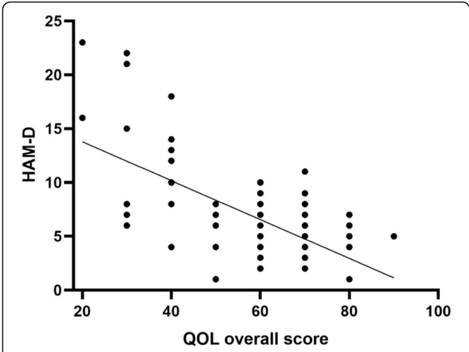
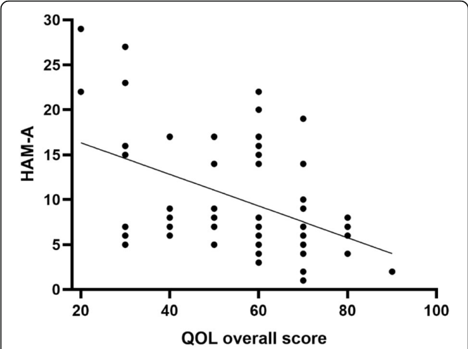
Abstract Background Depression and anxiety are non-motor symptoms of Parkinson’s disease (PD) that are often overlooked and underrated. This study aimed to highlight the frequency and risk factors of depression and anxiety among subjects with PD. Methods Sixty-four patients with PD who were diagnosed according to United Kingdom Parkinson’s Disease Society (UKPDS) Brain Bank Criteria and 50 sex- and age-matched healthy control subjects are evaluated for depression and anxiety. PD severity and staging were assessed using Unified Parkinson’s Disease Rating Scale (UPDRS) and Hoehn and Yahr scale. Depression and anxiety were diagnosed using DSM-IV TR criteria and scored using Hamilton Depression and Hamilton Anxiety Rating Scales (HAM-D and HAM-A). The World Health Organization Quality of Life (WHOQOL)-BREF was used to assess impact of depression and anxiety on quality of life. Results 31.25% of patients with PD had depression while 40.6% of patients had anxiety disorder. Depression was higher in females and patients with history of depression and low socioeconomic status (SES). Anxiety was common in young patients and those who had history of anxiety. Overlap between depression and anxiety was recorded in 23.4%. Total UPDRS and Hoehn and Yahr scale accounted for 33.4% of variance for depression. Total UPDRS and earlier age of onset accounted for 39% of variance for anxiety. Advanced disease stage and severity were independent predictors for depression while disease severity and younger age of onset were the main predictors for anxiety. Depression and anxiety have a negative impact on the overall quality of life of PD patients especially on physical and psychosocial domains. Conclusion Depression and anxiety are relatively common in PD. Female gender, low SES, and history of depression were the main risk factors for developing depression. Young age and history of anxiety were risk factors for anxiety. Both had negative impact on quality of life.
Overview
The claims and statistics of this paper haven’t been checked yet.
Free: it reads the open-access text and checks the first 5 claims that cite a source we can check. Create a free account to check every claim.
Integrity signals
Registry
Cites
Statistics
Figures
Verification
Claims the paper makes
The claims and statistics of this paper haven’t been checked yet.
Free: it reads the open-access text and checks the first 5 claims that cite a source we can check. Create a free account to check every claim.
Self-check
Percentages, sums and reported differences re-computed from the paper’s own numbers.
The self-check needs the paper’s full text.
Citations
Cites
1 retracted
Hallit, S. R., Haddad, C., Hallit, R. R., Akel, M., Obeïd, S., Haddad, G., Soufia, M., Khansa, W., Khoury, R., Kheir, N., et al. (2019) · Clinical Epidemiology and Global Health · doi:10.1016/j.cegh.2019.02.002 · Cited by 33
RetractedFolstein, M. F., Folstein, S. E., & McHugh, P. R. (1975) · Journal of Psychiatric Research · doi:10.1016/0022-3956(75)90026-6 · Cited by 88,282
Parkinsonism: onset, progression, and mortality
Hoehn, M. M., & Yahr, M. D. (1967) · Neurology · doi:10.1212/wnl.17.5.427 · Cited by 12,107
Hughes, A. J., Daniel, S. E., Kilford, L., & Lees, A. J. (1992) · Journal of Neurology, Neurosurgery & Psychiatry · doi:10.1136/jnnp.55.3.181 · Cited by 10,378 · cited 2×
“Inclusion criteria included patients diagnosed with PD according to the United Kingdom Parkinson’s Disease Society (UKPDS) Brain Bank Criteria [11, 12], non-demented, willing to participate in the study, and able to give informed consent.”
MethodMDS clinical diagnostic criteria for Parkinson’s disease
Postuma, R. B., Berg, D., Stern, M., Poewe, W., Olanow, C. W., Oertel, W., Obeso, J., Marek, K., Litvan, I., Lang, A. E., et al. (2015) · Movement Disorders · doi:10.1002/mds.26424 · Cited by 7,653
Recent Developments in Parkinson's Disease
Hurtig, H. I. (1987) · Neurology · doi:10.1212/wnl.37.5.893 · Cited by 1,920
A systematic review of prevalence studies of dementia in Parkinson's disease
Aarsland, D., Zaccai, J., & Brayne, C. (2005) · Movement Disorders · doi:10.1002/mds.20527 · Cited by 1,689
A systematic review of prevalence studies of depression in Parkinson's disease
Reijnders, J. S. A. M., Ehrt, U., Weber, W. E. J., Aarsland, D., & Leentjens, A. F. G. (2008) · Movement Disorders · doi:10.1002/mds.21803 · Cited by 1,239
Sydney multicenter study of Parkinson's disease: Non‐L‐dopa–responsive problems dominate at 15 years
Hely, M. A., Morris, J. G. L., Reid, W. G. J., & Trafficante, R. (2005) · Movement Disorders · doi:10.1002/mds.20324 · Cited by 1,050
Depression in Parkinson disease—epidemiology, mechanisms and management
Aarsland, D., Påhlhagen, S., Ballard, C. G., Ehrt, U., & Svenningsson, P. (2012) · Nature Reviews Neurology · doi:10.1038/nrneurol.2011.189 · Cited by 593
Research works printed but not linked: 4
- El-Tawab A. Socioeconomic status scale, faculty of education, department of psychology. Assiut University; 2004.
- First MB, Spitzer RL, Gibbon M, Williams JBW, Benjamin LS. Structured clinical interview for DSM-IV-clinician version (SCID-CV) (user's guide interview). Washington, DC: American Psychiatric Press; 1997.
- El Missiry A, Sorour A, Sadek A, Fahy T, Abdel Mawgoud M, Asaad T. Homicide and psychiatric illness: an Egyptian study [MD thesis]. Cairo: Faculty of Medicine, Ain Shams University; 2004.
- Jeffrey S. Psychiatric symptoms have greater impact in early vs late PD. Medscape medical news; 2007.
Cited by
Zhou, L., Xiong, J., Chai, Y.-Q., Huang, L., Tang, Z.-Y., Zhang, X., Liu, B., & Zhang, J.-T. (2022) · Frontiers in Psychiatry · doi:10.3389/fpsyt.2022.933704 · Cited by 133
Exploring public perceptions and awareness of Parkinson’s disease: A scoping review
Crooks, S., Carter, G., Wilson, C. B., Wynne, L., Stark, P., Doumas, M., Rodger, M. W. M., O’Shea, E., & Mitchell, G. (2023) · PLoS ONE · doi:10.1371/journal.pone.0291357 · Cited by 37
Lai, T. T., Gericke, B., Feja, M., Conoscenti, M. A., Zelikowsky, M., & Richter, F. (2023) · npj Parkinson's Disease · doi:10.1038/s41531-023-00547-4 · Cited by 36
Bareeqa, S. B., Samar, S. S., Kamal, S., Masood, Y., Allahyar, Ahmed, S. I., & Hayat, G. R. (2022) · Neurodegenerative Disease Management · doi:10.2217/nmt-2022-0001 · Cited by 29
Alpha Synuclein Toxicity and Non-Motor Parkinson’s
Mazzotta, G. M., & Conte, C. (2024) · Cells · doi:10.3390/cells13151265 · Cited by 22
Metadata
- Authors
- Khedr, E. M., Abdelrahman, A. A., Elserogy, Y., Zaki, A. F., & Gamea, A.
- Affiliations
- Assiut University Hospitals (EG)
- South Valley University (EG)
- Corresponding author
- Khedr, Eman M.
- Venue
- The Egyptian Journal of Neurology, Psychiatry and Neurosurgery
- Published
- 2020-12
- Volume
- 56
- Issue
- 1
- ISSN
- 1110-1083 (ISSN-L)
- 1687-8329
- OpenAlex
- W3113290029
- Cited by
- 61
- References
- 71
- Citations by year
- 2026: 5 · 2025: 12 · 2024: 21 · 2023: 11 · 2022: 10 · 2021: 2
- FWCI
- 2.49
- Type
- journal article
- Language
- en
- Open access
- diamond
- doi.org
- Licence
- cc-by
- creativecommons.org/licenses/by/4.0 (tdm)
- creativecommons.org/licenses/by/4.0 (vor, 8 d)
- Locations
- The Egyptian Journal of Neurology Psychiatry and Neurosurgery (publishedVersion, cc-by)
- DOAJ (DOAJ: Directory of Open Access Journals) (submittedVersion, cc-by-sa)
- Greater South Information System
- Topics
- Health Sciences › Medicine › Clinical Neurology › Parkinson's Disease Mechanisms and Treatments
- Health Sciences › Medicine › Clinical Neurology › Deep Brain Stimulation and Movement Disorders
- Health Sciences › Medicine › Psychiatry and Mental health › Dementia and Cognitive Impairment Research
- Keywords
- Parkinson's disease, depression, anxiety, non-motor symptoms, quality of life, risk factors, disease severity, age of onset, socioeconomic status, sex differences, comorbidities
About these checks
Registry, retraction, Cites and statistics results are computed, not judged, with one exception: a printed reference that no index lists is read once by a model before it counts as a citation error. Claims are extracted by a model and kept only when their quote appears verbatim in the text; each cited source is then checked, with a model’s help, for whether it says what the claim relies on. Those verdicts can be wrong — read the claim’s quote and the cited source before relying on one.
Statistics and arithmetic are recomputed, not judged.
Confidence bands are shown only for fields calibrated on our annotated test set. None is calibrated yet, so no band is shown.
What counts as a claim ›How we measure confidence ›How we check this ›
Are you an author, or do you see a problem with this page? Request a review
How to cite
Cite CoChat for the checks on this page, and the paper for its own findings.
- This page
- CoChat. (2026). Citation check: Depression and anxiety among patients with Parkinson’s disease: frequency, risk factors, and impact on quality of life. https://app.cochat.ai/papers/10.1186/s41983-020-00253-5
- The paper
- Khedr, E. M., Abdelrahman, A. A., Elserogy, Y., Zaki, A. F., & Gamea, A. (2020). Depression and anxiety among patients with Parkinson’s disease: frequency, risk factors, and impact on quality of life. The Egyptian Journal of Neurology, Psychiatry and Neurosurgery. https://doi.org/10.1186/s41983-020-00253-5
Data sources
Bibliographic data: Semantic Scholar, OpenAlex, Crossref.
Contains information from the Semantic Scholar Academic Graph Datasets, made available under the ODC Attribution License (ODC-BY 1.0).
Semantic Scholar’s data is described in: Kinney, R., et al. (2023). The Semantic Scholar Open Data Platform. arXiv:2301.10140.
