

Depression in adolescence: a review
Open accessThe DOI matches its Crossref record; 92 of the 92 references it cites were found in a registry or an index.
Abstract
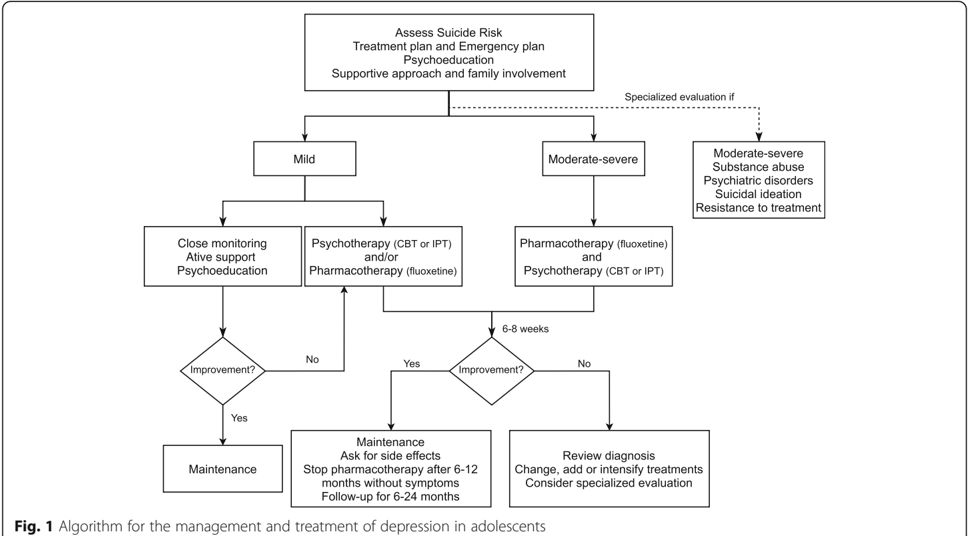
Abstract Background Depression is a common mental health disease, especially in mid to late adolescence that, due to its particularities, is a challenge and requires an effective diagnosis. Primary care providers are often the first line of contact for adolescents, being crucial in identifying and managing this pathology. Besides, several entities also recommend screening for depression on this period. Thus, the main purpose of this article is to review the scientific data regarding screening, diagnosis and management of depression in adolescence, mainly on primary care settings. Main body Comprehension of the pathogenesis of depression in adolescents is a challenging task, with both environmental and genetic factors being associated to its development. Although there are some screening tests and diagnostic criteria, its clinical manifestations are wide, making its diagnosis a huge challenge. Besides, it can be mistakenly diagnosed with other psychiatric disorders, making necessary to roll-out several differential diagnoses. Treatment options can include psychotherapy (cognitive behavioural therapy and interpersonal therapy) and/or pharmacotherapy (mainly fluoxetine), depending on severity, associated risk factors and available resources. In any case, treatment must include psychoeducation, supportive approach and family involvement. Preventive programs play an important role not only in reducing the prevalence of this condition but also in improving the health of populations. Conclusion Depression in adolescence is a relevant condition to the medical community, due to its uncertain clinical course and underdiagnosis worldwide. General practitioners can provide early identification, treatment initiation and referral to mental health specialists when necessary.
Overview
The claims and statistics of this paper haven’t been checked yet.
Free: it reads the open-access text and checks the first 5 claims that cite a source we can check. Create a free account to check every claim.
Integrity signals
Registry
Cites
Statistics
Figures
Verification
Claims the paper makes
The claims and statistics of this paper haven’t been checked yet.
Free: it reads the open-access text and checks the first 5 claims that cite a source we can check. Create a free account to check every claim.
Claims other papers make about this one
Each is checked against this paper’s own text: does it say what the citing paper says it does?
The cited source says what the claim attributes to it.
In the citing paper
“In medical research, depression is often conceptualized as a clinical disorder with a specific set of symptoms that can be identified and treated (4, 5).”
From Anti-stigmatizing: a collaborative autoethnography on recovery from depression (2024) · cites this paper as [4]
Self-check
Percentages, sums and reported differences re-computed from the paper’s own numbers.
The self-check needs the paper’s full text.
Citations
Cites
Diagnostic and Statistical Manual of Mental Disorders
American Psychiatric Association (2013) · doi:10.1176/appi.books.9780890425596 · Cited by 116,369
A psychobiological model of temperament and character
Cloninger, C. R. (1993) · Archives of General Psychiatry · doi:10.1001/archpsyc.1993.01820240059008 · Cited by 5,458 · cited 1×
“According to Cloninger, temperament is responsible for automatic and emotional responses to environmental stimuli and encompasses four dimensions: novelty seeking, exploratory activity, harm avoidance, reward dependence and persistence [22].”
BackgroundThapar, A., Collishaw, S., Pine, D. S., & Thapar, A. K. (2012) · The Lancet · doi:10.1016/s0140-6736(11)60871-4 · Cited by 2,365
(2009) · Cited by 2,013
The social brain in adolescence
Blakemore, S.-J. (2008) · Nature Reviews Neuroscience · doi:10.1038/nrn2353 · Cited by 1,896
Mental Health Surveillance Among Children — United States, 2013–2019
Bitsko, R. H., Claussen, A. H., Lichstein, J., Black, L. I., Jones, S. E., Danielson, M. L., Hoenig, J. M., Davis Jack, S. P., Brody, D. J., Gyawali, S., et al. (2022) · MMWR Supplements · doi:10.15585/mmwr.su7102a1 · Cited by 1,723
Risch, N., Herrell, R., Lehner, T., Liang, K.-Y., Eaves, L., Hoh, J., Griem, A., Kovacs, M., Ott, J., & Merikangas, K. R. (2009) · JAMA · doi:10.1001/jama.2009.878 · Cited by 1,655 · cited 1×
“However, such findings seem to vary not only by genotype but also by age, sex, and severity of symptoms, and are also reliant on good quality measures of adversity and depression [18, 20].”
BackgroundSeedat, S., Scott, K. M., Angermeyer, M. C., Berglund, P., Bromet, E. J., Brugha, T. S., Demyttenaere, K., de Girolamo, G., Haro, J. M., Jin, R., et al. (2009) · Archives of General Psychiatry · doi:10.1001/archgenpsychiatry.2009.36 · Cited by 1,518
Mental Health of Children and Young People in Great Britain, 2004: (557702010-001)
Green, H., McGinnity, A., Meltzer, H., Ford, T., & Goodman, R. (2005) · PsycEXTRA Dataset · doi:10.1037/e557702010-001 · Cited by 1,216
Research works printed but not linked: 1
- Roberts C, Ballantyne F, Van Der Klift P (2003) Aussie optimism. Curtin University of Technology, Perth, Australia, Social life skills. Teacher resource
Cited by
The Mediterranean Diet and the Western Diet in Adolescent Depression-Current Reports
Zielińska, M., Łuszczki, E., Michońska, I., & Dereń, K. (2022) · Nutrients · doi:10.3390/nu14204390 · Cited by 84
“5% of disability adjusted life years (DALY) in young people [11].”
BackgroundBai, S., Xie, J., Bai, H., Tian, T., Zou, T., & Chen, J.-J. (2021) · Journal of Inflammation Research · doi:10.2147/jir.s324922 · Cited by 51
Maftei, A., Merlici, I.-A., & Dănilă, O. (2023) · Frontiers in Public Health · doi:10.3389/fpubh.2022.1062688 · Cited by 49
Depression, Anxiety, and Suicide Among Adolescents: Sex Differences and Future Perspectives
Toro, G. V. R., Arias, P., de la Torre‐Luque, A., Singer, J. B., & Lagunas, N. (2025) · Journal of Clinical Medicine · doi:10.3390/jcm14103446 · Cited by 51
Calandri, E., Graziano, F., Begotti, T., Cattelino, E., Gattino, S., Rollero, C., & Fedi, A. (2021) · Frontiers in Psychology · doi:10.3389/fpsyg.2021.643088 · Cited by 31
The Management of Anxiety and Depression in Pediatrics
Pettitt, R., Brown, E. A., Delashmitt, J. C., & Pizzo, M. N. (2022) · Cureus · doi:10.7759/cureus.30231 · Cited by 39
“This therapeutic approach has been suggested to be particularly beneficial when there is a well-established relational component to the underlying cause of the patient’s depressive symptoms [29].”
BackgroundInfluentialGraziano, F., Mastrokoukou, S., Cattelino, E., Rollè, L., & Calandri, E. (2024) · Behavioral Sciences · doi:10.3390/bs14110977 · Cited by 28
Tiwari, S., Qi, L., Wong, J. W., & Han, Z. (2022) · Brain and Behavior · doi:10.1002/brb3.2581 · Cited by 24
“These heterogeneous variables are interdependent in a complexmanner, and any disruption of this complex mechanism may give rise to depression (Athira et al., 2020; Beirão et al., 2020; McEwen & Akil, 2020).”
BackgroundOlisaeloka, L., Udokanma, E. E., & Ashraf, A. (2024) · International Journal of Mental Health Systems · doi:10.1186/s13033-024-00642-w · Cited by 23
“The prevalence of depression is low in children (1%), then rises substantially during adolescence, especially among females [13].”
BackgroundBansal, K., Singh, V., Mishra, S., & Bajpai, M. (2023) · Current Pharmaceutical Biotechnology · doi:10.2174/0113892010265344230919170611 · Cited by 22
Ratnam, K. K. Y., Farid, N. D. N., Yakub, N. A., & Dahlui, M. (2022) · International Journal of Environmental Research and Public Health · doi:10.3390/ijerph19159324 · Cited by 17
“Although the study has not shown the association of the number of family members with depression, anxiety and self-esteem, family discord was identified to be one of the contributing factors for the occurrence of depression and anxiety among adolescents [19].”
BackgroundLawal, R. O., Akinsulore, A., Oginni, O. A., Aloba, O. O., Mosaku, S., & Akanmu, A. S. (2023) · BMC Psychiatry · doi:10.1186/s12888-023-04912-8 · Cited by 17
“Five of the items [2, 5, 6, 8, 9] are negatively worded and reversely scored while the other five are positively worded [13].”
BackgroundGilbert, W., Eltanoukhi, R., Morin, A. J. S., & Salmela‐Aro, K. (2024) · Journal of Youth and Adolescence · doi:10.1007/s10964-024-02045-z · Cited by 21
“This is congruent with the sharp increase in depressive symptoms observed from early to mid-adolescence (Beirão et al., 2020).”
Dhara, S., Thakur, J., Pandey, N., Mozumdar, A., & Roy, S. (2024) · PLoS ONE · doi:10.1371/journal.pone.0306071 · Cited by 17
Pangemanan, L., Irwanto, I., & Maramis, M. M. (2023) · Veterinary World · doi:10.14202/vetworld.2023.595-600 · Cited by 15
“An animal depression model is needed to investigate the symptomatology, pathophysiology, and treatment of depression [5, 6].”
BackgroundJayawardana, D., Gannon, B., Doust, J. A., & Mishra, G. D. (2022) · Health Economics · doi:10.1002/hec.4641 · Cited by 12
Mitiku, K. W., Tegegne, E., Amsalu, M., Habtegiorgis, S. D., & Melaku, B. (2023) · Clinical Child Psychology and Psychiatry · doi:10.1177/13591045231209078 · Cited by 11
“However, a review in the Middle East and USA revealed that depression in teens is a dif fi cult challenge among adolescent girls because it is caused by both environmental and hereditary factors (Cree et al., 2018; Beirão et al., 2020).”
BackgroundDepression in adolescents on treatment for rifampicin-susceptible TB in Lima, Peru
Sanchez-Guzman, V., Tanzer, J. R., Sinche, B. R., Santacruz, J., Contreras, C., Desrosiers, A., Lecca, L. W., & Chiang, S. S. (2025) · IJTLD OPEN · doi:10.5588/ijtldopen.25.0305 · Cited by 10
Trager, B. M., Koning, I. M., Rainosek, L. M., Geurts, S. M., van den Eijnden, R. J. J. M., & Vossen, H. G. M. (2025) · Journal of Adolescent Health · doi:10.1016/j.jadohealth.2025.05.025 · Cited by 10
“Also, although we used a 12-month interval between waves, we know that the development of anxiety/depression may take years [37].”
Adolescent depression in school: risk factors and consequences on school functioning
Fassl, F., Muth, J., Hofleitner, M., & Lüftenegger, M. (2025) · Zeitschrift für Bildungsforschung · doi:10.1007/s35834-024-00458-1 · Cited by 13
“Despite the importance of understanding the pathogenesis of adolescent depression, it is difficult to fully comprehend the mechanisms underlying the disorder due to the variety of contributing factors and the range of clinical presentations (Beirão et al., 2020; Thapar et al., 2012).”
Ge, W., Wang, H., Chen, J., Yang, X., & Wang, Y. (2024) · Current Psychology · doi:10.1007/s12144-024-06489-1 · Cited by 9
“Therefore, it is important to explore the causes of lifetime depressive symptoms, and provide effective guid - ance to reduce the subsequent risk of adolescent suicide as well as social and educational impairments due to depression (Beirão et al., 2020).”
Trombeta, G. (2022) · Psychological Studies · doi:10.1007/s12646-022-00664-9 · Cited by 9
“…variables reminds us that a central issue of adolescents’ emotional responses and behavioural resources is that they are not isolated events, but rather are a part of a complex context in which a variety of variables play different roles in shaping adolescent functioning (Beirão et al., 2020).”
BackgroundHo, Y., Chiou, H., Molloy, L., Lin, K., Chang, P., & Chang, H. (2023) · Journal of Adolescence · doi:10.1002/jad.12161 · Cited by 7
Evaluation and treatment of sleep disorders in adolescents with depression; a scoping review
Mensah, S. O., Duan, X., Ling, Y., Xu, F., You, Y., Li, L., Wei, Y., & Chen, X. (2025) · BMC Psychiatry · doi:10.1186/s12888-025-07652-z · Cited by 6
“During this stage, the incidence of mental health disorders rises sharply, with depressive disorders being among the most common psychiatric conditions in adolescents globally [1].”
Palacios, D., Caldaroni, S., Berger, C., Tata, D. D., & Barrera, D. (2024) · Behavioral Sciences · doi:10.3390/bs14111110 · Cited by 6
“Adolescent depression is relatively high in mid-to-late adolescence [3], with prevalences ranging from 4%–5% [4] to 34% of adolescents reporting depressive symptoms [5].”
Mengelkoch, S., Alley, J. C., Cole, S. W., & Slavich, G. M. (2024) · Journal of Affective Disorders · doi:10.1016/j.jad.2024.11.024 · Cited by 5
“Although many treatment options for depression are available, including cognitive behavior therapy and psychopharmaco-logical medication (Beir ˜ ao et al., 2020; Girardi et al., 2009; Oud et al., 2019), an ounce of prevention is worth a pound of cure.”
Singh, R. K., Khanal, P., Tol, W. A., Jefferies, P., Jordans, M. J. D., & Lund, C. (2025) · Child and Adolescent Psychiatry and Mental Health · doi:10.1186/s13034-025-00964-8 · Cited by 6
Experience of psychosocial rehabilitation; perspectives of depressed adolescents
Kodzo, L. D., Danso, N. A. A., Budu, J. T., Kafle, A., Hussain, A., & Zhang, R. (2024) · European Child & Adolescent Psychiatry · doi:10.1007/s00787-024-02473-z · Cited by 4
“Beirão, Monte, and Amaral confirm restlessness, impatience, anger, and melancholy to be symptoms of depression [35].”
The research progress on effective connectivity in adolescent depression based on resting-state fMRI
Deng, X., Cui, J., Zhao, J., Bai, J., Li, J., & Li, K. (2025) · Frontiers in Neurology · doi:10.3389/fneur.2025.1498049 · Cited by 4
“Adolescent depression’s clinical presentations can be somewhat complicated, with a high misdiagnosis rate and a range of symptoms that include loss of interest and self-blame (21, 22).”
Manajemen Depresi Berbasis Kelompok Dukungan Sebaya pada Mahasiswa Kesehatan
AS, A. N. A., Padad, A. T., & Jauhar, M. (2024) · Jurnal Inovasi Penelitian dan Pengabdian Masyarakat · doi:10.53621/jippmas.v4i1.287 · Cited by 5
“Pencegahan atau pengobatan depresi tergantung mencakup psikoterapi (terapi perilaku kognitif, terapi interpersonal, atau terapi farmakoterapi sesuai dengan tingkat keparahan (Beirao et al., 2020).”
BackgroundNavarrete-Chávez, F. B. (2025) · Erevna Research Reports · doi:10.70171/dqehfy17 · Cited by 4
Prevention of Mental Health Disorder among Adolescents during The COVID-19 Pandemic
Khariri, A., Mahendra, A. I., Maesarah, Augustria, N. R., Heru, R. A. S., & Zahra, Z. (2022) · Jurnal Psikiatri Surabaya · doi:10.20473/jps.v11i2.29688 · Cited by 4
Depressive symptoms and alcohol and marijuana use among adolescents
Maltoni, J., Corrêa, R. S., de Matos, M. G., & Neufeld, C. B. (2023) · Psico-USF · doi:10.1590/1413-82712023280303 · Cited by 4
“Environmental stressors and adverse events have an influence as important as heredity, and suicidal behaviors are associated with greater severity of the disorder (Beirão et al., 2020; Sadock et al., 2017; Thapar et al., 2012).”
BackgroundParents and high school students’ social interaction
Saputra, M. O., Darmayanti, K. K. H., Meyrinda, J., Zaharuddin, Z., Afifah, S., Despiana, D., Fadhli, M., & Winata, E. Y. (2025) · Journal of Education and Learning (EduLearn) · doi:10.11591/edulearn.v19i3.21751 · Cited by 3
“Understanding the risk and protective factors of a mental disorder, both specific and non-specific, can help overcome mental health problems [48].”
Valkovskaya, M., Hassan, A., Zartaloudi, E., Hussain, F., Umar, M., Khizar, B., Khattak, I., Gill, S. A., Khan, S.-U.-D. A., Dogar, I. A., et al. (2022) · Psychiatric Genetics · doi:10.1097/ypg.0000000000000333 · Cited by 3
“Second, for consistent usage of questionnaires to assess depression and its predominants in the cohort because a different set of tools is recommended for depression assessment in adolescents (Beirão et al., 2020).”
Modern principles of primary headaches prevention in children and adolescents
Esin, O. R. (2023) · S S Korsakov Journal of Neurology and Psychiatry · doi:10.17116/jnevro202312305131 · Cited by 3
Alberti, A., Vieira, W. F., Coelho, D. R. A., & Martins, D. F. (2024) · Photonics · doi:10.3390/photonics11090839 · Cited by 3
Maryam, M., Rahman, A., & Haider, S. (2024) · Journal of Disability Research · doi:10.57197/jdr-2024-0045 · Cited by 3
Anti-stigmatizing: a collaborative autoethnography on recovery from depression
Zhu, D., & Lyu, K. (2024) · Frontiers in Psychiatry · doi:10.3389/fpsyt.2024.1360967 · Cited by 2
“In medical research, depression is often conceptualized as a clinical disorder with a speci fi c set of symptoms that can be identi fi ed and treated (4, 5).”
Rongen, W. C. H., Creemers, D. H. M., Spijker, J., Vermulst, A. A., & Rasing, S. P. A. (2025) · BMC Psychiatry · doi:10.1186/s12888-025-06955-5 · Cited by 2
Agbesanwa, T. A., Adegbilero‐Iwari, O. E., Oniyide, A. A., Ibrahim, A. O., Aina, F. O., & Fatunla, O. A. (2022) · Open Journal of Medical Psychology · doi:10.4236/ojmp.2022.112006 · Cited by 4
“In addition to this, psychological well-being has an impact on cardiovascular outcomes in some people [12]; loneliness, reduced self-esteem, unhappiness, and mental health disorders have been reported as some of the fallout of low psychological well-being [11] [12] [13] [14].”
IMPACT OF THE PROTAGONIST'S DEPRESSION IN JAY ASHER’S NOVEL THIRTEEN REASONS WHY
Putri, N. F., & Wulan, S. H. (2024) · JOURNAL OF LANGUAGE · doi:10.30743/jol.v6i1.8873 · Cited by 2
Najafabadi, A. J., & Bagh, K. (2026) · Springer eBooks · doi:10.1007/978-3-032-18509-9_1 · Cited by 1
Olarza, A., Nyklíček, I., Mindeguia, R., Soroa, G., & Aritzeta, A. (2025) · Mindfulness · doi:10.1007/s12671-025-02742-1 · Cited by 1
Sairitupa-Sanchez, L. Z., Morales-García, S. B., Rivera-Lozada, O., & Morales-García, W. C. (2026) · Behavioral Sciences · doi:10.3390/bs16020269 · Cited by 1
The effect of a positive psychology intervention on adolescents' depression, hope, and optimism
ÇEVİK, Ö., & Tanhan, F. (2026) · Acta Psychologica · doi:10.1016/j.actpsy.2026.106724 · Cited by 1
Routine Outcome Monitoring in Psychotherapy Treatment Using Sentiment-Topic Modelling Approach
Yusof, N. F. A., & Lin, C. (2021) · International Journal on Advanced Science Engineering and Information Technology · doi:10.18517/ijaseit.11.6.13602 · Cited by 1
“, medication, psychotherapy, or a combination of both [2]–[4], greatly depend on the individual cases.”
BackgroundSuicide Prevention Mechanism Survey: Basis for Mental Health Intervention Program
Tura, R., & Cadorna, M. (2024) · Journal of interdisciplinary perspectives · doi:10.69569/jip.2024.0390 · Cited by 1
Risk Factors for Depression Among Adolescents in Secondary Schools in Kakamega County, Kenya
Bakesia, G. B., Olayo, R. N., Mengich, G. J., & Opiyo, R. A. (2023) · American Journal of Applied Psychology · doi:10.11648/j.ajap.20231204.13
“Studies have further indicated that the start of depression peaks in adolescence [4].”
BackgroundAnalysis of Psychological Problems in People with HIV/AIDS
Roza, D. (2023) · Jurnal Aisyah Jurnal Ilmu Kesehatan · doi:10.30604/jika.v8i3.2272
CERİT, E., & Miniksar, D. Y. (2024) · Bozok Tıp Dergisi · doi:10.16919/bozoktip.1341258
Do Boycotts Harm Retail Workers?
Ridzwan, S. I., Ridzwan, S. B., & Zainuddin, A. (2024) · International Journal of Advanced Research in Economics and Finance · doi:10.55057/ijaref.2024.6.1.9
Adolescent Boys, Young Men, and Mental Health in Southern Africa
Chitando, M. (2024) · Springer eBooks · doi:10.1007/978-3-031-40754-3_44
Wahab, S. A., Kee, P., & Ahmad, A. B. (2024) · International Journal of Academic Research in Progressive Education and Development · doi:10.6007/ijarped/v13-i3/21523
“(Beirão et al., 2020).”
The role of circadian rhythm preference in the onset of depression in adolescentsPreprint
Liu, D., Teng, H.-M., & Li, H. (2024) · Research Square · doi:10.21203/rs.3.rs-4541635/v1
Candidate SNPs associated with anxiety and depression in children and adolescents in the USH1C gene
Flores-Carrasco, S. V., Roco-Videla, Á., Montaña, R. M., & Aguilera-Eguía, R. A. (2024) · Salud Ciencia y Tecnología · doi:10.56294/saludcyt2024.1007
AFECTIVITATEA NEGATIVĂ LA PREADOLESCENȚI ȘI ADOLESCENȚI ȘI PREDICTORII EI CONTEXTUALI
Școala de Studii Avansate a Academiei Române, I. D. F. Ș. P. „. R.-M., Constantin, C.-N., Popa, C., Școala de Studii Avansate a Academiei Române, I. D. F. Ș. P. „. R.-M., NIȚU, C., Școala de Studii Avansate a Academiei Române, I. D. F. Ș. P. „. R.-M., PETRESCU, G., Școala de Studii Avansate a Academiei Române, I. D. F. Ș. P. „. R.-M., Preda, G., & Școala de Studii Avansate a Academiei Române, I. D. F. Ș. P. „. R.-M. (2025) · Revista de psihologie. · doi:10.59277/rpsih.2025.3.04
L’évaluation diagnostique et la prise en charge de la dépression de l’adolescent « en cinq étapes »
Aabbassi, B., & Manoudi, F. (2025) · Journal de Pédiatrie et de Puériculture · doi:10.1016/j.jpp.2025.10.008
Ghadimi, S., Delāvar, A., Marzabadi, E. A., & Bahramabadi, M. Z. (2025) · مجله دانشگاه علوم پزشکی اردبیل · doi:10.61882/jarums.25.2.164
Inwanna, S., Matthews, A. K., Handrup, C. T., Steffen, A. D., Thongpan, M., & Abboud, S. (2025) · Patient Preference and Adherence · doi:10.2147/ppa.s540183
Olisaeloka, L., Udokanma, E. E., & Ashraf, A. (2024) · Figshare · doi:10.6084/m9.figshare.26737764
Olisaeloka, L., Udokanma, E. E., & Ashraf, A. (2024) · Figshare · doi:10.6084/m9.figshare.26737758
Olisaeloka, L., Udokanma, E. E., & Ashraf, A. (2024) · Figshare · doi:10.6084/m9.figshare.26737761
Olisaeloka, L., Udokanma, E. E., & Ashraf, A. (2024) · Figshare · doi:10.6084/m9.figshare.26737755
Geograafilise ruumi sotsiaalse konteksti andmete seos depressiooni- ja ärevuse riskiga
Aganits, L. (2024) · DSpace repository (University of Tartu) · Cited by 1
Distanciamento social obrigatório, saúde mental e comportamentos suicidários em adolescentes
Paim, G. P. A. (2022) · Portuguese National Funding Agency for Science, Research and Technology (RCAAP Project by FCT)
The distress of young people due to modern technology
Zorn, L. (2024) · Repository of the University of Ljubljana (University of Ljubljana)
Áhrif forvarna gegn sjálfsvígshættu ungmenna. Bera forvarnir raunverulegan árangur?
Helgason, Á. (2021) · Skemman
Divine, A. (2024) · Theseus (Ammattikorkeakoulujen)
Kisielewska, M., & Mirucka, B. (2025) · Kultura i Edukacja · doi:10.15804/kie.2025.04.01
Nandi, S., Hussain, S., Dharkiya, S., Rukayya, & Sharma, A. (2026) · Springer eBooks · doi:10.1007/978-3-032-12320-6_7
Rosdi, N. N. H., Ghaffar, S. F. A., Hassan, S., Yusoff, N. D. M., & Awang, H. (2026) · Symbiohealth · doi:10.59525/symbiohealth.1097
“For example, children with early signs of EBP, such as anxiety, depression, or behavioral problems, were probably to have similar symptoms in adolescence or adulthood (Beirao et al., 2020; Abd Rahim et al., 2023).”
Affective lability and pre-sleep social-media use in relation to adolescent suicide attempts
Manzour, R., Sereika, S. M., & Zelazny, J. M. (2026) · Archives of Psychiatric Nursing · doi:10.1016/j.apnu.2026.152123
Ambayo, F., Karume, M., & Kihara, M. (2022) · Impact Journal of Transformation · doi:10.63988/ppaz3624 · Cited by 1
Computer-based tree drawing test in adolescents and adults with depression
Jin, H., Liu, Y., Li, Y., Liu, L., Gao, L., Liu, W., Zhang, Y., & Liu, G. (2026) · Frontiers in Psychiatry · doi:10.3389/fpsyt.2026.1785760
“During emotional and social development, adolescents may rely more on external support to cope with internal confusion and distress, while adults may develop more complex defense mechanisms and self-regulation capabilities (16).”
Comparative Assessments of Psychological Outcome of Mental Health Issues Among Adolescent Student
Chukwuemeka, A. C., Sanni, F. O., Akyala, A. I., Jaggu, A. R., Amuta, E. U., Gitundu, L. K., Ejikeme, A., & Charles-Amaza, R. (2026) · Academic Bulletin of Mental Health · doi:10.25259/abmh_61_2025
García, J. E. N., Pérez-Torres, V., Barrientos, J., López‐Sáez, M. Á., & Ruiz, Y. P. (2026) · The Journal of LGBTQ+ Mental Health · doi:10.1080/30678935.2026.2697756
Jafarpour, L., Sajjadi, M., & Mohseni, M. (2025) · Mental Health and Lifestyle Journal · doi:10.61838/mhlj.228
Zhang, K., Jiang, X., Wang, C., Liao, S., Jia, X., & Gunn, S. (2026) · Child Psychiatry & Human Development · doi:10.1007/s10578-026-02061-z
Gümüş, F., Demir, M., & Dıkeç, G. (2026) · International Journal of Addiction Nursing · doi:10.1097/jan.0000000000000696
Jimenez, M. E. N. (2026) · Repositorio Institucional USAT (Universidad Católica Santo Toribio de Mogrovejo)
Gingras, M.-P. (2026) · Archipel (Université du Québec à Montréal)
Mukaromah, A., Rizki Fitryasari, P. K., & Kristiawati, K. (2026) · Jurnal Ners · doi:10.31004/jn.v10i3.61669
6-KADS (KUTCHER ADOLESCENT DEPRESSION SCALE) VERSI BAHASA INDONESIA: ADAPTASI ALAT UKUR
Sari, M., Arbianingsih, A., Syisnawati, S., & Amal, A. A. (2023) · Jurnal Keperawatan Muhammadiyah · doi:10.30651/jkm.v8i3.18452
Estudio observacional transversal de la dieta y los síntomas depresivos en adolescentes
Regaña, M. B. (2023) · Rovira & Virgili repository
Estudio observacional transversal de la dieta y los síntomas depresivos en adolescentes
Oualite, I. A. (2023) · Rovira & Virgili repository
Ardian, S. P., & Uyun, Q. (2026) · Psikologika Jurnal Pemikiran dan Penelitian Psikologi · doi:10.20885/psikologika.vol31.iss1.art2
“…interpersonal factors served as protective resources in coping with emotional stress during adolescence, and were significant predictors of depressive tendencies, both simultaneously and independently, during a developmental period characterized by high psychosocial dynamics (Beirão et al., 2020).”
Raichel, N., & Oved, O. (2026) · RMLE Online · doi:10.1080/19404476.2026.2725835
“…and is often accompanied by emotional, cognitive, and social challenges, including dissatisfaction with appearance and behavior, heightened social comparison, and ongoing processes of personal and gender identity formation (Beirão et al., 2020; Blakemore & Bunge, 2012; Kalimeri et al., 2020).”
GOMEZ, M. 3. D., & Gómez, M. D. (2018) · Repositorio del Tecnológico de Monterrey (Tecnológico de Monterrey) · Cited by 2
Metadata
- Authors
- Beirão, D., Monte, H., Amaral, M., Longras, A., Matos, C., & Villas-Boas, F.
- Affiliations
- Fernando Pessoa University (PT)
- Corresponding author
- Beirão, Diogo
- Venue
- Middle East Current Psychiatry
- Published
- 2020-10-02
- Volume
- 27
- Issue
- 1
- ISSN
- 2090-5408 (ISSN-L)
- 2090-5416
- OpenAlex
- W3090484732
- Cited by
- 70
- References
- 92
- Citations by year
- 2026: 11 · 2025: 13 · 2024: 24 · 2023: 11 · 2022: 8 · 2021: 3
- FWCI
- 2.20
- Type
- journal article
- Language
- en
- Open access
- diamond
- doi.org
- Licence
- cc-by
- creativecommons.org/licenses/by/4.0 (tdm)
- creativecommons.org/licenses/by/4.0 (vor)
- Locations
- Middle East Current Psychiatry (publishedVersion, cc-by)
- DOAJ (DOAJ: Directory of Open Access Journals) (submittedVersion, cc-by-sa)
- Topics
- Social Sciences › Psychology › Clinical Psychology › Child and Adolescent Psychosocial and Emotional Development
- Health Sciences › Medicine › Psychiatry and Mental health › Mental Health Treatment and Access
- Health Sciences › Medicine › Pharmacology (medical) › Treatment of Major Depression
- Keywords
- adolescent depression, depression screening, depression diagnosis, primary care, differential diagnosis, pathogenesis, genetic and environmental risk factors, cognitive behavioral therapy, interpersonal psychotherapy, fluoxetine, psychoeducation, family involvement, depression prevention, general practitioners
About these checks
Registry, retraction, Cites and statistics results are computed, not judged, with one exception: a printed reference that no index lists is read once by a model before it counts as a citation error. Claims are extracted by a model and kept only when their quote appears verbatim in the text; each cited source is then checked, with a model’s help, for whether it says what the claim relies on. Those verdicts can be wrong — read the claim’s quote and the cited source before relying on one.
Statistics and arithmetic are recomputed, not judged.
Confidence bands are shown only for fields calibrated on our annotated test set. None is calibrated yet, so no band is shown.
What counts as a claim ›How we measure confidence ›How we check this ›
Are you an author, or do you see a problem with this page? Request a review
Data sources
Bibliographic data: Semantic Scholar, OpenAlex, Crossref.
Contains information from the Semantic Scholar Academic Graph Datasets, made available under the ODC Attribution License (ODC-BY 1.0).
Semantic Scholar’s data is described in: Kinney, R., et al. (2023). The Semantic Scholar Open Data Platform. arXiv:2301.10140.
