

The DOI matches its Crossref record; 71 of the 72 references it cites were found in a registry or an index.
Getting Under the Hood: How and for Whom Does Increasing Course Structure Work?
Open accessAbstract
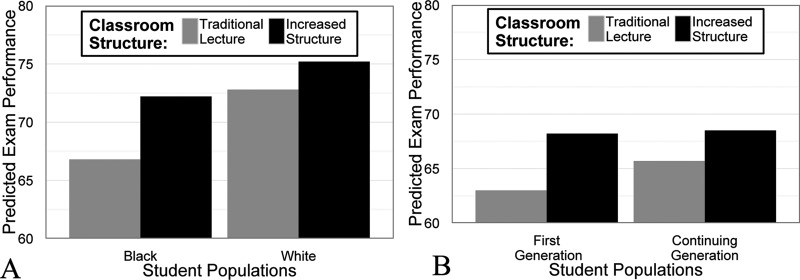
At the college level, the effectiveness of active-learning interventions is typically measured at the broadest scales: the achievement or retention of all students in a course. Coarse-grained measures like these cannot inform instructors about an intervention's relative effectiveness for the different student populations in their classrooms or about the proximate factors responsible for the observed changes in student achievement. In this study, we disaggregate student data by racial/ethnic groups and first-generation status to identify whether a particular intervention-increased course structure-works better for particular populations of students. We also explore possible factors that may mediate the observed changes in student achievement. We found that a "moderate-structure" intervention increased course performance for all student populations, but worked disproportionately well for black students-halving the black-white achievement gap-and first-generation students-closing the achievement gap with continuing-generation students. We also found that students consistently reported completing the assigned readings more frequently, spending more time studying for class, and feeling an increased sense of community in the moderate-structure course. These changes imply that increased course structure improves student achievement at least partially through increasing student use of distributed learning and creating a more interdependent classroom community.
Overview
The claims and statistics of this paper haven’t been checked yet.
Run the check — free, no account needed. It reads the open-access text and checks the sources it cites.
Integrity signals
Registry
Cites
Statistics
Figures
Verification
Claims the paper makes
The claims and statistics of this paper haven’t been checked yet.
Run the check — free, no account needed. It reads the open-access text and checks the sources it cites.
Claims other papers make about this one
Each is checked against this paper’s own text: does it say what the citing paper says it does?
The source backs part of the claim, not all of it — or backs it for a different population, condition or comparison.
In the citing paper
“students in active-learning course designs that reduced or eliminated achievement gaps have reported an increased sense of community and self-efficacy compared to their peers in the lecture-intensive version of the same course (22, 23).”
From Active learning narrows achievement gaps for underrepresented students in undergraduate science, technology, engineering, and math (2020) · cites this paper as [22]
Experimental — accuracy not yet measuredThe source backs part of the claim, not all of it — or backs it for a different population, condition or comparison.
In the citing paper
“Disturbingly, data demonstrate that retention rates for first-generation college students in STEM are lower than those of continuing generation college students (Chen, 2013; Doerschuk et al., 2016) especially in key gatekeeping courses like General Biology and General Chemistry (Eddy & Hogan, 2014; Gregg-Jolly et al., 2016; Harackiewicz et al., 2014).”
From Exploring Organic Chemistry I students’ responses to an exam wrapper intervention. (2020) · cites this paper as Eddy & Hogan, 2014
Experimental — accuracy not yet measuredThe cited source says what the claim attributes to it.
In the citing paper
“Auspiciously however, interventions involving student centered pedagogies have shown excellent promise in combating these trends (Crimmins, 2017; Eddy & Hogan, 2014; Haak, HilleRisLambers, Pitre, & Freeman, 2011).”
From Exploring Organic Chemistry I students’ responses to an exam wrapper intervention. (2020) · cites this paper as Eddy & Hogan, 2014
Self-check
Percentages, sums and reported differences re-computed from the paper’s own numbers.
The self-check needs the paper’s full text.
Citations
Cites
Modern Applied Statistics with S
Venables, W. N., & Ripley, B. D. (2002) · Statisctics and computing/Statistics and computing · doi:10.1007/978-0-387-21706-2 · Cited by 25,941
Active learning increases student performance in science, engineering, and mathematics
Freeman, S., Eddy, S. L., McDonough, M., Smith, M. K., Okoroafor, N., Jordt, H., & Wenderoth, M. P. (2014) · Proceedings of the National Academy of Sciences · doi:10.1073/pnas.1319030111 · Cited by 9,787 · cited 2×
“This type of research is being referred to as second-generation education research (Eddy et al., 2013; Freeman et al., 2014) and will help refine and optimize active-learning interventions by identifying the critical elements that make an intervention effective.”
BackgroundSelf-citationOther people's children: cultural conflict in the classroom
(1995) · Choice Reviews Online · doi:10.5860/choice.32-6344 · Cited by 3,898
Dunlosky, J., Rawson, K. A., Marsh, E. J., Nathan, M. J., & Willingham, D. T. (2013) · Psychological Science in the Public Interest · doi:10.1177/1529100612453266 · Cited by 3,138
Other people’s children: Cultural conflict in the classroom
Delpit, L. (1995) · College Composition and Communication · doi:10.2307/358724 · Cited by 2,502 · cited 1×
“Yet the different racial and ethnic groups that are included in the URM designation have very different cultures, histories, and exposure to college culture that could impact whether a particular classroom strategy is effective for them (Delpit, 2006).”
BackgroundA question of belonging: Race, social fit, and achievement.
Walton, G. M., & Cohen, G. L. (2007) · Journal of Personality and Social Psychology · doi:10.1037/0022-3514.92.1.82 · Cited by 2,163 · cited 1×
“Finally, feeling like they are part of a community increases both performance and motivation, especially for historically underrepresented groups (Walton and Cohen, 2007; Walton et al., 2012).”
BackgroundHurtado, S., & Carter, D. F. (1997) · Sociology of Education · doi:10.2307/2673270 · Cited by 1,938 · cited 1×
“…of our study, arguably as important as increased performance, because a sense of being part of a community (belonging) is crucial for retention (Hurtado and Carter, 1997; Hoffman et al., 2002) and has been 464 CBE—Life Sciences Education correlated with increased performance for…”
BackgroundStudent Engagement and Student Learning: Testing the Linkages*
Carini, R. M., Kuh, G. D., & Klein, S. P. (2006) · Research in Higher Education · doi:10.1007/s11162-005-8150-9 · Cited by 1,799 · cited 1×
“Thus, through increased engagement with the material (because of increased interest in it) student performance will increase (Carini et al., 2006).”
BackgroundAmbient belonging: how stereotypical cues impact gender participation in computer science
Cheryan, S., Plaut, V. C., Davies, P. G., & Steele, C. M. (2009) · Journal of Personality and Social Psychology · doi:10.1037/a0016239 · Cited by 1,372 · cited 1×
“When discussing reasons for leaving STEM, many students, particularly students of color and women, describe feelings of isolation and lack of belonging (Hewlett et al., 2008; Cheryan et al., 2009; Strayhorn, 2011).”
BackgroundStephens, N. M., Fryberg, S. A., Markus, H. R., Johnson, C. S., & Covarrubias, R. (2012) · Journal of Personality and Social Psychology · doi:10.1037/a0027143 · Cited by 1,312
Research works printed but not linked: 17
- Bodenhofer U, 2008, Mathware Soft Comput, 15, 5
- Borrego M, 2013, J Eng Educ, 102, 294
- Burchfield CM, 2000, Teach Psychol, 17, 58
- Dirks C, 2006, Cell Biol Educ, 5, 218
- Fassinger PA, 2000, J Class Inter, 35, 38
- Fox J, 2010, An R Companion to Applied Regression
- Handelsman J, 2007, Scientific Teaching
- Hewlett SA, 2008, The Athena Factor: Reversing the Brain Drain in Science. Engineering, and Technology
- Keeler CM, 1995, J Stats Educ, 3, 1
- Lee P, 2011, Harvard Kennedy School's Asian American Policy Review, 21, 19
- Minchella DJ, 2002, Am Biol Teach, 64, 352, 10.2307/4451310 · DOI
- National Science Foundation, 2013, Division of Undergraduate Education NSF, 13
- Poelzer GH, 2008, J Coll Sci Teach, 38, 59
- Sharma MD, 2005, Austral J Educ Tech, 21, 137
- Tsui L, 2002, J High Educ, 73, 740
- Tsui L, 2007, J Negro Educ, 76, 555
- van Wyk MM, 2012, J Soc Sci, 33, 261
Cited by
Sorted by citations
Theobald, E. J., Hill, M. J., Tran, E., Agrawal, S., Arroyo, E. N., Behling, S., Chambwe, N., Cintrón, D. L., Cooper, J. D., Dunster, G., et al. (2020) · Proceedings of the National Academy of Sciences · doi:10.1073/pnas.1916903117 · Cited by 1,387
“Based on this observation, we endorse recent appeals for researchers to disaggregate data and evaluate how course interventions impact specific subgroups of students (13, 22, 34, 59, 60).”
Knekta, E., Runyon, C., & Eddy, S. L. (2019) · CBE—Life Sciences Education · doi:10.1187/cbe.18-04-0064 · Cited by 765
“Generally, each question on these instruments asked about something different and did not involve extensive use of measures of validity to ensure that researchers were, in fact, measuring what they intended to measure (Armbruster et al., 2009; Rissing and Cogan, 2009; Eddy and Hogan, 2014).”
BackgroundSelf-citationThe Curious Construct of Active Learning
Lombardi, D., Shipley, T. F., Astronomy Team, B. T., Bailey, J. M., Bretones, P. S., Prather, E. E., Ballen, C. J., Knight, J., Smith, M. K., Stowe, R. L., et al. (2021) · Gothic.net · doi:10.1177/1529100620973974 · Cited by 547
“Further impetus for active learning has been added by evidence suggesting that active-learning strategies provide more equitable outcomes for underrepresented students in undergraduate biology education (Ballen et al., 2017; Eddy & Hogan, 2014; Haak et al., 2011).”
BackgroundIncreased Preclass Preparation Underlies Student Outcome Improvement in the Flipped Classroom
Gross, D., Pietri, E. S., Anderson, G., Camihort, K., & Graham, M. J. (2015) · CBE—Life Sciences Education · doi:10.1187/cbe.15-02-0040 · Cited by 297
“In addition, what is known is largely indirect evidence, including self-reported or observational data (Herreid and Schiller, 2012; Eddy and Hogan, 2014; Halverson et al., 2014).”
BackgroundThe Flipped Classroom – From Theory to Practice in Health Professional Education
Persky, A. M., & McLaughlin, J. E. (2017) · American Journal of Pharmaceutical Education · doi:10.5688/ajpe816118 · Cited by 287
Metadata
- Authors
- Eddy, S. L., & Hogan, K. A.
- Affiliations
- University of Washington (US)
- University of North Carolina at Chapel Hill (US)
- Corresponding author
- Hogan, Kelly A.
- Venue
- CBE—Life Sciences Education
- Published
- 2014-09
- Volume
- 13
- Issue
- 3
- Pages
- 453-468
- ISSN
- 1931-7913 (ISSN-L)
- PMC
- PMC4152207
- OpenAlex
- W2096648490
- Cited by
- 553
- References
- 72
- Citations by year
- 2026: 30 · 2025: 49 · 2024: 71 · 2023: 38 · 2022: 54 · 2021: 67 · 2020: 67 · 2019: 53 · 2018: 40 · 2017: 35 · 2016: 31 · 2015: 14 · 2014: 3
- FWCI
- 142.29
- Type
- journal article
- Language
- en
- Open access
- hybrid
- doi.org
- Licence
- cc-by-nc-sa
- Locations
- CBE—Life Sciences Education (publishedVersion, cc-by-nc-sa)
- PubMed Central (publishedVersion, cc-by-nc-sa)
- PubMed (publishedVersion)
- Carolina Digital Repository (University of North Carolina at Chapel Hill) (submittedVersion)
- UNC Libraries
- Funders
- National Science Foundation (1118890, 0942215)
- Topics
- Social Sciences › Education › Innovative Teaching Methods
- Social Sciences › Education › Higher Education Research Studies
- Social Sciences › Education › Evaluation of Teaching Practices
- Keywords
- course structure, active learning, academic performance, racial and ethnic disparities, first-generation college students, Black-White achievement gap, distributed learning, classroom community, student study time, higher education
- MeSH terms
- Behavior, Curriculum, Educational Measurement, Ethnicity, Female, Humans, Male, Perception, Regression Analysis, Students, Time Factors, Universities, Problem-Based Learning, Racial Groups
About these checks
Registry, retraction, Cites and statistics results are computed, not judged, with one exception: a printed reference that no index lists is read once by a model before it counts as a citation error. Claims are extracted by a model and kept only when their quote appears verbatim in the text; each cited source is then checked, with a model’s help, for whether it says what the claim relies on. Those verdicts can be wrong — read the claim’s quote and the cited source before relying on one.
Statistics and arithmetic are recomputed, not judged.
Confidence bands are shown only for fields calibrated on our annotated test set. None is calibrated yet, so no band is shown.
What counts as a claim ›How we measure confidence ›How we check this ›
Are you an author, or do you see a problem with this page? Request a review
