

The DOI matches its Crossref record; 71 of the 72 references it cites were found in a registry or an index.
Getting Under the Hood: How and for Whom Does Increasing Course Structure Work?
Open accessAbstract
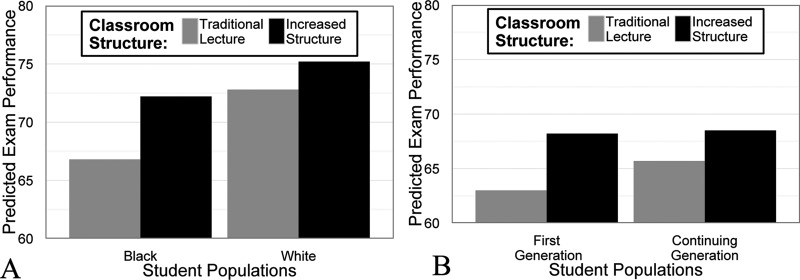
At the college level, the effectiveness of active-learning interventions is typically measured at the broadest scales: the achievement or retention of all students in a course. Coarse-grained measures like these cannot inform instructors about an intervention's relative effectiveness for the different student populations in their classrooms or about the proximate factors responsible for the observed changes in student achievement. In this study, we disaggregate student data by racial/ethnic groups and first-generation status to identify whether a particular intervention-increased course structure-works better for particular populations of students. We also explore possible factors that may mediate the observed changes in student achievement. We found that a "moderate-structure" intervention increased course performance for all student populations, but worked disproportionately well for black students-halving the black-white achievement gap-and first-generation students-closing the achievement gap with continuing-generation students. We also found that students consistently reported completing the assigned readings more frequently, spending more time studying for class, and feeling an increased sense of community in the moderate-structure course. These changes imply that increased course structure improves student achievement at least partially through increasing student use of distributed learning and creating a more interdependent classroom community.
Overview
The claims and statistics of this paper haven’t been checked yet.
Run the check — free, no account needed. It reads the open-access text and checks the sources it cites.
Integrity signals
Registry
Cites
Statistics
Figures
Verification
Claims the paper makes
The claims and statistics of this paper haven’t been checked yet.
Run the check — free, no account needed. It reads the open-access text and checks the sources it cites.
Claims other papers make about this one
Each is checked against this paper’s own text: does it say what the citing paper says it does?
The source backs part of the claim, not all of it — or backs it for a different population, condition or comparison.
In the citing paper
“students in active-learning course designs that reduced or eliminated achievement gaps have reported an increased sense of community and self-efficacy compared to their peers in the lecture-intensive version of the same course (22, 23).”
From Active learning narrows achievement gaps for underrepresented students in undergraduate science, technology, engineering, and math (2020) · cites this paper as [22]
Experimental — accuracy not yet measuredThe source backs part of the claim, not all of it — or backs it for a different population, condition or comparison.
In the citing paper
“Disturbingly, data demonstrate that retention rates for first-generation college students in STEM are lower than those of continuing generation college students (Chen, 2013; Doerschuk et al., 2016) especially in key gatekeeping courses like General Biology and General Chemistry (Eddy & Hogan, 2014; Gregg-Jolly et al., 2016; Harackiewicz et al., 2014).”
From Exploring Organic Chemistry I students’ responses to an exam wrapper intervention. (2020) · cites this paper as Eddy & Hogan, 2014
Experimental — accuracy not yet measuredThe cited source says what the claim attributes to it.
In the citing paper
“Auspiciously however, interventions involving student centered pedagogies have shown excellent promise in combating these trends (Crimmins, 2017; Eddy & Hogan, 2014; Haak, HilleRisLambers, Pitre, & Freeman, 2011).”
From Exploring Organic Chemistry I students’ responses to an exam wrapper intervention. (2020) · cites this paper as Eddy & Hogan, 2014
Self-check
Percentages, sums and reported differences re-computed from the paper’s own numbers.
The self-check needs the paper’s full text.
Citations
Cites
Modern Applied Statistics with S
Venables, W. N., & Ripley, B. D. (2002) · Statisctics and computing/Statistics and computing · doi:10.1007/978-0-387-21706-2 · Cited by 25,941
Active learning increases student performance in science, engineering, and mathematics
Freeman, S., Eddy, S. L., McDonough, M., Smith, M. K., Okoroafor, N., Jordt, H., & Wenderoth, M. P. (2014) · Proceedings of the National Academy of Sciences · doi:10.1073/pnas.1319030111 · Cited by 9,787 · cited 2×
“This type of research is being referred to as second-generation education research (Eddy et al., 2013; Freeman et al., 2014) and will help refine and optimize active-learning interventions by identifying the critical elements that make an intervention effective.”
BackgroundSelf-citationOther people's children: cultural conflict in the classroom
(1995) · Choice Reviews Online · doi:10.5860/choice.32-6344 · Cited by 3,898
Dunlosky, J., Rawson, K. A., Marsh, E. J., Nathan, M. J., & Willingham, D. T. (2013) · Psychological Science in the Public Interest · doi:10.1177/1529100612453266 · Cited by 3,138
Other people’s children: Cultural conflict in the classroom
Delpit, L. (1995) · College Composition and Communication · doi:10.2307/358724 · Cited by 2,502 · cited 1×
“Yet the different racial and ethnic groups that are included in the URM designation have very different cultures, histories, and exposure to college culture that could impact whether a particular classroom strategy is effective for them (Delpit, 2006).”
BackgroundA question of belonging: Race, social fit, and achievement.
Walton, G. M., & Cohen, G. L. (2007) · Journal of Personality and Social Psychology · doi:10.1037/0022-3514.92.1.82 · Cited by 2,163 · cited 1×
“Finally, feeling like they are part of a community increases both performance and motivation, especially for historically underrepresented groups (Walton and Cohen, 2007; Walton et al., 2012).”
BackgroundHurtado, S., & Carter, D. F. (1997) · Sociology of Education · doi:10.2307/2673270 · Cited by 1,938 · cited 1×
“…of our study, arguably as important as increased performance, because a sense of being part of a community (belonging) is crucial for retention (Hurtado and Carter, 1997; Hoffman et al., 2002) and has been 464 CBE—Life Sciences Education correlated with increased performance for…”
BackgroundStudent Engagement and Student Learning: Testing the Linkages*
Carini, R. M., Kuh, G. D., & Klein, S. P. (2006) · Research in Higher Education · doi:10.1007/s11162-005-8150-9 · Cited by 1,799 · cited 1×
“Thus, through increased engagement with the material (because of increased interest in it) student performance will increase (Carini et al., 2006).”
BackgroundAmbient belonging: how stereotypical cues impact gender participation in computer science
Cheryan, S., Plaut, V. C., Davies, P. G., & Steele, C. M. (2009) · Journal of Personality and Social Psychology · doi:10.1037/a0016239 · Cited by 1,372 · cited 1×
“When discussing reasons for leaving STEM, many students, particularly students of color and women, describe feelings of isolation and lack of belonging (Hewlett et al., 2008; Cheryan et al., 2009; Strayhorn, 2011).”
BackgroundStephens, N. M., Fryberg, S. A., Markus, H. R., Johnson, C. S., & Covarrubias, R. (2012) · Journal of Personality and Social Psychology · doi:10.1037/a0027143 · Cited by 1,312
Research works printed but not linked: 17
- Bodenhofer U, 2008, Mathware Soft Comput, 15, 5
- Borrego M, 2013, J Eng Educ, 102, 294
- Burchfield CM, 2000, Teach Psychol, 17, 58
- Dirks C, 2006, Cell Biol Educ, 5, 218
- Fassinger PA, 2000, J Class Inter, 35, 38
- Fox J, 2010, An R Companion to Applied Regression
- Handelsman J, 2007, Scientific Teaching
- Hewlett SA, 2008, The Athena Factor: Reversing the Brain Drain in Science. Engineering, and Technology
- Keeler CM, 1995, J Stats Educ, 3, 1
- Lee P, 2011, Harvard Kennedy School's Asian American Policy Review, 21, 19
- Minchella DJ, 2002, Am Biol Teach, 64, 352, 10.2307/4451310 · DOI
- National Science Foundation, 2013, Division of Undergraduate Education NSF, 13
- Poelzer GH, 2008, J Coll Sci Teach, 38, 59
- Sharma MD, 2005, Austral J Educ Tech, 21, 137
- Tsui L, 2002, J High Educ, 73, 740
- Tsui L, 2007, J Negro Educ, 76, 555
- van Wyk MM, 2012, J Soc Sci, 33, 261
Cited by
Sorted by citations
Theobald, E. J., Hill, M. J., Tran, E., Agrawal, S., Arroyo, E. N., Behling, S., Chambwe, N., Cintrón, D. L., Cooper, J. D., Dunster, G., et al. (2020) · Proceedings of the National Academy of Sciences · doi:10.1073/pnas.1916903117 · Cited by 1,387
“Based on this observation, we endorse recent appeals for researchers to disaggregate data and evaluate how course interventions impact specific subgroups of students (13, 22, 34, 59, 60).”
Knekta, E., Runyon, C., & Eddy, S. L. (2019) · CBE—Life Sciences Education · doi:10.1187/cbe.18-04-0064 · Cited by 765
“Generally, each question on these instruments asked about something different and did not involve extensive use of measures of validity to ensure that researchers were, in fact, measuring what they intended to measure (Armbruster et al., 2009; Rissing and Cogan, 2009; Eddy and Hogan, 2014).”
BackgroundSelf-citationThe Curious Construct of Active Learning
Lombardi, D., Shipley, T. F., Astronomy Team, B. T., Bailey, J. M., Bretones, P. S., Prather, E. E., Ballen, C. J., Knight, J., Smith, M. K., Stowe, R. L., et al. (2021) · Gothic.net · doi:10.1177/1529100620973974 · Cited by 547
“Further impetus for active learning has been added by evidence suggesting that active-learning strategies provide more equitable outcomes for underrepresented students in undergraduate biology education (Ballen et al., 2017; Eddy & Hogan, 2014; Haak et al., 2011).”
BackgroundIncreased Preclass Preparation Underlies Student Outcome Improvement in the Flipped Classroom
Gross, D., Pietri, E. S., Anderson, G., Camihort, K., & Graham, M. J. (2015) · CBE—Life Sciences Education · doi:10.1187/cbe.15-02-0040 · Cited by 297
“In addition, what is known is largely indirect evidence, including self-reported or observational data (Herreid and Schiller, 2012; Eddy and Hogan, 2014; Halverson et al., 2014).”
BackgroundThe Flipped Classroom – From Theory to Practice in Health Professional Education
Persky, A. M., & McLaughlin, J. E. (2017) · American Journal of Pharmaceutical Education · doi:10.5688/ajpe816118 · Cited by 287
First-Generation College Students as Academic Learners: A Systematic Review
Ives, J., & Castillo‐Montoya, M. (2020) · Review of Educational Research · doi:10.3102/0034654319899707 · Cited by 339
“Eddy and Hogan (2014) found that increasing course structure in biology (e.g., adding guided-reading questions, in-class group activities) helped increase the reported sense of classroom community and reduced the gap in final grades between first-generation and continuing-generation students. In their study of a servi…”
BackgroundInfluentialConnell, G. L., Donovan, D. A., & Chambers, T. G. (2016) · CBE—Life Sciences Education · doi:10.1187/cbe.15-03-0062 · Cited by 231
“More recently, Eddy and Hogan (2014) found that a moderate course structure, which included preclass guided-reading questions and some in-class activities completed in informal groups, yielded higher exam scores compared with low course structure, especially for AfricanAmerican students and first-generation students.”
BackgroundRethinking the Course Syllabus: Considerations for Promoting Equity, Diversity, and Inclusion
Fuentes, M. A., Zelaya, D. G., & Madsen, J. W. (2020) · Teaching of Psychology · doi:10.1177/0098628320959979 · Cited by 277
“Specifically, Eddy and Hogan (2014) found that a moderately structured, active learning approach led to students reading and studying more in the course as well as perceiving a greater sense of community.”
BackgroundGender differences in student participation in an active-learning classroom
Aguillon, S. M., Siegmund, G.-F., Petipas, R. H., Drake, A. G., Cotner, S., & Ballen, C. J. (2020) · CBE—Life Sciences Education · doi:10.1187/cbe.19-03-0048 · Cited by 215
“Many studies show that active learning has a disproportionate benefit on the performance of groups historically underrepresented in STEM (Lorenzo et al., 2006; Eddy and Hogan, 2014; Ballen et al., 2017b; Casper et al., 2019).”
BackgroundInfluentialCooper, K. M., & Brownell, S. (2016) · CBE - Life Sciences Education · doi:10.1187/cbe.16-01-0074 · Cited by 188
“While active-learning approaches have been shown to decrease achievement gaps among students of different social identities (Eddy and Hogan, 2014), the interaction among students in active-learning classrooms can promote greater awareness of who other students are and may exacerbate feelings of…”
BackgroundTeaching and Learning in the Time of COVID: The Student Perspective
Means, B., & Neisler, J. (2021) · Online Learning · doi:10.24059/olj.v25i1.2496 · Cited by 192
Eddy, S. L., Brownell, S. E., Thummaphan, P., Lan, M., & Wenderoth, M. P. (2015) · CBE—Life Sciences Education · doi:10.1187/cbe.15-05-0108 · Cited by 197
“, 2006; White, 2011), although we are only aware of one study that has examined these differences specifically in STEM classrooms (Eddy and Hogan, 2014).”
BackgroundSelf-citationEddy, S. L., Converse, M., & Wenderoth, M. P. (2015) · CBE—Life Sciences Education · doi:10.1187/cbe.14-06-0095 · Cited by 182
“The blue instructor decreased failure rates (instances of a “C−” or lower) on exams by 41% (Eddy and Hogan, 2014) when the instructor changed from traditional lecturing to a more active-learning environment that incorporated greater use of group work in class and weekly reading quizzes.”
BackgroundSelf-citationStains, M., & Vickrey, T. (2017) · CBE—Life Sciences Education · doi:10.1187/cbe.16-03-0113 · Cited by 177
“…Tanner (2011) highlighted the need to develop a common language to describe what takes place when an EBIP is implemented in order to increase FOI; Eddy and Hogan (2014) studied conditions and populations for which course structure is most impactful and thus helped characterize factors that may…”
BackgroundTo Flip or Not to Flip? A Meta-Analysis of the Efficacy of Flipped Learning in Higher Education
Bredow, C. A., Roehling, P. V., Knorp, A. J., & Sweet, A. M. (2021) · Review of Educational Research · doi:10.3102/00346543211019122 · Cited by 266
“Compared with their “majority” classmates, racially minoritized and first-generation students reap greater academic gains from active learning interventions, narrowing the achievement gap between these groups (Eddy & Hogan, 2014; Theobald et al., 2020).”
BackgroundInclusive Pedagogy and Universal Design Approaches for Diverse Learning Environments
Sanger, C. S. (2020) · Springer eBooks · doi:10.1007/978-981-15-1628-3_2 · Cited by 192
University learning: Improve undergraduate science education
Bradforth, S. E., Miller, E. R., Dichtel, W. R., Leibovich, A. K., Feig, A. L., Martin, J. D., Bjorkman, K. S., Schultz, Z. D., & Smith, T. L. (2015) · Nature · doi:10.1038/523282a · Cited by 161
Student Buy-In to Active Learning in a College Science Course
Cavanagh, A. J., Aragón, O. R., Chen, X., Couch, B. A., Durham, M. F., Bobrownicki, A., Hanauer, D. I., & Graham, M. J. (2016) · CBE—Life Sciences Education · doi:10.1187/cbe.16-07-0212 · Cited by 166
“Eddy and Hogan (2014) examined the relationship between increased course structure (a core component of active learning) and student outcomes, identifying higher levels of student preparation and a more cohesive class environment as key mediators in this relationship.”
BackgroundResultInfluentialStudent perception of group dynamics predicts individual performance: Comfort and equity matter
Theobald, E. J., Eddy, S. L., Grunspan, D. Z., Wiggins, B. L., & Crowe, A. J. (2017) · PLoS ONE · doi:10.1371/journal.pone.0181336 · Cited by 176
Self-citationActive Learning in Flipped Life Science Courses Promotes Development of Critical Thinking Skills
Styers, M. L., Zandt, P. A. V., & Hayden, K. L. (2018) · CBE—Life Sciences Education · doi:10.1187/cbe.16-11-0332 · Cited by 155
“Do Some Groups of Students Disproportionately Benefit from Active Learning? Active learning has previously been shown to promote greater learning gains in some subpopulations, including women, first-generation college students, and URM students (Lorenzo et al., 2006; Eddy and Hogan, 2014).”
BackgroundResultInfluentialImproving undergraduate STEM education: The efficacy of discipline-based professional development
Manduca, C. A., Iverson, E., Luxenberg, M. G., Macdonald, R. H., McCONNELL, D. A., Mogk, D. W., & Tewksbury, B. J. (2017) · Science Advances · doi:10.1126/sciadv.1600193 · Cited by 152
“One widely used strategy to facilitate this transformation is to provide professional development opportunities for faculty to learn about alternative approaches to teaching that have been shown to reduce attrition, improve student learning (3, 4), and reduce the achievement gap among student populations (5, 6).”
BackgroundInfluentialEngland, B. J., Brigati, J., & Schussler, E. (2017) · PLoS ONE · doi:10.1371/journal.pone.0182506 · Cited by 146
Perets, E. A., Chabeda, D., Gong, A. Z., Huang, X., Fung, T. S., Ng, K. Y., Bathgate, M., & Yan, E. C. Y. (2020) · Journal of Chemical Education · doi:10.1021/acs.jchemed.0c00879 · Cited by 144
A Campus-Wide Study of STEM Courses: New Perspectives on Teaching Practices and Perceptions
Smith, M. K., Vinson, E. L., Smith, J. L., Lewin, J. D., & Stetzer, M. R. (2014) · CBE—Life Sciences Education · doi:10.1187/cbe.14-06-0108 · Cited by 139
Seidel, S. B., Reggi, A. L., Schinske, J. N., Burrus, L. W., & Tanner, K. D. (2015) · CBE—Life Sciences Education · doi:10.1187/cbe.15-03-0049 · Cited by 134
“If as little as a single sentence uttered by an instructor or a 15-min writing assignment can have an impact on student performance on an exam, studying Instructor Talk may be critically important for understanding and overcoming stereotype threat and achievement gaps that have been identified for some student populat…”
BackgroundInfluentialRace and Gender Differences in Undergraduate Research Mentoring Structures and Research Outcomes
Aikens, M. L., Robertson, M. M., Sadselia, S., Watkins, K., Evans, M., Runyon, C. R., Eby, L. T., & Dolan, E. L. (2017) · CBE—Life Sciences Education · doi:10.1187/cbe.16-07-0211 · Cited by 126
“Lessons learned from the classroom about reducing disparities can also be adapted and applied in undergraduate research experiences, such as building in structure (Freeman et al., 2011; Tanner, 2013; Eddy and Hogan, 2014).”
ASPECT: A Survey to Assess Student Perspective of Engagement in an Active-Learning Classroom
Wiggins, B. L., Eddy, S. L., Wener-Fligner, L., Freisem, K., Grunspan, D. Z., Theobald, E. J., Timbrook, J., & Crowe, A. J. (2017) · CBE—Life Sciences Education · doi:10.1187/cbe.16-08-0244 · Cited by 125
“Furthermore, different student populations are disproportionally affected by active-learning activities (Springer et al., 1999; Haak et al., 2011; Eddy and Hogan, 2014).”
BackgroundSelf-citationBest practices in active and student-centered learning in physiology classes
Goodman, B. E., Barker, M., & Cooke, J. E. (2018) · AJP Advances in Physiology Education · doi:10.1152/advan.00064.2018 · Cited by 132
“More structured classrooms, in which the learner is asked to read before coming to class, has activities in class, and practices outside of class, preferentially benefit women and first-generation university students (14).”
BackgroundDemystifying the Meaning of Active Learning in Postsecondary Biology Education
Driessen, E. P., Knight, J. K., Smith, M. K., & Ballen, C. J. (2020) · CBE - Life Sciences Education · doi:10.1187/cbe.20-04-0068 · Cited by 115
“…the most at-risk student groups, such as first-generation college attendees and those who identify with races/ethnicities historically underrepresented in STEM fields (Beichner et al., 2007; Haak et al., 2011; Eddy and Hogan, 2014; Ballen et al., 2017; Wilton et al., 2019; Bauer et al., 2020).”
BackgroundSalehi, S., Burkholder, E., Lepage, G. P., Pollock, S., & Wieman, C. (2019) · Physical Review Physics Education Research · doi:10.1103/physrevphyseducres.15.020114 · Cited by 123
England, B. J., Brigati, J. R., Schussler, E. E., & Musgrove, M. M. C. (2019) · CBE—Life Sciences Education · doi:10.1187/cbe.17-12-0284 · Cited by 142
“Performance and/or persistence differentials have been observed between different genders (Eddy et al., 2014; Eddy and Brownell, 2016), ethnicities (Eddy and Hogan, 2014), and those who completed different numbers of Advanced Placement (AP) courses (Ackerman et al., 2013).”
BackgroundResultJordt, H., Eddy, S. L., Brazil, R., Lau, I. H., Mann, C., Brownell, S. E., King, K. R., & Freeman, S. (2017) · CBE—Life Sciences Education · doi:10.1187/cbe.16-12-0351 · Cited by 123
“Different instructors and/or instructional strategies can impact achievement gaps between white students and historically underrepresented groups in college STEM courses (Kreutzer and Boudreaux, 2012; Eddy and Hogan, 2014).”
BackgroundInfluentialSelf-citationTeaching as Brain Changing: Exploring Connections between Neuroscience and Innovative Teaching
Owens, M. T., & Tanner, K. D. (2017) · CBE—Life Sciences Education · doi:10.1187/cbe.17-01-0005 · Cited by 125
“Indeed, frequent, active homework that consists of writing or problem solving is an important part of the high or moderate course structure that has been shown to reduce achievement gaps for students from underrepresented groups and to improve learning for all students (Freeman et al., 2011; Eddy and Hogan, 2014).”
BackgroundExams disadvantage women in introductory biology
Ballen, C. J., Salehi, S., & Cotner, S. H. (2017) · PLoS ONE · doi:10.1371/journal.pone.0186419 · Cited by 113
Borda, E. J., Schumacher, E., Hanley, D., Geary, E., Warren, S., Ipsen, C., & Stredicke, L. (2020) · International Journal of STEM Education · doi:10.1186/s40594-020-0203-2 · Cited by 127
“…in terms of reducing gaps in course grades, performance on concept inventories, and/or failure rates between underrepresented (in STEM) groups and majority students (Beichner, Saul, Abbott, Morse, Deardorff, Allain, & Risley, 2007; Eddy & Hogan, 2014; Haak, Hillerislambers, Pitre, & Freeman, 2011).”
BackgroundCrimmins, M. T., & Midkiff, B. (2017) · Journal of Chemical Education · doi:10.1021/acs.jchemed.6b00663 · Cited by 101
Deep teaching in a college STEM classroom
Dewsbury, B. M. (2019) · Cultural Studies of Science Education · doi:10.1007/s11422-018-9891-z · Cited by 110
“Research into active learning is still attempting to clearly identify the specific aspects of this approach that promotes learning, and the contexts in which it is more effective (but see Eddy and Hogan 2014).”
BackgroundInstructional Utility and Learning Efficacy of Common Active Learning Strategies
McConnell, D. A., Chapman, L., Czajka, C. D., Jones, J. P., Ryker, K. D., & Wiggen, J. (2017) · Journal of Geoscience Education · doi:10.5408/17-249.1 · Cited by 113
“…(e.g., Pollock and Finkelstein, 2008; Derting and Ebert-May, 2010; Freeman et al., 2011, 2014) but also contribute to increased retention rates (Russell et al., 2007; Graham et al., 2013) and a reduction in the achievement gap among student populations (Haak et al., 2011; Eddy and Hogan, 2014).”
BackgroundGarnjost, P., & Lawter, L. (2019) · The International Journal of Management Education · doi:10.1016/j.ijme.2019.03.004 · Cited by 104
Promoting student interaction, engagement, and success in an online environment
Cavinato, A. G., Hunter, R. A., Ott, L. S., & Robinson, J. K. (2021) · Analytical and Bioanalytical Chemistry · doi:10.1007/s00216-021-03178-x · Cited by 130
Auerbach, A. J., & Andrews, T. C. (2018) · International Journal of STEM Education · doi:10.1186/s40594-018-0112-9 · Cited by 106
“Random call avoids gender bias in who is heard in the classroom and thus may indirectly influence persistence in STEM (Eddy et al. 2014).”
BackgroundPetersen, C. I., Baepler, P., Beitz, A., Ching, P., Gorman, K. S., Neudauer, C. L., Rozaitis, W., Walker, J. D., & Wingert, D. (2020) · CBE—Life Sciences Education · doi:10.1187/cbe.19-04-0079 · Cited by 123
“Moreover, moving away from a focus on content coverage may promote equity in STEM education by supporting the learning of traditionally underrepresented groups of students (Lorenzo et al., 2006; Handelsman et al., 2007; Eddy and Hogan, 2014; Freeman et al., 2014).”
BackgroundClassroom sound can be used to classify teaching practices in college science courses
Owens, M. T., Seidel, S. B., Wong, M., Bejines, T. E., Lietz, S., Perez, J. R., Sit, S., Subedar, Z.-S., Acker, G. N., Akana, S., et al. (2017) · Proceedings of the National Academy of Sciences of the United States of America · doi:10.1073/pnas.1618693114 · Cited by 92
“Trans Audio Speech Lang Process 14(6):2264–2274.”
Culturally Relevant Pedagogy: A Model To Guide Cultural Transformation in STEM Departments
Johnson, A. C., & Elliott, S. (2020) · Journal of Microbiology and Biology Education · doi:10.1128/jmbe.v21i1.2097 · Cited by 108
Gin, L. E., Guerrero, F. A., Cooper, K. M., & Brownell, S. E. (2020) · CBE—Life Sciences Education · doi:10.1187/cbe.20-03-0049 · Cited by 84
“However, active learning has also been shown to present challenges for some groups of students (Eddy and Hogan, 2014; Eddy et al., 2015; Eddy and Brownell, 2016; Cooper and Brownell, 2016; Cooper et al., 2018b; England et al., 2017, 2019; Downing et al., 2020).”
BackgroundHigh-impact teaching practices foster a greater sense of belonging in the college classroom
Kirby, L. A. J., & Thomas, C. L. (2021) · Journal of Further and Higher Education · doi:10.1080/0309877x.2021.1950659 · Cited by 103
“More specifically, inclusive practices that benefit all students – especially marginalised groups – include increasing course structure (Eddy and Hogan 2014), using cooperative learning (Johnson, Johnson, and Smith 2014), implementing social-belonging interventions (Walton and Cohen 2011),…”
BackgroundHudley, A. H. C., Mallinson, C., & Bucholtz, M. (2024) · doi:10.1093/oso/9780197755303.001.0001 · Cited by 79
Smart Pedagogy for Technology-Enhanced Learning
Daniela, L. (2018) · Springer eBooks · doi:10.1007/978-3-030-01551-0_1 · Cited by 78
Sellami, N., Shaked, S., Laski, F. A., Eagan, K., & Sanders, E. R. (2017) · CBE—Life Sciences Education · doi:10.1187/cbe.16-12-0341 · Cited by 76
“The effect of LAs on URMs in particular may have been influenced by affective factors promoted by LAs, such as improved sense of belonging and scientist identity (Seymour, 2000; Beasley and Fischer, 2012; Eddy and Hogan, 2014).”
BackgroundWilton, M., Gonzalez-Niño, E., McPartlan, P., Terner, Z., Christoffersen, R. E., & Rothman, J. H. (2019) · CBE—Life Sciences Education · doi:10.1187/cbe.18-08-0155 · Cited by 82
“This result is perplexing, given the growing body of biology DBER literature demonstrating that active-learning practices and peer-led learning communities, two components of the intervention course, are associated with disproportionate increases in academic achievement and social– psychological metrics (Freeman et al…”
BackgroundResultInfluentialReplicating Meyerhoff for inclusive excellence in STEM
Domingo, M. R. S., Sharp, S. M., Freeman, A., Freeman, T. C., Harmon, K., Wiggs, M., Sathy, V., Panter, A. T., Oseguera, L., Sun, S., et al. (2019) · Science · doi:10.1126/science.aar5540 · Cited by 73
Modeling temporal self-regulatory processing in a higher education biology course
Greene, J. A., Plumley, R. D., Urban, C. J., Bernacki, M. L., Gates, K. M., Hogan, K. A., Demetriou, C., & Panter, A. T. (2019) · Learning and Instruction · doi:10.1016/j.learninstruc.2019.04.002 · Cited by 73
Self-citationStanich, C. A., Pelch, M. A., Theobald, E. J., & Freeman, S. (2018) · Chemistry Education Research and Practice · doi:10.1039/c8rp00044a · Cited by 72
Wright, C. D., Eddy, S. L., Wenderoth, M. P., Abshire, E. T., Blankenbiller, M., & Brownell, S. E. (2016) · CBE—Life Sciences Education · doi:10.1187/cbe.15-12-0246 · Cited by 74
“…emphasis on practice in active-learning classrooms may therefore be contributing to the reduction in achievement gaps seen between low- and middle/high-SES students (Haak et al., 2011) as well as between first-generation and continuing-generation students (Eddy and Hogan, 2014) in these classes.”
BackgroundSelf-citationStudent Engagement in Active Learning Classes
Hodges, L. C. (2020) · Springer eBooks · doi:10.1007/978-3-030-33600-4_3 · Cited by 68
Toledo, S., & Dubas, J. M. (2015) · Journal of Chemical Education · doi:10.1021/acs.jchemed.5b00184 · Cited by 68
Biology Education Research 2.0
Dolan, E. L. (2015) · CBE—Life Sciences Education · doi:10.1187/cbe.15-11-0229 · Cited by 67
“Texas Institute for Discovery Education in Science, College of Natural Sciences, University of Texas at Austin, Austin, TX 78712 Editorial and that it works especially well for students who have been traditionally underserved (e.g., Eddy and Hogan, 2014).”
BackgroundBrame, C. J. (2019) · Elsevier eBooks · doi:10.1016/b978-0-12-814702-3.00009-3 · Cited by 71
Cotner, S. H., Jeno, L. M., Walker, J. D., Jørgensen, C., & Vandvik, V. (2020) · International Journal of STEM Education · doi:10.1186/s40594-020-00252-1 · Cited by 66
“Suggested causes often include social reasons (Rogoff, 2003; West and Zimmerman, 1987; Ceci, Williams, and Barnett, 2009) such as interest in course content (Jones, Howe and Rua, 2000; Hulleman and Harackiewicz, 2009; Diekman, Clark, Johnston, Brown and Steinberg, 2011), science identity (Cundiff, Vescio, Loken and Lo…”
BackgroundFlipped Classroom in Organic Chemistry Has Significant Effect on Students’ Grades
Cormier, C., & Voisard, B. (2018) · Frontiers in ICT · doi:10.3389/fict.2017.00030 · Cited by 67
“It was proposed that this kind of classroom setting was beneficial because of extra time students devoted to course material and because of a culture of community in class instead of a competitive environment (Eddy and Hogan, 2014).”
BackgroundHidden Identities Shape Student Perceptions of Active Learning Environments
Henning, J. A., Ballen, C. J., Molina, S. A., & Cotner, S. H. (2019) · Frontiers in Education · doi:10.3389/feduc.2019.00129 · Cited by 73
“…performance and the reduction of achievement gaps in under-represented groups in STEM, to enhanced well-being and improved classroom social climate (Eddy and Hogan, 2014; Ballen et al., 2017) – the interpersonal aspects of many of these pedagogies by definition include social elements not present…”
BackgroundInquiry and Gender Inequity in the Undergraduate Mathematics Classroom
Johnson, E., Larson, C., Keene, K. A., Melhuish, K., Keller, R., & Fortune, N. (2020) · Journal for Research in Mathematics Education · doi:10.5951/jresematheduc-2020-0043 · Cited by 63
Hodges, L. C. (2018) · CBE—Life Sciences Education · doi:10.1187/cbe.17-11-0239 · Cited by 70
“…formats (which included required preparation and in-class group discussions) helped all students, but positively affected outcomes disproportionately for economically or educationally disadvantaged students (Haak et al., 2011) or Black and first-generation students (Eddy and Hogan, 2014).”
BackgroundOldfield, J., Rodwell, J., Curry, L., & Marks, G. (2017) · Journal of Further and Higher Education · doi:10.1080/0309877x.2017.1301404 · Cited by 61
Owens, M. T., Trujillo, G., Seidel, S. B., Harrison, C. D., Farrar, K. M., Benton, H. P., Blair, J. R., Boyer, K. E., Breckler, J. L., Burrus, L. W., et al. (2018) · CBE—Life Sciences Education · doi:10.1187/cbe.17-06-0106 · Cited by 65
“While it is still too early to detect whether Biology FEST has altered our department’s 4- and 6-year graduation rates, previous research has suggested that active-learning approaches can disproportionately increase course performance for students from underserved groups, providing hope that our efforts will increase…”
BackgroundMore than fun in the sun: The pedagogy of field trips improves student learning in higher education
Jones, J. C., & Washko, S. E. (2021) · Journal of Geoscience Education · doi:10.1080/10899995.2021.1984176 · Cited by 60
Couch, B. A., Wright, C. D., Freeman, S., Knight, J., Semsar, K., Smith, M. K., Summers, M. M., Zheng, Y., Crowe, A. J., & Brownell, S. E. (2019) · CBE—Life Sciences Education · doi:10.1187/cbe.18-07-0117 · Cited by 59
“Furthermore, these results highlight the need for investigation at the program and national levels into why these groups perform differently (Eddy and Hogan, 2014; Wright et al. , 2016) and how programs might alter their instruction to better serve the needs of all students (National Research…”
Eastman, M., Miles, M. L., & Yerrick, R. K. (2019) · Journal of Engineering Education · doi:10.1002/jee.20290 · Cited by 64
“(Sheppard, Macatangay, Colby, & Sullivan, 2008, p. xxi) Alternative learning environments that promote these deep learning experiences have been shown to enhance academic performance for a diverse student audience (Eddy & Hogan, 2014; Freeman et al., 2007).”
BackgroundClements, T. P., Friedman, K. L., Johnson, H., Meier, C. J., Watkins, J., Brockman, A. J., & Brame, C. J. (2022) · CBE—Life Sciences Education · doi:10.1187/cbe.21-09-0287 · Cited by 61
“…structured courses that incorporate preclass assignments, in-class engagement activities, and/or postclass review assignments (Haak et al., 2011; Eddy and Hogan, 2014; Gavassa et al., 2019) and that increase use of active-learning approaches (Smith et al., 2011; Tsaushu et al., 2012; Theobald…”
BackgroundResultWeir, L. K., Barker, M. K., McDonnell, L., Schimpf, N. G., Rodela, T. M., & Schulte, P. M. (2019) · PLoS ONE · doi:10.1371/journal.pone.0220900 · Cited by 69
Dennin, M. B., Schultz, Z. D., Feig, A. L., Finkelstein, N. D., Greenhoot, A. F., Hildreth, M., Leibovich, A. K., Martin, J. D., Moldwin, M. B., O’Dowd, D. K., et al. (2017) · CBE—Life Sciences Education · doi:10.1187/cbe.17-02-0032 · Cited by 57
“…learn more, persist in STEM (science, technology, engineering, and mathematics) fields, and experience higher rates of completing their undergraduate degrees (Lorenzo et al., 2006; Haak et al., 2011; Eddy and Hogan, 2014; Freeman et al., 2014; Becker et al., 2015; Trenshaw et al., 2016).”
BackgroundSuccess with EASE: Who benefits from a STEM learning community?
Solanki, S., McPartlan, P., Xu, D., & Sato, B. K. (2019) · PLOS ONE · doi:10.1371/journal.pone.0213827 · Cited by 55
Characterizing Student Perceptions of and Buy-In toward Common Formative Assessment Techniques
Brazeal, K. R., Brown, T. L., & Couch, B. A. (2016) · CBE—Life Sciences Education · doi:10.1187/cbe.16-03-0133 · Cited by 56
“This course structure has been associated with reduced failure rates and improved achievement for all students, with the largest gains for students from traditionally underrepresented groups (Freeman et al., 2011; Haak et al., 2011; Eddy and Hogan, 2014).”
BackgroundPersistence of Underrepresented Minorities in STEM Fields: Are Summer Bridge Programs Sufficient?
Ghazzawi, D., Pattison, D., & Horn, C. (2021) · Frontiers in Education · doi:10.3389/feduc.2021.630529 · Cited by 57
Reframing Educational Outcomes: Moving beyond Achievement Gaps
Shukla, S. Y., Theobald, E. J., Abraham, J. K., & Price, R. (2022) · CBE - Life Sciences Education · doi:10.1187/cbe.21-05-0130 · Cited by 49
“…educational systems and research on those systems, the biology education research community must consider the historical and social weight of its literature to address racism head on, as progressive articles have been doing (e.g., Eddy and Hogan, 2014; Canning et al., 2019; Theobald et al., 2020).”
BackgroundPfeifer, M. A., Cordero, J. J., & Stanton, J. D. (2022) · CBE—Life Sciences Education · doi:10.1187/cbe.21-12-0329 · Cited by 65
Harrison, C. D., Nguyen, T. A., Seidel, S. B., Escobedo, A. M., Hartman, C., Lam, K., Liang, K. S., Martens, M., Acker, G. N., Akana, S. F., et al. (2019) · CBE—Life Sciences Education · doi:10.1187/cbe.18-10-0215 · Cited by 54
“…threat” may be an underappreciated variable influencing classrooms widely, potentially driving achievement gaps that have been identified for some student populations in science, technology, engineering, and mathematics (STEM) courses (Lauer et al., 2013; Madsen et al., 2013; Eddy and Hogan, 2014).”
BackgroundLombardini, C., Lakkala, M., & Muukkonen, H. (2018) · International Review of Economics Education · doi:10.1016/j.iree.2018.01.003 · Cited by 55
“Increasing course structure has been shown to be highly supportive of learning: it reduces failure rates (Freeman et al., 2011) and increases course performance proportionately more for students from less privileged economic and social backgrounds (Eddy and Hogan, 2014).”
BackgroundLeatherman, J. L., & Cleveland, L. M. (2019) · Journal of Biological Education · doi:10.1080/00219266.2019.1575266 · Cited by 52
Luna, Y. M., & Winters, S. A. (2017) · Teaching Sociology · doi:10.1177/0092055x16685373 · Cited by 61
“Diversity of students’ races/ethnicities brings a range of cultural, historical, and educational backgrounds, and interventions should be tested for each category (Eddy and Hogan 2014).”
BackgroundResultInfluentialAkiha, K., Brigham, E., Couch, B. A., Lewin, J. D., Stains, M., Stetzer, M. R., Vinson, E. L., & Smith, M. K. (2018) · Frontiers in Education · doi:10.3389/feduc.2017.00068 · Cited by 49
Theobald, E. J., Aikens, M. L., Eddy, S. L., & Jordt, H. (2019) · Physical Review Physics Education Research · doi:10.1103/physrevphyseducres.15.020110 · Cited by 49
“For example, researchers have tested whether student characteristics influence: passing or failing a test [38] or a course [39], majoring or not majoring in physics [40], matriculating or not matriculating into medical or graduate school [41], or completing or not completing a science, technology,…”
Self-citationVariation in Incoming Academic Preparation: Consequences for Minority and First-Generation Students
Salehi, S., Cotner, S. H., & Ballen, C. J. (2020) · Frontiers in Education · doi:10.3389/feduc.2020.552364 · Cited by 50
A multidimensional assessment of reformed teaching practice in geoscience classrooms
Teasdale, R., Viskupic, K., Bartley, J., McConnell, D., Manduca, C., Bruckner, M., Farthing, D., & Iverson, E. (2017) · Geosphere · doi:10.1130/ges01479.1 · Cited by 44
“…material across STEM (science, technology, engineering and mathematics) disciplines (Prince, 2004; Kuh et al., 2005; Fairweather, 2009; Singer et al., 2012; Freeman et al., 2014; Kober, 2015), and to reduce the achievement gap among student populations (Haak et al., 2011; Eddy and Hogan, 2014).”
BackgroundBarral, A. M., Ardi-Pastores, V. C., & Simmons, R. E. (2018) · CBE—Life Sciences Education · doi:10.1187/cbe.17-07-0129 · Cited by 55
“, 2011) and to disproportionately help certain demographic populations such as Blacks/African Americans, Hispanics, or first-generation college students (Quitadamo and Kurtz, 2007; Eddy and Hogan, 2014).”
BackgroundNadile, E. M., Alfonso, E., Barreiros, B. M., Bevan-Thomas, W. D., Brownell, S. E., Chin, M. R., Ferreira, I., Ford, S. A., Gin, L. E., Gomez-Rosado, J. O., et al. (2021) · PLOS ONE · doi:10.1371/journal.pone.0243731 · Cited by 46
“A study of primarily firstyear students in a large-enrollment introductory biology course found that Black students were significantly less likely to self-report that they speak up in a traditional lecture class compared to white students [40].”
BackgroundKnight, J., & Brame, C. J. (2018) · CBE—Life Sciences Education · doi:10.1187/cbe.18-02-0025 · Cited by 46
“While active-learning approaches have generally been shown to be particularly effective for students from underrepresented groups (e.g., Eddy and Hogan, 2014), investigating the nuanced effects within particular groups of students can help instructors make effective choices (Eddy et al., 2015).”
BackgroundTaking higher order thinking seriously: Using Marzano’s taxonomy in the economics classroom
Dubas, J. M., & Toledo, S. (2015) · International Review of Economics Education · doi:10.1016/j.iree.2015.10.005 · Cited by 48
Student Perceptions of Instructor Supportiveness: What Characteristics Make a Difference?
Schussler, E. E., Weatherton, M., Musgrove, M. M. C., Brigati, J. R., & England, B. J. (2021) · CBE—Life Sciences Education · doi:10.1187/cbe.20-10-0238 · Cited by 50
“, first-generation students, Black, indigenous, and other students of color), suggesting they may be effective tools for increasing persistence (Eddy and Hogan, 2014; Theobald et al., 2020).”
BackgroundInfluentialFlipped University Class: A Study of Motivation and Learning
Xiu, Y., & Thompson, P. (2020) · Journal of Information Technology Education Research · doi:10.28945/4500 · Cited by 50
“Because there is no one model for flipping a classroom, instructors might have different implementations, which could lead to different effects on students’ course performance, completion assigned course materials, time spent for study, and the sense of classroom community (Eddy & Hogan, 2014).”
BackgroundAn examination of belongingness and confidence among female computer science students
Sankar, P., Gilmartin, J., & Sobel, M. (2015) · ACM SIGCAS Computers and Society · doi:10.1145/2809957.2809960 · Cited by 43
Broadening Participation in the Life Sciences with Social–Psychological Interventions
Tibbetts, Y., Harackiewicz, J. M., Priniski, S. J., & Canning, E. A. (2016) · CBE—Life Sciences Education · doi:10.1187/cbe.16-01-0001 · Cited by 47
“, 2007) and may be particularly beneficial for underrepresented students in the life sciences (Stephan and Stephan, 2001; Haak et al., 2011; Gasiewski et al., 2012; Eddy and Hogan, 2014).”
BackgroundHe, Y. M., Lu, J., Huang, H., He, S., Ma, N., Sha, Z., Sun, Y., & Li, X. (2019) · PLoS ONE · doi:10.1371/journal.pone.0214624 · Cited by 44
Feijóo, J. C. M., Suárez, F., Chiyón, I., & Alberti, M. G. (2021) · Education Sciences · doi:10.3390/educsci11050211 · Cited by 50
Albahrani, A. (2022) · The Journal of Economic Education · doi:10.1080/00220485.2022.2075507 · Cited by 43
“This creates a more structured course and promotes academic equity among diverse students (Haak et al. 2011; Eddy and Hogan 2014; Carmichael et al. 2016; Gavassa et al. 2019; Wilton et al. 2019).”
BackgroundLongitudinal Data on Flipped Class Effects on Performance in CS1 and Retention after CS1
Latulipe, C., Rorrer, A. S., & Long, B. (2018) · ACM Technical Symposium on Computer Science Education (SIGCSE) · doi:10.1145/3159450.3159518 · Cited by 41
“Research suggests that creating a structured learning environment with active learning, as exemplified in most flipped classrooms, provides better results across all demographic groups, but is especially helpful to under-represented groups and first-generation college students [8].”
BackgroundBlumer, L. S., & Beck, C. W. (2019) · CBE—Life Sciences Education · doi:10.1187/cbe.18-08-0152 · Cited by 40
“Similarly, Eddy and Hogan (2014) found significantly increased effectiveness of an active-learning intervention (use of guided-reading questions, online preclass homework, and in-class problem-solving activities) with the greatest benefits (examination points earned and course pass rates)…”
BackgroundExploring Models in the Biology Classroom
Bryce, C. M., Baliga, V. B., de Nesnera, K. L., Fiack, D., Goetz, K. T., Tarjan, L. M., Wade, C. E., Yovovich, V., Baumgart, S., Bard, D. G., et al. (2016) · The American Biology Teacher · doi:10.1525/abt.2016.78.1.35 · Cited by 40
Getting started with team-based learning (TBL): An introduction
Ruder, P. J., Maier, M., & Simkins, S. (2021) · The Journal of Economic Education · doi:10.1080/00220485.2021.1925187 · Cited by 39
“…classes improve the overall learning of students (Freeman et al. 2014; Wieman 2014) while disproportionately benefiting students from underrepresented groups (Beichner et al. 2007; Horwitz et al. 2009; Freeman, Haak, and Wenderoth 2011; Haak et al. 2011; Eddy and Hogan 2014; Theobald et al. 2020).”
BackgroundMetzger, K. J., Dingel, M. J., & Brown, E. C. (2023) · CBE—Life Sciences Education · doi:10.1187/cbe.22-06-0103 · Cited by 41
“…(Schinske et al., 2016; Dewsbury and Brame, 2019; Binning et al., 2020; Hammarlund et al., 2022) or to foster more equitable educational outcomes (Eddy and Hogan, 2014; Weatherton and Schussler, 2021), and to adopt approaches that inform systematic change toward more just institutions of higher…”
Background
Metadata
- Authors
- Eddy, S. L., & Hogan, K. A.
- Affiliations
- University of Washington (US)
- University of North Carolina at Chapel Hill (US)
- Corresponding author
- Hogan, Kelly A.
- Venue
- CBE—Life Sciences Education
- Published
- 2014-09
- Volume
- 13
- Issue
- 3
- Pages
- 453-468
- ISSN
- 1931-7913 (ISSN-L)
- PMC
- PMC4152207
- OpenAlex
- W2096648490
- Cited by
- 553
- References
- 72
- Citations by year
- 2026: 30 · 2025: 49 · 2024: 71 · 2023: 38 · 2022: 54 · 2021: 67 · 2020: 67 · 2019: 53 · 2018: 40 · 2017: 35 · 2016: 31 · 2015: 14 · 2014: 3
- FWCI
- 142.29
- Type
- journal article
- Language
- en
- Open access
- hybrid
- doi.org
- Licence
- cc-by-nc-sa
- Locations
- CBE—Life Sciences Education (publishedVersion, cc-by-nc-sa)
- PubMed Central (publishedVersion, cc-by-nc-sa)
- PubMed (publishedVersion)
- Carolina Digital Repository (University of North Carolina at Chapel Hill) (submittedVersion)
- UNC Libraries
- Funders
- National Science Foundation (1118890, 0942215)
- Topics
- Social Sciences › Education › Innovative Teaching Methods
- Social Sciences › Education › Higher Education Research Studies
- Social Sciences › Education › Evaluation of Teaching Practices
- Keywords
- course structure, active learning, academic performance, racial and ethnic disparities, first-generation college students, Black-White achievement gap, distributed learning, classroom community, student study time, higher education
- MeSH terms
- Behavior, Curriculum, Educational Measurement, Ethnicity, Female, Humans, Male, Perception, Regression Analysis, Students, Time Factors, Universities, Problem-Based Learning, Racial Groups
About these checks
Registry, retraction, Cites and statistics results are computed, not judged, with one exception: a printed reference that no index lists is read once by a model before it counts as a citation error. Claims are extracted by a model and kept only when their quote appears verbatim in the text; each cited source is then checked, with a model’s help, for whether it says what the claim relies on. Those verdicts can be wrong — read the claim’s quote and the cited source before relying on one.
Statistics and arithmetic are recomputed, not judged.
Confidence bands are shown only for fields calibrated on our annotated test set. None is calibrated yet, so no band is shown.
What counts as a claim ›How we measure confidence ›How we check this ›
Are you an author, or do you see a problem with this page? Request a review
