

The DOI matches its Crossref record; 3 of the 3 references it cites were found in a registry or an index.
Inside and Out: Factors That Support and Hinder the Self-Advocacy of Undergraduates with ADHD and/or Specific Learning Disabilities in STEM
Open accessAbstract
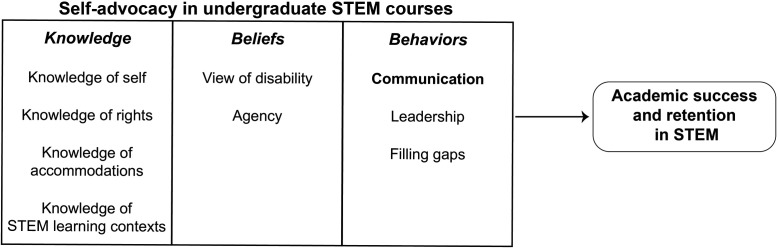
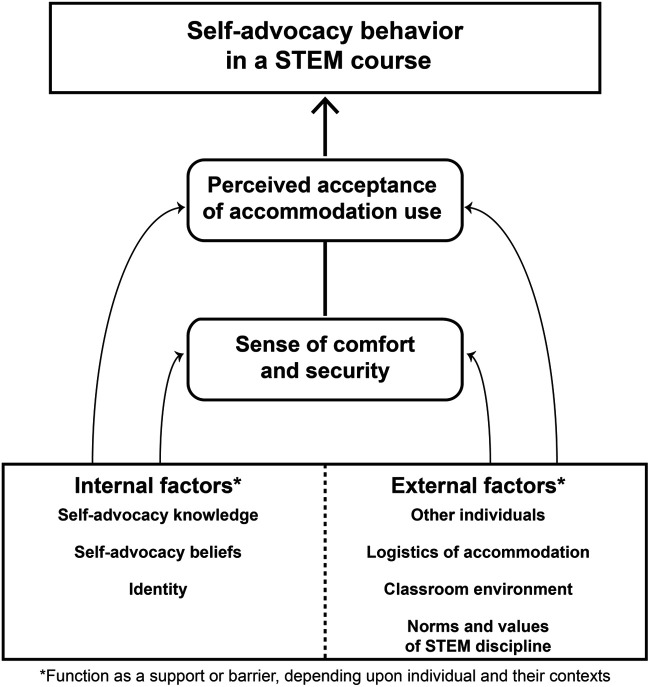
Self-advocacy is linked to the success and retention of students with disabilities in college. Self-advocacy is defined as communicating individual wants, needs, and rights to determine and pursue required accommodations. While self-advocacy is linked to academic success, little is known about how students with disabilities in science, technology, engineering, and mathematics (STEM) practice self-advocacy. We previously developed a model of self-advocacy for STEM students with attention-deficit/hyperactivity disorder (ADHD) and/or specific learning disabilities (SLD). Here, we use this model to examine what factors support or hinder self-advocacy in undergraduate STEM courses. We conducted semistructured interviews with 25 STEM majors with ADHD and/or SLD and used qualitative approaches to analyze our data. We found internal factors, or factors within a participant, and external factors, the situations and people, described by our participants, that influenced self-advocacy. These factors often interacted and functioned as a support or barrier, depending on the individuals and their unique experiences. We developed a model to understand how factors supported or hindered self-advocacy in STEM. Supporting factors contributed to a sense of comfort and security for our participants and informed their perceptions that accommodation use was accepted in a STEM course. We share implications for research and teaching based on our results.
Overview
The claims and statistics of this paper haven’t been checked yet.
Run the check — free, no account needed. It reads the open-access text and checks the sources it cites.
Integrity signals
Registry
Cites
Statistics
Figures
Verification
Claims the paper makes
The claims and statistics of this paper haven’t been checked yet.
Run the check — free, no account needed. It reads the open-access text and checks the sources it cites.
Claims other papers make about this one
Each is checked against this paper’s own text: does it say what the citing paper says it does?
The source backs part of the claim, not all of it — or backs it for a different population, condition or comparison.
In the citing paper
“In the HE context, common barriers to full inclusion that have been mentioned by students include negative faculty attitudes [50, 76, 85, 103], stigma [112], college stressors [50], the quality and accessibility of disability support services [50, 78], inaccessible course design and digital materials [78, 102], fi nances [109], and balancing academic and social lives [59, 75, 78].”
From "I'd Never Actually Realized How Big An Impact It Had Until Now": Perspectives of University Students with Disabilities on Generative Artificial Intelligence (2025) · cites this paper as [85]
Experimental — accuracy not yet measured
Self-check
Percentages, sums and reported differences re-computed from the paper’s own numbers.
The self-check needs the paper’s full text.
Citations
Cites
Qualitative Quality: Eight “Big-Tent” Criteria for Excellent Qualitative Research
Tracy, S. J. (2010) · Qualitative Inquiry · doi:10.1177/1077800410383121 · Cited by 7,536 · cited 2×
“We deliver detailed methods and provide our codebook in Supplemental File 2, highlighting our data analysis procedures so that readers may assess our processes (Krefting, 1991; Tracy, 2010; Richards and Hemphill, 2018).”
MethodComorbidity of LD and ADHD: Implications of DSM-5 for Assessment and Treatment
DuPaul, G. J., Gormley, M. J., & Laracy, S. D. (2013) · Journal of Learning Disabilities · doi:10.1177/0022219412464351 · Cited by 451
Harrison, C. D., Nguyen, T. A., Seidel, S. B., Escobedo, A. M., Hartman, C., Lam, K., Liang, K. S., Martens, M., Acker, G. N., Akana, S. F., et al. (2019) · CBE—Life Sciences Education · doi:10.1187/cbe.18-10-0215 · Cited by 54
Research works printed but not linked: 62
- American Psychiatric Association, 2013, Diagnostic and statistical manual for mental disorders, 10.1176/appi.books.9780890425596 · DOI · Paper page
- Ben-Moshe L., 2014, Women, Gender, and Families of Color, 2, 105, 10.5406/womgenfamcol.2.2.0105 · DOI
- 10.3310/phr04080 · DOI
- 10.1187/cbe.15-07-0155 · DOI
- Budd J., 2016, Journal of Education and Training Studies, 4, 206, 10.11114/jets.v4i4.1255 · DOI
- Cawthon S. W., 2010, Journal of Postsecondary Education and disability, 23, 112
- Charlton J., 2010, Disability Studies Reader, 3, 147
- Charmaz K., 2006, Constructing grounded theory: A practical guide through qualitative analysis
- Cole E. V., 2015, Journal of Postsecondary Education and Disability, 28, 163
- Daly-Cano M., 2015, Journal of Postsecondary Education and Disability, 28, 213
- 10.1187/cbe.19-01-0021 · DOI
- 10.1177/1053451212443151 · DOI
- Dunn D. S., 2015, American Psychologist, 70, 255, 10.1037/a0038636 · DOI
- Eckes S. E., 2005, American Secondary Education, 33, 6
- Fram S. M., 2013, Qualitative Report, 18, 1
- 10.1177/0885728808317658 · DOI
- 10.1187/cbe.20-03-0049 · DOI
- Gokool-Baurhoo N., 2019, Teaching and Teacher Education, 79, 17, 10.1016/j.tate.2018.11.016 · DOI
- Goodley D., 1997, Disability & Society, 12, 367, 10.1080/09687599727227 · DOI
- Hadley W. M., 2007, Journal of College Admission, 195, 9
- 10.1080/00336297.2016.1143849 · DOI
- Harbour W. S., 2017, Campus climate and students with disabilities
- Hedrick B., 2010, Journal of Postsecondary Education and Disability, 23, 129
- Ireland D. T., 2018, Review of Research in Education, 42, 226, 10.3102/0091732X18759072 · DOI
- Isaacson M. D., 2015, Journal of Science Education for Students with Disabilities, 18, 1, 10.14448/jsesd.07.0001 · DOI
- Isaacson M. D., 2011, Journal of Science Education for Students with Disabilities, 15, 5
- Janiga S. J., 2002, Journal of Learning Disabilities, 35, 463, 10.1177/00222194020350050601 · DOI
- Johnson R. B., 1997, Education, 118, 282
- Keller R. M., 2010, Microaggressions and marginality: Manifestation, dynamics, and impact, 241
- Kinney A. R., 2017, Journal of Postsecondary Education and Disability, 30, 343
- Krefting L., 1991, American Journal of Occupational Therapy, 45, 214, 10.5014/ajot.45.3.214 · DOI · Paper page
- 10.3389/fpsyg.2018.01466 · DOI
- Kurth N., 2006, Journal of Postsecondary Education and Disability, 19, 71
- Lee A., 2011, Career Development for Exceptional Individuals, 34, 72, 10.1177/0885728810386591 · DOI
- Lee A., 2014, Journal of Postsecondary Education and Disability, 27, 261
- Lombardi A., 2011, Journal of Student Affairs Research and Practice, 48, 107, 10.2202/1949-6605.6214 · DOI
- Love T. S., 2014, Journal of Education and Training Studies, 3, 27
- Majocha M., 2018, Journal of Microbiology & Biology Education, 19, 10.1128/jmbe.v19i1.1381 · DOI
- Martin J. E., 1995, Intervention in School and Clinic, 30, 147, 10.1177/105345129503000304 · DOI
- 10.1080/22054952.2020.1720434 · DOI
- Moon N. W., 2012, Accommodating students with disabilities in science, technology, engineering, and mathematics (STEM)
- Mullins L., 2013, Disability & Society, 28, 147, 10.1080/09687599.2012.752127 · DOI · Paper page
- Ofiesh N. S., 2007, Learning Disabilities Research & Practice, 22, 237, 10.1111/j.1540-5826.2007.00252.x · DOI
- Olson J. D., 2016, Qualitative Report, 21, 26
- Pham A. V., 2015, Current Psychiatry Reports, 17, 38, 10.1007/s11920-015-0584-y · DOI
- Pfeifer M. A., 2020, International Journal of STEM Education, 7, 1, 10.1186/s40594-020-00233-4 · DOI
- Richard M. M., 1995, Journal of Postsecondary Education and Disability, 11, 16
- Richards K. A. R., 2018, Journal of Teaching in Physical Education, 37, 225, 10.1123/jtpe.2017-0084 · DOI
- 10.1037/dhe0000176 · DOI
- S J., 2015, The coding manual for qualitative researchers
- 10.1186/s40594-019-0161-8 · DOI
- Sinclair J., 2013, Autonomy, the Critical Journal of Interdisciplinary Autism Studies, 1
- Smith T. E., 2001, Remedial and Special Education, 22, 335, 10.1177/074193250102200603 · DOI
- 10.1187/cbe.18-12-0239 · DOI
- Stodden R. A., 2011, New Directions for Higher Education, 154, 83, 10.1002/he.437 · DOI
- Tinto V., 1993, Leaving college: Rethinking the causes and cures of student attrition
- Trammell J., 2009, Learning Assistance Review, 14, 21
- 10.1126/science.aba6129 · DOI
- 10.1002/ir.20084 · DOI
- Villarreal P., 2002, Faculty knowledge of disability law: Implications for higher education practice
- Wehmeyer M. L., 2003, Theory in self-determination: Foundations for educational practice
- Wolf L. E., 2001, Annals of the New York Academy of Sciences, 931, 385, 10.1111/j.1749-6632.2001.tb05792.x · DOI
Cited by
Atcheson, A., Khan, O., Siemann, B., Jain, A., & Karahalios, K. (2025) · Proceedings of the 2025 CHI Conference on Human Factors in Computing Systems · doi:10.1145/3706598.3714121 · Cited by 22
Bartolo, P. A., Borg, M., Callus, A.-M., De Gaetano, A., Mangiafico, M., Mazzacano D’Amato, E., Sammut, C., Vella Vidal, R., & Vincent, J. (2023) · Frontiers in Education · doi:10.3389/feduc.2023.1218120 · Cited by 24
Metadata
- Authors
- Pfeifer, M. A., Reiter, E. M., Cordero, J. J., & Stanton, J. D.
- Affiliations
- University of Georgia (US)
- Corresponding author
- Stanton, Julie Dangremond
- Venue
- CBE—Life Sciences Education
- Published
- 2021-06
- Volume
- 20
- Issue
- 2
- Pages
- ar17
- ISSN
- 1931-7913 (ISSN-L)
- PMC
- PMC8734393
- OpenAlex
- W3138652959
- Cited by
- 85
- References
- 3
- Citations by year
- 2026: 14 · 2025: 22 · 2024: 28 · 2023: 9 · 2022: 8 · 2021: 4
- FWCI
- 15.32
- Type
- journal article
- Language
- en
- Open access
- diamond
- doi.org
- Licence
- cc-by-nc-sa
- Locations
- CBE—Life Sciences Education (publishedVersion, cc-by-nc-sa)
- PubMed Central (publishedVersion, cc-by-nc-sa)
- PubMed (publishedVersion)
- Topics
- Social Sciences › Education › Disability Education and Employment
- Social Sciences › Sociology and Political Science › Disability Rights and Representation
- Social Sciences › Education › Inclusion and Disability in Education and Sport
- Keywords
- self-advocacy, attention deficit hyperactivity disorder, specific learning disabilities, STEM students, academic accommodations, student retention, internal and external factors, models of disability, higher education
- MeSH terms
- Attention Deficit Disorder with Hyperactivity, Humans, Learning Disabilities, Mathematics, Students, Technology
About these checks
Registry, retraction, Cites and statistics results are computed, not judged, with one exception: a printed reference that no index lists is read once by a model before it counts as a citation error. Claims are extracted by a model and kept only when their quote appears verbatim in the text; each cited source is then checked, with a model’s help, for whether it says what the claim relies on. Those verdicts can be wrong — read the claim’s quote and the cited source before relying on one.
Statistics and arithmetic are recomputed, not judged.
Confidence bands are shown only for fields calibrated on our annotated test set. None is calibrated yet, so no band is shown.
What counts as a claim ›How we measure confidence ›How we check this ›
Are you an author, or do you see a problem with this page? Request a review
Data sources
Bibliographic data: Semantic Scholar, OpenAlex, Crossref.
Contains information from the Semantic Scholar Academic Graph Datasets, made available under the ODC Attribution License (ODC-BY 1.0).
Semantic Scholar’s data is described in: Kinney, R., et al. (2023). The Semantic Scholar Open Data Platform. arXiv:2301.10140.
