

The DOI matches its Crossref record; 59 of the 59 references it cites were found in a registry or an index.
Maternal depression during pregnancy and offspring depression in adulthood: Role of child maltreatment
Open accessAbstract
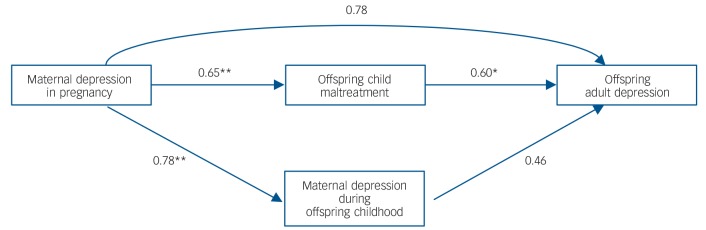
BACKGROUND: Studies have shown that maternal depression during pregnancy predicts offspring depression in adolescence. Child maltreatment is also a risk factor for depression. AIMS: To investigate (a) whether there is an association between offspring exposure to maternal depression in pregnancy and depression in early adulthood, and (b) whether offspring child maltreatment mediates this association. METHOD: Prospectively collected data on maternal clinical depression in pregnancy, offspring child maltreatment and offspring adulthood (18-25 years) DSM-IV depression were analysed in 103 mother-offspring dyads of the South London Child Development Study. RESULTS: Adult offspring exposed to maternal depression in pregnancy were 3.4 times more likely to have a DSM-IV depressive disorder, and 2.4 times more likely to have experienced child maltreatment, compared with non-exposed offspring. Path analysis revealed that offspring experience of child maltreatment mediated the association between exposure to maternal depression in pregnancy and depression in adulthood. CONCLUSIONS: Maternal depression in pregnancy is a key vulnerability factor for offspring depression in early adulthood.
Overview
The claims and statistics of this paper haven’t been checked yet.
Run the check — free, no account needed. It reads the open-access text and checks the sources it cites.
Integrity signals
Registry
Cites
Statistics
Figures
Verification
Claims the paper makes
The claims and statistics of this paper haven’t been checked yet.
Run the check — free, no account needed. It reads the open-access text and checks the sources it cites.
Claims other papers make about this one
Each is checked against this paper’s own text: does it say what the citing paper says it does?
In the citing paper
“association that is mediated, at least in part, by an increased risk of the offspring being exposed to maltreatment and other stressful events in childhood (Plant et al., 2013(Plant et al., , 2015)).”
From Why are depressed patients inflamed? A reflection on 20 years of research on depression, glucocorticoid resistance and inflammation (2017) · cites this paper as Plant et al., 2015
Self-check
Percentages, sums and reported differences re-computed from the paper’s own numbers.
The self-check needs the paper’s full text.
Citations
Cites
(2013) · Cited by 44,563
Molecular Mechanisms of Depression: Perspectives on New Treatment Strategies
Lang, U. E., & Borgwardt, S. (2013) · Cellular Physiology and Biochemistry · doi:10.1159/000350094 · Cited by 8,526
Spitzer, R. L. (1978) · Archives of General Psychiatry · doi:10.1001/archpsyc.1978.01770300115013 · Cited by 6,946
A Meta-Analysis of Cytokines in Major Depression
Dowlati, Y., Herrmann, N., Swardfager, W., Liu, H., Sham, L., Reim, E. K., & Lanctôt, K. L. (2010) · Biological Psychiatry · doi:10.1016/j.biopsych.2009.09.033 · Cited by 4,729
Fetal origins of coronary heart disease
Barker, D. J. P. (1995) · BMJ · doi:10.1136/bmj.311.6998.171 · Cited by 3,570
Norman, R. E., Byambaa, M., De, R., Butchart, A., Scott, J., & Vos, T. (2012) · PLoS Medicine · doi:10.1371/journal.pmed.1001349 · Cited by 3,387
Green, J. G., McLaughlin, K. A., Berglund, P. A., Gruber, M. J., Sampson, N. A., Zaslavsky, A. M., & Kessler, R. C. (2010) · Archives of General Psychiatry · doi:10.1001/archgenpsychiatry.2009.186 · Cited by 2,323
The HPA axis in major depression: classical theories and new developments
Pariante, C. M., & Lightman, S. L. (2008) · Trends in Neurosciences · doi:10.1016/j.tins.2008.06.006 · Cited by 2,009
Self-citationNanni, V., Uher, R., & Danese, A. (2012) · American Journal of Psychiatry · doi:10.1176/appi.ajp.2011.11020335 · Cited by 1,480
Antenatal maternal stress and long‐term effects on child neurodevelopment: how and why?
Talge, N. M., Neal, C., Glover, V., & the Early Stress, T. R. A. P. S. N. F. A. N. E. O. C. A. A. M. H. (2007) · Journal of Child Psychology and Psychiatry · doi:10.1111/j.1469-7610.2006.01714.x · Cited by 1,349
Research works printed but not linked: 4
- Sharp, 1992, Childbirth Related Emotional Disorders in Primary Care: A Longitudinal Prospective Study
- First, 1996, Structured Clinical Interview for DSM-IV Axis I Disorders, Clinician Version (SCID-CV).
- 1978, Mental Disorders: Glossary and Guide to Their Classification in Accordance with the 9th Revision
- 2007, Antenatal and Postnatal Mental Health: Clinical Management and Service Guidance. NICE Clinical Guidelines, No. 45
Cited by
Sorted by citations
Identifying the women at risk of antenatal anxiety and depression: a systematic review
Biaggi, A., Conroy, S., Pawlby, S., & Pariante, C. M. (2016) · Journal of Affective Disorders · doi:10.1016/j.jad.2015.11.014 · Cited by 1,657
Self-citationVan den Bergh, B. R. H., van den Heuvel, M. I., Lahti, M., Braeken, M., de Rooij, S. R., Entringer, S., Hoyer, D., Roseboom, T., Räikkönen, K., King, S., et al. (2020) · Neuroscience & Biobehavioral Reviews · doi:10.1016/j.neubiorev.2017.07.003 · Cited by 1,181
Perinatal mental health: a review of progress and challenges
Howard, L. M., & Khalifeh, H. (2020) · World Psychiatry · doi:10.1002/wps.20769 · Cited by 1,118
Baldwin, J. R., Reuben, A., Newbury, J. B., & Danese, A. (2019) · JAMA Psychiatry · doi:10.1001/jamapsychiatry.2019.0097 · Cited by 1,094
Pariante, C. M. (2017) · European Neuropsychopharmacology · doi:10.1016/j.euroneuro.2017.04.001 · Cited by 382
Self-citation
Metadata
- Authors
- Plant, D. T., Pariante, C. M., Sharp, D., & Pawlby, S.
- Affiliations
- King's College London (GB)
- Corresponding author
- Plant, Dominic T.
- Venue
- British Journal of Psychiatry
- Publisher
- Royal College of Psychiatrists
- Published
- 2015-09
- Volume
- 207
- Issue
- 3
- Pages
- 213-220
- ISSN
- 0007-1250 (ISSN-L)
- 1472-1465
- PMC
- PMC4555443
- OpenAlex
- W1857560301
- Cited by
- 184
- References
- 59
- Citations by year
- 2026: 8 · 2025: 13 · 2024: 15 · 2023: 15 · 2022: 18 · 2021: 21 · 2020: 27 · 2019: 21 · 2018: 17 · 2017: 18 · 2016: 9 · 2015: 2
- FWCI
- 16.41
- Type
- journal article
- Language
- en
- Open access
- hybrid
- doi.org
- Locations
- The British Journal of Psychiatry (publishedVersion, cc-by)
- Europe PMC (PubMed Central) (publishedVersion, cc-by)
- PubMed Central (publishedVersion, cc-by)
- PubMed (publishedVersion)
- Research Portal (King's College London) (submittedVersion, cc-by)
- Funders
- Wellcome Trust
- Psychiatry Research Trust
- National Institute for Health and Care Research
- King's College London
- Cardiff University
- Medical Research Council (MR/J002739/1)
- Topics
- Health Sciences › Medicine › Public Health, Environmental and Occupational Health › Maternal Mental Health During Pregnancy and Postpartum
- Social Sciences › Psychology › Clinical Psychology › Child Abuse and Trauma
- Social Sciences › Psychology › Clinical Psychology › Child and Adolescent Psychosocial and Emotional Development
- Keywords
- maternal depression, pregnancy, offspring depression, early adulthood, child abuse, mediation, intergenerational transmission, vulnerability factors
- MeSH terms
- Adolescent, Adult, Child, Child Abuse, Child, Preschool, Depressive Disorder, Female, Humans, Longitudinal Studies, Pregnancy, Pregnancy Complications, Prenatal Exposure Delayed Effects, Prospective Studies, Depression, Postpartum, Adult Survivors of Child Abuse, Young Adult
About these checks
Registry, retraction, Cites and statistics results are computed, not judged, with one exception: a printed reference that no index lists is read once by a model before it counts as a citation error. Claims are extracted by a model and kept only when their quote appears verbatim in the text; each cited source is then checked, with a model’s help, for whether it says what the claim relies on. Those verdicts can be wrong — read the claim’s quote and the cited source before relying on one.
Statistics and arithmetic are recomputed, not judged.
Confidence bands are shown only for fields calibrated on our annotated test set. None is calibrated yet, so no band is shown.
What counts as a claim ›How we measure confidence ›How we check this ›
Are you an author, or do you see a problem with this page? Request a review
