

The DOI matches its Crossref record; 60 of the 60 references it cites were found in a registry or an index.
Social isolation, mental health, and use of digital interventions in youth during the COVID-19 pandemic: A nationally representative survey
Open accessPublished version of a preprint
Abstract
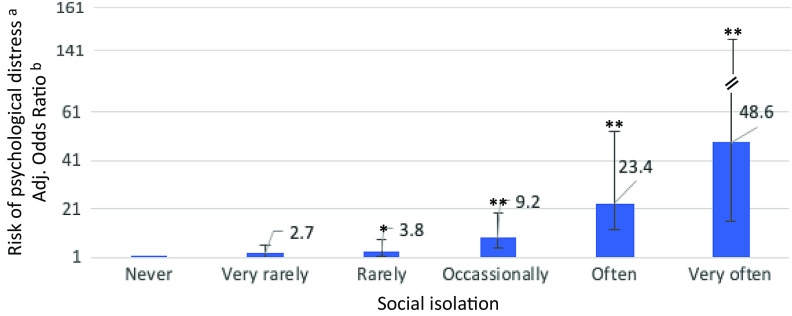
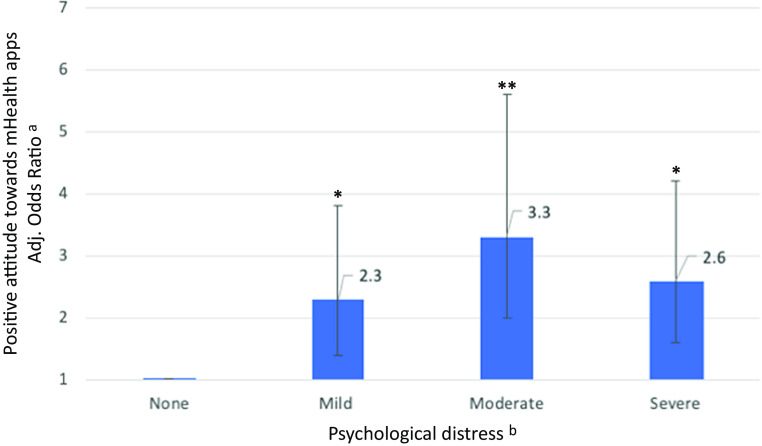
Background: Public health measures to curb SARS-CoV-2 transmission rates may have negative psychosocial consequences in youth. Digital interventions may help to mitigate these effects. We investigated the associations between social isolation, COVID-19-related cognitive preoccupation, worries, and anxiety, objective social risk indicators, and psychological distress, as well as use of, and attitude toward, mobile health (mHealth) interventions in youth. Methods: Data were collected as part of the “Mental Health And Innovation During COVID-19 Survey”—a cross-sectional panel study including a representative sample of individuals aged 16–25 years ( N = 666; M age = 21.3; assessment period: May 5, 2020 to May 16, 2020). Results: Overall, 38% of youth met criteria for moderate or severe psychological distress. Social isolation worries and anxiety, and objective risk indicators were associated with psychological distress, with evidence of dose–response relationships for some of these associations. For instance, psychological distress was progressively more likely to occur as levels of social isolation increased (reporting “never” as reference group: “occasionally”: adjusted odds ratio [aOR] 9.1, 95% confidence interval [CI] 4.3–19.1, p < 0.001; “often”: aOR 22.2, CI 9.8–50.2, p < 0.001; “very often”: aOR 42.3, CI 14.1–126.8, p < 0.001). There was evidence that psychological distress, worries, and anxiety were associated with a positive attitude toward using mHealth interventions, whereas psychological distress, worries, and anxiety were associated with actual use. Conclusions: Public health measures during pandemics may be associated with poor mental health outcomes in youth. Evidence-based digital interventions may help mitigate the negative psychosocial impact without risk of viral infection given there is an objective need and subjective demand.
Overview
The claims and statistics of this paper haven’t been checked yet.
Run the check — free, no account needed. It reads the open-access text and checks the sources it cites.
Integrity signals
Registry
Cites
Statistics
Figures
Verification
Claims the paper makes
The claims and statistics of this paper haven’t been checked yet.
Run the check — free, no account needed. It reads the open-access text and checks the sources it cites.
Claims other papers make about this one
Each is checked against this paper’s own text: does it say what the citing paper says it does?
The source backs part of the claim, not all of it — or backs it for a different population, condition or comparison.
In the citing paper
“The online approach can reduce the possibility of infection caused by person-toperson contact and the cost of the client ' s access to services (Rauschenberg et al., 2021; Wasil et al., 2021).”
From The Online Strength-Informed Acceptance and Commitment Therapy Among COVID-19-Affected Adolescents. (2022) · cites this paper as Rauschenberg et al., 2021
Experimental — accuracy not yet measured
Self-check
Percentages, sums and reported differences re-computed from the paper’s own numbers.
The self-check needs the paper’s full text.
Citations
Cites
KESSLER, R. C., ANDREWS, G., COLPE, L. J., HIRIPI, E., MROCZEK, D. K., NORMAND, S.-L. T., WALTERS, E. E., & ZASLAVSKY, A. M. (2002) · Psychological Medicine · doi:10.1017/s0033291702006074 · Cited by 10,327
The environment and disease: association or causation?
Hill, A. B. (2015) · Journal of the Royal Society of Medicine · doi:10.1177/0141076814562718 · Cited by 7,804
The Environment and Disease: Association or Causation?
Hill, A. B. (1965) · Proceedings of the Royal Society of Medicine · doi:10.1177/003591576505800503 · Cited by 6,974
Holmes, E. A., O'Connor, R. C., Perry, V. H., Tracey, I., Wessely, S., Arseneault, L., Ballard, C., Christensen, H., Cohen Silver, R., Everall, I., et al. (2020) · The Lancet Psychiatry · doi:10.1016/s2215-0366(20)30168-1 · Cited by 5,715
The Revised UCLA Loneliness Scale: concurrent and discriminant validity evidence
Russell, D., Peplau, L. A., & Cutrona, C. E. (1980) · Journal of Personality and Social Psychology · doi:10.1037/0022-3514.39.3.472 · Cited by 5,173
A Short Scale for Measuring Loneliness in Large Surveys: Results From Two Population-Based Studies
Hughes, M. E., Waite, L. J., Hawkley, L. C., & Cacioppo, J. T. (2004) · Research on Aging · doi:10.1177/0164027504268574 · Cited by 4,781
Huang, Y., & Zhao, N. (2020) · Psychiatry Research · doi:10.1016/j.psychres.2020.112954 · Cited by 3,736
Salari, N., Hosseinian-Far, A., Jalali, R., Vaisi-Raygani, A., Rasoulpoor, S., Mohammadi, M., Rasoulpoor, S., & Khaledi-Paveh, B. (2020) · Globalization and Health · doi:10.1186/s12992-020-00589-w · Cited by 3,560
Pierce, M., Hope, H., Ford, T., Hatch, S., Hotopf, M., John, A., Kontopantelis, E., Webb, R., Wessely, S., McManus, S., et al. (2020) · The Lancet Psychiatry · doi:10.1016/s2215-0366(20)30308-4 · Cited by 2,621
Leigh-Hunt, N., Bagguley, D., Bash, K., Turner, V., Turnbull, S., Valtorta, N., & Caan, W. (2017) · Public Health · doi:10.1016/j.puhe.2017.07.035 · Cited by 2,158
Research works printed but not linked: 1
- Mallet, 1997, MRC sociodemographic schedule
Cited by
Sorted by citations
Review: Mental health impacts of the COVID‐19 pandemic on children and youth – a systematic review
Samji, H., Wu, J., Ladak, A., Vossen, C., Stewart, E., Dove, N., Long, D., & Snell, G. (2022) · Child and Adolescent Mental Health · doi:10.1111/camh.12501 · Cited by 953
Nochaiwong, S., Ruengorn, C., Thavorn, K., Hutton, B., Awiphan, R., Phosuya, C., Ruanta, Y., Wongpakaran, N., & Wongpakaran, T. (2021) · Scientific Reports · doi:10.1038/s41598-021-89700-8 · Cited by 743
Philippe, T. J., Sikder, N., Jackson, A., Koblanski, M. E., Liow, E., Pilarinos, A., & Vasarhelyi, K. (2022) · JMIR Mental Health · doi:10.2196/35159 · Cited by 436
Labrague, L. J., De los Santos, J. A. A., & Falguera, C. C. (2021) · Perspectives in Psychiatric Care · doi:10.1111/ppc.12721 · Cited by 276
Rauschenberg, C., Schick, A., Hirjak, D., Seidler, A., Paetzold, I., Apfelbacher, C., Riedel-Heller, S. G., & Reininghaus, U. (2021) · Journal of Medical Internet Research · doi:10.2196/23365 · Cited by 205
Self-citation
Metadata
- Authors
- Rauschenberg, C., Schick, A., Goetzl, C., Roehr, S., Riedel-Heller, S. G., Koppe, G., Durstewitz, D., Krumm, S., & Reininghaus, U.
- Affiliations
- Heidelberg University (DE)
- Leipzig University (DE)
- Universität Ulm (DE)
- King's College London (GB)
- Corresponding author
- Rauschenberg, Christian
- ORCID
- Venue
- European Psychiatry
- Publisher
- Royal College of Psychiatrists
- Published
- 2021
- Volume
- 64
- Issue
- 1
- Pages
- e20-e20
- ISSN
- 0924-9338 (ISSN-L)
- 1778-3585
- PMC
- PMC7985650
- OpenAlex
- W3134046440
- Cited by
- 158
- References
- 60
- Citations by year
- 2026: 6 · 2025: 21 · 2024: 27 · 2023: 37 · 2022: 38 · 2021: 28
- FWCI
- 22.34
- Type
- journal article
- Language
- en
- Open access
- gold
- doi.org
- Locations
- European Psychiatry (publishedVersion, cc-by)
- PubMed Central (publishedVersion, cc-by)
- PubMed (publishedVersion)
- Research Publications (Maastricht University) (publishedVersion, cc-by-nc-nd)
- DOAJ (DOAJ: Directory of Open Access Journals) (submittedVersion)
- Research Portal (King's College London) (submittedVersion, other-oa)
- PsyArXiv (OSF Preprints) (submittedVersion, cc-by)
- PsyArXiv (OSF Preprints) (submittedVersion)
- Research Publications (Maastricht University) (submittedVersion, other-oa)
- Topics
- Social Sciences › Psychology › Clinical Psychology › COVID-19 and Mental Health
- Social Sciences › Psychology › Applied Psychology › Digital Mental Health Interventions
- Social Sciences › Sociology and Political Science › Impact of Technology on Adolescents
- Keywords
- social isolation, youth mental health, COVID-19 pandemic, mobile health intervention, digital interventions, psychological distress, anxiety, worry, public health measures, adolescents and young adults
- MeSH terms
- Internet-Based Intervention, COVID-19, SARS-CoV-2, Anxiety, Cross-Sectional Studies, Female, Germany, Humans, Male, Mental Health, Quarantine, Social Isolation, Stress, Psychological, Telemedicine, Young Adult
About these checks
Registry, retraction, Cites and statistics results are computed, not judged, with one exception: a printed reference that no index lists is read once by a model before it counts as a citation error. Claims are extracted by a model and kept only when their quote appears verbatim in the text; each cited source is then checked, with a model’s help, for whether it says what the claim relies on. Those verdicts can be wrong — read the claim’s quote and the cited source before relying on one.
Statistics and arithmetic are recomputed, not judged.
Confidence bands are shown only for fields calibrated on our annotated test set. None is calibrated yet, so no band is shown.
What counts as a claim ›How we measure confidence ›How we check this ›
Are you an author, or do you see a problem with this page? Request a review
