

The DOI matches its Crossref record; 37 of the 37 references it cites were found in a registry or an index.
Temozolomide Followed by Combination With Low-Dose Ipilimumab and Nivolumab in Patients With Microsatellite-Stable, O6-Methylguanine–DNA Methyltransferase–Silenced Metastatic Colorectal Cancer: The MAYA Trial
Open accessAbstract
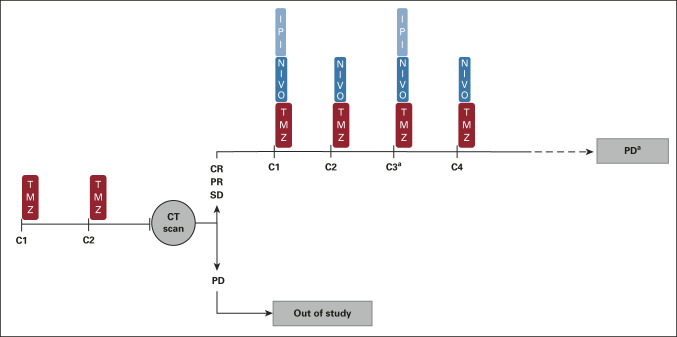
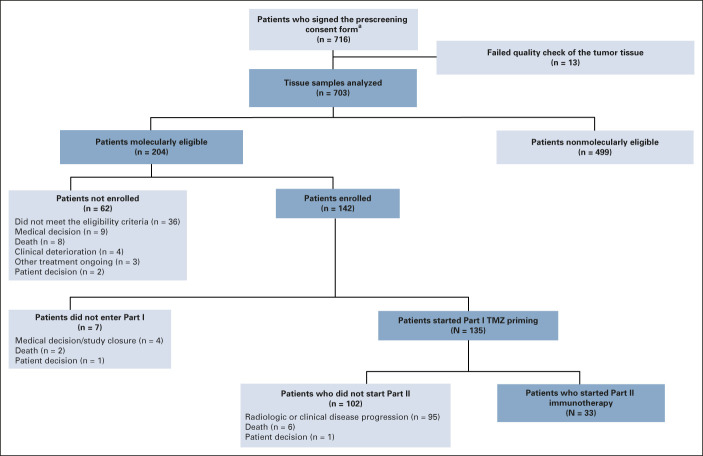
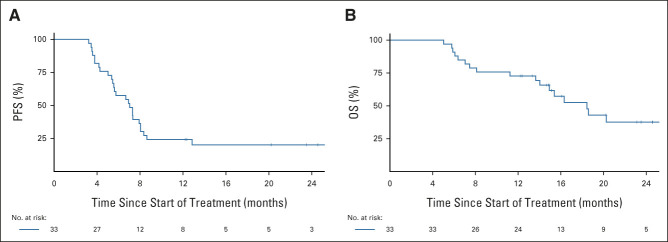
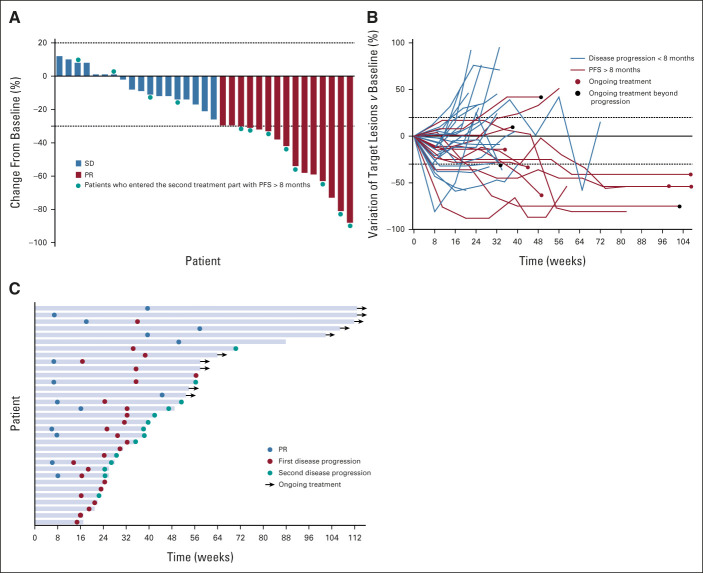
PURPOSE: This is a multicenter, single-arm phase II trial evaluating the efficacy and safety of an immune-sensitizing strategy with temozolomide priming followed by a combination of low-dose ipilimumab and nivolumab in patients with microsatellite-stable (MSS) and O 6-methylguanine–DNA methyltransferase (MGMT)–silenced metastatic colorectal cancer (mCRC). PATIENTS AND METHODS: Patients with pretreated mCRC were centrally prescreened for MSS status and MGMT silencing (ie, lack of MGMT expression by immunohistochemistry plus MGMT methylation by pyrosequencing). Eligible patients received two priming cycles of oral temozolomide 150 mg/sqm once daily, days 1-5, once every 4 weeks (first treatment part) followed, in absence of progression, by its combination with ipilimumab 1 mg/kg once every 8 weeks and nivolumab 480 mg once every 4 weeks (second treatment part). The primary end point was the 8-month progression-free survival (PFS) rate calculated from enrollment in patients who started the second treatment part, with ≥ 4 out of 27 subjects progression-free by the 8-month time point as decision rule. RESULTS: Among 716 prescreened patients, 204 (29%) were molecularly eligible and 135 started the first treatment part. Among these, 102 (76%) were discontinued because of death or disease progression on temozolomide priming, whereas 33 patients (24%) who achieved disease control started the second treatment part and represented the final study population. After a median follow-up of 23.1 months (interquartile range, 14.9-24.6 months), 8-month PFS rate was 36%. Median PFS and overall survival were 7.0 and 18.4 months, respectively, and overall response rate was 45%. Grade 3-4 immune-related adverse events were skin rash (6%), colitis (3%), and hypophysitis (3%). No unexpected adverse events or treatment-related deaths were reported. CONCLUSION: The MAYA study provided proof-of-concept that a sequence of temozolomide priming followed by a combination of low-dose ipilimumab and nivolumab may induce durable clinical benefit in MSS and MGMT-silenced mCRC.
Overview
The claims and statistics of this paper haven’t been checked yet.
Run the check — free, no account needed. It reads the open-access text and checks the sources it cites.
Integrity signals
Registry
Cites
Statistics
Figures
Verification
Claims the paper makes
The claims and statistics of this paper haven’t been checked yet.
Run the check — free, no account needed. It reads the open-access text and checks the sources it cites.
Claims other papers make about this one
Each is checked against this paper’s own text: does it say what the citing paper says it does?
In the citing paper
“All patients in the ARETHUSA study were RAS mutant patients, and the majority (72%) of the patients in the MAYA study were RAS mutant patients.”
From RAS Mutations in Advanced Colorectal Cancer: Mechanisms, Clinical Implications, and Novel Therapeutic Approaches (2025) · cites this paper as [90]
In the citing paper
“With this combination treatment, an mPFS of 7.1 months (95% CI, 5.6–8.4) was observed.”
From RAS Mutations in Advanced Colorectal Cancer: Mechanisms, Clinical Implications, and Novel Therapeutic Approaches (2025) · cites this paper as [90]
In the citing paper
“In the MAYA study, there was no significant difference in the objective response rates of TMZ and IO between RAS mutant and wild patients (p = 0.660).”
From RAS Mutations in Advanced Colorectal Cancer: Mechanisms, Clinical Implications, and Novel Therapeutic Approaches (2025) · cites this paper as [90]
Self-check
Percentages, sums and reported differences re-computed from the paper’s own numbers.
The self-check needs the paper’s full text.
Citations
Cites
Signatures of mutational processes in human cancer
Initiative, A. P. C. G., Alexandrov, L. B., ICGC Breast Cancer Consortium, ICGC MMML-Seq Consortium, PedBrain, I., Nik-Zainal, S., Wedge, D. C., Aparicio, S. A. J. R., Behjati, S., Biankin, A. V., et al. (2013) · Nature · doi:10.1038/nature12477 · Cited by 9,660
MGMT Gene Silencing and Benefit from Temozolomide in Glioblastoma
Hegi, M. E., Diserens, A.-C., Gorlia, T., Hamou, M.-F., de Tribolet, N., Weller, M., Kros, J. M., Hainfellner, J. A., Mason, W., Mariani, L., et al. (2005) · New England Journal of Medicine · doi:10.1056/nejmoa043331 · Cited by 7,405
The repertoire of mutational signatures in human cancer
Alexandrov, L. B., Kim, J., Haradhvala, N. J., Huang, M. N., Tian Ng, A. W., Wu, Y., Boot, A., Covington, K. R., Gordenin, D. A., Bergstrom, E. N., et al. (2020) · Nature · doi:10.1038/s41586-020-1943-3 · Cited by 3,496
Pembrolizumab in Microsatellite-Instability-High Advanced Colorectal Cancer
André, T., Shiu, K.-K., Kim, T. W., Jensen, B. V., Jensen, L. H., Punt, C., Smith, D., Garcia-Carbonero, R., Benavides, M., Gibbs, P., et al. (2020) · New England Journal of Medicine · doi:10.1056/nejmoa2017699 · Cited by 3,099
Grothey, A., Cutsem, E. V., Sobrero, A., Siena, S., Falcone, A., Ychou, M., Humblet, Y., Bouché, O., Mineur, L., Barone, C., et al. (2013) · The Lancet · doi:10.1016/s0140-6736(12)61900-x · Cited by 2,895
Overman, M. J., McDermott, R., Leach, J. L., Lonardi, S., Lenz, H.-J., Morse, M. A., Desai, J., Hill, A., Axelson, M., Moss, R. A., et al. (2017) · The Lancet Oncology · doi:10.1016/s1470-2045(17)30422-9 · Cited by 2,836
Self-citationiRECIST: guidelines for response criteria for use in trials testing immunotherapeutics
Seymour, L., Bogaerts, J., Perrone, A., Ford, R., Schwartz, L. H., Mandrekar, S., Lin, N. U., Litière, S., Dancey, J., Chen, A., et al. (2017) · The Lancet Oncology · doi:10.1016/s1470-2045(17)30074-8 · Cited by 2,472
Overman, M. J., Lonardi, S., Wong, K. Y. M., Lenz, H.-J., Gelsomino, F., Aglietta, M., Morse, M. A., Van Cutsem, E., McDermott, R., Hill, A., et al. (2018) · Journal of Clinical Oncology · doi:10.1200/jco.2017.76.9901 · Cited by 2,079
Self-citationLlosa, N. J., Cruise, M., Tam, A., Wicks, E. C., Hechenbleikner, E. M., Taube, J. M., Blosser, R. L., Fan, H., Wang, H., Luber, B. S., et al. (2015) · Cancer Discovery · doi:10.1158/2159-8290.cd-14-0863 · Cited by 1,487
Randomized Trial of TAS-102 for Refractory Metastatic Colorectal Cancer
Mayer, R. J., Van Cutsem, E., Falcone, A., Yoshino, T., Garcia-Carbonero, R., Mizunuma, N., Yamazaki, K., Shimada, Y., Tabernero, J., Komatsu, Y., et al. (2015) · New England Journal of Medicine · doi:10.1056/nejmoa1414325 · Cited by 1,431
Self-citation
Research works printed but not linked: 1
- Jacques FH, 2021, Neurooncol Adv, 3, vdab118
Cited by
Sorted by citations
Signaling pathways involved in colorectal cancer: pathogenesis and targeted therapy
Li, Q., Geng, S., Luo, H., Wang, W., Mo, Y.-Q., Luo, Q., Wang, L., Song, G.-B., Sheng, J.-P., & Xu, B. (2024) · Signal Transduction and Targeted Therapy · doi:10.1038/s41392-024-01953-7 · Cited by 546
Therapeutic landscape and future direction of metastatic colorectal cancer
Bando, H., Ohtsu, A., & Yoshino, T. (2023) · Nature Reviews Gastroenterology & Hepatology · doi:10.1038/s41575-022-00736-1 · Cited by 151
Crisafulli, G., Bianchi, A. S., Lazzari, L., Pietrantonio, F., Amatu, A., Macagno, M., Barault, L., Cassingena, A., Bartolini, A., Luraghi, P., et al. (2022) · Cancer Discovery · doi:10.1158/2159-8290.cd-21-1434 · Cited by 137
Self-citationRecent developments in immunotherapy for gastrointestinal tract cancers
Chong, X., Madeti, Y., Cai, J., Li, W., Cong, L., Lu, J., Mo, L., Liu, H., He, S., Yu, C., et al. (2024) · Journal of Hematology & Oncology · doi:10.1186/s13045-024-01578-x · Cited by 132
Systemic treatment for metastatic colorectal cancer
Leowattana, W., Leowattana, P., & Leowattana, T. (2023) · World Journal of Gastroenterology · doi:10.3748/wjg.v29.i10.1569 · Cited by 116
Metadata
- Authors
- Morano, F., Raimondi, A., Pagani, F., Lonardi, S., Salvatore, L., Cremolini, C., Murgioni, S., Randon, G., Palermo, F., Antonuzzo, L., Pella, N., Racca, P., Prisciandaro, M., Niger, M., Corti, F., Bergamo, F., Zaniboni, A., Ratti, M., Palazzo, M., Cagnazzo, C., Calegari, M. A., Marmorino, F., Capone, I., Conca, E., Busico, A., Brich, S., Tamborini, E., Perrone, F., Di Maio, M., Milione, M., Di Bartolomeo, M., de Braud, F., & Pietrantonio, F.
- Affiliations
- Fondazione IRCCS Istituto Nazionale dei Tumori (IT)
- Istituto Oncologico Veneto (IT)
- Università Cattolica del Sacro Cuore (IT)
- University of Pisa (IT)
- Azienda Ospedaliero-Universitaria Careggi (IT)
- University of Udine (IT)
- Azienda Ospedaliera Citta' della Salute e della Scienza di Torino (IT)
- Fondazione Poliambulanza Istituto Ospedaliero (IT)
- Azienda Socio Sanitaria Territoriale di Cremona (IT)
- University of Turin (IT)
- Agostino Gemelli University Polyclinic (IT)
- Department of Oncology, University of Turin, Division of Medical Oncology, Ordine Mauriziano Hospital, Turin, Italy
- Department of Medical Oncology, Fondazione IRCCS Istituto Nazionale dei Tumori, Milan, Italy
- Corresponding author
- Pietrantonio, Filippo
- ORCID
- Morano, Federica
- Raimondi, Alessandra
- Lonardi, Sara
- Salvatore, Lisa
- Cremolini, Chiara
- Murgioni, Sabina
- Randon, Giovanni
- Palermo, Federica
- Antonuzzo, Lorenzo
- Prisciandaro, Michele
- Niger, Monica
- Corti, Francesca
- Bergamo, Francesca
- Zaniboni, Alberto
- Ratti, Margherita
- Palazzo, Michele
- Cagnazzo, Celeste
- Calegari, Maria Alessandra
- Marmorino, Federica
- Capone, Iolanda
- Conca, Elena
- Busico, Adele
- Brich, Silvia
- Tamborini, Elena
- Perrone, Federica
- Di Maio, Massimo
- Milione, Massimo
- Pietrantonio, Filippo
- Venue
- Journal of Clinical Oncology
- Published
- 2022-05-10
- Volume
- 40
- Issue
- 14
- Pages
- 1562-1573
- ISSN
- 0732-183X (ISSN-L)
- 1527-7755
- PMC
- PMC9084437
- OpenAlex
- W4220750583
- Cited by
- 134
- References
- 37
- Citations by year
- 2026: 18 · 2025: 33 · 2024: 32 · 2023: 36 · 2022: 15
- FWCI
- 12.14
- Type
- journal article
- Language
- en
- Open access
- hybrid
- doi.org
- Licence
- cc-by-nc-nd
- Locations
- Journal of Clinical Oncology (publishedVersion, cc-by-nc-nd)
- PubMed Central (publishedVersion, cc-by-nc-nd)
- PubMed (publishedVersion)
- Florence Research (University of Florence) (submittedVersion, cc-by-nc-nd)
- Institutional Research Information System University of Turin (University of Turin) (submittedVersion, other-oa)
- CINECA IRIS Institutial research information system (University of Pisa) (submittedVersion, cc-by-nc-nd)
- ArTS Archivio della ricerca di Trieste (University of Trieste https://www.units.it/) (submittedVersion)
- PubliCatt (Università Cattolica del Sacro Cuore) (submittedVersion, other-oa)
- Topics
- Health Sciences › Medicine › Oncology › Colorectal Cancer Treatments and Studies
- Health Sciences › Medicine › Oncology › Cancer Immunotherapy and Biomarkers
- Health Sciences › Medicine › Pathology and Forensic Medicine › Genetic factors in colorectal cancer
- Keywords
- temozolomide, ipilimumab, nivolumab, metastatic colorectal cancer, microsatellite stable, immune checkpoint inhibitors, progression-free survival, immune-related adverse events, MGMT promoter methylation, combination immunotherapy
- MeSH terms
- Ipilimumab, Temozolomide, Nivolumab, Antineoplastic Combined Chemotherapy Protocols, Colonic Neoplasms, Humans, Rectal Neoplasms, Colorectal Neoplasms, Microsatellite Repeats, O(6)-Methylguanine-DNA Methyltransferase
About these checks
Registry, retraction, Cites and statistics results are computed, not judged, with one exception: a printed reference that no index lists is read once by a model before it counts as a citation error. Claims are extracted by a model and kept only when their quote appears verbatim in the text; each cited source is then checked, with a model’s help, for whether it says what the claim relies on. Those verdicts can be wrong — read the claim’s quote and the cited source before relying on one.
Statistics and arithmetic are recomputed, not judged.
Confidence bands are shown only for fields calibrated on our annotated test set. None is calibrated yet, so no band is shown.
What counts as a claim ›How we measure confidence ›How we check this ›
Are you an author, or do you see a problem with this page? Request a review
