

Modified-Release Hydrocortisone in Congenital Adrenal Hyperplasia
Open accessThe DOI matches its Crossref record; 55 of the 56 references it cites were found in a registry or an index.
Abstract
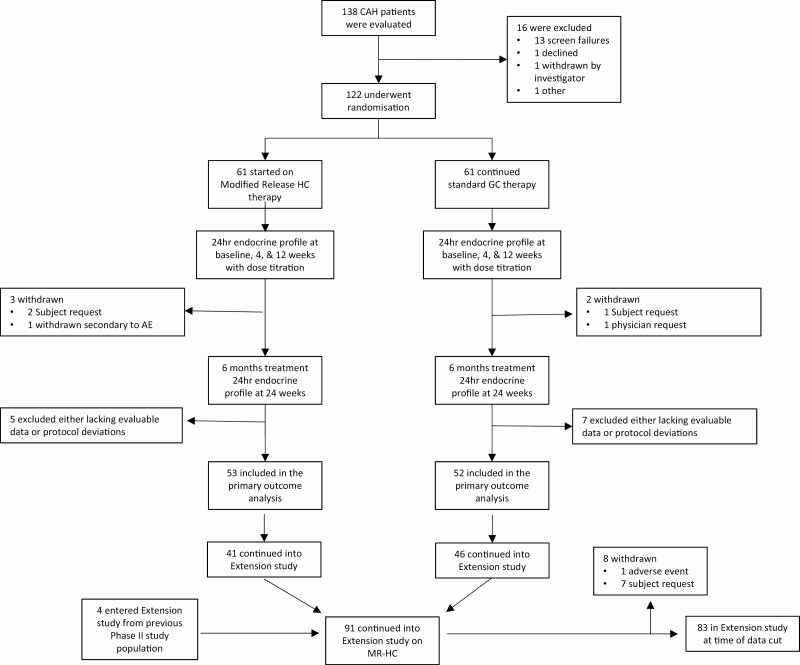
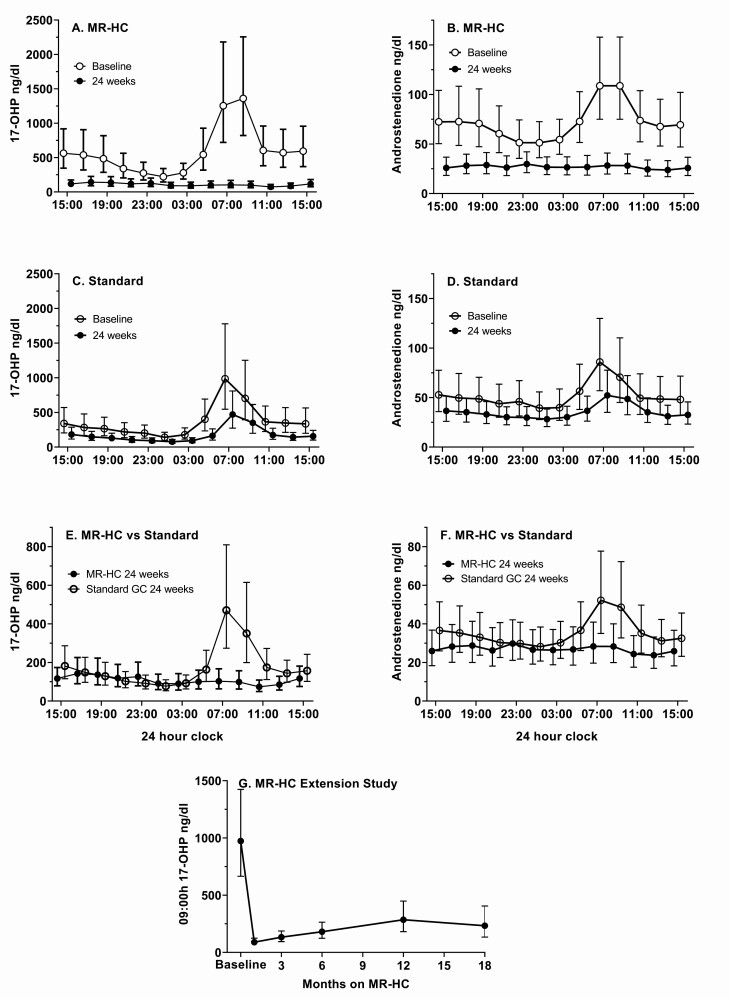
Context: Standard glucocorticoid therapy in congenital adrenal hyperplasia (CAH) regularly fails to control androgen excess, causing glucocorticoid overexposure and poor health outcomes. Objective: We investigated whether modified-release hydrocortisone (MR-HC), which mimics physiologic cortisol secretion, could improve disease control. Methods: A 6-month, randomized, phase 3 study was conducted of MR-HC vs standard glucocorticoid, followed by a single-arm MR-HC extension study. Primary outcomes were change in 24-hour SD score (SDS) of androgen precursor 17-hydroxyprogesterone (17OHP) for phase 3, and efficacy, safety and tolerability of MR-HC for the extension study. Results: The phase 3 study recruited 122 adult CAH patients. Although the study failed its primary outcome at 6 months, there was evidence of better biochemical control on MR-HC, with lower 17OHP SDS at 4 (P = .007) and 12 (P = .019) weeks, and between 07:00h to 15:00h (P = .044) at 6 months. The percentage of patients with controlled 09:00h serum 17OHP (< 1200 ng/dL) was 52% at baseline, at 6 months 91% for MR-HC and 71% for standard therapy (P = .002), and 80% for MR-HC at 18 months’ extension. The median daily hydrocortisone dose was 25 mg at baseline, at 6 months 31 mg for standard therapy, and 30 mg for MR-HC, and after 18 months 20 mg MR-HC. Three adrenal crises occurred in phase 3, none on MR-HC and 4 in the extension study. MR-HC resulted in patient-reported benefit including menses restoration in 8 patients (1 on standard therapy), and 3 patient and 4 partner pregnancies (none on standard therapy). Conclusion: MR-HC improved biochemical disease control in adults with reduction in steroid dose over time and patient-reported benefit.
Overview
The claims and statistics of this paper haven’t been checked yet.
Free: it reads the open-access text and checks the first 5 claims that cite a source we can check. Create a free account to check every claim.
Integrity signals
Registry
Cites
Statistics
Figures
Verification
Claims the paper makes
The claims and statistics of this paper haven’t been checked yet.
Free: it reads the open-access text and checks the first 5 claims that cite a source we can check. Create a free account to check every claim.
Claims other papers make about this one
Each is checked against this paper’s own text: does it say what the citing paper says it does?
The source backs part of the claim, not all of it — or backs it for a different population, condition or comparison.
In the citing paper
“In a recent clinical trial comparing immediate-release and MR-HC in patients with CAH, both groups were able to achieve better 24-hour 17-OHP levels at 24 weeks compared to baseline, thus failing to prove their primary outcome.”
From Hypoglycaemia in adrenal insufficiency (2023) · cites this paper as [60]
Experimental — accuracy not yet measuredThe source backs part of the claim, not all of it — or backs it for a different population, condition or comparison.
In the citing paper
“However, an extension of this clinical trial showed an overall improvement in disease control in the MR-HC group due to lower 17-OHP and androstenedione levels at multiple points throughout the day, with a significant reduction in 17-OHP variability.”
From Hypoglycaemia in adrenal insufficiency (2023) · cites this paper as [60]
Experimental — accuracy not yet measuredThe cited source says what the claim attributes to it.
In the citing paper
“Dose reduction was also achievable in the MR-HC group whilst maintaining good disease control (60).”
From Hypoglycaemia in adrenal insufficiency (2023) · cites this paper as [60]
The cited source says what the claim attributes to it.
In the citing paper
“In a recent clinical trial comparing immediate-release and MR-HC in patients with CAH, both groups were able to achieve better 24-hour 17-OHP levels at 24 weeks compared to baseline, thus failing to prove their primary outcome.”
From Hypoglycaemia in adrenal insufficiency (2023) · cites this paper as [60]
4 more claims about this paper
Create a free account to see every claim other papers make about this one.
Self-check
Percentages, sums and reported differences re-computed from the paper’s own numbers.
The self-check needs the paper’s full text.
Citations
Cites
Bornstein, S. R., Allolio, B., Arlt, W., Barthel, A., Don-Wauchope, A., Hammer, G. D., Husebye, E. S., Merke, D. P., Murad, M. H., Stratakis, C. A., et al. (2016) · The Journal of Clinical Endocrinology & Metabolism · doi:10.1210/jc.2015-1710 · Cited by 1,769 · cited 3×
“Age, y, median (range) 35 (19-61) 40 (19-68) 35 (20-67)”
BackgroundSelf-citationSpeiser, P. W., Azziz, R., Baskin, L. S., Ghizzoni, L., Hensle, T. W., Merke, D. P., Meyer-Bahlburg, H. F. L., Miller, W. L., Montori, V. M., Oberfield, S. E., et al. (2010) · The Journal of Clinical Endocrinology & Metabolism · doi:10.1210/jc.2009-2631 · Cited by 1,468
Self-citationCongenital Adrenal Hyperplasia
(1987) · New England Journal of Medicine · doi:10.1056/nejm198711263172211 · Cited by 1,409
Congenital adrenal hyperplasia
Speiser, P. W., & White, P. C. (2003) · New England Journal of Medicine · doi:10.1056/nejmra021561 · Cited by 1,405
Speiser, P. W., Arlt, W., Auchus, R. J., Baskin, L. S., Conway, G. S., Merke, D. P., Meyer-Bahlburg, H. F. L., Miller, W. L., Murad, M. H., Oberfield, S. E., et al. (2018) · The Journal of Clinical Endocrinology & Metabolism · doi:10.1210/jc.2018-01865 · Cited by 1,234 · cited 2×
“Clinicians measure biomarkers before and after dosing (42), and aim for 17OHP levels above the reference range and androstenedione within the reference range for good control, with normal 17OHP indicating overtreatment and high androstenedione indicating undertreatment (14, 24).”
BackgroundSelf-citationCongenital adrenal hyperplasia
El-Maouche, D., Arlt, W., & Merke, D. P. (2017) · The Lancet · doi:10.1016/s0140-6736(17)31431-9 · Cited by 669
Self-citationCongenital adrenal hyperplasia.
Merke, D. P., & Bornstein, S. R. (2005) · The Lancet · doi:10.1016/s0140-6736(05)66736-0 · Cited by 628 · cited 1×
“Adrenal insufficiency causes life-threatening adrenal crises (1-3), while androgen excess causes atypical genitalia in 46,XX neonates, promotes abnormal growth, short stature, and precocious puberty, and in adulthood, virilization of women and infertility in both sexes (4).”
BackgroundSelf-citationHealth status of adults with congenital adrenal hyperplasia: a cohort study of 203 patients
Arlt, W., Willis, D. S., Wild, S. H., Krone, N., Doherty, E. J., Hahner, S., Han, T. S., Carroll, P. V., Conway, G. S., Rees, D. A., et al. (2010) · The Journal of Clinical Endocrinology & Metabolism · doi:10.1210/jc.2010-0917 · Cited by 506 · cited 10×
“Current glucocorticoids used in the treatment of 21-OHD-CAH are immediate-release preparations such as hydrocortisone, prednisolone, prednisone, and dexamethasone, which fail to mimic the early-morning cortisol rise (10, 11).”
BackgroundMethodResultInfluentialSelf-citationCongenital Adrenal Hyperplasia: Is there an Effect on Penile Growth?
Levy, J. B., & Husmann, D. A. (1996) · The Journal of Urology · doi:10.1097/00005392-199608001-00060 · Cited by 415
Congenital adrenal hyperplasia due to 21-hydroxylase deficiency
Merke, D. P., & Auchus, R. J. (2020) · New England Journal of Medicine · doi:10.1056/nejmra1909786 · Cited by 341 · cited 3×
“Management involves balancing glucocorticoid doses to avoid both glucocorticoid deficiency, risking adrenal crisis, and iatrogenic glucocorticoid excess, leading to short stature, obesity, hypertension, osteoporosis and an adverse metabolic profile (1-3,5-7).”
BackgroundSelf-citation
Cited by
Items 101–121 of 121
Xu, S., Li, Z., Fu, Q., Lin, Q., & Liu, H. (2026) · Pakistan Journal of Pharmaceutical Sciences · doi:10.36721/pjps.2026.39.6.151.1
Nokoff, N., Fechner, P. Y., Kim, M. S., Marshall, I. H., Merke, D. P., Sarafoglou, K., Hartzell, A. L., Lin, V. H., & Thornton, P. (2026) · The Journal of Clinical Endocrinology & Metabolism · doi:10.1210/clinem/dgag192
Self-citationRapid turnover of corticosterone in humans
Nixon, M., Mackenzie, S. D., Devine, K., Kyle, C. J., Ostojic, A., Upreti, R., Homer, N. Z. M., Reynolds, R. M., Walker, B. R., Walker, B. R., et al. (2026) · European Journal of Endocrinology · doi:10.64898/2026.04.27.720824
Real-world outcomes with modified-release hydrocortisone in classic congenital adrenal hyperplasia
Auer, M. K., Bayer, K., Nowotny, H. F., Tschaidse, L., Dervishi, O., Welp, A.-C., Lottspeich, C., Bidlingmaier, M., Kunz, S. L., & Reisch, N. (2026) · European Journal of Endocrinology · doi:10.1093/ejendo/lvag087
Self-citationMedical and social challenges awaiting adolescents with congenital adrenal hyperplasia
Nixon, M., & Davies, J. H. (2026) · Frontiers in Adolescent Medicine · doi:10.3389/fradm.2026.1870467
Pharmacotherapeutic strategies for the management of congenital adrenal hyperplasia
Goai, W. H., & Torpy, D. J. (2026) · Expert Opinion on Pharmacotherapy · doi:10.1080/14656566.2026.2695099
“In the following Phase 3 trial, 122 adults with classic CAH were randomized to MRHC or conventional glucocorticoid therapy [39].”
InfluentialLankes, E., Wiebelt, L., Helge, K., Schnabel, D., Kühnen, P., Blankenstein, O., & Neumann, U. (2026) · Frontiers in Endocrinology · doi:10.3389/fendo.2026.1854737
Modified-release hydrocortisone for female fertility in congenital adrenal hyperplasia
Tschaidse, L., Nowotny, H. F., Auer, M. K., Dervishi, O., Ziefer, A., Welp, A.-C., Kunz, S. L., Bidlingmaier, M., Hawley, J. M., Keevil, B. G., et al. (2026) · The Journal of Clinical Endocrinology & Metabolism · doi:10.1210/clinem/dgag303
Self-citationCrinecerfont: emerging role in the management of congenital adrenal hyperplasia
Fedorova, O., & Falhammar, H. (2026) · Expert Review of Endocrinology & Metabolism · doi:10.1080/17446651.2026.2713482
“Despite these promising results, it is not licensed worldwide, as the Phase 3 trial missed its primary endpoint (because the difference between groups in the morning failed to translate into a 24-h difference at week 24) [20,21].”
Auer, M. K., Tschaidse, L., Dervishi, O., Kruse, P., Bidlingmaier, M., Kunz, S. L., Bayer, K., Krämer, U. M., Nowotny, H. F., & Reisch, N. (2026) · Human Reproduction Open · doi:10.1093/hropen/hoag071
Self-citationGiri, D., Alderson, J., Bashir, M., Shalaby, M. S., Williams, C., & Park, J. (2026) · Journal of Pediatric Endocrinology and Metabolism · doi:10.1515/jpem-2026-0106
Approach to the patient: the pregnant woman with congenital adrenal hyperplasia
Reisch, N., Auer, M. K., Nowotny, H. F., Welp, A.-C., Dervishi, O., Rogenhofer, N., Thaler, C., & Tschaidse, L. (2026) · The Journal of Clinical Endocrinology & Metabolism · doi:10.1210/clinem/dgag332
Self-citationImpatto cardiometabolico delle patologie surrenaliche: evidenze da studi clinici
Tizianel, I. (n.d.) · Padua Research Archive (University of Padova)
The evolution of new approaches to the treatment of congenital adrenal hyperplasia
Merke, D. P., & Auchus, R. J. (2026) · Endocrine Reviews · doi:10.1210/endrev/bnag033
Self-citationTizianel, I., Bovo, G., Mazzeo, P., Ceccato, F., & Barbot, M. (2026) · Frontiers in Adolescent Medicine · doi:10.3389/fradm.2026.1919128
“Clinical trials have demonstrated improved control of adrenal steroid excess, including significant reductions in morning 17OHP and androstenedione concentrations compared with standard treatment (48, 49).”
Valia, R., Jangir, A. K., Sahu, D., Menon, J. C., Varghese, J., Sundar, S., Yadav, A., & Kamble, S. (2026) · Endocrine Regulations · doi:10.2478/enr-2026-0022
“Emerging evidence suggests that modified-release hydrocortisone leads to diurnal cortisol levels similar to normal diurnal cortisol secretion that results in improved disease control along with reduced steroid dose over time (Merke et al. 2021), thereby decreasing the risk of adverse events.”
Szklarz, M., Wołos-Kłosowicz, K., Szulc, J., Górny, J. M., & Matuszewski, W. (2026) · Middle East Fertility Society Journal · doi:10.1186/s43043-026-00364-8
“In an extension study in which physicians adjusted the dose of Chronocort, the average daily dose decreased from 30 to 20 mg over time [120].”
Rooman, R. (2023) · Belgian Journal of Paediatrics
Diagnóstico y manejo de la hiperplasia suprarrenal congénita: revisión sistemática
Sanchez-Zambrano, J., Zamora-Trejo, I. B., & Castellano-Castellano, F. G. (2026) · Cuaderno de odontología. Revista científica. · doi:10.62574/sodygynv
Yao, L., Qi, T., Li, X., Huang, T.-X., Xiao, J., Ren, S.-Y., Wen, Z.-Y., Chen, Z., He, Z.-P., & Wang, Y. (2026) · Pharmacological Research · doi:10.1016/j.phrs.2026.109728
Adrenogenitales Syndrom (AGS) und Hirsutismus
Dervishi, O., & Reisch, N. (2026) · Elsevier eBooks · doi:10.1016/b978-3-437-23857-4.00017-5
Self-citation
Metadata
- Authors
- Merke, D. P., Mallappa, A., Arlt, W., Brac de la Perriere, A., Lindén Hirschberg, A., Juul, A., Newell-Price, J., Perry, C. G., Prete, A., Rees, D. A., Reisch, N., Stikkelbroeck, N., Touraine, P., Maltby, K., Treasure, F. P., Porter, J., & Ross, R. J.
- Affiliations
- National Institutes of Health (US)
- University Hospitals Birmingham NHS Foundation Trust (GB)
- Hospices Civils de Lyon, Fédération d’Endocrinologie, Groupement hospitalier Est, Bron Cedex, France
- Department of Women’s and Children’s Health, Karolinska Institutet and Department of Gynecology and Reproductive Medicine, Karolinska University Hospital, Stockholm, Sweden
- University of Copenhagen (DK)
- University of Sheffield (GB)
- Queen Elizabeth University Hospital (GB)
- Neuroscience and Mental Health Research Institute, Cardiff University, Cardiff, UK
- LMU Klinikum (DE)
- Radboud University Medical Center (NL)
- Sorbonne Université (FR)
- Diurnal (United Kingdom) (GB)
- Peter Treasure Statistical Services Ltd, Kings Lynn, UK
- Corresponding author
- Ross, Richard J
- ORCID
- Venue
- The Journal of Clinical Endocrinology & Metabolism
- Publisher
- The Endocrine Society
- Published
- 2021-01-29
- Volume
- 106
- Issue
- 5
- Pages
- e2063-e2077
- ISSN
- 0021-972X (ISSN-L)
- 1945-7197
- PMC
- PMC8063257
- OpenAlex
- W3127984913
- Semantic Scholar
- dcde4ff42d185ac53e64ec1c8c5ba43821258255
- Cited by
- 109
- References
- 56
- Citations by year
- 2026: 21 · 2025: 26 · 2024: 23 · 2023: 18 · 2022: 13 · 2021: 8
- FWCI
- 4.86
- Type
- journal article
- Language
- en
- Open access
- hybrid
- doi.org
- Licence
- Locations
- The Journal of Clinical Endocrinology & Metabolism (publishedVersion, cc-by-nc-nd)
- Yearbook of pediatric endocrinology (publishedVersion)
- PubMed Central (publishedVersion, cc-by-nc-nd)
- PubMed (publishedVersion)
- Research at the University of Copenhagen (University of Copenhagen) (publishedVersion, cc-by-nc-nd)
- University of Birmingham Research Portal (University of Birmingham) (publishedVersion, cc-by-nc-nd)
- White Rose Research Online (University of Leeds, The University of Sheffield, University of York) (acceptedVersion)
- ORCA Online Research @Cardiff (Cardiff University) (acceptedVersion)
- Radboud Repository (Radboud University) (submittedVersion)
- Spiral (Imperial College London) (submittedVersion, cc-by-nc-nd)
- Radboud Repository (Radboud University) (submittedVersion, other-oa)
- Funders
- National Institutes of Health
- Topics
- Health Sciences › Medicine › Endocrinology, Diabetes and Metabolism › Sexual Differentiation and Disorders
- Health Sciences › Medicine › Endocrinology, Diabetes and Metabolism › Adrenal Hormones and Disorders
- Health Sciences › Medicine › Reproductive Medicine › Ovarian function and disorders
- Keywords
- congenital adrenal hyperplasia, modified-release hydrocortisone, glucocorticoid therapy, hyperandrogenism, 17-hydroxyprogesterone, adrenal crisis, dose reduction, pregnancy, patient-reported outcomes
- MeSH terms
- Adrenal Hyperplasia, Congenital, Adult, Aged, Anti-Inflammatory Agents, Female, Follow-Up Studies, Humans, Hydrocortisone, Male, Middle Aged, Prognosis, Young Adult
About these checks
Registry, retraction, Cites and statistics results are computed, not judged, with one exception: a printed reference that no index lists is read once by a model before it counts as a citation error. Claims are extracted by a model and kept only when their quote appears verbatim in the text; each cited source is then checked, with a model’s help, for whether it says what the claim relies on. Those verdicts can be wrong — read the claim’s quote and the cited source before relying on one.
Statistics and arithmetic are recomputed, not judged.
Confidence bands are shown only for fields calibrated on our annotated test set. None is calibrated yet, so no band is shown.
What counts as a claim ›How we measure confidence ›How we check this ›
Are you an author, or do you see a problem with this page? Request a review
Data sources
Bibliographic data: Semantic Scholar, OpenAlex, Crossref.
Contains information from the Semantic Scholar Academic Graph Datasets, made available under the ODC Attribution License (ODC-BY 1.0).
Semantic Scholar’s data is described in: Kinney, R., et al. (2023). The Semantic Scholar Open Data Platform. arXiv:2301.10140.
